By P Gosselin on 24. February 2026
The Sahara Desert has shrunk, satellite images confirm…evidence of a real ecological shift
For decades, the narrative surrounding the Sahara was one of unstoppable desertification—a vast, arid landscape slowly swallowing everything in its path, including Europe alarmists have warned.

Symbol image generated by Grok AI
However, recent scientific findings are painting a much more hopeful and complex picture. Thanks to advanced satellite technology and Artificial Intelligence, researchers have discovered something remarkable: The edges of the Sahara and the Sahel zone are becoming significantly greener.
A real ecological shift
In the past, satellite imagery was often too “blurry” to detect individual trees in arid regions. Sparse vegetation was frequently overlooked, leading to an underestimation of the actual biomass.
By using high-resolution satellite data and deep-learning algorithms, scientists have now been able to count individual trees and shrubs. The results are stunning: there are billions of trees in areas previously thought to be mostly barren. This isn’t just a correction of old data; it’s evidence of a real ecological shift.
Why is the Desert Greening?
Several factors are driving this “greening” effect at the world’s largest hot desert. Firstly, in certain regions of the Sahel, precipitation levels have risen over the last few decades.
Scondly, the CO2 Fertilization Effect: While rising CO2 levels are claimed to be a major driver of climate change, they are definitely a potent fertilizer for plants. Higher CO2 concentrations allow trees to use water more efficiently. They can keep their pores (stomata) partially closed to prevent evaporation.
Thirdly, shifts in how often fires occur in these regions have allowed young saplings to reach maturity instead of being destroyed in their early stages.
Why Does This Matter?
This findings have profound implications for our planet: More trees mean more carbon dioxide is being pulled from the atmosphere. Trees provide shade, reduce soil erosion, and help retain moisture in the ground, making the environment more livable for local communities.
Moreover, a greener landscape supports a wider variety of insects, birds, and mammals, strengthening the local ecosystem.
This reminds us that nature is resilient and that our understanding of the Earth’s ecosystems is constantly evolving. The desert is not just a place of sand and heat—it is a place of hidden life, slowly reclaiming its ground.
Somehow, they’ll twist this to be a terrible thing and more “evidence” the apocalypse is nigh.
“The children won’t know what sand is.”
[Cue the violins]
Camels become extinct.
And scorpions! OMG!
Some people might drown in the new rivers and lakes.
Ban DHMO (dihydrogen monoxide)!
They already have. It’s greening in the wrong places; too much greening; upsetting the biodiversity.
This report is speculative, not empirical. No data. Wishful thinking. Many here will agree with the “findings” and accept them because they want them to be true. But the “study” is porous. I’ve parsed too much junk science for too long. I know what it looks and smells like.
It might be the Sahara is marginally greener than 20 years ago, but this study does not provide any real evidence. It also posits causal theories where no effect is demonstrated. That’s called “attribution” and it is fallacious — whether you want to believe it or not.
Humans in the Sahara traveled in chariots pulled by horses 4000 years ago. Chariots were made of wood and iron.
On average there are about 500 drawings of chariots across the Sahara, from the Fezzan in Libya through the Aïr of Niger into northern Mali and then westward to the Atlantic coast, but not all were produced by the Garamantes.
https://africanrockart.britishmuseum.org/thematic/chariots-in-the-sahara/
It is a plausible conclusion, but you are right.
It is woefully unjustified.
Unvalidated AI recalculations of fuzzy satellite images? Come back when they’ve verified some of the AI estimates against people counting on the ground.
A lot of ground. Over many different types.
This sparks my junk science sense too.
Comment to WUWT Editors:
WUWT is rightfully proud to be calling out the MSM and various AGW/CAGW alarmist organizations and individuals for their misrepresentations of “facts”.
I note with alarm that in the above article, under the first photograph therein, is this statement:
“Symbol image generated by Grok AI”,
and there being no reference to this being either sarcasm or an attempt at humor.
IMHO, WUWT should not be following the tactics of those they criticise . . . that is, why couldn’t a relatively current actual aerial or satellite image of a “greened” region of the Sarah—shown perhaps alongside a previous image of that same area from 20-30 years ago—have made the same point without having to resort to the equivalent of “photoshopping” an image using an AI bot?
I expect better from WUWT going forward.
INSECTS !!
Insects will thrive !
I’ve actually seen this argument .
Got a question of no importance. More vegetation not only sucks up CO2, it also produces more O2. How much O2 do humans need, as a percentage of the available atmospheric O2? If, say, there were 100 billion humans, would they begin to make any kind of dent in atmospheric O2?
And then there’s all the animals sucking up O2 also. How do they compare to humans in consuming O2?
A hundred billion humans would have an impact far larger than oxygen consumption alone. The greatest consumers of oxygen (my guess) are wildfires and oxidization of minerals, but who knows.
The answer is quite simple. All you need to do is set up a Global Circulation Model. If you’re clever enough, you can get any answer you wish. Note that you only need to be clever enough. It’s, not necessary to be smart enough. In fact, that might be counterproductive.
If O2 concentration is on the rise then perhaps oxygen should be classified as a pollutant with the increased fire hazard and all.
Plants have to breathe too so they also need oxygen.
Plants create oxygen, they don’t consume it.
They also breathe so they DO consume oxygen, only they produce more than they consume.
From Google’s AI.
Of course you could always look at the plant for confirmation, ignoring AI rubbish.
Plants grow taller/wider/more volume because they absorb carbon from the atmosphere to make cellulose, etc.
IF they breathed out more than they took in, then the plant would start large and shrink. That isn’t observed. So you can safely state that a plant, (on average), consumes carbon dioxide from the atmosphere.
This conversation is about whether plants take in oxygen, not about carbon intake. As a lifelong forester, Mr. Zorzin certainly knows that plants take in more carbon dioxide than they respire
I love helping trees turn that carbon into useful and valuable wood products. 🙂
At night plants exhale CO2. Dr AD Karve of Pune, India showed that by erecting 1.5 m high plastic walls making a field of crops into separate squares that suppressed ground level breezes, the CO2 (heavier than air) would accumulate at night and be re-absorbed in the morning. This enhances growth.
Plant respiration is not a one-way street.
Scarecrow Repair wrote, “More vegetation not only sucks up CO2, it also produces more O2…”
In a strict sense, plants don’t produce oxygen. They just convert it from one form to another. They strip the C from CO2, leaving the O2 as a waste product.
Likewise, animals, humans and fires don’t consume oxygen. They just convert it from one form to another. They combine the oxygen with carbon, changing O2 to CO2.
Assume that the current dry atmosphere contains about 20.945% O2 and 0.043% CO2, by molar fraction; a/k/a 209,450 ppmv O2 and 430 ppmv CO2.
If we somehow managed to double the CO2 level, that would change 430 of 209,450 from O2 to CO2, leaving us with 20.902% O2, a negligible change. Doubling CO2 would be extremely beneficial for agriculture and natural ecosystems, and it would still leave us with 99.795% of the O2 we have now. The world would be a much lusher and more hospitable place.
Unfortunately, there’re not enough recoverable fossil fuels for us to double the CO2 level.
If all the CO2 were stripped of its carbon that would leave us with 20.988% O2, which is also a negligible change. But it would also leave us with 0.000% CO2, so everything would die.
Fortunately, that won’t happen, either.
The bottom line is that O2 is not an issue.
The Sahara may well be greening but this article doesn’t offer any evidence. It states—flat out—that old satellite observations missed a lot of vegetation, but now we can see more clearly. Seeing what was already there is not more vegetation.
Whoa! What? What evidence?
I’d love to believe the Sahara is greening but this isn’t the article bringing me that glad news.
I read it that way at first as well, but I don’t believe that is what it is saying. They aren’t comparing modern data with old data, they are just saying that now that resolution has increased, they are able to measure (like-for-like resolution) changes better
But that implies the old pictures were lower resolution and may not have seen what was already there. That’s his point: the comparisons claim higher resolution sees what low resolution didn’t, then assumes that means there was nothing for the low resolution pictures to not see.
This reminds me of the discovery of the ozone hole. People automatically assumed that it never existed before their discovery.
The Ozone Hole certainly existed before the introduction of CFC’s.
Sir, basically I tend to agree with you as you rightly noted that the author did not properly enough deliver the “glad news”. Because it’s no longer “news”. Greening Sahara, Sahel etc. due to the CO2 fertilization effect and the alteration in precipitation patterns (the latter requires more research, though) is a very well established fact that is well appreciated by the expert community. As far as I’m concerned the item first appeared on the global agenda a good 20 years ago and ever since then the evidence has only grown (see e.g. DOI: 10.1111/jacf.12665 and doi.org/10.1016/j.gecco.2023.e02791, just to mention a couple of recent academic publications).
On the other hand, the author rightly pointed out the roots and causes of the phenomenon, namely, the CO2 fertilization, [favorable] change in precipitation, [positive] change in fire patterns. Was it something new (at least for me)? Not at all, it wasn’t. Should we continue disseminating this information? Yes, of course, time and time again, by any means available and properly targeting different audiences.
Let me present my point in the other way round. If CNN/BCC/The Guardian etc. stops brainwashing people about a “climate crisis” every single day those people will quietly forget about it within a few weeks. Likewise if the same news makers start regularly praising the CO2 fertilization, the same people will take it for proven and love it. Like it or not, but this is how it works.
Thank you.
Goebbels.
Greta Thunberg
The alternative is to say that the Sahara is greener than we previously thought.
I searched and found studies that confirm the North African Humid periods occur in cycles of 21,000 years.
New research reveals why and when the Sahara Desert was green.The results confirm the North African Humid Periods occurred every 21,000 years and were determined by changes in Earth’s orbital precession.
https://www.bristol.ac.uk/news/2023/september/sahara-desert-greening.html
The atmosphere over Australia today has more moisture than tropical ocean.
Up to 70mm total water column. The result is a boost to greening the outback, And it has been improving every year this decade.
The monsoon trough has been a long way south and is now persistent. This is bringing record rain to many parts of the outback.
Not bad for a country predicted to have no rain making it to the ground after 2007 and the dams to never fill again. Victoria’s catchment recorded 300mm yesterday.
Make Australia Green Again! MAGA
None here in the Hunter….. and we really need it. !
The monsoon trough across centra Australia is robbing your moisture. It is being fed from both Coral Sea and Timor Sea and now plenty of rain in Victoria.
The water column over the Hunter is near the lowest across the country. Today only 16mm. But the trough will not persist for much longer and the coastal rain will return.
I expect good autumn rain south of the tropics.
SE Melbourne had no rain in January. So far 17mm in February and more forecast this weekend. But all from monsoonal convective instability so can be patchy and intense.
Not much in NE vic where I am. A well needed 35mm over the last week but no where near the 300mm you quoted above.
Another 100mm over the next week, (not in one downpour thanks), would be a great start to the growing season. And it’s still needed.
Long term average for February around here is 109mm.
So far (1 day left) we have only had 22mm.
That means February has also been significantly warmer than the long term temp.
Speaking of grifters, what’s “Parched-Arse” Tim up to these days?
No more than 10-12% of Aussies have ever voted for the Greens.
So many people have no brain ?
It may not be entirely natural, they may be observing some results from the great green wall initiative.
I do wish people would explain their kneejerk down votes; why pointing out that a genuine initiative that has had some results as it was intended, greening parts of the Sahara and Sahel, and has obviously partly contributed to the observations in the article, should offend anyone, is beyond me.
I’d never heard of the great green wall initiative
“The Great Green Wall is a project adopted by the African Union in 2007, initially conceived as a way to combat desertification in the Sahel region and hold back expansion of the Sahara Desert, by planting a wall of trees”
But:
“In March 2019, 15% of the wall was complete with significant gains made in Nigeria, Senegal and Ethiopia.”
15 percent in 12 years = 100 percent in 80 years… so the project should be done before 2100.
Also – why do I wonder whether I (in the USA) paid for these trees? More googling…
Yup. It became a UN project, and then…
“As of 2023, the Great Green Wall was reported as “facing the risk of collapse” due to terrorist threats, absence of political leadership, and insufficient funding. “The Sahel countries have not allocated any spending in their budgets for this project. They are only waiting on funding from abroad, whether from the European Union, the African Union, or others,” said Issa Garba, an environmental activist from Niger, who also described the 2030 guideline as an unattainable goal. Amid the existing stagnation, a growing number of voices have called for scrapping the project.”
The key phrase, everyone knows what it means: “waiting on funding from abroad“
No where in any of the discussions is proof of a single “control know.”
Many factors, much complexity, I will not dare venture a guess at how little we really understand about this planet and the energy systems within.
Story Tip
But scientists not underestimating the resilience of nature? Exhibit this crazy piece of climate catastrophe penguin porn.
https://www.bbc.co.uk/news/articles/c204626888zo
Ah Fretwell by name and Fretwell by nature. 😉
Oh no! The Sahara is dying….. Where are the save the Sahara demonstrators, they must be out there. The upcoming Save Our Deserts International Treaty or SOD IT for short, is making its way through the UN as we post….
“The Sahara Desert has shrunk, satellite images confirm…evidence of a real ecological shift”
So why use a picture cobbled together by AI ???
Don’t get me going on the stupidity of relying on the outputs of AI.
Try asking – How big was the largest iceberg in the Arctic.
Ans =
The largest iceberg in the Arctic, known as B-15, initially measured about 11,000 square kilometers when it calved from the Ross Ice Shelf in 2000. It broke apart in 2002, with the largest remaining piece, B-15A, still being significant at around 3,000 square kilometers.
ME: I want to know size of The largest iceberg in the ‘Arctic’
GPT-4o mini
Size of the Largest Iceberg in the ArcticThe largest iceberg currently in the Arctic region is A23a. While originally calving from the Filchner-Ronne Ice Shelf in Antarctica in 1986,
ME: How did it cross the equator without melting ?
GPT-4o mini
Crossing the Equator: How Icebergs Like A23a Manage to SurviveDespite the challenge of warm waters and rising temperatures, icebergs like A23a can occasionally drift towards lower latitudes, including areas near the equator, without completely melting. Several factors contribute to this phenomenon.
***
I asked all this a few weeks ago & after providing many convincing statements to prove its information was correct, AI capitulated & agreed it had provided misinformation, promising to amend its algorithm. However, it is still giving the same answers & misinformation today.
Never ask AI a question you don’t know the approximate answer to.
“So why use a picture cobbled together by AI ???”
Yes, I was wanting to see a real picture of the scene, too.
Billions of extra trees ought to make a good picture.
Amen to that.
The key thing to understand about AI is not that it sometimes hallucinates, it is that it ALWAYS hallucinates. It is a trick of the human brain—probably similar to pareidolia—that makes us think it is ever “right”.
A mighty bubble’s gonna burst…
(I’m not a total cynic. There is a lot of useful stuff that gets called AI. Image recognition/classification is getting very reliable. As is language translation.)
“I’m not a total cynic.”
Which bits are missing ??? (;-))
AI is not intelligent. People view it as intelligent because of the outstanding human interface module.
AI works on the preponderance of the evidence (the lowest legal evidentiary standard) and gets all of its data from the internet. If someone publishes an article and it is republished 100 times, it weighs higher in the decision tree that an article that is found only once.
One of the reasons google and others demote WUWT is to influence AI.
Google and the UN have an agreement that Google promotes their publications.
AI…Just a consensus engine…useful as a starting point if you know nothing.
From the article: “This findings have profound implications for our planet: More trees mean more carbon dioxide is being pulled from the atmosphere.”
You were doing so well, until you got here.
Yea, it does play into the Tran-Reality Alarmist handbook after a fashion.
The statement has an implied assumption that pulling CO2 from the atmosphere is necessary, not just a natural function of trees and plants.
Yes, the author is assuming too much.
“CO2 Fertilization Effect”
No. CO2 is not fertilizer. It is plant food.
Nitrogen compounds are fertilizers as well as other elements.
When we use the Trans-Reality Alarmist lexicon we boost their credibility.
We need to go back to concise scientific vocabulary and abandon the context derived definitions used in thought control of the population.
Sir, the “CO2 fertilization effect” is a common terminology widely accepted in academia. I also think that Dr.Judith A. Curry, whose article I referred to, would only be glad to learn that she qualifies as a “Trans-Reality Alarmist”.
I’ve read that the Sahara has gone from desert to green and back over 200 times during the Pleistocene.
A satellite image showing the green expansion would be appropriate if you wish to convince anyone. An AI image is just part of an anecdotal narrative, unfortunately.
The Sahara was a rainforest 10,000 years ago.
Humans began to settle in the Sahara rainforest. They practiced slash-and-burn agriculture and used the trees for boats, houses and heating.
The slash-and-burn agriculture caused the soil to dry out and the Sahara became a desert.
My first thought was “Cool!” My second was “Where is the data?” I see I am not alone. That’s what is great about Anthony’s creation, real reviews and critiques of any claim.
Humans dislike wetlands and drain them. This causes wetlands to dry out and become desert land.
To restore desert land to wetlands, the water flow in streams and rivers must be slowed down.
It appears most commenters have missed the long-term horror of this approaching apocalypse! If all the projected trees realize an extended growth period, it approaches near certainty (as climate forecasters calculate, anyway) that all that vegetation becomes liable to fossilization during the next glaciation, worldwide catastrophic inundation or extinction-level asteroidal/cometary impact (whichever occurs first). Thus, our inattention to forestalling these seeds of future fossil fuels will lead future generations to continue the doom cycle in which we find ourselves, /sarc off
You guys just are not postulating disasters with enough enthusiasm…
This article is pointless.
This is real, but it’s old news. I hoped to see a new study cited, but the article seems to be based on studies which I think we already discussed here at WUWT:
1. Zhu, Z., et al. (2016). Greening of the Earth and its drivers. Nature Clim Change 6, 791–795. https://doi.org/10.1038/nclimate3004
2. Venter, Z.S., et al. (2018). Drivers of woody plant encroachment over Africa. Nat Commun 9, 2272. https://doi.org/10.1038/s41467-018-04616-8
NASA measures global greening, from satellites:
https://www.nasa.gov/feature/goddard/2016/carbon-dioxide-fertilization-greening-earth
https://www.youtube.com/watch?v=zOwHT8yS1XI
It’s amazing that, by dint of incessant propaganda, the climate industry has managed to gin up such alarm over imaginary problems.
Over 31,000 American scientists (including engineers in relevant disciplines) signed a petition affirming our conviction that, “There is substantial scientific evidence that increases in atmospheric carbon dioxide produce many beneficial effects upon the natural plant and animal environments of the Earth.”
Chief among those beneficial effects is healthier, faster-growing plants, especially in dry climates. This study found that in warm, arid environments, as CO2 levels increased by 14% over 28 years (1982-2010) foliage cover increased by 11%:
3. Donohue, R.J. et al. (2013). Impact of CO2 fertilization on maximum foliage cover across the globe’s warm, arid environments. Geophysical Research Letters, 40(12), 3031–3035. https://doi.org/10.1002/grl.50563
Elevated CO2 (eCO2) improves plants’ water use efficiency, which mitigates drought impacts and helps plants grow in dryer climates. It increases carbon uptake relative to water lost to transpiration, which decreases their water requirements, through reduced stomatal conductance.
In other words, with more CO2 plants need less water to get the carbon they need from CO2 in the atmosphere. That’s especially helpful in dry climates, and during droughts. Here’s a paper about it:
4. Chun, J.A. et al. (2021). Effect of elevated carbon dioxide and water stress on gas exchange and water use efficiency in corn, Agricultural and Forest Meteorology, 151(3), 378–384, ISSN 0168-1923. https://doi.org/10.1016/j.agrformet.2010.11.015
EXCERPT: “There have been many studies on the interaction of CO2 and water on plant growth. Under elevated CO2, less water is used to produce each unit of dry matter by reducing stomatal conductance.”
That’s settled science. Yet most so-called “climate scientists” seem ignorant of it.
eCO2 is especially beneficial for places like India, which used to be plagued by famines, mostly due to droughts. These photos were both taken in India, but more than a century apart:
Look at those potatoes!
The large benefits of eCO2 for potatoes and all other major crops has been known to science for more than a century. The benefits are so dramatic that in 1920(!) Scientific American called anthropogenic CO2 emissions “the precious air fertilizer.”
5. Gradenwitz A. (1920). Carbonic Acid Gas to Fertilize the Air. Scientific American, Nov 27, 1920. doi:10.1038/scientificamerican11271920-549
The world is literally getting greener, largely thanks to anthropogenically elevated atmospheric CO2 levels. Here’re some references, and here’s a map:
Here’s a 2009 National Geographic article about the greening Sahara / Sahel:
https://www.sealevel.info/Owen2009_Sahara_Desert_Greening-atGeo30639457.html
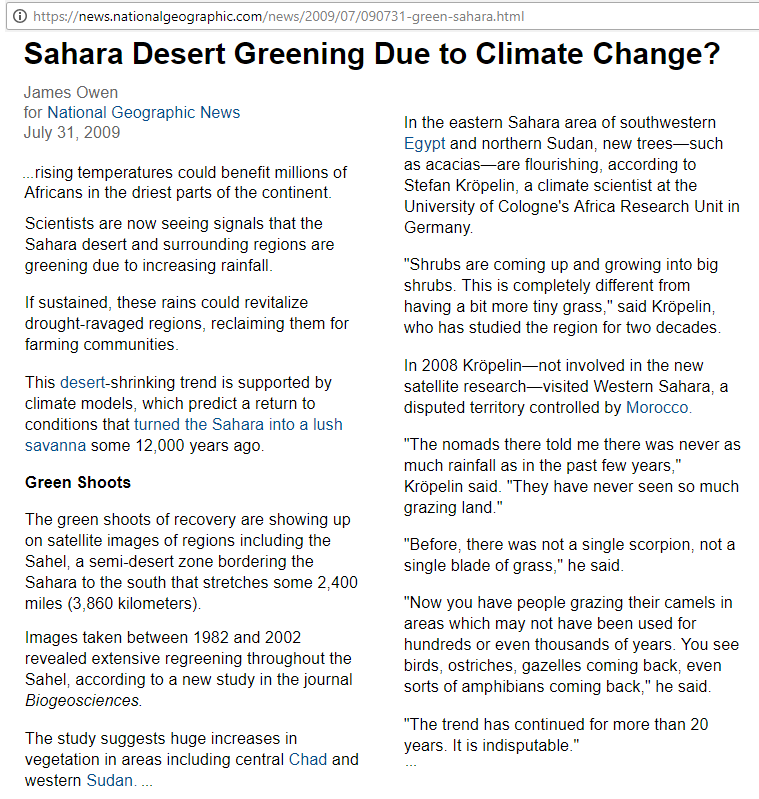
EXCERPT: “…extensive regreening… huge increases in vegetation… ‘Before, there was not a single scorpion, not a single blade of grass… Now you have people grazing their camels in areas which may not have been used for hundreds or even thousands of years. You see birds, ostriches, gazelles coming back, even sorts of amphibians coming back… The trend has continued for more than 20 years. It is indisputable.'”
Here’s an older article, in New Scientist. It mentions dramatic improvements in yields of sorghum & millet, which are C4 crops. They’re often grown in dry climates because of their low water requirements and high drought resilience.
Here’s 2 more papers reporting that eCO2 improves water use efficiency & drought resilience:
6. De Souza, A.P. et al. (2015). Changes in Whole-Plant Metabolism during the Grain-Filling Stage in Sorghum Grown under Elevated CO2 and Drought, Plant Physiology, 169(3), Nov 2015, 1755–1765. https://doi.org/10.1104/pp.15.01054 (+ article)
7. Fitzgerald GJ, et al. (2016). Elevated atmospheric [CO2] can dramatically increase wheat yields in semi-arid environments and buffer against heat waves. Glob Chang Biol. 22(6), 2269-84. https://doi.org/10.1111/gcb.13263
I’d be interested in seeing a high level genuine debate about what range of carbon dioxide levels in the air would be optimal for overall ecosystem health.
The argument is clearly not ‘higher is bad’, but there be an optimum range where systems optimise in equilibrium….
Commercial greenhouses typically use CO2 generators to raise daytime CO2 levels in the greenhouses to about 1500 ppmv, because that strikes a reasonable balance between the cost of fueling the CO2 generators, and the nonzero but diminishing benefits of raising levels beyond that.
That’s probably not too far from optimal.
Sadly, there aren’t enough recoverable fossil fuels on planet Earth to make that a practical goal:
Wang, J et al (2017). The implications of fossil fuel supply constraints on climate change projections: A supply-side analysis. Futures 86, pp.58-72. https://doi.org/10.1016/j.futures.2016.04.007
We’ve only raised the CO2 level by about 150 ppmv (since 1750), so far. To reach the presumably near-optimal goal of 1500 would require raising raising the level by another 1070 ppmv, which is 7× the increase that we’ve managed since the start of the industrial revolution.
What’s more, the higher the CO2 level goes, the faster natural negative feedbacks remove it from the atmosphere, making it increasingly difficult to raise it further.
So, practically speaking, the the higher we can raise the CO2 level, the better.