Guest post by David Archibald
In energy policy, the Australian government is compounding stupidity upon stupidity. Hundreds of millions of dollars are now to be spent on the dead end that is the hydrogen economy. To put that stupidity into context, let’s go back a few years and look at the missed opportunities to put things to right.
After Trump’s election win in 2016, Myron Ebell of the Competitive Enterprise Institute in Washington was given the job of finding a director for the Environmental Protection Agency. Instead of taking the job himself as he should have done, the job was given to Scott Pruitt who was more interested in decorating his office than reform. Mr Pruitt left the position in 2018. Dr Will Happer came into the administration for a while and was expected to write a paper debunking global warming. This was to be the first government report on the planet to say that global warming is a nonsense. That effort was apparently killed off by Jared Kushner and Dr Happer left. Consequently tens of billions of dollars continue to be wasted fighting the phantom menace of global warming.
In fact the global warming misinformation campaign keeps ratcheting up. In 2017 the globalists of the World Economic Forum, based in Geneva but best known for their annual meeting in Davos, created an offshoot called the Hydrogen Council. This is based in Belgium, which is also the birthplace of Dr Evil. The promoters of hydrogen must know it is a non-starter. Their market research on selling global warming would have told them that they needed a positive story about a future nirvana that would be free of the evil carbon. So they go through the charade of promoting the hydrogen heaven to come.
Why is hydrogen no good? A succinct paper on the whys and wherefores was published by Baldur Eliasson and Ulf Bossel in 2003 – “The Future of the Hydrogen Economy: Bright or Bleak?” From that paper, energy lost in power transmission, operation of oil refineries and transport is usually less than 10% of the energy traded. The losses in hydrogen manufacture and transport are much higher and inherent to this element.
Hydrogen has a heating value of 142 MJ/kg compared to methane at 55 MJ/kg. But in terms of volumetric heating value, hydrogen is less than a third of methane at 11.7 kJ/litre. Methane’s value is 36.5 kJ/kg.
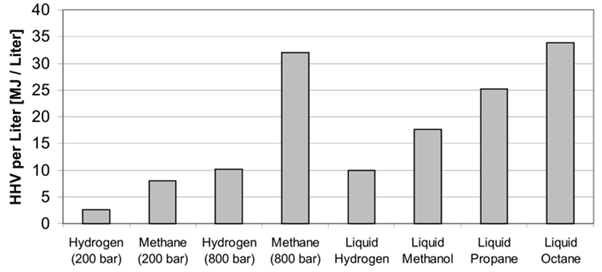
Figure 1: Heating value per litre.
Hydrogen has to compressed or liquefied for storage and transport. As figure 1 shows for an equivalent amount of low pressure storage and transport, facilities for handling hydrogen are three times larger than the same energy content of methane. At 800 bar or in the liquid state hydrogen must be kept in hi-tech pressure tanks or cryogenic vessels whereas liquid hydrocarbon fuels are kept at atmospheric pressure in simple containers.
Hydrogen can be made by electrolysis of water, which is 75% efficient, or by steam reforming of natural gas, 90% efficiency. But as the religious compulsion is “clean hydrogen”, no fossil fuels or nuclear energy is allowed.
Producing 1 kg of hydrogen (which has a specific energy of 143 MJ/kg or about 40 kWh/kg) requires 50–55 kWh of electricity.
Solar panels made in China using power priced at US$0.04/kWh can produce power priced equivalent to power from diesel engines at about US$0.15/kWh under ideal conditions in a desert, for eight hours per day. So at best clean hydrogen could be produced for US$8.00/kg, not including the capital costs of the electrolysis segment.
Ten times as much energy is required to compress hydrogen as the same weight of methane. To compress one tonne per hour of hydrogen to 200 bar (natural gas pipelines operate up to 150 bar) takes 7.2% of its heating value.
Liquefying hydrogen is highly energy intensive. At a plant capacity of 100 kg of liquid hydrogen per hour, about 60 MJ of electrical energy is used per kg of hydrogen. Plant efficiency increases with plant size but with a theoretical minimum of about 40 MJ, equating to 28% of the contained energy of the hydrogen produced. By comparison liquefying methane takes 6% of the contained energy of the methane feedstock.
Storing hydrogen as a metal hydride of alkali metals is comparable to compression in terms of energy consumption. External heat is needed to release hydrogen from the metal hydride storage material. The amount of hydrogen that can be stored per cubic metre of metal hydride is about 60 kg, approaching that of liquid hydrogen of 72 kg per cubic metre. But it is well short of the 100 kg contained in a cubic metre of methanol.
Distribution of hydrogen by pipeline would require a new system. It is well established that existing pipelines cannot be used for hydrogen, because of diffusion losses, brittleness of materials and seals, incompatibility of pump lubrication with hydrogen and other technical issues. That hasn’t stopped Australian gas distributors from spiking their gas supply with 5% hydrogen. No doubt one day they will wake up to find their pipes and valves embrittled and leaking like a sieve.
Because of the low volumetric energy density of hydrogen, the flow velocity must be increased by over three times in a pipeline delivering hydrogen as compared to methane. In a natural gas pipeline 0.3% of the contained energy of the transported gas is used every 150 km to run the compressors. In a hydrogen pipeline this rises to 1.4% every 150 km.
If delivering hydrogen by pipeline is energy-intensive, distributing it by road transport is far more problematic. By Eliasson and Bossel’s figures, a 40 ton truck could deliver 25 tons of gasoline, 3.2 tons of methane but only 320 kg of hydrogen. This is a consequence of the low energy density of hydrogen and the weight of the pressure vessels.
In their parable of the gasoline station, a mid-size filling station on a freeway sells 25 tons of fuel each day. This can be delivered by one 40 ton truck. But it would need 21 hydrogen trucks to deliver the same amount of energy to the station. About one in one hundred trucks on the road are gasoline or diesel tankers. For hydrogen distribution by road that would rise to 120 trucks on the road with 21 of these transporting hydrogen with one out of six truck accidents involving a hydrogen truck.
What if hydrogen was generated at filling stations by electrolysis and then compressed to 200 bars? Eliasson and Bossel calculate that at a station servicing 1,000 vehicles per day the efficiency of conversion of the electric power required would be about 50%, in turn requiring power generation capacity to be tripled.
The problems of hydrogen are innate – its physical properties are incompatible with the requirements of the energy market. As Eliasson and Bossel state, most of hydrogen’s problems cannot be solved by additional research and development. If hydrogen is irredeemable, what would be the ideal energy carrier? It would be a liquid with a boiling point of at least 60°C and a solidification point under 40°C. It would stay liquid under normal weather conditions and at high altitudes. Even if oil had never been discovered, the world would not use synthetic hydrogen but a synthetic hydrocarbon fuel.
All the above is known to the promoters of the glorious hydrogen economy to come. Theirs is a cynical exercise in duping the public in order to advance the globalist agenda. Australia’s politicians are either foot soldiers in that globalist putsch or easily deluded simpletons.
We rational people can dream too. Economic modelling gives President Trump a 90% chance of winning the election a few weeks away. Soon after Dr Happer will be recalled and sign off on the report that drives a stake through the heart of the global warming monster. The globalist rent-seekers will be forced to get real jobs. Scientific truth will be pursued as an end in itself. We can dream.
David Archibald is the author of American Gripen: The Solution to the F-35 Nightmare
People indulge in all this nonsense because of the false assertion that carbon dioxide emitted from human activities is causing catastrophic global warming. It isn’t.
Once we accept the manifold real and measurable benefits of the rising atmospheric carbon dioxide concentration, we can then think objectively and accept there is nothing to worry about. Climate Hustle 2 exposes the global warming con. It’s not about carbon dioxide. It’s about authoritarian control.
That said, then when it comes to hydrogen as a source of power, there should be no need to worry about it because the free market economy will dictate the future of hydrogen.
So while many pessimists will continue, for bizarre reasons, to condemn commercial hydrogen production and its se in the energy market, others like me see an optimistic and growing future for hydrogen based energy.
How many subsidies do you expect to get for that view? The economics do not look very compelling with green hydrogen costing 10 times as much as natural gas.
Do you understand the workings of the free market? Anything that requires government funding is not viable. So if companies find it profitable to commercially produce hydrogen without government funding, that’s a plus. Those who who can’t will soon incur losses and move out of commercial hydrogen production.
As for hydrogen power in the future, it is down to market forces. The projection for future hydrogen power is looking very good.
Yes, but we’ll have to be patient.
Bindidon Sept 25 11.00am
Admittedly Airbus might have a trick up its sleeve. The problem is that the UK press reported the announcement generally along the lines of the emissions would not be a problem as it was “only” water vapour. Seems they don’t know that water vapour is a potent greenhouse gas.
No one has yet mentioned that … hydrogen in air does not BURN….
At just a 5% mixture of H2 in Air …. It DETONATES !
Recall Japan’s Fukushima Daiichi Nuclear Power Plant …..
When the reactors shut down, the water that cooled the reactor dissociated, forming hydrogen
and three Nuclear Power Plants exploded….
So think about it….the FIRST hydrogen fueled car, that had a small H2 leak and blows up …
Would be the LAST!
Rod Evans: “We have to get more of this basic data into the mainstream media, we need to be active in as many media outlets as possible and at every opportunity.
The media have got to be educated into the fundamental truths about the materials they think will provide the answer to tomorrow’s energy needs.
I have stopped counting the number of wind energy articles that present converting the occasional excess energy they produce into hydrogen as a storage “solution”. If only!
We have a lack of engineers in the media and it shows.”
Sounds like a practical point – educate the journalists to understand a bit more about technical details important in the search for an “answer to tomorrow’s energy needs”. Then they’ll spend less time enthusing about totally impractical ideas and start a public debate about really important stuff. Right?
Ummm.
No. Won’t happen.
To begin with, “tomorrow’s energy needs”, while sounding so futuristic and fresh and new, is just another slogan. Humanity’s energy needs are the same as they’ve always been: cheap, reliable, dispatchable power. Fossil fuels, hydro, and nuclear fit the bill. Nothing’s changed, except the politics.
The journalists are playing from only half a deck of cards because of the ‘CO2-dangerous warming’ misinformation.
There’s actually no need to suddenly address “tomorrow’s energy needs” because they’re the same as yesterday’s. So everyone’s starting from a false premise .. the CO2 error.
The second flaw in Ted Evans’ otherwise very practical-sounding suggestion, is in the ownership of the media outlets where the misinformed journalists work. The same Billionaires Club running the WEF meetings at Davos each year – at which plans are made for our ‘more equitable sustainable future” – also own the media outlets.
So it isn’t necessary for the journalists to understand science. In fact, the less they know, the better. Because their employment depends on them disseminating only what their employers want disseminated.
In other words, we only hear what we’re required to hear.
I have a degree in applied science (that’s ‘hard’ science, by the way, not sociology). I know exactly how science works and I’ve spent 11 years examining the climate story – otherwise erroneously called ‘The Science” by the climate people.
There’s nothing wrong with the climate today; nothing at all unusual about it. CO2 is categorically NOT an environmental problem.
Well-meaning folk like Griff are in awe of the sheer scale of the misinformation all around them, to the extent that they can’t see the naked facts which refute it. I would suggest s/he disregard the media and the technical reports and examine the assumptions underlying the story. Every climate assertion is as fragile as April snow and melts away on close inspection. I know. I’ve looked at it myself – every bit of it.
There is no scientific basis to it.
Earnest people like Ted Evans (no disrespect intended at all) are still imagining that once we educate the journalists, everything will be OK. But they’ve already been through the same education system that’s caused Griff’s mindset. The damage is done. The CO2 deception is inextricably tangled up in everything they think and do. And it won’t be easily put right.
Forget about CO2. Forget about global warming. Even forget about global pandemics. That’s just a series of distractions.
Watch for the “Reset” coming soon. You’ll hear that word more and more. (See Davos 2021 and the lead-up to it.)
Watch for the “Building Back Better” slogan. You’ll hear that a lot too.
This political game is huge .. global in scale.
Griff is just one of a large number of people who’ve unknowingly helped it along.
The biggest problem with hydrogen, which is highly explosive, was always about how to store it safely at ambient temperature.
Safe, low cost hydrogen storage was resolved by Professor Stephen Bennington using nano technology. He invented a material that:
1. allows hydrogen to be stored in a form of plastic pellets
2. a pin head size pellet can store a litre of hydrogen.
3. pellets heated above 100c releases the hydrogen stored
3. it is safe, no high pressure or cryogenic temperature requirements
4. can be stored indefinitely at room temperature
5. low toxicity can be handle.
Check this out
That was us a year ago. We have progressed significantly since!
Grant
Bindidon, perhaps the average WUWT poster, but there are a lot of real life hydrogen people here who know a lot about hydrogen and its hazards. Listen/read and learn.
Hydrogen Fueling Triples Cost.
Nikola Corp. CEO Mark Russell believes that making hydrogen at fueling stations by electrolysis of water is the new way of electric trucking. Russell explains that producing hydrogen at each fueling station can produce hydrogen fuel below the cost of diesel. Russell says the cash cost to manufacture one kilogram of hydrogen at fueling stations is 100 times the cost of a kilowatt-hour of electricity. He says today’s cost of a gallon of diesel at $2.42 has the same energy content as a kilo of hydrogen, then hydrogen is less costly only where electricity costs less than 2.42 cents per kwhr. But general service electricity cost (not considering demand charges) averaged $0.077 per kwhr for 32 states in 2016, so where is inexpensive electricity in the U.S. to manufacture hydrogen at less cost without massive federal or state subsidy? Russell implies by his statement that hydrogen is not an economical alternative in the U.S. without subsidies because electricity averages $0.077/kwhr which translates to cost of hydrogen at $7.70/kg or equivalent to paying $7.70 per gallon of diesel, so Nikola’s hydrogen is triple today’s diesel cost, the fuel that Nikola plans to replace. In Arizona, California and Germany where Nikola will locate operations the cost of industrial scale electricity is three-fold more expensive where it sold for $0.075 to $0.105 to $0.36 per kwhr respectively in 2016. Transport Topics, Jun 22, August 17 2020
Hydrogen Fueling Triples Cost.
Nikola Corp. CEO Mark Russell believes that making hydrogen at fueling stations by electrolysis of water is the new way of electric trucking. Russell explains that producing hydrogen at each fueling station can produce hydrogen fuel below the cost of diesel. Russell says the cash cost to manufacture one kilogram of hydrogen at fueling stations is 100 times the cost of a kilowatt-hour of electricity. He says today’s cost of a gallon of diesel at $2.42 has the same energy content as a kilo of hydrogen, then hydrogen is less costly only where electricity costs less than 2.42 cents per kwhr. But electricity cost averaged $0.077 per kwhr for 32 states in 2016, so where is inexpensive electricity in the U.S. to manufacture hydrogen at less cost without massive federal or state subsidy? Russell implies by his statement that hydrogen is not an economical alternative in the U.S. without subsidies because electricity averages $0.077/kwhr which translates to cost of hydrogen at $7.70/kg or equivalent to paying $7.70 per gallon of diesel, so Nikola’s hydrogen is triple today’s diesel cost, the fuel that Nikola plans to replace. In Arizona, California and Germany where Nikola will locate operations the cost of industrial scale electricity is three-fold more expensive where it sold for $0.075 to $0.105 to $0.36 per kwhr respectively in 2016. Transport Topics, Jun 22, August 17 2020
Every year trillions of dollars are spent on energy.
Air pollution kills millions of people per year .
We can make hydrogen at 10 cents per kg, without emissions, from oil fields and have already sold our Australian license to a very large wind and solar player there.
We are already making hydrogen in Saskatchewan with rapid expansion plans and big customers.
Even if you use half the hydrogen to liquify the other half, the cost per kg goes up to 20 cents per kg ($1.40/GJ).
This baseload power from pure hydrogen through compatible turbines, or in the boiler of existing coal plants (instead of coal dust), can save Australians money on electricity, far lower cost fuel for transportation, and much lower cost ammonia for fertilizer.
Diesel, gasoline, and jet fuel are far more expensive than hydrogen. To not switch is to keep your economy burning more money than competitor economies that switch to the much lower cost hydrogen fuel.