The Guardian publishes another classic: “It’s worse than we thought” story.
Modelling suggests climate is considerably more sensitive to carbon emissions than thought
Oy
Worst-case global heating scenarios may need to be revised upwards in light of a better understanding of the role of clouds, scientists have said.
Recent modelling data suggests the climate is considerably more sensitive to carbon emissions than previously believed, and experts said the projections had the potential to be “incredibly alarming”, though they stressed further research would be needed to validate the new numbers.
Modelling results from more than 20 institutions are being compiled for the sixth assessment by the United Nations Intergovernmental Panel on Climate Change, which is due to be released next year.Football pitch-sized area of tropical rainforest lost every six secondsRead more
Compared with the last assessment in 2014, 25% of them show a sharp upward shift from 3C to 5C in climate sensitivity – the amount of warming projected from a doubling of atmospheric carbon dioxide from the preindustrial level of 280 parts per million. This has shocked many veteran observers, because assumptions about climate sensitivity have been relatively unchanged since the 1980s.Advertisement
“That is a very deep concern,” Johan Rockström, the director of the Potsdam Institute for Climate Impact Research, said. “Climate sensitivity is the holy grail of climate science. It is the prime indicator of climate risk. For 40 years, it has been around 3C. Now, we are suddenly starting to see big climate models on the best supercomputers showing things could be worse than we thought.”
We’re doomed!
Worst-case projections in excess of 5C have been generated by several of the world’s leading climate research bodies, including the UK Met Office’s Hadley Centre and the EU’s Community Earth System Model.
Timothy Palmer, a professor in climate physics at Oxford University and a member of the Met Office’s advisory board, said the high figure initially made scientists nervous. “It was way outside previous estimates. People asked whether there was a bug in the code,” he said. “But it boiled down to relatively small changes in the way clouds are represented in the models.”
But but but…uncertainty?
The IPCC is expected to include the 5+C climate sensitivity figure in its next report on the range of possible outcomes. Scientists caution that this is a work in progress and that doubts remain because such a high figure does not fit with historical records.
From the article: ” Modelling suggests climate is considerably more sensitive to carbon emissions than thought
Oy”
That made me bust out laughing! “Oy” is right!
From the article: “Recent modelling data suggests the climate is considerably more sensitive to carbon emissions than previously believed, and experts said the projections had the potential to be “incredibly alarming”, though they stressed further research would be needed to validate the new numbers.”
I got some more good laughs out of this paragraph.
Let’s see: “Modelling suggests” and “projections had the potential to be “incredibly alarming”.
The background is the Alarmists at the UN IPCC are trying to hype the “danger” of CO2 by adjusting their computer models to project even higher temperatures than they did in the past, if nothing is done to reduce CO2.
So it’s no wonder their new computer models “suggest” CO2 will raise the temperaptures higher than thought in the past and that these projections are incredibly alarming. That’s the whole point of the exercise for them.
The Alarmist computer modellers are projecting what they want to happen. Just because the models are getting more extreme doesn’t mean the Earth’s weather is getting more extreme.
The old, less extreme climate computer models were not even close to reflecting reality, so I wonder how the alarmists think making even more extreme projections is going to help their case.
The more extreme models will just be farther off the mark, than the old extreme models. What’s the upside? That they give new propaganda material to the Leftwing Media? That’s the only benefit to them I can see. Which is a considerable benefit to them, we have to admit.
From the article: “The IPCC is expected to include the 5+C climate sensitivity figure in its next report on the range of possible outcomes. Scientists caution that this is a work in progress and that doubts remain because such a high figure does not fit with historical records.”
Almost none of the IPCC projections fit the historical records.
If we proceeded using historical records, there wouldn’t be an IPCC because it would be plain that CO2 is not the control knob of the Earth’s climate. It was just as warm in the Early Twentieth Century as it is today, and it was even warmer in the Medieval Warm Period and other warm periods in history, where the CO2 levels were lower than today.
Just about any regional Tmax chart will show it was just as warm in the recent past as it is today, which means CO2 is not a major player in the Earth’s climate, but the IPCC and other alarmists choose to ignore the historical record because it doesn’t fit their “hotter and hotter and hotter”, and “hottest year ever” narrative.
The IPCC is making it up for political/monetary/power purposes. And as their narrative falls apart, they double down on outrageous projections with their new climate computer models. Their models are tuned using politics. Reality is nowhere to be seen.
Here’s the one that got me:
“Now, we are suddenly starting to see big climate models on the best supercomputers showing things could be worse than we thought.”
So big and fast means more accurate?
CAGW LIES MATTER!!!
The worst case scenario is occurring in a model.
To make a rational decision, we need to assign a probably to this scenario actually occurring in the real world. (Based on the current track record of these models, this probability would be 0. (Note that probability = 0 is different from impossible.)
If we made decisions on the worst case scenario
a) We would never drive a car.
b) We would never take a flight.
c) We would never buy stocks.
d) We would never leave the house, or in fact, get out of bed.
e) We would never go to bed in the first place (you might never wake up).
At least they got one thing right: models can only “suggest” things. They do not produce data, as commonly defined, and they aren’t oracles that can see into the future.
Shall we cut to the chase here?
IPCC *know* ECS isn’t high and *know* low ECS is climate Kryptonite to AGW. Hence, this make-it-up-as-you-go-along ‘study’, designed to generate implausible but deliberately scary headlines. It’s smoke and mirrors all the way down.
(The game is given away in the final sentence where ‘caution’ and ‘doubts’ remain the order of the day. Nice bit of covering your a**e there, lads! )
I get it we’ve seen this slight brightening, still enough to “explain” global warming via albedo. With mechanism behind undetermined, it would lower CO2 sensitivity if nevertheleless well worked into modeling as e.g. solar-induced. If the brightening is worked into modeling with instead CO2 somehow causing it, sensitivity comes out raised – right?
The development would seem to highlight processes behind albedo variability.
The only thing the “proper understanding of clouds” will cause is the end of the GHE hoax. As all the data clearly show, clouds are warming Earth and thus put “GHGs” into a marginal role in terms of climate. All GHGs together warm Earth by no more than 5-6K, CO2 itself only about 1K.
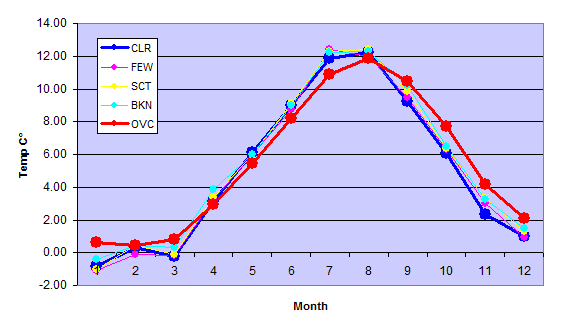
Here is the ground breaking analysis of northern pacific weather records – a region that is supposed to have a negative CRE (cloud radiative effect) of some -50W/m2, according to some NASA models (ERBE, CERES). Note: this is there very foundation of the “GHE”. Real life data show a totally opposing picture.
Seasonal CRE:
Annual average CRE:
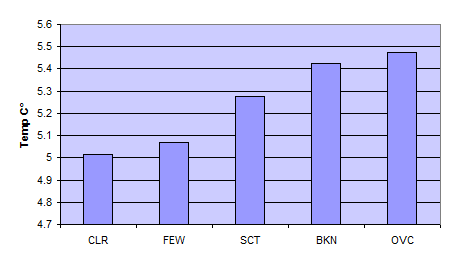
Even in the northern pacific (like anywhere else) the CRE is strictly positive.
Excerpts:
Modelling suggests……………….
considerably more sensitive to carbon emissions than previously believed………….
incredibly alarming……………
shocked many veteran observers…………
That is a very deep concern…………….
way outside previous estimates………..
This is science? It is just puerile scaremongering.