Reposted from Dr. Susan Crockford’s Polar Bear Science
Posted on June 4, 2020 |
Here are ice conditions at the end of May, which signals the near-end of the critical spring feeding period for polar bears. This is because young-of-the-year seals take to the water to feed themselves, leaving only predator-savvy adults and subadults on the ice from some time in June onward (depending on the region).

Spring is the critical feeding period for polar bears (Crockford 2019, 2020; Lippold et al. 2020; Obbard et al. 2016):
“Unexpectedly, body condition of female polar bears from the Barents Sea has increased after 2005, although sea ice has retreated by ∼50% since the late 1990s in the area, and the length of the ice-free season has increased by over 20 weeks between 1979 and 2013. These changes are also accompanied by winter sea ice retreat that is especially pronounced in the Barents Sea compared to other Arctic areas. Despite the declining sea ice in the Barents Sea, polar bears are likely not lacking food as long as sea ice is present during their peak feeding period. Polar bears feed extensively from April to June when ringed seals have pups and are particularly vulnerable to predation, whereas the predation rate during the rest of the year is likely low.“ [Lippold et al. 2019:988]
NISDC comparative graphs shows 2020 ice extent at 31 May 2020 was higher than 2016 on the same date (and about the same as 2015).
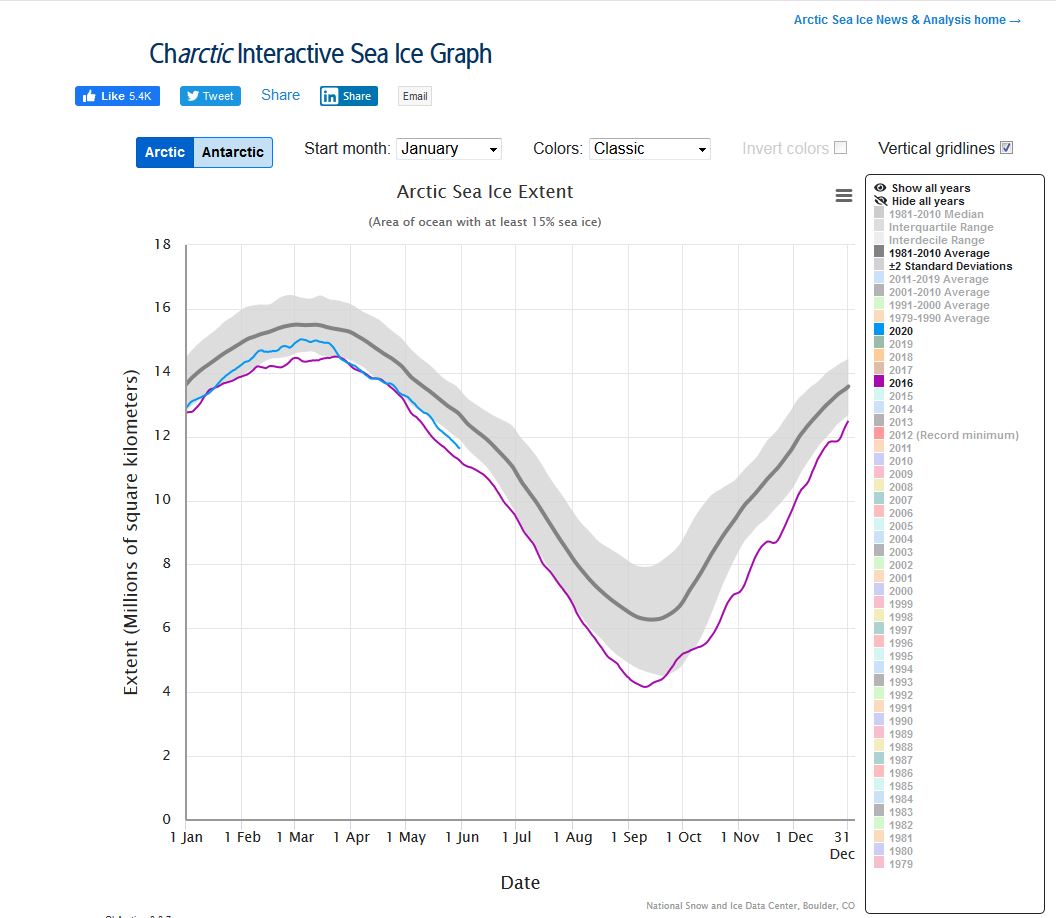
Below is the map for Arctic Canada at 31 May 2020, which has a noteable lack of open water in the Beaufort Sea:

Compare to 31 May 2016:

Last year (31 May 2019), however, was quite different again, especially in Hudson Bay and Hudson Strait:

Stirling et al. (1981:54) discussed why polynyas can be so important in the Southern Beaufort and Hudson Bay (my bold):
“One useful approach is to ask what would happen if the polynya was not there? Obviously this is impossible to evaluate on an experimental basis, but by examining the consequences or natural seasonal variation, some useful insights can be gained. For example, the influence of rapidly changing ice conditions on the availability of open water, and consequently on populations of seals and polar bears, has been observed in the western Arctic. Apparently in response to severe ice conditions in the Beaufort Sea during winter 1973-74, and to a lesser degree in winter 1974-75, numbers of ringed and bearded seals dropped by about 50% and productivity by about 90%. Concomitantly, numbers and productivity of polar bears declined markedly because of the reduction in the abundance of their prey species. …If the shoreleads of the western Arctic or Hudson Bay ceased opening during winter and spring, the effect on marine mammals would be devastating.”
Ice cover over Hudson Bay for the last week of May:
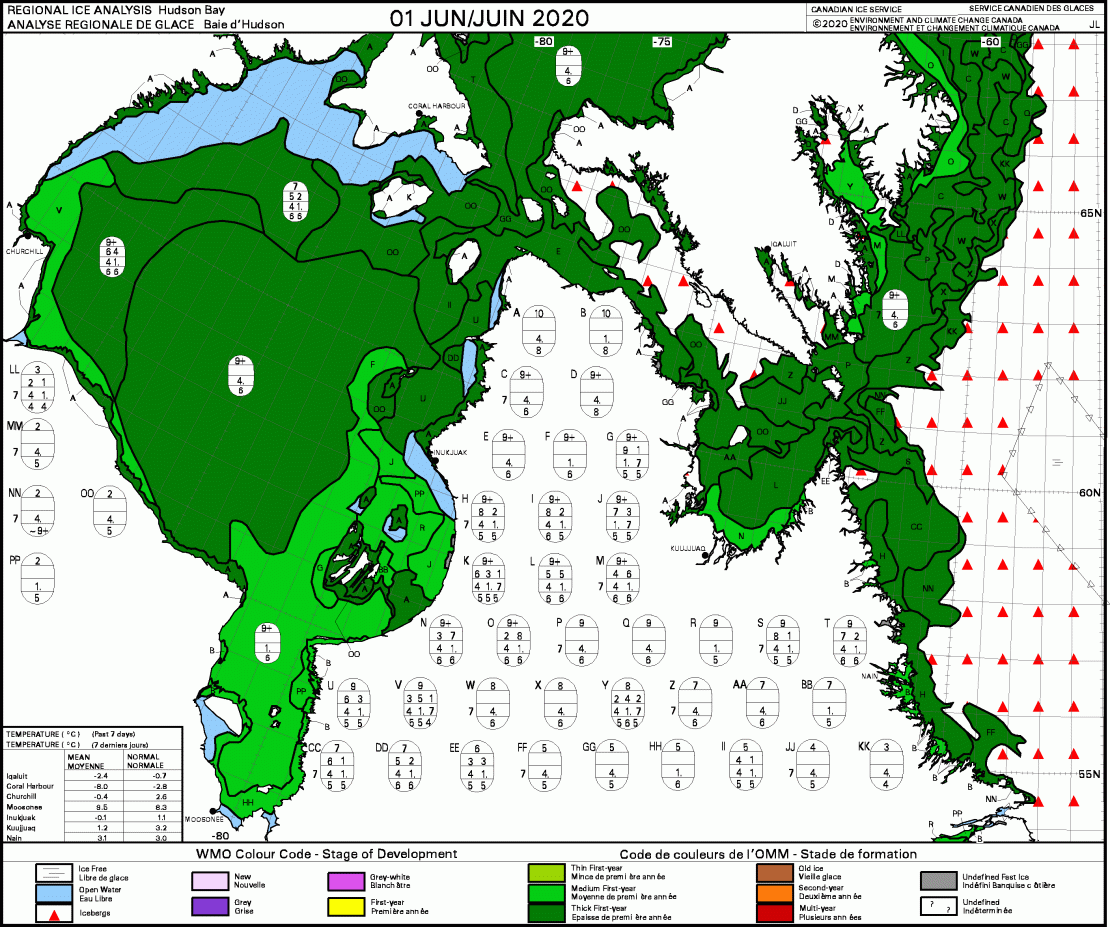
Ice cover over the western Canadian Arctic (Eastern Beaufort Sea) for the last week of May:

The Alaskan portion of the Beaufort was still predominantly multiyear ice at the end of May and thick first year ice in the Chukchi Sea (note this map does not show areas of open water): 
Areas of open water in the western Beaufort/Chukchi/Bering Seas at end May 2020:

Ice thickness at this time (less relevant for bears and seal, who prefer first year ice):

See previous posts on spring feeding here and here, with references, and on the Beaufort Sea polynya (recurrent open water) here and here.
References
Crockford, S.J. 2019. The Polar Bear Catastrophe That Never Happened. Global Warming Policy Foundation, London. Available in paperback and ebook formats.
Crockford, S.J. 2020. State of the Polar Bear Report 2019. Global Warming Policy Foundation Report 39, London. PDF here.
Lippold, A., Bourgeon, S., Aars, J., Andersen, M., Polder, A., Lyche, J.L., Bytingsvik, J., Jenssen, B.M., Derocher, A.E., Welker, J.M. and Routti, H. 2019. Temporal trends of persistent organic pollutants in Barents Sea polar bears (Ursus maritimus) in relation to changes in feeding habits and body condition. Environmental Science and Technology 53(2):984-995.
Obbard, M.E., Cattet, M.R.I., Howe, E.J., Middel, K.R., Newton, E.J., Kolenosky, G.B., Abraham, K.F. and Greenwood, C.J. 2016. Trends in body condition in polar bears (Ursus maritimus) from the Southern Hudson Bay subpopulation in relation to changes in sea ice. Arctic Science 2:15-32 Doi 10.1139/AS-2015-0027 http://www.nrcresearchpress.com/doi/abs/10.1139/AS-2015-0027#.VvFtlXpUq50
Stirling, I, Cleator, H. and Smith, T.G. 1981. Marine mammals. In: Polynyas in the Canadian Arctic, Stirling, I. and Cleator, H. (eds), pg. 45-58. Canadian Wildlife Service, Occasional Paper No. 45. Ottawa. Pdf of excerpts of above paper here.
Polar bears falling from the sky; no wait . . .
Does anyone have a copy of that WWF ad?
Looks like it was Plane Stupid.
The story I was told went something like this:
So, if the story is true, Polar Bears aren’t limited to feeding on hapless seal pups once a year.
The wiki article on Ring Seals mentions that they maintain a large separation from each other when they are hauled up on the ice. I wonder if that’s protective against Polar Bear predation.
I also heard an account of a juvenile PB running and carrying a seal. As far as I could make out, there was no ice free water in the vicinity.
It sounds to me like the Polar Bear and Ringed Seal ecologies are not as well understood as some people think.
The polar bears must be able to survive changing climate, because they have managed in the past 500K years. Yes there will be ecological changes in the parts of the world not inhabited by polar bears, but changing is what life does. If all changes stopped, then we better get worried.
Fat polar bears mean lots n lots of baby seals getting torn apart and eaten alive.
Isn’t ‘mother nature’ wonderful?
Climate change is causing dangerous obesity in polar bears.
Greenpeace’s next scare story.
“Fat polar bears mean lots n lots of baby seals getting torn apart and eaten alive.
Isn’t ‘mother nature’ wonderful?”
There are more baby seals in the Arctic than lentils and lentils require cooking.
Polar bears have limited access to cooking facilities.
And more ringed seals means more shrimp, cod and herring getting torn apart and eaten alive.
A strong implication that when Arctic seals suffer a severe decline, polar bear condition and population will similarly suffer.
A classic prey-predator relationship.
One gets the notion that the international alleged polar bear experts severely misstate the situation when they foist all of their ‘polar bear-prey’ claims as dependent upon sea ice.
ATheoK,
Just so, ATheo! Isn’t all natural ‘mother nature’ grand?
“the length of the ice-free season has increased by over 20 weeks between 1979 and 2013. ”
Wut?
The ice-free season in the Barent’s Sea has increased by 5 months?
No, of course not. The data that claim is based on is pure junk.
The southern part of Barents Sea has never ever had winter ice, much less summer ice. The map that figure is based on is simply a map of the areas with shallow water in the Barents sea, and Stern & Laidre 2016 (where the map is taken from) seem to simply have assumed that all such areas were formerly ice-covered. So of course, since they are never ice-covered today you get a steep decline.
It’s quite incredible that no reviewer reacted to that nonsense.
Arctic convoys of World War II https://en.wikipedia.org/wiki/Arctic_convoys_of_World_War_II
sailing through the Barents Sea all through the winter and spring months.
1942
PQ 8
departed Hvalfjörður January 8;
arrived Arkhangelsk January 17
Combined PQ 9 and PQ 10
departed Reykjavík, Iceland February 1;
arrived Murmansk February 10
PQ 11
departed Loch Ewe, Scotland February 7;
departed Kirkwall February 14;
arrived Murmansk February 22
PQ 12
departed Reykjavík March 1;
arrived Murmansk March 12[6]
PQ 13
departed Reykjavík March 20;
arrived Murmansk March 31
PQ 14
departed Oban, Scotland March 26;
arrived Murmansk April 19
PQ 15
departed Oban April 10;
arrived Murmansk May 5
PQ 16
departed Reykjavík May 21;
arrived Murmansk May 30
PQ 17
departed Reykjavik June 27;
dispersed, arrived July 4
PQ 18
departed Loch Ewe September 2;
arrived Arkhangelsk September 21: first convoy with aircraft carrier escort (HMS Avenger)
JW 51A
departed Liverpool December 15;
arrived Kola Inlet December 25
JW 51B
departed Liverpool December 22;
arrived Kola Inlet January 4, 1943;
see Battle of the Barents Sea
Arctic temperature, Arctic Ocean heat content and presumably sea ice coverage are all at least partly a result of the cyclical Atlantic Multidecadal Oscillation (AMO) of an approximate 60 year frequency.
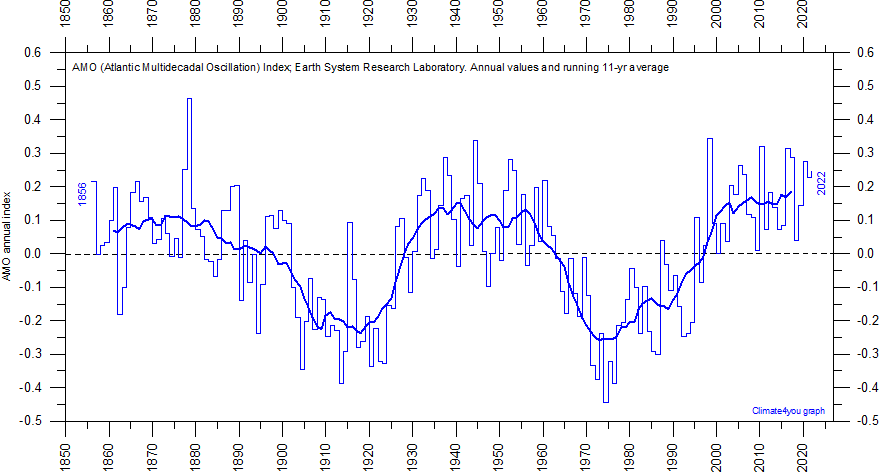
(Annual Atlantic Multidecadal Oscillation (AMO) detrended index values since 1856).
Consequently all the satellite observation trends of sea ice cover start at about the lowest point of the cycle.
To infer any effect of increasing CO2 on Arctic sea ice and the Arctic in general will have to wait until around 2040.
““Unexpectedly, body condition of female polar bears from the Barents Sea has increased after 2005, although sea ice has retreated by ∼50% since the late 1990s in the area, and the length of the ice-free season has increased by over 20 weeks between 1979 and 2013. ”
Why is it ‘unexpectedly’? After this surely the assertion that polar bears will suffer with less ice is not true.