Guest post by Geoff Sherrington
The global problem.
In response to the threat of a global viral epidemic, countries announced lockdowns at various times near 25th March 2020. https://en.wikipedia.org/wiki/COVID-19_pandemic_lockdowns
This caused a reduction of industrial activity and hence a lower rate of emission of anthropogenic carbon dioxide to the atmosphere. An example of reduction from aircraft is given at https://en.wikipedia.org/wiki/Impact_of_the_COVID-19_pandemic_on_aviation
Numerous sources asked if the reduction in CO2 emission could be detected in analysis of air for CO2 content, which had been done for decades. Early questions and speculative answers came from many sources including –
https://www.esrl.noaa.gov/gmd/ccgg/covid2.html
By late May 2020, the emerging consensus was that the reduction would be too small to show at the main measuring stations such as Mauna Loa, Hawaii.
This CO2 event has some consequences for global warming alarmism. There has long been argument that the contribution of anthropogenic CO2 to air is tiny compared to natural sources and sinks. Another argument says that the decades-long increase in CO2, the Keeling Curve, is mainly due to mankind, because the estimated emissions from industry account for about double the increase measured each year. Here is part of that curve to mid-May 2020:

It follows that an absence of a fall in the curve in the 2020 lockdown could indicate that the emissions of mankind are dwarfed by natural emissions. Whereas, a fall can be interpreted as proof that atmospheric CO2 levels are directly and measurably influenced by man-made emissions.
In terms of global political action, there are numerous calls to lower CO2 emissions by reduction or removal of fossil fuel generators such as electric power plants, cement manufacturing, gas autos replaced by electric and so on.
If the lockdown causes a 10% reduction in man-made emissions and this does not show in measurements, what does this mean for models of global climate and their forecasts? How are we going to monitor progress from drastic cuts to fossil fuel use if we cannot see the result in the numbers?
CITIZEN SCIENCE INVESTIGATES.
You are an interested scientist seeking to do your own investigation of CO2 levels in 2020. You prefer daily reports of CO2 to preserve the fine texture of the measurements and their comparisons from one weather station to another. You seek data from other weather stations.
There are 4 stations typically listed as keys to the system. These are –
Barrow, Alaska
Mauna Loa, Hawaii
Cape Grim, Tasmania
The South Pole, Antarctica
There are many secondary stations such as these in the AGAGE (Advanced Global Atmospheric Gases Experiment https://agage.mit.edu/global-network
About 23rd March 2020 I started to download files of CO2 in air from some of these stations. There were problems. Almost none of them had daily data for year 2020, some had no 2020 data at all. NOAA, for example, had daily South Pole data to only 31st December 2019. Mauna Loa was the exception. It had data from two sets of instruments, one under the NOAA banner, the other from Scripps. I managed to download some NOAA daily data ending in March 2020, but when I tried again I could not find the original source. If I try the following URL, the data stop at 31st December 2019.
ftp://aftp.cmdl.noaa.gov/data/trace_gases/co2/in-situ/surface/
Ralph Keeling from Scripps was most helpful with data. By email of 27 April 2020, he sent a few years of past daily Mauna Loa data to 12th April 2020. I told him I would not use it unauthorised, but then later found it to be identical to data downloaded here.
https://scrippsco2.ucsd.edu/data/atmospheric_co2/mlo.html
This is the most up-to-date, comprehensive source of daily CO2 data that I have found for year 2020.
The other Mauna Loa people, NOAA, write in their read-me notes that –
These data are made freely available to the public and the
scientific community in the belief that their wide dissemination
will lead to greater understanding and new scientific insights.
The availability of these data does not constitute publication
of the data. NOAA relies on the ethics and integrity of the user to
ensure that ESRL receives fair credit for their work.
Sadly, I have not succeeded in finding daily CO2 data for Mauna Loa for much of 2020 despite perhaps 20 searches, except for the Scripps source and Ralph Keeling.
What did I do with the daily CO2 data from Mauna Loa, NOAA versus Scripps?
NOAA HAS A PROBLEM OR THREE.
First, I did a straight comparison. It was something of a shock, because it demonstrated there was strong circumstantial evidence that NOAA was making up numbers that went into their official historic record. I would not have detected this feature if I had not got daily data from Ralph Keeling, with gaps labelled NaN for missing data. Here is but one example of it.
YEAR MONTH DAY SCRIPPS CO2 NOAA CO2
2020 1 374 413.39 413.1
2020 1 375 413.46 413.15
2020 1 376 413.25 413.2
2020 1 377 413.23 413.25
2020 1 378 NaN 413.3
2020 1 379 NaN 413.35
2020 1 380 NaN 413.4
2020 1 381 NaN 413.45
2020 1 382 NaN 413.49
2020 1 383 NaN 413.54
2020 1 384 NaN 413.58
2020 1 385 NaN 413.62
2020 1 386 NaN 413.67
2020 1 387 NaN 413.71
2020 1 388 413.16 413.74
2020 1 389 412.58 413.78
2020 1 390 412.54 413.82
2020 1 391 413 413.85
2020 1 392 414.76 413.89
For reasons unknown to me, Scripps had 10 consecutive days when no data were reported. It seems like NOAA had a similar gap, because the NOAA numbers are a simple linear infill with synthetic numbers, each either 0.4 or 0.5 ppm apart.
It is reasonable to presume that some of the NOAA numbers are not real, but are guesses.
Here is another NOAA problem, problem number two, from a that graph follows with small annotations, from the public source https://www.co2.earth/daily-co2
Around 22nd March 2020, there is a gap of some 4-5 days of missing data. I have added pictorial yellow trend lines that indicate (roughly) that the observations had a step change of about 1 ppm CO2 over these 5 days. This type of change would alert any experienced analytical chemist, with a strong message like “What is going on here? The dots do not join.” This is rather significant jump when, as references above show, we are seeking a change of 0.2 ppm over some months as an indicator of an effect of the global lockdown.
Here we have a change of about 1 ppm in 5 days.

NOAA have a detailed explanation of how they manage their accuracy and errors at Mauna Loa.
https://www.esrl.noaa.gov/gmd/ccgg/about/co2_measurements.html
They note that
- The Observatory near the summit of Mauna Loa, at an altitude of 3400 m, is well situated to measure air masses that are representative of very large areas.
- All of the measurements are rigorously and very frequently calibrated.
- Ongoing comparisons of independent measurements at the same site allow an estimate of the accuracy, which is generally better than 0.2 ppm.
They have the following graph about rejection of observations that are unsuitable – or perhaps “inconvenient” as in truth?

The colour code for grey-blue, letter U, is said to represent
There is often a diurnal wind flow pattern on Mauna Loa driven by warming of the surface during the day and cooling during the night. During the day warm air flows up the slope, typically reaching the observatory at 9 am local time (19 UTC) or later. The upslope air may have CO2 that has been lowered by plants removing CO2 through photosynthesis at lower elevations on the island, although the CO2 decrease arrives later than the change in wind direction, because the observatory is surrounded by miles of bare lava. Upslope winds can persist through ~7 pm local time (5 UTC, next day, or local hour 19 in Figure 2). Hours that are likely affected by local photosynthesis (11am to 7pm local time, 21 to 5 UTC) are indicated by a “U” flag in the hourly data file, and by the blue color in Figure 2.
It is important to note that these words are conjecture. They are guesses at a mechanism. NOAA do not reference controlled experiments that confirm these conjectures. Another conjecture might be that the grey-blue dots are correct; and that higher values are from positive contamination of CO2 from elsewhere.
An important deduction is that NOAA have introduced subjective results into the official record. In hard analytical chemistry, this is not done. Some regard it as cheating. We have already seen an example of NOAA using invented numbers, another no-no. A double strike is hardly a compliment.
Three strikes and you are out? Yes, here is the third strike. It is about accuracy. NOAA claim that
Ongoing comparisons of independent measurements at the same site allow an estimate of the accuracy, which is generally better than 0.2 ppm.
The accuracy of measurements from a laboratory has long been calculated as if an unknown client walks off the street with a sample and asks the lab to analyse it. The lab does not have access to the history of the sample. In reference to the graph just above, selected hourly averages. you need to consider all of the colours of all of the points to calculate accuracy. If accuracy is expressed in customary terms of a normal distribution with 95% of measurements falling within the 2 sigmas of standard deviation either side of the mean, even a rough eyeball estimate puts the 2 sigmas at about +/- 2 ppm accuracy. This is really elementary, classical science. With extreme special pleading by NOAA, using only their black “accepted” points, we are looking at +/- 0.7 or so ppm 2 sigma. It is hard to fathom the source of their accuracy claim of 0.2 ppm, but then they might have created their own definitions for measurement and expression of accuracy.
Here is another graph, this one a comparison of Scripps and NOAA from the same location but using different instruments, calibration procedures and algorithms to treat data.

It is not hard to find reason to question both the NOAA claim of 0.2 ppm accuracy and the accuracy at Scripps. This graph shows results something similar to the “man off the street “ exercise noted above.
Three counts.
In the olden days, if my laboratory operators had these counts against them, they would have handed in their badges of professionalism and gone home before sunset. I see two factors at work here. First is a lack of accountability. My operators knew that they would be fired on the spot for transgressions like these, so they behaved in an accountable way. The performance of people in the work place improves when there are open measures of accountability. Second, there might be aspects of post-modern or post-normal science at work here. As Wiki explains it in summary – https://en.wikipedia.org/wiki/Post-normal_science
Post-normal science (PNS) represents a novel approach for the use of science on issues where “facts [are] uncertain, values in dispute, stakes high and decisions urgent”.[1] PNS was developed in the 1990s by Silvio Funtowicz and Jerome R. Ravetz.[2][3][1] It can be considered as a reaction to the styles of analysis based on risk and cost-benefit analysis prevailing at that time, and as an embodiment of concepts of a new “critical science” developed in previous works by the same authors.[4][5] In a more recent work PNS is described as “the stage where we are today, where all the comfortable assumptions about science, its production and its use, are in question”.[6]
WHAT OF LOCATIONS AWAY FROM MAUNA LOA?
By email of 3rd April 2020, I attempted to obtain CO2 results from the New Zealand Authority NIWA, for Baring Head near Wellington.
Hello from Melbourne,
Do you have a web site link from which I can download your daily measurements of the carbon dioxide concentration in the air as measured at Baring Head? I am seeking daily concentrations from about Jan 2015 to the present day or so, preferably in .csv of similar format Alternatively, can you advise me of the correct procedure to request this information, including that for recent weeks?
Thank you Geoffrey H Sherrington
Scientist
Their reply was –
Dear Geoff,
The Baring Head carbon dioxide data that are available publicly, on the World Data Centre for Greenhouse Gases (https://gaw.kishou.go.jp/), in our plots at https://niwa.co.nz/atmosphere/our-data/trace-gas-datasets and on our ftp site ftp://ftp.niwa.co.nz/tropac/, currently go through to the end of 2018.
Before we make our Baring Head CO2 data publicly available, we go through a very thorough validation process which is explained below. We do this annually and are very close to releasing the 2019 data. The above links will be updated with the 2019 data once it is available. The 2020 data will not be available until about this time next year as it needs to go through the same validation process before it is released.
Our data validation process involves scrutinising the calibration gas measurements for the previous year. Below is a quick description of the calibration process:
At Baring Head we have eight calibration gases that are used as long-term transfer standards providing a link for our measurements to the World Meteorological Organisation (WMO) mole fraction scale. The CO2 mole fractions for the eight long-term transfer standard calibration gases are determined by the WMO Central Calibration Laboratory (CCL), with an estimated uncertainty of ±0.07 ppm (1-sigma) with respect to the WMO scale. We use these eight calibration gases to determine the calibration response for our instrument. These eight calibration gases are usually run on a fortnightly basis. We also run another four calibration gases as short-term working standards, which are run several times each day. More details can be found in Brailsford et al., Atmos. Meas. Tech., 5, 3109–3117, 2012; www.atmos-meas-tech.net/5/3109/2012/ doi:10.5194/amt-5-3109-2012.
Kind regards, Caroline
By email of 30th March 2020, I requested daily data from CSIRO Australia, for Cape Grim.
Message: Can I please obtain data as .csv or similar, showing daily measurements of atmospheric carbon dioxide from start 2014 to today, or to the last day of measurement from Cape Grim? I have viewed some data for the years 2014-2019 incl., but the period of most interest is daily and it starts March 1 2020
There were several emails, the most recent from CSIRO being –
Hi Geoffrey,
Thanks for contacting CSIRO.
The Cape Grim monthly averaged baseline data is made available to the public on a monthly basis. It is provisioned at this frequency, rather than hourly or daily, because the high resolution data needs to be run through a process by our team that is not instant.
The monthly data is currently sufficient for all other publications, enquirers and users, and our robust and peer-reviewed data publishing process will not be changed based upon your request.
We trust that the recently published March 2020 monthly averaged data point will be of use to you.
These bodies seem keen to gatekeep their data for reasons unexplained. The Australian data are paid for by the Australian public, who have a reasonable expectation of being able to access the data. I know of no law or regulation that allows CSIRO to act as censor or gatekeeper against the public. Perhaps there are some acts & regs, but I have never found them or seen them quoted.
The whole sorry procedure takes me back to my friend Warwick Hughes, who received that shattering email from Prof Phil Jones back in 2004-5.
“Why should I make the data available to you,
when your aim is to try and find something wrong with it.”
Must one conclude, with a heavy heart, that there remain vested interests among the science community who simply do not know of the damage that can be done through failing to learn from the history of Science? And who are more willing to obscure than to learn?
And no, this essay is not a candidate for a formal, peer reviewed publication because it does not present any useful advance of Science. It uses methods little more complicated than addition and subtraction of simple numbers. It is not meant to advance understanding of Science, so much as to minimise the decline.
THE END.
Geoff Sherrington
Scientist
Melbourne, Australia.
21st May 2010.
Good stuff, as far as it goes, pity you can’t access the data from other locations.
Have you considered using the global data measured by satellite? This is plotted on https://earth.nullschool.net/#current/chem/surface/level/overlay=co2sc/orthographic=-161.60,2.41,139
These plots show significant variations around the globe and with time, the distribution is a long way from being homogeneous. They do not appear to back-up the idea that CO2 concentrations are controlled by human emissions. Furthermore they show clearly that gor a reduction of emissions in China, or even the USA, to impact the records from Hawaii there would be a significant time lag. At some times of the year this location appears to be south of the effective boundary between winds in the northern and southern hemispheres such that changes due to reduced industrial activity may never be observed at all.
It also appears to me that any changes would be so small they would be lost in the background noise and would be indistinguishable from other changes that can be seen in the official records for previous seasons.
Conclusion – lots of people clutching at straws when expecting to see anything in the (dubious) official CO2 statistics.
https://earth.nullschool.net/
seems to be inconsistent with the measurements reported here :
https://www.climate4you.com/GreenhouseGasses.htm
The discrepancy clearly appears on this map :
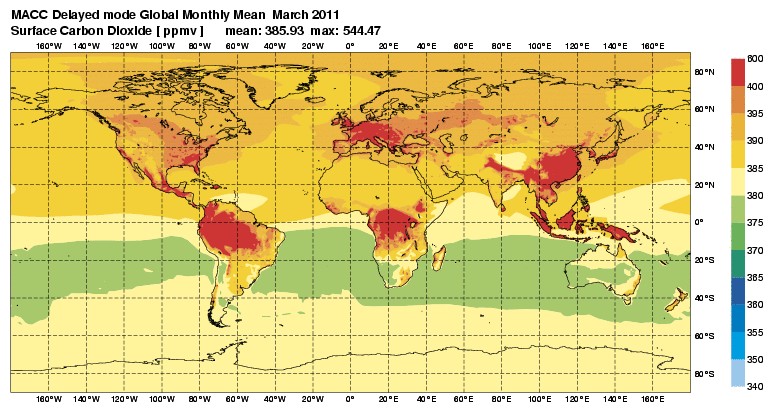
It can be seen here that rainforests have a higher surface CO2 concentration than the average.
This is rather consistent with the fact that there is a high life density under the canopy that emits CO2 and that rainforests may be net CO2 emitters when all the ecosystem they induce is taken into account.
I don’t know if this is correct but it may be somewhat embarrassing for the climate show.
Petit_Barde,
You are right, the satellites measure the whole column and even can focus on near ground emissions for CO2. “Background” CO2 monitoring is done away from local sources, thus never in the first several hundred meters over land, which have their own “tall towers” to measure CO2 fluxes:
https://www.researchgate.net/publication/332445404_Tall_tower_eddy_covariance_for_monitoring_CO2_emissions_from_the_city_of_Vienna
The differences may be due to daily values Vs averaged monthly values?
Forest areas and areas similarly rich in biomass have ground-level and near-ground-level CO2 varying with sunlight, lower when the sun is shining (biomass is a net sink) and higher when the sun is not shining (biomass is a net source). Also, convection causes more mixing with air higher up when the sun is shining and lack of mixing (air is more stagnant) when the sun is not shining. This means moderation by convection of ground-level CO2 concentration deviations from the overall atmospheric background (in a given forested area) is disproportionately of downward deviations, while upward deviations of ground-level CO2 concentration deviate from overall local atmospheric background more freely. This causes ground-level CO2 concentration to average more than the local atmospheric background CO2 even when the biomass is not a net source over an average 24 hour period.
Tim Crone,
Tim Crone raises some good points. In response, from what I can deduce from a limited study of the satellite-based CO2 measurements, they lack comparable accuracy, they have problems being tied to land-based spot locations like Mauna Loa and they are hard to interpret. If your satellite work shows a positive blob over some place on land, how can you distinguish between the land emitting CO2 because a mechanism makes it in excess, as opposed to the blob being a store of CO2 created because the land sink below it is slower to absorb it and leads to a queue? Mainly, though, the satellite method seems to be working so close to the limits of performance that as always, near detection or performance limits, accuracy suffers,
More data manipulated into junk science by NOAA…
Color me surprised.
Not!
Proof positive that data engineers at NOAA are not doing their jobs.
False, fake, changed data are all illegal in government records. i.e. NOAA’s Inspector General is not performing their duties either.
Excellent investigation and analysis, Geoff!
Thank you.
Quite a few of the comments by gaseous and data experts are instructive and compelling too.
Thank you! To those commenters!
I should like to add that the Scripps process does not measure the CO2 fraction in the actual local atmosphere. Rather, it measures the fraction in a subsample that has the humidity removed.
It follows that in the subsample, not only is the component ratio different, it also varies with local atmospheric humidity.
We can see that the annual variation in the Scripps measurement at the various sites:
https://scrippsco2.ucsd.edu/graphics_gallery/other_stations/global_stations_co2_concentration_trends.html
…… matches the annual humidity variations at these sites:
https://www.timeanddate.com/weather
The consequences of the Scripps process measuring two variables instead of just one, casts doubts on the veracity of the ‘Keeling Curve’ and also the assumption behind the AGW conjecture that “temperature follows increases in CO2”
TonyN,
Sorry, all CO2 measurements all over the world are expressed as CO2 in dry air, as that is the only way to compare the ratio’s worldwide as water vapor is highly variable from sea level to Mauna Loa height and the bone dry dessert of the South Pole…
That is done by cooling the air over a cold trap, which freezes out most of all water vapor, but doesn’t include CO2, only a small adherence at the surface, for which is compensated by allowing several minutes of airflow before measurements are taken.
When temperatures change over the seasons, both vegetation and humidity do change, but that doesn’t imply that the CO2 measurements are influenced… South Pole measurements are the lowest, although water vapor there is the lowest too…
Ferdinand,
Thanks for joining in. Can you answer this possible contradiction? If the cold treatment to dry the air prior to analysis does not change the CO2 level, how do we have CO2 in glacial ice cores? Do people measure the CO2 in the ice that forms in the laboratory drying procedure? Geoff S
Geoff: removing the water from the “air” does not seem fair. Why don’t they remove the Oxygen, Nitrogen, Argon, etc while they are at it?
In, other words, remove all constituents of a given mass of “air” except CO2 and then tell us the alleged ppm relative to the lb of “air” at the beginning of the constituent removal process.
My measurements and experience along with alleged factual info on the www tell me: less water = more cold relative to the given environ in spite of alleged CO2 concentration.
meiggs,
The problem with water vapor is that it is highly variable which makes the absolute CO2 levels also variable, while the CO2/dry air ratio doesn’t change.
Therefore all CO2 levels are expressed in dry air to make world wide comparisons possible.
The only calculations where the absolute CO2 levels are important is for the calculation of the CO2 transfer between atmosphere and ocean surface, as the absolute partial pressure of CO2 is the driving force.
BTW, if they want to measure the different isotopes of CO2 and other gases in ice cores, they sublimate everything and with cryogenic separation measure CO2, O2, N2,… with all their isotopic variations…
Further, CO2 is a weak GHG compared to water vapor, but that doesn’t imply that its effect is zero, only small…
Ferdinand: Thanks for the information and I follow your points. The point I think I was trying to make is use of select scales tend to mislead casual viewers/readers of MSM. For example, thinking of global dT in F or C seems ominous to some but on an absolute scale it begins to become apparent R or K that there is not much to worry about. Precip data is always clear…datum is zero, so absolute scale by convention. I would guess that absolute pressure is used routinely even by the TWC as changes in atm pressure would seem insignificant to casual viewers if presented in “column of Hg gauge”. RH is obviously relative and (unlike precip) not an intuitive unit measure for most folks. If CO2 concentration included H2O affect on relative content of a given sample it might give the casual observer the impression that CO2 concentration varies wildly throughout the world which is at odds with the warmist agenda. In my rather sloppy backyard experiment with an IR camera, amb T and amb RH it became very clear that atm water vapor calls the shots in terms of overhead sky temperature. Dry sky = colder. Wet sky = warmer…but I assumed same CO2 concentration in both cases in the ensuing calculations. As you point out absolute CO2 levels vary for wet v dry…assuming wet air has less absolute CO2 than dry I then will point out to warmists that lower CO2 concentrations for a given location = warmer air…………
meiggs,
The error of looking at dry or wet CO2/air ratio levels indeed depends of water vapor content, but is only high at near sea surface. Higher in the atmosphere or latitudes, absolute humidity rapidly drops to low levels, with the exception of clouds, but that is a complete different story…
Geoff,
CO2 doesn’t fit in the ice matrix. All CO2 of ice cores is in the enclosed air bubbles, but there may be a little amount of CO2 in the near-liquid surface of unordered ice/water some 5 molecules thick and/or water around salt impurities, depending of temperature and amount of impurities.
At the start as snow, CO2 is in the 90% air and when compressed with depth, the density of the ice gets higher and the in-between pores get smaller. Until then, there is free exchange with the atmosphere, be it slower and slower as the pores get smaller. At a certain depth, there is no exchange anymore. The difference between atmosphere and 72 depth (at Law Dome) is only 7 ppmv or a difference of average 10 years in age.
When grated just under freezing and high vacuum, any liquid water is removed and freezed out over a cold trap. That forms a regular sheet of ice, where CO2 isn’t incorporated, but a very small quantity may adhere on the surface. That is compensated for by several minutes of passing by of a calibration gas through the whole equipment before the sample is measured…
Thanks, Ferdinand,
That is also my understanding. I raised the matter to help others understand the assumptions behind drying the CO2 before analysis.
As with all science, one makes assumptions that seem reasonable and hopes that they stand the test of time. My private view, as a non-profit expert, is that we should be cautious about firn mechanisms and expect some upsets. There is a lot going on over a long time in human terms, hard to observe, hard to set up experiments. Geoff S
I doubt you can compare CO2 in the air with historical glacial trapped CO2 extracted using the DRY method.
Anyone familiar with this?
https://www.sciencedirect.com/science/article/pii/004896979290428U
Zoe
Yes of course. It has been much discussed over the Years. I think you wrote once about the wet method of measuring co2 . Presumably you are aware of the work of the late Ernst beck?
Tonyb
Yes, I like Ernst Beck’s work.
Zoe and Tony,
Please let the late Dr. Jaworowski rest in peace, together with his impossible ideas about CO2 in ice cores. His remarks of 1992 were already refuted in 1996 by the work of Etheridge e.a. on three Law Dome ice cores. Jaworowski made some remarks like the migration of CO2 via cracks in the ice from low levels towards higher levels which are physically impossible and “shifts” in timing which didn’t exist, as he simply looked at the wrong column of the results…
See: http://www.ferdinand-engelbeen.be/klimaat/jaworowski.html
The same for the work of the late Ernst Beck, with whom I had several years of discussion. While he did a tremendous lot of work, he lumped all results together: the good, the bad and the ugly.
At last he removed the ugly, but still included a lot of bad data…
Not bad because of the wet method itself (which was accurate to +/- 10 ppmv), but bad because where was measured: within forests, towns, under, in-between and above growing crops, etc…
See: http://www.ferdinand-engelbeen.be/klimaat/beck_data.html
“His remarks of 1992 were already refuted in 1996 by the work of Etheridge e.a. on three Law Dome ice cores.”
Can you show me where Etheridge refuted Jaworowski’s notion that the DRY extraction method is fallacious?
Even if Etheridge rationalized the DRY method by his own decree, that doesn’t make it legitimate.
“Dry method good. Wet method bad. Jaworowski debunked!!!”
Is not a scientific argument.
Zoe,
For Antarctic ice cores, there is little difference in CO2 measured by wet or dry extraction methods, that gives about the same results. Modern equipment even uses a 100% sublimation technique, followed by mass spectroscopy, which measures everything, including the different isotopes. There is no difference at all between the dry grating technique (just below freezing) and mass spectroscopy, thus quite reliable.
Why then is the wet measuring technique abandoned for CO2 measurements? Because the results for Greenland ice cores were ambiguous: dependent of time one could find a doubling of CO2 levels over hours. Why? Greenland ice has frequent inclusions of highly acid dust from nearby Icelandic volcanoes. That reacts with sea salt dust from the Atlantic Ocean and sets CO2 free by the reaction between the carbonates in sea salt and the acid volcanic dust. Not only in-situ, which makes CO2 measurements in Greenland ice problematic, but a fortiori with the wet method, that mixes more dust layers and thus more CO2 release from momentary reactions…
Some background of 1995:
https://www.tandfonline.com/doi/pdf/10.3402/tellusb.v47i4.16061
Antarctic ice has 10 times less dust inclusions, both of carbonates and even less from volcanoes. The maximum error there would be about 3 ppmv.
Etheridge only worked with dry extraction and GC measurements, but answered many other objections that Jaworowski posed: he used different drilling methods, both wet and dry (no difference), measured CO2 top down in firn from the surface to bubble closing depth (only 7 ppmv difference in CO2 level between open air and closing depth) and no difference between still open pores and already closed bubbles. Thus no fractionation due to the closing process (but there is for the smallest molecules like Ar and O2).
The Tom Segalstad paper that I linked shows variations in DRY and WET technique in Antarctica.
You ignore all that and make it a Greenland/Antarctica issue.
Jaworowski did not write the paper I linked, but you attacked him anyway.
You’re some type of pathological apoligist for climate scam, and therefore I can’t take you seriously.
You did not read my material before you started fabricating stories.
Zoe Phin,
Did you read your own references? The title shows:
“Do glaciers tell a true atmospheric CO2 story?
Author Z. Jaworowski, T.V. Segalstad, N. Ono
As far as I can tell, Jaworowski was the lead author. Not only that, but he repeated his accusations in 2007, long after his objections were refuted…
http://www.warwickhughes.com/icecore/zjmar07.pdf
Nobody is perfect, myself included, but if you can’t admit that you are wrong when that is proved, you are no scientist…
Further, his remarks about high CO2 levels in Antarctic cores have no merit, as I wrote in my comment, which you have obviously not read, here what he wrote himself:
“both these deep cores were heavily fractured and contained drilling fluid”.
Thus they measured a very broad range of results in some parts of the ice core with the high CO2 levels in drilling fluid, not in the ice core bubbles. Neftel rejected all high outliers and only used the lowest values, as these were in line with measurements above and below the fractured and contaminated part. Neftel simply was right to reject the outliers and Jaworowski was wrong…
Thus sorry, Jaworowski may have been an excellent researcher about radio nucleides in ice cores, but for CO2 in ice cores he was totally wrong…
“Further, his remarks about high CO2 levels in Antarctic cores have no merit, as I wrote in my comment, which you have obviously not read”
Oh they have no merit because you say so?
There is a list of other papers in my link that shows a range for Antarctica.
The wet and dry method is compared with numerous papers. Greenland, Antarctica, doesn’t matter.
There’s over two dozen papers referenced.
I guess I should ignore all that and believe your ASSERTIONS?
“repeated his accusations in 2007, long after his objections were refuted”
You obviously don’t know what refuseted means. He answered all possible objections to his work, and his critics merely repeated the very things he debunked!
Come back when you can refute the dozens of papers that show variations of DRY vs. WET technique in Antarcrica. And by refute, I don’t mean dismiss and assert lies.
Wow Zoe,
If someone says that CO2 in ice cores migrates from inside the ice cores at 180 ppmv towards 380 ppmv during at least one year of cold storage (used for ice relaxation, the deep core ice expands with about 50%) through “cracks”, then I doubt that he knows what he is talking about.
If the same person looks at the wrong column of the age of the ice, instead of the average age of the included gas bubbles, and uses that to accuse others of fraud, then I doubt his knowledge of the air enclosing process.
When I wrote to him that he was wrong on that point, he assured that all ice cores show frequent layers of melted and refreezed ice, so that no exchange with the atmosphere is possible, but Neftel, the accused, did encounter only one layer of melt and refreezing in the depth, for which the average gas age was compensated for.
If the same person uses clearly contaminated samples of the ice cores, which are rightfully rejected as unreliable, as reason for accusing others of fraud, then that are false accusations.
Thus sorry, whatever his knowledge of radioactive fallout on ice cores was, his remarks on CO2 in ice cores are simply unreliable…
I have not the time or courage to read all the 100+ references in Jaworowski’s work, but if you have even one reference that the wet method for CO2 in Antarctic ice cores is preferential better than the dry method or the sublimation / mass spectrometer technique, I am very interested.
Here the latest techniques to measure CO2 in ice cores, even in bubble-free clathrate ice:
https://www.researchgate.net/publication/253089968_A_sublimation_technique_for_high-precision_measurements_of_d13CO2_and_mixing_ratios_of_CO2_and_N2O_from_air_trapped_in_ice_cores
If you want reliable data, go outside and guess.
Geoff,
Your next-to-last illustration, showing color-coded readings for 2014, is interesting. While most of the “U” coded readings are below the general trend, there appear to be some on the trend and included in the spikes above the trend. It isn’t clear whether Scripps handles all the grey-blue coded measurements the same. What do the red “V” dots represent?
Clyde,
The full explanation is at:
https://www.esrl.noaa.gov/gmd/ccgg/about/co2_measurements.html
The “V” is a label given to hourly data with a “huge” stdv (over 0.3 ppmv), mostly with downslope winds from the fumaroles, which can give several ppmv extra CO2 but also high variability in the readings.
Take a look at what Michael Mann had to say on MSNBC about this.
https://climatechangedispatch.com/michael-mann-hails-crushing-lockdown-co2-emissions-dropped/
Mann & Co = Carbon for them but not for you. Hypocrites all.
What an idiot.
AKA: your master
I referred to Mann, sorry.
Does Mann believe that crops and foodstuffs grow themselves, that products produce themselves? Apparently, yes he does: ergo he’s an idiot.
Carlo: He believes he is entitled and you are not. His pal Saul A. got rich telling others how to live as has gold bars Gore. These are not idiots, these are very rich, and very dangerous, sociopaths. As Bill Bonner oft quoted: “It’s all been said before and nobody was listening.” WUWT a perfect example. Suggest “Mobs, Messiahs, and Markets: Surviving the Public Spectacle in Finance and Politics” as particularly relevant to the ginned up CV19.
Thank you for your informative replies, Clyde and Tim. Like most people, I tend to read the simple version of the Science and assume that that is actually the reality. Until I thought about it, I just assumed that the atmosphere was a solution whose constituent gases quickly dispersed, leading to constant homogeneity all over the world. This is pretty much the idea that everybody else has too. Of course, if atmospheric carbon dioxide concentrations are variable and local, and atmospheric carbon dioxide really does cause warming, China’s emissions become China’s warming, and are of no concern to people on the opposite side of the world. Climate alarmists aren’t having any of that, I’d say.
As long as I’m here, global sea level is the same all over the Earth, right? The oceans are contiguous, and sea level can’t actually be higher in some places than others, surely. Once again, I really, really don’t know, and am sincerely asking for information.
Ian: global sea level is never the same any where any time measured on the scale of Planck Space & Time. It’s never even the same if measured with 12 inch ruler and a stop watch with a second hand. Reality does not stand still in spite of what the alarmists may say. https://en.wikipedia.org/wiki/Planck_units
I didn’t read a refutation of http://www.drroyspencer.com/2020/05/why-the-current-economic-slowdown-wont-show-up-in-the-atmospheric-co2-record/
Just some nitpicking on observations.
Hans Erren,
Are you suggesting that I should have arrempted to refute work by Dr Spencer? If so, why would I want to do that? Geoff S
Usualy 3 ppm CO2 is emittet in the months march, april and may (Scripps). That is 52 Gt CO2.
This year 17% down = 43 Gt, so 9 Gt less.
Of the usual 52 Gt only 23,5 Gt would have stayed in the atmosphere. Now it is only 14,5 Gt (9 down).
14,5 Gt CO2 is 1,85 ppm, but 3 ppm is measured. Something is wrong with the model (the IPCC’s model)
Bjarne: “Wrong” is a subjective term similar to “right.” What is wrong relative to what right?
Regarding: “If the lockdown causes a 10% reduction in man-made emissions and this does not show in measurements, what does this mean for models of global climate and their forecasts?”
One thing is that a few months of a 10% decrease of emissions is not going to do much against a buildup that has been in the making for decades.
One thing to note: Dr. Roy Spencer figures it would take a 43% decrease of manmade emissions to achieve a leveling off of atmospheric CO2, and that leveling off would be +/- regular seasonal variations, irregularities in seasonal variations and irregularities from one year to the next such as onces caused by ENSO. http://www.drroyspencer.com/2020/05/why-the-current-economic-slowdown-wont-show-up-in-the-atmospheric-co2-record/ In the past five years, atmospheric CO2 increased at an average rate of slightly over 2.6 PPMV per year. So, a 43% decrease in manmade emissions sustained for a year would cause atmospheric CO2 to be 2.6 PPMV less than if there was no decrease at all. A 10% decrease for two or three months would only make atmospheric CO2 .1-.2 PPMV less than emissions being unchanged. Note: On average, May runs about 3 PPMV above the longer term trend obtained by taking a 1-year average over the time period centered on a particular time.
Dr. Spencer’s analysis is incorrect. Dr. Berry explains why.
https://edberry.com/blog/climate/climate-physics/human-co2-has-little-effect-on-the-carbon-cycle/#comment-86023
Note that Mauna Loa’s daily measuremets is a speedometer, not a mileometer.
A decline in emission should be measured immediately or at least after only a few days of atmosphere mixing.
A 10% decline in emission, should cause a 22% decline in accumulation. A 20% emission decline should cause a 44% accumulattion decline, and a 45% emission decline should cause 100% accumulation decline.
Bjarne: velocity vs distance, I get that. Assuming what I’ve read here and other www sites there is no real change in the CO2 speedometer due to the lock down so far. Are you then implying the human CO2 is not significant compared to other sources?
Bjarne,
The decline of the emissions is about 11% or from the 4.5 ppmv/year 0.4 ppmv less emissions. From that figure only halve stays as mass in the atmosphere. The difference thus is 0.2 ppmv/year less increase. Or less than 0.02 ppmv/month. The accuracy of the measurement method at Mauna Loa is… 0.2 ppmv. That means that the change may be real, but not measurable until after a full year of measurements…
That something is too small to be measured by the current methods doesn’t imply that it doesn’t exist… Ask it at Lance Armstrong what that means…
Ferdinand:
I posted this on a recent (and interesting wuwt article about I think Mauna Loa Mar 2020 a month or two ago):
3) Based on gasoline price say in the last 2 months humans have emitted 1 Gt less than usual. 415*1/3260 ~= 0.1 ppm negative impact on atm CO2 concentration….too small to measure. In my world anyway.
4) And, that seems to be what the measurements are showing?
I love science…the real thing sorta like truth without BS.
But I’m not a scientist but have spent time atop both Mauna Loa and Mauna Kea, and many other such places…reality is always good to hold in mind. In the hills nearby my part of the world the darn Fir trees appear to be moving the wrong way on the mtn. But I recognize they can’t read and so don’t know which way to go.
Ferdinand,
How can you say that the accuracy at ML is 0.2 ppm, after I wrote a fairly inarguable essay showing by examples that that is WRONG? The correct value is almost certainly greater than 1 ppm. That was the main point of the essay. You need to show I am wrong if you persist with your 0.2 ppm assertion. Geoff S
Geoff,
The resolution of the method itself is better than 0.2 ppmv. That doesn’t imply that the measured air is always within that limit…
There is a larger difference between independent Scripps measurements and NOAA measurements, but then you need to compare the same samples at the same moment of the day taken from the same inlet (there are two inlet lines, which are switched after 20 minutes, followed by 20 minutes calibrating gases).
My impression was that Scripps did take multiple flask samples from one of the inlets to analyse them later at La Jolla. If that is the case, then they have discrete samples, presenting a full day, and you need to compare them with the values of Mauna Loa at exact the same time as sampling by Scripps…
Calibration gases have to be used with care. The partial pressures as measured with an RGA change from when the bottle is full to when the bottle is nearly empty . In a well run lab, the bottle is exchanged when half full. Any step changes are noted.
Better to change when half empty
Great work Geoff. Three strikes indeed.
Regarding the graph with the gap and a ~1 PPMV jump at the gap: I noticed that the curve after the gap is a little concave downward, and the curve before the gap is a little concave upward. This looks like it came from a weather pattern change. I was able to find a graph like this at:
http://web.archive.org/web/20200409184929/https://www.esrl.noaa.gov/gmd/ccgg/trends/monthly.html
More severe irregularities but without a 5 day gap show up in March 2019.
http://web.archive.org/web/20190331063422/https://www.esrl.noaa.gov/gmd/ccgg/trends/monthly.html
Two multiday gaps, neither with a jump, one with a slight drop happened in June 2019:
http://web.archive.org/web/20190704191803/https://www.esrl.noaa.gov/gmd/ccgg/trends/monthly.html
There was a roughly 2 PPMV drop over a few days in mid February 2020 that caused the period of 1/18 to 2/18 2020 to end about where it started around 413 PPMV. That drop undid a ~2 PPMV increase that was going on during that time, in a time of year when on average CO2 historically increases by about .8 PPMV.
http://web.archive.org/web/20200211232103/https://www.esrl.noaa.gov/gmd/ccgg/trends/monthly.html
These irregularities seem explainable by movements and changes of large scale weather patterns. Such weather pattern movements and shifts change wind transport of air from places with large seasonal sources/sinks.
Donald makes several good points. In response, generally, I am promoting experiment to identify concentration changes, rather than supposition or conjecture, no matter how logical the explanation seems. Geoff S
In case there are wrong inferences drawn, I make it clear that Ralph Keeling has been most cooperative and nothing I have written is intended to disrespect the value of the pioneering scientific work of the Keeling family in regard to CO2 at Mauna Loa. The climate research community shows a distinct lack of recent scientific breakthroughs, reflecting perhaps a lower quality of researcher joining the ranks. I recall Richard Lindzen saying much the same. We need more like the Keelings. Geoff S
Problem is, if lockdowns on the current scale have so little effect, the whole green agenda is fantasy. The level of lockdown it would take to do what they want would require the stopping of all human activity.
Exactly!
michel,
It is not because the current lockdown is too small to be measured in a few months of data, that it doesn’t exist. You need 1-2 years of data with the same emissions reduction to be sure of the difference.
Take sea level changes: you need 20-25 years of data to be sure that sea level increases with a few mm/year within the huge meters variation of waves and tides…
If humans halved their emissions, CO2 levels would stabilize, that too is economically imposible, but less impossible than zero emissions as the EU want to imply at 2050. That in any case is economical suicide…
The problem is, this level of lockdown we are now doing only produces a 17% fall in global emissions. To drop emissions by half would be what, exactly? Just about total end of all economic activity, and probably all domestic heating too?
michel: you are rather naive. It would most likely mean the end of your life. Forget heating and think about eating.
https://woodfortrees.org/plot/uah6/plot/esrl-co2/from:1978/mean:12/derivative/scale:4/offset:-0.5
The green is essentially the difference between values for the same month in consecutive years – 6 months before t and 6 months after, divided by 12 to be in units of ppm per month. It’s scaled by 4.
If measured to 0.2 ppm, that is an error of √ 0.04+0.04 /3 or 0.1 on the scale of the above graph for the green. There is also a 0.1 error for the red.
Rather than scaling so that they have similar lines of best fit. Detrending each independently and then normalizing before comparing would be the best way to approach this, but simple scaling and offsetting seems to the job.
I’ve read an article interviewing Charles Keeling where he claims to have best job in the world. Surf in the morning then work in the best view in the world.
Surely the Sahara or Atacama would have been more suitable?
I was OiC of Cape Grim for 18 months around 2008 – we reckoned AGAGE actually stood for “Another Gas – Another Golfing Expedition” as pretty much all those on the AGAGE gravy train were mad keen golfers and a global network gives you access to some really nice golf courses.
Geoff, I have written to both the Ministers in the NZG who have an interest or responsibility for NIWA asking them to release the data and set up a daily record live on line. If you send me you email I will copy you hearlek@eol.co.nz
“There has long been argument that the contribution of anthropogenic CO2 to air is tiny compared to natural sources and sinks.”
Made by disingenuous propagandists, cynically intent on creating doubt where none exists and then ofcourse repeated as fact by the ignorati. Resorting to this kind of hogwash, which you surely know is bunkum, unmasks your real motive. Shame.
True to tradition: Another hollow rant from the army of billionaire funded trolls.
Bottom Line: The COVID experiment has now rendered this lame claim as viable as the Democrats’ latest foray in legislation: “As dead as fried chicken”.
Loydo
You incautiously said, “Resorting to this kind of hogwash, which you surely know is bunkum, unmasks your real motive.” There is an old saying that when you point a finger at someone, there are three more pointing back at yourself. I suggest that you look at the numbers in the second illustration found here:
https://www.earthobservatory.nasa.gov/features/CarbonCycle
Note that all the estimates are only made to the nearest 10 gigatons, at best, except for the human emissions, which are to the nearest 1 gigaton. What does that tell you about the uncertainty in the estimates?
I do wish that you would read more and write less. Also, try thinking before you write. Your motive is showing.
I can’t tell whether you’re choosing to ignore the elephant or genuinely too blinkered to see it. Humans activity has resulted in the atmoshperic CO2 concentration rising *abruptly* from about 280ppm to 415.

Uncertainty? Really?
“anthropogenic CO2 to air is tiny” this is nothing but a tawdry lie repeated by die-hard disinformers.
So what’s your motive in promoting it?
Loydo,
Thank you, you raise some good points. One is accuracy of quotation. Indeed, I did write “There has long been argument that the contribution of anthropogenic CO2 to air is tiny compared to natural sources and sinks.” This is correct and there are numerous examples of other authors writing similarly. But nowhere did I write that I agree with this sentence.
I nalso wrote “Another argument says that the decades-long increase in CO2, the Keeling Curve, is mainly due to mankind, because the estimated emissions from industry account for about double the increase measured each year.”
What is the reason for your comment? You write “a tawdry lie repeated by die-hard disinformers. So what’s your motive in promoting it?” Loydo, where was I promoting it? Was it a sin for me to mention that there has been argument, then summarising the opposing views?
An apology from you would be decent, thank you. Geoff S
The “promoting” comment was directed at Clyde.
No I won’t apologise, these words are yours: “the contribution of anthropogenic CO2 to air is tiny compared to natural sources and sinks.”
“Another argument says that the decades-long increase in CO2, the Keeling Curve, is mainly due to mankind…”
Its a false premise, like saying: some have long argued the Earth is flat, another argument is that its actually round. Its what disinformers say to seed doubt where there is none.
So many posters here continue to repeat this same nonsense – that human contributions are too small to have any affect. If your goal is to perpetuate anti-science talking points like this then shame on you.
Loydo
Yes, really! The fossil fuel emissions are probably close to being accurate. However, had you looked and examined the NASA graphic, you would have observed that the natural fluxes are all rounded to the nearest 10’s or 100’s of gigatons. That means they are estimates where the uncertainty is in the same position, or 10-times larger, as/than the calculated human emissions! The human emissions are down at the level of natural variation or noise in the total fluxes.
If you look closely at the graphic that you linked to, it should be obvious that there is much more variability in the post-1958 data than in the pre-1958 data. That is explained partly by the general principle that the temporal resolution of pre-historic data is inversely proportional to the time elapsed. That is, very ancient data looks like data that has been low-pass filtered. One of the consequences of low-pass filtering is a reduction of peaks because they are averaged over a long time period.
It is a tenable hypothesis that the current abrupt rise is a result of anthropogenic influences. However, you are assuming that there is an elephant in the room when the elephant is not in evidence. However, that is the crux of the disagreement between the two camps. It is not clear whether CO2 is the cause or the effect of rising temperatures. The best that can be said is the there appears to be a correlation.
My motive is to support the best possible science arguments, by pointing out un-examined assumptions made by those who are unadvisedly playing in the deep end of the pool.
“a tenable hypothesis”?
Clyde, questioning the anthropogenic source of that CO2 spike is naked doubt-mongering.
Loydo
OK, if you insist, untenable. Thank you for the abundance of independently verified facts that conclusively prove your religious beliefs. Opinion rules, and hail Gaia.
Geoff,
Brilliant work!
The Scripps method provides a measure of CO2 in dried air at various sites, compared with CO2 in dried air from a lab. In the process, information about temperature and humidity is lost.
As varying air temperature causes humidity to vary, and humidity affects the ratio of atmospheric gases in a sample, it follows that the removal of H2O from the sample changes the ratio of the gases and so has a hidden effect on the CO2 readings of the Scripps process.
It follows that temperature changes precede humidity changes, and humidity changes affect CO2 measurements.
This can be illustrated by reference to NASA’s report of the ‘greening’ of the planet, yet this huge effect on the amplitude of the seasonal CO2 excursion does not appear in the Scripps record. Rather, the Scripps excursions appear to track the annual steady rise and fall of temperature and hence humidity at the various measuring sites.
Whilst this is no criticism of the Scripps process itself, it surely invalidates the hypothesis that increasing levels of atmospheric CO2 are the cause of climate-change. Rather, CO2 rises in response to temperature increases via the rise in humidity, and we must look elsewhere for the causes of ‘climate change’
Wasn’t there a satellite measuring co2 over the globe?
That one would be interesting.
Alex
Start here:
https://en.wikipedia.org/wiki/Orbiting_Carbon_Observatory_2
Geoff, my complete reaction doesn’t show up, so here a few remarks:
My impression is that you are too much comparing the data gathering at Mauna Loa and other stations with a lot of environmental and mechanical problems with the analytic possibilities of a clean laboratory…
About rejecting some measurements:
If you want to measure “background” CO2 levels, you MUST reject all data that are contaminated by local influences. Like downslope winds from the fumaroles or upslope winds in the afternoon, slightly depleted in CO2 by photosynthesis.
If you are interested in volcanic vent releases, then measure around volcanic vents, as was done around mount Etna, Italy.
If you are interested in CO2 fluxes by vegetation, then measure above vegetation, as is done worldwide with tall towers with intake at different heights.
In fact it is a luxury problem. In the old days there were some sporadic measurements once or a few times a day. Now there are 24 hourly averages per day. Even if half of them must be rejected, there still are 12 per day left for a maximum seasonal change of background CO2 of 0.03 ppmv/day. If you take a single sample every week (at the right moment of background air), you can plot exactly the same curve with the same slope.
At the South Pole they had several years of bi-weekly flask samples and that was already sufficient…
I have downloaded the 2004 hourly data some years ago and plotted both all raw data and only the non-flagged data, thus without the rejected data. There is near zero difference in amplitude or trend over a year:
Raw hourly data:
http://www.ferdinand-engelbeen.be/klimaat/klim_img/mlo2004_hr_raw.jpg
Selected only hourly data:
http://www.ferdinand-engelbeen.be/klimaat/klim_img/mlo2004_hr_selected.gif
The only difference is that there is less noise around the curve…
As long as there are stringent a priori criteria for inclusion or exclusion of data, I don’t see a real problem of rejecting data which don’t represent what you want to measure…
Ferninand,
After failures to convert people from belief in religion, I stopped trying when I realised that they would need a message from God to convince them, not a message from me, henceforth branded as a heretic.
You have made the mistake of equating NOAA’s work here, with the work of God. Take the scales from your eyes and believe what you see in front of them.
I feel so, so sorry for you, confusing belief with science. Belief has no place in science.
So, please tell me precisely what more you need to be shown to falsify your belief that the said accuracy is 0.2 ppm.
Geoff S
Geoff,
All I need is a comparison of samples taken by Scripps and NOAA at the same moment and from the same inlet…
Ferdinand
You remarked, “Even if half of them must be rejected, there still are 12 per day left for a maximum seasonal change of background CO2 of 0.03 ppmv/day.” You are presenting a strawman argument. No one, certainly not Geoff, has complained that there aren’t enough measurements.
What is at issue is the justification of deleting a large number of measurements, and impacting the average and standard deviation. Implicit in the procedure of deleting measurements suspected of being diminished in CO2 is that somehow those aren’t ‘real’ measurements or are unrepresentative of air that makes it from the ocean to the summit. What is retained is a subset that probably best represents what the air with a long fetch, rising off the ocean, is like. However, the reason for choosing ML was the claim that the high altitude best represented a large region. If that is a valid reason, then there shouldn’t be an effort to characterize the air at sea level! Almost certainly, the average CO2 concentration of air upwind from the summit is higher than what is downwind after the air parcels experience orographic uplift.
Clyde,
I made a full scale graph of a few days hourly averaged CO2 measurements (all raw data) at Barrow, Mauna Loa and the South Pole and compared them with the half hour data from a modern station in Giessen, Germany, one of the main places that provided the late Ernst Beck with a CO2 “peak” in 1939-1941. That illustrates the reason why Keeling did choose for SPO and MLO in first instance to have reliable “background” data and why Beck’s 1941 “peak” didn’t exist…
http://www.ferdinand-engelbeen.be/klimaat/klim_img/giessen_background_zero.jpg
As I said, the MLO data have a luxury problem…
Ferdinand
Thank you for the graph. It looks like Barrow is running consistently lower than MLO. I previously questioned whether it was appropriate to remove the MLO measurements that were presumed to be depleted in CO2, from passing over the upslope vegetation. The graph clearly shows Giessen source and sink periodicity. However, it is unclear from the graph when it might be human activity or vegetation respiration. Do the day marks start at local midnight?
Clyde,
The day marks indeed are at midnight. It was an exceptional situation those days at Giessen: no wind and a strong inversion in a semi-rural area. That makes that most variability is from vegetation, with some extra peak in morning rush hours. Interesting to see that photosynthesis depletes CO2 below background, despite more turbulence in sunlight and warmer temperatures… For the historical measurements, only three samples per day were taken at 7 am, 2 pm and 9 pm. The first and last were taken on the flanks of the decrease and increase and the middle in depleted air…
That made many historical measurements not fit for purpose (background CO2)…
And compared to history, we have a luxury problem at Mauna Loa…
Ferdinand
You remarked, ” Interesting to see that photosynthesis depletes CO2 below background, despite more turbulence in sunlight and warmer temperatures…” Not really surprising. In still air, one should expect that the plants would withdraw CO2, and the air in contact with the leaves would be depleted in CO2. With moving air, fresh, high-concentration CO2 air will be supplied, drawing down the CO2 in the whole air mass, instead of just the air immediately in contact with the leaves.
Hasn’t this global shutdown effectively falsified AGW theory? Despite the largest industrial collapse of all time global CO2 concentrations haven’t altered a jot.
1. Human influence is therefore exposed as absolutely irrelevant compared to natural variations.
2. This huge industrial and emissions collapse cannot simultaneously be too small to impact both global CO2 emissions and atmospheric concentrations while still being large enough to imperil the planet. It can only be one or the other.
3. Finally, if this unprecedented shutdown isn’t enough to even move the dial on global CO2, then what level of shutdown would be? The answer can only be the complete closure of the industrialised world, and that is NOT going to happen. Therefore whether scientifically or philosophically, AGW is dead as Monty Python’s parrot.
Nobody expected this real-time worldwide experiment to occur but it has, and it’s become the biggest real world falsification of CO2 theory anyone has ever seen. It trumps every pro-AGW computer model and ‘study’ ever created. Therefore the true implications of this shutdown and the total failure of CO2 to cooperate with the sacred theory should not be overlooked.
How this is anything other than game over?
Cheshire: Game ain’t over ’till their printing presses stop pumping out lies. And that’s ain’t gonna happen.
CheshireRed,
You need 20-25 years of good data to detect a few mm of sea level change in the meters of change by waves and tides. That doesn’t imply that there is no sea level change. Only that the change is small
You need 1-2 years of good data to detect a small change in emissions in the daily to yearly natural variability. That doesn’t imply that there is no human cause of the CO2 increase. Only that the change is small.
Dear Mr. Engelbeen,
You are completely right: “Only that the change is small”. However, your statement implies also that the EFFECT is also small (eventually negligible compared to the effects of the natural component(s) (for example to the effects of tides and waves). For this reason CheshireRed has also right (“Human influence is therefore exposed as absolutely irrelevant compared to natural variations.”), and the climate- and CO2-hysterics lie.
Hari Seldon,
The proven physical effect of a CO2 doubling (280 to 560 ppmv, expected at the end of this century) is about 1 degr.C. That is all. All the rest of the horror stories is based on failed climate models.
The warming caused by a CO2 doubling gives a shift in “climate” of about 350 km in the direction of the poles. Far more beneficial than that it would give any extra problems…
@ur momisugly Ferdinand Engelbeen
Yep, all that’s fair enough, but what does this say about the real level of ‘threat’ we face by AGW? It’s a total nonsense when alarmists are using decades and centuries long projections in order to arrive at a figure that sounds scary enough. And that’s what’s happening here.
0.13C per decade of warming doesn’t merit ANY ‘climate action’ whatsoever. Literally none. Is it beneficial or detrimental or benign? Is it linear? Will it last? Will it slow, stop or even reverse? Nobody knows, not least the ‘scientists’ who pretend they do yet constantly amend their data or studies to wail ‘it’s worse than previously thought’! (ie we were wrong last time, but please believe us this time. Oh and send more money)
To be squandering precious resources on the Mother of all Precautionary Principles is off the scale bonkers.
Game, and Set ?
And to be sure of the Match, I should like to serve this one:
The Scripps record actually demonstrates that temperature leads CO2, and not the other way round.