Guest post by Geoff Sherrington
The global problem.
In response to the threat of a global viral epidemic, countries announced lockdowns at various times near 25th March 2020. https://en.wikipedia.org/wiki/COVID-19_pandemic_lockdowns
This caused a reduction of industrial activity and hence a lower rate of emission of anthropogenic carbon dioxide to the atmosphere. An example of reduction from aircraft is given at https://en.wikipedia.org/wiki/Impact_of_the_COVID-19_pandemic_on_aviation
Numerous sources asked if the reduction in CO2 emission could be detected in analysis of air for CO2 content, which had been done for decades. Early questions and speculative answers came from many sources including –
https://www.esrl.noaa.gov/gmd/ccgg/covid2.html
By late May 2020, the emerging consensus was that the reduction would be too small to show at the main measuring stations such as Mauna Loa, Hawaii.
This CO2 event has some consequences for global warming alarmism. There has long been argument that the contribution of anthropogenic CO2 to air is tiny compared to natural sources and sinks. Another argument says that the decades-long increase in CO2, the Keeling Curve, is mainly due to mankind, because the estimated emissions from industry account for about double the increase measured each year. Here is part of that curve to mid-May 2020:

It follows that an absence of a fall in the curve in the 2020 lockdown could indicate that the emissions of mankind are dwarfed by natural emissions. Whereas, a fall can be interpreted as proof that atmospheric CO2 levels are directly and measurably influenced by man-made emissions.
In terms of global political action, there are numerous calls to lower CO2 emissions by reduction or removal of fossil fuel generators such as electric power plants, cement manufacturing, gas autos replaced by electric and so on.
If the lockdown causes a 10% reduction in man-made emissions and this does not show in measurements, what does this mean for models of global climate and their forecasts? How are we going to monitor progress from drastic cuts to fossil fuel use if we cannot see the result in the numbers?
CITIZEN SCIENCE INVESTIGATES.
You are an interested scientist seeking to do your own investigation of CO2 levels in 2020. You prefer daily reports of CO2 to preserve the fine texture of the measurements and their comparisons from one weather station to another. You seek data from other weather stations.
There are 4 stations typically listed as keys to the system. These are –
Barrow, Alaska
Mauna Loa, Hawaii
Cape Grim, Tasmania
The South Pole, Antarctica
There are many secondary stations such as these in the AGAGE (Advanced Global Atmospheric Gases Experiment https://agage.mit.edu/global-network
About 23rd March 2020 I started to download files of CO2 in air from some of these stations. There were problems. Almost none of them had daily data for year 2020, some had no 2020 data at all. NOAA, for example, had daily South Pole data to only 31st December 2019. Mauna Loa was the exception. It had data from two sets of instruments, one under the NOAA banner, the other from Scripps. I managed to download some NOAA daily data ending in March 2020, but when I tried again I could not find the original source. If I try the following URL, the data stop at 31st December 2019.
ftp://aftp.cmdl.noaa.gov/data/trace_gases/co2/in-situ/surface/
Ralph Keeling from Scripps was most helpful with data. By email of 27 April 2020, he sent a few years of past daily Mauna Loa data to 12th April 2020. I told him I would not use it unauthorised, but then later found it to be identical to data downloaded here.
https://scrippsco2.ucsd.edu/data/atmospheric_co2/mlo.html
This is the most up-to-date, comprehensive source of daily CO2 data that I have found for year 2020.
The other Mauna Loa people, NOAA, write in their read-me notes that –
These data are made freely available to the public and the
scientific community in the belief that their wide dissemination
will lead to greater understanding and new scientific insights.
The availability of these data does not constitute publication
of the data. NOAA relies on the ethics and integrity of the user to
ensure that ESRL receives fair credit for their work.
Sadly, I have not succeeded in finding daily CO2 data for Mauna Loa for much of 2020 despite perhaps 20 searches, except for the Scripps source and Ralph Keeling.
What did I do with the daily CO2 data from Mauna Loa, NOAA versus Scripps?
NOAA HAS A PROBLEM OR THREE.
First, I did a straight comparison. It was something of a shock, because it demonstrated there was strong circumstantial evidence that NOAA was making up numbers that went into their official historic record. I would not have detected this feature if I had not got daily data from Ralph Keeling, with gaps labelled NaN for missing data. Here is but one example of it.
YEAR MONTH DAY SCRIPPS CO2 NOAA CO2
2020 1 374 413.39 413.1
2020 1 375 413.46 413.15
2020 1 376 413.25 413.2
2020 1 377 413.23 413.25
2020 1 378 NaN 413.3
2020 1 379 NaN 413.35
2020 1 380 NaN 413.4
2020 1 381 NaN 413.45
2020 1 382 NaN 413.49
2020 1 383 NaN 413.54
2020 1 384 NaN 413.58
2020 1 385 NaN 413.62
2020 1 386 NaN 413.67
2020 1 387 NaN 413.71
2020 1 388 413.16 413.74
2020 1 389 412.58 413.78
2020 1 390 412.54 413.82
2020 1 391 413 413.85
2020 1 392 414.76 413.89
For reasons unknown to me, Scripps had 10 consecutive days when no data were reported. It seems like NOAA had a similar gap, because the NOAA numbers are a simple linear infill with synthetic numbers, each either 0.4 or 0.5 ppm apart.
It is reasonable to presume that some of the NOAA numbers are not real, but are guesses.
Here is another NOAA problem, problem number two, from a that graph follows with small annotations, from the public source https://www.co2.earth/daily-co2
Around 22nd March 2020, there is a gap of some 4-5 days of missing data. I have added pictorial yellow trend lines that indicate (roughly) that the observations had a step change of about 1 ppm CO2 over these 5 days. This type of change would alert any experienced analytical chemist, with a strong message like “What is going on here? The dots do not join.” This is rather significant jump when, as references above show, we are seeking a change of 0.2 ppm over some months as an indicator of an effect of the global lockdown.
Here we have a change of about 1 ppm in 5 days.

NOAA have a detailed explanation of how they manage their accuracy and errors at Mauna Loa.
https://www.esrl.noaa.gov/gmd/ccgg/about/co2_measurements.html
They note that
- The Observatory near the summit of Mauna Loa, at an altitude of 3400 m, is well situated to measure air masses that are representative of very large areas.
- All of the measurements are rigorously and very frequently calibrated.
- Ongoing comparisons of independent measurements at the same site allow an estimate of the accuracy, which is generally better than 0.2 ppm.
They have the following graph about rejection of observations that are unsuitable – or perhaps “inconvenient” as in truth?

The colour code for grey-blue, letter U, is said to represent
There is often a diurnal wind flow pattern on Mauna Loa driven by warming of the surface during the day and cooling during the night. During the day warm air flows up the slope, typically reaching the observatory at 9 am local time (19 UTC) or later. The upslope air may have CO2 that has been lowered by plants removing CO2 through photosynthesis at lower elevations on the island, although the CO2 decrease arrives later than the change in wind direction, because the observatory is surrounded by miles of bare lava. Upslope winds can persist through ~7 pm local time (5 UTC, next day, or local hour 19 in Figure 2). Hours that are likely affected by local photosynthesis (11am to 7pm local time, 21 to 5 UTC) are indicated by a “U” flag in the hourly data file, and by the blue color in Figure 2.
It is important to note that these words are conjecture. They are guesses at a mechanism. NOAA do not reference controlled experiments that confirm these conjectures. Another conjecture might be that the grey-blue dots are correct; and that higher values are from positive contamination of CO2 from elsewhere.
An important deduction is that NOAA have introduced subjective results into the official record. In hard analytical chemistry, this is not done. Some regard it as cheating. We have already seen an example of NOAA using invented numbers, another no-no. A double strike is hardly a compliment.
Three strikes and you are out? Yes, here is the third strike. It is about accuracy. NOAA claim that
Ongoing comparisons of independent measurements at the same site allow an estimate of the accuracy, which is generally better than 0.2 ppm.
The accuracy of measurements from a laboratory has long been calculated as if an unknown client walks off the street with a sample and asks the lab to analyse it. The lab does not have access to the history of the sample. In reference to the graph just above, selected hourly averages. you need to consider all of the colours of all of the points to calculate accuracy. If accuracy is expressed in customary terms of a normal distribution with 95% of measurements falling within the 2 sigmas of standard deviation either side of the mean, even a rough eyeball estimate puts the 2 sigmas at about +/- 2 ppm accuracy. This is really elementary, classical science. With extreme special pleading by NOAA, using only their black “accepted” points, we are looking at +/- 0.7 or so ppm 2 sigma. It is hard to fathom the source of their accuracy claim of 0.2 ppm, but then they might have created their own definitions for measurement and expression of accuracy.
Here is another graph, this one a comparison of Scripps and NOAA from the same location but using different instruments, calibration procedures and algorithms to treat data.

It is not hard to find reason to question both the NOAA claim of 0.2 ppm accuracy and the accuracy at Scripps. This graph shows results something similar to the “man off the street “ exercise noted above.
Three counts.
In the olden days, if my laboratory operators had these counts against them, they would have handed in their badges of professionalism and gone home before sunset. I see two factors at work here. First is a lack of accountability. My operators knew that they would be fired on the spot for transgressions like these, so they behaved in an accountable way. The performance of people in the work place improves when there are open measures of accountability. Second, there might be aspects of post-modern or post-normal science at work here. As Wiki explains it in summary – https://en.wikipedia.org/wiki/Post-normal_science
Post-normal science (PNS) represents a novel approach for the use of science on issues where “facts [are] uncertain, values in dispute, stakes high and decisions urgent”.[1] PNS was developed in the 1990s by Silvio Funtowicz and Jerome R. Ravetz.[2][3][1] It can be considered as a reaction to the styles of analysis based on risk and cost-benefit analysis prevailing at that time, and as an embodiment of concepts of a new “critical science” developed in previous works by the same authors.[4][5] In a more recent work PNS is described as “the stage where we are today, where all the comfortable assumptions about science, its production and its use, are in question”.[6]
WHAT OF LOCATIONS AWAY FROM MAUNA LOA?
By email of 3rd April 2020, I attempted to obtain CO2 results from the New Zealand Authority NIWA, for Baring Head near Wellington.
Hello from Melbourne,
Do you have a web site link from which I can download your daily measurements of the carbon dioxide concentration in the air as measured at Baring Head? I am seeking daily concentrations from about Jan 2015 to the present day or so, preferably in .csv of similar format Alternatively, can you advise me of the correct procedure to request this information, including that for recent weeks?
Thank you Geoffrey H Sherrington
Scientist
Their reply was –
Dear Geoff,
The Baring Head carbon dioxide data that are available publicly, on the World Data Centre for Greenhouse Gases (https://gaw.kishou.go.jp/), in our plots at https://niwa.co.nz/atmosphere/our-data/trace-gas-datasets and on our ftp site ftp://ftp.niwa.co.nz/tropac/, currently go through to the end of 2018.
Before we make our Baring Head CO2 data publicly available, we go through a very thorough validation process which is explained below. We do this annually and are very close to releasing the 2019 data. The above links will be updated with the 2019 data once it is available. The 2020 data will not be available until about this time next year as it needs to go through the same validation process before it is released.
Our data validation process involves scrutinising the calibration gas measurements for the previous year. Below is a quick description of the calibration process:
At Baring Head we have eight calibration gases that are used as long-term transfer standards providing a link for our measurements to the World Meteorological Organisation (WMO) mole fraction scale. The CO2 mole fractions for the eight long-term transfer standard calibration gases are determined by the WMO Central Calibration Laboratory (CCL), with an estimated uncertainty of ±0.07 ppm (1-sigma) with respect to the WMO scale. We use these eight calibration gases to determine the calibration response for our instrument. These eight calibration gases are usually run on a fortnightly basis. We also run another four calibration gases as short-term working standards, which are run several times each day. More details can be found in Brailsford et al., Atmos. Meas. Tech., 5, 3109–3117, 2012; www.atmos-meas-tech.net/5/3109/2012/ doi:10.5194/amt-5-3109-2012.
Kind regards, Caroline
By email of 30th March 2020, I requested daily data from CSIRO Australia, for Cape Grim.
Message: Can I please obtain data as .csv or similar, showing daily measurements of atmospheric carbon dioxide from start 2014 to today, or to the last day of measurement from Cape Grim? I have viewed some data for the years 2014-2019 incl., but the period of most interest is daily and it starts March 1 2020
There were several emails, the most recent from CSIRO being –
Hi Geoffrey,
Thanks for contacting CSIRO.
The Cape Grim monthly averaged baseline data is made available to the public on a monthly basis. It is provisioned at this frequency, rather than hourly or daily, because the high resolution data needs to be run through a process by our team that is not instant.
The monthly data is currently sufficient for all other publications, enquirers and users, and our robust and peer-reviewed data publishing process will not be changed based upon your request.
We trust that the recently published March 2020 monthly averaged data point will be of use to you.
These bodies seem keen to gatekeep their data for reasons unexplained. The Australian data are paid for by the Australian public, who have a reasonable expectation of being able to access the data. I know of no law or regulation that allows CSIRO to act as censor or gatekeeper against the public. Perhaps there are some acts & regs, but I have never found them or seen them quoted.
The whole sorry procedure takes me back to my friend Warwick Hughes, who received that shattering email from Prof Phil Jones back in 2004-5.
“Why should I make the data available to you,
when your aim is to try and find something wrong with it.”
Must one conclude, with a heavy heart, that there remain vested interests among the science community who simply do not know of the damage that can be done through failing to learn from the history of Science? And who are more willing to obscure than to learn?
And no, this essay is not a candidate for a formal, peer reviewed publication because it does not present any useful advance of Science. It uses methods little more complicated than addition and subtraction of simple numbers. It is not meant to advance understanding of Science, so much as to minimise the decline.
THE END.
Geoff Sherrington
Scientist
Melbourne, Australia.
21st May 2010.
Eisenhower had this all figured out sixty years ago. It’s very sad that no one heard the warning.
Eisenhower’s speech looks more and more prescient as decades go by. However, it’s important to remember his conclusion was not to avoid the military/industrial or political/science complexes. He seemed to accept they would continue to grow. He was simply noting the problems created by each; his final statement is critical: “It is the task of statesmanship to mold, to balance, and to integrate these and other forces, new and old, within the principles of our democratic system — ever aiming toward the supreme goals of our free society.”
Geoff, be very suspicious of these “quality” control processes. This period of global lockdown has already raised eyebrows in connection with there being no discernable change in CO2 so far.
This is not normal times, which are bad enough when it is. The warming warriors are already worrying that locking people up globally is going to show that the human contribution is markedly less than advertised.
We know how much we burn, but maybe most of it is sequestered, or perhaps there is something like the leChâtelier principle at work. Maybe the reduction in human CO2 invigorates bacteria and termite emissions to replace it?
Whatever the case, no detection will be the end of the whole climate CO2 debacle. Weve had 3 or 4 years of cooling and sea ice rebound, and they have been staggered by lefty Michael Moore’s documentary that renewables don’t work as a sub for fossil fuels. They virtually have no choice but to “homogenize” the data to fit the narrative. Please keep collecting the raw data!!!
Unlike NOAA with its vague statements about “accuracy”, the New Zealanders at least try to use the language of the Guide to the Expression of Uncertainty in Measurements (GUM). Their quoted +/-0.07 ppm (= 0.02%) uncertainty seems like only a single error source (the calibration transfer), and not a combined uncertainty of the entire CO2 measurement procedure, which probably should be quite a bit larger.
NOAA doesn’t even get basic use of significant figures correct.
It used to be that Scrips was the sole provider of CO2 reference gases for calibration. I don’t know if this is still the case but it would not be a good practice if it is because it would introduce bias into measurements.
As Scissor says, that is most likely the analytical accuracy of analysing one sample. It does not make any claims about how close any sample bottle is to the imaginary “average” of atmospheric CO2.
What does look more telling is the 1ppm jump. It is a shame you did not compare the same period to the Scripps data to see if there was a similar rise.
There are days when the wind (unusually) blows from the direction of the volcanic vents. Scripps carefully removed these as they do anything which deviated by more than 2 S.D. IIRC.
I think all this was discussed here a week or two ago
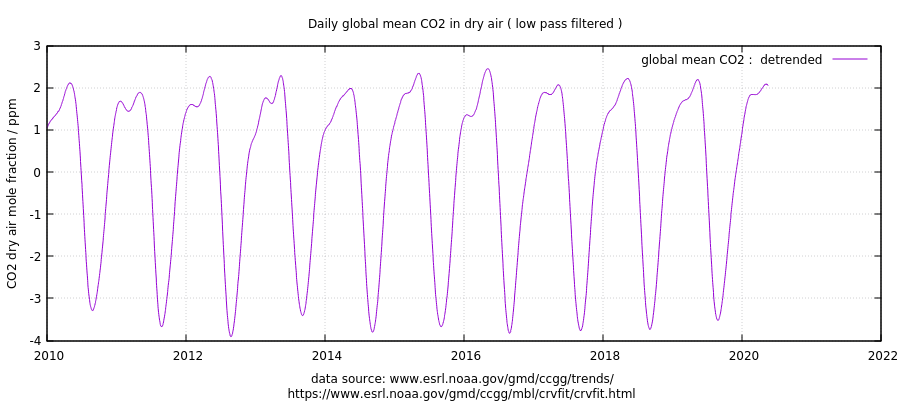
If the rising trend and the interannual variation is removed we see that even the annual cycle has quite a variable peak at about this time of year. It would be hard to see how anything less than 1ppm could be shown to outside normal, natural variations.
Scissor,
NOAA currently makes the calibration gases for most CO2 monitoring stations, but Scripps still uses its own calibration gases (and CO2 scale) and so doe the Japanese.
I am pretty sure that if NOAA would tamper with the calbration gases, that Scripps would be happy to bring that out. They still are very unhappy that their privilege was taken by NOAA (on order of the WMO)…
Talking about New Zealand. The longest running continuous record of daily CO2 measurements in the Southern Hemisphere is from NIWA’s atmospheric monitoring station at Baring Head (an extremely windy point in Cook Strait near Wellington). Perhaps Geoff would like to update his data gathering to include this set so that he can sit it alongside some of the shorter lived ones.
NIWA cannot be trusted and what’s more they were found by a high court judge to be beyond question. They can legally do whatever they want and there is no legal access to data or scientific validation of their results.
They are willfully and legal exempt from any auditing or validation, therefore NOT a scientific body.
Why would any have any interest in their bogus “data”?
Interesting topic. In a past job, I was responsible for quality-assuring continuous emission monitoring equipment that is very similar to the equipment used to measure CO2 at all of the stations listed. The monitoring equipment I worked with was used for monitoring emissions at power plants for EPA’s Acid Rain Program, Clean Air Interstate Rule and the Mercury and Air Toxics Rule. EPA requires daily calibration tests, quarterly linearity checks and annual “relative accuracy test audits” (comparing the instrument in the stack to a “reference” instrument owned by a 3rd party contractor).
The instruments are set up to measure at a certain range of concentrations, as one would expect. Calibration gasses used in daily and quarterly QA tests are spec’d out to EPA standards as prescribed in the rule to be representative of stack conditions. Calibrations are performed at a zero-level and a span level. Linearity tests are performed at a low (or zero), mid and span level. The specifications for passing these tests are +/-5% accuracy. Using EPA’s pass/fail criteria, 400 ppm +/- 5% = 20 ppm. I’m not sure what NOAA is using for their QA criteria, but I doubt it is 1 ppm or less. It’s impossible to keep a gas analyzer measuring that accurately.
Another topic I could go on for hours about is missing data. The March 7 spike to approximately 418 ppm is interesting. It appears to settle down to approximately 415 ppm in the following days. This looks to me like instrument drift more than a signal in the data. The break in the data starting on March 21 is likely due to a failed calibration. The daily calibration (if they are doing calibrations that frequently) probably failed, and the data was considered missing until someone went to the analyzer and recalibrated it. That may also explain the wonky data before the break in the data and the 1 ppm jump.
For a geek like me, this is interesting stuff. Maybe I should book a vacation to Hawaii to visit the NOAA instrument up on the mountain.
Would the EPA allow you to prepare and use your own calibration standards?
I believe that Scripps has a good business going being the primary supplier of reference standards. I don’t know details of the situation today.
Industry was required to use certified protocol gasses. EPA worked with NIST to develop standards that cal gas manufacturers (i.e. Airgas, Aire Liquide, etc) are required to use. Each gas bottle came with a certification sheet. Last I had checked, there were dozens of certified vendors. There is an entire program set up for this called the Protocol Gas Vendor Program (PGVP). PGVP participation was required to consider the cal gas “valid” for use in monitoring equipment. The cal gas bottle certification data was required to be required to be submitted on a quarterly basis for all emission units affected by EPA rules such as ARP/CAIR/MATS/NSPS/Boiler MACT, etc.
Thanks. I suspect that NOAA never had to do anything as rigorous even though their data goes into billion dollar decision making. I’d wager that they’ve never even had a third party audit.
Scissor: those who make the rules never follow the rules.
EPA CEMS cal regs are fairly stringent and I would guess practical since they use the data collected to persecute their cause. Doubtful that the CO2 crowd has to adhere to same.
Monitoring anything to ppm or less is easy to finagle, seen it done many times.
Introduce gov and msm agenda into a cal process…. at that point walking on water springs to mind.
I wonder if the “very thorough validation process” or the manipulation of the “high resolution data (that) needs to be run through a process by our team” will miraculously discover a significant drop in atmospheric CO2 due to the lock downs?? Or am I just being paranoid?
Yes, Aussie CSIRO are about as cagey and European data sentinels.
Though most of this is paid for by the tax payer they do not get the right of access, as is generally the case in the USA.
They are welcome to “put it through a process” but that should not prevent free access to raw data incase someone else wants to invent their own “process”.
“21st May 2010.”
?
Should be 2020. Apologies.
Any more errors? Geoff S
The very end of the article is dated 21st May 2010. Are we off by 10 years? With this Covid quarantine, I sometimes have trouble remembering what day of the week it is. 🙂
Clearly, it should have been marked March 82nd.
“Pay no attention to the raw data behind the curtain.”
🙂
“Data” continues to be one of the most frequently and egregiously misused words in climate science. Data, once “adjusted”, cease to be data and become merely estimates. Data, multiply “adjeusted” become deception.
“Oh the tangled web we weave when first we practice to deceive.” (HT: Sir Walter Scott)
Yes “constructs” would be a more accurate term than “data”
But hey, we’re talking about “climate science” here, so it’s mostly about contributing to “the movement”.
(Btw – “movement” is an apt description of what these jokers produce. I also have a movement. Every morning.)
Ed
It would be grammatically correct to distinguish between “raw data” and “adjusted data.” As long as the “adjusted data” are identified as such, and an explanation of the adjustments and the need for them are provided, it is acceptable. However, the “raw data” should be made available (archived!) so that the “adjusted data” can be verified independently.
Clyde –> There is no such thing as “adjusted data”. I always call it “results” of calculations. Interpolated and homogenized results should not be considered data nor should they published as data. Scientists are free to use “results” but need to justify why and what effects are experienced as compared to original, recorded data.
Jim
You said, “Scientists are free to use “results” but need to justify why and what effects are experienced as compared to original, recorded data.”
That is essentially what I said!
When I was in school, I was taught that if I made an obvious error in data entry, I wasn’t supposed to erase it. Instead, I was supposed to put a line through it and put the correct value near it. The purpose for this practice was the possibility that the first entry was actually correct, and it could be recovered after analysis.
Which is the “data,” the entry with the line through it (known to be wrong), or the second entry correcting it? I think that some flexibility is necessary in definitions. The important issue is not to give the impression that data points in a time-series are the original data when they aren’t.
I would consider “results” to be something like recording whatever the measuring instrument reads out in, such as degrees F, and then converting it to some other units such as Kelvin. It is the same information, and I would consider it to be data.
In any event, the important thing is to clearly define what information a data set carries, and to have an audit trail to track corrections and conversions to different units, and to detail the methodology used for derivative sets of information applying to the same physical phenomena, such as averaging.
See: https://www.merriam-webster.com/dictionary/data
I agree. Part of the problem is definitions. “Corrected” is not the same as “changed”. Yet too many official and semi-official organizations treat them the same.
The thing is I work with Relational Databases and this kind of presentation is trivial using a database. ie The data is stored “as is” in tables and at the most simple level if you need to make adjustments/corrections then you just present that as a View of the raw data. It is then easy to show multiple interpretations alongside the raw data as multiple views of the same raw data.
The thing is things like temperature data still seems to live in the world of spreadsheets and csv files rather than “trivially” available to the world in an online database. If the Views of the data are not want you want it is really easy to write your own your own SQL against all the “raw data” or reinterpret the data that has at least just been corrected in a reasonable way.
I still don’t understand why the science community doesn’t use databases more. R/Python type approaches definitely have very good uses but a lot of that calculation is much, much easier to do with a simple SQL query.
Geoff Sherrington – many thanks for taking the time to write about this.
I think what we are learning about the so called “gold standards” are they are made from iron pyrite. Just about all data these days is sloppily gathered and run through smoothing algorithms before entering the historical databases (but always to the hundredth of the unit being measured). Of course the algo’s are based more on politics than science but it’s all purported to be highly accurate and real. Good luck on finding the truth.
Will NOAA, NIWA, and CSIRO ever rise to BIPM’s international standard on uncertainty in measurements?
Thanks Geoff for exposing some of the major Type B (or Type 2) systematic errors in the “best” global CO2 data. The ~ +/- 1.5 ppm errors graphed are far larger than the NOAA’s amazing assertion:
I have yet to find IPCC making ANY reference to the BIPM international standard:
“GUM: Guide to the Expression of Uncertainty in Measurement” https://www.bipm.org/en/publications/guides/gum.html
Evaluation of Measurement Data: Guide to the Expression of Uncertainty in Measurement JCGM 100:2008 PDF
https://www.bipm.org/utils/common/documents/jcgm/JCGM_100_2008_E.pdf
See also NIST Uncertainty Machine
NIST Technical Note TN1297: Guidelines for Evaluating and Expressing the Uncertainty of NIST Measurement Results, Barry N. Taylor and Chris E. Kuyatt
https://www.nist.gov/pml/nist-technical-note-1297
NIST knows what they are doing with regard to measurements and statistics. It would be better to have NIST in charge of Mauna Loa at least instead of “scientists” from NOAA.
Adhering to the GUM is hard work requiring due diligence toward all error sources; it is way, way easier to hand-wave bad guesses about “accuracy”.
Geoff Sherrington,
You are trying to minimize the decline, whereas they are trying to ‘hide the decline’.
Sorry couldn’t resist. Great work. Interesting to see the true range of CO2 values measured, versus the smooth curves that are always shown for Mauna Loa.
Yes, good work by Mr. Sherrington!
Surely there is, somewhere, in this process criminal acts which are meant to deceive (possibly for financial gain) and some organisation, such as the FBI, should carry out an investigation and shine a light on it(?)
Or just common old “Noble Cause Corruption”
“…Nobel Cause Correption.”
FIFY. 🙂
Yes, surely, this should be thoroughly investigated to find out if such discrepancies serve to enable racketeering.
Have you followed the whole Russian collusion and Flynn cases? I ask because it shows just how much politics have corrupted the FBI and DOJ. Even with a change in leadership there is obvious stonewalling going on in those departments. Personally I suspect the swamp runs so deep that we’ll have to have massive firing of all management to see everything come to light that’s been asked for.
With CC being very political just how much could we trust an FBI led investigation of Big Climate Change?
What I see in climate science is the claim that there is a responsiveness of atmospheric composition to fossil fuel emissions at an annual time scale but I could not find evidence for that relationship in the data. Pls see
https://tambonthongchai.com/2020/05/18/12479/
Chaamjamal,
You are presenting important, innoivative work that more people might benefit from reading. Especially noted long ago the improper use of correlation analysis based on cumulative numbers.
But as we used to say, “You can lead a horse to drink, but you can’t make it water”.
There is an amorphous blob out there that is self-convinced it knows best, fails to respond to valid evidence that it does not and causes enormous economic harm through not much more than ignorance. It is full of followers when it needs new, original science researchers with sparkling ideas. We are stuck with monotonous repetition of wrong, 1980s concepts. Some stupid urge makes me think of Tom Lehrer singing about the old dope peddler “He gives the kids free samples because he knows full well that todays young innocent faces will be tomorrow’s clientele.” Regards Geoff S
Right off the bat:
If the lockdown causes a 10% reduction in man-made emissions…
Big fat “IF”. In my fast skim through the article, did I miss where the 10% figure was verified by means other than attempting to measure atmospheric CO2 concentration.
Besides that –
Ralph Keeling estimates that global fossil fuel use would have to decline by 10% for a full year to clearly impact CO2 concentrations in the atmosphere
It’s only a little over two months, so why should we see anything at all so far?
What “adjustments” are made for the adjacent volcanoes?
Am I repetitive?
Hasn’t the entire climate change debate been an endless 30 year loop of the same repetitive nobody listening and every body pushing their agendas?
By reflecting away 30% of the ISR the atmospheric albedo cools the earth much like that reflective panel behind a car’s windshield.
For the greenhouse effect to perform as advertised “extra” energy must radiate upwards from the surface. Because of the non-radiative heat transfer processes of the contiguous atmospheric molecules such ideal BB upwelling “extra” energy does not exist.
https://www.linkedin.com/posts/nicholas-schroeder-55934820_climatechange-globalwarming-carbondioxide-activity-6655639704802852864-_5jW
There is no “extra” energy for the GHGs to “trap” and “back” radiate and no greenhouse warming.
With no greenhouse effect what CO2 does or does not do, where it comes from or where it goes, is moot.
Equally moot are temperatures, ice caps, glaciers, polar bears, sea levels, hurricanes, nuclear power….
The Mauna Loa observatory sits right on top of a dormant volcano. Most geologists will tell you that such features are emitters of carbon dioxide.
It’s like a check valve…it keeps geothermal and solar trapped…just trying to figure out how a two way check valve knows which way the photons should go?
Nick Schroeder,
The CO2 data are mostly from the trade winds at Mauna Loa. If there are downslope winds from the fumaroles, that gives a huge variability in the hourly data and the result is marked and not used for daily to yearly averages. If there are upslope winds in the afternoon, which are slightly depleted of CO2, these are marked and not used for averages. Both raw and “cleaned” data are available for comparison…
Plotting all raw data or only the “cleaned” data doesn’t make any difference in trend with a maximum of 0.1 ppmv/year…
Geoff I have been looking into the same and working on a paper framework for this exact topic. Is there a way I can contact you off the site?
Guest,
You are most welcomed.
sherro1 at optusnet dot com dot au
Geoff S
“What is going on here?”
At a casual glance I would assume instrument drift to failure – data gap – replacement and calibration.
Probably nothing sinister – but the lack of explanation is !
At the very least questionable.
Fascinating that the very thing (CO2) that AGW is founded on is not an accurately known quantity in the atmosphere. Precise models have been built to quantify the temperatures based on this gas. Large sums have been spent on promoting and mitigating AGW but it appears that there is little science being applied to the real world. Thank you Geoff for your professional inquiry. I expect these agencies will quickly respond to set the record straight. Well maybe not quickly if ever.
Once again it sounds like some people out there in the climate measurement community have no idea of the difference between accuracy and precision.
Sure they do. Their data is precisely inaccurate.
It’s been said before, so I’ll say it again. You record the data exactly as it is measured. Whether you like the numbers or not. Even if the equipment is broken. Or out of calibration (unexpectedly). Etc. Later, you note that the equipment was found to be out of cal during the period blah blah, or was broken and subsequently repaired- found to have a defective umpty blah… You don’t monkey with the data and then record it AS IF that is what was measured. That’s what the words Measured Data mean.
Good luck.
Gerry Parker
Gerry
I agree with you completely. By selectively deleting, or otherwise editing, data points that are assumed to be unrepresentative, information is lost and the results are probably biased. As to information that is lost, we might be able to learn something about the rates of photosynthesis with respect to temperature, humidity, and wind speed if the raw data were available. Further, if the raw data were available, the assumptions about the reasons for wanting to treat the low CO2 readings as being unrepresentative could be verified independently. Geoff has demonstrated that, once again, researchers in the field of climatology are sloppy in their practices and there is a likelihood of the CO2 time-series being biased downward from actual average values.
Gerry,
It isn’t that simple. Suppose CO2 levels are measured by using a laser what is actually measured is
the number of electrons produced in a photodiode. But even this is usually not measured directly by
the current goes through a resistor and the voltage is measured after appropiate filtering etc. Supplying
that voltage against time to anyone would be useless. Then there is a huge amount of processing and assumptions go into converting the number of electrons observed into a measure of CO2. There is no
such thing as pure unmanipulated data.
Izaak –> Gerry was not discussing the mechanism of a measuring device. That is done thru calibration. What it means is that you record the data from the mechanism without change. You don’t replace it with what you think it should be. You then explain why it is not reliable due to *****”.
Jim,
The point is that people don’t measure temperature or CO2 or almost anything. The only
thing most people measure is the voltage across a resistor. However almost nobody in any scientific paper records measurements as ‘voltage’. Even time is actually measured in terms of an oscillating voltage. Do you really want all graphs in almost every paper to be just Voltage against Voltage? Or do you want researchers to do a minimal amount of processing and then present the result? And if you accept that then how exactly where do you draw the line?
There is no simple answer to that question just as there is no such thing as ‘raw data’.
Walton
You said, “Then there is a huge amount of processing and assumptions go into converting the number of electrons observed into a measure of CO2.” No, it is a process called “calibration” that all measuring devices should be subjected to.
I don’t think that you understand! What we are discussing here is whether it is appropriate to delete or ‘correct’ a measurement that is the output of a calibrated measuring instrument.
Clyde,
define ‘calibrate’? That is just data processing done by humans at a different lab often in a different country and then stored in a computer program that has been complied and is not accessible to independent verification. If you trust that process then why not trust the person
who performed the measurement to recognise when the instrument is faulty and discard the result?
Izaak,
Clyde said:
“I don’t think that you understand! What we are discussing here is whether it is appropriate to delete or ‘correct’ a measurement that is the output of a calibrated measuring instrument.”
I agree with Clyde, who put it very clearly.
Yes, every measuring system relies on calibration. If you use a simple mercury thermometer, you are really measuring a length of mercury and relying on the calibration between that and the temperature. Actually, what you are really measuring is a pattern imprinted onto your retina. And so on, all the way through your nervous system to your brain.
Suppose I measure the temperature at 20 degrees and write that down. That’s data. It’s what was measured.
But then suppose I decide I don’t like that figure. I cross it out and write down 20.5.
It’s no longer data. It’s adjusted data. It has nothing to do with the essential calibration of the thermometer. It has everything to do with the fact that I didn’t like the figure and I thought it was ok to change it.
Chris
Walton
You think you understand something, but your words demonstrate that you are fooling yourself.
To calibrate something means to compare the output of a measuring device with some standard. Today, that usually means converting a proxy, such as voltage or current, to the units of the physical manifestation. One ends up with a graph or equation defining the relationship between the proxy units and the desired units. Most notably, it reveals if there is a bias or systematic offset between the displayed units and some standard reference. This might be a two-step process where, for convenience, the proxy is immediately converted to a display, such as the travel time for a light beam to a speed on a radar gun. A secondary calibration verifies that there has been no offset or drift such that the measuring device displays incorrectly.
https://en.wikipedia.org/wiki/Calibration
You asked, “… why not trust the person …” Because, in formal comparison calibrations, there is a rigorous protocol that must be followed for certification that the measuring device matches a standard. In deciding whether to retain measured data, it may be a single person making an ad hoc decision based on subjective opinion, (e.g. variance > x) or an unverified hypothesis to ‘justify’ removal. The Scripps description of the data analysis conjectures that low CO2 values are the result of upslope winds bringing ocean air over photosynthetically active vegetation, depleting the ocean air of CO2. Nowhere do they present evidence that the conjecture has been proven, and more damning, they do not even attempt to provide a quantitative relationship between all the variables. They just delete the data.
Interestingly, those same parcels of air would be depleted of CO2 whether the monitoring station was there or not, and the air reaching high elevations would have reduced CO2 much of the time. That is, the natural state of air being supplied to the mountaintop is not the same as at the ocean surface (which might be increased by out-gassing), but is reduced by the natural vegetation. The unstated assumption is that the vegetation artificially modifies the air. That isn’t the case, and for that reason, treating readings as outliers artificially reduces the average values. Mauna Loa simply is part of the mixing mechanism that leads to a “well-mixed gas.”
As a mineral exploration geologist who discovered several scams involving analytical/assay manipulated data (by “consumers” not by labs) I was instantly alarmed by your statement “Some regard it as cheating.”. After the BREX scandal the Canadian Government put in place the National Instrument 43-101 rules, which are demands for quality control/quality assurance. This greatly reduced, but did not eliminate, scams and scandals. If the CO2 monitor values do not eventually reflect the substantial downturn in commercial production of CO2, either the impact of fossil fuel utilization will be shown to be insignificant, as regards atmospheric CO2, or a widespread cheating and/or manipulation of the data will be known. Thanks for the posting, Geoff.
It has been often pointed out that the non-human CO2 flux (ocean, termites, plants, etc.) is more than 20 times human emissions. The claimed increases due to human activity is only 2 or 3 ppm per year. The uncertainty and variability in normal non-human daily/ monthly/yearly flux could, it seems to me, easily obscure any changes in human emissions over a few months. Therefore, any variance due to recent human events might be well below the sensitivity of measurements.
AndyHce, I’m guessing here, but some trace atmospheric gas whose change “might well below the sensitivity of measurements” is probably not any calculable threat to humanity, so, no pasa nada.
Ron Long,
As once chief geochemist for a mining company that found several (multi-million ounce) gold mines from greenfields work, where I was responsible for chemical data quality, we were well aware of cowboys as competition for industry reputation. They are collectively not very smart and so are easy to unmask.
It worries me that there is a blurry line, getting worse, between criminal intent to deceive on one hand, and sloppy, ignorant science that has the capacity to deceive, on the other. I really dislike that phrase “Good enough for government work”. Overall, climate research needs both adoption of standards like BIPM have published and a regulatory enforcement that shuts down non-conformists. Geoff S
Hear! Hear!
If all the data logging is properly time coded, why would it take moths to calculate and filter the final data?
Most computer programs do things like these in seconds, assuming the program is well written.
Oh, I understand, they are using their fountain pen and their wooden calculator.
… moths to calculate and filter the final data?
Carl is trying to start a new scientific/computer myth with this reference to “moths.”
Obviously has a few bugs.
A myth is a female moth..
First reported computer bug was found in the 1940’s stuck in a mechanical relay inside the computer. It was a moth that supposedly was saved taped in a log book as part of the record. The first computer debugging.
Carl
I think that their abacus is now made of plastic.
Isn’t it only a fortnight if you’re actually, ya know, in a fort?
Okay, I’m a Science illiterate, so you have to explain things to me that more learned people might already understand, but what is special about the air of Mauna Loa that measurements of the concentration of carbon dioxide in it are proxies for the concentration of carbon dioxide in the Earth’s atmosphere? Is it true that the Earth’s atmosphere is a homogenous gas whose constituent gases appear in the same concentrations all over the world? This is a serious question; I really want to know the answer. I’m not just trying to be clever.
From what I’ve read, if China emits more carbon dioxide this causes global warming everywhere, and not just in China. That’s the tale I’ve been told. Which, now that I think about it, seems kind of odd. Obviously, the particulate air pollution in China’s cities doesn’t harm anyone in North America. But the carbon dioxide does, apparently. Am I getting that right?
I’m not being sarcastic I really don’t know, so somebody explain it, please.
Ian
While CO2 commonly is called a “well-mixed gas,” it is not as well mixed as oxygen and nitrogen. It tends to be more variable close to the surface, where most of the sources and sinks are located. Mauna Loa was selected as a sampling location to get higher up into the troposphere, where CO2 was expected to be more uniform. Unfortunately, there is reason to believe that it was a less than ideal location because of the abundant vegetation below the tree line. It doesn’t help that there is a small quantity of CO2 coming from vents on the volcano. If all the measured (raw) data were included, the standard deviation of the measurements would be larger and the uncertainty range would be larger. As it is, the ‘uncertainty’ is being reduced with subjective judgements about what adjusted data to present to the world.
Point Barrow measurements are nearly at sea level, but have their own problems because of the proximity of a small airport, and a town where almost everyone owns at least one snowmobile, and the army base has trucks and heavy equipment. Large ships also dock in the vicinity to provide supplies that can’t be delivered by air. In a manner similar to Mauna Loa, Point Barrow measurements are edited to remove high transient CO2 readings.
Clyde,
They have the South Pole where there is no volcano in over 1500 km and no vegetation at all…
Still the same trend as at Barrow and Mauna Loa, but less seasonal variability in the SH (less vegetation in the SH), only more mechanical problems of the equipment he long winters…
Ferdinand
I don’t doubt that the directionsof the tends are similar. However, what is germane is whether the absolute values are the same, and whether the slopes are the same, and whether the precisions (as indicated by the standard deviation) are the same. If not, then there are some questions begging to be answered, such as which time series is the most reliable and most precise. I suspect that, except for the down-times, the Antarctic data are going to be the best. If that is the case, then they might be able to infill with the second best data, adjusted to match the Antarctic data.
Clyde,
Why infill?
Infilling is an exercise on its own, one familiar to estimators of ore reserves from drilling sparse holes and analysing the core. Customary interploations were found lacking in the 1970s and the whole new branch of geostatistics emerged. The point of infilling in this case is eventually to assist in the calculation of uncertainty because it converts into $$$.
The infill with South Pole data that you mention seems more to make a pretty presentation, like a full set of teeth is a nicer look for a model than a jaw with several gaps. But can you make plastic infills as good as the original teeth? You are competing with Nature on Nature’s home ground. Thanks for your comments here and elsewhere. Geoff S
Geoff
Sometimes infilling is necessary with a discontinuous data series, such as when calculating an FFT. It won’t work if you leave the entries blank, and arbitrary dummy numbers are not much better. So, if you want to get a reasonable result, one has to use the best estimate available.
Yes, there is an issue of esthetics when graphing data. However, if the thing being measured is well characterized and changes slowly, a linear interpolation over a short range may be justifiable.
Let’s assume that what we are recording is the performance of an experimental aircraft under test. Perhaps the primary sensor(s) fails during the expensive test or just before it is destroyed in a crash. The missing data are important. The best data are recorded by the primary sensor. However, missing data tell one nothing. If a secondary sensor can be used as a proxy, it might enlighten the analysts as to what happened just before the crash. One doesn’t always have the data they want. But, the analysts have to work with what is available. The important thing is to be aware of the limitations and possible error in infilling from a secondary source.
Clyde,
There is very little difference between the slopes and only a small lag between Mauna Loa and the South Pole:
http://www.ferdinand-engelbeen.be/klimaat/klim_img/acc_co2_1960_cur.jpg
Needs some update…
The lag is from the fact that 90% of human emissions are in the NH and the ITCZ hinders the exchange of air between the NH and SH (about 10% per year is exchanged). As human emissions increased a 3 to 4 fold over the same period, the lag increased.
Although Mauna Loa and South Pole have the longest data series, these are not used as “average global” CO2 data. They use the average of several near-surface stations.
Mauna Loa has the longest series of continuous measurements (South Pole had a few years only bi-weekly flask samples) and therefore is mostly used as “the” Keeling curve, but the difference with the “global” CO2 curve is small…
As far as I remember, if they have to infill data due to failing equipment, they have an algorithm which takes the average slopes of the previous 3 or 4 years over the same period to calculate the in between data.
Ferdinand
So, you are confirming that the data sets from the various stations are not interchangeable.
You remarked, “… they have an algorithm which takes the average slopes …” That is basically substituting historical data for current data. Thus, if there were some event of significance, such as a major volcanic eruption or, god forbid, a decline in fossil fuel use, there would be no chance to observe it in the averaged historical-data used to infill the time series. Basically, that results in graphs that appear smooth and convey an unjustified accuracy. The time lag you mention probably precludes using any NH data for infilling, if one wants more than an aesthetically pleasing graph.
Clyde,
That is NOT what I said or implied. The differences between any CO2 monitoring station from near the North Pole to the South Pole are less than +/- 2% of full scale, despite a 20% per season (!) exchange of CO2 between atmosphere and other reservoirs, mainly oceans and vegetation…
Thus while there are small differences in level, it doesn’t matter at all if you take the data series from Barrow or the South Pole as base for the effect of the extra CO2 (which also is small, but that is another discussion)…
Further there is NO substitution whatever for any data, if any data (good or bad) are present. Only when there was an equipment failure (hard disk crash…), they infill the data with the average slopes of the previous 3-4 years at the same station.
All historical data are available as hourly averages + stdv over that hour. Sometimes with a delay, but they do publish them.
Ferdinand
You said, “… these are not used as “average global” CO2 data. They use the average of several near-surface stations.” I don’t recollect ever seeing anything in the news outlets other than what was recorded at Mauna Loa.
That is because MLO is about the symbol for the CO2 increase and the Keeling Curve…
But they have global surface CO2 data too:
https://www.esrl.noaa.gov/gmd/ccgg/trends/global.html
You can switch between the two via de top references. global is a few ppmv lower than MLO, but for the rest they parallel each other…
Ferdinand
You said, “Further there is NO substitution whatever for any data, if any data (good or bad) are present.” You ignored a very important point: How to convert a discontinuous time series into a continuous, recent time-series without relying on data much older than the range of the time-series. That is, how to make a continuous series where the infilled data are current. A similar problem is addressed frequently when a new satellite is launched, where there is overlap between the satellite observations. Slope, intercept, and amplitude can be adjusted to agree with what is considered the data set of highest quality. Typically, the data sets do not agree completely over the period of overlap. That is, the data sets are rarely, if ever, interchangeable. Without data sets that agree well enough to be interchangeable, then some other approach has to be resorted to. If you didn’t say or imply that the Mauna Loa and Antarctic time-series are not interchangeable, you should have, because while a 2% bias of full scale is small (10% of seasonal range), it is not zero. Not correcting for the difference would be obvious and require an explanation for the offset.
Clyde,
The difference between satellite measurements and CO2 measurements is that with esch satellite, new equipment with its own offset and slope must be calibrated with the old satellite over a sufficient overlap of time, while for CO2 it doesn’t matter as after a break, either the same equipment is used again or with a new instrument, the same calibration gases are used as before.
Then how to fill the gaps?
One can’t use the “best” data of the South Pole to infill the gaps of Mauna Loa, as the South Pole has hardly any seasonal variability and that is even opposite to the much larger seasonal variability at Mauna Loa in the NH.
The slope caused by the CO2 increase over a year is about 2.5 ppmv or 0.2 ppmv/month, about the detection limit at Mauna Loa. The maximum slope caused by the seasonal changes is 1.2 ppmv in one month (May). Thus infilling the average slope of previous years of the own site seems appropriate…
There is an offset between the different monitoring stations as the human emissions are for 90% in the NH and it takes time to equal the differences down to the South Pole, which doesn’t succeed, because human emissions still continue in the NH…
In fact it doesn’t matter, as the effect of a CO2 doubling is quite small, around 1 K, thus a difference of 8 ppmv on 120 ppmv is not measurable at all.
Ferdinand
You said, “… while for CO2 it doesn’t matter as after a break, either the same equipment is used again or with a new instrument, the same calibration gases are used as before.”
Do you have any thoughts as to why Geoff’s 4th figure above shows a jump of 1 PPMV over a period of 5 days, and an apparent change in slope between the pre- and post-gap data?
You also said, “Thus infilling the average slope of previous years of the own site seems appropriate…” But, that approach has no chance of capturing any significant changes that might take place during the gap! If one is only interested in long-term changes, and there is no interest in the short-term changes, then one only has to take a single reading at the beginning of an interval, and the end, and calculate the slope. Why waste the money on a continuously monitoring station if only the general trend is of interest?
Even if the entire economy shut down for an entire year and CO2 kept rising at 2+ ppm/year, the mass balancers still wouldn’t admit that the rise is natural. (lunacy)…
p.s. ~ ms. m., keep up the good work
RE: “It seems like NOAA had a similar gap, because the NOAA numbers are a simple linear infill with synthetic numbers, each either 0.4 or 0.5 ppm apart.”
Should be ” …each either 0.04 – 0.05 ppm apart”.
J Mac,
Apologies, my error, you are quite correct.
I wrote this essay in one day, which might help explain the lack of polish. I meant to include a reference to expert guidelines like BIPM France, but slipped up. Geoff S
Geoff,
No problem! That’s what peer review is for: “All have sinned and come short of the glory!” I fat finger typos a lot… and then can’t see them before I press ‘send’.
Keep up the good work!
Mac
Geoff,
I don’t think that are infilled data.
Scripps uses the same intake equipment as NOAA at Mauna Loa, but that are only flask samples at a certain moment of the day (*). If for some reason these samples weren’t taken, that doesn’t imply that the (unmanned) automatic equipment of NOAA didn’t work.
If NOAA has to infill some data, they us an algorithm that averages the slopes of the past 3-4 years over the same time period to calculate the probable data. Found it back where Pieter Tans showed what was done when they had a hard disk failure:
https://wattsupwiththat.com/2008/08/06/post-mortem-on-the-mauna-loa-co2-data-eruption/
(*) in the above story, Pieter Tans says that Scripps still runs its own continuous equipment? If that is right, it may have failed a few days, independent of the NOAA equipment…
Ferdinand,
When you compare NOAA and Scripps daily over a longer term, you can find many one-day missing data entries from Scripps as NaN. The same day data from NOAA is a simple arithmetic average of the days before and after. It is a logical thing to do if you want to do some later calculations on the data, but it is not a valid thing to do for a historic primary data set. It is wrong, wrong, wrong. If there is no data, you do not invent it for raw source files. Many experienced data people would agree.
Geoff S.
Geoff,
Do they show the stdev of the (hourly) samples over the same days of probable infill?
If they do, that are real measurements, not infilled data…