Guest Post by Willis Eschenbach
After considering the tide gauge records around Fairbourne in my last post, I wanted to look at a larger picture. Remember that we’ve been repeatedly told that acceleration in sea level rise is not just forecast, it’s actually occurring. I wrote about some of these claims in my post entitled “Accelerating The Acceleration“. Plus we’ve been deluged, if you’ll excuse the word, with endless cartoons and memes and movies and earnest predictions about the Statue of Liberty going underwater, cities being drowned, islands being overtopped by the sea, and the like. And not only that, but we’re assured that we can see and measure the acceleration in both the tide gauge and the satellite sea-level records.
So I went to get the satellite sea-level records from the University of Colorado. But when I plotted them up, I realized that they stopped in 2018. I couldn’t find anything on their website that explained why. Here’s their data.

Figure 1. University of Colorado sea-level record. Note that it is a splice of four satellite datasets that all seem to be in quite good agreement.
I wanted more up-to-date records, so I went to the AVISO site. That’s the French group that is keeping the original satellite records.
I did have to laugh, though, when I looked around the AVISO site and found the following graph:

Figure 2. All nine available satellite sea-level records
YIKES! I truly had no idea that it was all this bad. It seems the good folks in Colorado have simply picked some convenient records from the group above, spliced them together, and called it a valid record fit for all purposes.
I, on the other hand, would say that this is enough data to maybe give us a trend with lots of uncertainty … but teasing acceleration out of that farrago? Don’t make me laugh.
However, I figured I’d look at the AVISO “Reference” dataset. This is the dataset shown in green above. It is basically identical to the Colorado dataset, but it extends to the end of 2019. So I analyzed it.
Now, I’ve recently started to use a sea-level analysis method I developed myself. It’s based on a lovely kind of analysis called “Complete Ensemble Empirical Mode Decomposition” (CEEMD). I described CEEMD in a 2015 post called “Noise Assisted Data Analysis“.
What the CEEMD method does is to identify and remove, one by one, the underlying cycles in the dataset under analysis. And at the end of the CEEMD analysis what’s left is called the “Residual”. It’s what remains when all identifiable cycles have been removed.
Of course, the method can’t identify the cycles that are nearly as long as the dataset itself or longer. So for example, from my last analysis, I looked at 40 to 50 year long datasets. Here’s an example, this one is 44 years long.

Figure 3. A CEEMD analysis of the tidal data from Fishguard, Wales.
As you can see, this has not removed a cycle that’s on the order of 33 years long—too long to resolve in a 44-year dataset.
And this demonstrates a huge problem with trying to determine if the rate of sea level rise is accelerating. It’s well known that the tides have very long-term cycles of fifty years and more. But as I pointed out in my post called “Accelerating The Acceleration“, the people who produced the “US Sea Level Report Card” cut the tidal data short. They removed everything before 1969 … which guarantees that the signal will still contain cycles. And that, in turn, guarantees that any conclusions that they come to will be meaningless.
The other problem is that in the “US Sea Level Report Card”, they don’t even attempt to remove the tidal cycles at all. They foolishly think that you just need to check and see if the raw data is accelerating … but instead, they end up simply measuring some long-term tidal cycle or other.
With that as prologue, I decided to look at the longest sea-level records and see if there is any acceleration. We have a few of these that have 100 to 150+ years of data. This is long enough to remove most of the long-term tidal cycles. As above, I used the CEEMD method to remove the cycles, leaving just the underlying residual. To start with, I looked at the sea-level data for Cuxhaven in Germany. It’s a 176-year dataset.
So just what longer-term sea-level cycles are being removed by the CEEMD method? Here are the empirically-determined groups of cycles that make up the Cuxhaven sea level data:

Figure 4. Periodograms of the groups of cycles removed from the Cuxhaven sea level data by the CEEMD method.
As you might expect, there are a number of short-term cycles between one and five years. There is also energy in cycles that peak at eight, seventeen, and twenty-nine years or so. Note that one of the largest cycles is up near fifty years … highlighting the foolishness of a) not removing the persistent long-period tidal cycles, and b) using short-length datasets to try to determine if there is acceleration.
Finally, note that there is still some energy in cycles longer than fifty years. This is why we need very long datasets in order to determine if there is acceleration.
So what’s left as a residual once we remove all of those cycles from the Cuxhaven data? Here’s the result:

Figure 5. CEEMD analysis of the sea level data from Cuxhaven, Germany. Black/white line is the original Cuxhaven data.
As you can see, there is no sign of acceleration in the Cuxhaven sea level data. Remember that we’ve been warned for the last thirty years that sea level would be accelerating and cities would be drowning … but it appears that the ocean didn’t get the memo.
Let me demonstrate how badly folks are going wrong by using shorter-term data and not removing the underlying tidal cycles from the original data. Here’s the previous graph, plus a Gaussian smooth in blue of the post-1950 original data.

Figure 6. As in Figure 5, but with a 19-year FWHM centered Gaussian smooth of the post-1950 original data.
Now, if all that we had was the 68 years of the post-1950 data, and in addition, we didn’t remove any underlying cycles, we’d look at the blue gaussian smooth and come away firmly convinced that the sea level was running level from 1950 to about 1975, and that it had accelerated since then … none of which is true. That’s just one of the underlying longer-term tidal swings that are removed by the CEEMD method. And unfortunately, scientists around the planet are all too frequently mistaking those tidal swings for an underlying acceleration.
Unwilling to stop there, I looked at a number of the few other long-term sea level datasets we have. As you might expect, most of them are from Europe. Here’s a 170-year dataset from Wismar in Germany.

Figure 7. CEEMD residual analysis. Black/white line is the actual data.
Again, there’s no sign at all of any acceleration in the Wismar data.
And below, without much in the way of comments, are a number of the other long-term sea-level datasets. In all cases, the black/white line with dots is the original data.


I don’t see the rumored acceleration in those plots. I’d also say that the early data from IJmuiden is very suspect … next, some data from the US.


Note the larger trend in Baltimore, which is known to be the result of land subsidence along most of the US east coast.

And to close out this section, here’s the longest uninterrupted sea-level dataset I know of, that of Stockholm in Sweden, two hundred and seventeen years long …

You can see how the earth in Sweden is still rebounding from being covered with trillions of tons of ice during the most recent glaciation. The land is actually rising faster than the ocean … go figure.
So those are the majority of the long tidal datasets. I gotta say, I am simply not seeing the acceleration claimed by the boffins. I don’t know just how they’ve calculated their results, but the best long-term datasets that we have simply don’t show the acceleration that they claim to find.
In closing, let me circle back to where I started, with the spliced AVISO satellite sea level data. Here’s what the AVISO and the Colorado folks are combining to get their final data:

Figure 8. The four satellite sea-level records chosen by Colorado and Aviso from the nine extant satellite sea-level records.
I gotta say … given that the satellite sea level is supposed to be accurate to tenths of a millimetre per year, why are there such large differences between the different satellite records?
In any case, here is the same data, with a black line showing their final dataset created by combining those four datasets.

Figure 9. The four satellite sea-level records chosen by Colorado and Aviso from the nine extant satellite sea-level records, along with their combined record which is shown in black.
Hmmm … and finally, here is the CEEMD analysis of that combined record.

Figure 10. CEEMD analysis of the AVISO / Colorado satellite dataset. It is composed of four different satellite datasets spliced together. Midpoints of the splices are shown by the vertical red dotted lines.
Now, is there acceleration in that record?
Well … regarding the question of whether there is acceleration shown in that spliced satellite record, I’ll say the three most important words that any scientist can ever say:
We. Don’t. Know.
We don’t know for a few reasons. The first is that it’s a spliced dataset, and the changes in the trend line all occur at and after the splices. Makes a man suspicious, particularly given the differences in the initial individual datasets.
The second is that the record is only 27 years long, so we really don’t have enough data to draw many conclusions. This is particularly true since the variations from a straight line are quite small.
Third, the rise was right along the linear trend line up until 2005. So there was no acceleration before that time. Then the rate of rise started decreasing around 2005 … deceleration rather than acceleration? Why? And then, according to the spliced dataset, it started rising faster around 2011. Again, why? Assuredly those three, first a straight line, then deceleration, then acceleration, are unlikely to be caused by a monotonic rise in CO2. Nor do they conform with any expected pattern of acceleration.
Finally, as with many other tidal records shown above, the satellite seems to be “porpoising” above and below the trend line. There’s no clear acceleration anywhere in the record.
DISCUSSION AND CONCLUSIONS
The long-term tide gauge datasets are all in agreement that there is no acceleration, neither in the early nor in the recent parts of the records. Yes, they often porpoise a bit above and a bit below the trend line, but there is no evidence of any CO2-caused recent increase in the rate of sea-level rise.
The satellite dataset, on the other hand, is a splice of a selected four of the nine available satellite sea-level datasets. The changes in trend seem to be associated with the splices. Unfortunately, this spliced record is both too short and too fractured to draw any conclusions about acceleration.
Here, it’s 12:24 AM and a gentle and lovely rain is falling … first rain in five weeks, and the forest is happy. I’m happy too, drought is not my friend.
My best regards to everyone,
w.
PS—As is my custom, I ask that when you comment you quote the exact words that you are discussing. That way we can all be clear on both who and what you are talking about.
Discover more from Watts Up With That?
Subscribe to get the latest posts sent to your email.
Here is a global map of sea level height change.
I feel that those who think greenhouse gases create such a pattern are not quite right in the head.
Geothermal and cloud cover changes seem much more sensible.
Thanks, Zoe. I saw the other day that Dr. Roy Spencer said the pattern could be from incorrect adjustment for water vapor … who knows?
w.
Sure. If you’re theory fails at prediction then others did improper adjustments. So would the “corrections” change the fact some some sea level is rising while other is falling?
The global map of sea level height changes are stated on the linked graphic to be over a 22 year period.
Therefore, it is surprising to see that there are many regions where an accumulated -7 cm of sea surface change is located immediately (say, within 500 km) to an adjacent region of +7 cm sea surface change over this long period.
Also, why are there distinct, generally-latitudinal, persistent bands of significant sea surface height change (particularly east of Japan, China and the Philippine Islands; less so East of North Carolina, US, extending longitudinally as far east as to be south of Greenland)?
These sea surface height variations DO NOT correlate with the mapped variations of the Earth’s surface gravitation field (ref: https://en.wikipedia.org/wiki/Gravity_of_Earth ).
There is something not quite right (i.e., an uncorrected factor) in the sea surface change data as presented in the graphic. The above-noted variations, on the order of centimeters over hundreds of kilometers, do not seem to explained by winds, land uplift/subsidence, geothermal/ocean temperature variation, barometric pressure variations, or gravitation field variations over 22 years . . . what else is left?
Gordon, bear in mind those long, 50-year cycles in sea level height, as well as many cycles that are somewhat shorter. Think of these as water slowly “sloshing” in the ocean basins and the differences in sea level become somewhat more understandable.
w.
Thanks, I understand. But my particular concern re: Zoe’s linked graphic is the more “pinpoint” features . . . those (again, centimeters of surface change over hundreds of km of surface distance as determined over 25 years) are hard for me consider as “sloshing”.
Gordon,
Stop thinking an listen to Willis. He knows the desired conclusion.
Zoe, I have no “desired conclusion”. I’m simply pointing out things that I think may be responsible for SOME PART of what we’re seeing. Not all. Some part. I’ve pointed out two things. Water vapor, and slow sloshing (actually not super slow, 25 years) of water in the basins.
Now, if you have other things that you think are responsible, how about you stop with the ugly personal accusations and let us know what those other things are.
w.
OK, fair enough Willis.
You stick to tidal sloshing and water vapor error accusations, and I’ll stick with cloud cover and geothermal changes.
Zoe Phin March 8, 2020 at 8:41 pm
Zoe, I don’t “stick to” anything. I offered up a couple of possiblities. But as Paul Samuelson said,
w.
Paul Samuelson was a Keynsian retard who thought the Soviet economy would overtake the US just as it was about to collapse. He argues against his betters that thought the Soviet economy was like 5-10 times smaller. The Soviets multi-counted their production stream. He should have known better, like his wiser colleagues.
So thanks for admitting you’re like him.
Willis Eschenbach March 8, 2020 at 11:49 pm
Zoe Phin March 9, 2020 at 5:02 am
Once again, Zoe is totally unwilling to deal with the actual ideas, so she attacks the man … this is getting quite boring.
w.
Actually, Willis, I attacked Keynesianism and all its retarded followers. What’s wrong with that? It’s an attack on a brain dead ideology.
Zoe Phin March 9, 2020 at 9:28 am Edit
What’s wrong with that? You accused me of being “stuck on” some claim. In response I put out this idea for discussion, which well describes my own scientific philosophy:
But instead of discussing or attacking the IDEA, you predictably reverted to your go-to diversionary tactic, which is to attack the MAN and not even mention the idea under discussion.
And that’s why it is absolutely no fun to try to discuss anything with you. Instead of responding to what someone actually said, you attack them with all kinds of ugly accusations and drag the conversation in some totally meaningless direction.
w.
Zoe posted (March 9, 9:28 am): “It’s an attack on a brain dead ideology.”
Careful, Zoe, there is growing evidence of “the pot calling the kettle black” here.
Not quite, Gordon. There is no growing EMPIRICAL evidence against me. My empirical evidence was dismissed. You’re free to inhabit the same fantasy land as Willis and Samuelson.
I am of the belief that questions should not be asked by someone unwilling to do a little research on their own toward finding an answer to the question being posed.
Therefore, I went to one major NASA website that reports global sea surface height (https://www.nasa.gov/mission_pages/hurricanes/features/seasurface_heights.html ) and found an image ) of global sea level height variations that is stated to be from a single day, 30 December 2008. This image also presents many similar sea-surface height “fine structure” variations (aka “residuals”) that I questioned in my OP regarding a similar graphic (linked above) that is stated to cover a 22 year interval.
So, this “single day” image (it might reflect just the time required for Jason-1 orbits to accumulate the full Earth coverage shown) would further rule out many postulated causes of the features that I questioned above. It would appear to rule out sloshing variations having a greater-than-one day period. Also, I cannot believe that effects of clouds or water vapor would result in such similar features existing between the two images being referenced.
The NASA linked website does go so far as to state:
“Sea surface heights are one component helpful to hurricane forecasters, as higher seas indicate warmer waters (that power storms) while lower seas indicate cooler waters (such as those in La Nina events in the eastern Pacific).”
and
“Jason-1 completed its seventh year on orbit on December 7, 2008. From its vantage point 1,330 kilometers (860 miles) above Earth, this follow-on to the highly successful Topex/Poseidon mission has provided measurements of the surface height of the world’s ocean to an accuracy of 3.3 centimeters (1.3 inches).
So, even though the nice color maps have height scales indicating cm-scale resolution, viewers should keep in mind the accuracy of the asserted surface height changes may be three times worse (+/- 3 cm), and the accuracy itself probably varies spatially.
Bottom line, while I have a hard time believing ocean thermal expansion changes can create centimeters of surface elevation change over just hundreds of kilometers of surface distance (is horizontal thermal equilibration in the open oceans really that slow?), that is NASA’s top level explanation. Perhaps there is a geophysical/climate explanation for how the underlying ocean thermal variations can be so stable as to produce the fine, bead-like, longitudinal bands and structures that appear to have such great persistence over time.
Gordon Dressler March 9, 2020 at 2:13 pm
Sorry, Gordon, but that’s not true. Imagine a basin of water sloshing back and forth with say a four-second period. Now take a photo of it … does that “rule out sloshing variations having a greater-than-one” photo’s time period?
Nope. They’ll show up in the photo, despite the sloshing having a period a thousand times longer than the time required to take the photo.
Regards,
w.
Basin sloshing, similar in surface form to a vibrating drumhead, will have certain characteristic modes of oscillation (aka, eigenvalues). Yes, first- and second- and third- and maybe even forth-order modes certainly would be captured by day or less duration “snapshots” . . . but these should be reflected as very large areas of the world’s major ocean basins (Pacific Ocean, Atlantic Ocean, Indian Ocean, and Southern Ocean) showing large areas of higher-than-median surface height with approximately equal areas of each ocean basin having offsetting lower-that median surface height. But this is not what is seen in the NASA global images.
Instead, most of the world’s oceans display relatively small localized area’s of plus and minus displacements. In particular, there are the very fine, bead-like like structures that are predominately in latitudinal bands, to which I referred earlier. That they maintain their approximate positions over the two separate NASA images, referenced above, is strong indication that they are note traveling displacement waves (“sloshing”), but are more akin to standing surface waves . . . assuming such features are even indicative of physical long period surface displacements on water.
NASA implies pretty strongly that the small scale surface height features are due to localized difference in surface water temperature (i.e., a thermal expansion effect). If I go across the extremes of the color banding given in the 22-year global surface height difference plot, equivalent to approximately 14 cm of net ocean surface height difference and assume this was a static condition, I calculate that this would be equivalent to approximately the thermal expansion in the top 10 m ocean depth below surface for a temperature in that volume increasing uniformly by 6 C from cold to hot. I guess I can see that something on this order is possible over distances of hundreds of kilometers, BUT the apparent geographical persistence of areas of such high temperature gradients remains troublesome to me.
Gordon Dressler March 9, 2020 at 7:33 pm
Thanks, Gordon. While what you say would be 100% true in a circular ocean that slopes evenly to the center, real oceans have channels, seamounts, coastal shelves, fjords, islands, surface currents, midwater currents, bottom currents, thermohaline circulation, underwater canyons, and subsea mountain ranges.
In addition, we’re not talking sloshing at a single frequency. There are tidal cycles with various periods from annual to 75 years or more, all of them constructively and destructively interfering with each other.
As a result, the surface displacements from the sloshing are NOT simple, symmetrical, or easily analyzable.
Let me start by reposting the graphic under discussion:
As you say, standing waves are an expected result of the sloshing … but again, not simple, symmetrical standing waves.
Please be clear. I’m NOT saying that all of the variations in sea level are the result of the sloshing. I’m saying it is one of the many causes of the variations.
For one thing, the wind has a huge effect on ocean heights—we see the extreme effects of this in the El Nino/La Nina alteration, which has an effect on the height of tides all across the Pacific. The La Nina “dishes out” the surface area along the equator, moving it due west, where it piles up … as you can see in the graphic above. There’s further discussion of this issue here.
Now, the effect of the Nino/Nina pump is to move the warm water from the Equatorial tropics to the poles. Since it’s doing this by physically pushing the water, and the warmer water is expanded, it results in generally higher sea levels in the western Equatorial Pacific and along the east coasts of Asia and Australia.
Next are the effects of currents. Where they collide the water tends to pile up. In addition, where they hit the continents they raise the water level.
We also have vortices (eddies). We have a long eddy train that is clearly visible in the graphic above peeling off of the southern tip of South Africa. Like any whirlpool, they tend to be lower in the middle and higher at the rim. We can also see eddies off the southern tip of South America, as well as off the east coast of the US due to the Gulf Stream.
Then there are geostrophic currents, which are circular currents that pile up water above the surrounding sea level height.
Finally, there’re simple temperature differences. You can see the warmth of the Gulf Stream near the US east coast, for example, with the cooler waters just sound of the Stream.
In short, as with many things regarding the ocean … there are no simple answers.
My best to you,
w.
Willis, thank you very much for your comprehensive reply, which explains several of my issues with the reposted NASA image.
In particular, I had neglected to consider the interaction of persistent ocean currents with the topology of the ocean floor, and that this itself could set up standing surface waves (analogous to the patterns of water flowing over rocks in a shallow stream) as well as the shedding of vortices. These factors are consistent with—and alone could fully account for—the latitudinal bands of the fine-structure, bead-like, surface height variations that exist in various latitudinal bands, which I was questioning.
This is a much more satisfactory answer than highly localized, steep gradients in water temperature.
I also admit that I greatly oversimplified the complex patterns that would eventually (asymptotically) develop from varying frequencies of “sloshing” in the highly asymmetric (both in vertical and horizontal extent) ocean basins of Earth.
Our discussions have been very educational for me. Thank you for expending your personal time to make it so!
Likewise, my best wishes to you.
Judging by the eastern and western portions of the Pacific Ocean, the sea level height changes seem to reflect more episodes of La Niñas than El Niños.
Interesting post Willis. I hope I’m not misreading your log scales again but isn’t that a peak near 29, not 24y ?
As far as how tacking all these pieces together goes, I’m very suspicious about what is going on around 2013. Just like they mess with everything they get their hands on they seem to have “homegenised” some increase in to the data.
Claiming to get long terms trends for this kind of inhomogenous mess of short record from different platforms some with little to not cross-calibration period, it just a case of getting the result you “expect”.
I gave up on satellite altimetry years ago, it was obvious it had not objective scientific value in terms of climate.
True re 29 vs 24, good catch, fixed.
w.
That Fishguard Wales looks like ocean cycles (60-65 years).
“Well … regarding the question of whether there is acceleration shown in that spliced satellite record, I’ll say the three most important words that any scientist can ever say:
We. Don’t. Know.”
Yes Willis “We. Don’t. Know.” is certainly not use anywhere enough by to day’s so called “scientist”. Where this hebris comes from is either to little knowledge or just a big ego. One of my father’s axioms of life was. “Are you sure you understand all that you know about this”? Something a lot of educated people need to be asked regularly.
AVISO:
So the already mangled data “adjusted from biases” ( probably their own ) are only available a pics.
No chance of any validation or reproducing the same results.
Secret science is NOT science, it is cult belief and religion.
Willis.
I wonder what effect the isostatic rebound in the north will have on sea levels in the rest of the world.
You have land all across the north, from Sweden to Canada and on to Russia, that is rising at 400mm per century according to your graph. That is displacing a huge amount of water into lower latitudes, which must surely raise sea levels across the rest of the world.
So how much of the recorded sea level rise is simply caused by isostatic rebound displacement??
Ralph
My new favorite article on fake global sea level acceleration.
The sea level monitoring by hundreds tide gauges, among them many are as old as one century or older, is the frailest Achille’s heel of the CAGW hoax.
And also because its very, very difficult to “adjust” the older values lower as they do with temperature. Sea levels Leave all sorts of records for us thankfully.
Thanks, Willis. Well done.
Regards,
Bob
Thanks, Bob, your approval is valued.
w.
About 50 years ago I learned that the Gulf of Bothnia was getting shallower and piers had to be extended every X years. Years later I learned there are inland lakes, once at sea level, with creatures now adapted to the fresh water.
The “Swedish High Coast” and Skuleskogen National Park would be on my travel list – if I had a travel list.
Thanks Willis.
That “1918” date is getting a lot of media attention via comparison of the “Spanish Flu” to the new flu.
There is a place in Sweden called Ratan.
http://www.ratan.se/sevart/mareograf.htm
21 aug. 1774 a pupil of Linné made a water level mark there, in the stone.
That mark is today some 8 feet above sea level.
Not sure how I missed that one. The sea level there is currently dropping at -7.72 mm per year. 1774 to the present is 246 years. IF the drop around Sweden was constant (as it appears to be since 1800), that’s a 6.2 foot drop, in good agreement with your number.
No acceleration there either … go figure …
w.
“No acceleration there either”
That IS an interesting point.
It would be deceleration with land rising smoothly (ie at a consistent rate per year) and sea levels supposedly accelerating.
It is very interesting that is not observed. It can only mean that suddenly the rate of land rise has accelerated to completely match the increased rate of sea level rise. 😉
Willis,
Excellent post; clear and informative with lots of examples to peruse! If only more college professors were as erudite and excited about their subjects as you! I am beginning to believe that sending kids off to college today is like giving your toddlers over to a pack of wolves to be reared; they will likely not return home and if they do they see you as prey, not parent.
I noticed you live above the California coast. I have a childhood friend who lives in Kneeland and one who lives in Gualala; what a beautiful area to explore. I particularly miss the abalone and fresh salmon! Are you a Mendocino, Sonoma or Humboldt County man? Thanks again! Bravo! Encore!
Thanks, Abolition. I live in Sonoma County about six miles (10 km) straight inland from Bodega Bay, my erstwhile home port as a commercial fisherman.
w.
The first sea level observations ever made in the world began in 1679 in Brest (France).
Continuous tide gauge records started in 1807 in this place under Napoleon’s reign.
“The completeness and the accuracy of the Brest sea level time series dating from 1807 make it suitable for long-term sea level trend studies.”
https://link.springer.com/article/10.1007%2Fs10236-005-0044-z
Sadly, there are gaps in the Brest record, from 1833-1845, 1857-1859, and 1944-1952.
Sigh …
w.
Speaking of acceleration, how about in the opposite direction?
https://agupubs.onlinelibrary.wiley.com/doi/epdf/10.1029/2019GL085814
Courtesy of Judith Curry
Regarding the CU Sea Level Research Group [CSLRG] pronounced SEE-slurg they have changed their data over the years. here’s a sampling of each year:
2004_rel1.2
cu2004_rel3.0
2005_rel5
2006_rel3
2008_rel4
_2009_rel3
2010_rel2
2011_rel4
2012_rel4
2013_rel8
2014_rel5
2015_rel4
2016_rel4
2018_rel1
Nothing for 2017 and 2019
The WayBack Machine is wonderful (-:
Here’s what some of those CSLRG time series look like when plotted out:
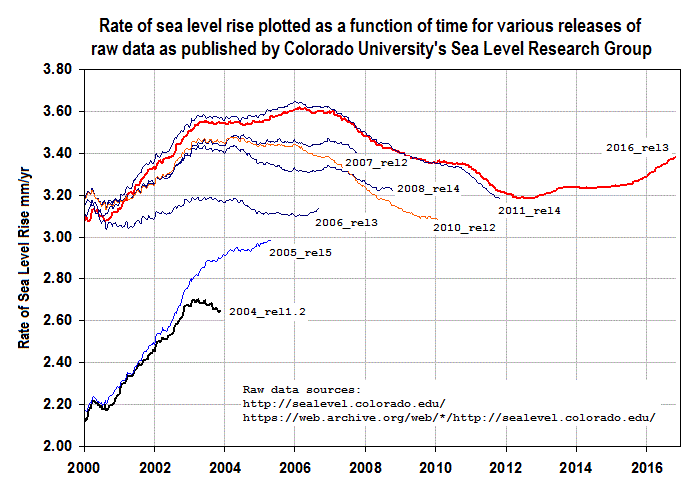
All of those plots should have fallen on top of one another unless there were adjustments/corrections.
The obvious question, is what’s going on?
Wow, I didn’t think that would post with all those links (-:
Outstanding work Steve, I’ve just taken a copy of all that.
I noticed whole sale manipulation in C.U. data years ago , that is when I realised analysing the data was a waste of time and stopped taking it seriously.
I was looking at the data to see if there where any identifiable patterns but when I downloaded an update hoping for some updates I found the whole structure of the data had changed. It was like the 2004 and 2005 versions on your graph.
Another dataset had been destroyed by the climate zealots.
So maybe this is why they need all those ice sheet collapse and catastrophic sea level rise scenarios.
A tacit admission that willis is right, that the data from tidal guages and altimetry aren’t doing the job.
https://tambonthongchai.com/2020/03/06/west-antarctic-ice-sheet-collapse/
The dip in the SLR in 2011 was attributed to the Australian rainfall deluge.
https://www.climatecentral.org/news/floods-in-australia-briefly-slowed-sea-level-rise-study-finds-16373
Does anyone think that can’t happen again? OR happens a few times every century? Probably.
====
Willis,
As for the “Reference” line in Figure 2 and Figure 9, the AVISO site says:
“Reference” products are computed with the T/P-Jason-1-Jason-2-Jason-3 serie (sic) for the time series and with merged datasets for the maps;”
What I find curious (or rather “dubious”) is that since the Reference plot is above BOTH the Jason-2 (ends 2017), Jason-3 (starts 2016), and the Saral/AltiKa (which isn’t used for Reference) data lines from about 2012 onwards and then to get an acceleration post-2013, just what the Hell is the Reference based on? Homogenization? In-filling? Fake Data manipulations?
Really, I can’t see how “Reference” after 2013 can be above the underlying Jason 2/3 data? Do they explain that anywhere else?
Joel, see my comment above. They’ve simply aligned the overlaps, from oldest to newest.
w.
Willis, you seem to unusually trusting in this regard. With the amount of noise on all those records they have a lot of choice about exactly what bits they align. They also do not even say how they do it, neither do they provide the individual datasets so that anyone can check and reproduce their work.
If you want data you have to work ground up from low level gridded datasets. In fact I don’t think you can even register for access now unless you are with an accredited academic institution.
That kind of belligerent obfuscation gives me zero confidence in their sausage making processes and scientific integrity.
I’m surprised you seem to accept it at face value.
Greg, I neither trust it nor accept it at face value. From the head post:
and
w.
The rise in ocean level is a shore thing.
Can any one explain the port which Thor Heyerdahl excavated in India, dating back about 6000 years?
The current location of the site is about 600 feet above sea level.
How did all those people get across the Bering Strait 13,000 years ago? Was there a land bridge?
Note well: water which freezes on land (Greenland, Antartica) lowers the amount of liquid water available. Water which melts raises the sea level (consider the American ice sheet).
We really do not have good data.
Mathman, I find nothing about such a Heyerdahl excavation. Link?
w.
Excellent post, many thanks to WE. There is plenty of evidence of glaciation in England even as recently as 10,000 years ago. Boulder clays containing Scandinavian rocks for instance. The heave of London clay, when unloaded in an excavation, is the result of precompression under ice sheets. My flat in Muswell Hill was near the southern extent of the moraine in that area. https://www.geolsoc.org.uk/ks3/gsl/education/resources/rockcycle/page3585.html https://www.locallocalhistory.co.uk/gd/gdpage06.htm
Thank you for an informative and easily understood article. I believe there are a few tide gauge records from the Southern Hemisphere that go back more than 100 years. Your analysis applied to them would be interesting. I had not heard of a fifty year tidal cycles before. Are these related to orbital variations of the earth and or moon or something else?
Newcastle & Sydney, Fort Denison 1 & 2 Australia, have the longest records. The latter back to the 1880s. Freemantle to the 1890s, Mumbai (India) into the 1870s – however missing data from 1995-2005, Aukland (NZ) goes for around 100 years from 1900-2000.
The Fremantle (correct spelling) harbour tide gauge near Perth, Western Australia, is one of Australia’s longest-recording gauges, and shows a steady rise of 1.7mm a year.
Graeme, the problem with the Fremantle record from my perspective is that the record has a number of gaps, in 1910, 1917, 1925, and a nearly one-year gap in the 1940s. The CEEMD analysis requires that there be no gaps in the record. This is why I have only a small number of records that fit the criteria of being both long and uninterupted.
Best to you,
w.
“I gotta say … given that the satellite sea level is supposed to be accurate to tenths of a millimetre per year, why are there such large differences between the different satellite records?”
That’s the question. It’s easy to see potential problems in satellite altimetry. Estimating wave heights for example. The Jason 3 product handbook devotes about 6 pages to discussing potential error sources. https://www.ospo.noaa.gov/Products/documents/hdbk_j3.pdf But it’s really hard to see any problem(s) that shouldn’t (mostly) average out over time. So we’re left wondering why the satellite estimates of SLR are so much larger than the tidal gauge estimates.
Tidal gauges have their own lengthy list of potential and actual problems BTW. They sink. Or clog up. Or are damaged and have to be rebuilt. Or move (without documentation) when the pier they are mounted on is torn down. Or are replaced by gauges using different technologies that aren’t in exactly the same place.
I’m not sure that either satellites or tidal gauges are trustworthy on the scale we’d need to actually compute a valid (small) acceleration in sea level rise.
It does seem pretty clear that water moves around quite a bit on timescales of months, years, decades. And we’re dealing with VERY small changes. And sometimes it moves onto land. And the rates of sea level change from water stored on land either as liquid or ice returning to the sea probably aren’t constant.
I’ve been trying from time to time to find out if there is a reliable method of identifying small accelerations in noisy data. Not coming up with much. I’m beginning to think that its genuinely impossible to do so. If there is a way, it probably doesn’t involve fitting a quadratic to the data — which seems to be where claims of acceleration originate. Even some firmly committed climate alarmists doubt that fitting to a quadratic will work. or is a good idea.
Anyway, another nice article. Thanks.
” … I’m not sure that either satellites or tidal gauges are trustworthy on the scale we’d need to actually compute a valid (small) acceleration in sea level rise. … ”
—
But do we even need to?
I would say we don’t. Genuine climate change within the geological history record is often determined by the up or down directions of a sea level trend reversing and going back the other way. Normally by more than 5 meters to 100 meters. There are 50,000 0.1 mm ‘changes’ in a 5 meter change and 1 million of them within a 100 meter change.
This is a UN-IPCC cAGW inspired pondering of decimals of sub-millimeter changes. Even multi-millimeter levels of change can be put aside as noise in the timeline of genuine planetary climate-change. I’ll become interested in sea level change when it reverses direction. Or if the change in the change increases by two orders of magnitude over the period of a decade. That would maybe mean something. Sorry, but the whole topic of measuring sea level on this level over these time scales is becoming neurotic.
The rate at which a 5 meter change in sea level occurs is telling us the real time-scale upon which genuine planetary climate-change occurs, and it isn’t even close to the arbitrary “30 years” (utter nonsense) of the ‘satellite era’. These are clearly weather cycle noise and the sea level change over 30 years globally, is laughable within the context of the known climate-change trends.
Known climate-change trends have a characteristic range in time-scale, and it isn’t anything like what the IPCC and fellow-travelers of the AGW gravy-train claim. They claim it only to insinuate something different (human-esque) is Shirley occurring, but the truth is that nothing out out of the ordinary has occurred, or is looking like occurring.
Have another look in it in century or so, but so stop playing their game in the interim. We need to scoff at them and this absurd CO2 neurosis pushing this accelerated sea-level change garbage.
WxCycles: You certainly have a point. But I think the key question is “how much Sea Level Change can humanity tolerate without altering its (incorrect) assumption that sea levels are immutable”? Right now, we’re doing sort of OK if you ignore occasional massive damage from storm surge where we’ve built stuff that mostly doesn’t have to be right on the waterfront a bit too close to the sea. But if the current one inch per decade becomes, for example, five inches per decade, that genuinely will be a major economic problem. And we might have to do something intelligent to accommodate it. Doing intelligent things isn’t necessarily humanity’s strong point.
The link below shows my analysis of the Brest results. A quadratic fit gives an acceleration of 0.0128mm/yr2 and a sinusoidal curve with a 1000 year period results in a +/-450mm amplitude.
You pays your money and takes your choice but 200 years is probably too short a period to judge.
https://drive.google.com/file/d/1ze31aDw8jO7NswELha83VfQgYHE4m97C/view?usp=sharing
” I am simply not seeing the acceleration claimed by the boffins.”
You misspelled buffoons. 🙂
That’s funny!
Willis: Thanks for this exceptional report. Have you considered publishing some or all of this in a magazine or, even better, a reviewed journal?
I appreciate the kind words, Forrest, always good to hear from you. My experience with the journals has not been good. I kind of gave up on them after one journal shared my research with Michael Mann, and he subsequently published it as his own … see here for the ugly details.
I also feel like I have to give myself a lobotomy to write in the blocked, stultifying style preferred by the journals.
My biggest success was when Craig Loehle and I teamed up to write up my research on extinctions. I said he could have first author if he did the hard part, which for me is all the writing and the negotiations with the journal. He did a sterling job, it’s gotten over a hundred citations.
Now, if you or someone else wants to make the same deal, I have a number of my posts that really should be journal articles, including this one … let me know.
My best to you,
w.
Willis
I hope that you thing again about publishing your work.
Two possible options for you:-
1. Join Research Gate (its free).
https://www.researchgate.net/
2. Use Science Publishing Group. You pay for publication of your work but you retain the copyright.
http://www.sciencepublishinggroup.com/home/index
There’s an enormous inconsistency in how “acceleration” is defined by different people in “climate science.” Tacitly using various smoothings of data (yes Virgina, linear trends smooth the critical high frequencies), virtually none of them express the basic mathematical definition. Thus it’s more a matter of looking with all the wrong metrics than in all the wrong places.
The on-going multi-billion dollar effort to measure sea level using satellite altimetry and also gravity analysis is a great demonstration of killing a fly with a nuclear weapon.
The analysis of short data strings is very iffy, as correctly pointed out above, especially when seeking nonlinear trends. Further, the removal of the long term trends is rivaled by the difficulty to remove short term trends since the short term trends are far larger than the 1-3 millimeters/year trend (above).
To wit, the various tides range from 12 hours to 18.6 years, with amplitudes from 5 centimeters to over 10 meters, meteorological effects from winds-storms, evaporation-precipitation, ocean surface topography, El Nino Southern Oscillation, Kelvin-Rossby waves, seasonal water balance between oceans seasonal variations in the slope of the ocean surface, river runoff-floods, and seasonal water density changes cause sea level variations from 5 centimeters to 5 meters, seiches are up to 5 m, tsunamis and related earthquakes are up to 10 meters. ALL these effects are MANY times larger than the sea level trends and bury the trend in noise at all time scales out to 20 years.
There is ‘Balm in Gilead’: a FAR simpler, highly accurate method which has none of the model dependent assumptions required in determining sea level rise from satellite altimetry – gravity data:
Measure the amount of land lost or gained at all coast lines of the world.
Satellite imagery is highly precise, requires no model assumptions, is readily available to anyone with an internet connection, AND there are suitable algorithms to automate the analysis, as noted in the Nature paper referenced here.
DOI: 10.1038/nclimate3111,NATURE CLIMATE CHANGE, pg 810-813, VOL 6 | SEPTEMBER 2016,www.nature.com/natureclimatechange
In this paper, with a very small error, it was determined that a NET 13,000 km2 of coastal land was added globally in the past 35 years, during which time satellite imagery was available.
This result is a surprise to many. The sea level is apparently rising according to the satellite and tidal gauge data, so How can there be MORE land? The implicit assumption is that a RISE of sea level MUST cause a LOSS of land. That is obviously NOT a correct assumption.
The straightforward measurement by satellite imagery shows the assumption of land loss was incorrect over the past 35 years. That is the time frame of the satellite measurements of sea level rise which are extremely difficult to disentangle from all the competing effects. Will this gain of land continue? THAT is a prediction and the information to make the prediction is not available since the data lies in the future.
Climate models all predict flooding of the large cities on the coastal plains and the inundation of Pacific and Indian Ocean islands. The counter example to those assertions is available from measurement.
One should ask what land is being lost and why? The excellent two decade study, here: https://news.nationalgeographic.com/2015/02/150213-tuvalu-sopoaga-k, shows that Pacific and Indian Oceans islands are not sinking, UNLESS being sunk by people strangulating their normal nourishment mechanisms.
Bangkok, Thailand is a prime example of a coastal city where the ground water is being removed at such a high rate that buildings are disappearing, floor by floor. It is the same effects as long known in the Central Valley of California.
In the LONG term, the sea is likely to fall, if and when the Earth enters a new glaciation. The downward trend of temperature over the past 6000 years, if it continues, would reverse the thermal increase of the sea level, and would reverse the melting of Greenland ice. Those effects should mean more land, but not a better climate to support large numbers of humans.
I would use a place that isn’t tectonically active or on a plate. The best place I can think of is at Honolulu US base. It has a very long timeline in the a massive basalt structure in the middle of the ocean so little in the way of large cycles and with being a military base good equipment and procedures.
https://tidesandcurrents.noaa.gov/sltrends/sltrends_station.shtml?id=1612340
Changing rivers, sediment compaction and large buildings adding compaction would typically put a small increase in gauge reading that isn’t sea level rise.
Keith, Honolulu results are shown above. The cycles which have been removed by the CEEMD method are shown below.
Regards,
w.
Honululu isnt on a plate but is an active location. The Hawaiian chain is effectively sinking as you see by the older islands , where there is no volcanic activity, with less elevation above SL. The newest island with volcanic activity is growing faster than its sinking Same occurs with many volcanic islands in pacific they sink into the ocean crust until all thats left is an surrounding reef with sand islets
When I realized that glaciers are already displacing their mass in magma I relaxed… I mean, seriously do people not understand physics?
It’s like panicking about “catastrophic fat level rise” as your chilli slowly cooks… the fat isn’t gonna somehow climb over the edge of the pot.
Now about that solar wind converting atmospheric oxygen to water… that’s a real apocalyptic catastrophy.