Guest Post by Willis Eschenbach
After considering the tide gauge records around Fairbourne in my last post, I wanted to look at a larger picture. Remember that we’ve been repeatedly told that acceleration in sea level rise is not just forecast, it’s actually occurring. I wrote about some of these claims in my post entitled “Accelerating The Acceleration“. Plus we’ve been deluged, if you’ll excuse the word, with endless cartoons and memes and movies and earnest predictions about the Statue of Liberty going underwater, cities being drowned, islands being overtopped by the sea, and the like. And not only that, but we’re assured that we can see and measure the acceleration in both the tide gauge and the satellite sea-level records.
So I went to get the satellite sea-level records from the University of Colorado. But when I plotted them up, I realized that they stopped in 2018. I couldn’t find anything on their website that explained why. Here’s their data.

Figure 1. University of Colorado sea-level record. Note that it is a splice of four satellite datasets that all seem to be in quite good agreement.
I wanted more up-to-date records, so I went to the AVISO site. That’s the French group that is keeping the original satellite records.
I did have to laugh, though, when I looked around the AVISO site and found the following graph:

Figure 2. All nine available satellite sea-level records
YIKES! I truly had no idea that it was all this bad. It seems the good folks in Colorado have simply picked some convenient records from the group above, spliced them together, and called it a valid record fit for all purposes.
I, on the other hand, would say that this is enough data to maybe give us a trend with lots of uncertainty … but teasing acceleration out of that farrago? Don’t make me laugh.
However, I figured I’d look at the AVISO “Reference” dataset. This is the dataset shown in green above. It is basically identical to the Colorado dataset, but it extends to the end of 2019. So I analyzed it.
Now, I’ve recently started to use a sea-level analysis method I developed myself. It’s based on a lovely kind of analysis called “Complete Ensemble Empirical Mode Decomposition” (CEEMD). I described CEEMD in a 2015 post called “Noise Assisted Data Analysis“.
What the CEEMD method does is to identify and remove, one by one, the underlying cycles in the dataset under analysis. And at the end of the CEEMD analysis what’s left is called the “Residual”. It’s what remains when all identifiable cycles have been removed.
Of course, the method can’t identify the cycles that are nearly as long as the dataset itself or longer. So for example, from my last analysis, I looked at 40 to 50 year long datasets. Here’s an example, this one is 44 years long.

Figure 3. A CEEMD analysis of the tidal data from Fishguard, Wales.
As you can see, this has not removed a cycle that’s on the order of 33 years long—too long to resolve in a 44-year dataset.
And this demonstrates a huge problem with trying to determine if the rate of sea level rise is accelerating. It’s well known that the tides have very long-term cycles of fifty years and more. But as I pointed out in my post called “Accelerating The Acceleration“, the people who produced the “US Sea Level Report Card” cut the tidal data short. They removed everything before 1969 … which guarantees that the signal will still contain cycles. And that, in turn, guarantees that any conclusions that they come to will be meaningless.
The other problem is that in the “US Sea Level Report Card”, they don’t even attempt to remove the tidal cycles at all. They foolishly think that you just need to check and see if the raw data is accelerating … but instead, they end up simply measuring some long-term tidal cycle or other.
With that as prologue, I decided to look at the longest sea-level records and see if there is any acceleration. We have a few of these that have 100 to 150+ years of data. This is long enough to remove most of the long-term tidal cycles. As above, I used the CEEMD method to remove the cycles, leaving just the underlying residual. To start with, I looked at the sea-level data for Cuxhaven in Germany. It’s a 176-year dataset.
So just what longer-term sea-level cycles are being removed by the CEEMD method? Here are the empirically-determined groups of cycles that make up the Cuxhaven sea level data:

Figure 4. Periodograms of the groups of cycles removed from the Cuxhaven sea level data by the CEEMD method.
As you might expect, there are a number of short-term cycles between one and five years. There is also energy in cycles that peak at eight, seventeen, and twenty-nine years or so. Note that one of the largest cycles is up near fifty years … highlighting the foolishness of a) not removing the persistent long-period tidal cycles, and b) using short-length datasets to try to determine if there is acceleration.
Finally, note that there is still some energy in cycles longer than fifty years. This is why we need very long datasets in order to determine if there is acceleration.
So what’s left as a residual once we remove all of those cycles from the Cuxhaven data? Here’s the result:

Figure 5. CEEMD analysis of the sea level data from Cuxhaven, Germany. Black/white line is the original Cuxhaven data.
As you can see, there is no sign of acceleration in the Cuxhaven sea level data. Remember that we’ve been warned for the last thirty years that sea level would be accelerating and cities would be drowning … but it appears that the ocean didn’t get the memo.
Let me demonstrate how badly folks are going wrong by using shorter-term data and not removing the underlying tidal cycles from the original data. Here’s the previous graph, plus a Gaussian smooth in blue of the post-1950 original data.

Figure 6. As in Figure 5, but with a 19-year FWHM centered Gaussian smooth of the post-1950 original data.
Now, if all that we had was the 68 years of the post-1950 data, and in addition, we didn’t remove any underlying cycles, we’d look at the blue gaussian smooth and come away firmly convinced that the sea level was running level from 1950 to about 1975, and that it had accelerated since then … none of which is true. That’s just one of the underlying longer-term tidal swings that are removed by the CEEMD method. And unfortunately, scientists around the planet are all too frequently mistaking those tidal swings for an underlying acceleration.
Unwilling to stop there, I looked at a number of the few other long-term sea level datasets we have. As you might expect, most of them are from Europe. Here’s a 170-year dataset from Wismar in Germany.

Figure 7. CEEMD residual analysis. Black/white line is the actual data.
Again, there’s no sign at all of any acceleration in the Wismar data.
And below, without much in the way of comments, are a number of the other long-term sea-level datasets. In all cases, the black/white line with dots is the original data.


I don’t see the rumored acceleration in those plots. I’d also say that the early data from IJmuiden is very suspect … next, some data from the US.


Note the larger trend in Baltimore, which is known to be the result of land subsidence along most of the US east coast.

And to close out this section, here’s the longest uninterrupted sea-level dataset I know of, that of Stockholm in Sweden, two hundred and seventeen years long …

You can see how the earth in Sweden is still rebounding from being covered with trillions of tons of ice during the most recent glaciation. The land is actually rising faster than the ocean … go figure.
So those are the majority of the long tidal datasets. I gotta say, I am simply not seeing the acceleration claimed by the boffins. I don’t know just how they’ve calculated their results, but the best long-term datasets that we have simply don’t show the acceleration that they claim to find.
In closing, let me circle back to where I started, with the spliced AVISO satellite sea level data. Here’s what the AVISO and the Colorado folks are combining to get their final data:

Figure 8. The four satellite sea-level records chosen by Colorado and Aviso from the nine extant satellite sea-level records.
I gotta say … given that the satellite sea level is supposed to be accurate to tenths of a millimetre per year, why are there such large differences between the different satellite records?
In any case, here is the same data, with a black line showing their final dataset created by combining those four datasets.

Figure 9. The four satellite sea-level records chosen by Colorado and Aviso from the nine extant satellite sea-level records, along with their combined record which is shown in black.
Hmmm … and finally, here is the CEEMD analysis of that combined record.

Figure 10. CEEMD analysis of the AVISO / Colorado satellite dataset. It is composed of four different satellite datasets spliced together. Midpoints of the splices are shown by the vertical red dotted lines.
Now, is there acceleration in that record?
Well … regarding the question of whether there is acceleration shown in that spliced satellite record, I’ll say the three most important words that any scientist can ever say:
We. Don’t. Know.
We don’t know for a few reasons. The first is that it’s a spliced dataset, and the changes in the trend line all occur at and after the splices. Makes a man suspicious, particularly given the differences in the initial individual datasets.
The second is that the record is only 27 years long, so we really don’t have enough data to draw many conclusions. This is particularly true since the variations from a straight line are quite small.
Third, the rise was right along the linear trend line up until 2005. So there was no acceleration before that time. Then the rate of rise started decreasing around 2005 … deceleration rather than acceleration? Why? And then, according to the spliced dataset, it started rising faster around 2011. Again, why? Assuredly those three, first a straight line, then deceleration, then acceleration, are unlikely to be caused by a monotonic rise in CO2. Nor do they conform with any expected pattern of acceleration.
Finally, as with many other tidal records shown above, the satellite seems to be “porpoising” above and below the trend line. There’s no clear acceleration anywhere in the record.
DISCUSSION AND CONCLUSIONS
The long-term tide gauge datasets are all in agreement that there is no acceleration, neither in the early nor in the recent parts of the records. Yes, they often porpoise a bit above and a bit below the trend line, but there is no evidence of any CO2-caused recent increase in the rate of sea-level rise.
The satellite dataset, on the other hand, is a splice of a selected four of the nine available satellite sea-level datasets. The changes in trend seem to be associated with the splices. Unfortunately, this spliced record is both too short and too fractured to draw any conclusions about acceleration.
Here, it’s 12:24 AM and a gentle and lovely rain is falling … first rain in five weeks, and the forest is happy. I’m happy too, drought is not my friend.
My best regards to everyone,
w.
PS—As is my custom, I ask that when you comment you quote the exact words that you are discussing. That way we can all be clear on both who and what you are talking about.
2nd Paragraph….”stopped at 1918″. 2020?
Thanks, fixed.
“…So I went to get the satellite sea-level records from the University of Colorado. But when I plotted them up, I realized that they stopped in 1918…”
2018 I presume…
Thank you for bringing clarity to the complete lack of clarity on this topic.
I have suspected there was more to this than the people at the University of Colorado, no matter how well intended, have been letting on. I am also extremely skeptical that the satellites can measure sea level to the millimeter on a consistent basis.
One problem we have in the geosciences is we keep proclaiming we can do things that we can do on occasion but cannot do consistently in a quality manner. This is confirmation that the problem extends beyond meteorology.
1918 ->2018
When your second paragraph mentioned the satellite data “stopping in 1918”, it made a fun start to my day! Thanks!
“…stopped in 1918..” …2018…
Willis, satellite records “that stop in 1918” would be some kind of Twilight Zone deal. Maybe 2018?
Opening paragraph: did you mean 2018?
Mr. Eschenbach,
In the second sentence of your second paragraph appears, “…they stopped in 1918.” I suspect this is a typo and the intended date is 2018.
Respectfully,
John Garrett
O Barmy knew! Why else would he buy a mansion three feet above sea level?
Now, explain why Harlech castle sea gate is 4 metres above present sea level. Stable land 1000 years old. My guess is volcanoes under WAIS.
I’m happy to be corrected, Chas, but my understanding is that Harlech castle is now distant from the sea because siltation filled in the shoreline and extended it outwards, and NOT because the castle and the surrounding land has levitated … hang on …
Yeah, that’s what happened. It was at the shoreline, but the river delta filled in the area.
w.
Harlech. Brings to mind a great scene in a great movie (Zulu 1964):
Willis & Chas.
The fact that the sea gate at Harlech castle is now 4m above current sea level is due to Britain tilting down to the south-east. This can be seen because on the east coast there is considerable subsidence and erosion (complicated by erosion due to the North Sea and the extraction of ground water under London) and simultaneous rising fo the land on the western side. See Pendine Sands, etc.
Fascinating article, anyway, Willis.
This is a common thing. See the following:
(from Wikipedia] The Büyük Menderes River (historically the Maeander or Meander, from Ancient Greek . . . is a river in southwestern Turkey.
Map of the river’s mouth and the evolution of silting of Miletus Bay during Antiquity
LINK
I am not sure that explains it all Willis.
The Harlech port is above the current sea level, and no amount of siltation can raise the port. It can extend the shoreline, but not raise the port.
The same is true across the Med, where Greek and Roman ports are generally above the current sea level. I don’t know how much the Med basin may have raised over the last two millennia, but on the surface it does appear that Roman sea levels were higher than now.
This is true of western Anatolia and in Spain. I noted a Roman-cut sea-channel in Xavia, Spain, which used to deliver sea water to inland salt pans. But the current level of that channel is a meter above the present high tide, and it would not function today.
Ralph
Hey, Ralph, good to hear from you.
Regarding Harlech, a couple of points.
The port is still there. From Google Earth, you can see the boats.
Next, here’s a reconstruction of the “sea-gate”. Note that the castle doesn’t extend all the way to the ocean. Instead there’s a wooden structure going down.
Finally, here’s the castle today. Much of the surrounding wall has fallen down, but the sea gate is still visible.
The photo is taken from the area that has silted in at the foot of the castle.
So no, I’m sorry, but I’m NOT ascribing that to some mysterious fall in the sea level. Consider—if the sea level actually had fallen by 4 metres since the 1200s, we’d see evidence of it all over the world, not just at one obscure castle.
Finally, I don’t think that it’s from the post-glacial rebound. Several reasons. One is that the UK didn’t get covered with glaciers during the last glacial. Second, those places that did (like Stockholm) are still rising. Third, Stockholm is rising on the order of 6 mm/year. That’s about a half metre since the castle was built … not enough to move it the claimed 4 metres vertically.
Short answer? I think the castle has NOT moved vertically and the sea level has NOT gone down. I think it is a combination of siltation moving the beach horizontally, and people mistakenly thinking that the sea gate shown in the picture was originally at water level (it wasn’t).
Sorry …
w.
Willis,
It’s not clear from the photo where the water level was, it could have been considerably lower.
“One is that the UK didn’t get covered with glaciers during the last glacial.”
Not all of it. no. There was an ice cap on the Pennines and Scotland and another on the northern part of Ireland. That twisted Britain, with the west side being dragged down following Ireland and Scotland.
“Second, those places that did (like Stockholm) are still rising.”
So is Harlech.
Third, Stockholm is rising on the order of 6 mm/year. That’s about a half metre since the castle was built … not enough to move it the claimed 4 metres vertically.
Stockholm isn’t Harlech (and vice versa). As I said, we don’t know what the actual water level was, so we are somewhat in the dark.
I agree with you on the effect of the siltation, however the land has risen too. Here’s a map, Harlech is in the green (rising) region.
“One is that the UK didn’t get covered with glaciers during the last glacial. ”
Sorry Willis, that statement is flat out wrong.
The south east of England including London is current sinking because of the removal of ice from the highlands of the northwest of these islands (Scotland, Wales, Cumbria etc.) Icecap loading on land creates a “rim bulge” around the icecap. During glacial times the ice load depresses the centre and the surrounding ice free land is uplifted. Remove the ice and central rebound occurs, but the surrounding rim bulge deflates and so the formerly uplifted peripheral area sinks.
Glacial rebound and sea‐level change in the British Isles
https://onlinelibrary.wiley.com/doi/abs/10.1111/j.1365-3121.1991.tb00166.x
Ralph
You are correct. I went on a dig at Harlech castle many years ago. It was built at the very end of the MWP when sea levels were generally higher as can be seen in various places including st michaels mount and Harlech.
The sea levels subsequently dropped during the colder centuries that followed and undoubtedly the river exacerbated the situation by dropping silt. it’s a big and often muddy river
I would say that we currently have around one foot or two foot lower sea levels than in the epoch of sea castle building and the same applied in roman times! as can be seen in the forts of the Saxon shore in southern England.
All this complicated by a dividing line whereby some land levels are rising whilst others are falling
Tonyb
Harlech Castle was built in the Medieval Warm period. 1282 -1290. Perhaps sea levels were higher then?
I appreciate you bringing the facts to light and I’m not surprised at your findings. It seems to be a never ending task to find the truth when it comes to any aspect of so called AGW,
I think the greatest thing about Willis’s posts is not that he refutes the political movement of Catastrophic Anthropogenic Global Warming (CAGW) directly, but that he refutes the quality of the science purported to “prove” to us that catastrophe is coming and it is our fault. The oh-so-complex system of oceans and atmosphere of the Earth contains a chaotic, uncertainty component that will forever limit how narrow measurements of this system and their standard errors can be. Which means that only measurements over a great deal of time, eg a century time scale, is going to reveal the basic truths about something as supposedly one dimensional as the sensitivity of the climate to CO2.
On the issue of sea level trends alone, one might chime in that we know that the El Niño/La Niña cycle alone can shift the sea level east and west in the Pacific Ocean by at least tens of centimeters as a matter of wind-induced water flow. And we know that must produce secondary effects all over the Pacific as a matter of gravitation-induced flow, shifting the water north and south as the water seeks to level. And that these effects all take time…..hence never reach equilibrium, because the winds shift faster than the water can redistribute. This produces an element of chaos or uncertainty in sea levels that cannot be zeroed out in accurate measurements of the the sea level of the whole world.
This does not mean that seal level cannot be measured. Tidal gauges do that in sea ports the world wide. But attempting to peg a number for the world’s sea level at any point in time accurate to mm’s is simply not possible.
Long term, as with the world’s temps since the Little Ice Age, the seas appear to be steadily rising on a multi-decadal scale….as one would predict from some ice melting and the expansion of warming water.
The CAGW-ers will have to look elsewhere to find the so far elusive proof of CO2 effects on the climate.
Excellent comment, kwinterkorn. My thoughts exactly.
The people who claim the mantle of science are doing very poor science in service to ideology.
The people who do quality science are dismisses as bought and paid for industry scammers .. that is the argument – attack the purveyors, not the science. Because the science is true and unassailable.
It is like the old lawyer joke:
“When the facts are on your side, pound the table and shout ‘the facts!’.
When the law is on your side, pound the table and shout ‘the law!’
But when neither the facts nor the law are on your side, just pound the table and shout.”
Willis and/or ctm,
There is a typo in the above article’s second paragraph, immediately above Figure 1: “1918” should be replaced by “2018”.
It currently reads:
“So I went to get the satellite sea-level records from the University of Colorado. But when I plotted them up, I realized that they stopped in 1918. I couldn’t find anything on their website that explained why. Here’s their data.”
I wonder what applying your technique to the difference between the spliced record and the raw satellite data would show? The large positive offset between their combined dataset and the latest (and presumably best) Jason catches the eye.
Hi, Willis, good post.
You can also learn a lot here:
https://phzoe.wordpress.com/2020/03/04/dumbest-math-theory-ever/
Thanks, Zoe.
You can also learn a lot here.
Or here.
Or here, for that matter.
My best to you,
w.
I’ll stick to empirical evidence, and you can stay in ideological math land.
On a 1 to 10 scale of rational technical analysis, Willis is a 10, and Zoe’s claims of “silly”, “unbelievable”, “fallacy” and “geothermal” are not on scale…reading her/his stuff is half an hour you will never get back….
My favorite insult is that I must be a man because women are stupid and unoriginal. Is that what you’re implying?
Zoe Phin March 8, 2020 at 12:42 pm
Say what? He said absolutely nothing of the sort. YOU are the one falsely bringing sex into the discussion. Paranoid much?
w.
“reading her/his stuff”
Willis, your reading comprehension is poor.
So, because he didn’t know your sex, he used his/her. And you come up with some weird implication? Not.
I suppose it’s hard to tell with my name and photo. Not.
There’s no photo here. Get off it already.
Jeff,
“Zoe’s claims of “silly”, “unbelievable”, “fallacy” and “geothermal””
Shows visit to my site, which has photo.
You ever met a guy named Zoe?
In the Colorado combined graph, figure 9, why is the black line presented to the public always higher than the JASON-2 and JASON-3 data and usually higher in the JASON-1 data? The line matches up perfectly with the TOPEX data.
That part is understandable, Wade. They’ve adjusted the various datasets so that they match at the period of each of their overlaps. If you do that starting with the earliest one (TOPEX) the others need to be shifted upwards. If you started with the most recent one (Jason-3) it would match and the black line would be offset from the TOPEX data.
My question is more basic. Given that all of those are supposed to be ground-truthed and verified against e.g. known elevations like lake levels … why are they all so different to begin with?
w.
You have a typo in the 2nd paragraph, “I realized that they stopped in 1918” should be 2018.
Good report and analysis, Willis. When will mainstream scientists ever get around to analyzing signal to noise, with cycles removed, data, and declare there’s nothing to worry about on a global scale. Locally, watch out, but globally no pasa nada. Have a great day.
One question:
I understand that all these satellite measurements are calibrated against some reference points. They are not just measurements based on the orbit isn’t it?
So against what positions are these values calibrated? How valid are those points of being ‘stationary’?
My understanding is that they are calibrated against lake levels, and tidal levels in bays and estuaries.
w.
Thanks for the answer Willis, especially as it was not directly on topic!
I think I understand how the 3mm+ rise came up, when tide gauge average shows less. All one needs is the right reference frame.
This results in a bend line when one shows the previous sea level rise studies and splicing on those the satellite measurements. Thus any longer time evaluation for oscillations is made impossible with this data set, one has to give up on satellite measurements for such study.
Well anyhow splicing different data sets together is a bad idea…
Nice stuff Willis
You say;
“You can see how the earth in Sweden is still rebounding from being covered with trillions of tons of ice during the most recent glaciation. The land is actually rising faster than the ocean … go figure.”
This point really needs to be emboldened, put in capitals and highlighted. Very many records that are old come from Europe and are subject to isostatic action and the land is either rising or falling as a result.
General subsidence of land -or it rising for other reasons such as volcanic action- also needs to be taken into account.
So when a convenient graphic is put together by such as Colorado it really ought to come with health warnings as there are so many caveats that an ‘average’ -as with so many things climate- misses out the interesting nuances.
BTW did you ever find out why Colorado appeared to bow out of the game in 2018?
tonyb
tonyb March 8, 2020 at 10:38 am
No clue.
w.
The data was not alarming enough.
The same happened with Cryosphere Today , their web site was a collection of over excited claims decorated with various pics. When the Arctic “canary” failed to keel over and has recovered somewhat since the trough in 2012, they lost all interest and just left all the alarmist claims in place with no data updates.
tonyb
Something else to consider is that with the high-latitude isostatic rebound, and the land rising out of the seas, that means the volume of the northern ocean basins is decreasing. The water that formerly covered the land then has to be accommodated by a world-wide ocean basin that is smaller! Thus, one can expect that sea level should rise everywhere as a fixed volume of water has to be ‘shoehorned’ into a smaller ‘container.’
Eventually, I’d expect that the ocean basins would sink a little under the added weight of the now melted former ice sheets. If their weight was enough to push down the land as ice, it’d be no different as water.
If course, this will take a long time, so there will be a temporary rise in sea levels. In reality, it will never reach equilibrium but will oscillate on time scales that we humans have little chance of observing directly.
While there is some truth to that, when the skeptics point out that the Holocene Optimum had sea levels higher by 1-2 meters globally, they reply with the opposite argument that the oceanic basins also are readjusting from 400 feet average lower ocean depth, and the oceanic crust is also depressing from the melted ice age glacier water, which adjusts the entire global gravitational geoid which is also still changing, along with isostatic rebound and or depression, including that the formerly covered glacial regions are also rebounding over what is now ocean that used to have a lot of ice on it and is now covered by water. Which would also cause more water displacement to the global ocean raising sea levels. While perhaps the entire oceanic crust is slightly depressing due to more water volume. Is it a moot point in the scheme of things? I don’t know.
Given that the earths crust is essentially thinner somewhat over the global ocean, and the ice sheets were much heavier locally over mostly thicker crust land, it is nearly impossible to exactly know what is happening globally since 400 feet of less oceanic water over the global ocean thinner crust is less weight per sq mile than the ice sheets that occupied a lot less land area, being 2 miles thick over a thicker crust. It can get quite complicated because everything changes everything.
Which is what really matters in the final analysis is that sea level is mostly a local affair. And then there are the long term lunar cycles, and so on and so forth. It is good meditation exercise pondering all this every day and brings me great calm, knowing there is no catastrophic ocean rise coming anytime soon, even in the next century or two.
This is a splendid and exhaustive post. Gratitude for your realism and explanations of each move you made.
“I don’t know just how they’ve calculated their results, …”
Well, I suggest the boffins owe you as much diligence to show their data and method as you have done here. How can we get that to happen?
General comment: When charts and ‘stories’ of sea level rise reach the public, a common slant is to “allow” people to confuse “rise” with “acceleration.” Many times I see no effort to include a sentence that calls out this differentiation – happy to allow the public to panic over rise, when there is no acceleration. Hello, this is the Holocene, there is still residual rise.
Willis,
Thank you for yet another really excellent post. Application of CEEMD to the datasets of global SLR appears to be very beneficial to this topic. And I very much appreciate your conclusion that “we don’t know” . . . it is a rare scientist that will admit such without simultaneously asking for additional funding for “better understanding”.
I would just add that multi-year barometric pressure pressure variations over certain geographic areas may be a significant contributor to the 1-10 year (maybe even longer?) cyclic “noise” (“porpoising”)revealed by your CEEMD.
That is a very convincing detailed analysis, Willis.
Hi Willis,
“But when I plotted them up, I realized that they stopped in 1918.”
I think you mean 2018.
Also some typos in the place names Delfzijl and IJmuiden.
Difference between Hoek van Holland and Maassluis can also be subsidence or due to Maassluis being more inland by about 8 miles. Maassluis might also not be suitable anymore as it is behind the Maeslantkering, a flood barrier.
Thanks ,a very informative post. !
Correction :
Two of the Dutch stations have incorrect names:
-IJmudgen = IJmuiden
-Delfzigl = Delfzijl
True. But I’d have to redo the graphs, which would take a while … aw, what the heck. After all, my motto is:
Fixed.
w.
Willis,
One can see an excellent demonstration of glacial rebound in the northern Ohio River valley by looking westward from the top of the bluffs near the river. The land there is a level plain as far as the eye can see, and the river and streams feeding it have cut the valley as the land rose.
A question about your analytic method: is there any way to create a “raw” data set in which your method would expose an acceleration in the rise? IOW, what would the tidal gauge data have to look like for there to actually be an acceleration?
Willis you’re too kind……someone had to put effort into it to make it show acceleration
Latitude March 8, 2020 at 11:24 am
Seems doubtful. My rule of thumb is:
I suspect they were unaware of the deleterious effects of short tidal datasets, and of the necessity to remove the inherent tidal cycles.
w.
they had to pick and splice those data sets to get that answer…
..and they had to do in exactly that order to show an increase
that’s not an accident…they know cycles when it’s convenient for them to know it…obviously and they used them
pick any tide gauge, and it’s obvious why they started at that date too >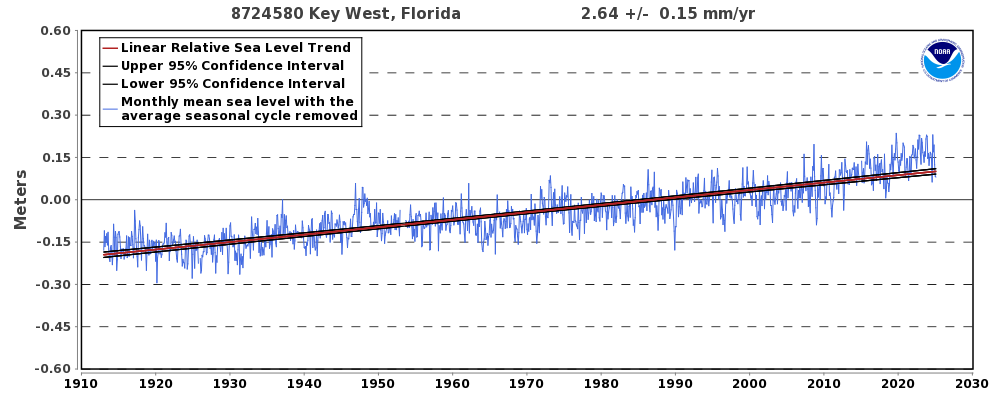
Willis says:
My rule of thumb is: Never ascribe to malice what is adequately explained by ignorance and/or stupidity…
I dunno, that might’a been true in the past, but nowadays, especially concerning anything climate…..
Beng, I think it’s true re climate as well. I think that most climate scientists truly believe the cr@p that they’re selling … which is harder to fight than malice and duplicity.
w.