Feb 21st is the day we’ll know if the puzzling dimming of Betelgeuse is just an alignment of dimming cycles in a highly variable star, or a prelude to a supernova we’ll be able to witness with our bare eyes. If it happens, the dying star will be visible in the daytime and shine as bright as the moon.
From Spaceweather.com :
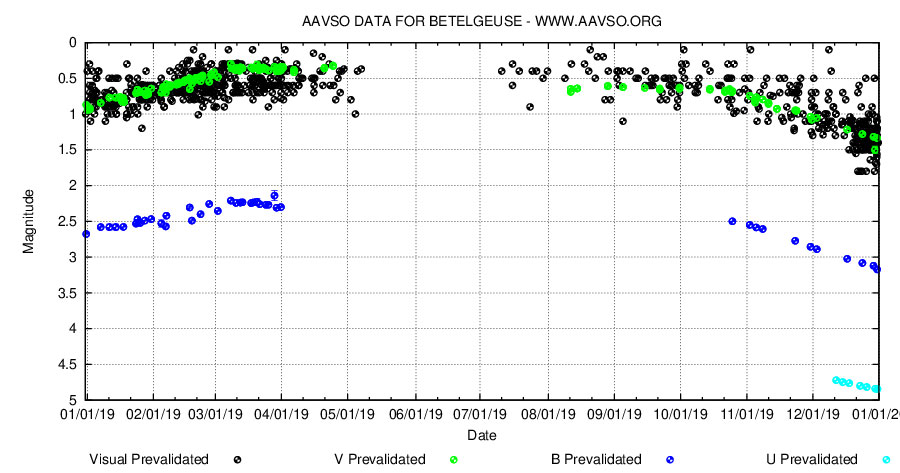
For months, astronomers have been keeping a wary eye on Betelgeuse, the bright red star in Orion’s shoulder. What’s attracting their attention? All of a sudden, Betelgeuse isn’t bright anymore. Its luminosity has “fallen off a cliff”–a sign that the star could be on the verge of going supernova.
“The most recent measurements put the visual magnitude of Betelgeuse at about +1.66, the dimmest its been in our 25 years of photometry,” says Edward Guinan of Villanova University.

Betelgeuse is a highly evolved red supergiant–the type of star that could collapse and explode at any moment. Indeed, the dimming of Betelgeuse could be explained if the star has suddenly contracted to about 92% of its previous radius. But that’s not the only possibility. Betelgeuse might be dimmed by a giant starspot–or maybe it is shrouded by an outburst of stardust from its own cool outer layers–or something else entirely. No one knows.
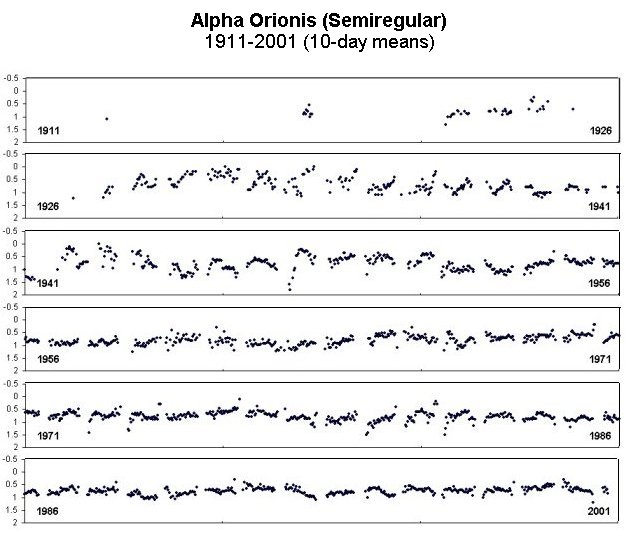
Answers might be forthcoming on Feb. 21st. Astronomers have long known that Betelgeuse is a variable star. It pulsates with many periods, as shown in this Fourier analysis of Betelgeuse’s light curve:

“This shows a dominant (probable pulsation) period of P = 430 days,” note Guinan and colleague Richard Wasatonic in a recent Astronomical Telegram. Given this result, “the minimum brightness is expected on 21 (+/-7d) February 2020.”
If Betelegeuse starts to bounce back on Feb. 21st, this whole episode might just be a deeper-than-average pulsation, and perhaps the supernova watch can be called off. However, notes Guinan, “even if the 430-day period is still working, this would indicate a minimum brightness near 0.9 mag–much brighter than the current value near 1.6 mag. So something very unusual is going on.”
Stay tuned for updates as Feb. 21st approaches.
From Astronomy Picture of the Day:



Didn’t read every comment, so apologies if someone else already pointed this out – but the date of the 21st is surrounded by a +/- 7 day range – presumably something like a 95% confidence interval or some statistical cousin. So it’d probably be more accurate to say that if it either continues to decline or fails to recover after February 28th, we’re definitely in uncharted statistical waters.
Now, if it would only stop being cloudy when Betelgeuse goes boom.
(Not that boom is the correct word for a star’s collapse.)
Typical SN light curve takes about a month from peak to 90%
I hope Betelgeuse holds off blowing itself up until we get the James Webb telescope in orbit.
It may damage the sensors of the James Webb telescope.
Welcome to the Snews-alert@lists.bnl.gov mailing list! Welcome to the
SNEWS alert mailing list. You will only get mail from this list in
event of the detection of supernova neutrinos, so you can get out and
observe as early as possible (aside from rare list administrative
emails). Any real alert email will be signed with the SNEWS gpg key,
see http://snews.bnl.gov/ for details.
I’ll have to see if I can actually see the dimmed-star Betelgeuse from my location (if it ever clears up — we’ve been having a lot of snow and fog in Colo. Spgs.) It’s my understanding that Betelgeuse is the upper-left star in the Orion constellation (the media said the northwest star).
Fascinating, but the the odds of a relatively-close supernovae at any given time are very low. Much more likely an ejection of gas by the star, an intervening dust cloud in the line-of-sight, etc.
The recent dimming of Betelgeuse seems much more pronounced than previous cycles over the past 10 years, so that it’s more likely that something major will happen soon, but how long does it take for a dimming red giant to completely collapse and then explode into a supernova? We could still be waiting for decades to come.
If a Betelgeuse supernova would be as bright as the full moon, it would definitely be noticeable to the casual observer on a clear night, and possibly even during daylight hours when the sun is not near the constellation of Orion (a gibbous moon is often visible on sunny days in early morning or late afternoon). People wouldn’t need a telescope to see it.
If Betelgeuse is over 600 light years away, the supernova may have already occurred before Columbus sailed the ocean blue, but we’re still waiting to get the message.
Steve Z, I’d agree, the cycles will most likely continue w/increasing volatility for some time, perhaps for many decades or more before a total core-collapse.
If you have a close-to pinpoint light source as bright as the full moon, can that damage eyes?
Betelgeuse as a neutron star is predicted to have about 1.5 Solar Masses (See below). Lee Smolin predicted 2.1 Solar Mass minimum for Black Hole formation.
Dolan, Michelle M.; Mathews, Grant J.; Lam, Doan Duc; Lan, Nguyen Quynh; Herczeg, Gregory J.; Dearborn, David S. P. (2017). “Evolutionary Tracks for Betelgeuse”. The Astrophysical Journal. 819 (1): 7. arXiv:1406.3143v2. Bibcode:2016ApJ…819….7D. doi:10.3847/0004-637X/819/1/7
Correction! Smolin’s prediction was of maximum neutron star mass at about 2 Solar Masses.
Betelgeuse is AAVSO’s Star Of The Month with a good article explaining the choice. Oh, AAVSO stands for American Association of Variable Star Observers.
https://www.aavso.org/star-month-february-2020-alpha-ori
“I’ve seen things you people wouldn’t believe. Attack ships on fire off the shoulder of Orion. I watched C-beams glitter in the dark near the Tannhäuser Gate. All those moments will be lost in time, like tears in rain. Time to die. ”
– Roy Batty, from Blade Runner
I think you should credit Rutger since he winged it and improvised the speech from the original. One of cinema’s greatest moments.
@robin
True, but in the interest of brevity I did not.
Okay?
If you wish upon a star and the star blows up while you are making your wish, does your wish still come true?
And can I get a government grant to research that?
There’s one more thing to add to the list of cosmic mysteries of the past couple of years.
1) the first Russian fireball
2) the deep-space asteroid Oumuamua, “the first known interstellar object detected passing through the Solar System.”
3) several green comets. Green comets?
4) another Russian fireball
5) possible nearby supernova
We’re being sized up, I’m telling ya.
Then there is that never ending argument, accuracy vs precision.
Another grand experiment is ‘running’ in the galactic lab! And we may witness demonstrative new data on February 21? Bring it on!
Thanks for posting this, Anthony…. More, Please!
Prayers for all the ovum planets in the kill zone, hatched yet or not. May as many of them as possible still produce the value of which they are capable.
What about the intelligent species in the kill zone? Frantically developing interstellar transport so a few of them might be able to escape total annihilation???
We’re doomed.
Betelgeuse needs to be monitored in terms of all sorts of parameters so we will be able to predict future supernovas. Certainly iron being forged in the core is a sign that the end must be near. Being relatively close, there will be a wealth of information. Just hope any gamma ray burst is not headed in our direction.
Nonetheless, WHEN the supernova comes, it will be spectacular. It is on the astronomical bucket list. Eta Carina is also on the watch list in terms of supernova. It could well be that both have blown up already but we are awaiting the result for those 7-10 thousand years.
Hopefully, the idiotic greenie types blame human CO2 for the supenova. We can goad them in to supporting the notion since they are totally scientifically illiterate, then use the strawman against them, making total idiots of them.
” … making total idiots of them.”
—
It takes a lot less than a supernova to do that on a daily basis.
“It’s tough to make predictions, especially about the future.”
~Yogi Berra
Recent observations aside, the estimate is sometime in the next 10,000 years for Betelgeuse.
This is just one scenario that could disrupt our lives and require the added protection of guns at home. There are many more possible events not being taken into account by the short sighted view of those wishing to take our protection away, and even those arguing against it.
Arrogant, short sighted, blind.
This supernova would disrupt satellites required for today’s high technology.
EMP which they promise to protect us from.
Can you think of a few more which we have been fortunate to avoid in recent history?
It shouldn’t be their decision. Arrogance.
In “Unclear Winter”, Charles Sheffield discussed the effect on Earth of various disasters – including a supernova within 100 lightyears of Earth. He calculates that would bombard us with radiation and particles roughly equivalent to a nuclear war. That should happen very roughly every 2 – 3 billion years.
A supernova within 50 lightyears would be far worse. He says that there are aprox 1,000 star systems that close, so a very crude estimate is that on average that will happen every 10 billion years.
That was published in 1988, so these estimates might have changed a lot since then with increasing knowledge.
Galactose is coming?
For Marvel fans
Galactos
Galactose? Oh no!
Not Galactose the Intolerant!
Flee!
As bright as the full moon, but full spectrum light instead of pale gray moon light. And the shadows cast will have the sharpest edges ever seen, even for objects far away. It will be spectacularly noticeable for the few months it is at peak brightness.
Latest news is that supernova has been postponed for now – Betelgeuse is brightening again.
All’s well. The light curve is bending uowards again!
https://www.aavso.org/lcg/plot?auid=000-BBK-383&starname=BETELGEUSE&lastdays=100&start=&stop=2458900.2324118516&obscode=&obscode_symbol=2&obstotals=yes&calendar=calendar&forcetics=&pointsize=1&width=800&height=450&mag1=&mag2=&mean=&vmean=&grid=on&v=on