Reposted from Polar Bear Science
Posted on November 30, 2019
Polar bears leaping on the backs of belugas off Seal River, in western Hudson Bay, is being falsely promoted by the BBC’s new “Seven Worlds: One Planet” TV special as an unprecedented effect of climate change.

More specifically, the Daily Mail (30 November 2019) this morning quoted the documentary, narrated by Sir David Attenborough, as saying:
‘This extraordinary behaviour has only been recorded here, in this remote corner of North America, and only in the last few years.’
Poppycock. More climate change hyperbole from Attenborough’s seemingly never-ending litany of nonsense that’s easily refuted. There is scientific literature documenting such behaviour in Canada’s far north in the 1980s, which I included in the blog post I wrote about this phenomenon a few months ago (after National Geographic published a similar scare-story), which I have reposted below.
And from the sounds of it, there was no mention in the BBC special that freeze-up along western Hudson Bay was early again this year: for the third year in a row. So if the footage was filmed any time since 2017, the claim of accelerating sea ice loss in this region and bears on land for longer than ever is pure fantasy. PS. Fat bears are not ‘starving’.
Reposted from May 6, 2019
This time National Geographic’s ‘Hostile Planet’ series laughably claims a fat polar bear that’s caught a beluga calf off the coast of Western Hudson Bay has been saved from starvation! The message: here is a prime example of climate change pushing a species to its limit. This is nonsense, of course: polar bears hunting beluga whales from rocks has nothing to do with climate change or desperately hungry bears. More importantly, there is a much better video of the action that is both more informative and truthful.
See both below and decide which you’d prefer your kids or grandkids to watch.
National Geographic footage with focus on climate change
First, here is the polar bear sequence from the ‘Hostile Planet’ series, which it has clearly released for distribution to the media:
Applying standard media hyperbole, Rolling Stone Magazine rephrased this to read “See a Starving Polar Bear Hunt for Beluga Whales” as if viewers can’t see the rolls of fat on this bear with their own eyes. Says Rolling Stone, 6 May 2019 [links in the original, my bold]:
“Some scientists fear a third of the polar bears in the world may be gone by 2030 due to climate change and how it will affect future sea conditions. To show how the species is struggling to survive as they search for food, National Geographic captured a moment where a starving polar bear hunts a pod of beluga whales in open water in Canada’s Hudson Bay. Featured in Hostile Planet‘s finale on Monday, it’s a chilling a reminder of how the Arctic predators are desperate to find prey to meet their needs.
The six-part nature docuseries, hosted and narrated by Bear Grylls, zooms in on the world’s most extreme habitats to reveal the animal kingdom’s most dramatic stories of survival on our changing planet.
The Hostile Planet series finale airs tonight at 9pmET/PT on National Geographic.”
Wildlife guides on the ground
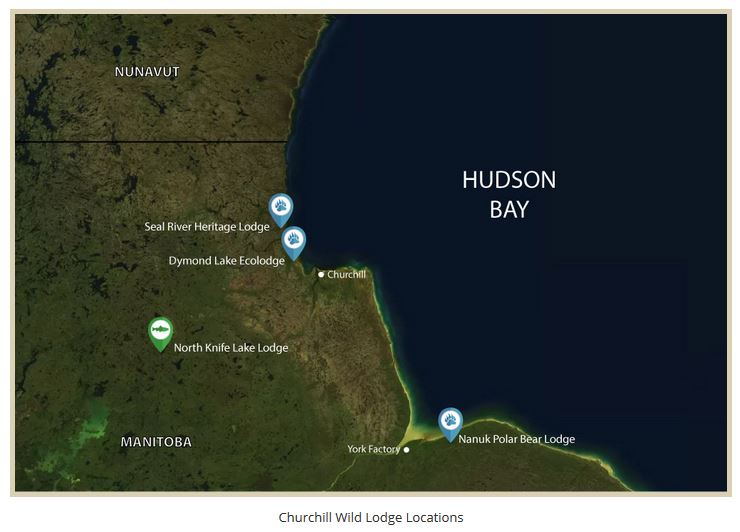
However, we know from reports from guides at the Seal River Heritage Lodge that polar bears hunting beluga from rocks were observed in late summer (August/September) 2017 at the mouth of the Seal River, which is north of Churchill on Western Hudson Bay (see map below). This was the same summer a litter of triplet cubs were spotted in the area, discussed in the same report.
A photo of a Seal River polar bear hunting beluga from a rock, late summer 2017:
CBC nature film footage
As the video below, from CBC’s “The Wild Canadian Year: Summer” narrated by David Suzuki of “The Nature of Things” (uploaded 8 December 2018 to Youtube). I’m no fan of Sukuki’s stance on climate change but am happy to report it does not enter the narrative here, at least in the polar bear clip (I haven’t listened to the rest).
The polar bear hunting beluga sequence starts at 36:50 with the catch at about 42:00.
Clearly, dozens of bears have learned this hunting strategy – probably after watching one local individual give it a try. Polar bear cubs learn hunting skills by watching their mothers, so they are primed to learn a new skill by watching other adults do it. These bears are very smart and learn quickly.
This new hunting strategy had nothing to do with being ‘desperate’ for food, since the bears shown in this video are in excellent condition, as were most bears that summer. Fall freeze-up came early in 2017 (and again in 2018), so they had a shorter wait than usual before they could hunt seals from the ice again.
However, polar bears hunting beluga whale calves in open water is not unheard-of behaviour that has only emerged recently due to climate change: researchers in the 1980s saw bears in the Canadian Arctic hunt beluga calves close to the shore of Somerset Island in a similar if not identical manner (ironically, this is the same island where NG’s equally misleading ‘starving’ polar bear was filmed in 2017). In one case, rather than a rock, a big male bear in 1985 used an isolated pan of ice as a platform from which to leap onto beluga calves swimming in the water (Smith and Sjare 1990:100).
References
Smith, T.G. and Sjare, B. 1990. Predation of belugas and narwhals by polar bears in nearshore areas of the Canadian High Arctic. Arctic 43(2):99-102. DOI: https://doi.org/10.14430/arctic1597
The internet is full of published documents and further citations describing Polar Bear Beluga kills in maximum and minimum ice conditions and many general info pages on Polar Bear mention it (although it’s not a major prey species).
https://pdfs.semanticscholar.org/ac89/f69c3b949f23601cf4918e04cbdbca7905f2.pdf
http://pubs.aina.ucalgary.ca/arctic/Arctic29-1-56.pdf
Even NOAA.
” Instances of polar bears killing beluga whales (Delphinapterus leucas) have been reported (DegerbZI and Freuchen 1935, Kleinenberg et al. 1964, Freeman 1973, Heyland and Hay 1976).”
https://swfsc.noaa.gov/publications/CR/1988/8804.PDF
Has the video “The Wild Canadian Year: …” disappeared?
I have tried to view it from both a Swedish IP (direct) and a French IP (proxy), but I get this message from YT:
“ERROR: This video is not available.
Sorry about that.”
Maybe us over 75 should start a campaign. No payment of TV license until truth and non partisanship prevail at the BBC. Let’s put pressure on them. Climate warmists do not get to decide who is allowed to debate.
Isn’t that free for OAP’s in the UK now?
It is voluntary and the BBC has decided to end this.
A quiz programme on British television recently asked a contestant to name the ten most-threatened land mammals, according to the WWF. Surprise, surprise: polar bears were on the list.
Long time reader, first time commenting. Against my better judgement, I watched the Antarctic episode of the series and David Attenborough showed a “heart-rending” scene about a grey-headed albatross chick being blown off the nest by strong winds “due to climate change”. Well, as someone who spent 14 months as a meteorologist on a sub-Antarctic Island 35 years ago, and saw the same thing on a fairly regular basis, my interest was piqued, so I downloaded historical daily wind data from the South Atlantic and South Indian Ocean sub-Antarctic islands (some going back to the 1950s). I looked for trends in mean daily as well as sustained maximum wind speeds (no gust data was available, unfortunately). The result: no trend for most stations and a downward trend for another. This wasn’t the most robust statistical analysis, I admit, but the picture was clear. What with the polar bears, the walrus “suicide” and now this, I won’t be watching any more of this blatant propaganda.
The problems the g-h albatross faces are well documented and known by real science – millions are eaten alive by rodents(hence the rodent eradication programs on their main breeding sites!) and young birds have been satellite tracked to industrial fishing grounds, confirming what was suspected, they become bycatch by the thousands.
Just had a ”scientist” on the radio this morning moaning about the decline in snakes here (Aust) with one of the causes being climate change. It’s clear this is politically driven because there is no way he could possibly come up with any evidence for this whatsoever. What has happened to science???
yeah well I happily call bullshit on that
I will be paying for 2 yrs the bill for last yrs snakebit dog in my yard!
$4,800 and 4 days hospital 2 days intensive care in that ;-((
and at the vets today I asked had they had many bitten patients
the answer was a firm and sad YES!
BBC:
This extraordinary behaviour has only been recorded here, in this remote corner of North America, and only in the last few years.
tty:
It is an interesting measure of the professional competence of journalists in the BBC and elsewhere that they have apparently swallowed this nonsense without the slightest doubt or research, while a bunch of complete amateurs on WUWT has dug up dozens of well-documented instances of beluga hunting by polar bears all over the Arctic and over almost a hundred years in half an hour.
What more can one say?
@ur momisugly Phil Salmon
What more can one say?
The truth will not be paid, fake news will be
It really is time this poor old man retired completely. He obviously can’t read these days or he might have found the article https://oceana.org/marine-life/marine-mammals/beluga-whale which describes the what, why when and how polar bears have always hunted the Beluga whalw.
Ursus Maritimus. Sea Bear. NOT Ursus Glacialis. Just sayin’
There was a program on the BBC last night of somesupposed comedian who went up to the arctic. He went to the ocean to see animals but could not because there was too much ice. Laughed myself to sleep on that one.
So can’t this false information broadcast by the BBC be reported through official channels? I realize it’s probably fruitless to do so, but someone in the UK should at least make the effort, to document both the false information, and the (potential) lack of response.
Endless complaints to the BBC are never answered, complaints of bias are rejected on the basis that “fair coverage” is given across all our outlets (prhaps the Russian service) etc. The next Conservative Government has suggested that they may loose their Charter though (effectively closed down), and it has made them a bit more even in the election coverage and interviewing. Interesting….
A must have for / where are all the polar bears gone / Charles Rotter:
https://www.google.com/search?q=polar+bear+spray+painted&oq=polar+bear+spra&aqs=chrome.
I thought that the Daily Telegraph was one of the better quality papers but it seems they are just like the rest.
https://www.telegraph.co.uk/news/2019/12/06/dozens-polar-bears-stranded-outside-russian-arctic-village-melting/amp/