Reposted from Jennifer Marohasy’s blog
Why Deny the Beautiful Coral Reefs Fringing Stone Island?
November 21, 2019 By jennifer
We live in an era when it is politically incorrect to say the Great Barrier Reef is doing fine, except if it’s in a tourist brochure. The issue has nothing to do with the actual state of corals, but something else altogether.
Given that the Great Barrier Reef is one ecosystem comprising nearly 3000 individual reefs stretching for 2000 kilometres, damaged areas can always be found somewhere. And a coral reef that is mature and spectacular today may be smashed by a cyclone tomorrow – although neither the intensity nor frequency of cyclones is increasing at the Great Barrier Reef, despite climate change. Another reason that coral dies is because of sea-level fall that can leave some corals at some inshore reefs above water on the lowest tides. These can be exceptionally low tides during El Niño events that occur regularly along the east coast of Australia.
A study published by Reef Check Australia, undertaken between 2001 to 2014 – where citizen scientists followed an agreed methodology at 77 sites on 22 reefs encompassing some of the Great Barrier Reef’s most popular dive sites – concluded that 43 sites showed no net change in hard coral cover, 23 sites showed an increase by more than 10 per cent (10–41 per cent, net change), and 17 sites showed a decrease by more than 10 per cent (10–63 per cent, net change).
Studies like this, which suggest there is no crisis but that there can be change, are mostly ignored by the mainstream media. However, if you mention such information and criticise university academics at the same time, you risk being attacked in the mainstream media. Or in academic Dr Peter Ridd’s case, you could be sacked by your university.
After a career of 30 years working as an academic at James Cook University, Dr Ridd was sacked essentially for repeatedly stating that there is no ecological crisis at the Great Barrier Reef, but rather there is a crisis in the quality of scientific research undertaken and reported by our universities. It all began when he sent photographs to News Ltd journalist Peter Michael showing healthy corals at Bramston Reef, near Stone Island, off Bowen in north Queensland.
More recently, I personally have been ‘savaged’ – and in the process incorrectly labelled right wing and incorrectly accused of being in the pay of Gina Rinehart – by Graham Readfearn in an article published in The Guardian. This was because I supported Dr Ridd by showing in some detail a healthy coral reef fringing the north-facing bay at Stone Island in my first film, Beige Reef.
According to the nonsense article by Mr Readfearn, quoting academic Dr Tara Clark, I should not draw conclusions about the state of corals at Stone Island from just the 25 or so hectares (250,000 square metres) of near 100 per cent healthy hard coral cover filmed at Beige Reef on 27 August 2019. Beige Reef fringes the north-facing bay at Stone Island.
This is hypocritical – to say the least – given Dr Clark has a paper published by Nature claiming the coral reefs at Stone Island are mostly all dead. She based this conclusion on just two 20-metre long transects that avoided the live section of healthy corals seaward of the reef crest.
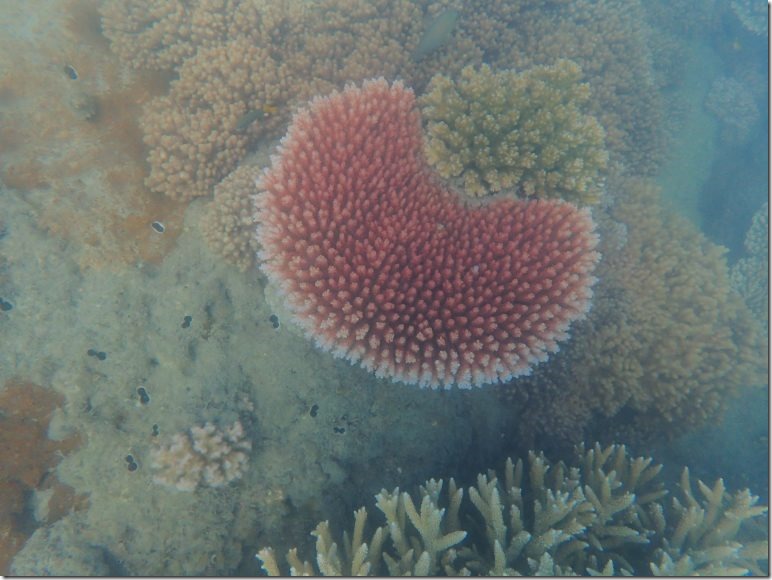
I will refer to this reef as Pink Plate Reef – given the pink plate corals that I saw there when I went snorkelling on 25 August 2019.
Dr Clark – the senior author on the research report, which also includes eight other mostly high-profile scientists – is quoted in The Guardian claiming I have misrepresented her Great Barrier Reef study. In particular, she states,
We never claimed that there were no Acropora corals present in 2012.”
Yet this is really the only conclusion that can be drawn from the information presented in her report, which states in different sections the following:
Using a combination of anecdotal, ecological and geochemical techniques, the results of this study provide a robust understanding of coral community change for Bramston Reef and Stone Island.”
At Stone Island, the reef crest was similar to that observed in 1994 with a substrate almost completely devoid of living corals.”
For Stone Island, the limited evidence of coral growth since the early 19th Century suggests that recovery is severely lagging.”
… by 1994 the reef was covered in a mixture of coral rubble and algae with no living Acropora and very few massive coral colonies present …”
Clark and colleagues recorded the corals along two transects, which they explain included a section of the reef now stranded above the mean low spring sea level. The sections they studied are some metres away from healthy corals – Porites and Acropora species, including pink plate corals that I snorkelled over on 25 August 2019.
Fringing inshore reefs often show distinct zonation, with live and healthy corals growing along the seaward edge. At Pink Plate Reef, the reef edge extends for some 2 kilometres and is about 20 metres wide in parts, while much narrower in other sections.
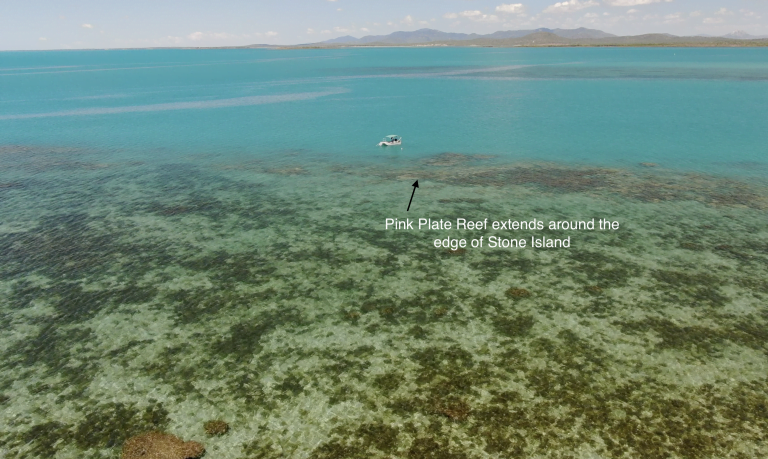
This picture was taken with my drone, Skido, looking south east towards the edge of Pink Plate Reef
on 26th August 2019.
The more inshore section of such fringing inshore reefs, sometime referred to as ‘the lagoon’ between the beach and the reef edge, is usually muddy. This mud has a terrestrial origin. From the lagoon towards the seaward edge there may be an elevated section, which is often referred to as the reef crest.
It is uncontroversial in the technical scientific literature that there has been sea-level fall of about 1.5 metres at the Great Barrier Reef since a period known as the Holocene High Stand thousands of years ago.
It is also uncontroversial that sea levels fall with the El Niño events that occur regularly along the east coast of Australia most recently during the summer of 2015–2016.
As a consequence, the reef crest at many such inshore fringing reefs may end up above the height of mean low spring sea level. This is too high for healthy coral growth; because of sea-level fall, corals in this section of these reefs are often referred to as ‘stranded’ and will be dead.
Dr Clark and colleagues clearly state that they began their transects at Stone Island at the reef crest, which they also acknowledge is at ‘the upper limit of open water coral growth’. It could reasonably be concluded that Dr Clark’s study set out to sample the section of this reef that could be referred to as stranded.
Our society places enormous trust in scientists. It is as though they are the custodians of all truth.
Yet, as recently reported in another article in The Guardian by Sylvia McLain on 17 September, entitled ‘Not breaking news: many scientific studies are ultimately proved wrong!’, most scientific studies are wrong because scientists are interested in funding their research and their careers rather than the truth.
So, while another The Guardian journalist, Graham Readfearn, may look to scientists like Dr Clark and colleagues to know the truth about the Great Barrier Reef, reef scientists may be inclined to report what is best for their career in the longer term. This is increasingly likely to be the case, given the recent sacking of Dr Ridd for daring to speak against the consensus.
This could also to be the case for film makers. The Guardian has reported my honest attempts at showing how beautiful and healthy one of the fringing coral reefs at Stone Island is – including through spectacular wide angle underwater cinematography – the headline:
Scientists say rightwing think tank misrepresented her Great Barrier Reef study”.
This was the headline in The Guardian on Tuesday, accompanying the first review of my first film – Beige Reef. Many of the comments at YouTube now uncritically link to this misinformation.
It is not easy telling the truth when it comes to the state of corals at the Great Barrier Reef.
In my film Beige Reef, I show such a diversity of beautiful hard corals including species of Acropora and Turbinaria under dappled light at Beige Reef, which is a true coral garden fringing the north facing bay at Stone Island.
Meanwhile, Tara Clark and colleagues – lauded by journalists such as Graham Readfearn – write in their study published by Nature: ‘Only nine dead corals were found along transects 1 and 2, and that these corals were covered in mud and algae.’
Such a statement is perhaps politically smart, because it plays to the current zeitgeist that suggests humankind is having a terrible impact – destroying the planet everywhere, including at the Great Barrier Reef. So, the beautiful reefs that do fringe Stone Island – not just Beige Reef in the north facing bay, but also the reef along the south western edge, the reef that I’ve name Pink Plate – must be denied.
It seems an absolute tragedy to me that the beauty and resilience of these healthy coral reefs is not acknowledged. Further, the idea that the Great Barrier Reef is in peril creates tremendous anxiety throughout our community, particularly for the younger generation.
In another part of the same report, Dr Clark and colleagues state that coral cover was 0.09 per cent at Stone Island. This is not consistent with their ‘benthic survey’ only finding nine dead corals, and is certainly a lot less than the near 100 per cent coverage that I found at Beige Reef just around the corner. It is also a lot less than would have been found if their transects had been placed in that section of Pink Plate Reef with living corals – the section of reef at the seaward edge that extended for perhaps 2 kilometres.
********
Pink Plate Reef will be the focus of my next short film.
My travel to Stone Island and the film were funded by the B. Macfie Family Foundation through the Institute of Public Affairs.
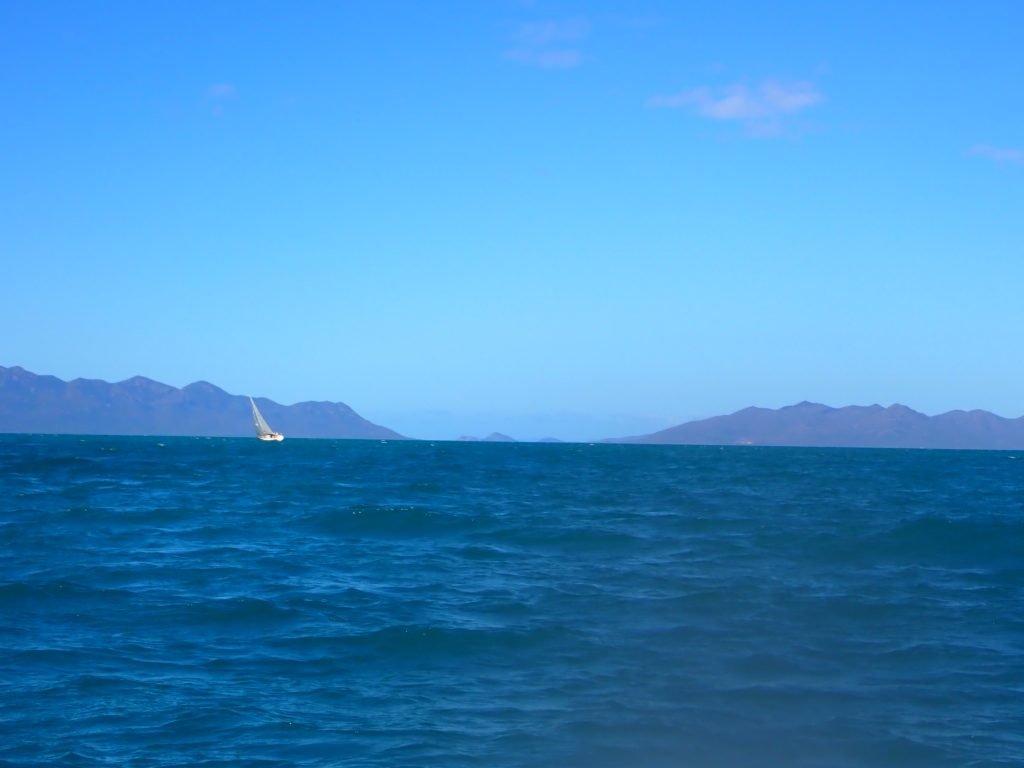
I snapped the picture of the sailing boat with Gloucester passage in the background, as featured at the top of this blog post, from Pink Plate Reef in the early afternoon on 25th August 2019.
It’s about money. Travel around and tell people at travel agencies that the Guardian says the reef is dead and there’s no reason to sell tickets there. Stand outside with signs saying the Guardian and others says you’re wasting your money on a dead reef. I know there’s a desire to educate, but stupid people cannot learn and many simply have no desire to learn. However, tourist locations depend on selling an image. Report what the news media does about the location. It’s honest and all evidence says it will be very, very effective. Australia depends on tourists—so, take those away and see if lies are still the way to go according to the press and government.
Whether is it “science”, journalism, politics, religion, or any of countless topics, whenever a truth teller is effectively goring a liar’s ox, the liar attacks the truthteller, not the underlying truth that exposes their lies.
Just look at what the scurilous GOPers, lead by the criminally inclined tweeting POTUS, are doing to the truth tellers in the House impeachment hearings.
Humans. Our nature never changes – only the names change.
“Just look at what the scurilous GOPers, lead by the criminally inclined tweeting POTUS, are doing to the truth tellers in the House impeachment hearings.
Humans. Our nature never changes – only the names change.”
Yeah, humans see what we want to see, don’t we.
What I saw was the POTUS and the GOPers telling the truth, and pointng out that your “truth tellers” have not laid a glove on Trump. The US ambassador to Ukraine said yesterday, and said plainly, that he had no knowledge of a quid pro quo between Trump and the Ukranian president, yet ABC News yesterday led off their broadcast with the blatant lie that Trump had been caught trying to coerce the Ukranian president. The source of this lie, the US ambassador, actually refuted the lie in his testimony, and then ABC News reports the lie as fact, even though they know it’s a blantant lie. That’s the state of our “News Media” today. They are blatant political propagandists pushing leftwing lies.
Do you get your news from ABC News, Duane?
Strobe Talbot. Remember that name.
Your misanthropy is showing.
Duane: I see you live in the land of fantasy…..
Duane, I believe you should invest in a mirror.
We are dealing with a group who, if they are credentialed scientists, see their training and positions as a means to proselytize to the unenlightened masses. The neo-Marxists or Progressives are a radical cult-like religion that has set out to, and largely succeeded in, taking over academia and most media in a conscious effort to subvert liberal, Western democracies for their Great Sin of refuting Marxism by making their citizens freer and more prosperous than any other group in human history. Whether your talking about urinalists at the Grauniad or CNN, professors at JCU and most other universities or the politicians and bureaucrats who try to rule over stinky masses, you’re talking about like-minded individuals who received thieir indoctrination throughout college or earlier and will use ANY MEANS NECESSARY to attain their goals.
Anyone who majored in urinalism or something with “studies” or “science” in the title is probably an adherent of this religion. Many scientists have become reluctant novices in order to receive grant money and favorable publicity. Asking to them to use facts, logic or history is like wrestling a pig in mud; you just get filthy and the pig enjoys the exercise. We should be pointing to the lies and fallacies of their faith instead.
Over the last ten years our society has been pushed from accepting gay “marriage” to transgenderism with the repeated CAGW mantra thrown in as a bass line. Where will this go next? It looks like pedophilia and bestiality are in the works; many Progressives are already in favor of one or both! Without the work of talented individuals like Dr. Marohasy we will never be able to push back effectively against this cult of ignorance and lies. Know your arguments (I like geology and astrophysics) and don’t be afraid to ask them, “Do you really believe all that religious mumbo-jumbo!?” They really hate that!
From the article: “although neither the intensity nor frequency of cyclones is increasing at the Great Barrier Reef, despite climate change. ”
Huh? Despite climate change? That’s an odd way to put it. What does that mean exactly?
If more people would get out of the house and experience nature, rather than constantly watching youtube, it would be a lot harder for this type of misinformation.
It’s interesting that the Guardian claims that Marohasy has misrepresented Clark’s research and Marohasy is claiming and showing that the reef is doing well in an area that Clark claimed no longer has coral. If Clark is claiming that she has been misrepresented she must therefore be claiming that there is indeed coral in the area referred to and presumably we can all agree that the reef is not dying. Her claim of misrepresentation doesn’t in any way invalidate that contrary to claims by scientists the reef is not dead which thanks to Marohasy’s film people can see with their own eyes.
I find it’s a major chutzpah to claim criticism of a cherry picked piece of activist research was unfairly refuted by a cherry picked piece of research. Even if Mahorasy’s footage is the only healthy coral in the whole of the 2000 kilometres of the GBR it is not discredited by such argument cause we can see it with our own eyes.
Ironically hopefully the highlighting of Marohasy’s film by the Guardian might show to some of its readers that maybe the death of the GBR has been called prematurely. However my guess is that their readers are so indoctrinated to the global warming agenda that they will be incapable of seeing the truth with their own eyes.
My wife and I are avid snorkelers. We visited Australia Dec 2018-Jan 2019 and went snorkeling on the Great Barrier Reef at many locations during our month long visit. This was off the East coast near Port Douglas, Cairns and Airlie Beach.
While we did see shallow areas of dead coral, many of the areas showed renewed coral growth. We were told the Super El Niño of 2016-16 along with a large typhoon caused much of the recent bleaching events and since then the ocean has cooled and corals are returning to healthy growth and color. The reef fish were abundant and snorkeling was better in some areas than others.
In 2018 we went Malaysia and the snorkeling there was out of this world with very little coral bleaching and a virtual underwater garden. The only downside there being the amount of plastics floating in what would otherwise be a pristine underwater paradise.
Great Observations! I’m fairly sure the water in Malaysia is warmer than in Australia. The fact that reefs can flourish in warmer waters kind of sinks the notion that GBR is being harmed from CAGW.
PS, El Nino related coral bleaching is not from warmer than normal water, it is from sea level drop in the Western Pacific (the El Nino winds push the water to the Eastern Pacific up against the Americas)
PS, El Nino related coral bleaching is not from warmer than normal water, it is from sea level drop in the Western Pacific (the El Nino winds push the water to the Eastern Pacific up against the Americas)
__________________________
You’re right about the water level dropping slightly, but you are not correct at all about a lack of warmer water temperatures.
During El-Ninos the air relatively stagnates over Queensland and becomes very hot, with a much drier than normal hot NE tropospheric wind flows, which inhibits the usual cooling during La-Nina’s SE trade-wind flow. That results in very few clouds, more hot land breezes more often, plus much less onshore wind and currents, thus less cooler oceanic waters flushing though the very wide GBR lagoon area. There is also less rain and higher salinity, due higher evaporation and less mixing.
The result is the 30 km to 150 km wide shallow littoral GBR ‘lagoon’ waters rise sharply in temperature during El-Nino summers, to levels that severely damage and bleach the shallow water corals.
Let’s not pretend such water heating doesn’t occur, it does, and it effectively terminates hallow most water corals. The deeper corals almost always survive as deeper lagoon waters remain cooler as there is less mixing due to the slack winds.
It’s a very hot and unpleasant time for humans, on the coast, as well.
When La-Nina returns the trade winds and cooling air resume, and the GBR lagoon waters cool down again, cloud cover and cooling showers also return, and there’s much more on-shore mixing of ocean waters with lagoon waters, each tide change.
Then the damaged and bleached shallow-water corals are recolonized by freshly spawned coral plankton during Spring and there is an explosion of new species and healthy coral-cover rapidly begins to approach 100%. Once grown the corals compete and may kill each other off a bit until the density drops back some, as the less competitive corals are overgrown. Coral reefs are very dynamic and are just as ‘seasonal’ as a forest or field. El-Nino to La-Nina temperature and water level variations just serve to disturb them, and make them more dynamic, with no damage lasting beyond about two or three years. Most damage is gone within 18 months.
Warmer than normal water is very much a factor in the health of the reef, but the impacts have simply been blown out of all proportion, and the fact that the reef grows like a weed in your garden is also ignored, omitted and down-played. The shallow corals to suffer heat stress, and they can die, but they also recolonize and return very quickly to a dead zone, all by themselves. In fact, as dead shallow sunny substrate is paradise for coral plankton to settle on and grow.
The growth rate skyrockets in those conditions, once the cooling south Pacific trade winds and currents return.
Of late I have been considering the contrast between scientific publication peer review and engineering peer review. There are lesson to be learnt.
I am a practicing engineering geologist. I compile geotechnical reports for building sites. If my conclusions are wrong and lead to failure it costs my client, my reputation, and my insurance company a lot of money. The degree of field investigation is controlled by the value and hazard potential of the project. We need to infer much of the ground conditions based around training and experience. Design factors of safety are significant.
Recently I completed a very problematic job where the client had bought a section in which a natural watercourse bisected their proposed dwelling footprint. The report went in to council and bingo, they sent it our for peer review. The review came back with all kinds of extra demands on analysis and report content. Some of the demands where – in my view – silly and would blow out a normal quote for this scale of job.
I have never been peer reviewed before and was pretty pissed. However having now gone through the process I rank it as a very valuable experience and have adopted some of the recommendations in subsequent reports. I gave way a bit and so did they. The job went ahead.
The main point I make here is that engineering peer review requires a MEETING of the PARTIES where differences can be hammered out such that potential flaws or conclusions in a design proposal can be minimised. Imagine if we where to communicate through the media. How stupid.
In my case a client’s life investment is at stake. All vested parties have to swallow their pride in the endeavor for the best outcome. Surely the GBR is of sufficient economic importance to warrant a meeting of all parties to talk through differences in a mature manner. IMO there is no other option.
The most important professional in the room will be the statistician. I am picking that given the area of the GBR, current research will far from adequate.
Engineers have one thing on their mind: the best possible outcome. Maybe its time to introduce a law where climate modelers and/or predictors are financially liable for inaccuracies in the future. Some peoples’s life investments are at stake.
Just some thoughts
M
Dr Jennifer is terrific.
Not only does this Film show actuality but her fights with the Australian Bureau of Mythology (sorry Meteorology) are legend as she makes them backtrack on absurd “homogenizations” and fake headlines.
I too have had the privilege of snorkeling on the Great Barrier Reef. It is indeed a wondrous place. We started our trip out of Port Douglas and as suggested in a previous comments, depending on your starting point it is quite a boat trip out to the reef. It took us more than an hour to reach our dive point. These reefs cover a massive area.
We get some serious cyclones in this part of Australia from time to time and sometimes damage occurs on the reefs, they inevitably recover. There is a creature called the crown of thorn starfish that loves to eat coral and at times the conditions favour the starfish more than the corals. When they out of control you can see more of these starfish than coral. I believe that these are an introduced species, nonetheless the corals eventually recover.
Natural weather events also affect the corals. We do get extreme heat here at times and that is not new, but if it is prolonged and coincides with low tides then it puts some of the more exposed corals under stress.
After our dive we were given a very informative talk by a marine biologist. At no time did he mention climate change or that the reef was under any kind of threat (this trip was only a few years ago). He did mention a fact that stayed with me that I don’t think has been mentioned in this post. Reef corals have a symbiotic relationship with algae which is where their colour comes from. During times of extreme heat the algae dies and at this point is expelled by the corals. The coral appears white but is not in fact dead at this point. It has, I believe, up to 14 weeks to take up fresh algae and resume it’s healthy status.
Things are not always as they seem.
Live Web cam Great Barrier Reef:
https://www.google.com/search?q=Live+Web+cam+Great+Barrier+Reef&oq=Live+Web+cam+Great+Barrier+Reef&aqs=chrome.