Guest “that was easy” by David Middleton
Like most Bloomberg energy articles, this is very stupidly written… Starting off with the headline that implies that “Warren’s fracking ban” is something more than a fantasy…
Politics
Exxon, Chevron Begin Pushing Back Against Warren’s Fracking Ban
By Kevin Crowley
November 1, 2019America’s two biggest oil companies are starting to push back against the fracking ban touted by the leading candidates for the Democratic presidential nomination, which may become one of the most consequential flashpoints for energy markets during the election campaign.
Exxon Mobil Corp. and Chevron Corp. executives spoke out publicly against the proposals for the first time on Friday, saying they would shift profits from crude production from the U.S. to other countries, and may increase prices for consumers while doing nothing to reduce oil demand or greenhouse-gas emissions.[…]
To be sure, whoever gets elected next year will find it difficult to end fracking. Presidential powers to enact a ban only extend to federal lands, something that would be certain to face immediate legal challenges. A wider restriction would need to go through Congress.
“Any efforts to ban fracking or restrict supply will not remove demand for the resource,” Neil Hansen, Exxon’s vice president of investor relations, said on a conference call with analysts. “If anything it will shift the economic benefit away from the U.S. to another country, and a potentially impact the price of that commodity here and globally.”[…]
“It’s really unlocked an economic huge economic benefit for the country, as well as for the companies involved,” Jay Johnson, the boss of Chevron’s upstream business, said during the company’s earnings conference call.
[…]
Bloomberg
Here’s Liawatha’s Tweet and one of the funnier replies…
Well on a positive note that should make OPEC Happy that they will be back in The Oil business big time.
— Redlion’s Den (@eddiern24) September 8, 2019
What a Joke. Get off the Stage..
Setting aside the fact that the President has no authority to ban frac’ing anywhere other than Federal lands, and might not even have the authority to do it there. Leasing on federal lands and the Outer Continental Shelf (OCS) is governed by laws. Presidents are charged with faithfully executing the laws, not faithlessly disregarding them.
Obama’s unlawful drilling moratorium and subsequent permit-orium were repeatedly slapped down by Federal judges. Obama’s defiance of these rulings did more damage to Gulf of Mexico crude oil production than any hurricane has.
Day 9: Obama repeatedly defied federal court with Gulf oil policies
by Conn Carroll
September 26, 2013[…]
After reviewing the facts and science in the case, the U.S. District Court for the Eastern District of Louisiana found that Obama’s drilling ban was an “arbitrary and capricious” abuse of executive authority, and ordered the ban overturned.
But instead of following the law and allowing Gulf drilling to resume, Obama doubled down, issuing a new moratorium featuring minor technical changes from the first.
The second Obama drilling moratorium applied for the exact same length of time as the first moratorium, through Nov. 30, 2010.
But after intense bipartisan political pressure from Louisiana Sens. David Vitter, a Republican, and Mary Landrieu, a Democrat, Obama nominally lifted the moratorium on Oct. 12, 2010.
By that time about 36 rigs in the Gulf of Mexico had been put out of work, five rigs were being transferred to Egypt and other parts of Africa, and 12,000 jobs had been lost.
Energy industry experts predicted that if new oil leases were not issued, the long-term and indirect economic losses would include more than 175,000 jobs in the region.
But even though the Obama the moratorium had been nominally lifted, a functional ban remained because the Interior Department refused to issue any new drilling permits.
So oil companies again took Obama to federal court, this time seeking an order holding the chief executive in contempt of court and asking that the government pay all of their legal fees.
Again, the U.S. District Court for the Eastern District of Louisiana ruled against Obama, finding him in contempt of court for “a flagrant and continuous disregard of the Court’s Order.”
Finally, on Feb. 28, 2011, almost a month after he had been found in contempt, Obama granted the first oil lease in the Gulf of Mexico.
But while the Interior Department has since stepped up the pace of issuing leasing permits, Gulf oil production is still far below pre-Deepwater Horizon levels. The month before the blowout, according to the Energy Information Administration, oil companies were pumping 1.6 million barrels of oil a day out of the Gulf.Today they are pumping just 1.07 million barrels a day, a 33 percent drop in production.
All told, according to a 2012 American Petroleum Institute study, Obama’s Gulf oil drilling moratorium cost the United States more than $24 billion in lost energy investments and about 90,000 jobs.
Those losses make the $440,596.68 in legal fees the Eastern District forced Obama to pay the oil companies for defying its court order seem like a drop in the bucket.
Washington Examiner
Hurricanes in 2005 (Katrina & Rita) and 2008 (Ike) inflicted extensive damage on Gulf of Mexico oil & gas infrastructure, depressing production by about 250,000 bbl/d from 2006-2008. The Obama maladministration’s unlawful drilling moratorium and “permitorium” in response to the Deepwater Horizon blowout and oil spill depressed production by about 500,000 bbl/d from 2011-2013.

Since then, Gulf of Mexico oil production has surged to record levels and is expected to top 2 million barrels per day in 2020 as a dozen recent deepwater discoveries are brought online.
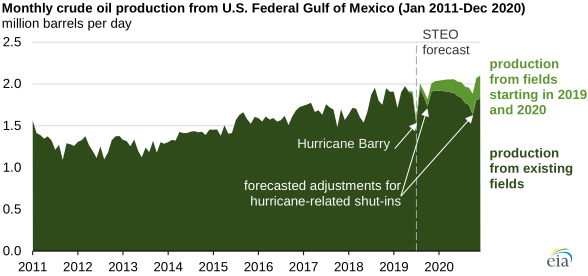
While a President Fauxcahontas could inflict similar damage, barring new legislation from Congress, the courts would probably slap her down even harder than they slapped Obama down.
What if a Marxist POTUS was able to ban frac’ing and offshore drilling?
POTUS = President Of These United States
JULY 8, 2019
U.S. crude oil production surpassed 12 million barrels per day in AprilU.S. crude oil production and lease condensate reached another milestone in April 2019, totaling 12.2 million barrels per day (b/d), according to EIA’s latest Petroleum Supply Monthly. April 2019 marks the first time that monthly U.S. crude oil production levels surpassed 12 million b/d, and this milestone comes less than a year after U.S. crude oil production surpassed 11 million b/d in August 2018.
Texas and the Federal Offshore Gulf of Mexico (GOM), the two largest crude oil production areas in the United States, both reached record levels of production in April at 4.97 million b/d and 1.98 million b/d, respectively. Oklahoma also reached a record production level of 617,000 b/d.
The U.S. onshore crude oil production increase is driven mainly by developing low permeability (tight) formations using horizontal drilling and hydraulic fracturing. EIA estimates that crude oil production from tight formations in April 2019 reached 7.4 million b/d, or 61% of the U.S. total.
[…]
US EIA
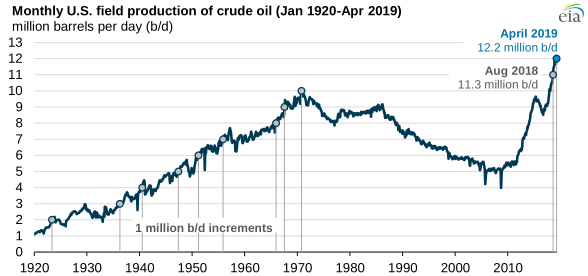
About 9.2 million barrels per day of current US oil production comes from tight formations and the Gulf of Mexico.
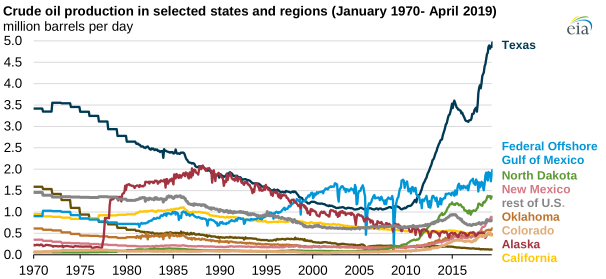
Frac’ing and offshore drilling account for over 75% of current US crude oil production and almost all of the future growth potential for US production and reserves growth.
While an Enviromarxist ban on frac’ing and offshore drilling wouldn’t drop our production to zero-point-zero immediately, the decline would be quick and particularly sharp in the tight formations. There is a very significant relationship between “rig count” and production.

Obama’s unlawful Gulf of Mexico moratorium, very quickly dropped production by about 500,000 bbl/d and the 2014-2016 crash in oil prices caused a similar decline in the Permian Basin. A ban on frac’ing would be catastrophic in the Permian Basin.
Permian Basin oil production with frac’ing…

What would have happened if frac’ing was banned in 2010…

It would be even worse for natural gas.
About 70% of current US natural gas production and all of the future growth potential is from “shale” and other tight formations requiring frac’ing.

The biggest slice of the “shale” gas pie is the Marcellus formation…

Natural gas production from the Appalachia region is mostly from the Marcellus and Utica formations.
Appalachia region natural gas production with frac’ing…

What would have happened if frac’ing was banned in 2010…

Conclusion
Anyone calling for frac’ing ban is mentally ill. Any POTUS who tried to enact a frac’ing ban would be committing Treason. A frac’ing ban wouldn’t change this:

A frac’ing ban would just drive up oil & natural gas prices, force us to import more crude oil and convert LNG export terminals into import terminals. To paraphrase Jeff Goldblum as Dr. Ian Malcolm in The Lost Word, Jurassic Park…
A frac’ing ban would be “the worst idea in the long, sad history of bad ideas.”
Notes about nomenclature
Fracking vs. frac’ing
Frac’ing is a common well completion procedure that has been safely employed in oil & gas production for more than 70 years. There is no evidence whatsoever that frac’ing has ever polluted groundwater or triggered palpable earthquakes. Wastewater injection wells aren’t frac’ing. Frac’ing is a hyphenated abbreviation of “hydraulic fracturing”. Fracking is a cleaned up version of the “F” word.
What is frac’ing? And, is it the same as hydraulic fracturing?
In short, yes. The term “fracking,” which is (supposedly) shorthand for the well completion process of hydraulic fracturing, is actually correctly spelled “frac’ing.” Fracking has become the most used word to describe natural gas from shale deposits, such as the Barnett Shale.Google “fracking” and you get 10,200,000 links.
Unfortunately, the word fracking appears to be widely misunderstood and misused. In fact, it is being used in ways that have nothing to do with the process of frac’ing. For example, the Fort Worth Star-Telegram used the words “pipelines used for fracking” in a recent article’s title, which is incorrect, since pipelines are not used in frac’ing. It’s a good example of how fracking has become an epithet, not a proper description term.
I asked a few people about the word usage recently. “It’s a co-opted word and a co-opted spelling used to make it look as offensive as people can try to make it look,” said Michael Kehs, vice president for Strategic Affairs at Chesapeake Energy, the nation’s second-largest natural gas producer. To the surviving humans of the sci-fi TV series “Battlestar Galactica,” it has nothing to do with oil and gas. It is used as a substitute for the very down-to-earth curse word.So, to set the record straight, here is a quick primer on frac’ing:
First, frac’ing is a well completion or well stimulation technique actually called hydraulic fracturing. It is not a drilling technique, as is commonly written. The fracturing process consists of pumping a combination of 99.5% water and sand, and .5% chemical additives, into the wellbore under high pressure, creating tiny fractures in the shale to release the natural gas. Frac’ing is done after the drilling rig has been removed.
Second, frac’ing is done after the drilling rig has completed the wellbore and has been removed. The actual process of frac’ing a Barnett Shale natural gas well takes less than a week to complete. At that point, the natural gas produced from the well that was hydraulically fractured is no different than any other natural gas well, regardless of how the well was completed.
Finally, and most importantly, the abundant quantities of natural gas contained in shale deposits have been unlocked by combining hydraulic fracturing with horizontal drilling. While the combination of these technologies has been used for decades, it was perfected for shales about 10 years ago. The result is a complete change in the energy outlook for the United States, and many countries in the world for that matter.
[…]
Barnett Shale Energy Education Council
Shale vs. “shale”
I try to put quotation marks around the word shale when I use it in reference to “shale” plays. Most “shale” plays aren’t actually shale.
Is it Shale or not Shale? That is the Question.
In a previous blog on unconventionals, ”Conventional vs. Unconventional Shale: What is my Reservoir?,” Richard Day wrote about the nontrivial problem of classifying reservoirs as conventional or unconventional formations. I would like to continue this topic, as, in Europe, this issue has made it into the headlines of local newspapers. People in small villages have become “experts” in the field of geology, and believe they can determine whether exploration is for conventional or unconventional hydrocarbons, and whether it threatens their tranquillity. If they deem it so, from England to Poland, they voice their concerns.Personally, if I had a choice, I would prefer to have unconventional drilling in my backyard rather than conventional. The high environmental standards and restrictive regulations give more guarantees that unconventional drilling is more secure and environmentally friendly than conventional drilling. But, sometimes, local people are afraid of whatever we call “shale.” Here, I would like to show examples of rocks that do not meet the definition of shale, but are still perceived as shale. Definitions can be misleading, and the nature of shale is more complex than people believe.
[…]
Recently, I was forced to change my presentation because I used the word “shale” for a rock containing over 45% clay minerals (as was reported in an X-ray diffraction (XRD) test and consistent with my petrophysical analysis), but the operator was wary of naming this rock as a “shale.” Shale can be defined as: ”Shale is laminated, indurated (consolidated) rock with > 67% clay-sized materials.” Jackson, J.A. (1997). Glossary of Geology, 4th Ed., American Geological Institute.
While it is always good to have reliable sources of knowledge, please take a look at the mineral composition of known shale gas plays in the U.S., as presented in Fig. 1 – which shows that almost none of the U.S. shale gas plays meet the criteria of the definition given above. According to this definition, there are no shale gas plays in the U.S. “Houston, we have a problem…”
[…]
Halliburton

Notes on comments
If you’re going to complain about my style and use of words like:
- Liawatha
- Fauxcahontas
- Marxist
- Enviromarxist
Don’t bother to comment. At best, I will ignore you. At worst, I will ridicule the living schist out of you.
Trump should take heart that hopefully she will be the Democratic nominee and he will have been handed golden advertising content. Should she get the nomination, it will be interesting to see how she can manage to turn to the center left given the insane platform she has staked out.
RE:
Liawatha
Fauxcahontas
Marxist
Enviromarxist
I was going to complain that you don’t use them enough, but I’m too scared now. 🙂
Right on! Frack them and feed them fish heads! Somebody has to tell it like it is.
Not fair! EnviroNazi’s should get equal billing.
HotScot,
You just need to try Pocahontas’s “Pow-Wow Chow” and her other authentic Cherokee Nation recipes.
https://elizabethwarren.co/
Enjoy!
Don’t bother to comment. At best, I will ignore you. At worst, I will ridicule the living schist out of you.
and you can be sure that other posters here very well may do so as well.
that woud be gneiss
I kinda took that for granite.
Schorly you aren’t serious?
Of quartz, he is.
Gneiss… 👍👍
The tiny solar contribution is maybe misleading, does it refer only to solar farms whose output is metered, and not to embedded (such as rooftop) solar PV? As I write this I’m being warmed by direct sunlight through a window. I’m not at all a solar zealot, but sceptics should be prepared for counter arguments.
I think the BP data are just for utility scale solar. I’ll see if I can dig up the EIA data, which include distributed (rooftop) solar, this evening. I don’t think it will make much difference.
Many years ago I saw an estimate of 7% (or so) for the thru window solar contribution to space heating. I haven’t been able to find it on the internet though.
In Southern California, where I had the misfortune to live for 28 years, that 7% contribution to space heating is believable. I would imagine it was even higher at my place (which had lots of window area facing south), especially in the summer – when it was usually > 100 F outside. Because I couldn’t get past the eye-rolling from my ex whenever I would call for closing the blinds in summer (she was unmoved by terminology such as “radiative heat load”), our electric bills were around $1,000 a month in summer. Just one of the reasons she’s my ex.
A frac’ing ban would be good for coal.
picnic–picnic’ing?
traffic–traffic’ing?
mimic–mimic’ing?
“fracking” won out for a reason. It makes sense.
None of those examples are abbreviations.
Technically, frac’ing is a contraction (like it’s or isn’t or wasn’t).
Your friend,
Marian the Grammarian
Cor’ect
How is frac’ing pronounced? With a soft c as in racing? Or with a hard c as in … fracking? If the former, will people understand the word when it is spoken?
Unclear pronunciation or unfamiliar spelling style works against adoption. Better options might be fracting or hyfracting. However, if the aim is to remove negative overtones of the word fracking, it may be a lost cause; the negative perception may just move to the new spelling.
Oh lord above, if warren becomes potus, then the american people have truly lost the plot.. If oil/production is shut down like these greens want the job loss would be horrific… who is going to support those familes who lose their jobs? From drilling to transportation to sales, goodness me i dont even want to think of how many jobs would be lost…
All told, according to a 2012 American Petroleum Institute study, Obama’s Gulf oil drilling moratorium cost the United States more than $24 billion in lost energy investments and about 90,000 jobs.
By that time about 36 rigs in the Gulf of Mexico had been put out of work, five rigs were being transferred to Egypt and other parts of Africa, and 12,000 jobs had been lost.
Energy industry experts predicted that if new oil leases were not issued, the long-term and indirect economic losses would include more than 175,000 jobs in the region.
It will mean that the number of people who believe they are entitled to steal from others, just because they want to, has reached a majority of the population.
Since the source of all wealth creation is from agriculture, resource extraction, and manufacturing, the removal of a major source of resource extraction will affect far more jobs than those directly.
Intellectual activity also creates wealth.
Middleton-
★★★★★
You made my morning (in a lot of ways). Thank you for yet another excellent piece.
I hadn’t seen “Liawatha” before. It’s quite clever; I will add it to my vocabulary.
Funny (or not so funny). Obummer’s damage wasn’t as acutely damaging as 2 major hurricanes, but it was much longer lasting, and in fact would have continued had Shrillary-What-Does-It-Matter-Now been elected instead of Trump.
Yep. Rita, Katrina and Ike pretty well shut down all production for a brief period of time.
Glad that hurricane Barry disaster is past. Hopefully, hurricane Elizabeth will dissipate or turn right and disappear out to sea.
WTF is this? I hadn’t heard of hurrcane Elizabeth so I googled it. Found this site:
https://hypotheticalhurricanes.fandom.com/wiki/Hurricane_Elizabeth_(2038)
Are they pre-writing history now?
I take it you are not in/from the US. Hurricane [insert person’s name here] is an idiom to indicate what a disaster the person is and/or causes. In this case “hurricane Elizabeth” is referring to Elizabeth Warren. (and Hurricane Barry was referring to Barrack Obama aka Barry Soetoro).
WARNING…Paleface’s Plans are for primary voters only and mentions of them could be hazardous or cause death to a General Election victory. Always take with a grain of salt.
Great job and excellent data, David!
Thank you!
Frankly, it’s refreshing to get the geological perspective!
As I devour the latest delicious Lithographie issue; “Rubellite, Tourmaline Rouge”.
I guess the question is, why do Lyin’ Liz and her legions of marxist ecoloons hate America so much? And what sort of tardos would vote for her?
One thing you have to give the enviro-alarmists is their skill at inventing and promoting new pejorative words such as “fracking,” “ocean acidification,” and “climate catastrophe,” to appeal to emotion rather than sticking to the objective facts. Their behavior says a lot about what they think of the audience they are addressing. It also speaks to their ethics, or lack thereof.
As for what Warren might do regarding laws and policies:
Not to worry.
My cat has a roughly equivalent chance as Warren of winning the White House in 2020.
And not just any of my cats, but the stupidest one.
As damaged as her brand already is/was, her $52 trillion Medicare math, in which everyone gets free health care that is better, and 99% of people do not pay a penny extra for it, is faker math than her fake genetic heritage math.
Note that we have just exited one of the most benign hurricane seasons. Extreme cold and high altitude shear ended it pretty abruptly. Bahamas got hit but that was all of real consequence. We observe Caribbean water temperatures throughout November to June as we sail the Windwards and Leewards. Last year was the coldest (least warm) of the last three. We even had to wear warm gear on long dive and snorkel trips. Each progressively cooler season has been accompanied by a down year for hurricanes.
David, I sure do enjoy reading your posts, and I’d hazard a guess that you enjoy writing them.
Have fun.
Regards.
Bob
I thought the term was “lining Schiff” as in “Schiff for Brains.”
A fracking ban is a great idea…..for short-term, get-ahead strategy in the poll reach using low information voter bases and tactical political consultants. Otherwise, it’s a dead end idea that only works in a state with no shale resources and 100x more service and financial sector jobs than natural resource potential. It all comes down to what is included in the claimed-mandate list the days after the election. That is where the real fiction writers are brought in.
David, aren’t the “shale” tight formations essentially the “impermeable” reservoir enclosing formations for conventional oil and gas deposits? Are there significant o&g shales with no conventional resources nearby?
They are. And they are also usually source rocks for conventional reservoirs in their basins.
David,
Um, I’m not sure I understood your reply to Gary. Generally “conventional” reservoirs are penetrated by a single vertical or directional well bore into a formation with good porosity and permeability. And after almost 10 years in Canada of horizontal drilling and multiple hydraulically fractured intervals in tight (low porosity and permeability) shale, we still call it “non-conventional”. I don’t have a graph handy, but most, if not all viable remaining conventional reservoirs are offshore, at least in North America. I added this BC government link just to provide clarification of the two terms.
https://www2.gov.bc.ca/gov/content/industry/natural-gas-oil/petroleum-geoscience/pet-geol-conv-uncon
The Bakken, Eagle Ford and tight formations of the Permian were the source rocks for conventional reservoirs in their respective basins. Prior to the “shale” revolution, these basins were in decline.
I don’t think we disagree on the definitions of conventional and unconventional.
Apart from Alaska, I would agree that almost all of the conventional potential is offshore.
IF someone were a Russian operative, they would speak exactly like Warren and Sanders. And here we sit, slowly letting our children be brainwashed by these exact type of people in our de-education system. There is no way our Republic will last with the poisoning that is currently happening to our youth’s minds.
They’d also try to label the other side (Republicans and the Republican President) as Russia Agents, and a stooge for Putin.
Oh wait… they already have.
We know who are the real Russian Stooges and Agents.
Mr. “Tell Mr Putin I’ll have more flexibility after the election” Obama was a god-send for the Russian’s go-ahead in seizing the Crimea and eastern Ukraine. And 30% of Democrats supporting Mr. “I honey-mooned in Moscow, and express love of Cuba and Venezuela” Sanders couldn’t be more clear as well.)
UK govt just banned fracking…
No it didn’t.
No, griff, they didn’t (at least according to the BBC and I quote “However, it has stopped short of an outright ban” and “[Business Secretary] Andrea Leadsom emphasises that this is not a ban – and the government is ‘following the science'”, so griff even the climate-Kool-Aid drinking BBC disagrees with your assertion). What they did do was to temporarily halt it, a temporary halt is not a ban. Though Labour, Lib Dems and the Green Party want it banned, that hasn’t yet happened. Opposition leader Jeremy Corbyn called the pause an “election stunt” in a tweet, vowing that labour would “ban fracking permanently”.
It’s hard to try and explain to liberals there has not been one documented case of fracking causing pollution of groundwater. They might try the whole Gasland fairy tale but when you explain to them that Cabot O&G was cleared of any wrongdoing by both the EPA and PA DEP, you can see their minds close. My favorite example of the enviros crashing and burning was in Pavillion Field in Wyoming where the EPA claimed there was evidence of groundwater pollution from fracking only to discover their control samples of distilled water sent to their lab tested positive for the same pollutants they claimed were in the water samples from the wells. Yet libs take it as a matter of faith that fracking is evil, proving only that you can’t fight determined stupidity.
And didn’t the EPA label C02 as a “pollutant”?
No, they have not.
No, they have not. Despite the endangerment finding, EPA hasn’t formally classified CO2 as a pollutant.
As David pointed out, no the EPA did not. Don’t confuse the endangerment finding with labeling CO2 a pollutant, as that just shows your own ignorance of the facts.
The endangerment finding does not declare CO2, by itself, to be a pollutant – The EPA lumped carbon dioxide with five other gases — methane, nitrous oxide, hydrofluorocarbons, perfluorocarbons and sulfur hexafluoride — into a single class and that it was the aggregate of those gases that Endanger Public Health and Welfare. They declared that *the concentrations* of carbon dioxide and the other gases “are well above the natural range of atmospheric concentrations” and that while there were some benefits to the increased CO2 and to increased warming, that on balance, the negative impacts of climate change outweigh the positive.
In short the endangerment finding is an endorsement of “man-made climate change” as being a problem not a declaration that CO2, by itself, is a pollutant.
(hint: this is where you get to say “thanks, I learned something”, anything else is, by your own logic, acting like desmogblog).
David
This was great post, but there is one small error in it. “There is no evidence whatsoever that frac’ing has ever polluted groundwater or triggered palpable earthquakes.” Unfortunately, tremors induced by hydraulic fracturing are quite common in certain parts of northeast British Columbia. Geoscience BC is a non – profit, non-partisan organization, http://www.geosciencebc.com/major-projects/seismic-research-consortium/ conducting research into the phenomenon. More links to information on induced seismicity can be found at the BC Oil and Gas Commission’s website. https://www.bcogc.ca/public-zone/seismicity/induced-seismicity. Although people up here worry about it, as far as I know, there has never been a verifiable incident of fracturing fluids or produced water ever contaminating groundwater in BC. Geo Science BC also has new projects for water monitoring and deep aquifer fluid disposal. http://www.geosciencebc.com/our-research/?pt=17&sa=&sat=&pa=water. I am a new 100% supporter of WUWT, and I have 40+ years in the oil and gas industry in drilling and completions. I certainly do not claim to be an “expert” , but if anyone has any oil &gas activity related questions, I’ll try to answer them.
The first paper I clicked on, alleged that a M 4.6 quake was due to frac’ing. The paper actually linked the quake to wastewater injection wells.
I only know of one example of an earthquake being directly linked to a frac’ing operation. However, I wouldn’t describe it as palpable.
David. Yes, the 4.6 event was from a disposal well.
Here’s a link from a local paper https://www.dawsoncreekmirror.ca/regional-news/prrd/kiskatinaw-seismic-monitoring-report-1.23999127.
Although the 14 events of 2018 were only 3.4 – 4.5, they were definitely “felt”. No verifiable reports of damage.
I am referring to specific quakes linked to specific frac’ing operations.
I think there was an earthquake linked to a fracking operation in eastern Ohio but it was being conducted on a Utica well within a couple of miles of a deep disposal well. So, sort of linked to fracking but without the nearby injection well likely no earthquakes.
There’s one example from Oklahoma… and it’s only 50-50… https://wattsupwiththat.com/2012/01/11/dallas-earthquake-not-caused-by-fracking-and-neither-was-the-ohio-quake/
David, I am by no means trying to discredit your excellent article, but all the felt events above were due to hydraulic fracturing activity. Here’s another link: https://www.jwnenergy.com/article/2018/5/bc-regulator-enacts-new-rules-seismic-monitoring-montney-region-after-increased-number-felt-events/.
This does not link frac’ing operations to earthquakes…
It’s nothing but journalistic arm waving.
An earthquake triggered by a frac’ing operation would be synchronous, as in the single example I am aware of.
Reports of increased seismicity in areas of increased frac’ing operations are invariably related to wastewater injection wells, resulting from an increase in oil & gas production.
This is routinely and erroneously reported as being the result of frac’ing b cause the media and many academics think that the entire process from spudding to producing a well is fracking.
Furthermore, the sort of seismicity mentioned in the article is like a large truck driving past your house, and most likely due to the large frac crew trucks driving by people’s houses.
The BC article states: “Earthquakes are
well clustered around the hydraulic fracturing wells.
Babaie Mahani et al. (in press) studied seismic activity and
fluid injection in this region from October 2014 to the end
of 2015. It was found that events are better correlated in
space and time with hydraulic fracturing than other types of
fluid injection in the area.”
I see a problem with the scale. ” Well clustered” refers to three frac’ed wells, 10 km apart near an area of seismic activity. I checked a good detailed micro-seismic plot of a 24 stage frack. The lateral effect averages 250 meters and the maximum reach of the frack is 600 meters. I would hesitate to attribute any effect at the distances show in that publication, regardless of some spatial correlation.
Yep. The epicenter of an earthquake induced by a frac’ing operation would be within the radius of the lateral effect and it would occur during the operation.
David and Doug,
Please click on Special Project Order in the following link. https://www.bcogc.ca/kiskatinaw-seismic-monitoring-and-mitigation-area-ksmma. It’s from the provincial Regulator’s website, and please read this from Geo Science. http://www.geosciencebc.com/projects/2018-052/
Induced seismicity is real, and a bit mysterious in its distribution.
I live and work in the referenced area.
Induced seismicity is very real… As is the definition of frac’ing.
Neither link provides anything linking frac’ing to earthquakes.
PeterT, is there a science-based argument to be made that the seismic energy which is being released more frequently by smaller earthquakes caused by hydraulic fracturing might actually reduce the magnitude of larger, more destructive earthquakes happening later, but at less frequent intervals?
Beta
That’s a really good question, and waaaay above my pay grade!
My only experience with earthquakes of any kind are the the ones induced by hydraulic fracturing. They are very common in the large Montney play in north eastern British Columbia, but are much more frequent between the cities of Dawson Creek and Fort ST. John. Geoscience BC is trying to get a handle on why this is happening in this specific area, instead of throughout the huge field which extends well into the province of Alberta. http://www.geosciencebc.com/projects/2018-052/
My only experience with earthquakes of any kind are the the ones induced by hydraulic fracturing.
so your experience with earthquakes is pretty much Zero point zero
https://www.youtube.com/watch?v=NkCa49I6_xw&feature=emb_logo
from your link
With a focus on the populated Fort St. John-Dawson Creek area, where hydraulic fracturing and fluid injection by the petroleum industry is a concern for public safety
1) being a concern does not mean the concern is founded. I’m sure you can think of many things people are “concerned” about that aren’t really a problem. *cough*climate change*cough*
2) as David points out hydraulic fracturing and fluid injection are two different things. Even without David pointing it out, the “and” between the two terms should be a big honking clue.
3) That link does not make any conclusions about the subject (basically the link is says they’re studying the matter, not that they’ve finished studying the matter) as such it does not support *your* conclusions on the subject.
I do think the bureaucrats intentionally confuse people… “hydraulic fracturing and fluid injection”… Frac’ing and involves fluid injection… However, >99% of fluid injection consists of wastewater disposal. For a frac job to cause an earthquake, it would be during the operation and the epicenter would be within the frac radius. On the other hand, wastewater injection wells operate over long time periods and inject large volumes of fluid into the formation. Induced seismicity can occur anytime during the process and at a considerable distance from the injection site.
The “populated Ft. St. John – Dawson Creek area” is not very populated at all. I drive through it at least twice a year on my way to and from Alaska and the lower 48s (Dawson Creek is the start if the Alaska Hwy), and that’s pretty dang empty. Beautiful countryside, I do see a few places where they vent gas, never felt a quake. Didn’t meet many people either. One has to really look to find any negative impacts there. The other thing that I find amazing is how people can complain about fracking in that area. The whole north of BC is hurting economically, despite its incredibly abundant resources, both below and above ground. It remains incomprehensible to me how bad BC is at developing its resources and providing high paying jobs to its residents
If you have ever sat in on a fracing operation it is very intense for about 15 to 30 minutes. Depends on the formation and tubulars. There is no typical frac. But most don’t last long but there could be 40 individual fracs spaced along a very long section of horizontal shale play. Each frac spaced to gain maximum effect based on the characteristics of the formation. None of the fracs would communicate with the other to maximize their effect.
During a frac, there are probably two frac trucks working to pump down the fluid. If we make a guess that the trucks burn 100 gallons of diesel in that time, but only 15% is used as work the rest being waste heat, then only 15 gallons of diesel is used to pump the fluid. But most of the energy in fracing is used to overcome the friction of the tubulars. Which may leave about 5 gals of energy to actually pump the fluid and part the rock.
I have a problem with people telling me that the energy from 5 gallons of diesel is going to create an earthquake. We detonated several atomic bombs in Colorado in an attempt to frac a gas play. Didn’t work but we didn’t have any seismic activity afterwards.
If you look at the rate of energy expended, the atomic bomb expends it’s energy instantly, the hydraulic frac is drawn out and the rate that energy enters the formation is slow and steady. Not a process that would cause and earthquake. The fluid from the hydraulic frac if flowed back relativily quickly (several days to weeks).
I would seriously question any study showing a correlation between fracing and earthquakes.
Wait, what? Several atomic bombs detonated in Colorado in an attempt to frac a gas play?
I did not know that Edward Teller was still alive and working in the petroleum engineering field.
I think the great Edward Teller was alive back then.
As he died in 2003 and the “nuclear fracing” took place in the late 1960s/early 1970s, you think correctly – but then you already knew that 🙂
Wait, what? Several atomic bombs detonated in Colorado in an attempt to frac a gas play?
yes. in 1967, 1969 and 1973. The tests were part of a government initiative to find peaceful uses for nuclear explosions.
https://www.forbes.com/sites/jeffmcmahon/2014/01/29/u-s-experimented-with-nuclear-fracking/
SMS.
Sigh.
Twenty years ago, after many years of operating pumping equipment on fracs myself (admittedly with much less hydraulic horsepower, and on vertical wells) I would have declared BS to any claim of induced seismicity due to hydraulic fracturing operations.
Now, with multi interval horizontal fracs, and a lot more HHP, these events are being felt. PLEASE dig into the links I’ve provided in earlier posts. For some reason, still being evaluated by Geoscience BC, the BC Oil and Gas Commission,and the AER- Alberta Energy Regulator, these events only take place in certain geographic areas. There are a lot more fracs in Alberta than BC, and fracs are done on virtually every well drilled in Saskatchewan. Very few events have been reported in Alberta, and none that I know of in Saskatchewan. Go figger. I guess geology may have something to do with it? We’re near the Rockies, my dad was an oilfield geologist in the area starting in 1949, and I’ve been in the the industry ( and continue to be) for more than 40 years. I double-dog dare anyone to challenge me on my experience in drilling, hydraulic fracturing, techniques or horizontal well completions. I am not a scientist, but I am here in the middle of the Canadian oil industry. Also, I’m not stupid, or uninformed.
Don’t do like Desmogblog, and refute every post. David, dig a little deeper, and qualify your comments with a little more research.
That said, I’ll repost a link. https://www.bcogc.ca/public-zone/seismicity/induced-seismicity.
Regulators are working to avoid exceeding felt events. Every major operator in NE British Columbia has its own dense seismic instrument array installed out to ~3km from the padsite in areas that have a propensity for these events, and by law, they will be shut down if they exceed a magnitude of 3, or consistently exceed 1.5. Nearby landowners must be notified by the oil company in advance of fracturing activities. Up here, Encana, Murphy Oil, ARC Resources, Tourmaline, CNRL, Kelt, and Seven Generations have been reporting, and occasionally have been at least temporarily shut down to mitigate effects directly attributable to their operations. This is not “journalistic arm waving” as David suggests. It’s simply a fact. Not a consensus. A fact. Please look into it. I don’t want devotees of WUWT to become exactly what we all hate. XR, Desmogblog, and a bazillion other sites/ organizations denying empirical evidence.
I work in a position that deals with this directly, but ironically, I’d probably get fired for posting on this site, only because Canada’s present posture is pro- Greta.
Peter… you just continue to exhibit total ignorance of the subject matter.
David.
Au contraire mon ami.
You are the ignorant individual in this little “duel”. You don’t even read the links I’ve sent. Events recognized by oil companies, land owners, government agencies, and casual observers, have created government orders to mitigate the issue you say can’t exist. (As in: Law)
“Total ignorance of the subject matter.”
I absolutely defy you to challenge me on any step of the drilling, stimulating, and producing of an oil or gas well. If you aren’t aware of “things that really do occur” this will be a really short battle.
I’m deeply depressed that you, and a couple others in this discourse have decided to be experts in an area you know nothing about.
Reminds me of Desmogblog.
PeterT,
I’ve read your postings and I have to say I haven’t seen anything in your writings that would suggest you know anything about drilling, completions or production.
From your writing style I would say you are sixteen.
PeterT, David’s knowledge of the oil and gas industry is well demonstrated through various posts on this site over the course of years. Your knowledge of the industry, has not been demonstrated at all. Any anonymous person on the internet can claim to be experienced in anything, doesn’t make it so. (and with a little googling, they may even fool some people for a bit). Your posting links that don’t back your assertions like you think they do does little to enhance your credibility (which is sorely lacking). Between the two of you, it’s obvious which one is the one that is ignorant on the subject (and it isn’t Mr Middleton). As SMS says, you are coming across like a teenager, one that’s trying to pretend he knows better than someone that actually does know what they’re talking about. Not only are you on the losing end of “this little “duel”.” as you call it, it’s clear you entered into it unarmed.
PeterT
Double sigh (see, even I can be condesending in my own way) In other words, grow up.
How much parted casing was a result of the claimed seismic activity? None.
We are talking about the difference between an EARTHQUAKE and parting of rock for a distance of, maybe 200 feet when hydraulic fracing is used to place a small amount of sand in a very thin crack. Both may cause seismic activity but one is significant and dangerous.
Thanks, SMS.
I’m actually 64 years old and have spent most of my adult life in drilling and production (in more countries than you most likely have years.)And right back atcha, I would seriously question the depth of your knowledge about the subject of hydraulic fracturing. A small amount of sand? Parted casing? 200 feet? Okaay…. You do the math. Let’s start with a medium frac job, maybe 25 intervals: Say 7000′ horizontal, with conservatively 400 lbs per foot of sand= 2,800,000 lb of sand + say 6,000,000 gal of water and chemicals (viscosifying agents and friction reducers, but I don’t want to bore you with the details.) It’s mixed in a thing they actually call a blender and pumped at pressures up to around 8,000 psi, at maybe 25 barrels a minute . The casing strings are isolated from all this violence by a device called a well head isolation tool, or tree saver. (Hence no damage from seismicity! /sarc) Not to mention erosion and pressure. Unlike you, I have actually participated in these operations more times than I can remember.
Let’s drop the insults, and get back to C02, and its supposed threat to life on Earth as we know it.
Been there, done that. You are still sixteen.
You forgot to mention the mountain mover, limited entry, frac plugs, frac balls and so much more.
Your volumes sound about right as long as you have a 40 to 50% pad. I’ll give you that.
The casing part would have been a result of the earthquake caused by the fracing process. But that didn’t happen.
Go back to your links and read them again with a skeptics eye. It falls apart as you read it. But David already told you that.
And neither can cause and earthquake with an epicenter outside the frac radius of the well.
PeterT,
Sorry you have been insulted, and I hope you continue to bring your expertise to these discussions. I’m also 64, also have been out on all sorts of oil field operations in more countries than I care to mention. I also have advanced degrees in geology and geophysics (even had graduate courses in earthquake seismology).
One thing you learn in the academic world is to critically evaluate publications. I don’t doubt for a second that you work and live where there have been big-honkin’ frack jobs, and that there have been earthquakes. The papers you cite however, do nothing to establish cause and effect. Looking at the data, I’d say David is correct, those quakes are not caused by the fracking.
After a million frack jobs, there will undoubtedly be some done in areas of seismicity. Those will become poster boys for the anti-frack crowd. Be careful about promoting them as a cause and effect situation.
It’s a common fallacy of government bureaucrats, academics and journalists to conflate frac’ing with the entire life cycle of drilling and producing oil & gas wells.
Wastewater injection wells have pretty clearly caused induced seismicity, including a few damaging quakes. The extraction of oil & gas can trigger induced seismicity. At one time, the USGS considered voidage of the Barnett Shale to be one DFW’s two seismic hazards, the other being the New Madrid Fault Zone. There has been a pretty clear correlation of wastewater injection well to minor quakes west of DFW Airport.
But the only clear example of a frac’ing operation causing a quake that I have seen was the Oklahoma incident I cited in another comment.
Almost every fracking-earthquake headline invariably involves a nebulous correlation of increased drilling & production activity with increased seismicity. The rare specific attributions involve wastewater injection.
Your link doesn’t provide any evidence of anything.
Someone needs to continue the message that cheap affordable fossil fuel is the best choice for maintaining civilization
Which is exactly why the left want to eliminate it.
Pointing out that what they’re calling for is massively destructive will not help, because massive destruction is the goal, not an unintended side-effect.
Warren threatens to invent vast new powers for the Chief Executive but we are supposed to fear Trump the dictator.