Are we in a solar grand minimum? We’ve seen this before, but now predictions are for an extremely weak solar cycle ahead.
Today is the summer solstice in the northern hemisphere. The sun has been without a single observable sunspot now for over a month – 33 days according to NOAA and SIDC data. Spaceweather.com says:
“This is a sign of Solar Minimum, a phase of the solar cycle that brings extra cosmic rays, long-lasting holes in the sun’s atmosphere, and a possible surplus of noctilucent clouds. “

There’s been sightings of the electric blue noctilucent clouds as far south as Joshua Tree, near Los Angeles, and many many other locations. But one of the most interesting things is due to the fact that the Sun’s magnetic field has weakened, more cosmic rays are now bombarding Earth and some airline flights are seeing doses of radiation up to 73 times that which we’d see at ground level.
For example, a flight from Chicago, IL to Teterboro, NJ which flies at 45,000 feet gets 73.3 times the radiation dosage than a traveler would experience at ground level. A typical commercial flight across the United States gives you about 40x exposure – about the same amount of radiation as a typical dental x-ray. The Chicago-Teterboro flight is almost double that. Frequent air travelers during the solar minimum like we have now would get an even more elevated dose of cosmic rays.
Spaceweather.com is monitoring passenger flights:
We are constantly flying radiation sensors onboard airplanes over the US and and around the world, so far collecting more than 22,000 gps-tagged radiation measurements. Using this unique dataset, we can predict the dosage on any flight over the USA with an error no worse than 15%.
E-RAD lets us do something new: Every day we monitor approximately 1400 flights criss-crossing the 10 busiest routes in the continental USA. Typically, this includes more than 80,000 passengers per day. E-RAD calculates the radiation exposure for every single flight.
The Hot Flights Table is a daily summary of these calculations. It shows the 5 charter flights with the highest dose rates; the 5 commercial flights with the highest dose rates; 5 commercial flights with near-average dose rates; and the 5 commercial flights with the lowest dose rates. Passengers typically experience dose rates that are 20 to 70 times higher than natural radiation at sea level.
Here is a table of recent “hot flights” arranged by radiation dosage level:

There’s now a dedicated website setup for monitoring this https://www.radsonaplane.com/
Meanwhile, the sun seems to be in a deep slumber, PerspectaWeather reports:
The sun continues to be very quiet and it has been without sunspots this year 62% of the time as we approach what is likely to be one of the deepest solar minimums in a long, long time. In fact, all indications are that the upcoming solar minimum may be even quieter than the last one which was the deepest in nearly a century.

In addition, there are now forecasts that the next solar cycle, #25, will be the weakest in more than 200 years. The current solar cycle, #24, has been the weakest with the fewest sunspots since solar cycle 14 peaked in February 1906. Solar cycle 24 continues a recent trend of weakening solar cycles which began with solar cycle 21 that peaked around 1980 and if the latest forecasts are correct, that trend will continue for at least another decade or so.
Full story here
By the time President Trump gets reelected in 2020, the liberal left’s “Greenie” heads will be exploding at a constant rate of 0.97% per hour +/- 0.42…IMHO : )
But now predictions are for an extremely weak solar cycle ahead.
If the polar fields are any guide, the next maximum will be a bit stronger than SC24:
https://leif.org/research/Prediction-of-SC25.pdf
I am inclined to believe in this analysis. Thanks, Leif for the reminder.
But how long will it last? That’s important.
I doubt anyone could credibly say yet. Perhaps a next cycle prediction is the best that can be done w/the current science (polar field persistence). I doubt pattern-matching (the previous long minimums started out w/minimum sunspot cycles, so that’s what will happen) is credible.
But that’s OK according to the IPCC who ignores things like night and seasonal change as they assert that despite acknowledged uncertainty about how the Sun may change over long periods of time, there’s no need to account for it relative to the future climate or past reconstructions.
I wonder what kind of nonsense they’ll come up with next to explain a cooling planet. Perhaps it will be man made aerosols that are cooling the planet …
Ban deodorant…Ban Hair spray…Ban Spray paint…Ban Bug spray…Ban Spray___…
We’ll teach those aerosols a lesson
Liberal chicks love their candles. Lots of candles. (not just liberals, but then they are ones who are hypocrites).
If you really want to get the Liberal’s attention…. ban candles. Or make them so expensive that only the richest can afford them.
Modern candles are of course made with highly refined paraffin, which is a petroleum product. The alternative would be sperm whale oil, marine mammal blubber, or other animal fat derived candles.
Ah! Save the panek (er, planet), burn the whales!
Outlaw fossil-fueled candles!
Only permit “natural” candle light. Burn the whales!
That’s not totally true. Also bee wax is a good product to make candles. In my childhood (1970s and 80s), all our candles at home were made out of bee wax.
No CO2 is emitted either.
Burn the bees!
hello? beeswax are the best and cleanest burning candles;-) and yes they are getting expensive as the cold weather n pesticides take their toll on the bees along with varroa and other issues.
Daniël Lemmers, bee wax is a natural byproduct of honey production. That’s OK.
Problems raised in landscapes where honey production were “no problem at all”.
The word comes from the Greek σκάφη, skáphe, meaning “anything scooped (or hollowed) out”. It entailed trapping the victim between two boats, feeding and covering him with milk and honey, and allowing him to fester and be devoured by vermin.
https://www.google.com/search?client=ms-android-huawei&ei=H0IOXaXCBcfKrgTkjr3YBA&q=The+Ancient+Persian+Torture+Method+That+Killed+Victims+With+Milk+And+Honey+meaning&oq=The+Ancient+Persian+Torture+Method+That+Killed+Victims+With+Milk+And+Honey+meaning&gs_l=mobile-gws-wiz-serp.
Contrary to the landscapes where the only lighting means was olive oil:
The drawing illustrates a parable in Matthew 25:1-13 used by Jesus to warn listeners to be spiritually prepared:
“Then shall the kingdom of heaven be likened unto ten virgins, which took their lamps, and went forth to meet the bridegroom. And five of them were wise, and five were foolish.”
https://www.google.com/search?q=Then+it+will+be+with+the+kingdom+of+heaven%2C+as+with+ten+virgins%2C+who+took+their+lamps+and+went+to+meet+the+bridegroom.+…+The+foolish+ones+took+their+lamps+with+them%2C+but+no+oil%2C+the+wise%2C+but+took+oil+in+pitchers+besides+the+lamps.+When+the+bridegroom+did+not+come+for+a+long+time%2C+they+all+got+tired+and+fell+asleep.&oq=Then+it+will+be+with+the+kingdom+of+heaven%2C+as+with+ten+virgins%2C+who+took+their+lamps+and+went+to+meet+the+bridegroom.+…+The+foolish+ones+took+their+lamps+with+them%2C+but+no+oil%2C+the+wise%2C+but+took+oil+in+pitchers+besides+the+lamps.+When+the+bridegroom+did+not+come+for+a+long+time%2C+they+all+got+tired+and+fell+asleep.&aqs=chrome.
Aerosols have already been blamed — for the ~1945-1975 cooling.
Ineffectively blamed. They tried to blame coal-fired power and sulphate aerosol. The correlation between AG emissions and temperature is a weak as AG CO2 and temperature.
Do you remember the ’80’s and the solar dimming – how sunlight was going to be so weak on the ground that crops couldn’t grow by 2000?
You are right. Oceans oscillations are much better blame.
Switch to cool is coming very soon.
“I wonder what kind of nonsense…”
Through the looking glass we go.
I wonder if aerosols and an insolation downturn have helped cool things over the past 50 years, then how much AGW would there have been without them?
It´s very easy to count. 0 – 0 = 0, and 0 + 0 = 0. All, what has happened is natural variation, and because AGW is not (nothing), it´s 0 (zero). Mmkay?
How much you can count from nothing? And I mean in reality, not in climate”scientists” wet dreams.
It´s already climate change, which they still call global warming. Every weather phenomenon is covered. It´s winwin to UN whatever happens.
I am sure I am not the only one watching and waiting and wondering about this, and related questions.
Has the outlook based on the polar fields been changing over the past several years?
IOW, any trend in the polar field guided outlook?
Of course, and with the exception of fervent noctilucent cloud aficionados, many or most, and perhaps all of us are really wondering about what is happening and going to be happening here on Earth, and looking to the Sun for a possible confirmation of a link, or confirmation there is not one.
Or at the very least some evidence.
Worst case scenario: It plays out in a way which is perfectly indeterminant, and nothing is settled, no one changes their mind, no insight is gained…
Well, the last 3 years we’ve noticed a drop in spring/summer temps.
We are 5 weeks behind in planting crops in my local. (Ontario, Canada)
We just had a very long brutally cold winter that lasted far into April this year.
The wild jet stream brings us temps too cold or temps too hot when we’re normally moderate and big crop growers. This year fields are still not planted (too late for corn now) and what’s been planted only got in last weekend when we finally warmed up.
Corn from here will be way down this year. Hay will be in abundance tho since many are doing that on their still boggy fields.
hi guys
did I not tell you?
I take this opportunity to again warn you all about the big drought times coming to the great plains of America. You can see what the reason is: the continued lower solar polar magnetic field strengths allow more of the most energetic particles to be released from the sun. On earth, we are protected from these particles as they are involved in the creation of ozone, peroxides and N-oxides [hence , do not go to to Mars before you have created an atmosphere].
However, more ozone & others mean less UV (i.e. less heat) going into the oceans.
We clearly see the repetitiveness of the coming droughts, namely every 87-90 years,
2019\ possible start of the coming drought / we already had a very dry summer 2018 in Europe/
1932-1939 Dust Bowl drought. This was one of the biggest disasters in the history of the USA…
1845-1856 Apparently the drought times were so severe that it seriously affected the Bison population..
1755 – There is evidence of special tax concessions made in Virginia due to the drought…
Again, I am not the first person who figured out the periodicity of the coming drought times. Before they started with the CO2 nonsense there were at least two reports who also found the 90 year periodicity of drought times in the USA.
See here:
https://documentcloud.adobe.com/link/track?uri=urn:aaid:scds:US:d6ec23b0-6f50-4758-b93f-80dfdbe4e289
Interesting read, thanks HenryP.
2004 through 2015 the effects last 7-11 years. Happens about every 66 years.
No. The big drought at the higher lats comes every 87 years, give or take a few years. However, looking at Europe it is very dry already. USA drought coming up ….just about now…
It is due to less UV on the equator, i.e. it is cooling…
just as I was saying
[was somebody reading my mind?]
https://wattsupwiththat.com/2019/06/26/part-of-the-pacific-ocean-is-not-warming-as-expected-buy-why/
there is less UV heating up the ocean…
Mind you. A lot of the uv hitting the ocean goes straight into evaporation of the water.
Leif,
A peak amplitude tells us as much about a SC as does a peak wind strength or minimum eye pressure for a hurricane. The dissipation/release of stored energy is what really tells us how strong an event is.
Does anyone integrate the area under a smooth GSN curve, sort of like ACE is calculated for tropical cyclones?
An accumulated Solar magnetic event energy release by time for each cycle?
“Does anyone integrate the area under a smooth GSN curve, sort of like ACE is calculated for tropical cyclones?”
Seems kind of hard to do with a forecast that only predicts peak amplitude.
Well it wouldn’t be based on forecast magic. It would be calculated maybe each month based on smoothed (actual) GSN, or something like that.
The problem I see is that each solar hemisphere behaves slightly different in timing of its peak. SC24 is a perfect example, where the N-S peaks were separated by almost 2 years. Had they been almost simultaneous, then the peak SSN for cycle 24 would have been much higher (and Dr. Hathaway would have been spot on with his prediction, and Leif would have been SOL). And Leif’s prediction doesn’t take such differential peak behavior (delayed-separated peaks) into account as far as I can see.
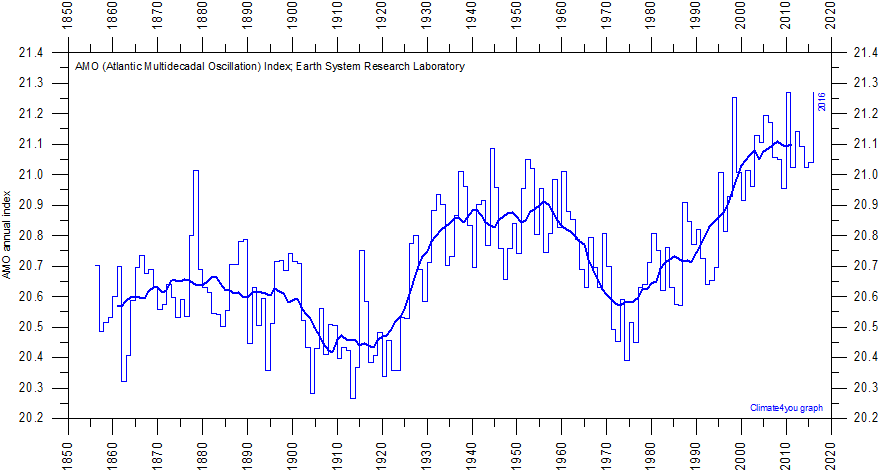
A bit stronger than SC24 is not saying much in the context of the series of cycles 12-16 centered around the year 1900. Moving the needle on decadal global temp trends might take multidecadal cycles to do it and some distributed lag term.
example:
There are others who predict differently:
From NASA,
and,
Hi Dr. S., have you seen this aricle yet?
Wondering if you might comment on this?
The Origin of Parity Changes in the Solar Cycle
Soumitra Hazra, Dibyendu Nandy
(Submitted on 16 Jun 2019)
Abstract
…Although hemispheric asymmetry in the emergence of sunspots is observed in the Sun, a parity shift has never been observed. We simulate hemispheric asymmetry through the introduction of random fluctuations in a computational dynamo model of the solar cycle and demonstrate that changes in parity are indeed possible in long-term simulations covering thousands of years. Quadrupolar modes are found to exist over a significant fraction of the simulated time. In particular, we find that a parity shift in the underlying nature of the sunspot cycle is more likely to occur when sunspot activity dominates in any one hemisphere for a time which is significantly longer than the cycle period. We establish causal pathways connecting hemispheric asymmetry and cross-equatorial phase-shifts to parity flips in the underlying dynamo mechanism. Our findings indicate that the solar cycle may have resided in quadrupolar parity states in the distant past, and provides a possible pathway for predicting parity flips in the future….
https://arxiv.org/abs/1906.06780
electric blue noctilucent clouds as far south as Joshua Tree, near Los Angeles
Warmies BEWARE. If you don’t die from the heat, the electric clouds will zap you….
How much albeto do noctilucent clouds add and does it contribute to cooling during solar minimums?
On a possibly related note, I drove through Illinois and Wisconsin yesterday and today (summer solstice) and very few corn fields looked “normal” for this date. Most fields were either unplanted or had newly emerged plants ~4” tall. Many areas of standing water are still on the fields. (climate change or solar minimum?)
Good question, farmer retired :
“Clouds, water vapor and other atmospheric gasses also absorb about 20 percent of this incoming solar radiation. Low-level clouds reflect the greatest amount of heat, which is why we enjoy cooler temperatures during a cloudy day.”
https://www.google.com/search?client=ms-android-huawei&ei=p0UOXdxqiOuuBN6vr5gI&q=How+much+albedo+do+noctilucent+clouds+add+and+does+it+contribute+to+cooling+during+solar+minimums+meaning&oq=How+much+albedo+do+noctilucent+clouds+add+and+does+it+contribute+to+cooling+during+solar+minimums+meaning&gs_l=mobile-gws-wiz-serp.
Farmer, old chap, you ask –
“Many areas of standing water are still on the fields. (climate change or solar minimum?)”
Weather.
Have a great evening.
Auto
What a great opportunity to finally see what impact the solar cycles have on short and long term weather and climate. As long as the data isn’t corrupted by the governments, we will be able to see how the Earth responds. With feedbacks and long lag times it will take a while but in 30-40 years we should have a great perspective on all this.
Unfortunately I probably won’t be around 40 years from now, but I’m betting with a change in the wavelengths hitting the Earth and the total power going down, it will turn colder.. and maybe much colder. Even now it appears changes are happening, but again it will take years for anything to become dominate.
Don’t believe the BS about the planet responding so slow. The effects will be far more immediate since if the planet didn’t respond rapidly to solar changes, we wouldn’t even notice seasonal temperature changes, much less diurnal variability.
June in the UK is shaping up to be one of the17 COLDEST of the last 350 years from the Central England Temperature record according to a recent article.
Anecdotal but I don’t ever recall having to have heating on most days in June as we have this year, and that’s in 65 years since early childhood.
Ditto re my central heating, it’s been so relatively cold in SW England! Brrr!
Alan the Brit
What part of SW UK are you?
I’m writing this from N Devon ( Clovelly Way)
Good to know there’s more than just me trying to hold back the AGW tide in this part of the world
The CET’s June data has a ‘zero’ (10^-4,or +0.01C/century) trend in its 350 year long history.
http://www.vukcevic.co.uk/June-July.gif
(this is an old graph I need to update).
now all we need is a year where its only june
Hi Steven
Your analytical mind is telling you reasons why there are no long term temperature rises due to CO2 or major fall at the time of the solar Grand Minima with principal spectral component at 22 yr Hale cycle, in the month of the peak TSI.
After *one* day of ‘summer’ on the 12th when it hit 100F, I am back to having to have the heat on with the highs in the upper 60’sF.
That’s Steven Mosher wet dreams :
ONE month he always can refer to.
And too one month he can blame “deniers” always falsely referring to.
Same from here in Canada and we’re just above the USA border.
10 yrs ago (we heat with wood) we use to order 10 to 12 cords of wood for the whole winter, in last few years we’ve been adding on 5 cords per year, last winter we went through 25 cords, in June we were taking dead trees down and burning them for heat. This year we’ll be adding another 5 cords. Everyone we know that burns wood for heat, ran out this year.
rbabcock – June 21, 2019 at 7:01 am
Well now, some of us have been “paying attention” to the changes in the weather during the past 3 Solar Cycles …… and we have been predicting a “cool down” iffen there was a continued diminishing number of Sunspots ……… and that “cool down” appears to be exactly what has been occurring, …. more profoundly during the past 8 months (November thru mid-June 2019) with above average rain events and massive flooding. Just like history tells us happened during the onslaught of the LIA.
So, iffen the rains and cool temperatures continue throughout summer and into the fall, the price of food will increase accordingly …….. and it matters not a twit what all the “experts” and their measurements and calculations are telling them to tell us.
By the way, just how many “experts” were there that their calculations predicted …. the massive rain and flood event for the Fall, Winter and Spring of 2018-2019?
Why? I thought the lower solar activity during the Maunder Minimum was responsible for colder climate. Similarly the Dalton Minimum. Not that there’s much evidence of a significantly colder climate during the Dalton Minimum period (or after)
Actually the Dalton Minimum was a very cold period, at least in Europe, which is the only area with good data that far back. The Thames froze for the last time in 1814.
So, if the prophecy of CAGW is correct, and CO2 is the determining factor in global warming, cooling, and climate change, then it is incumbent upon us to return hydrocarbons into the wild, and optimize conversion of the Sun’s low energy output. Then again, we still have temperature swings of 10, 20, 100 degrees and more, even in a steady solar state, and anthropogenic huffing and puffing has a negligible effect.
Seems almost counterintuitive to find that a quiet sun results in more radiation exposure.
Most primary galactic cosmic rays are in fact charged particles rather than the photons of electromagnetic radiation. As such, they are deflected by the magnetic fields of the galaxy, sun and earth.
https://imagine.gsfc.nasa.gov/science/toolbox/cosmic_rays1.html
NASA’s writer should have said “atomic nuclei stripped of their” electons, not “atoms”.
Primary GCRs produce secondary particles in the atmosphere, which can form cloud condensation nuclei.
NASA’s writer has a PhD in mathematics and is the production editor of Science@NASA.com. He has a side interest in GCR physics and uses that as the basis of teaching calculus that is relevant to research. I think Tony Phillips is one of the “real, pure” scientists still at NASA.
I don’t know who wrote the article I linked. The site is a “service of the High Energy Astrophysics Science Archive Research Center (HEASARC), Dr. Alan Smale (Director), within the Astrophysics Science Division (ASD) at NASA/GSFC”.
But you don’t get a charged particle (proton or alpha particle, ie an H or He nucleus) by stripping off an atom. You do if you strip an electron off a hydrogen atom or two off a helium atom.
Oops, sorry John. I misread your statement. I have seen Dr P make the same oversimplification of GCR physics.
No worries!
IMO anyone interested enough in GCRs to read that article would understand that atoms are composed of protons, neutrons and electrons, except for normal H, which has no neutron.
For reasons of the solar magnetic field polarity during the SC minima following even numbered cycles there is a prolonged but somewhat less intense exposure to the GCR
Cosmic rays shower

The radiation is cosmic rays from deep space, not the sun. The solar magnetic field normally deflects them but a quiet sun has weaker fields allowing the cosmic rays to reach earth in greater numbers. They are subatomic particles such as protons and electrons.
@cat
@Tom
I am not so sure about that.
What we get from the stars is totally negligible compared to what we get from the sun?
They’re called GCRs because they come from outside the solar system, as from supernovae and the supermassive black hole at the Milky Way’s center. The solar wind is also composed of charged particles, but earth’s magnetic field deflects most of them.
GCRs move at near light speed, while the slow solar wind near earth travels at 300-500 km/s, and the fast SW at up to 750 km/s.
John,
high speed CME’s can approach and occasionally exceed 3,000 km/sec. Most are at below 1,000 km/sec. It is the CME’s that astronauts and satellite planners need to be concerned with, as the not just the particle speed goes up, but the fluence goes up dramatically (particles per area).
Even a manned Mars mission, the latest measurements tell us that CME events will be concern for extended manned Martian surface missions.
John, et al:
As the Sun “quiets” Earth’s atmosphere “shrinks”. It doesn’t mean
there’s less atmosphere between us and space… just that rarified
space is closer to ground level than usual.
The GCRs encounter atmospheric molecules at a lower level than
they might during an “active” Sun.
The cascades of daughter particles from GCR collisions with whatever
is floating in the now “lowered” upper levels of our atmosphere have
the opportunity to interact with “high” (as measured from ground
level) altitude objects.
So too will the dust/smoke from infalling meteorites make it to a
lower level… hence the recent plethora of noctilucent cloud
observations.
See:
https://spaceweatherarchive.com/2018/09/27/the-chill-of-solar-minimum/
Joel,
You’re right that I should have added CMEs to the solar wind mix.
But still less energetic than galactic cosmic “rays”.
What we get from the sun are low energy and mostly deflected by the Earth’s magnetic field.
S-Cat,
The GCR’s that interact with Earth’s upper atmosphere are largely devoid of ultra-relativistic electrons due their trapping in the outer Van Allen radiation belt. Thus GCR’s of consequence to the Earth are almost all protons and some helium nuclei and even rarer high mass relativistic nuclei up to iron.
(ultra-relativistic electrons defined as > 5 MeV)
See more here:
“An impenetrable barrier to ultrarelativistic electrons in the Van Allen radiation belts”
D. N. Baker, A. N. Jaynes, V. C. Hoxie, R. M. Thorne, J. C. Foster, X. Li, J. F. Fennell, J. R. Wygant, S. G. Kanekal, P. J. Erickson, W. Kurth, W. Li, Q. Ma, Q. Schiller, L. Blum, D. M. Malaspina, A. Gerrard & L. J. Lanzerotti
Nature volume 515, pages 531–534 (27 November 2014)
https://www.nature.com/articles/nature13956
and see an open access Supp Figure here from that paper:
https://www.nature.com/articles/nature13956/figures/9
Note: This is in situ measured data by a satellite. (Not some model simulation.)
The sun’s magnetic field protects the earth from cosmic radiation.
Tom
I think what happens is that
= > less solar magnetic field strengths
= > more of the most energetic particles being able to escape from the sun
earth’s atmosphere is obviously protecting us but at higher levels obviously there is more risk of exposure…?
= > more ozone, peroxides & N-oxides produced TOA
= > less UV going into the oceans
= > it is cooling
On the positive side – if it weren’t for the global warming climate cult …. we’d be getting crazy lunatic rantings from the academics absolutely certain (they get money from) the global cooling climate cult.
It´s very easy smoothly switch W to C = AGC. They are not going to abandon good cult.
Anthony Watts wrote, ” … some airline flights are seeing doses of radiation up to 73 times that which we’d see at ground level.”
The “73 times” flight in the data box is XOJET 780, a charter jet (a Cessna Citation X) flying at 45,000 feet, not an airline flight at 35,000 and below like those listed.
That’s perfect irony. The rich and famous get most of the rads.
Let’s hope Gore and DeCrappio fly good and high.
Yeah, don’t see the point of the flights v rays table. Looks like altitude is the overwhelming factor in ray penetration, just as you would expect. And no other useful data shown.
“Some airline flights are seeing doses of radiation up to 73 times.. that at ground level”
Sounds like a bad advert for stain remover. So what? Do we have a useful comparison to previous solar cycles?
Long-haul cruise flights up to 41,000 feet occur as fuel burns away (depending on takeoff weights). Certainly 38 to 39kft is a common cruise altitude later during a flight. An altitude of 35kft would be low except for shorter distance domestic or intra-regional flights.
Today there was a charter flight from LAX to White Plains, N.Y. at 49,000 ft. that received an 86.6 dose rate.
Invest in lead aprons now.
Maybe tinfoil skycaps…
If “tinfoil” sky caps would help, the airliner’s aluminum fuselage would have eliminated all exposure.
less so the carbon fibre ones
Pressurized aircraft are already made of a thick gauge of aluminum ‘foil’, so no need to wear the foil beanie just yet.
“In addition, there are now forecasts that the next solar cycle, #25, will be the weakest in more than 200 years.”
If my calculations are any good (the last time gave the ‘incredibly’ accurate result http://www.vukcevic.co.uk/SSN.htm ), I have to estimate the max time of the SC25. Assuming this is a long minimum, the next max is most likely to occur some time in late 2025 or 26. If so the SC25 annual smoothed max would be be in the low 50s in the old (Wolf) numbers (mid 70s new corrected). As far as I understood Dr. Svalgaard predicts much higher peak possibly around 100 (Wolf), or in 140s in the new corrected numbers.
Solar Cycle 25 Prediction Panel
“We expect Solar Cycle 25 will be very similar to Cycle 24: another fairly weak cycle, preceded by a long, deep minimum,”
SC24 peaked at 116 in April 2014.
Then, according to the usual WUWT discourse regarding a “grand solar minimum”, it should feel cold. It does not.
Yeah, like AGW should feel warm. It doesn´t.
Dalton minimum was just couple of cycles which wasn’t long enough for temperature to drop significantly, most of the reduction is thought to be due to couple of large volcanic eruptions.
Maunder Minimum lasted 5 cycles, the fall in temperature started after about 20+ years.
According to my calculations, if they are any good,
http://www.vukcevic.co.uk/NH-GM.htm
you can see what might happen if there is another Maunder type minimum in the next few decades, depending on the 60 year and the multi-centenary cycles.
I guess blaming sunspot-famine on global warming and CO2 is a non-starter?
Blame Trump.
That’ll get a lot of traction in certain circles.
YES! His intergalactic policies have the Sun in a huff, so it joined the resistance!
Cheers!
Joe
“We are constantly flying radiation sensors onboard airplanes over the US and and around the world, so far collecting more than 22,000 gps-tagged radiation measurements.”
Imagine if the purported ‘Greenhouse gas’ property could be measured. We could have sensors at ground level, and sensors on airplanes. We could generate meaningful charts and derive meaningful formulae describing this effect by elevation. And, we could begin to formulate answers to simple questions like: If Denver has a mile less of the densest atmosphere above it than does Miami, FL, why does Denver typically get several days per year over 100F while Miami has never been over 100F?
But alas, our inability to measure this ‘property’ leaves us unable to advance our knowledge.
Miami is close to the ocean which has a localized cooling effect. Try central Florida in the summer and you will see 100F
Denver ==> Continental, lack of water mass, rain-shadow fewer clouds
Miami ==> Coastal, surrounded by water, clouds=reflection
The many real physical characteristics overwhelm any CO2 effect that might otherwise (or not) be there.
Climate classification systems have many categories.
Earth does not have a single ‘climate’.
John F. Hultquist: “The many real physical characteristics overwhelm any CO2 effect that might otherwise (or not) be there.”
Precisely!
“Imagine if the purported ‘Greenhouse gas’ property could be measured. We could have sensors at ground level…”
And the TV weather forecasts would include the CO2 count for the day:
“CO2 in the tri-cities will be over 425 parts per million over the weekend. Temperatures will increase by 0.137 degrees Fareinheit. Instead of the previously predicted high of 87, get ready for a blistering 87.137 degrees both Saturday and Sunday.”
Ever hear that? Or anything like it? Any report of CO2 levels on the weather report?
No.
Goldenrod pollen counts in PPM, yes. Humidity, yes. Minutes of sunshine, yes.
Barometric pressure, yes.
Many, many, many measurements that effect our weather are reported every day. Never is CO2 reported.
Over and over and over the CO2 cult chants: Basic physics! Arrhenius!
What’s going on?
So flying at a higher altitude increases your exposure. This is new?
Flying high during a solar minimum increases your exposure over what is usual at other times during a solar cycle is what I got out of that particular point. And it makes a lot of sense.
flying at night is OK?
Um, ok I’ll bite. No. The cosmic rays don’t come from the sun. Are you just trolling?
We are going to die….
Eventually…
But for those who believe…
No. I am puzzled by your comment.
Since cosmic rays don’t come from the sun, day or night makes no difference.
Nope–them Cosmics are 24/7
The way I understand it flying any time the weather allows is just fine. The exposure is still well below danger levels for normal air travelers. Does not matter if it’s day or night because the sources of the rays are from our galaxy and beyond and not from our sun. It’s just that the weakness of the suns magnetosphere is resulting in more cosmic rays reaching the earths magnetosphere and thus more of them penetrating our magnetosphere and atmosphere. The higher up in the atmosphere you are the greater the exposure. Astronauts outside of the earths atmosphere and yet still in earth magnetosphere are getting more than the those flying in the atmosphere. Astronauts that would be in space beyond earth magnetosphere would get even more and exposure to cosmic rays and solar radiation when the sun gets very active and has coronal mass ejections is one of the big problems that will have to be solved for extended space travel or habitation beyond a planets magnetosphere, such as a trip to mars or colonization of the moon.
Navy reactors on surface ships are, of course, installed below decks, below tons of steel and concrete and plastic shielding: The plastic slows and reflects neutrons, the steel provides pressure barriers for the high pressure steam and water and ships structural needs, the steel and concrete and water and petroleum fuel provides gamma and beta ray attenuation. Nuclear dosimetry is worn by all engineering personnel and by the CO and XO (who are always nuclear qualified officers.
On carriers, the CO and XO are also flight qualified. Those two are always the highest dosed individuals on the ship. Even though they have the LEAST time near the reactor! Even their time up high in the ship on the bridge and flight deck gives them more radiation from space than those who live below the shielding.
Nuclean submarine crews on deployment receive less radiation than civilians living on the surface.
water is a great insulator from radiation and cosmic rays.
Leif, I am a bit confused by your pdf.
Cannot I get the latest update on this graph here?
http://www.leif.org/research/Solar-Polar-Fields-1966-now.png
henryp, Leif Svalgaard , charles the moderator,
Actually, many of the graphs on our WUWT Solar reference page remain out-of-date (have not been updated) since the 2015-2016.
Slides 9 ff show the polar fields for several cycles…
Slide 18 shows the polar fields for each cycle back to number 1.
“…….airline travelers (sic) getting dosed with up to 70 times more radiation……..”
Um. The implication there seems to be a bit misleading. Travellers are NOT getting 70x more radiation than usual – they are getting a maximum of around 70x the radiation at ground level.
A normal flight gives you radiation at about 40x ground level. So in this increased period of solar radiation, the amount you get is nearly doubled, compared to a less active period…
Without defining what they mean by 70x normal radiation at ground level, their analysis is meaningless. The few times I’ve pulled out my survey meter on a plane, I typically see about 2-2.5mR/hr, at cruising altitude (typically 30-35k feet). Next time I’m on a plane (next week) I’ll see check and see if anything has changed.
ok – they mean some kind of average. there will be problems with any average but so long as they use the same averaging technique it should cancel out…
Ok fine. But they don’t tell us what the average is.
It is cold and cloudy here day after day. No summer yet. High today in the 40s. We are missing our opportunity to see those noctilucent clouds, darn it.
and where is that?
Oh sorry for you and family… Here in Northern Germany, the somewhat colder May has made way for a wonderfully warm June.
In France, however, they aren’t so happy, as they expect up to 40 °C next week.
Blasted weather! If only there was some way to control it…🙄
😱 With less than 12 years left to live, who cares? 😉 ;-(
And so, does this not seem the perfect time to be researching Henrik Svensmark’s theory and trying to quantify just how much effect cloud seeding by cosmic rays really does effect weather and climate?
I’ll tell you that based on just anecdotal evidence this truck driver observes in his little patch of this earth here in Indiana that there sure seems to be something to the idea the effect is significant. Seven days with 7″ in the rain gauge and more in the forecast and little sun between the showers and thunderstorms.
It’s been 12 years since his book “The chilling stars” was published. Quite an appropriate title. And there was the cloud experiment at CERN. But as with nearly everything you search for on the internet, there is still furious denials that cosmic rays have any affect on our weather. Only the existence of God seems to have as many internet battles. Then again, climate change is the new religion.
From a top level look at things, the local green houses here in central iowa are no longer stocking zone 5 plants. I lost some that have been doing fine for the last 15 years. These last two years did them in. The green houses took some big hits this last winter and spring.
I had a large ash tree (red berry type) that used to fill mybackyard with berries that then filled my backyard with hundreds of blue grosbeaks that cleaned up the berries in a day ir two.
https://www.audubon.org/field-guide/bird/blue-grosbeak
The past three excessively cold winters killed it off ~1/3 at atime. We had to saw it down this spring.
Plant wild cherry trees. They are amazing bird attractors. Especially fun when the late ripe beries start fermenting and the birds get drunk.
I had 6 -7 big wild cherry trees on the back of my property in Massachusetts (abutted on the Assabet River). So much good natural bird food. The only down-side was the birds covered by back deck with cherry pit-seeds, and needed regular sweeping.
From the misleading headlines department:
Sun spotless for 33 days straight – airline travelers getting dosed with up to 70 times more radiation
Passengers typically experience dose rates that are 20 to 70 times higher than natural radiation at sea level.
So just how much more “cosmic radiation” (primarily high-energy protons and atomic nuclei) does one get from a spotless sun? It isn’t 7,000% now, is it?
It’s Gaia’s revenge; for helping to kill the planet. Payback’s a beech.
Payback’s a beech.
Payback can also bite you in the ash.
Obviously the proper take away is that CO2 is weakening the sun’s output…..
I wager the presently humid mesosphere has as much to do with NLC formation as increased GCR. I’m getting the notion that nothing in nature has just a single factor driving it.
< Sun spotless for 33 days straight.
However, according to the SIDC (Belgium), there was a small sunspot on May 29.
How do the predictions for sunspots made by Leif Svalgaard and his group compare with the predictions produced by Professor Valentina Zharkova, using a different method?