
Glaciers Appear to be Growing, not Melting in Recent Years
By Roger I. Roots, J.D., Ph.D.,
Founder, Lysander Spooner University
May 30, 2019. St. Mary, Montana. Officials at Glacier National Park (GNP) have begun quietly removing and altering signs and government literature which told visitors that the Park’s glaciers were all expected to disappear by either 2020 or 2030.
In recent years the National Park Service prominently featured brochures, signs and films which boldly proclaimed that all glaciers at GNP were melting away rapidly. But now officials at GNP seem to be scrambling to hide or replace their previous hysterical claims while avoiding any notice to the public that the claims were inaccurate. Teams from Lysander Spooner University visiting the Park each September have noted that GNP’s most famous glaciers such as the Grinnell Glacier and the Jackson Glacier appear to have been growing—not shrinking—since about 2010. (The Jackson Glacier—easily seen from the Going-To-The-Sun Highway—may have grown as much as 25% or more over the past decade.)
The centerpiece of the visitor center at St. Mary near the east boundary is a large three-dimensional diorama showing lights going out as the glaciers disappear. Visitors press a button to see the diorama lit up like a Christmas tree in 1850, then showing fewer and fewer lights until the diorama goes completely dark. As recently as September 2018 the diorama displayed a sign saying GNP’s glaciers were expected to disappear completely by 2020.
Video of the diorama two years ago.
But at some point during this past winter (as the visitor center was closed to the public), workers replaced the diorama’s ‘gone by 2020’ engraving with a new sign indicating the glaciers will disappear in “future generations.”
Almost everywhere, the Park’s specific claims of impending glacier disappearance have been replaced with more nuanced messaging indicating that everyone agrees that the glaciers are melting. Some signs indicate that glacial melt is “accelerating.”
A common trick used by the National Park Service at GNP is to display old black-and-white photos of glaciers from bygone years (say, “1922”) next to photos of the same glaciers taken in more recent years showing the glaciers much diminished (say, “2006”). Anyone familiar with glaciers in the northern Rockies knows that glaciers tend to grow for nine months each winter and melt for three months each summer. Thus, such photo displays without precise calendar dates may be highly deceptive.
Last year the Park Service quietly removed its two large steel trash cans at the Many Glacier Hotel which depicted “before and after” engravings of the Grinnell Glacier in 1910 and 2009. The steel carvings indicated that the Glacier had shrunk significantly between the two dates. But a viral video published on Wattsupwiththat.com showed that the Grinnell Glacier appears to be slightly larger than in 2009.
The ‘gone by 2020’ claims were repeated in the New York Times, National Geographic, and other international news sources. But no mainstream news outlet has done any meaningful reporting regarding the apparent stabilization and recovery of the glaciers in GNP over the past decade. Even local Montana news sources such as The Missoulian, Billings Gazette and Bozeman Daily Chronicle have remained utterly silent regarding this story.
(Note that since September 2015 the author has offered to bet anyone $5,000 that GNP’s glaciers will still exist in 2030, in contradiction to the reported scientific consensus. To this day no one has taken me up on my offer. –R.R.)
Additional Facebook video from Roger Roots.
Ooooooops . . . as the saying goes, reality is a b-i-t-*-h.
But wait, I’m sure there is a government grant somewhere to find out why this is occurring despite infallible, mankind-originated CO2 global warming.
The person who authorized the expenditure to design, make, and install that display should be made to pay for it out of his/her own pocket as a fraudulent use of taxpayer money, then sent off to prison. Wanna bet it cost over $1M (and someone related to the same person got the job?)
Regular Readers: Please Help ==> Somewhere here at WUWT recently there was a graph of percentages of mortality due to heat and cold. Can anyone give me a link to the post it appeared in? Thanks, Kip
Stand down. I helped him.
Kip,
I found this today: https://www.wunderground.com/cat6/Which-Kills-More-People-Extreme-Heat-or-Extreme-Cold
Hopefully, it might be of use to you.
So depending how you rig the statistics you can get either in front and as we have no way in a toxic political field to agree on how it should be treated .. let the games resume.
Jan 6 2010 WUWT post ?
This display was up at the Smithsonian until recently – maybe it’s still there (-:
New gone by 2050 signs/messages will be phased-in over the coming months.
When I visited the GNP last summer I noted these signs and lamented, loudly so those around us could hear, to my wife that our government should not be in the business of indoctrinating people like this. There were others who I could overhear talking to their children about how I was a dreaded “science denier”, and not to listen to me. All I could do was laugh at the ridiculousness of it. Now, come to find out the glaciers have been growing for almost a decade, unfortunately most of the population will never hear that information and remain ignorant until it becomes undeniable in another decade or two.
The pictures were also highly suspect in my book, just as the ones in the Olympic NP are at Hurricane Ridge. Melting glaciers are par for the course, not some unusual catastrophe to be avoided at all costs to our economy and culture.
I was at the Garfield park conservatory in Chicago. In the kids tutorial they had a sign that plants use water and air to grow. They couldn’t mention that it’s carbon dioxide and not air in general. Might give CO2 a good name after all.
I’ve been to GNP twice in the last two years. If you can go there and do anything other than marvel at the health and resiliency and magnificence of that environment you are sick in the head. To sight see while fretting over the imagined future of the park is truly going out of your way to diminish the whole experience. But, different strokes.
97% of all scientists were wrong.
It can be higher than that, it was about 99% in Einsteins time. On all published polls you won’t find a number higher than 20% of scientist that accept QM because you have to include all the soft sciences. I think acceptance of General Relativity has increased lately because of the gravity wave detectors but it languished at around 42% for years.
That is why science is not a popularity contest because it is not unusual for the majority to be wrong.
I bet the scientist behind this will soon never have been existed and the author has always been an uneducated summer employee or something.
Pity that the pictures are disabled.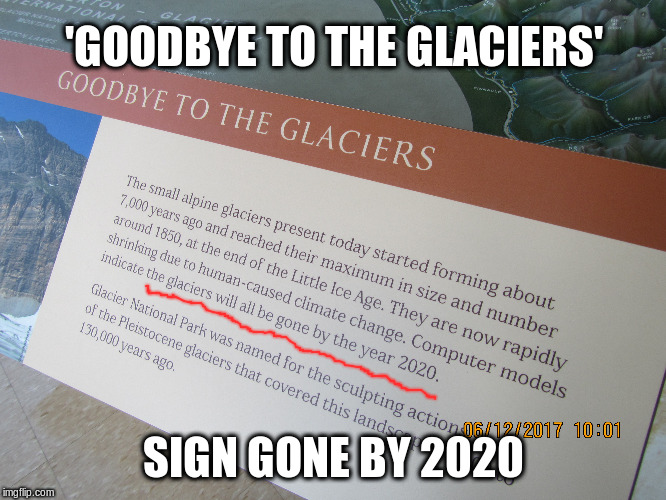
I thought it was good.
This was on display in the Smithsonian until recently – maybe it’s still there (-:
Before we declare victory in the war for climate truth, is it possible that this change in signage is just due to different bureaucrats in D.C. ?
Once again liberals attempt to re-write history.
dont get your science from park signs, or old newspaper clippings, or youtube videos.
I know its hard, but read the actual science.
There is no science. When you try to touch it, poof, it evaporates.
steven mosher June 6, 2019 at 6:13 pm
…read the actual science.
Analyse the actual data. (if you can find it)
If you were tortured that much would you hang around to be found.
LdB June 7, 2019 at 6:28 am
Ha ha ha ha ha ha ha ha ha!
First chuckle of the day (-:
Which one?
These?!?
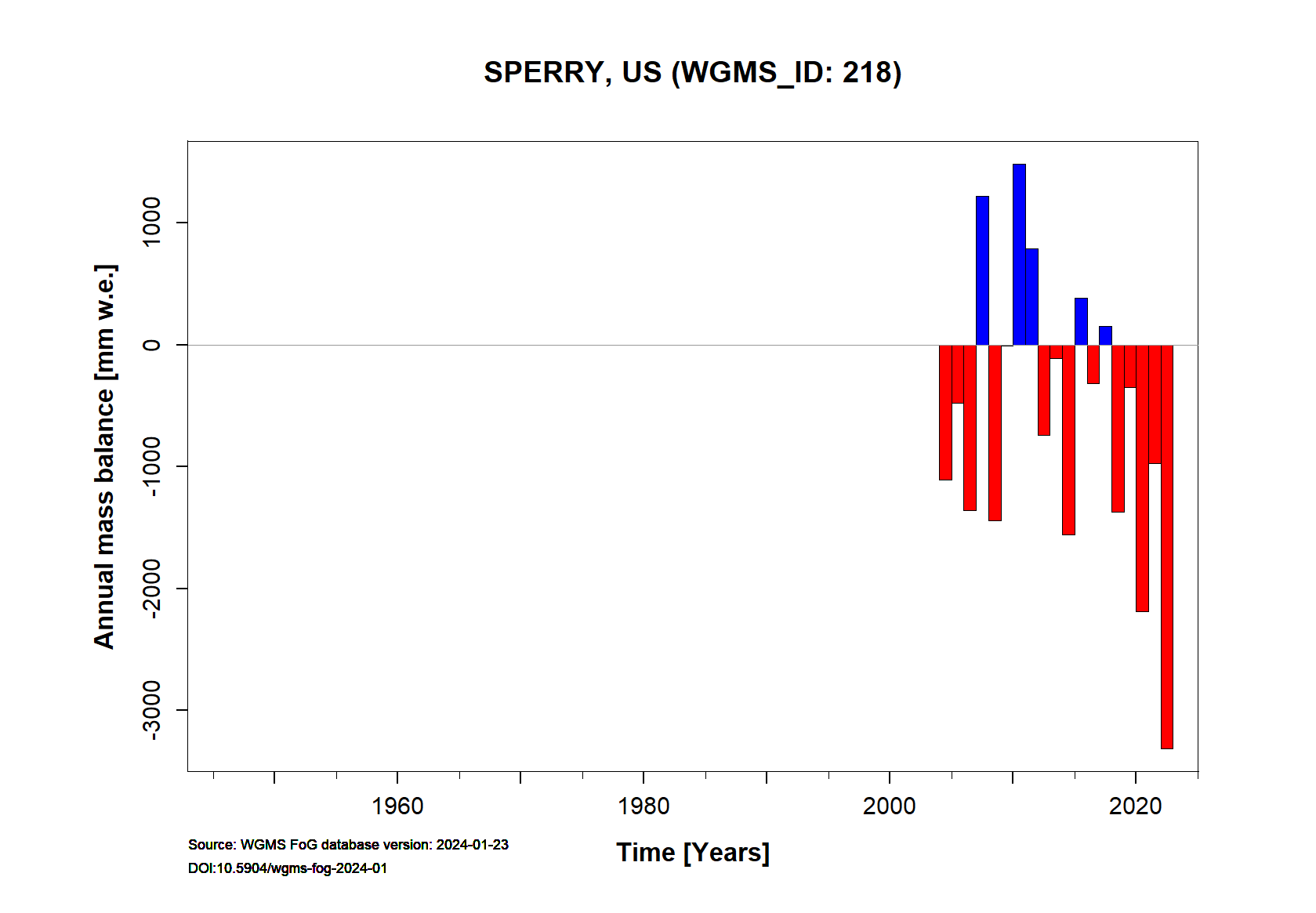
WGMS Sperry glacier
https://www.usgs.gov/news/glaciers-rapidly-shrinking-and-disappearing-50-years-glacier-change-montana
or these?
GNP Glacier area
https://www.usgs.gov/data-tools/area-named-glaciers-glacier-national-park-gnp-and-flathead-national-forest-fnf-including
Science from park signs, old newspaper clippings and youtube videos is far more honest than the sort of Climate “Science” you espouse.
“dont get your science from park signs, or old newspaper clippings, or youtube videos”
or drive by commenters
As usual, Mosher misses the point. The vast majority people will never “read the actual science”. They’ll just get bombarded by this nonsense over and over again, and will come to see it as truth. I’m surprised you don’t see how that works.
On an Alaskan cruise back in 2013, I went up Glacier Bay.. A nice Park Ranger lady on our ship explained how the original British explorers in the late 1700’s couldn’t go up the bay because it was blocked by …glaciers.
But today? We can go all the way up. Why ? Because the glaciers have retreated, and (in her words) a “healthy glacier” would not do that.
I challenged her, pointing out that IF the glaciers had not retreated, she would not have a job in Alaska—because it would have been utterly frozen all year round. AND that the glaciers there had been retreating long before anyone could attribute their retreat to ACG. IOW it has nothing to do with their “health”.
She had no comment…and probably no understanding, either—when I tried to explain the Pathetic Fallacy to her.
more interesting than park signs
https://www.nature.com/articles/s41586-019-1258-4
I thought I recognized roger
https://wattsupwiththat.com/2016/05/04/usgs-appears-to-be-removing-its-websites-claiming-all-glaciers-will-be-melted-from-glacier-national-park-by-2030/
start here
http://www.antarcticglaciers.org/glaciers-and-climate/glacier-recession/mapping-worlds-glaciers/
“Number of glaciers
From the RGI, we can learn that there are 198,000 glaciers in the World. However, this is a slightly arbitrary quantity, as it depends on the quality of the digital elevation model used, mapping resolution, and the minimum-area threshold used. Most analysts use a minimum area threshold of 0.1 km2; they will not map anything smaller than this due to difficulties in distinguishing between glaciers and snowpacks. If these small glacierets are including, the number of glaciers in the World could be up to 400,000, but they would still only account for 1.4% of the World’s glacierised area.
Together, these glaciers cover 726,000 km2. The region with the most ice is the Antarctic and Subantarctic, with 132,900 km2, closely followed by Arctic Canada North (104,900 km2). At the other end of the scale, New Zealand has only 1160 km2 of ice. In total, 44% of the World’s glacierised area is in the Arctic regions, and 18% is in the Antarctic and Subantarctic. Glaciers cover 0.5% of the Earth’s land surface13.”
want to track glaciers over time?
http://www.glims.org/
view them?
http://www.glims.org/maps/glims
You will have a tough time finding the glaciers mentioned in the post because they are the tiniest cherries
Of the glaciers that “they” are monitoring, How many are the big tidewater glaciers?
Hubbard glacier, the largest Northern Hemisphere tidewater glacier outside of Greenland….Advancing. https://pubs.usgs.gov/fs/fs-001-03/
Taku Glacier… the largest glacier of the Juneau ice field. A tidewater glacier which is advancing/growing – the largest glacier in the Juneau Ice field. Recognized as the deepest and thickest alpine temperate glacier known in the world, the Taku Glacier is measured at 4,845 feet (1,477 m) thick.[1] It is about 58 kilometres (36 mi) long, and is largely within the Tongass National Forest. BTW – it’s advancing.
Same thing with the largest tidewater glacier in the Southern Hemisphere outside of Antarctica… is advancing – Perito Moreno Glacier The 250 km2 (97 sq mi) ice formation, 30 km (19 mi) in length, is one of 48 glaciers fed by the Southern Patagonian Ice Field located in the Andes system shared with Chile. This ice field is the world’s third largest reserve of fresh water.
Are these glaciers of the ones being monitored, cherry picked?? Probably not …
It should be clear that these statistics don’t include the Greenland and Antarctic icecaps.
However, and somewhat confusingly, they do include other glaciers in Greenland and Antarctica, even if they are more or less contiguous with the ice-caps, but are glaciologically independent. It was this that caused the Time Atlas debacle some years ago when they got hold of a map of the main Greenland icecap without these smaller glaciers and trumpeted that huge areas had become ice-free:
https://wattsupwiththat.com/2011/09/17/complaints-over-false-info-in-new-times-world-atlas-grow/
Steven, your references stopped short of declaring what the ‘correct’ area of glacier coverage is for the Earth. Is 0.5% of the Earth’s land surface more than the correct area or less? Perhaps you could tell us if we currently have too much glaciation going on or not enough, and why?
An incompetent, exaggerating, cherry picker such as this, offering to bet $5,000 against the consensus of scientific experts such as yourself, should be easy pick’ns.
Another thing…. the latest opening of Going to the Sun Road over Logan Pass was July 13th, 2011…not that many years ago…
They now say it’s because of a reduced staff…lol…they didn’t say that at the time…I remember following it at the time. It was because of the increased winter snowfall that year.
That was not that many years ago…and the records go back to 1933 – 1934 – That’s 85 years or more.
I have wondered about the definition of a glacier.
When does a patch of snow/ice that lasts through the summer months become a glacier? When it flows?
And if that is so, then when does a patch of multiyear ice cease being a glacier? When it completely melts away one summer even though it has been retreating for years/decades/centuries and thus not really flowing?
Correct, when it flows. That is the definition of a glacier. When a glacier stops flowing it becomes “dead ice”. Dead ice can last for centuries before melting, particularly if covered by sediments, but it is no longer a glacier.
And a patch of snow can also last for many years, but as long as it doesn’t flow, it is just a perennial snow patch.
Climate science or Nick hasn’t redefined them yet? There is low hanging fruit to get more melt water from when the science really needs it.
I was in Aspen CO in 1965 and 1966. I remember in the early fall in 1966 before the snow fell -, I walked up to the very top of the snow field in a late August afternoon… I could hear rocks falling by themselves from the highest Maroon peak as I sat there for a while to rest. I have an 8 mm video of me in street shoes sliding down the snow field… It didn’t take long to scramble up the 1-1500 feet to the top of the snowfield.
As far as I know there are no pics since then – 1966 where the ice field had disappeared…
It’s still there all summer.
At the Iris Griffith Centre on the Sunshine Coast, north of Vancouver, I photographed the Little Ice Age growth rings, clearly shown and labeled on a cedar log section from a tree that began life in 155 AD. https://photos.app.goo.gl/bXoyS2wfmz1eMT9P8
Rhe Stuff news website in New Zealand is reporting that CO2 levels are now the highest in human history and the highest in millions of years. Any comments please?
Paul … at 11:04 pm
…CO2 levels are now the highest in human history and the highest in millions of years. Any comments please?
Sure, “So What?”
For most of humanity life has never been so good. Humanity only advanced when energy became cheaper and more abundant.
All of the plant life on Planet earth benefits from increased atmospheric CO2 levels. All of the Planet Earth animal life benefits from the increasingly abundant plant life. It’s a ‘Win-Win’ solution.
You might want to look at this – CO2 is low capered to the past:
https://www.youtube.com/watch?v=JdmBaBS4zkU
JPP
The last time CO2 levels were this high was during the Pliocene Epoch 3-5 million years ago.
https://www.rmets.org/event/pliocene-last-time-earth-had-400-ppm-atmospheric-co2
Possibly, but proxy data have very low definition. If you change it to “CO2 levels are now the highest in human history, except perhaps for intervals up to a few centuries, and the highest in millions of years, except perhaps for intervals up to a few tens of millenia” I would agree.
If you look at stomata data, the only proxies that can give data for a single point in time, there are several studies that have yielded CO2 levels as high or higher than now. However they also only apply to a point in space, and while CO2 is often claimed to be well mixed in the atmosphere, it isn’t.
I too worried about the potential loss of glaciers in Glacier National Park. But I don’t any more, because I went there. When you visit, you realize the spectacle has little to do with the current crop of wimpy glaciers. The glaciers could all be gone and the name Glacier National Park would still be appropriate. That’s because the terrain – AMAZING vertical and expanses contained in rock walls thousands of feet high – was carved by raging full tilt glaciers of the last glacial prior to the current interglacial that started over 10,000 years ago.
Go see it. It’s way better than Yellowstone and even Yosemite.
/Doing so this early September.
If it’s consensus that it melts by
2020.. no 2030, and you offer bet at 1:1, then there surely should be takers… /sarcTypical Gummint waste when they could have simply crossed out the 2 for a 3 with a texta. Will this extravagant waste of the planet’s resources ever cease?
Well, gee whiz, they should be happy, shouldn’t they?
I have a friend who lives in Montana, who has told me that the biggest concern with residents of her city is that the snow/ice cover will be insufficient to supply the city’s water needs.
You’d think this would make people happy. Now they have to change the signs? There is never any rest for the weary and silly, is there? Why don’t these park employee mopes just use their tabletop models to show the retreat line and the “new” advance line, instead of trying to hide their errors? That’s like making mistakes on your homework and then trying to hide them from the teacher.
Meanwhile, back here in the UK…
Near where I live in Sussex, is Bodiam Castle – managed by English Heritage. just outside the inevitable Tea Room is a little stream – and on an information board descriptions of the busy Roman era ironworks which used said little stream for transporting goods to the sea. The information board concludes with the warning to take full advantage of the footpath beside the stream, because in 50 years time ‘the area will all be under water due to sea level rise’….
If only I could come back in 50 years time….
Lysander Spooner University
He’s one of my heroes and I did not know that a university had been founded in his honor. Interesting.