A new study has revealed how clouds are modifying the warming created by human-caused climate change in some parts of the world
Swansea University

A new study has revealed how clouds are modifying the warming created by human-caused climate change in some parts of the world.
Led by Swansea University’s Tree Ring Research Group, researchers from Sweden, Finland and Norway analysed information contained in the rings of ancient pine trees from northern Scandinavia to reveal how clouds have reduced the impact of natural phases of warmth in the past and are doing so again now to moderate the warming caused by anthropogenic climate change.
Even though northern Scandinavia should be strongly affected by global warming, the area has experienced little summer warming over recent decades – in stark contrast to the hemispheric trend of warming temperatures, which is strongly linked to rising greenhouse gas emissions. According to the study, temperature changes have been accompanied by an increase in cloudiness over northern Scandinavia, which in turn has reduced the impact of warming.
Mary Gagen, Professor of Geography at Swansea University, said: “The surface warming caused by rising greenhouse gases is modified by many complicated feedbacks – one thing changing in response to another – meaning that there are large geographical variations in the temperature of a particular place at a particular time, as the global average temperature rises. One of the most important, and most poorly understood, climate feedbacks is the relationship between temperature and clouds. We might think that, simply, when it is cool it is cloudy, and when it is warm it is sunny, but that is not always the case.”
The research team analysed tree ring records to find out what summer temperatures were like in the past, and how cloudy it was. Using their collected data, the team produced a new reconstruction of summer cloud cover for northern Scandinavia and compared it to existing temperature reconstructions to establish the relationship between temperature and cloud cover.
Professor Mary Gagen said: “Most people know that the width of a tree ring can tell us what the temperature was like in the summer that ring grew, but we can also measure other things in tree rings such as the isotopes of carbon and water that the wood is made from. Isotopes are just different types of an element, the amount of the different isotopes of carbon in the wood tells us how cloudy it was in the summer the tree ring grew. By combining the tree ring width and tree ring carbon measurements we built a record of both past summer temperatures and past summer cloud cover. Summer temperatures in Scandinavia have increased by less than the global average in recent decades because it also got cloudier at the same time, and that modified and reduced the warming. That turns out to also be the case back through time.”
Author Professor Danny McCarroll explained: “We found that over short timescales, increased cloud cover lead to cooler temperatures and vice versa in the past. However, over longer timescales -decades to centuries-we found that in warmer times, such as the medieval, there was increased cloud cover in this part of the world, which reduced local temperatures. The opposite being true in cool periods, such as the Little Ice Age.
“These finding are important as they help to explain the feedback relationship between cloud cover and temperature, which is one of the major uncertainties in modelling future climate. Understanding the past relationship between temperature and cloud cover in this part of the world means we can now predict that, as the global temperature continues to rise, that warming will be moderated in northern Scandinavia by increasing cloud cover. The next step is to find out whether the same is true for other parts of the world.”
Professor Mary Gagen added: “One of the main sources of uncertainty about future climate change is the way that clouds are going to respond to warming, cloud cover has a really big influence on temperature at the surface of the Earth.
“Clouds are going to be critical in modify warming of the climate. In some places, like Scandinavia, it turns out that the summer climate gets cloudier as the planet warms, in other places though it is likely that warming will be enhanced by a reduction in cloudiness which will make the surface of the Earth even warmer. What is really worrying is that climate models have shown that, if greenhouse gas emissions are allowed to continue until there is double or even triple the pre industrial amount of carbon dioxide in the atmosphere, then some of the most important clouds for cooling our planet, the big banks of oceanic clouds that reflect a lot of sunlight back to space, could stop forming altogether and this would really accelerate warming.”
###
The study, Cloud Cover Feedback Moderates Fennoscandian Summer Temperature Changes Over the Past 1,000 Years, is published in Geophysical Research Letters.
Public Release: 25-Mar-2019
Any “expert” would know that clouds ARE a response to any attempt to warm the planet.
Has the cloud cover gone up?
@Leitwolf and they reduce penetration of illumination more, not to mention they’re basically made of heat and water and emit that heat in all directions as well.
Err, is that not what Eschenbach said?
Read his Thunderstorm Thermostat Theory, it is on the web.
Ralph
In a previous article, I summed up current climate change science with one simple equation:
change = increasing CO2
After reading this article, I realized that there is another equation that I overlooked:
no change = increasing CO2
Modern climate change science in two simple equations. Or perhaps there is another equation:
good ≠ increasing CO2
Perfect! All the math you need to be an official climate scientist!
After reviewing fungal growth on my foot, I was able to determine the cause of the big bang. Do not ask me how I was able to correlate the two events, I just did.
How the hell do you use tree rings to determine cloudiness?
You could be on to something. Whenever I stub a toe I let out a big ouch.
In the tropics morning cloud formation EMERGES when water surface temperatures rise sufficiently. These clouds curtail the surface warming RATE significantly when they form. Thunderstorm cells and lines of storms frequently form thereafter leaving the surface temperatures LOWER than the temperatures that caused the storms to emerge. By nighttime, the cloud cover has usually dissipated…so relatively little positive feedback overnight. IN THE TROPICS, clouds are massively negative feedback elements. It has several degrees of negative effect that’s easily seen in the daily surface water temperature rise charts. Then at night, the usual absence of clouds has a relative cooling effect also. Intertropical diurnal temperature plots show clouds to be MASSIVELY negative…when and where temperatures get high enough to trigger cloud formation. This is all driven by water temperatures…hardly responsive at all to CO2 concentrations. Higher temperatures = more negative feedback. Lower temperatures = less negative feedback. This is active temperature regulation in the region where the sun’s radiation impacts earth the most. And it’s got next to nothing to do with CO2.
Clouds ARE both positive and negative feedback elements. Mostly negative during the day and only positive during the night. So the complex “when and where” of clouds (including altitude – higher clouds are mostly sun reflectors to space) makes all the difference. Daytime clouds frequently do not persist overnight. Nighttime cloud cover frequently “burns off” through the morning hours.
Further, daytime clouds reflect sunlight back into space across nearly the entire spectrum. Clouds reradiate back to earth only in the IR.
In this study, they appear to describe regions where negative feedbacks predominate.
The jury us still out on the entire earth cloud effect balance…as in the science is not settled on ONE OF THE MAJOR earth energy budget elements.
“Mostly negative during the day and only positive during the night.”
High Cirrus cloud is +ve 24/7.
More LWIR is back-radiated than SW is reflected …..
http://www.aos.wisc.edu/uwaosjournal/Volume28/Hang_MS.pdf
“Cirrus clouds exert a net warming effect in both hemispheres, but
especially in the mid latitudes where the radiative effect reaches 7 W m-2”
Well as a contradiction to this latest years cloudiness and warming goes hand in hand.
I do not contradict the paper but see another cause this time-SO2
We have reduced SO2 since 1980. Now it is less than 10% of what we used to emit -thanks to clean air act.
No doubt true in the US and Europe. Just the opposite in China, India and Africa.
Of course it does, as clouds are WARMING the planet. We actually cause some global warming by seeding the atmosphere with contrails.
Leitwolf: bear in mind that those contrails are typically at around 35,000 feet – near enough to just discern the aeroplane at the front – and the temperature up there is around -40 to -50 degrees Celsius.
Contrails are warming the planet ? Yet another scary story!
@Leitwolf, I can’t take you serious if you don’t provide any information as to how you get to your conclusions. My alarm bells go off when some one uses random caps-lock in a sentence and replies on almost everyones comment. This comes across as activisme and not trying to use arguments and have a civil conversation on a topic. Most people are here to learn and not to be mislead.
Don’t take it personal and use this feedback I gave you to your advantage.
I posted it already above..
https://de.scribd.com/document/369953233/The-Net-Effect-of-Clouds-on-the-Radiation-Balance-of-Earth-2
Clouds moderate temperature swings instead of enhancing them as all the models assume.
Interesting.
I wonder how long until the models are adjusted to add in this new data?
“Using their collected data, the team produced a new reconstruction of summer cloud cover ” ?
Tree rings can tell what the cloud cover was in the past ?
ROTFLMAO…..
Maybe the reason Scandanavia has less warming is they have more dense, more complete temperature records that are resistant to in-filling compared to places like Siberia, Alaska, and No. Canada?
I’ve looked at clouds from both side now:
So – H20 – the most plentiful greenhouse gas, is in fact, a moderating influence.
PREVENTING extremes.
I seem to remember saying this before.
Climate “Whack-a-Mole” continues.
It makes sense that warmer temperatures lead to more cloudiness. This will have the effect of moderating temperature extremes throughout the day. It will generally be cooler during the day, and warmer night. Now they just have to explain why this is bad.
clouds have moderated warming triggered by climate change
That has a familiar ring. Where have I read it before? I wonder.
“…triggered by ‘climate change’…”
WARNING! WARNING! ASSUMPTIONS AND BULLSHIT DETECTED!
AGW is not Science: “…triggered by ‘climate change’…”
WARNING! WARNING! ASSUMPTIONS AND BULLSHIT DETECTED!
The wording could be improved. The “warming” is the “climate change”. Climate changes in the past, the focus of the paper, have included alternations of warming and cooling.
This is concordant with other results showing that (a) rainfalll increases with warming (O’Gorman et al); and (b) lightning increases with warming (Romps et al — the lightning change representing a tiny fraction of the increase in net transfer of energy from the surface.)
So, the shorter version is, “The function of clouds as an aspect of climate continues to befuddle Warmists and their models.”?
Ferd wrote:
We might think that, simply, when it is cool it is cloudy, and when it is warm it is sunny, but that is not always the case.”
===========
“Nope, that only holds in daytime. At nightime it is reversed.”
I have felt like a stuck record saying exactly this on this site. Even obviously intelligent contributors here continue to ignore it. I have learnt it through working outdoors over the last 50 years. One man’s observations don’t count for much.
Crazy that one simple fact has to be repeated: At any one time half the world is in shade. Clear skies cool rapidly at night. Cloudy skies hold heat at night. So many intellectuals are blinded by detail.
Cheers
M
Sigh.
So once again, tree rings tell us temperature? NO, They don’t. Tree rings tell us how much that specific tree grew over that specific year in that specific place, and many things impact this growth such as sunshine, ground water, minerals, humidity/wind-speed, and yes – temperature.
And now an alarmist has discovered that cloud cover varies, and this affects temperature? Great, welcome to the 5th grade science level.
And their conclusion is that man-produced CO2 is causing increasing cloudiness in their specific country, but that the models tell us that clouds will stop forming if we don’t do something now? This is not even rationale, let alone scientific. Lots of things could be causing the increase in cloudiness (assuming they got that measurement right) – so let’s start by going through this list and ruling them out before jumping to a conclusion.
Models can’t predict cloud formation 1 year into the future, let alone 50 years. Why would anyone then jump to the conclusion that because the models say cloud formations will decrease it is suddenly going to warm in this place that isn’t warming now. Perhaps, just perhaps the Sun’s activity is driving increased cloud formation? Perhaps low level clouds will help to warm this area? Perhaps in 50 years they may finally have the models producing useful predictions?
This thing call CO2 can do just about anything. Just ask a climate alarmist. Amazing indeed.
Joel O’Bryan
“Maybe the reason Scandinavia has less warming is they have more dense, more complete temperature records that are resistant to in-filling compared to places like Siberia, Alaska, and Canada?”
I’m wondering how a person manages to inform us so accurately about solar irradiance facts while believing in such a nonsense like above.
Linear estimates OUT OF ghcn DAILY, for Denmark, Iceland, Sweden, Finland and Norway, in °C / decade, for 1949-present and 1979-present (Iceland had no valuable data before 1949)
Denmark
– 1949-2018: 0.07 ± 0.02
– 1979-2018: 0.28 ± 0.05
Iceland
– 1949-2018: 0.18 ± 0.02
– 1979-2018: 0.56 ± 0.05
Sweden
– 1949-2018: 0.24 ± 0.03
– 1979-2018: 0.50 ± 0.08
Finland
– 1949-2018: 0.30 ± 0.04
– 1979-2018: 0.58 ± 0.09
Norway
– 1949-2018: 0.32 ± 0.03
– 1979-2018: 0.58 ± 0.05
A good supplement to this data would be: how many stations per km² land surface were active in which years!
That might pretty good explain why Denmark keeps so ‘cool’…
Bindidon,
I’m curious as to what s/w you use for your trends and uncertainties. Excel? R? Something else entirely? I use both of the former, with some Oracle database-ing added in.
James Schrumpf
It depends on which source I process. Some of them can be directly entered into spreadsheets; some require huge preprocessing (especially GHCN daily with about 30 GB data). In that case I use sometimes GNU’s scilib.
It was a question, not a statement. Note the “?”.
I admitted no knowledge about the nature of the Scandanavian surface records.
And last time I checked, Iceland is not considered part of Scandanavia, nor is Greenland, even though Denmark administers it I think.
Joel O’Bryan
Each European knows that Iceland doesn’t belong to Scandinavia. I added it because so many Americans think so.
Scandinavia = Sweden + Norway
To include all the nordic countries the term “Norden” (literally “the North”) is used locally. This includes Finland, Sweden, Denmark, Norway, the Faeroes and Iceland (but not Greenland)
it looks like 3 of the 5 records would have negative values for the periods of 1949 – 1979.
Curious what the same records would indicate for the period of 1919 – 1949 and how that rate of warming compares to the 1979 – 2019 period
Bryan A
With the exception of Norway (+0.15 °C), all have for 1949-1978 a slightly negative trend between -0.09 and -0.14 °C / decade.
When I have some time to spend I’ll generate a graph comparing 4 of the 5 for their entire common period.
Bindidon,
Have you used the ODBC features of Excel to directly connect to databases such as MySQL, Oracle, Access, or SQLServer?
James Schrumpf
No. When processing temperature or sea ice or sea level time series, I do not really need database access.
https://drive.google.com/file/d/11asr5iVMPl_PhGsiwW5MYRQvmpyUO2-k/view
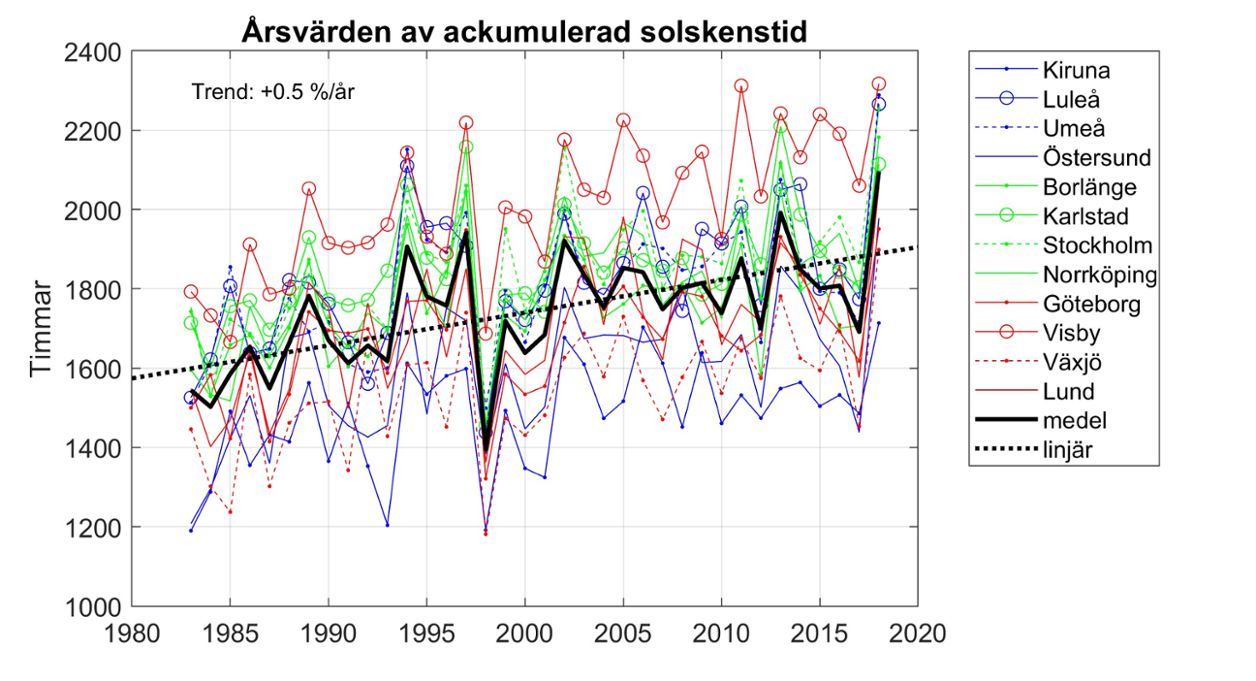
“According to the study, temperature changes have been accompanied by an increase in cloudiness over northern Scandinavia, which in turn has reduced the impact of warming.”
However the amount of solar radiation reaching the surface in Northern Scandinavia has been increasing by an average 0.3 % per year since 1980, not decreasing:
More fake science to save “the narrative”.
Is it global temperature increases that cause the increased cloud formation?
Or solar changes (indicated by solar flares and geo-solar magnetism changes) ?
Is this a “Svensmark Moment”?
Read the post above. Cloud cover has decreased