Guest Post by Willis Eschenbach
[UPDATE] I’ve discovered an error in the calculations that invalidates most of this post, with the exception of the snow extent data. See the explanation here.]
As I mentioned in a recent post, the CERES satellite folks have released another year’s worth of data. Since this should have gotten us past the temperature bump related to the 2016-2017 El Nino, I thought I’d take a look at the temperature and the temperature trends. First, the temperature:

Figure 1. Global average surface temperature, CERES satellite data.
Interesting … the trend is quite small, and is not statistically different from zero. Looking at that, I thought I should look to see which parts of the planet have warmed and cooled over that 18-year period. Figure 2 shows that result:

Figure 2. Map showing temperature trends on a 1° latitude by 1° longitude grid, Pacific centered. Areas in green and blue are cooling, and yellow to red are warming.
I love science for the surprises. Here’s the first surprise in this result—on average, the oceans are warming, but the land is cooling. In particular, the entirety of North America has been cooling over the 18 years. Here’s the view from the other side of the planet:

Figure 3. Map showing temperature trends on a 1° latitude by 1° longitude grid, Atlantic centered. Areas in green and blue are cooling, and yellow to red are warming.
And the second surprise is that the southern hemisphere is warming … but the northern hemisphere, with a trend of 0.00°C/decade, is neither warming nor cooling.
Now, we all live on the land. And almost 90% of us live in the Northern Hemisphere. For the last two decades, we’ve been subjected to endless harangues from climate alarmists telling us that the signs of runaway global warming are ALREADY HERE! BE VERY AFRAID!
But for everyone living in North America, in Europe, and in Asia, that’s simply not true. For the last eighteen years, the land has been cooling …
Finally, I’ve never seen a climate model from the turn of the century that predicted that for the first 18 years of the 21st Century the land would be cooling … and despite that, we’re supposed to believe that those same climate models can tell us what the temperatures will be doing in the year 2100 … yeah, that’s totally legit …
And there you have the results of my latest peregrination through the CERES data.
[UPDATE] More information on the time period in question.

Here on the North Coast of California, we’ve had two days of rain, then yesterday a day of sun. After the recent fires we’ve been cleaning up the forest floor, so yesterday we burned a couple of the big piles of limbs and brush that we’ve gathered over the last couple of months. Today … rain again, indoor work.
Best of both rain and sun to everyone,
w.
PS—When you comment, please quote the exact words that you are referring to, so we can all be clear on just who and what you are discussing.
As far as I know, CERES doesn’t measure/retrieve surface temperature. I suspect you grabbed one of the datasets that includes the GMAO GEOS model reanalysis data as an auxiliary dataset included for users’ convenience.
In North America it will be even colder due to the weakening geomagnetic field.
http://www.esa.int/var/esa/storage/images/esa_multimedia/images/2014/06/magnetic_field_changes/14582173-1-eng-GB/Magnetic_field_changes_node_full_image_2.jpg
Where is it colder and where is it warmer?
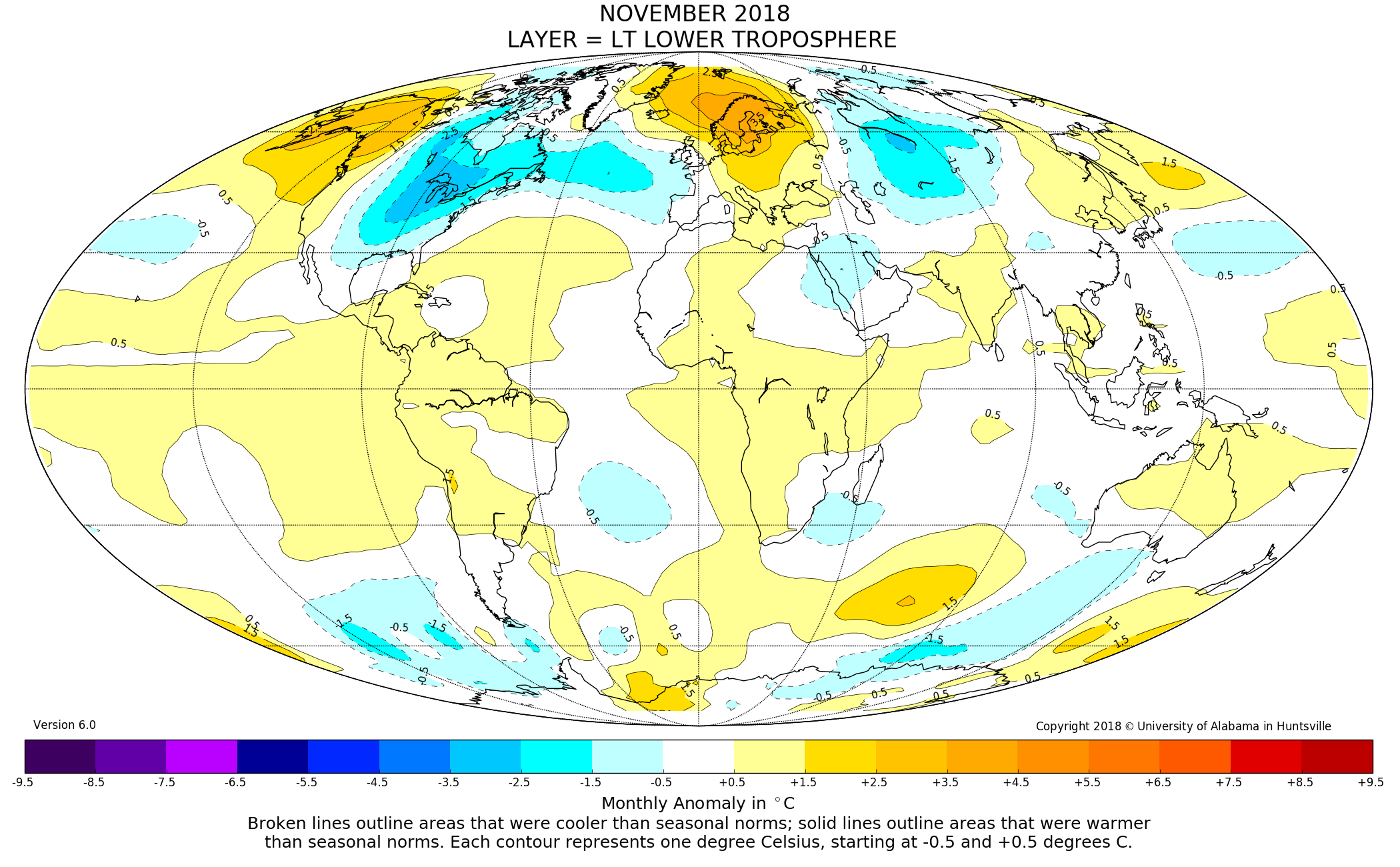
Your snow cover confirm my results.
Namely. It is cooling at the higher altitudes. Especially in winter.
Willis,
https://www.nsstc.uah.edu/data/msu/v6.0/tlt/uahncdc_lt_6.0.txt
According to the link below, which is to UAH TLT v6, by my calculations the lower 48 states (USA48) warmed at a rate of +0.23 C per decade between March 2000 and February 2018; even faster if you include Alaska (USA49, +0.25 C per decade). That’s a total warming of +0.45C over that period.
Your fig. 3 suggests there was -0.4 C per decade or more ‘cooling’ in the US inc. Alaska over this period. That’s a total cooling of at least -0.72C. UAH says +0.45C warming; your interpretation of the CERES data says -0.72C cooling. A disagreement of ~1.2C, with the respective trends moving in opposite directions. What do you make of this large divergence?
Link: https://www.nsstc.uah.edu/data/msu/v6.0/tlt/uahncdc_lt_6.0.txt
DWR 54 (what does the 54 stand for?)
I made a special study of the Elmendorf weather station in Anchorage.
Since 2000, it currently shows average cooling of
-0.02K / annum (maxima)
-0.01K / annum (mean) = -0.2K
-0.04K / annum (minima)
No reason to doubt you Henry. I’m just highlighting the difference between UAH TLT and Willis’s interpretation of the CERES data.
DWR54 was just my code-word for an online course I did once. DWR are my initials (David W Rice). I must have been the 54th person to enroll that year!
Thx. I figured the DWR were your initials. I was just curious to figure out the 54…
Not your age, then,,,,
Interesting discussion here now.
“Interesting … the trend is quite small, and is not statistically different from zero”
It would help if you drew a trend line on the graph. I’m guessing that temperatures are still well above the trend.
Willis, the maps in this post surprised me and I took a look at the maps from a previous post: https://wattsupwiththat.com/2018/03/24/where-the-warmth-is/
Comparing the maps from this post (figure 2 and 3) with the maps from figure 2 in Where The Warmth Is, the numbers I see for both of the Hemispheres, for Land / Ocean and for both of the Poles are very different.
There is a difference in the period you used for the data (one year more for this post) but that can’t explain all of the difference.
David
What,
exactly is it that melts snow?
Click on my name to read my final report.
Willis,
I don’t know how Ceres handles seasonality, but on its face Feb is cooler than March every year in the northern hemisphere, and the opposite in the southern.
Any chance of reposting with both starting and ending months being the same? Also responding to Dr Roy Spencer’s comment would be great.
I didn’t realize Willis was computing temperature from the estimated upwelling LW flux at the surface. I don’t know how good of a proxy for temperature that would be (depends upon how good the LW flux estimate is, corrections for clouds are always a major issue in LW estimates of surface temperature.
Well, that although in the Arctic is warmer.

http://polarportal.dk/fileadmin/polarportal/sea/CICE_curve_thick_LA_EN_20181205.png
Willis and others,
I’m trying to understand the warming and cooling of the land-ocean-atmosphere system. The land and surface of the water warm by solar radiation and cool by both infrared radiation plus conduction and convection. The surface of the land warms and cools quickly over diurnal and annual periods. Because of the much greater heat capacity of water, and because of some mixing near the surface, the surface water warms and heats more slowly than the land. Because of the differing densities of warmer and cooler water, there is much less mixing below the wind blown ocean surface and much slower warming and cooling there. This brings me to my question. I know the exchange of heat between the ocean and land areas is very complex, but with more solar radiation warming the earth’s surface for any reason (GHG, cloud cover, change in irradiation), wouldn’t the land warm more quickly than the seas and, then, with nature’s attempt at equilibrium, the seas continue to warm even if that increase in solar radiation reaching the earth’s surface stopped or reversed. Is that what is happening? Is that a partial explanation for the results Willis graphed?
Douglas
Taking the results at face value
https://wattsupwiththat.com/2018/12/05/cooling-down-the-land/#comment-2546508
In this case, some questions do arise from the results.
It is complicated, but I do have an answer for you:
The drop in maxima has to do with the amount of ozone/peroxides/N-oxides being produced by the most energetic particles coming from the sun. The atmosphere is protecting us to from this harmful radiation – hence do not go to Mars until you have formed an earthlike atmosphere- but in turn these chemicals are stunting certain types of UV radiation coming to earth.
That [in this case] the drop in minima is greater than the drop in maxima can IMHO only be explained by some type of contraction of the atmosphere, especially at the higher latitudes.
Excellent article and global map, Willis!
Offhand, most of the places warming are exactly the places where slight increases in water vapor make a difference in temperature. i.e. validating Joe Bastardi’s hypothesis, that El Nino’s pulse large amounts of water vapor into the atmosphere.
Atacama desert, Australia, South Africa, both polar regions; all arid regions.
That land areas are cooling affects precipitation and if cooling continues, permanent snow cover.
Keep digging into the data!
Interesting!
“on average, the oceans are warming”
I think you mean they warmed–the satellite does not do predictions.
And how much of the warming is caused by latent heat from a PDO cycle? and compared to past PDO cycles?
Earth has been cooling since Feb 2016 peak of El Nino.
How low can it go? Back to 2012 or 2008?
Thank you for the essay. I especially appreciated the presentation of the global distribution.
I think it is too soon to rule out a step increase as followed the 1998-1999 El Nino, but evaluating that will require waiting at least 5 more years.
Again
looking at the comments
I must say that there is no AGW
[click on my name to read my final report on that]
but I must warn that natural climate change is just as scary….
The dust bowl drought {1932-1939] was one of the worst disasters in US history. Just google it…
And it is here again. It comes every 87 years. The drought starting 1845 is now regarded as being the disaster that wiped out most of the bison population.
[contrary to popular thought it was not man that caused the decimation of the bison population]
Henry,
Why weren’t the bison wiped out in AD 1760, 1673, 1586 or at any other of 100 points in the preceding 8700 years?
John Tillman
I stumbled on clear evidence of the 87 year Gleissberg cycle when I carefully analysed all daily data [maxima] from the Elmendorf weather station in Anchorage. I subsequently also found similar results when observing minima. There are many current and historic papers confirming this 87 year cycle. If you want to see some of those papers, just ask/
NOTE:
https://www.researchgate.net/publication/286971648_Drought_in_the_western_Great_Plains_1845-56_Impacts_and_implications
Just doing some basic counting:
1932-87=1845 hence when I googled ‘1845’ and ‘drought’ I got something similar to the paper quoted above…the connection with the decimation of the bison population does not seem to be an isolated investigation?
Looking at the speed of cooling, we already were in the dip [of the sine wave] but are slowly climbing up now.
1932+ 87= 2019. Droughts coming up for the great plains of America- just about now. It is happening already?
As to your specific question
1) what historic observations existed in 1760? Did USA even exist? Could people even write in the USA at that time?
2) what was the bison population at that time?
So, nobody can answer that question – but in fact the question is also wrong. We don’t know anything about the bison population before the drought of 1845?
I think here [in South Africa] we already had the major drought time caused by the GB cycle but I must say: 40 years ago when there was a drought, people around you and on radio and TV asked you to pray for rain. I remember that I was surprised about that. Coming from Europe, praying for rain was something that was never done…. Nowadays, when there is drought all people here on radio are saying: : there is drought due to climate change and now it is YOUR fault!!!@ur momisugly
Click on my name to figure out exactly whose fault the drought will be??
BW
H.
Thanks, Henry. What was your source for the Elmendorf daily temperature data? Also, Elmendorf was only established in 1942, which is only 77 years ago. Diagnosing an 87-year cycle in 77 years of data? I doubt that greatly.
Also, you say:
What I’d like to see are two links: one link to whatever you consider to be the best and strongest of those “many current and historic papers”, and the other link to the data used in that paper. If you’ll post those I’ll be glad to analyze the paper. However, in order to analyze the paper, I have to have access to the data, which is why I need two links.
Please don’t bother sending all of your links. I just want two links, to the best paper and to the data underlying that paper.
I append a couple of my papers on the putative Gleissberg cycle.
Many thanks,
w.
The Tip of the Gleissberg 2014-05-17
A look at Gleissberg’s famous solar cycle reveals that it is constructed from some dubious signal analysis methods. This purported 80-year “Gleissberg cycle” in the sunspot numbers has excited much interest since Gleissberg’s original work. However, the claimed length of the cycle has varied widely.
The Effect of Gleissberg’s “Secular Smoothing” 2014-05-19
ABSTRACT: Slow Fourier Transform (SFT) periodograms reveal the strength of the cycles in the full sunspot dataset (n=314), in the sunspot cycle maxima data alone (n=28), and the sunspot cycle maxima after they have been “secularly smoothed” using the method of Gleissberg (n = 24). In all three datasets, there…
http://oi60.tinypic.com/2d7ja79.jpg
my data source is always http://www.tutiempo.net (historica)
but if you already know that I looked at the data from 1942 then you might be aware of the original source.
Remember my method: daily data is computed to give me yearly data which is summarized over periods (usually decades) by doing various backward regressions, giving me the derivatives of the least square equations, giving me the speed of warming/cooling in K/annum.
Click on my name to read my final report as I do explain there the way I work.
True enough, in the case of Elmendorf I did not have the whole cycle. At the time when I did this investigation, 2013, I found this report:
http://iie.fing.edu.uy/simsee/biblioteca/CICLO_SOLAR_PeristykhDamon03-Gleissbergin14C.pdf
Consequently
I estimated the wavelength as being 88 years. Subsequent investigations, e.g. here:
http://www.nonlin-processes-geophys.net/17/585/2010/npg-17-585-2010.html
and also the measurements (going back to 1971) of the north south magnetic field strengths on the sun, lead me to believe that currently the cycle is 86.5 years. From 1971-2014 you can see exactly one half the GB cycle, namely, instead of drawing straight lines,
http://oi63.tinypic.com/2ef6xvo.jpg
you can imagine drawing bi-nomials from the top to the bottom to the top that represent the average field strengths with the dead end stops both in 1971 and 2014
Assuming that maxima is a good proxy for incoming energy, that means that the sine wave of incoming energy was at its lowest point in 2014 and not in 2016 as I originally thought it was in 2013.
Interesting is that Leif Svalgaard now also seems to support an 87 year cycle.
More investigations/papers can be found in tables II and III, here,
http://virtualacademia.com/pdf/cli267_293.pdf
Figures 2 and 3 depend heavily on red-green color distinction. 8% of males are red-green color blind. Why doesn’t NASA adjust for this? My brother has been jokingly advocating for the rights of color-disabled people. I figure they have at least as much justification to feel mistreated as trans people have.
Willis – Thank you for the data analysis.
In the most basic way to say this, the energy of the transporting waves has increased, so the land under the storm tracks has cooled slightly over a ten year average. Cold air gets pushed more often than warm air.
What’s remarkable is that global plots of nominally insignificant trends in TOA LW emissions are used here as basis for physical inference about surface temperatures never really measured by CERES. The S-B equation cannot be used legitimately to relate radiative intensities to temperatures of a body that evaporates. The shown results over the oceans thus are highly suspect.
Willis, your posts on the CERES data inspired me to look at it myself. Not that I’m going to be able to generate the interesting posts you’ve made on the subject but I ran across something that has me puzzled. I started by just looking at the Solar monthly TOA since that’s fairly straight forward. I plotted it as a surface where x and y are time and latitude. That was is interesting of itself but I was puzzled by what I saw at the solstices. I expected the TOA to be increasing til you reached the poles but there is a “notch” that starts about at about +/- 46 deg to about +/-66 deg before the TOA starts increasing again. I was wondering if you had any idea as to what would cause that? I posted the graphs here if you’d be so kind as to look at it.
Thanks, Bear. I was able to duplicate your results. I’d never noticed that. What you see is the interplay of two things: the angle of the sun, and the amount of each latitude that receives sunlight during the day. These change at different rates, because the earth is a sphere. This leads to the curious result you’ve noticed.
Congratulations, you’re one of the few people who has actually taken up the torch and done your own analysis of the CERES data. Well done.
w.
Thank you. Your comment is appreciated. That’s high praise indeed IMO. My looking at that was due to your comment about looking at the data graphically. You never know what might jump out when you look at things from different perspectives. I had the thought that it might be something like what you describe and I’m guessing that the increase above the arctic/antarctic circle is probably due to the 24 hours of daylight above that latitude. The dip just didn’t fit with my preconceptions.
You’re right, the increase about the Arctic/Antarctic circles are the cause of the curious outcome.
w.
Bear:
The earth’s polar angle (now 23.45 degrees) from its orbit (the ecliptic plane, as some term it) is not related to the eearth’s distasnce from the sun (the eccentricty of its eliptical orbit). Yes, they are “close” together right in the whole M. cycle, but that’s only coincidence. Or Inteligent Design – Take your pick.)
The 23.45 degree tilt puts maximum solar exposure each day, with the sun highest in the sky each hour of the day, in the northern hemisphere June 22 each year, DOY = 173.
The same tilt puts the maximum solar exposure of the southern hemisphere on 22 December each year, DOY = 356. These “hours per day of solar exposure” and “solar elevation angles at each hour” would be the same regardless of how far the earth is away from the sun.
However …
TOA (Radiation received at the top of atmosphere, at the earth’s distance from the sun on each day of year (DOY)) reaches its maximum of 1408 watts/m^2 on 5 January each year. DOY = 5.
TOA reaches its minimum of 1316 on 5 July, DOY = 186.
Notice the December solstice averages 22 Dec, 14 days earlier than solar maximum. The June solstice is comparably earlier than the July minimum: 13 days difference.
Both TOA radiation and solar angle are “slow” changes, with each day’s TOA radiation only slightly different than the previous day’s value. Each day’s solar exposure (highest for the southern hemisphere, lowest for the northern hemisphere is also changing, but also changing slowly each day.
At the two equinoxes, the TOA radiation is changing rapidly, the length of day is changing most rapidly. You will marked changes even day-to-day of absorbed solar energy!
The effect you both see is I so strongly reject using “averages” for solar energy absorbed in either the Arctic or Antarctic: Each day the earth is struck by a varying amount of solar energy, each day the edge of the sea ice is at a different latitude, each day the sun’s exposure at each hour is at a different solar elevation angle. Every hour of every day of the year the solar energy that does reach the earth’s top of atmosphere passes through a different air mass, is striking the sea ice or water surface with a different albedo and radiating LW at a different surface temperature to a different air temperature through a different relative humidity zone.
I’m (partially) incorrect above: The change Bear highlighted was not day-by-changes by changes over latitude on certain days. Which also occurs as air mass, albedo, and absorption changes with time and solar elevation angles.
Dangalang, I’ve discovered an error that invalidates this post. See the discussion in my new post here …
w.
Willis, greeting from chilly Maine! 10% of the worlds fresh water mass can’t me wrong…. check out Mean Lake Superior Whole Volume Temp . It is pretty satisfying short term weather buffered TEMPERATURE PROXY data. Does not compute with the warming analysis so I prefer the huge heat sink to something else that doesn’t track with the heat sink. https://www.glerl.noaa.gov/res/glcfs/compare_years/
What’s your source for the two maps?
“After the recent fires we’ve been cleaning up the forest floor, so yesterday we burned a couple of the big piles of limbs and brush that we’ve gathered over the last couple of months.”
Stress. Wish you well.
___________________________________________________
Interesting question, interesting graphs.
One thing is certain, that the average temperature in the US in December will be below average, as in November.
https://www.longpaddock.qld.gov.au/soi/
Yes,
at the higher lats it will become drier, leading to cooler winters and warmer summers.