
- Scientists behind a headline-grabbing climate study admitted they “really muffed” their paper.
- Their study claimed to find 60 percent more warming in the oceans, but that was based on math errors.
- The errors were initially spotted by scientist Nic Lewis, who called them “serious (but surely inadvertent) errors.”
The scientists behind a headline-grabbing global warming study did something that seems all too rare these days — they admitted to making mistakes and thanked the researcher, a global warming skeptic, who pointed them out.
“When we were confronted with his insight it became immediately clear there was an issue there,” study co-author Ralph Keeling told The San Diego Union-Tribune on Tuesday.
Their study, published in October, used a new method of measuring ocean heat uptake and found the oceans had absorbed 60 more heat than previously thought. Many news outlets relayed the findings, but independent scientist Nic Lewis quickly found problems with the study.
Keeling, a scientist at the Scripps Institution of Oceanography, owned up to the mistake and thanked Lewis for finding it. Keeling and his co-authors submitted a correction to the journal Nature. (RELATED: Headline-Grabbing Global Warming Study Suffers From A Major Math Error)
“We’re grateful to have it be pointed out quickly so that we could correct it quickly,” Keeling said.
In a statement posted online Friday, Keeling said “the combined effect of these two corrections to have a small impact on our calculations of overall heat uptake.” However, Keeling said the errors mean there are “larger margins of error” than they initially thought.

People gather at the beach to cool off as a heat wave brings high temperatures and humidity to Oceanside, California, August 14, 2015. REUTERS/Mike Blake.
So, while Keeling said they still found there’s more warming than previously thought, there’s too much uncertainty to support their paper’s central conclusion that oceans absorbed 60 percent more heat than current estimates show.
“Our error margins are too big now to really weigh in on the precise amount of warming that’s going on in the ocean,” Keeling told The Union Tribune. “We really muffed the error margins.”
Keeling and his co-authors used the study to debut a new way of estimating ocean heat uptake by measuring the volume of carbon dioxide and oxygen in the atmosphere. Scientists are still intrigued by this method, but all the kinks need to be worked out.
“So far as I can see, their method vastly underestimates the uncertainty,” Lewis told The Washington Post in an interview Tuesday, “as well as biasing up significantly, nearly 30 percent, the central estimate.”
Lewis pointed out the errors in Keeling’s study in a blog post published Nov. 6 on climate scientist Judith Curry’s website. Lewis wrote that “[j]ust a few hours of analysis and calculations … was sufficient to uncover apparently serious (but surely inadvertent) errors in the underlying calculations.”
Lewis is an ardent critic of climate scientists’ over-reliance on climate models, which he says predict too much warming. Lewis and Curry published a study earlier in 2018 that found climate models overestimated global warming by as much as 45 percent.
Lewis’s corrections were quickly confirmed by University of Colorado professor Roger Pielke Jr. Pielke called Keeling’s acceptance and willingness to correct the mistakes a “lesson in graciousness.”
https://twitter.com/RogerPielkeJr/status/1062545914399645697
“Unfortunately, we made mistakes here,” Keeling told WaPo. “I think the main lesson is that you work as fast as you can to fix mistakes when you find them.”
Follow Michael on Facebook and Twitter
Tags : energy judith curry nic lewis roger pielke jr scripps institution of oceanography
So much for the vaunted ‘peer review’.
Isn’t that all supposed to have happened before the NYT gets its hands on your work?
“Our error margins are too big now to really weigh in on the precise amount of warming that’s going on in the ocean,” Keeling told The Union Tribune.”
The “precise amount”? Really? As if. They have no clue what’s going on with the oceans, and all they will admit is that they don’t know the “precise amount”. Oh, the hubris of these “scientists”.
And, they still found there’s “more warming than previously thought”. Of course. Still sticking 100% to the Warmist pseudoscience.
They are merely acting “grateful” they got caught with their hand in the cookie jar. It’s merely one more instance of CYA. Don’t fall for the act. They are not being sincere. At all.
They actually are bona fide scientists. It’s a bad mistake to think that there are real scientists somewhere who are paragons and completely lack human foibles.
” We expect the combined effect of these two corrections to have a small impact on our calculations of overall heat uptake, but with larger margins of error”, said Keeling. ( source CNN) that’s what they really meant, didn’t change hardly anything at all. No admission that they were wrong.
Whew! There, that fixed that problem……
See they were right all along. Just a couple of minor errors, the ocean up take on heat is still at the high end.
Ku zu dee! ( load of crap ) Surely, the thermal expansion of the oceans is hiding around here somewhere… That’s right!! We forgot!! The extra water is deforming the ocean floor… more ku zu dee
Since it seems that the Arctic is NOT getting on board, ships keep getting grounded, ( ALL a board for the Grand Polar Tour ) with the Global warming agenda, lets shift our focus somewhere else…. A few winters of extreme cold will end this nonsense, … maybe, kind of like the pause, as if it never happened, or the mythical warming hot spot …. but then what am I going to do without a constant source of amusement? I saw a commercial on glittering unicorn poop, naturally I thought of AGW… really, a real commercial.
AGREE
Scripps still has a long way to go to get their reputation back. I am old enough to remember it well, was taught by one of their graduates. I was told at least one of their recent graduates has some sense.
https://scripps.ucsd.edu/news/study-ocean-warming-detected-atmospheric-gas-measurements
“We expect the combined effect of these two corrections to have a small impact on our calculations of overall heat uptake, but with larger margins of error. We are redoing the calculations and preparing author corrections for submission to Nature.” We will see.
I see a post on Real Climate:
http://www.realclimate.org/index.php/archives/2018/11/resplandy-et-al-correction-and-response/
They certainly admit to the error margin error.
Not so sure they are admitting to overestimating the central estimate by 30%.
Instead of .88 plus or minus something they now seem to get 1.05 plus or minus something.
Can anyone tell if they have admitted both of the errors Nic Lewis found or just one?
In reading many of the WaPo reader’s comments, they don’t seem to understand the role of the reviewers and how they screwed-up bigtime. They simply praise the authors for admitting an error.
The main lesson here is that having people looking at work with a sceptical eye is absolutely critical to sound science, and the climate scientist lead attack on sceptics is ant-science…..how many times do “contrarians” have to expose errors and/or dishonest methods before they are treated as actual scientists and not pariahs…..there is no point in pretending this will Make Nic less welcome in climate science circles and within the media, and not more welcome.
Wow i should proof read before hitting send…. grade that a D-
“led”
“Anti-science”
“no point in pretending this will NOT make Nic….”
Brandon C/Brandon Caswell
Only 4 minutes to recognise your errors and post corrections.
You should apply for a job at Nature.
You could cite these posts on your CV. 🙂
ROFL. I would say I need some peer review….but that doesn’t seem to help….
How can a researcher come up with a dramatic unexpected result and not double check the numbers? If it’s unexpected wouldn’t a reviewer have scrutinized the numbers? It wouldn’t surprise me if Nature doesn’t comment
This was my first thought. And its a reason, despite their prompt and proper acknowledgement that I question their bona fides. When I hear dramatic results coming out of research, my first question is “Is that real? Or did something go wrong in the research or the analysis?” Anyone with experience in science has seen and/or personally experienced this – astounding results that either can’t be replicated or turn out to be an error in analysis.
That is the Sagan premise of science, “extraordinary claims need extraordinary evidence” but climate science has it’s own version “extraordinary claims it’s worse than we thought needs no evidence”.
To me, the significance of this is that many people were telling Nic Lewis that if he wanted to get results he had to write a letter to the editors or submit a formal complaint.
Instead, publishing his results on Dr. Judith Curry’s excellent blog was enough to bring it to the attention of the authors and impel them to deal with it. Well done to both of them.
I’ve said before that I write for the blogs because the scientific discussions are moving to the blogs, and because people of both sides read them. This is excellent confirmation of that claim.
Best to all,
w.
Well, it is Current Year. All the kids are using social media, so why can’t scientists?
Oh yeah…that’s right: scientists are actually a pretty conservative bunch who won’t mess with a paradigm if it requires working a bit harder. Or losing funding that maintains the paradigm.
Prior to posting, Lewis twice contacted the lead authkor and asked for a response before he went public. He received none.
Roger
I noted that as well. But Willis is right, there are many people reading these blogs and they are gradually becoming a more mainstream source of information than conventional sources.
I’m heartened to see criticism of sceptical essays run on WUWT, in whole or in part, by the readers of this blog. No one is getting paid and there are obviously some very capable people on here.
Willis, Dave Middleton, Tim Ball etc. all risk a beasting if they get something wrong which is more than can be said of peer review.
As unorthodox as it may be, perhaps scientists might consider testing their studies in the public arena before ‘publication’ in the future.
I also had in issue with several articles written on different organizations where Nic Lewis was identified as a climate contrarian and/or a climate skeptic. Even in the article Nick Stokes linked lets quote it
He may also be a transgender, red-neck, whisky swilling, smoking atheist but that has absolutely nothing to with the error, the error exists regardless of his background.
It is Climate Sciences and the left loonies backhanded way of trying to place doubt around any finding they don’t approve.
‘Mistakes’ Led To Alarming Results In Major Global Warming Study’
But it’s still really, really bad.
And it’s worse that we thought.
I agree with the tone of the post, being gracious to Keeling et al admitting to their mistakes is a toddler step in the direction back to real science.
Now if other scientists would only man(-ning) up to the fair critique of their papers, it would be a full step back from the brink.
Still waiting for the BBC and the lefty media in the UK, to formally advise the public of these errors and that the ocean is not over-heating as claimed – and with the same vehemence, frequency, and prominence as was provided for the reporting of these scientists’ “proofs” of massive over-estimates of this ocean heating.
I won’t hold my breath, waiting and neither will I sit up all night with my eye’s glued to the TV.
Can you imagine if these bozos had a real job working for a company that had a bottom line they would be out the door. Yeah my peer reviewer buddy says that I didn’t do it. Bless him. Oh and can I borrow some of that hidden heat so I can heat my house its going to be a very cold winter.
And just how does heat “hide” in the first place? Doesn’t any heat in Nature immediately begin to transfer energy by radiation, conduction and convection? Oh, unless it’s all hiding in a big Thermos™.
With the right models, you can make unicorns dance on the moon.
Its Dark Heat…its just like normal heat but it doesn’t interact with normal matter. The big concern is that it will eventually decompose into normal heat and matter which will warm the oceans and destroy all life on earth!
In my previous incarnation as “jeez” I postulated the existence of Dark Enthalpy almost a decade ago.
I knew I had hear about this somewhere, but couldn’t remember where…thanks for the reminder. I’ll try to use the correct term, Dark Enthalpy, in the future. In any case, we are all doomed!!!
I was just being an overt needy attention seeker. Carry on.
Peer review in climate science now… “I like the study’s conclusion. Yes, CO2 is still evil. Looks good to me.”
Seems like a half-hearted apology. Were their error margins so badly calculated that the paper shouldn’t have been published is the real question they should be addressing. It sounds like it to me.
I’m not holding my breath waiting for the BBC to acknowledge anything.
This also says something about the journal and its process. The news is not good for them either.
I noticed in the San Diego tribune article headline, they referred to Nic Lewis as a “contrarianism”.
https://www.sandiegouniontribune.com/news/environment/sd-me-climate-study-error-20181113-story.html
Yet he’s listed on the list of climate deniers.
https://denierlist.wordpress.com/2012/12/19/nic-lewis/
Anybody think this denier omission was deliberate so that it doesn’t give deniers credibility? If so, go to the head of the class.
Years ago I advocated strongly for the use of “contrarian” by journalists who were looking for a neutral term. I’m pleased to have maybe made some impact.
Sadly, I think the root cause of this is Confirmation Bias. When you get good results that prove what you believe, you aren’t too likely to scrutinize the work too hard. Apparently this also applies for the peer reviewers. Realistically, scientific papers need to have review from experts on both sides of the spectrum.
Another “mistake” that is in the warmist’s favor.
funny how it always works that way !
You think with that type of luck they spend their time at the tables at Las Vegas
Or counting Democratic ballots…
So, once again skeptics are right and climate fanatics are wrong.
Methinks Nic is a lukewarmer, not a denialist, but a true skeptic. Many ‘skeptics’ are not skeptic at all.
Now what is the new Resplandy result – it is not +60% but somethng like +10% +/_ 60%. Or what?
The paper in its corrected form is now quite unspectacular in its results. Such an unspectacular result which only supports similar results on OHC might have gotten published in a 3rd tier journal.
My other comment that Dr Ralph Keeling took the blame for this to likely shield the real culprit in this “mistake”, the first author, a former Post-Doc in his lab. The first author, Ms. Laure Resplandy now an Asst Prof at Princeton U, was also the corresponding author and is the person who generally writes the paper and her position as corresponding author would suggest it was she who should have responded to the media and to Nic Lewis.
The second author listed was Ralph Keeling, son of Charles Keeling who started the CO2 monitoring at MLO, who is 59 and is in a secure position at Scripps. The senior authors are W. Koeve & A. Oschlies at GEOMAR Helmholtz Centre for Ocean Research Kiel, Kiel, Germany.
The “contributions” section of the original paper reads (exactly quote):
That contributions statement clearly tells everyone it was Dr Resplandy who directed the analysis.
Dr Resplandy’s CV at Princeton U lists her postings:
2017-present: Assistant Professor at Princeton University.
2014-2016: Post-doc at Scripps Institution of Oceanography, UCSD (USA). Ralph Keeling’s group.
2012-2013: Post-doc at LSCE – CEA (France). Laurent Bopp’s group.
2010-2011: Post-doc at National Oceanographic Center (UK). Adrian Martin’s group.
2006-2010: PhD in Oceanography at LOCEAN (France). Advisor: Marina Lévy.
2005-2006: Junior geoscientist at Schlumberger. Geochemical modeling of carbon storage.
What is clear is Dr Keeling fell on the sword for this “error” to attempt to shield his former early-career Post-Doc from a career killing error. Dr Resplandy has yet to earn tenure at Princeton, and this could be a career ending error for her.
As I read up on Dr Resplandy’s other major 1st Author paper from Dr Keeling’s group while she was post-doc at Scripps, it too had a major correction to a mathematical error of substance that affected critical results.
That original paper is:
“Constraints on oceanic meridional heat transport from combined measurements of oxygen and carbon”
Resplandy, L., Keeling, R.F., Stephens, B.B. et al. Clim Dyn (2016) 47: 3335.
https://doi.org/10.1007/s00382-016-3029-3
And the correction to that paper is:
“Erratum to: Constraints on oceanic meridional heat transport from combined measurements of oxygen and carbon”
Resplandy, L., Keeling, R.F., Stephens, B.B. et al. Clim Dyn (2017) 49: 4317.
https://doi.org/10.1007/s00382-017-3839-y
The erratum reads:
(note: my bold to emphasize the magnitude of the “error” by Dr Resplandy.)
In other words, she neglected to remove the contribution of nitrogen to oceanic potential oxygen (OPOpi), the key parameter they were studying. This caused about a 11% error in the estimate of OPOpi (-3.9 nmol/J rather than the actual -4.4 nmol/J).
Her Figure 1 in the original paper is wrong by ~11% in its OPOpi graph.
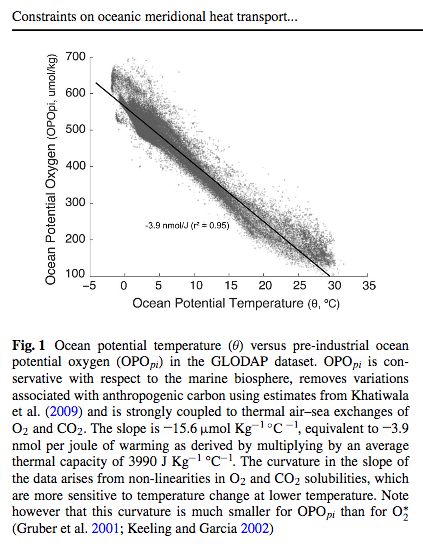
With a slope of -4.4 nmol/J, that clearly impacts the upper left part of the data set set shown. If line that is shifted upwards to match a -4.4 nmol/J slope, then that clearly indicates there is less Oxygen potential at the lower temps than they showed.
Furthermore their figure legend for Fig 1 they state, “The curvature in the slope of the data arises from non-linearities in O2 and CO2 solubilities, which are more sensitive to temperature change at lower temperature.”
Taken together it clearly indicates not only are their results sensitive to the lower ocean temps but that their error of using -3.9 rather than -4.4 is greatly amplified in the colder oceans where most of the oxygen from a warmer ocean are released.
It would seem Dr Resplandy is making a habit of major mathematical errors in her papers that steers them towards larger impacts on oxygen potential release and thus higher OHC impacts.
Okay my correction now: At a slope of -4.4 nmol/J it means there is more (not less) Ocean Potential Oxygen at the lower ocean potential temperature, theta, than they showed. Meaning the oxygen observed comes from smaller temperature changes.
“It would seem Dr Resplandy is making a habit of major mathematical errors in her papers that steers them towards larger impacts”
Yes, but how else is she going to make the “Big Leagues” if she doesn’t play by the rules that the Manns, etc. did to get there?
I did a little search on Google News looking for some posts of the original news, then went to those sites and added a comment to the post saying the paper had been retracted and included the San Diego Tribune URL for more details.
One page, https://www.eurekalert.org/pub_releases/2018-10/pu-eoh103118.php , didn’t accept comments, but had the Email for the media contact at Princeton, so I Emailed her directly.
They are attempting to correct the paper with Nature. The authors are not asking for retraction. Nature editors will send the received correction out to reviewers who will:
(1) either recommend accpetance of the correction, or
(2) accpetance of correction with further edits and clarifications, or
(3) outright retraction of the original manuscript if the original errors and the attempt at corrections are deemed such a magnitude to make the whole study is now questionable.
The editors will then have to decide what to do based on the reviewers’ recommendations on the correction.
If I keep calling retracted, maybe people will come to thing is retracted. 🙂
Can someone explain to me why the default assumption is that observed changes in atmospheric potential oxygen were measured properly?
https://www.sciencemag.org/news/2018/11/high-profile-ocean-warming-paper-get-correction
Confirmation bias anyone?
Now waiting to see correction articles in media…..
The Science article I posted has comments from Michael Mann and Gavin Schmidt