The Millennial Turning Point – Solar Activity and the Coming Cooling

Guest opinion by Dr. Norman Page

When analyzing complex systems with multiple interacting variables it is useful to note the advice of Enrico Fermi who reportedly said “never make something more accurate than absolutely necessary”.

My recent paper presented a simple heuristic approach to climate science which plausibly proposed that a Millennial Turning Point (MTP) and peak in solar activity was reached in 1991.

Zharkova et al 2015 DOI:10.10381/srep15683 says ” Dynamo waves are found generated with close frequencies whose interaction leads to beating effects responsible for the grand cycles (350-400 years) superimposed on a standard 22 year cycle. This approach opens a new era in investigation and confident prediction of solar activity on a millenium timescale. ”
Svalgaard concluded in his essay on WUWT 10/27 2018:

“The Wu et al. (2018) reconstruction of the sunspot number since 6755 BC combined with modern Multimessenger proxies covering the 19th century until today goes a long way to reconcile the cosmogenic solar activity record with recent assessments of long-term solar activity.”

This is entirely consistent with my approach and forecasts. The empirical temperature data is clear. The previous millennial cycle temperature peak was  at about 990. ( see Fig 3 in the link below)  The recent temperature Millennial Turning Point was about 2003/4 ( Fig 4 in link  below ) which correlates with the solar millennial activity peak at 1991+/. The cycle is asymmetric with a 650 year +/- down-leg and a 350 +/- year up-leg. The suns magnetic field strength as reflected in its TSI will generally decline (modulated by other shorter term super-imposed solar activity cycles) until about 2650.

The temperature increase since about 1650 is clearly chiefly due to the up- leg in the natural solar activity millennial cycle as shown by Lean 2018 “Estimating Solar Irradiance Since 850 AD” Fig 5

Lean 2018 Fig 5.

This Lean figure shows an increase in TSI of about 2 W/m2 from the Maunder minimum to the 1991 activity peak . This TSI and solar magnetic field variation modulates the earths albedo via the GR flux and cloud cover.  From the difference between the upper and lower quintiles of Fig 4 (in link below) a handy rule of thumb a la Fermi would conveniently equate this to a Northern Hemisphere temperature millennial cycle amplitude of about 2 degrees C with that amount of cooling probable by 2,650+/-.The MTP in cloud cover was at about 2000.

The decline in solar activity since the 1991 solar activity MTP is seen in the Oulu neutron count.

Because of the thermal inertia of the oceans there is a varying lag between the solar activity MTP and the varying climate metrics. The temperature peak is about 2003/4 – lag is about 12 years. The arctic sea ice volume minimum was in 2012 +/-  lag = 21 years. Possible sea level Millennial Turning Point – Oct 2015  lag = 24 years +/- (see https://climate.nasa.gov/vital-signs/sea-level/ ) Since Oct 2015 sea level has risen at a rate of only 8.3 cms/century. It will likely begin to fall within the next 4 or 5 years. For the details see data, discussion, and forecasts in  Figs 3,4,5,10,11,and 12 in the links below.

See the Energy and Environment paper
The coming cooling: usefully accurate climate forecasting for policy makers.
http://journals.sagepub.com/doi/full/10.1177/0958305X16686488
and an earlier accessible blog version at
http://climatesense-norpag.blogspot.com/2017/02/the-coming-cooling-usefully-accurate_17.html          See also the discussion with Professor William Happer at
http://climatesense-norpag.blogspot.com/2018/02/exchange-with-professor-happer-princeton.html
The establishment’s dangerous global warming meme, the associated IPCC series of reports ,the entire UNFCCC circus, the recent hysterical IPCC SR1.5 proposals and Nordhaus’ recent Nobel prize are founded on two basic errors in scientific judgement. First – the sample size is too small.
Most IPCC model studies retrofit from the present back for only 100 – 150 years when the currently most important climate controlling, largest amplitude, solar activity cycle is millennial. This means that all climate model temperature outcomes are too hot and likely fall outside of the real future world. (See Kahneman -. Thinking Fast and Slow p 118) Second – the models make the fundamental scientific error of forecasting straight ahead beyond the Millennial Turning Point (MTP) and peak in solar activity which was reached in 1991.These errors are compounded by confirmation bias and academic consensus group think.
0 0 votes
Article Rating

Discover more from Watts Up With That?

Subscribe to get the latest posts sent to your email.

211 Comments
Inline Feedbacks
View all comments
u.k.(us)
November 3, 2018 9:22 am

Until someone can accurately predict the moment a spinning top makes that 30 degree deflection before coming upright again…. well, I’ll just watch.

November 3, 2018 10:53 am

Vuk

I am not sure you are getting my point
and also why we are really having so many solar cycles

the most likely causes:
a) difference in irradiance coming from the sun {change of the gravity centre, planets positions, etc]
b) change in the position of the magnetic centre of the sun / that is time related – which would automatically re-align earth’s magnetic centre
…the magnetic stirrer effect….

Reply to  henryp
November 3, 2018 11:59 pm

HP, good morning
You may be right, but I was referring to my own research, not much time to look or analyse anything else.

ren
November 3, 2018 12:15 pm

The Western Arctic freezes quickly, which is a bad sign for America, because it means the shift of the stratospheric polar vortex above the eastern Arctic.
comment image
The distribution of ozone at the level of 30 hPa shows circulation in the stratospheric polar vortex.
comment image
The air flows from Siberia over the western Arctic to northern Canada.
For comparison, circulation in the middle stratosphere in December 2017.
comment image
This is the pattern of winter circulation over North America.

November 3, 2018 2:51 pm

Now, this is the TSI in action:
Mysterious interstellar asteroid ‘Oumuamua could be a giant solar sail ‘sent from another civilization to look for signs of life,’ claim astronomers
(They must have a mighty strong sun outhere to send sale through interstellar space)

Astronomers from the Harvard Smithsonian Center for Astrophysics (CfA) analyzed the strange cigar shape of the object, and an unexpected boost in speed and shift in trajectory as it passed through the inner solar system last year. They concluded that the strange asteroid ‘might be a lightsail of artificial origin.’
(no need to say anything more is there?, oh yes it is, but let the DM the bastion of unquestionable scientific provenance speak
https://www.dailymail.co.uk/sciencetech/article-6347379/Interstellar-asteroid-Oumuamua-giant-solar-sail-sent-civilization.html)

Reply to  vukcevic
November 3, 2018 3:28 pm

Sail

Editor
November 3, 2018 2:57 pm

I looked for a “millennial turning point”. According to the head post:

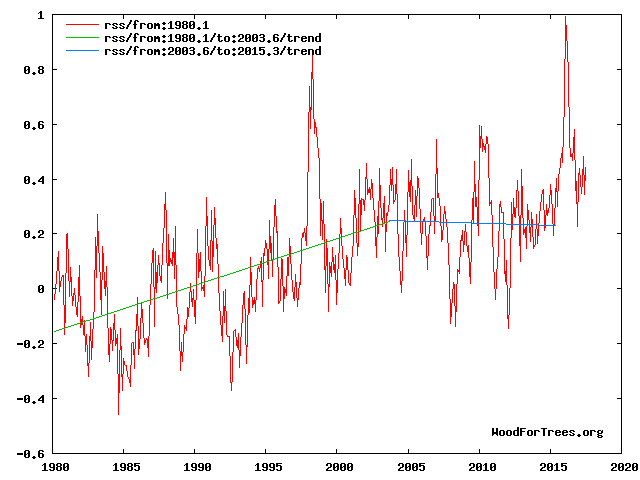
The recent temperature Millennial Turning Point was about 2003/4 ( Fig 4 in link below )

Here’s Figure 4 from the link


CAPTION:
Fig 4. RSS trends showing the millennial cycle temperature peak at about 2003 (14)

Wait, what?

First off, claiming that a graph that starts in 1980 shows a “millenial” turning point makes no sense at all.

Second, why doesn’t the right-hand trend line go to the end of the data?

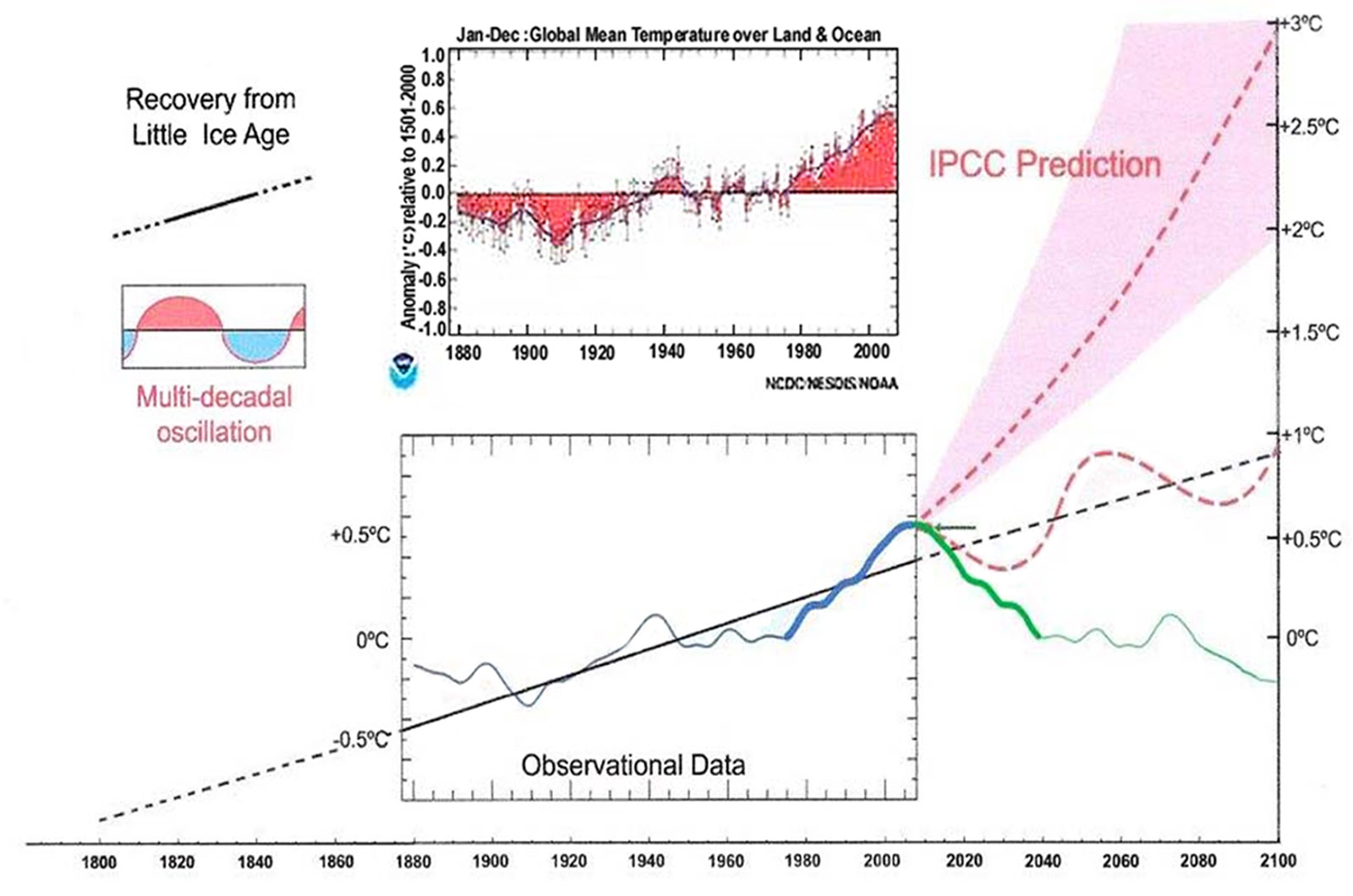
Finally, here’s his prediction of upcoming cooling from his paper, a prediction made in 2007:

I was curious about that, so I digitized it and compared it to the actual GISS LOTI temperature anomaly. Here’s that result:

Well … there’s your “Millennial Turning Point about 2003/4” … the only problem is, reality didn’t get the memo.

I’m sorry, but Dr. Page’s lovely theory has run aground on a reef of hard facts …

w.

Reply to  Willis Eschenbach
November 3, 2018 5:46 pm

Willis The prediction wasn’t made in 2007 – I assume you mean begins in 2007. I’m busy now I’ll get back to you tomorrow on the rest.

Reply to  Dr Norman Page
November 3, 2018 6:28 pm

Thanks, Dr. Page. I assumed that the prediction was made in 2007 because that is the limit of the “observational data” in your graphic above.

If you made the prediction after 2007, why did the observational data end in 2007?

In any case, regardless of when it was made, it most definitely has not been a good prediction, as shown above.

Best regards,

w.

Reply to  Willis Eschenbach
November 4, 2018 10:53 am

Willis. The intent of this Guest Opinion was to draw attention to Firmi’s wise approach to analyzing scientific problems with multiple interacting variables he said “never make something more accurate than absolutely necessary”. In other words you need first to make sure your possible solutions are in the ball park. I adapted the Akasofu paper to show the conceptual difference in forecasting trends when the Millennial Turning Point is ignored.
The paper says:
“Fig. 12 compares the IPCC forecast with the Akasofu (31) forecast (red harmonic) and with the simple and most reasonable working hypothesis of this paper (green line) that the “Golden Spike” temperature peak at about 2003 is the most recent peak in the millennial cycle. Akasofu forecasts a further temperature increase to 2100 to be 0.5°C ± 0.2C, rather than 4.0 C +/- 2.0C predicted by the IPCC. but this interpretation ignores the Millennial inflexion point at 2004. Fig. 12 shows that the well documented 60-year temperature cycle coincidentally also peaks at about 2003.Looking at the shorter 60+/- year wavelength modulation of the millennial trend, the most straightforward hypothesis is that the cooling trends from 2003 forward will simply be a mirror image of the recent rising trends. This is illustrated by the green curve in Fig. 12, which shows cooling until 2038, slight warming to 2073 and then cooling to the end of the century, by which time almost all of the 20th century warming will have been reversed”
The green curve is not meant to have great precision. In the real world we do not know enough to calculate short term outcomes – look at Leif’s attempts to forecast the amplitude of the next solar cycle. He thinks that when this solar cycle bottoms out he can successfully estimate the amplitude of the next cycle – about 6 years ahead.Currently the cooling trend has been interrupted by an unanticipated El Nino as explained in the text accompanying Fig 4.(You might want to read the whole paper before commenting)
The post says “The empirical temperature data is clear. The previous millennial cycle temperature peak was at about 990. ( see Fig 3 in the link below) The recent temperature Millennial Turning Point was about 2003/4 ( Fig 4 in link below ) which correlates with the solar millennial activity peak at 1991+/. The cycle is asymmetric with a 650 year +/- down-leg and a 350 +/- year up-leg. The suns magnetic field strength as reflected in its TSI will generally decline (modulated by other shorter term super-imposed solar activity cycles) until about 2650.
The temperature increase since about 1650 is clearly chiefly due to the up- leg in the natural solar activity millennial cycle as shown by Lean 2018 “Estimating Solar Irradiance Since 850 AD Fig 5” I believe the evidence presented for these statements here and in the paper is strong.
I’m pleased that you think I have a “lovely theory ” Maybe you can agree that it is more plausible than the consensus nonsense.
PS I think you’ve cracked it with your time of day of cloud formation in the tropics as the planetary temperature safety valve. (if I understand you correctly)

Reply to  Dr Norman Page
November 4, 2018 11:33 am

Norman
note that my calculation on Tmax global (54 weather stations/ balanced to zero latitude)
-which is a good proxy for incoming energy-

puts the solar output at maximum `1994′

My results on Tmin global seems to go over the line at exactly the new millennium,
more or less.

Don’t put too much trust in the terra data [biased towards the NH] and the SATs [probes cannot really withstand the solar irradiation without atmosphere]

Anyone else here: do not make a mistake. All signs are there that it is globally cooling and it [climate change] plays out exactly as I thought it would.

Click on my name if you would like to read my final report.

Best wishes

Henry

Reply to  henryp
November 4, 2018 11:48 am

Henry:
Remember that there are no signs of a 88-yr cycle in solar activity occurring the last 1000 years or so.

Reply to  Leif Svalgaard
November 4, 2018 12:27 pm

leif
you are confusing the issues being discussed.
I suggest you answer me here/
https://wattsupwiththat.com/2018/11/02/the-millennial-turning-point-solar-activity-and-the-coming-cooling/#comment-2509021

Reply to  henryp
November 4, 2018 12:30 pm

No, I am reminding you that there is no 88-yr cycle in recent solar activity.
Until you realise [and acknowledge] that there can be no reasonable discussion of any kind.

Reply to  Dr Norman Page
November 4, 2018 2:43 pm

Dr Norman Page November 4, 2018 at 10:53 am

Willis. The intent of this Guest Opinion was to draw attention to Firmi’s wise approach to analyzing scientific problems with multiple interacting variables he said “never make something more accurate than absolutely necessary”. In other words you need first to make sure your possible solutions are in the ball park.

and

The green curve is not meant to have great precision.

and

The post says “The empirical temperature data is clear. The previous millennial cycle temperature peak was at about 990. ( see Fig 3 in the link below) The recent temperature Millennial Turning Point was about 2003/4 ( Fig 4 in link below ) which correlates with the solar millennial activity peak at 1991+/.

Dr. Page, several points. First, I have no idea what Fermi’s quote has to do with your hypothesis or your results.

Next, as my graph shows, your possible solution is NOT “in the ballpark”. Here’s your prediction starting from 2007 versus the reality. Your prediction is the red line, the reality is the yellow line.

That’s not only not in the ballpark, it’s not in the same country.

You say that the Millenial Turning Point was in 2003 – 2004. And your prediction shows just that … but your prediction failed miserably. It wasn’t slightly right. It wasn’t kinda correct. It wasn’t “more accurate than absolutely necessary”.

It was 100% totally wrong.

Despite that, you continue to push the same beautiful theory … at this point, you’ve done the experiment, which has disagreed with your theory, and you need to follow the wise advice of Richard Feynman, viz:

It doesn’t matter how beautiful your theory is, it doesn’t matter how smart you are. If it doesn’t agree with experiment, it’s wrong.

Best regards,

w.

Reply to  Dr Norman Page
November 4, 2018 5:44 pm

Willis You say “First, I have no idea what Fermi’s quote has to do with your hypothesis or your results” This is obvious from your reply . I repeat “The green curve is not meant to have great precision. In the real world we do not know enough to calculate short term outcomes – look at Leif’s attempts to forecast the amplitude of the next solar cycle. He thinks that when this solar cycle bottoms out he can successfully estimate the amplitude of the next cycle – about 6 years ahead. Currently the cooling trend has been interrupted by an unanticipated El Nino as explained in the text accompanying Fig 4.(You might want to read the whole paper before commenting)”
When ,or if ,you figure out the relationship between the Fermi quote and the paper as a whole you will understand that your statements re the significance of the Red line ( That’s not only not in the ballpark, it’s not in the same country.You say that the Millenial Turning Point was in 2003 – 2004. And your prediction shows just that … but your prediction failed miserably. It wasn’t slightly right. It wasn’t kinda correct. It wasn’t “more accurate than absolutely necessary”.
It was 100% totally wrong. ) are not relevant. They are founded on a basic error in scientific judgement – the sample size is too small.
Best Regards Norman

Reply to  Dr Norman Page
November 4, 2018 6:02 pm

You said:
In the real world we do not know enough to calculate short term outcomes – look at Leif’s attempts to forecast the amplitude of the next solar cycle. He thinks that when this solar cycle bottoms out he can successfully estimate the amplitude of the next cycle – about 6 years ahead.

The difference between what you do and what I do is that if one knows [or understands] the basic physics behind a phenomenon [as we do for the sunspot cycle, at least in broad terms] then prediction is indeed possible even without centuries of past data. Without that, prediction is just guesswork or wishful thinking.
Even if the physics is wrong it can still be useful for prediction, e.g. the ancients’ idea of the sun god traveling in his carriage behind mountains in the north to re-emerge in the morning. One must have a mechanism [even if wrong] in order to make successful forecasts. You have no such thing and hence cannot make a reliable forcast.

Reply to  Dr Norman Page
November 4, 2018 8:24 pm

Dr Norman Page November 4, 2018 at 5:44 pm

Willis You say “First, I have no idea what Fermi’s quote has to do with your hypothesis or your results” This is obvious from your reply . I repeat “The green curve is not meant to have great precision. In the real world we do not know enough to calculate short term outcomes.

I’m not expecting it to have “great precision”. I am expecting it to have the right sign (increasing as reality did, not decreasing as your theory claims it would do). It is not lacking precision—it is laughably and totally wrong.

You continue

… your statements re the significance of the Red line

(You say that the Millenial Turning Point was in 2003 – 2004. And your prediction shows just that … but your prediction failed miserably. It wasn’t slightly right. It wasn’t kinda correct. It wasn’t “more accurate than absolutely necessary”.

It was 100% totally wrong. )

are not relevant. They are founded on a basic error in scientific judgement – the sample size is too small.

I don’t understand. Your excuses for the total failure of your prediction shown in your graph are that the prediction is “not meant to have great precision”, and “we do not know how to calculate short term outcomes”, and “the sample size is too small” … but if so, then why on earth did you make a prediction?

I’m sorry, Dr. Page, but knowing all of that, you still made the prediction. And I’m quite sure that if temperatures had fallen as you predicted, we’d never hear the end of your theory. You’d be crowing about how good your prediction was until it was coming out of our ears.

But since the temperatures didn’t do what you predicted, now you have one excuse after another after another as to why you couldn’t even get the sign right, much less the amplitude …

Let me suggest that if you are not going to stand behind your predictions, that you don’t make them in the first place. That way you can avoid the humiliation of having to come up with a list of bogus excuses when your predictions crash and burn …

w.

Reply to  Dr Norman Page
November 5, 2018 7:20 am

Leif. The Post above says
” This Lean figure shows an increase in TSI of about 2 W/m2 from the Maunder minimum to the 1991 activity peak . This TSI and solar magnetic field variation modulates the earths albedo via the GR flux and cloud cover. From the difference between the upper and lower quintiles of Fig 4 (in link below) a handy rule of thumb a la Fermi would conveniently equate this to a Northern Hemisphere temperature millennial cycle amplitude of about 2 degrees C with that amount of cooling probable by 2,650+/-.The MTP in cloud cover was at about 2000.” This describes and even quantifies my mechanism . What is your mechanism – I’ll be happy if you use only “broad terms”

DWR54
Reply to  Willis Eschenbach
November 4, 2018 2:02 am

Willis,

Think you may have got your colors mixed up in the legend. Surely the yellow line is the GISS data?

Rgds

Reply to  DWR54
November 4, 2018 2:37 am

Thanks for the heads-up, DWR, fixed.

Grrr …

w.

November 3, 2018 3:25 pm

“Because of the thermal inertia of the oceans there is a varying lag between the solar activity MTP and the varying climate metrics. The temperature peak is about 2003/4 – lag is about 12 years.”

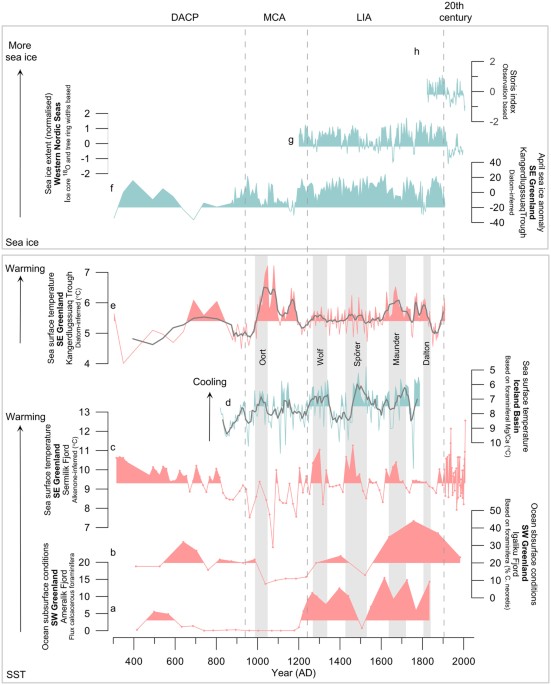
There is no such delay. From the mid 1990’s declining solar wind temperature/pressure has driven a warm AMO phase via negative North Atlantic Oscillation states, which has driven the decline in low cloud cover. The GCR postulate is backwards as low cloud cover has declined in the same time frame as GCR’s have increased. North Atlantic and Arctic ocean warming is normal during a solar minimum. It was in its warm phase during the late 1800’s Gleissberg solar minimum, and must have also been during the Dalton minimum for British naval ships to have reported great loss of sea ice 1815-1817.

SST’s off SE Greenland:
comment image

Greg Strebel
November 3, 2018 4:53 pm

Dr. Page may have been a little too quick in including economist William Nordhaus in this statement:
“The establishment’s dangerous global warming meme, the associated IPCC series of reports ,the entire UNFCCC circus, the recent hysterical IPCC SR1.5 proposals and Nordhaus’ recent Nobel prize are founded on two basic errors in scientific judgement.”

Nordhaus rigorously used IPCC numbers to calculate cost of achieving certain CO2 production reduction scenarios and compared them to the speculated costs of global temperature increases. His conclusion was that the costs of foregone GDP increases, or indeed of GDP reductions, necessary to achieve the modelled temperature limits were far greater than the cost of the presumed climate change consequences.
Tom Woods and Robert Murphy have a great podcast on this:
https://contrakrugman.com/ep-160-climate-change-alarmists-prematurely-cheer-new-nobel-winner/

Reply to  Greg Strebel
November 3, 2018 5:31 pm

Nordhaus’ analysis says “The equilibrium climate sensitivity (ECS) is based on the analysis of Olsen et al. (2012). The reasons for using this approach are provided in Gillingham et al. (2015). The final estimate is mean warming of 3.1 °C for an equilibrium CO2 doubling. The transient climate sensitivity or TCS (sometimes called the transient climate response) is adjusted to correspond to models with an ECS of 3.1 °:C, which produces a TCS of 1.7 °C.” Here is what the linked paper says re climate sensitivity :
“The IPCC AR4 SPM report section 8.6 deals with forcing, feedbacks and climate sensitivity. It recognizes the shortcomings of the models. Section 8.6.4 concludes in paragraph 4 (4): “Moreover it is not yet clear which tests are critical for constraining the future projections, consequently a set of model metrics that might be used to narrow the range of plausible climate change feedbacks and climate sensitivity has yet to be developed”
What could be clearer? The IPCC itself said in 2007 that it doesn’t even know what metrics to put into the models to test their reliability. That is, it doesn’t know what future temperatures will be and therefore can’t calculate the climate sensitivity to CO2. This also begs a further question of what erroneous assumptions (e.g., that CO2 is the main climate driver) went into the “plausible” models to be tested any way. The IPCC itself has now recognized this uncertainty in estimating CS – the AR5 SPM says in Footnote 16 page 16 (5): “No best estimate for equilibrium climate sensitivity can now be given because of a lack of agreement on values across assessed lines of evidence and studies.” Paradoxically the claim is still made that the UNFCCC Agenda 21 actions can dial up a desired temperature by controlling CO2 levels. This is cognitive dissonance so extreme as to be irrational. There is no empirical evidence which requires that anthropogenic CO2 has any significant effect on global temperatures.

Greg Strebel
Reply to  Dr Norman Page
November 3, 2018 7:33 pm

The point of the Woods/Murphy podcast was that, using the IPCC’s own numbers, Nordhaus concludes that limiting AGW to 2C will be more costly than living with the (purported) consequences of doing nothing. Nordhaus is an economist, he is examining the economic implications of scenarios provided by others, not critically examining the premises themselves. Like so much of the rest of the population, he appears to accept the ‘science’ from what he considers authoritative sources. You and I know that this ‘science’ is compromised.

Stephanie Hawking
November 3, 2018 10:24 pm

Must be really frustrating that the 70,000 publishing climate scientists producing 60,000 papers a year, science endorsed by the Royal Society, National Academy of Scientists, American Association for the Advancement of Science, American Physical Society, American Chemical Society, American Statistical Association etc etc etc, can’t be persuaded that it is the bloggers on here that are the real experts – who should be advising the governments of the world – not them.

Reply to  Stephanie Hawking
November 3, 2018 11:41 pm

Stephanie, please provide a cite showing that there are “70,000 publishing climate scientists”. I don’t believe that number for one moment.

Next, your claim that there are “60,000 paper a year” published about climate science is equally bogus. See here for real numbers.

Next, you are making the consensus argument. Richard Feynmann famously said “Science is the belief in the ignorance of experts” … but nooo, Stephanie believes them.

Next, the endorsements of the various societies are NOT what you think they are. They are statements made by a few members and have NOT been voted upon or approved by the membership. They are political statements, not scientific statements. You seem to think that science is decided by votes, but it’s not … and even then you’re miscounting the votes.

For a clear view of the foolishness of the consensus argument, see here.

Best regards,

w.

Stephanie Hawking
Reply to  Willis Eschenbach
November 4, 2018 11:59 am

Anthropenic Global Warming is a comprehensive and coherent explanation based on many lines of evidence (consilience) that has widespread acceptance (consensus) with no competing theory.

It’s exactly the science that goes into the textbooks, such as these two from Cambridge University Press. Andrew Dessler: Introduction to Modern Climate Change. John Houghton: Global Warming the complete briefing.

It’s perhaps the most scrutinised science ever. You think the learned scientific societies would lay their reputations on the line unless they were very sure the evidence was overwhelming and the science likely irrefutable…

Based on nothing but fear and wishful thinking.

Reply to  Stephanie Hawking
November 4, 2018 12:44 pm

Stephanie

show me your results?

click on my name to read my results

Reply to  Stephanie Hawking
November 4, 2018 12:53 pm

I got intrigued by your name so looked up someone with the same name on twitter, some good comments there.
You entered into a non-consensus domain at your intellectual peril.
You say ‘it’s most scrutinized science ever’ that may be right, but it doesn’t make it right.

Lars P.
Reply to  Stephanie Hawking
November 4, 2018 4:53 pm

Dear Stephany,
Unfortunately Global Warming is a textbook example of how bad our science became.
It is no longer possible to discuss a scientific hypothesis, the argument of authority is thrown immediately at the opponent followed by insults.
Nothing about the science itself.
What you do here is trolling on a thread that should be talking about the solar hypothesis. Do you have any arguments that invalidate anything that has been posted? Or supporting arguments?
No, you just ran your chicken little, “the sky is falling” story. Off topic, but on message.
Much ado about nothing.
But when one goes to real data all the alarmism is easily debunked:
UAH shows +0.22°C for 40 years. Nothing unusual, within normal variances. The Earth has seen much more dramatic changes contrary to what alarmists say.
The polar ice is melting…. screams the alarmist. We can row to the North Pole!
Funny, look at what happened to the rowers, there were some funny posts about those people here on WUWT.
On the other hand, satellites show +20% greening in 30+ years. A fact that alarmist like yourself try to hide, denigrate, contest. So much for your science loving arguments.
How much more food did increasing CO2 from 280 ppm to 410 ppm result in?
This is a question that alarmist avoid to answer. Let me hear your answer? But maybe no, I should not feed the trolls…

Warren
Reply to  Stephanie Hawking
November 4, 2018 3:52 am

What are you worried about Steph?
I bet it’s you that’s frustrated.
Your lefty socialist World will not prevail.
But I think you increasingly know that and that’s why you’ve been having a peek here!
Another climate talkfest is due soon, then another and another and what do they achieve; well nothing really.
So it’s you that has the problem Steph, not us!

November 4, 2018 7:22 am

It is a profound error to imagine the climate to be passive, only changing in response to external “forcing”.

Whether the forcing-de-jour is CO2 or solar variability, the error is the same.

Even the word “forcing” is rich in ignorance. It implies heaving with difficulty, against resistance, an object reluctant to move.

Climate changes by itself. There is plenty of internal nonlinear oscillatory dynamic to propel centuries and millennia of climate change even with constant solar input.

Solar variability can entrain ocean driven climate change as it does – with a 6500 year delay – with obliquity driven Milankovitch glacial-interglacial pacing. Solar variability can entrain internal oscillation. But the relationship between periodic forcing frequency and the emergent responsive frequency of the system is not simple.

This was the main point of Richard Lindzen’s recent climate lecture: climate is deeply complex and changes by itself by chaotic redistribution of internal energy.

But ignore all this, expect every climate wiggle to have direct astrophysical or magnetic forcing (or CO2 / particulate forcing) and you commit yourself to and endless, fruitless and pointless search for epicycles.

Reply to  Tasfay Martinov
November 4, 2018 11:46 am

Lot of fluff in your comment up there. I wouldn’t know about CO2, but there is no such thing as magnetic forcing in climate. In final analysis climate is made of long term changes in the intensity of the weather events. Earth’s magnetic field changes too slow to affect intensity of any weather event, and sun’s magnetic field at the Earth’s orbit is by far too weak, what we get from the sun is TSI + charged particles. The fact that there is a strong correlation between the Earth’s field and the global temperature
http://www.vukcevic.co.uk/CT4-GMF.htm
doesn’t mean that the first is forcing change in the second.

JimG1
Reply to  vukcevic
November 4, 2018 12:38 pm

https://www.google.com/search?biw=1280&bih=752&tbm=isch&sa=1&ei=sUnfW8T7BIvNjgSelYTYDg&ins=true&q=co2+vs+temperature+graph+geologic+time&oq=co2+vs+temperature+graph+geologic+time&gs_l=mobile-gws-wiz-img.3..33i299.4002.14610..15850…0.0..0.340.2297.6j4j3j1……0….1………0i30j0i8i30j33i10j30i10.9sxph7ilpd8#imgrc=4z8Gmc8F0k357M:

Apparently, no correlation is required to prove causation for ssome folks.

Editor
November 4, 2018 3:04 pm

Stephanie Hawking November 4, 2018 at 11:59 am

Anthropenic Global Warming is a comprehensive and coherent explanation based on many lines of evidence (consilience) that has widespread acceptance (consensus) with no competing theory.

Actually, I’ve put forward a competing theory which is slowly gaining acceptance. This is the theory that the earth’s temperature is NOT a linear function of forcing. Instead, it is thermally regulated by a variety of emergent phenomena. See below for a host of evidence that my theory is correct.

Also, if the current paradigm that change in temperature = climate sensitivity times forcing were actually correct, over the last fifty years we’d expect to see a narrowing of the possible values of climate sensitivity. We’ve not seen that, despite hundreds of thousands of hours studying the question … you do the math.

Best regards,

w.

The Thermostat Hypothesis 2009-06-14

Abstract: The Thermostat Hypothesis is that tropical clouds and thunderstorms actively regulate the temperature of the earth. This keeps the earth at a equilibrium temperature.

Which way to the feedback? 2010-12-11

There is an interesting new study by Lauer et al. entitled “The Impact of Global Warming on Marine Boundary Layer Clouds over the Eastern Pacific—A Regional Model Study” [hereinafter Lauer10]. Anthony Watts has discussed some early issues with the paper here. The Lauer10 study has been controversial because it found that…

The Details Are In The Devil 2010-12-13

I love thought experiments. They allow us to understand complex systems that don’t fit into the laboratory. They have been an invaluable tool in the scientific inventory for centuries. Here’s my thought experiment for today. Imagine a room. In a room dirt collects, as you might imagine. In my household…

Further Evidence for my Thunderstorm Thermostat Hypothesis 2011-06-07

For some time now I’ve been wondering what kind of new evidence I could come up with to add support to my Thunderstorm Thermostat hypothesis (q.v.). This is the idea that cumulus clouds and thunderstorms combine to cap the rise of tropical temperatures. In particular, thunderstorms are able to drive…

It’s Not About Feedback 2011-08-14

The current climate paradigm believed by most scientists in the field can be likened to the movement of balls on a pool table. Figure 1. Pool balls on a level table. Response is directly proportional to applied force (double the force, double the distance). There are no “preferred” positions—every position…

Estimating Cloud Feedback From Observations 2011-10-08

I had an idea a couple days ago about how to estimate cloud feedback from observations, and it appears to have panned out well. You tell me. Figure 1. Month-to-month change in 5° gridcell actual temperature ∆T, versus gridcell change in net cloud forcing ∆F. Curved green lines are for…

A Longer Look at Climate Sensitivity 2012-05-31

After I published my previous post, “An Observational Estimate of Climate Sensitivity“, a number of people objected that I was just looking at the average annual cycle. On a time scale of decades, they said, things are very different, and the climate sensitivity is much larger. So I decided to…

Sun and Clouds are Sufficient 2012-06-04

In my previous post, A Longer Look at Climate Sensitivity, I showed that the match between lagged net sunshine (the solar energy remaining after albedo reflections) and the observational temperature record is quite good. However, there was still a discrepancy between the trends, with the observational trends being slightly larger…

Forcing or Feedback? 2012-06-07

I read a Reviewer’s Comment on one of Richard Lindzen’s papers today, a paper about the tropics from 20°N to 20°S, and I came across this curiosity (emphasis mine): Lastly, the authors go through convoluted arguments between forcing and feed backs. For the authors’ analyses to be valid, clouds should…

Observations on TOA Forcing vs Temperature 2012-06-12

I recently wrote three posts (first, second, and third), regarding climate sensitivity. I wanted to compare my results to another dataset. Continued digging has led me to the CERES monthly global albedo dataset from the Terra satellite. It’s an outstanding set, in that it contains downwelling solar (shortwave) radiation (DSR), upwelling solar radiation (USR), and most…

A Demonstration of Negative Climate Sensitivity 2012-06-19

Well, after my brief digression to some other topics, I’ve finally been able to get back to the reason that I got the CERES albedo and radiation data in the first place. This was to look at the relationship between the top of atmosphere (TOA) radiation imbalance and the surface…

The Tao of El Nino 2013-01-28

I was wandering through the graphics section of the TAO buoy data this evening. I noted that they have an outstanding animation of the most recent sixty months of tropical sea temperatures and surface heights. Go to their graphics page, click on “Animation”. Then click on “Animate”. When the new…

Emergent Climate Phenomena 2013-02-07

In a recent post, I described how the El Nino/La Nina alteration operates as a giant pump. Whenever the Pacific Ocean gets too warm across its surface, the Nino/Nina pump kicks in and removes the warm water from the Pacific, pumping it first west and thence poleward. I also wrote…

Slow Drift in Thermoregulated Emergent Systems 2013-02-08

In my last post, “Emergent Climate Phenomena“, I gave a different paradigm for the climate. The current paradigm is that climate is a system in which temperature slavishly follows the changes in inputs. Under my paradigm, on the other hand, natural thermoregulatory systems constrain the temperature to vary within a…

Air Conditioning Nairobi, Refrigerating The Planet 2013-03-11

I’ve mentioned before that a thunderstorm functions as a natural refrigeration system. I’d like to explain in a bit more detail what I mean by that. However, let me start by explaining my credentials as regards my knowledge of refrigeration. The simplest explanation of my refrigeration credentials is that I…

Dehumidifying the Tropics 2013-04-21

I once had the good fortune to fly over an amazing spectacle, where I saw all of the various stages of emergent phenomena involving thunderstorms. It happened on a flight over the Coral Sea from the Solomon Islands, which are near the Equator, south to Brisbane. Brisbane is at 27°…

Decadal Oscillations Of The Pacific Kind 2013-06-08

The recent post here on WUWT about the Pacific Decadal Oscillation (PDO) has a lot of folks claiming that the PDO is useful for predicting the future of the climate … I don’t think so myself, and this post is about why I don’t think the PDO predicts the climate…

Stalking the Rogue Hotspot 2013-08-21

[I’m making this excellent essay a top sticky post for a day or two, I urge sharing it far and wide. New stories will appear below this one. – Anthony] Dr. Kevin Trenberth is a mainstream climate scientist, best known for inadvertently telling the world the truth about the parlous…

The Magnificent Climate Heat Engine 2013-12-21

I’ve been reflecting over the last few days about how the climate system of the earth functions as a giant natural heat engine. A “heat engine”, whether natural or man-made, is a mechanism that converts heat into mechanical energy of some kind. In the case of the climate system, the…

The Thermostatic Throttle 2013-12-28

I have theorized that the reflective nature of the tropical clouds, in particular those of the inter-tropical convergence zone (ITCZ) just above the equator, functions as the “throttle” on the global climate engine. We’re all familiar with what a throttle does, because the gas pedal on your car controls the…

On The Stability and Symmetry Of The Climate System 2014-01-06

The CERES data has its problems, because the three datasets (incoming solar, outgoing longwave, and reflected shortwave) don’t add up to anything near zero. So the keepers of the keys adjusted them to an artificial imbalance of +0.85 W/m2 (warming). Despite that lack of accuracy, however, the CERES data is…

Dust In My Eyes 2014-02-13

I was thinking about “dust devils”, the little whirlwinds of dust that you see on a hot day, and they reminded me that we get dulled by familiarity with the wonders of our planet. Suppose, for example, you that “back in the olden days” your family lived for generations in…

The Power Stroke 2014-02-27

I got to thinking about the well-known correlation of El Ninos and global temperature. I knew that the Pacific temperatures lead the global temperatures, and the tropics lead the Pacific, but I’d never looked at the actual physical

Arctic Albedo Variations 2014-12-17

Anthony has just posted the results from a “Press Session” at the AGU conference. In it the authors make two claims of interest. The first is that there has been a five percent decrease in the summer Arctic albedo since the year 2000: A decline in the region’s albedo –…

Albedic Meanderings 2015-06-03

I’ve been considering the nature of the relationship between the albedo and temperature. I have hypothesized elsewhere that variations in tropical cloud albedo are one of the main mechanisms that maintain the global surface temperature within a fairly narrow range (e.g. within ± 0.3°C during the entire 20th Century). To…

An Inherently Stable System 2015-06-04

At the end of my last post , I said that the climate seems to be an inherently stable system. The graphic below shows ~2,000 climate simulations run by climateprediction.net. Unlike the other modelers, whose failures end up on the cutting room floor, they’ve shown all of the runs ……

The Daily Albedo Cycle 2015-06-08

I discussed the role of tropical albedo in regulating the temperature in two previous posts entitled Albedic Meanderings and An Inherently Stable System. This post builds on that foundation. I said in the latter post that I would discuss the diurnal changes in tropical cloud albedo. For this I use…

Problems With Analyzing Governed Systems 2015-08-02

I’ve been ruminating on the continuing misunderstanding of my position that a governor is fundamentally different from simple feedback. People say things like “A governor is just a kind of feedback”. Well, yes, that’s true, and it is also true that a human being is “just…

Cooling And Warming Clouds And Thunderstorms 2015-08-18

Following up on a suggestion made to me by one of my long-time scientific heroes, Dr. Fred Singer, I’ve been looking at the rainfall dataset from the Tropical Rainfall Measuring Mission (TRMM) satellite. Here’s s the TRMM average rainfall data for the entire mission to d…

Tropical Evaporative Cooling 2015-11-11

I’ve been looking again into the satellite rainfall measurements from the Tropical Rainfall Measurement Mission (TRMM). I discussed my first look at this rainfall data in a post called Cooling and Warming, Clouds and Thunderstorms. There I showed that the cooling from th…

How Thunderstorms Beat The Heat 2016-01-08

I got to thinking again about the thunderstorms, and how much heat they remove from the surface by means of evaporation. We have good data on this from the Tropical Rainfall Measuring Mission (TRMM) satellites. Here is the distribution and strength of rainfall, and thus …

Reply to  Willis Eschenbach
November 4, 2018 3:22 pm

ROTFLMFAO Eschenbach.

31 links to a blog.

Not a single peer reviewed article published in a reputable journal.

http://www.drroyspencer.com/2013/10/citizen-scientist-willis-and-the-cloud-radiative-effect/

http://www.drroyspencer.com/2013/10/willisgate-take-2/

Reply to  Ralph Dave Westfall
November 4, 2018 4:13 pm

Ralph, ROTFLMFAO, not a single comment on any of the actual ideas, just an attack on where they were published. If I’d written them on a blackboard, you’d attack the blackboard.

Next, anyone depending on peer review is an idiot … if you want a system to squelch new interesting ideas, peer review is perfect. Peer review is meaningless.

Finally, you link to Dr. Roy’s comments, but not my reply … biased much?

w.

Reply to  Willis Eschenbach
November 4, 2018 4:21 pm

Don’t care about your reply to Spencer. He’s a climatologist, and you are an amateur. Recycling previously published ideas because you are not familiar with previous (prior) work is the sign of a bumbling amateur. Furthermore, if you want your ideas seriously considered, you have to get away from publishing them on a blog.

Reply to  Willis Eschenbach
November 4, 2018 4:25 pm

“Next, anyone depending on peer review is an idiot”

Typical response from someone that can’t pass peer review. What the matter? You always seem to boast about your peer reviewed comment that was published in Communications Arising…..now you diss it?

Reply to  Willis Eschenbach
November 4, 2018 8:06 pm

Ralph Dave Westfall November 4, 2018 at 4:21 pm

Don’t care about your reply to Spencer. … Recycling previously published ideas because you are not familiar with previous (prior) work is the sign of a bumbling amateur.

Dave, point me one idea that I’ve “recycled”. Dr. Roy is a long time scientific hero of mine, but in his claims about my ideas he was just plain wrong. He claimed that I had not acknowledged Ramanathan, but he didn’t do his homework—I had indeed acknowledged him. He also claimed that I had recycled Ramanathan’s ideas. Not true—my ideas were completely different from those of Ramanathan. You should care about my reply to Spencer. It pointed out exactly where Dr. Spencer’s claims were incorrect … which is probably why you don’t care about it.

Next, you rave on …

“Next, anyone depending on peer review is an idiot”


Typical response from someone that can’t pass peer review.

“Can’t pass peer review”??? What are you smoking? I have 6 peer-reviewed pieces published in the scientific journals, including the Brief Communications Arising published in Nature that you mention above. That one has ten citations in the scientific literature, and in total I have about 125 citations in the journals. A search of my name on Google Scholar turns up 140 references … and a search of your name turns up … a study entitled “Does Telecommuting Really Increase Productivity?”.

So I’m sorry, but I’ll take the opinion of the peer-reviewers at Nature and other scientific journals over your opinion as to whether my ideas regarding climate merit consideration … but I’ll get in touch if I have questions about telecommuting and productivity …

In closing, let me note to date that all you have done is attacked me personally. You have not identified one single error in any of my work. Not one math error, not one logic error, not one data error, nothing.

And as a result, your pathetic attempt to bite my ankles has failed …

Come back when you want to discuss the scientific issues. I’ll be here. But let me suggest in friendship that you give up on the personal attacks. You’re destroying your own reputation, not mine …

Regards,

w.

Reply to  Willis Eschenbach
November 5, 2018 12:05 pm

You claim Spencer was wrong. I claim he is right, so therein lies what we disagree on.
..
You can do better than reinventing the wheel.

Reply to  Willis Eschenbach
November 5, 2018 12:08 pm

Willis says: “I’ll take the opinion of the peer-reviewers at Nature”

Willis says: “anyone depending on peer review is an idiot.”

Does this mean you consider yourself an idiot?

Reply to  Willis Eschenbach
November 5, 2018 12:08 pm

Ralph Dave Westfall November 5, 2018 at 12:05 pm

You claim Spencer was wrong. I claim he is right, so therein lies what we disagree on.

Sorry, amigo, but that’s total BS.

I have provided EVIDENCE in my post that Spencer is wrong.

You have flapped your lips about Spencer and by all appearances you’ve been mightily impressed with the sounds coming out.

Therein lies the difference,

w.

Reply to  Willis Eschenbach
November 5, 2018 12:10 pm

Ralph Dave Westfall November 5, 2018 at 12:08 pm

Willis says: “I’ll take the opinion of the peer-reviewers at Nature”

Willis says: “anyone depending on peer review is an idiot.”


Does this mean you consider yourself an idiot?

Seriously? That’s your best shot? Logic fail. Go away, you’re embarrassing yourself.

w.

Reply to  Willis Eschenbach
November 5, 2018 12:18 pm

Spencer’s assessment of you is correct. You are an amateur. You posited a “hypothesis” which was something already considered in the past. Your lack of exposure to the literature cause your failure.

You may have lots of articles written, but all are commentary, and you have never, not once provided a new and significant insight into anything.

And my logic is sound. You diss peer review when it rejects your work, and you praise peer review when it accepts it. That in and of itself shows your amateur status.

Reply to  Willis Eschenbach
November 5, 2018 12:21 pm

And you have a significant character flaw. When someone is critical of your work, you think it’s a personal attack on you. Your problem with Spencer is that he is right, and your oversized ego can’t deal with it.

Reply to  Willis Eschenbach
November 5, 2018 12:25 pm

Once again, Ralph is not producing a single scrap of evidence that any of my scientific claims are incorrect.

Instead, once again he’s flapping his lips and getting impressed by the sound of his own voice.

Ralph, come back when you want to discuss the scientific issues and give up on the ad hominem attacks, and I’m your man. Until then …

… pass …

w.

Reply to  Willis Eschenbach
November 5, 2018 12:36 pm

Saying Spencer is correct is not an ad hominem attack. Your response proves my prior claim, that when anything critical of you is posted, “you think it’s a personal attack on you”

Reply to  Willis Eschenbach
November 5, 2018 12:58 pm

Ralph Dave Westfall November 5, 2018 at 12:36 pm

Saying Spencer is correct is not an ad hominem attack. Your response proves my prior claim, that when anything critical of you is posted, “you think it’s a personal attack on you”

Are you really this stupid, or do you just play an idiot on the web?

Dr. Roy falsely claimed that I was a plagiarist and that I did not give credit where credit was due. Saying he is correct is absolutely a personal attack, and a very untrue and ugly attack.

w.

Reply to  Willis Eschenbach
November 5, 2018 1:48 pm

Acknowledging that Spencer is correct is not a personal attack on you. It’s a criticism of YOUR WORK.

Again, you’re continuing to prove my point that you consider ANY criticism to be a personal attack.

Reply to  Willis Eschenbach
November 4, 2018 3:23 pm

Spencer is a real climate scientist.

Stephanie Hawking
Reply to  Willis Eschenbach
November 4, 2018 4:47 pm

Oh? Must have missed out the word plausible in “no competing theory”. (To AGW.)

If the sea level rose 2m by 2050 some people would be repeating their mantra:
A B C D Anything But Carbon Dioxide.

Reply to  Stephanie Hawking
November 5, 2018 1:06 pm

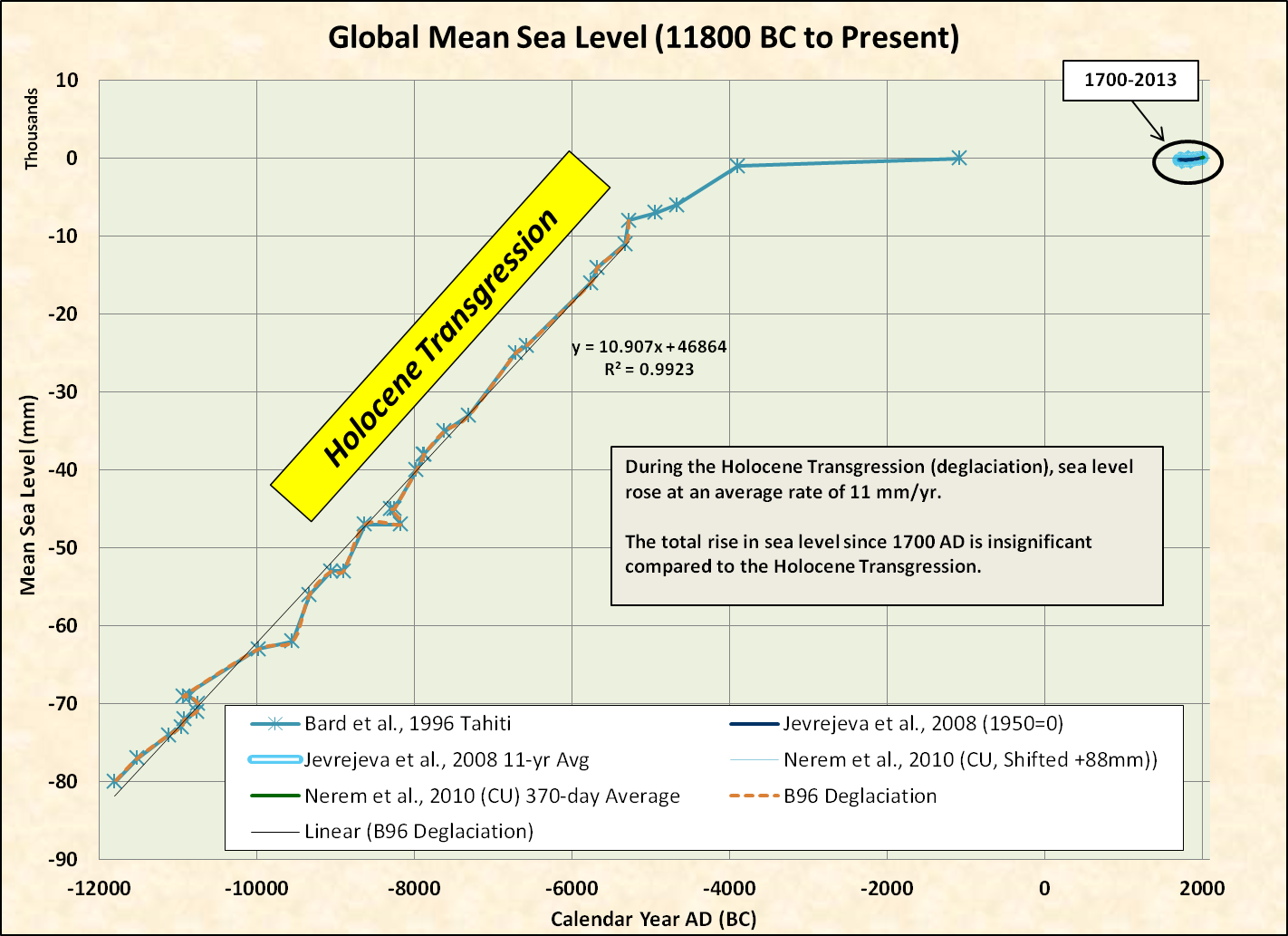
Stephanie, for the sea level to rise two metres by 2050 it would have to rise at 60 mm/year. There is no time in recorded history, including the end of the last ice age, that it has risen this fast. Do you really think it will suddenly happen? Really?

w.

Reply to  Willis Eschenbach
November 5, 2018 1:41 pm

Willis says to Stephanie: “You really should lay off of the heavy drugs”
….
Yet Willis tells me: ” give up on the ad hominem attacks”

I suggest Willis, you practice what you preach.

Reply to  Ralph Dave Westfall
November 5, 2018 2:43 pm

You’re correct, Ralph, I’ve edited out the offending comment.

w.

Stephanie Hawking
Reply to  Willis Eschenbach
November 5, 2018 8:43 pm

I did NOT say the slr would be 2m. I said IF… But since you ask me to tutor you here we go:

https://en.wikipedia.org/wiki/Meltwater_pulse_1A
Meltwater pulse 1A (MWP1a) is the name used by Quaternary geologists, paleoclimatologists, and oceanographers for a period of rapid post-glacial sea level rise, between 13,500 and 14,700 years ago, during which global sea level rose between 16 meters (52 ft) and 25 meters (82 ft) in about 400–500 years, giving mean rates of roughly 40–60 mm (0.13–0.20 ft)/yr.[1]

https://en.wikipedia.org/wiki/Meltwater_pulse_1B

Reply to  Stephanie Hawking
November 7, 2018 7:34 pm

MWP1a has no relevance in an interglacial stage…

In the first significant jump (meltwater pulse 1Ao, or MWP 1Ao), 19,600-18,800 years ago, ocean levels climbed at least 10 m within 800 years. However, not all sea level proxies register this event. A faster rise began 14,600 years ago during the comparatively mild Bølling-Allerød interstadial, accelerated about 300 years later and peaked about 13,800 years ago (meltwater pulse 1A, or MWP 1A) (Stanford et al., 2011). Sea level rose ~16 m during this event at rates of 26-53 mm/yr. Computer models that “fingerprint” spatial patterns of sea level rise attribute much of the meltwater to Antarctica. Different sources of ice melt leave geographically distinctive sea level fingerprints, because their ice unloading histories and gravitational pull between shrinking ice masses and ocean vary. On the other hand, geological data indicate significant deglaciation in Antarctica starting only toward the end of MWP 1A, which suggests that most of the meltwater originated from the breakup of Northern Hemisphere ice sheets.

https://www.giss.nasa.gov/research/briefs/gornitz_10/

MWP1a occurred while this was happening…

At the end of the last Pleistocene glacial stage, there was enough ice available for melting to raise sea level by more than 10 mm/yr for nearly 10,000 years.

There simply isn’t any physically realistic mechanism to replicate the Holocene Transgression or MWP1a during a warm interglacial stage.

It would require the destabilization of the East Antarctic Ice Sheet, which hasn’t happened since at least the Mid-Miocene Climatic Optimum…

Neogene T High Latitude SST (°C) From Benthic Foram δ18O (Zachos, et al., 2001) and HadSST3 ( Hadley Centre / UEA CRU via http://www.woodfortrees.org) plotted at same scale, tied at 1950 AD.

Possibly not since the Late Eocene…

RACookPE1978
Editor
Reply to  David Middleton
November 7, 2018 7:39 pm

Lot of effort there. Thank you!

Reply to  RACookPE1978
November 7, 2018 7:50 pm

warren
November 4, 2018 6:08 pm

Willis it looks like Dr Roy didn’t challenge you; too funny!
Fancy Dr Roy coming on here (primarily a citizen blog) to lecture you of all people.
Ralph and Steph are equally foolish but somehow worse as they clearly don’t have the ability to generate original thought (they’re parrots).
Keep up the good work Willis and know your detractors are one of the following:
Jealous.
Academic snobs.
Profession ‘protectors’.
Socialist ideologues.
Left-wing sponsored attack dogs.

November 5, 2018 7:38 am

Leif re your 6:02pm comment. The Post above says
” This Lean figure shows an increase in TSI of about 2 W/m2 from the Maunder minimum to the 1991 activity peak . This TSI and solar magnetic field variation modulates the earths albedo via the GR flux and cloud cover. From the difference between the upper and lower quintiles of Fig 4 (in link below) a handy rule of thumb a la Fermi would conveniently equate this to a Northern Hemisphere temperature millennial cycle amplitude of about 2 degrees C with that amount of cooling probable by 2,650+/-.The MTP in cloud cover was at about 2000.” This describes and even quantifies my mechanism . What is your mechanism – I’ll be happy if you use only “broad terms”

Reply to  Dr Norman Page
November 5, 2018 7:47 am

This describes and even quantifies my mechanism .
No, it doesn’t show why the sun would have a 1000-year cycle.

What is your mechanism?
https://arxiv.org/pdf/1808.08543.pdf
or
https://en.wikipedia.org/wiki/Solar_dynamo

Reply to  Leif Svalgaard
November 5, 2018 9:23 am

Leif The wiki link states
“During the solar cycle’s declining phase, energy shifts from the internal toroidal magnetic field to the external poloidal field, and sunspots diminish in number. At solar minimum, the toroidal field is, correspondingly, at minimum strength, sunspots are relatively rare and the poloidal field is at maximum strength. During the next cycle, differential rotation converts magnetic energy back from the poloidal to the toroidal field, with a polarity that is opposite to the previous cycle. The process carries on continuously, and in an idealized, simplified scenario, each 11-year sunspot cycle corresponds to a change in the polarity of the Sun’s large-scale magnetic field”
This is certainly compatible with and incorporated in my mechanism in the term “solar magnetic field variation modulates ……”. As to the first link the paper says :”We would like to argue that they figured out the correct physics partially, but not fully.Their success in predicting cycle 24 was due to a combination of intuition and luck”.
As to the 1000 year cycle, I note that you are not denying its existence just asking for its cause.
Here is a clue from a previous comment
“Great post Vuk. I hope all readers check it out to see the millennial cycle. I estimate that the periodicity drifts between 960 and 1020 years ie between 16 and 17 Jupiter/Saturn Lap cycles+/- The last millennial temperature cycle ran from 990 – 2004 ie 1014 years. I didn’t start with the astronomical cycles they just pop out of the temperature and solar activity data.”
Also check http://www.vukcevic.co.uk/Stein-Vuk.htm

Reply to  Dr Norman Page
November 5, 2018 9:49 am

As to the 1000 year cycle, I note that you are not denying its existence just asking for its cause.
I do deny its existence in the sense that it has no mechanism for its generation and therefore cannot be used for prediction as there is no reason for it continuing into the future.

Their success in predicting cycle 24 was due to a combination of intuition and luck
No, is was due to understanding the physics and using it to also successfully explain the last six cycles.

Reply to  Dr Norman Page
November 5, 2018 10:16 am

Their success in predicting cycle 24 was due to a combination of intuition and luck
Actually this is what it said:
“In order to model actual cycles, one needs to incorporate the actual fluctuations in the BL mechanism into the code. Choudhuri et al. (2007) devised a scheme of figuring out actual fluctuations of the BL mechanism from the observational data of the poloidal fields and then incorporating these in the dynamo code. Since such data are available only from the 1970s, actual cycles could be modelled only from that time. Choudhuri
et al. (2007) succeeded in modelling cycles 21–23 reasonably well and cycle 24 was predicted to be a weak cycle. Their prediction of cycle 24 was a robust prediction, since they had incorporated the weakness of the polar field at the beginning of cycle 24 in their model and the high diffusivity of their model would make this correlated with the strength of cycle 24. As we have already pointed out, this prediction has been borne out triumphantly—making this the first successful prediction of a solar cycle based on a theoretical dynamo model in the history of this subject.”

November 5, 2018 10:25 am

Leif
you said there is no evidence for a 87 year cycle Gleissberg in the solar data
https://wattsupwiththat.com/2018/11/02/the-millennial-turning-point-solar-activity-and-the-coming-cooling/#comment-2509681
As before, it seems you are stuck on SSN.

yet, I have repeatedly responded by saying that I can see the last GB half cycle in the recent data on the sun’s solar polar magnetic field strengths, namely from 1971 to 2014;
any good mathematician can see that you can draw the 2 binomials (parabola / hyperbola) that represent the average field strengths, from the 2 last Hale cycles that ran from 1971 – 2014

You honestly cannot agree with me on that?

Reply to  henryp
November 5, 2018 10:30 am

for those interested,
obviously all planets arrived in time and we did make the switch to the new GB cycle – or the new half cycle – if you so wish –
meaning there is no extended solar minimum.
It makes it all fairly easy to predict the strengths of the next few solar cycles.

Reply to  henryp
November 5, 2018 11:12 am

obviously all planets arrived in time
The planets have nothing to do with solar activity:
https://leif.org/research/aa22879-13-No-Planetary-Influence.pdf
“If the hypothesis of Abreu et al. is correct, it should be possible to find the same periodicities in the records of cosmogenic nuclides at earlier times [actually: all]. As mentioned above, 10Be in ice cores can be measured over several hundred thousand years in the past. We look here at the record of 10Be in the EPICA (European Project for Ice Coring in Antarctica) Dome C (EDC) ice core from Antarctica during the Marine Interglacial Stage 9.3 (MIS 9.3), 325–336 kyr ago. This record is part of a data setbetween 269–355 kyr that was produced (Cauquoin 2013) in the framework of a project to measure a continuous high-resolution profile in the EDC core over the past 800 kyr. ther data from this project are being published separately. The resolution of our measurements between 325–336 kyr (20–29 yr) is comparable to that (resampled at 22 yr) used by Abreu et al. (2012), and allows us to investigate all five of the periodicities cited by them….
In Fig. 3 [below] we show the same procedures applied to our 10Be flux for the period 325–336 kyr. For the Fourier spectrum, we find only one highly significant (greater then 99%) peak having the same periodicity (104 years) cited by Abreu et al. (2012). There is also a modestly significant peak (∼95%) at 150 years. The other frequencies cited by Abreu et al. (2012), at 88, 208, and 506 years, all have a significance of less than 95%, and appear consistent with red noise. The most significant periodicity in our record is at 130 years. Interestingly, a 130 year periodicity is also seen in the Fourier spectrum of Abreu et al., but not in the spectrum of the planetary torque. While the wavelet spectrum shows isolated periodicities at ∼500 and 1000 years, they are only about one cycle long, and therefore not considered significant.”
comment image

Reply to  henryp
November 5, 2018 10:31 am

As before, it seems you are stuck on SSN.
No, the SSN is just the metric. If you would take the rouble to read my paper you would see that all our solar data [incl. cosmic ray data] agree with each other and show that there has not been an 88-yr cycle in recent centuries.

I can see the last GB half cycle in the recent data on the sun’s solar polar magnetic field strengths
That does not show tha there actually is such a cycle repeating through centuries. All you see is a 44-yr segment, from which you cannot honest deduce the existence of a persitent 88-yr cycle.

Reply to  Leif Svalgaard
November 5, 2018 12:37 pm

Leif
My own data on Tmin and Tmax confirm the last 43 or 44 year segment. In addition there are papers that I can quote that extend the data to previous times, before they started with the CO2 nonsense. But, as we said to each other before: You believe in your figures and I will believe in my mine. That is science. Let us therefore agree to disagree. I find there is definitely correlation between what happens on the sun and the planets’ position. I am just not yet sure if it is caused by or cause to the varying degrees of solar activity.
I wonder how Vuk and Javier think about that?

Otherwise, I think I am quite happy with my final report.

[click on my name to read it]

November 5, 2018 12:38 pm

Leif
My own data on Tmin and Tmax confirm the last 43 or 44 year segment. In addition there are papers that I can quote that extend the data to previous times, before they started with the CO2 nonsense. But, as we said to each other before: You believe in your figures and I will believe in my mine. That is science. Let us therefore agree to disagree. I find there is definitely correlation between what happens on the sun and the planets’ position. I am just not yet sure if it is caused by or cause to the varying degrees of solar activity.
I wonder how Vuk and Javier think about that?

Otherwise, I think I am quite happy with my final report.

[click on my name to read it]

R. de Haan
November 6, 2018 1:29 am

TSI Reduction of about 8 watt per square meter predicted for the Grand Solar Minimum currently underway:
https://youtu.be/M_yqIj38UmY

Reply to  R. de Haan
November 6, 2018 2:14 am

There will not be a grand or extended minimum. Just a normal minimum.

Reply to  HenryP
November 6, 2018 8:20 am

Must add
I don’t think TSI changes all that much over solar maxima and minima.
What [I think] actually happens during a period of declining solar polar magnetic field strengths, is that the chi square distribution shifts a bit to the left, but the area [energy] beneath the curve stays more or less the same.
so
more of the lower wavelength particles are released => luckily we have an atmosphere who converts this type of very harmful radiation to ozone, peroxide and N-oxides.
Hence: don’t go to Mars until you have created a reasonable earthlike atmosphere…

Anyway, the extra ozone, peroxide and N-oxides blocks some of the incoming UV radiation and that means less warmth going into the oceans [mostly]

hence, you will have some global cooling during a period of declining solar magnetic field strengths.
Always keep an eye on SST!!!

Don
November 15, 2018 7:26 am

Just an FYI, is has been over 15 years since we have had a 200+ sunspot number 31 Oct 2003

Verified by MonsterInsights