The fast approaching solar minimum and its potential impact on the upcoming winter season
By Meteorologist Paul Dorian

Overview
In the long term, the sun is the main driver of all weather and climate and multi-decadal trends in solar activity can have major impacts on oceanic and atmospheric temperatures. In addition, empirical observations have shown that the sun can have important ramifications on weather and climate on shorter time scales including those associated with the average solar cycle of around 11-years. For example, there is evidence that low solar activity during solar minimum years tend to be well-correlated with more frequent “high-latitude blocking” events compared to normal and this type of atmospheric phenomenon can play an important role in the winter season.
Discussion
Weather conditions and snowpack during the fall and winter seasons in cold air source regions such as Greenland and northeastern Canada can, in turn, have quite an impact on the conditions experienced in the eastern US. These particular regions of North America are where many cold air masses originate and the fact that Greenland, for example, has been particularly cold since late July is quite a bullish sign for the formation of deep, cold air masses. [By the way, the temperature at Summit Station, Greenland at 4 PM on Sunday was minus 38 degrees (F)].
It is not only important to monitor the potential for the formation of cold air masses in these particular regions, it is also important to determine if there will be a mechanism to bring the cold air masses southward from the northern latitudes into the mid-latitudes including the Mid-Atlantic region. “High-latitude blocking” is a phrase given to just such an atmospheric phenomenon that indeed can bring cold air masses into the eastern US from these cold air source regions and with the “block” in the atmosphere during these events, cold air can stick around for awhile which is often an important pre-requisite for accumulating snow in some places such as the big cities of the I-95 corridor. “High-latitude blocking” during the winter season is characterized by persistent high pressure in northern latitude areas such as Greenland, northeastern Canada, and Iceland. There is evidence that low solar activity during solar minimum years tend to be well-correlated with more frequent “high-latitude blocking” events compared to normal.

This plot shows the daily observations of the number of sunspots during the last four solar cycles back to 1 January 1977 according to Solar Influences Data Analysis Center (SIDC). The thin blue line indicates the daily sunspot number, while the dark blue line indicates the running annual average. The current low sunspot activity is indicated by the arrow at the lower right of the plot. Last day shown: 30 Sep 2018. Data source: climate4you.com.
In terms of solar activity, we are now at the very end of the weakest solar cycle (#24) in more than a century and are rapidly approaching the next solar minimum – usually the least active time in a given solar cycle. In truth, there is a chance that we have already entered into the solar minimum phase which is not always known until “after-the-fact”. The last solar minimum that took place from 2007-to-2009 turned out to be the quietest period in at least a century and signs point to another deep solar minimum over the next couple of years.
The last time an inactive sun coincided with a moderate El Nino event – somewhat similar to expectations for this winter – was during the winter of 2009-2010 and the Mid-Atlantic region experienced quite a cold and snowy winter with, for example, Washington, DC experiencing their snowiest winter ever. Looking back to the preceding solar minimum which occurred in 1995-1996, there also was a “gangbuster” winter season in the I-95 corridor which included one of the biggest snowstorms ever on January 6-9, 1996.
Full analysis here at Perspecta Weather
Not only Greenland is cold.
http://masie_web.apps.nsidc.org/pub/DATASETS/NOAA/G02186/plots/4km/r08_Baffin_Bay_Gulf_of_St._Lawrence_ts_4km.png
The Beaufort Sea is almost completely covered with ice.
http://masie_web.apps.nsidc.org/pub/DATASETS/NOAA/G02186/latest/4km/masie_all_r01_4km.png
Regarding ENSO they are numerous occasions where El Nino doesn’t first develop until at least December of any given year. (>+0.5 for at least 3 months) Others years usually first occurred between September and November.
Examples below from the last 30 years.
The last 2 values are Nino3.4 with the anomaly.
1991 1 23.86 -0.60 25.65 0.02 29.00 0.70 27.01 0.44
1991 2 25.97 -0.10 26.27 -0.10 28.73 0.63 26.93 0.21
1991 3 26.51 -0.01 26.99 -0.15 28.64 0.45 27.25 0.03
1991 4 24.99 -0.48 27.32 -0.18 29.13 0.63 27.98 0.20
1991 5 24.37 0.17 27.58 0.50 29.42 0.63 28.35 0.50
1991 6 23.05 0.23 27.34 0.91 29.35 0.51 28.36 0.71
1991 7 22.05 0.45 26.57 0.95 29.26 0.46 27.92 0.70
1991 8 21.08 0.43 25.47 0.48 29.25 0.57 27.44 0.62
1991 9 20.75 0.39 25.05 0.20 29.19 0.50 27.07 0.35
Wasn’t until October for significant development.
1991 10 21.13 0.31 25.60 0.68 29.44 0.78 27.63 0.94
1991 11 22.18 0.59 25.98 1.00 29.45 0.82 27.86 1.21
1991 12 23.43 0.64 26.52 1.38 29.45 0.96 28.37 1.80
1994 1 24.32 -0.14 25.71 0.08 28.47 0.17 26.60 0.03
1994 2 25.79 -0.28 26.07 -0.30 28.07 -0.03 26.59 -0.13
1994 3 25.43 -1.09 26.89 -0.25 28.26 0.07 27.27 0.05
1994 4 24.32 -1.15 27.06 -0.44 28.62 0.12 27.90 0.12
1994 5 23.22 -0.98 26.97 -0.11 29.00 0.21 28.04 0.19
1994 6 22.43 -0.39 26.50 0.07 29.18 0.34 27.99 0.34
1994 7 21.21 -0.39 25.19 -0.43 29.40 0.60 27.35 0.13
1994 8 19.70 -0.95 24.71 -0.28 29.46 0.78 27.35 0.53
1994 9 20.16 -0.20 24.81 -0.04 29.23 0.54 27.00 0.28
Wasn’t until October until significant development.
1994 10 21.53 0.71 25.53 0.61 29.45 0.79 27.49 0.80
1994 11 22.41 0.82 25.87 0.89 29.63 1.00 27.87 1.22
1994 12 23.61 0.82 26.07 0.93 29.50 1.01 27.87 1.30
2014 1 24.79 0.27 25.26 -0.37 28.14 -0.17 26.06 -0.51
2014 2 25.40 -0.75 25.56 -0.81 28.37 0.27 26.18 -0.55
2014 3 25.86 -0.78 26.90 -0.24 28.71 0.52 26.99 -0.22
2014 4 25.23 -0.37 27.73 0.23 29.13 0.63 28.01 0.24
2014 5 25.57 1.30 27.69 0.61 29.56 0.77 28.31 0.46
2014 6 24.51 1.64 27.32 0.89 29.43 0.59 28.11 0.46
2014 7 22.98 1.36 26.27 0.65 29.09 0.29 27.40 0.18
2014 8 21.91 1.27 25.51 0.52 29.14 0.46 27.02 0.20
2014 9 21.30 0.96 25.31 0.45 29.34 0.65 27.17 0.45
2014 10 21.54 0.75 25.58 0.66 29.31 0.64 27.17 0.49
Wasn’t until November until there was significant development.
2014 11 22.33 0.74 25.88 0.91 29.52 0.88 27.50 0.85
2014 12 22.90 0.08 25.94 0.80 29.40 0.91 27.35 0.7
2018 1 23.71 -0.81 24.48 -1.14 28.03 -0.27 25.82 -0.75
2018 2 25.57 -0.57 25.36 -1.01 27.86 -0.24 25.83 -0.90
2018 3 25.83 -0.80 26.37 -0.76 28.14 -0.05 26.48 -0.73
2018 4 24.58 -1.02 27.12 -0.38 28.63 0.12 27.42 -0.36
2018 5 23.73 -0.54 26.94 -0.15 29.01 0.22 27.72 -0.13
2018 6 22.19 -0.69 26.72 0.29 29.16 0.32 27.85 0.20
2018 7 21.43 -0.19 26.05 0.43 29.10 0.30 27.52 0.30
2018 8 20.66 0.02 25.14 0.15 29.19 0.51 27.11 0.29
2018 9 20.26 -0.08 25.15 0.29 29.14 0.45 27.07 0.34
http://www.cpc.ncep.noaa.gov/data/indices/sstoi.indices
Until November has at least finished it’s still too early to judge where things will develop for Winter/Spring regarding El Nino. This pattern is also similar with developments of La Nina.
Picking the absolute bottom of the minimum is a mug’s game and means very little in the grand scheme. We are in the minimum and may stay here for some time. I think it would be wise to withhold judgment for another year. In the meantime, you may want to digest this and save it for later. It is a hypothesis about the bimodal solar peaks for the past several cycles and the heartbeat of the sun.
https://www.dropbox.com/s/d938a39pwzvk4ii/Zharkova%20et%20al%2C%202015.pdf?dl=0
I don’t think a absolute bottom of the minimum is necessary. Once a certain low threshold is reached and stays that way long enough that will do.
Sea surface temperature shows the current circulation over North America.
https://weather.gc.ca/saisons/animation_e.html?id=month&bc=sea
Contrary to appearances, on the west it will not be too warm.
http://www.cpc.ncep.noaa.gov/products/stratosphere/strat_int/gif_files/gfs_hgt_trop_NA_f24.png
Here in Cleveland Ohio, from 2009 to 2012 Winters were very warm and very low snowfall.
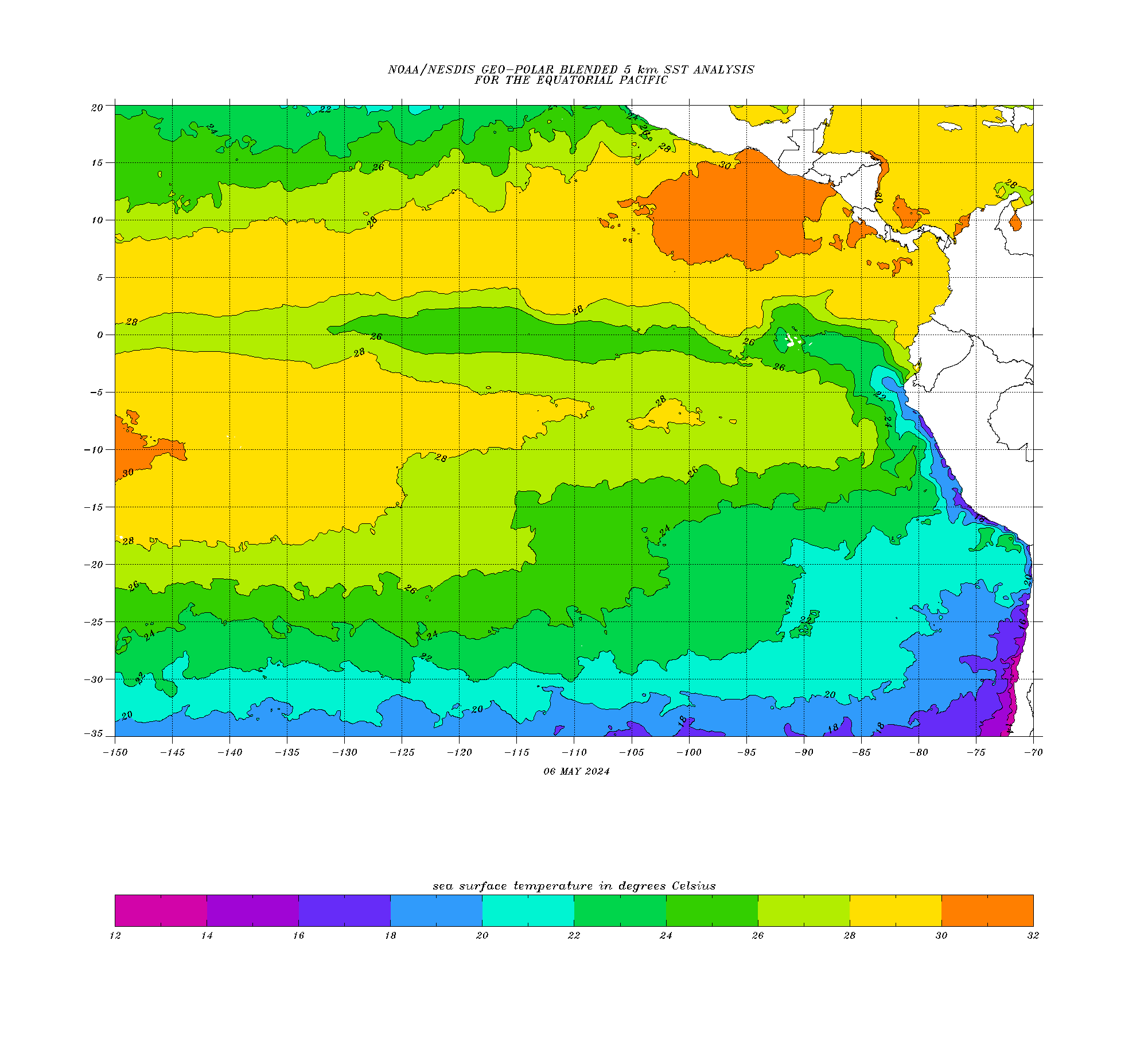
Let’s see the actual surface temperature of the equatorial Pacific.
Tom is correct on this.
It is actually quite amusing to watch all the usual suspects display their ignorance.
Leif,
That’s ok, just check in once in a while so I don’t worry about you if it’s about the sun.
Regards,
JimG1
Many people who are unaware of this have concluded similarly. The temperature rise follows the solar cycle influences across cycles. According to my work, the ocean warms/cool at decadal scales at a solar input threshold of 120 sfu in F10.7cm/94 v2 SSN, which each solar cycle shown exceeded, driving the accumulation of ocean heat and therefore surface temperature and general climate.
Bob I agree with this. We are not as far apart as it seems and I appreciate your hard work on this very complicated subject.
what “work”?
In general. You have much detailed data on what you are promoting , which I admit I lack in some areas especially when it comes to the geo magnetic field.
The thirty day SOI index has been increasing since 03/10/2018.
https://www.longpaddock.qld.gov.au/soi/
https://watchers.news/2018/03/08/research-helps-explain-ongoing-changes-in-geomagnetic-field/
Some rather recent information on geo magnetic field, which is not easy to come by.
The different sources that contribute to the magnetic field measured by Swarm. The coupling currents or field-aligned currents flow along magnetic field lines between the magnetosphere and ionosphere.
https://www.esa.int/spaceinimages/Images/2012/10/Magnetic_field_sources
“We have made major discoveries that contemporary science cannot explain at this time. Go to http://www.safireproject.com and we invite your constructive comments and thoughts as we journey through some of the most profound plasma phenomena ever seen before. To all who have contributed – a most sincere thanks.
The SAFIRE Team.
http://www.safireproject.com”
I have to admit the possibility of global warming scares me. Yes, it I know it means a growing food supply, fewer deaths… and generally a more productive planet. But I love cold weather. It I wasn’t married, I’d move to Alaska. When the temperatures rise into the 80’s here on my mountaintop near Reno, I get worried and seek shelter. At that elevation, the sun is fierce – even in the dead of winter. I go around in T-shirts in the winter here if the sun is shining, and the wind is light to moderate. We get a foot or so of snow in the winter – but not enough that I can justify getting a snowmobile – even at 5,900 ft altitude. I yearn for global cooling, although all my friends think I’m crazy.
When I get old, and my will bones crave the warmth (I hear), I can always light a juniper fire in the fireplace and warm up. Read a book. Watch an old favorite movie. Cuddle with my wife while I do either. What is old? I’m 64, and I still make snow angels in the buff (TMI, I know), make snowmen, and revel in the winter beauty. I love being able to track the deer (and trailing coyotes) in the snow – even if only for a few days – even though I do not hunt. Winter is fun. Skiing, sledding – just walking on a pristine mountain side. Or target shooting without fear of starting a wildfire.
But not everyone is adapted to cold, I have started to understand. I thought most of my friends were just teasing – who couldn’t love winter? Soaking in a hot tub outdoors while the snow falls is exhilarating! But an awful lot of people die every year from exposure to the cold. I wish they could all move to Florida, Texas, Arizona… and Southern California.
And leave me to play in my beautiful winter wonderland.
But I still like my fresh, inexpensive veggies and fruit. And that has only recently (my lifetime) been in such abundance. Sacrifices must be made. Let’s have more CO2, and maybe a bit more warming.
And maybe I’ll move to Alaska yet. Although I hear the summers there are warm, humid, and buggy. Sheesh. Maybe I can buy real estate in Antarctica?