From the “you’re drunk at the lab, go home” department comes this bit of ridiculous scare mongering from the university that brought us ClimateGate.

Severe climate events could cause shortages in the global beer supply, according to new research involving the University of East Anglia (UEA).
The study warns that increasingly widespread and severe drought and heat may cause substantial decreases in barley yields worldwide, affecting the supply used to make beer, and ultimately resulting in “dramatic” falls in beer consumption and rises in beer prices.
Beer is the most popular alcoholic drink in the world by volume consumed. Although the frequency and severity of drought and heat extremes increase substantially in a range of future climate scenarios, the vulnerability of beer supply to such extremes has never been assessed.
In recent years, the beer sector has consumed around 17% of global barley production, but this share varies drastically across major beer-producing countries, for example from 83% in Brazil to 9% in Australia. Results from the new study reveal potential average yield losses ranging from 3% to 17%, depending on the severity of the conditions. Decreases in the global supply of barley lead to proportionally larger decreases in barley used to make beer.
During the most severe climate events, the results indicate that global beer consumption would decline by 16%, or 29 billion litres – roughly equal to the total annual beer consumption in the US – and that beer prices would on average double. Even in less severe extreme events, beer consumption drops by 4% and prices rise by 15%.
The findings, published today in Nature Plants, suggest that total beer consumption decreases most under climate change in the countries that consumed the most beer by volume in recent years. For example, the volume consumed in China – today the largest consuming country – falls by more than any other country as the severity of extreme events increases, and by 4.34 billion litres in the most severe.
In the UK, beer consumption could fall by between 0.37 billion and 1.33 billion litres, while the price could as much as double. Consumption in the US could decrease by between 1.08 billion and 3.48 billion litres.
Co-ordinator of the research and lead UK author Dabo Guan, professor of climate change economics at UEA’s School of International Development, said: “Increasingly research has begun to project the impacts of climate change on world food production, focusing on staple crops such as wheat, maize, soybean, and rice.
“However, if adaptation efforts prioritise necessities, climate change may undermine the availability, stability and access to ‘luxury’ goods to a greater extent than staple foods. People’s diet security is equally important to food security in many aspects of society.
“Although some attention has been paid to the potential impacts of climate change on luxury crops such as wine and coffee, the impacts on beer have not been carefully evaluated. A sufficient beer supply may help with the stability of entertainment and communication in society.”
Prof Guan added: “While the effects on beer may seem modest in comparison to many of the other – some life-threatening – impacts of climate change, there is nonetheless something fundamental in the cross-cultural appreciation of beer.
“It may be argued that consuming less beer isn’t itself disastrous, and may even have health benefits. Nevertheless, there is little doubt that for millions of people around the world, the climate impacts on beer availability and price will add insult to injury.”
The international study involved researchers from the UK, China, Mexico, and the US, who identified extreme climate events and modelled the impacts of these on barley yields in 34 world regions. They then examined the effects of the resulting barley supply shock on the supply and price of beer in each region under a range of future climate scenarios.
Some countries with smaller total beer consumption face huge reductions in their beer consumption: the volume of beer consumed in Argentina falls by 0.53 billion litres, equivalent to a 32% reduction, during more severe climate events. Even in the least severe climate events, total beer consumption in Argentina and Canada decreases by 0.27 billion litres (16%) and 0.22 billion litres (11%) respectively.
Countries where beer is currently most expensive, for example Australia and Japan, are not necessarily where future price shocks will be the greatest. Changes in the price of beer in a country relates to consumers’ ability and willingness to pay more for beer rather than consume less, such that the largest price increases are concentrated in relatively affluent and historically beer-loving countries.
The researchers suggest that changes in barley supply due to extreme events will affect the barley available for making beer differently in each region, as the allocation of barley among livestock feed, beer brewing, and other uses will depend on region-specific prices and demand flexibilities as different industries seek to maximize profits.
Their findings show that global and country-level barley supply declines progressively in more severe extreme event years, with the largest mean supply decreasing by 27-38% in some European countries, such as Belgium, the Czech Republic and Germany.
The study was supported by the UK Economic and Social Research Council (ESRC), Natural Environment Research Council (NERC), the British Academy and Philip Leverhulme Prize.
The paper:
‘Decreases in global beer supply due to extreme drought and heat’, Wei Xie, Wei Xiong, Jie Pan, Tariq Ali, Qi Cui, Dabo Guan, Jing Meng, Nathaniel D Mueller, Erda Lin, and Steven J Davis, is published in Nature Plants. DOI: 10.1038/s41477-018-0263-1.
one of the few studies on “Climate Change” that shed light on a real problem.
Countries in temperate zones can spare areas for the production of barley, hops and malt.
For the production of beer, which has a moderate impact on the population.
________________________________________________
Countries that need all the fertile land to feed the population can provide only the least productive areas for alcohol production:
for the cultivation of “inferior” potatoes – for the production of vodka – which has a great impact on the population.
A problem which Russia is still fighting today.
/ NO sarc
The USSR supported Cuba by buying its sugar, which was turned into vodka, from which the Communist regime made money. The Politburo wanted its subjects to smoke and drink to excess, so that they’d have to pay less in old age pensions, plus garner more in taxes.
John Tillman,
dumm geboren, nix dazugelernt.
John Tillman,
be proud of it:
https://www.google.at/search?client=ms-android-samsung&ei=kfnEW9C0L5DmrgT4oKWICw&ins=false&q=Alaska+state+troopers+home+brew&oq=Alaska+state+troopers+home+brew&gs_l=mobile-gws-wiz-serp.12.
It’s part of the standard scare strategy where they try to make it “real” on an everyday level. They also push the line that global warming will lead to shortages of chocolate and coffee, but they tailor the message to the audience, so that women’s magazines are more likely to focus on chocolate rather than beer.
But, beer is like making love in a canoe.
“increasingly widespread and severe drought and heat”
They’ve been predicting this almost as long as they’ve been predicting a breakthrough in fusion power.
They also can’t make up their minds as to drought or flood from global warming.
Since they need more atmospheric water vapor to generate ECS above 1.2 degrees C per doubling of CO2, there must be at least increased humidity, if not also rainfall, which presumably would condense at slightly higher altitude in warmer air.
As usual the wording is “Could, could, could”.
What about less modelling and more “Facts”.
MJE
Let us guess they don’t want to show their data because someone may look for something wrong with it ?
it’s your choice:
beer, vodka or US Alaskan
https://www.google.at/search?q=Alaska+troopers+home+brew&oq=Alaska+troopers+home+brew&aqs=chrome..
The genesis for this study seems to lie in the idea that it is the elite that are concerned about “climate change.” (See Dr. Lindzen’s recent speech). When the warmistas wondered how to get Joe Sixpack on board, the answer was obvious: tell him climate change was going to make his beer expensive and scarce.
When checking out the reference for the paper, it was interesting to follow the money. Most of the co-authors were Chinese and funded by various agencies in China. There were three U.S. co-authors listed, all from the University of California, Irvine.
These U.S. co-authors listed their funding as being from National Science Foundation Grant: INFEWS grant EAR 1639318. From the NSF website, this almost 2 million dollar grant was to construct a computer model to: “…model the food, energy [and] water system (FEWS) nexus for California where the important interactions among these components can be comprehensively assessed using historical data. By addressing this system of systems at the intended level of spatial, temporal and mechanical detail, the project will advance the knowledge of FEW systems and how they respond to external and internal stress.”
https://www.nsf.gov/awardsearch/showAward?AWD_ID=1639318&HistoricalAwards=false
So now you know. You throw all the info about food, energy and water into the model and out pops the answer that barley is going to be scarce, therefore your beer is going to be expensive and scarce.
more likely with warming, the northern latitudes will become viable for viticulture, and less land for barley,
we’re all going to be forced to become wine sippers
doom!
97% of scientists agree… And this study has been done by one of them! “Drunk at the lab” – Anthony nailed it.
the difference is
– 5 volumes% alc in beer
– 80 volumes% in vodka
– 90 volumes% alcohol in Alaskan home brews + detergent in “dry indegenous” settlements with 1,000% profit and no taxes.
________________________________________________
no country for old men.
There was talk in Europe earlier this year of a shortage of beer being occasioned by, of all things, a shortage of bottled CO2 because the commercial suppliers had all decided to shut down at the same time for refurbishment. Link to one article here; http://time.com/5328059/carbon-dioxide-co2-beer-crumpet-shortage/
No climate involvement necessary at all for a beer shortage. Just messed up maintenance scheduling.
This study was clearly not done by an economist who understands micro-economics.
These Plant scientists obviously do not understand economics of large scale agriculture.
As the price of barley goes up, more farmers will put more acres to barley production.
Problem solved.
And idea of drought extremes affecting global scale barley supply is laughable. Barley isn’t grown in the desert or marginal lands today. The IPCC evens say that wet areas will get wetter, and dry areas will get drier under climate change.
And even more to the point of how much BS this paper is, you have to go see what the authors hid in the supplemental information.
https://static-content.springer.com/esm/art%3A10.1038%2Fs41477-018-0263-1/MediaObjects/41477_2018_263_MOESM1_ESM.pdf
Goto section 3.3 of the SI, page 23.
They analyzed all 4 RCP scenarios in CMIP5. Even in RCP2.6 (the most optimistic), they show severe declines in production across many countries. That result right there tell you there economic model is deeply flawed.
Their barley production %change by RCP by country results are here:
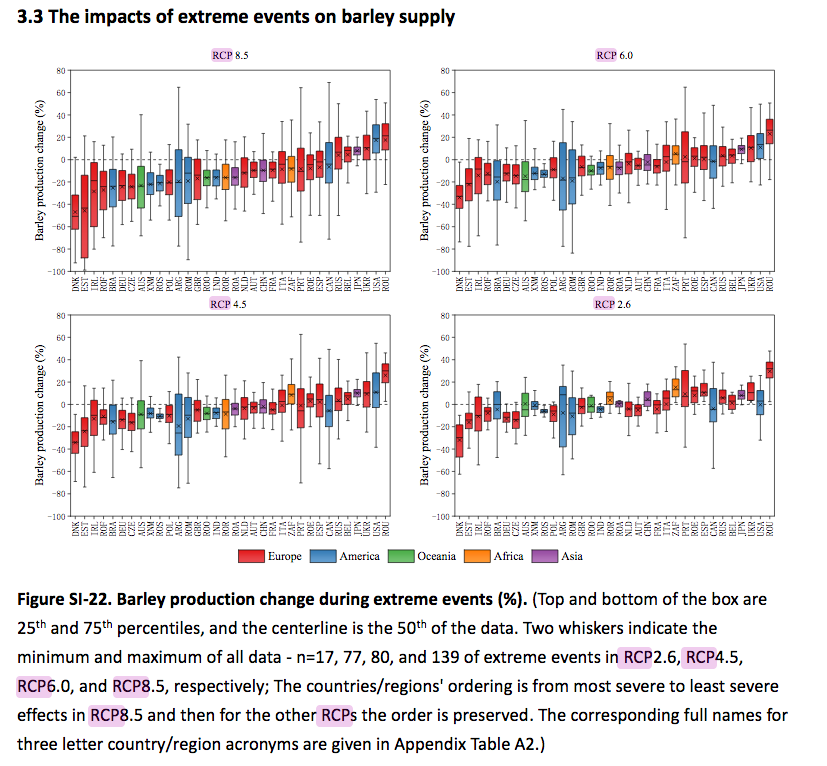
Even in their results (see figure at link above), they show US’s and Ukraine’s barley production will go up in all 4 RCP scenarios, while in “poor” Denmark’s and Ireland’s barley production will go down no matter what happens. What utter garbage.
For Scotch drinkers, the rain in Scotland is what matters.
The cost of barley in Guiness beer or Irish whisky is practically trivial, so Irish barley production scarcely signifies.
It’s amazing how the comments are a full 180 over on a tech site like arstechnica compared to here.
https://arstechnica.com/science/2018/10/barley-shortages-from-climate-change-could-mean-less-beer-worldwide/
They base this on computer models that simulate conditions for the next 100 years……….which have been exactly wrong over the past 20 years about global drought and world food production/crop yields.
1. Take note of the real world below………. world cereal production and stocks, which includes barley. They have been soaring higher, not in spite of climate change but because of it and especially the beneficially increasing CO2.
http://www.fao.org/worldfoodsituation/csdb/en/
2. What happened to barley in 76 studies with an increase in CO2 of 300 parts per million?
An increase of 40.6% in biomass yields.
http://www.co2science.org/data/plant_growth/dry/dry_subject.php
http://www.co2science.org/data/plant_growth/dry/dry_subject_b.php
http://www.co2science.org/data/plant_growth/dry/h/hordeumv.php
3. The planet is greening up. Global drought has decreased slightly, not increased.
https://www.nasa.gov/feature/goddard/2016/carbon-dioxide-fertilization-greening-earth
An international team of 32 authors from 24 institutions in eight countries led the effort, which involved using satellite data from NASA’s Moderate Resolution Imaging Spectrometer and the National Oceanic and Atmospheric Administration’s Advanced Very High Resolution Radiometer instruments to help determine the leaf area index, or amount of leaf cover, over the planet’s vegetated regions. The greening represents an increase in leaves on plants and trees equivalent in area to two times the continental United States.
Instead of adjusting(fixing) the climate models based on the real world, they instead, stick with increasingly wrong projections and repackage them in new creative and exaggerated ways to market the scam by alarming people. This time, we have a beer catastrophe. The world has a great deal of beer drinkers……oh my, maybe this will get their attention.
Should we believe the overwhelming empirical data/evidence from the real world above?
Or, should we believe models that have been telling us the opposite of this for the past 2 decades.
CO2 Science
http://www.co2science.org
A weekly review and repository of scientific research findings pertaining to carbon dioxide and global change.
300 ppm
600 ppm
900 ppm
Number of Results
76
4
3
Arithmetic Mean
40.6%
50.8%
38%
Standard Error
4.8%
16.4
14.1%
https://www.nasa.gov/feature/goddard/2016/carbon-dioxide-fertilization-greening-earth
An international team of 32 authors from 24 institutions in eight countries led the effort, which involved using satellite data from NASA’s Moderate Resolution Imaging Spectrometer and the National Oceanic and Atmospheric Administration’s Advanced Very High Resolution Radiometer instruments to help determine the leaf area index, or amount of leaf cover, over the planet’s vegetated regions. The greening represents an increase in leaves on plants and trees equivalent in area to two times the continental United States.
globe of Earth from North Pole perspective
Oh, no, not only are my chips going to be smaller, there won’t be any beer to wash them down with. Here, take all my money if you can save my chips and beer. Wait a minute though. I seem to remember the hottest years evah resulted in a bumper barley crop. Besides that beer can be made from many other things than barley. Wheat beers are quite popular, but any plant containing sugars and not poisonous could be used.
Every Sunday I shop for a 12 pack of beer. My goal is to get a medium quality beer for around a dollar a beer. Drinking a Rolling Rock right now – retailed for $10.90 for a twelve pack. And Rolling Rock is an OK beer. Moosehead and Modelo have also been very inexpensive here lately. (Arizona, USA).
CO2 is at over 400 ppm; it’s 2018. When does this beer overprice thing start? ‘Cause it hasn’t started yet. As far as my experience shows me, this is a golden age for inexpensive beer. And I don’t think climate change one way or the other has anything at all to do with beer prices.
I think it has a lot more to do with lots and lots of alternative specialty beers coming on the market and eating away at market share. I got a sixpack of something called nitro beer – it was a dark beer and it was expensive at $8.00 a sixpack. But it was really good. I’d never heard of it or seen it. So there’s lots of beer product out there right now and there’s competition for market.
This is great news!
A decrease in beer consumption means less drunkenness (the beer-drinkers won’t just drinnk something else as the alternatives are usually MORE expensive than beer anyway – worst case is they js they drink less of beer and the more expensive grog) and an increase in physical health.
So GlobalWarming will save BILLIONS of health-related dollars as well as a decrease in beer-fueled crimes.
Fantastic – bring it on!
I wonder if the lead author, Dr Guan, dropped the final ‘o’ in his name? He’s definitely guano crazy, if you know what I mean.