
Guest essay by Eric Worrall
Greens are celebrating that feeding algae to cows which breaks down into the organo-halide Bromoform seems to drastically reduce their flatulence of powerful greenhouse gasses. But the toxicology description of Bromoform suggests the need for a lot more caution before implementing this measure on a large scale.
Clearing the air: who should do the most to tackle climate change?
By Nicole Hasham
4 August 2018 — 11:37pmIn the balmy waters off Queensland’s coast grows a red algae that promises to help rescue the planet.
Sprinkled into the feed of cows, trials show the super-seaweed can all but eliminate greenhouse gas emissions produced by their burps and flatulence.
But the algae – Asparagopsis taxiformis – has never been farmed at scale. Scuba divers must painstakingly pluck it from the ocean. As research founder Rob Kinley of the CSIRO says, the challenges of commercial production are immense.
“The potential is global … but the barrier is the supply of seaweed. The scale of that is monstrous,” Kinley said.
“Every country wants to improve their environmental footprint from agriculture … what we need to do is come up with a massive supply.”
…
Tracking down the study;
The red macroalgae Asparagopsis taxiformis is a potent naturalantimethanogenic that reduces methane production duringin vitro fermentation with rumen fluid
Robert D. Kinley, Rocky de Nys, Matthew J. Vucko, Lorenna Machado and Nigel W. Tomkins
CSIRO Agriculture, Australian Tropical Science and Innovation Precinct, James Cook University,Townsville, Qld 4811, Australia.
BMACRO-Centre for Macroalgal Resources and Biotechnology, College of Marine and Environmental Sciences,James Cook University, Townsville, Qld 4811, Australia.CCorresponding author. Email: rob.kinley@csiro.auAbstract.
Livestock feed modification is a viable method for reducing methane emissions from ruminant livestock. Ruminant enteric methane is responsible approximately to 10% of greenhouse gas emissions in Australia. Some species of macroalgae have antimethanogenic activity on in vitro fermentation. This study used in vitro fermentation with rumeninoculum to characterise increasing inclusion rates of the red macroalga Asparagopsis taxiformis on enteric methaneproduction and digestive efficiency throughout 72-h fermentations. At dose levels at 1% of substrate organic matter there wasminimal effect on gas and methane production. However, inclusion at 2% reduced gas and eliminated methane production inthe fermentations indicating a minimum inhibitory dose level. There was no negative impact on substrate digestibility for macroalgae inclusion at 5%, however, a significant reduction was observed with 10% inclusion. Total volatile fatty acids were not significantly affected with 2% inclusion and the acetate levels were reduced in favour of increased propionate and, to alesser extent, butyrate which increased linearly with increasing dose levels. A barrier to commercialisation of Asparagopsis isthe mass production of this specific macroalgal biomass at a scale to provide supplementation to livestock. Another area requiring characterisation is the most appropriate method for processing (dehydration) and feeding to livestock in systems with variable feed quality and content. The in vitro assessment method used here clearly demonstrated that Asparagopsis caninhibit methanogenesis at very low inclusion levels whereas the effect in vivo has yet to be confirmed.
From the full study;
… It is known that the antibacterial defence mechanism of Asparagopsis is predominantly a result of the secondary metabolite bromoform (CHBr3) naturally present in themacroalgal biomass (Paul et al.2006). Bromoform is similar chemically and in antimethanogenic potency to that of bromochloromethane (BCM; CH2BrCl). In previous in vivo experiments investigating enteric CH4 abatement, BCM induced abatement in Brahman steers of 93% and 50% after separate 28 and 90 days feeding regimes, respectively (Tomkinset al.2009). However, BCM has been banned from manufacture and use in Australia due to its contribution to ozone depletion. The mode of action of BCM was described previously asinhibition of the methanogenic pathway at the final step by inhibition of the cobamide-dependent methyl transferase stepin release of CH4(Denman et al.2007). In that study inhibition of methanogenesis occurred immediately however the methanogen populations were only found to be reduced after several hours,thus the observed lag in the population decline suggested that the inhibition of methanogenesis directly affected growth of methanogens. They also commented that BCM would be removed from the rumen due to ruminal flow and unless it was replaced CH4 inhibition would decline …
Read more: Same link as above
The following from the toxicology description of Bromoform on Wikipedia caught my eye.
… The substance may be hazardous to the environment, and special attention should be given to aquatic organisms. Its volatility and environmental persistence makes bromoform’s release, either as liquid or vapor, strongly inadvisable.
Bromoform can be absorbed into the body by inhalation and through the skin. The substance is irritating to the respiratory tract, the eyes, and the skin, and may cause effects on the central nervous system and liver, resulting in impaired functions. It is soluble in about 800 parts water and is miscible with alcohol, benzene, chloroform, ether, petroleum ether, acetone, and oils. Its LD50 is 7.2 mmol/kg in mice, or 1.8g/kg. Bromoform is a confirmed animal carcinogen; (ACGIH 2004). Carcinogen category: 3B; (DFG 2004). …
Read more: https://en.wikipedia.org/wiki/Bromoform
The study authors celebrate that Bromoform is not the closely related chemical BCM, which has been banned in Australia because of its ozone depleting potential. But Bromohalides, especially comparatively lightweight halides like Bromoform, are also a potential ozone risk. Having said that, there is substantial natural production of Bromohalides from the ocean, possibly from relatives of the algae which greens want to feed to cows.
It is possible all the Bromoform is broken down in the cow’s stomachs, that this known animal carcinogen doesn’t contaminate the beef in sufficient quantities to present a hazard to humans or to the cows themselves, that this persistent environmental toxin won’t end up poisoning the farmer’s fields, that we can overlook the ozone depleting potential of thousands of acres of fields slowly evaporating eliminated Bromoform into the atmosphere.
But all these potential issues should be carefully reviewed, before rushing this “solution” to reducing agricultural methane into mainstream production.
We all expect climate obsessed governments to be sensible about this, right?
Does it work if you feed it to Greenies?
if by “work” you mean “cause cancer”, probably.
Greenies fart because they often eat an imbalanced diet, however most of the fermentation of ruminant’s fodder occurs in their four stomachs. So how about we miss out of the childish “flatulence” comments. [ he he he ! ]
Actually the fermentation occurs in one chamber or compartment of the four compartment stomach, that being the Rumen, the largest compartment of the four. That is where the bacteria are that do the actual fermentation. The Reticulum and Omasum serve filtering and water retention functions to keep the Rumen working and the Abomasum, which is the most similar to our stomach, specializes in digesting proteins which cannot be broken down by the bacteria in the Rumen.
And alarmists deserve every cow fart joke they get.
If the fermentation is stopped, is the cow still able to get nutrients out of the grass?
Rumen has very low uptake of glucose. Ruminant’s liver is mainly where propionate & butyrate absorbed from fermentation are metabolized (oxidation); acetate is not as well processed in ruminant livers & is oxidized more in peripheral tissue.
The propionate’s carbon is what ruminant livers make most of their internal glucose (& glycogen) from; in comparasion only a little glucose/glycogen carbon comes from butyrate
oxidation (acetate carbon only sparsely a liver sugar component). And, elevated ratios of both propionate & butyrate both depress acetate oxidation in the liver.
In view of the researcher’s observation their co-fermentation with algae ramps up propionate way more than it ramps up butyrate I’ll mention the following. Although the following dynamic does not operate in the reverse, increasing liver butyrate results in increased liver propionate reassembly into liver synthesized glucose.
Also it is only with propionate, & not butyrate or acetate, that ruminant livers produce lactate (as well as glucose). So the finding that total fatty acid is similar (at 2% algal feed)
does not mean the ruminant’s liver metabolism is similar.
If the bacteria are killed off and not replaced the ruminant dies. That is why you can’t give ruminants antimicrobials/antibiotics PO (by mouth).
I’m not a vet or a doctor. Just a former SF medic that was trained in vet medicine and animal husbandry. We used goats (Capra Hircus) as our patients for various training.
The EnviroPetaVegans want to eliminate cattle entirely because…reasons. They must assume that Earth will return to a ‘natural’ pristine condition where Deer, Antelope, Elk and Bison predominate…….and also fart.
‘It is possible all the Bromoform is broken down in the cow’s stomachs, that this known animal carcinogen doesn’t contaminate the beef in sufficient quantities to present a hazard to humans or to the cows themselves, that this persistent environmental toxin won’t end up poisoning the farmer’s fields, that we can overlook the ozone depleting potential of thousands of acres of fields slowly evaporating eliminated Bromoform into the atmosphere.’
I’m sure Monsanto can fix that… 🙁
Obviously, the next logical step is to feed the whole human population with the red macroalgae Asparagopsis taxiformis also in order to halt highly objectionable farting in lifts.
Feed to cows, give them cancer.
Cancer in cows, cow dies.
Cow dies, no more burping or flatulence.
Problem solved!
Plus no cows, nobody eating cow meat! This plan works on several levels, by eliminating those pesky cows (other livestock will be next) humans are forced to subsist on a vegan diet and our brains will slowly shrink until we are back in the trees….
Is CHBr3 a less potent greenhouse gas than CH4?
Bromoform is a confirmed animal carcinogen;…I’m pretty sure that includes us
What concentration do they propose feeding to cattle? How much reduction in CH4 emission is achieved at levels low enough to avoid blocking the cows digestion of grass. These questions are not clearly answered by:
“However, inclusion at 2% reduced gas and eliminated methane production inthe fermentations indicating a minimum inhibitory dose level. There was no negative impact on substrate digestibility for macroalgae inclusion at 5%, however, a significant reduction was observed with 10% inclusion. Total volatile fatty acids were not significantly affected with 2% inclusion and the acetate levels were reduced in favour of increased propionate and, to alesser extent, butyrate which increased linearly with increasing dose levels.”
Is this wordage intentionally clear as mud?
Does feeding cattle asparagopsis taxiformis result in the same lower rate of nutritional benefit as would be achieved by simply feeding cattle less, with a similar reduction in growth rate?
SR
I’m not sure of the exact concentration of Bromoform, but clearly it is at a level which has an impact on the biology of the bovine gut flora.
My impression is that total fatty acids obscures the significance of propionate to acetate ratio.
Propionobacteria convert what ferment into propionate & NAD+ (plus a little ATP). If subtrate of pyruvate gets through other enzymatic pathways they will make acetate & NADH.
Excessive priopionate has an impact on the bacteria cells growth. The cell has to use ATP to drive the cell membrane enzyme (H+-ATPase) in order to keep protons moving out from inside the bacterial cell.
At relatively lower pH (although propionobacteria don’t grow at 4.5pH) the ratio of propionate to acetate does go up. Yet the balance of acetate co-generated ATP is reduced; as is the NADH’s hydrogen for redox perpetuation is altered in ratio to NAD+ around.
Propionobacteria can also use lactate (not just glucose & xylose); so the algae may be altering the cattle bacterial consortium. To me the down regulation of acetate ratio is more likely some inhibition of enzymes like pyruvate dehydrogenase/phosphotransacetylase/acetate kinase involved in the pathway of acetate synthesis.
Researchers advise “in vivo” results are needed to confirm low dose utility. If my supposition is accurate that some pathway enzymes are selectively inhibited, then it remains to be seen whether living cattle cells are vulnerable to unanticipated enzymatic impact.
This methane non-problem appears at regular intervals. Here is a post I made on the subject 6 years ago – https://wattsupwiththat.com/2012/07/23/veterinary-research-and-global-warming/ . If you access the Ruminominics site – https://cordis.europa.eu/result/rcn/92194_en.html – you will see that the €7.7m project was a total waste of taxpayers’ money, apart from giving employment to the CC/GW industry. Seems to me that the only conclusion that this project produced was to have identified some further lines of research. Grant applications for about €50m are being prepared!
An excellent summary on this subject appears in the post: Methane Madness: The Battle for our Grasslands and Livestock by Viv Forbes and others which brings plenty of reality to the subject. – https://wattsupwiththat.com/2016/10/26/methane-madness-the-battle-for-our-grasslands-and-livestock/
Michael Oxenham
note is was IN VITRO only
ie in glass
because if they try feeding it TO the animals knowing its toxic and a carconogen clearly well established
thered be hell to pay!
bloody JCU again
and the fools at ag depts who oughta know better
JCU is taking funding from HILLS so you can bet all their nutrition for cats n dogs is biased to hell n back as well just quietly.
Methane from farmed livestock is a non problem.
The green blob have made out that it will warm the planet . Methane from livestock cannot warm the world.
The green blob want us to go vegan with no dairy food.
We have scientists working on this in New Zealand and they have not come up with any viable solutions .
Methane from farmed livestock is cyclic from CO2 in the atmosphere absorbed by forage plants , consumed by ruminant animals and during digestion a small amount of methane is released and this methane is broken down into CO2 and H2O in the upper atmosphere, and the cycle continues.
Most of us communicating on WUWT concede that fossil fuels are being burnt and that at least some of the increase in CO2 in the atmosphere is coming from this combustion .
Most of us agree that there might be a modest warming because of the extraction of coal oil and natural gas that has been locked up for millions of years .
To include methane from livestock in with fossil fuels defies logic.
John Maunder from New Zealand who was a member of the WMO attended the first two world conferences on global warming and told me that livestock emissions were never mentioned but they were introduced into the Kyoto climate treaty and adopted by the politicians without question .
There are 1.9 parts per million of methane in the atmosphere and livestock are not increasing the total amount as methane has a half life of 8 to 12 years so if every ruminant on the planet was slaughtered it would make no difference to the methane level in 10 years time .
“Methane from farmed livestock is a non problem.”
I agree. It is all part of a natural cycle. Cows don’t eat oil or coal. They consume vegetation that would decay or be burned if not consumed. Why are GHGs from cows worse than those produced by the insects and bacteria that breakdown the vegetation not eaten by animals? We have been told that it is greener to burn wood than coal because wood is a renewable resource, but burning coal releases sequestered CO2. If that is the case, then livestock food is also a renewable resource. It is a non problem.
This is absurd. How long goes CH4 even exist in the atmosphere? Also, how is CH4 a GHG? It has no dipole?
I checked, The longest wavelength (lowest energy) absorption band is ~1350 to 1450 cm-1, corresponding to ~7 to 8 microns. Compare to CO2 which is said to cause all the trouble at ~15 microns. The intensity of Outgoing Long Wavelength IR at that short wavelength (~7 to 8 microns) is virtually nil, CH4 is at too short a wavelength to have any significant effect.
Here is a reference spectrum:
https://webbook.nist.gov/cgi/cbook.cgi?ID=C74828&Type=IR-SPEC&Index=1
Wavelength can be converted to temperature using Wien’s displacement law. 15 um for CO2 corresponds to a temperature of 193K. Pretty cold. 8 um for CH4 corresponds to a temperature of 362K. Pretty hot. Hotter than any place on Earth.
The alarmists tell us what a powerful greenhouse gas is methane. I’m skeptical. As you point out, there’s not a whole lot of radiation at that temperature.
Absurd is the word.
One of these days the people who dream up these “solutions” are going to look very foolish outside the Skeptic community (they already look foolish to us:).
TOM ABBOTT :
In the meantime………let them eat their WEEDS and SEEDS
and let us eat our BEEF STEAKS with a clear conscience !
NO SEAWEED DIED IN MY BEEF STEAK PRODUCTION !!!
Ribeye steaks, baked potatoes, and field fresh sweet corn on the cob for dinner tonight. Finally mastered my new IR grill after a couple tries. This one is of a different design from my last IR and cooks faster. Now is the time for sweet corn in Indiana. And Indiana cantaloupe is better than you’ll find anywhere else.
Making me hungry!
That sounds good RAH. Do you get the chance to pick up nice supplies on your long drives?
CO2isLife, I think although methane appears to have perfect tetrahedral symmetry, there is a dynamic bending and stretching of the C-H bonds which distorts the symmetry of the electric field at any one moment.
As an O/T additional story, I once recall a student pub conversation with one of the Profs in our Chemistry Dept. He said the only PhD candidate he had ever actually failed was one studying the IR spectrum of methane. When asked to explain some unexplicable bands in the measured spectrum, the candidate was asked about the source of the methane, and how he had purified it. Their jaws dropped when he pointed to one of the laboratory gas spigots as the source of his material!
The ozone hole was the 1st big scam of the UN. Now we have 2 with AGW. One scam feeding off another scam. If this process keeps going; eventually everything will be dangerous to everything and we will all be back in caves eating wild rabbit.
Living in caves and eating wild rabbit are very unhealthy. I am reminded of this cartoon.
Eric, thanks for the heads up on this issue. I just want to emphasize the test was conducted in vitro, so there may be a sizeable chance it will not represent reality.
In vitro – !!! I missed that.
So I will take a guess at the back story.
These guys went over to the University Agricultural School, and told the people there about their great new experiment they wanted to run. The Agricultural School people had no intention of letting these guys poison their herd, and told them to get lost.
Yes, what happens with some rumen contents in the lab may not replicate in the complex gut system of an actual cow. There is methane production in the hindgut as well as the foregut – as those of us who are not ruminants know well.
hmm?
like the gmo soy tested by boiling the hell out of it and then using fake stomach acids far stronger than human to prove it was safe?
Actually said “In Vivo” (In Life) not replicated in a real life study. If I am correct.
You see it all over the place.
Shoddy, Expensive, Deadly.
This is the Triple Crown of environmentalists.
(Reference: The Grenfell Towers fire. 70 dead)
Now they want to feed a carcinogen to cows and and potentially inject that compound right into the human food supply.
Why am I not surprised by this?
What happens when bromoform shows up in milk and other dairy products? Will the enviros freak out like they do with (for example, Golden Rice) other foods, or will it get a pass like windmills killing endangered species?
Inquiring minds want to know.
The only breakthrough here is more nonsense from the CSIRO.
This is hilarious. Somebody didn’t understand that the whole point of complaining about cows emitting methane was that PETA wants to have a reason why we have to stop raising and slaughtering cattle. If you eliminate the “problem” then we can go back to eating beef.
What we have here is a failure to communicate on the part of the green blob. The “scientists” sucking down grant money are not supposed to try to solve problems, they are supposed to try to prove that the problems are much worse than anyone ever imagined.
I have an off-topic question, but I don’t know where else to put it where it would draw anyone’s attention. What I need to know is, since CO² is more than twice as heavy as atmospheric air, does it have any tendency to cloud on the ground, or is it found at roughly 400 pp at all altitudes. Any qualified help on this would be greatly appreciated.
Jimbo,
If you’re the original Jimbo, welcome back.
Because CO2 has a molecular weight of 44 while that of air is only 29, the relative concentration does indeed drop with increasing altitude. Since, CO2 is heavier than air, it naturally tends to concentrate a little at lower altitudes.
Sorry that I can’t help you with the difference at sea level versus, say, 1000, 2000 or 3000 meters above MSL. Mauna Loa, where it’s measured, is at 4169 m.
NOAA gives their official location of the MLO atmospheric observatory as:
Mauna Loa, Hawaii
19.5362 °N, 155.5763 °W
Affiliation: NOAA Observatory
Elevation: 3397 masl .
I stand corrected. Even I knew that the observatory wasn’t at the summit.
My bad.
CO2 concentrations vary greatly at close to ground level, especially in vegetated and urban areas. That is why the MLO record is on top of Mauna Loa is so well accepted as a global measure. It’s in the middle of the Pacific Ocean at 11,142 feet elevation (the lab is at 3397 meters asl and the CO2 intake is 40 meters above the site elevation). Other terrestrial CO2 observations are also on moutain top masts or taken on tall towers to avoid the surface variations.
see more at: https://www.esrl.noaa.gov/gmd/ccgg/insitu/
A NOAA ESRL tall tower in North Carolina.
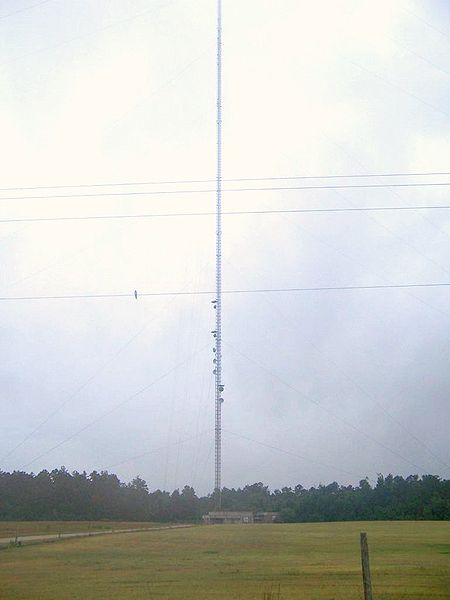
Here is a 6 day snapshot of CO2 data of the different intake elevations from Beech Island, South Carolina in May 2011.
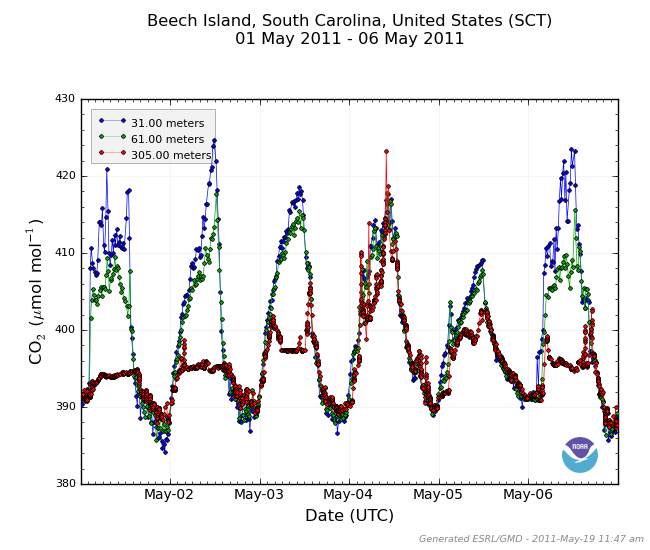
You can easily see how closer to the ground level the wider the fluctuations in CO2 concentrations.
Also it is clearly seen that the CO2 concentrations decrease during the early night time hours. This is due to the fact that it is at right after dark falls that most plants open their stomata to “breath in” CO2 for the dark reactions (Benson cycle) of photosynthesis.
Thank you one and all… No, I am not “the original Jimbo,” but I do, in retrospect, remember seeing some of his posts on here. Perhaps it was his signature which subliminally suggested itself to me. I used a slightly modified form of your answer (shamefully without attribution) for a Facebook argument I’m having. I appreciate the help and your tolerance allowing me to ask a question in an unrelated thread. Thank you for your time and trouble, facebook.com/jim.olsson.376
joelobryan is absolutely correct that ground level CO2 is all over the map on a daily basis.
More to the point is that CO2 does not segregate out due to MW. Gaseous diffusion will keep the CO2 well mixed with the other atmospheric gasses throughout the troposphere. This is the basis for the often stated phrase “Well Mixed Atmospheric Gasses”.
Gaseous diffusion is actually quite a powerful mixing force. (Entropy of mixing, actually)
the variance over hours on a bucketfull of plain dirt emitting co2 from soilbacteria is rather large
For all practical purposes gases diffuse into each other uniformly. They don’t stratify into layers, but their relative concentration varies with elevation according to molecular weight.
ppm, sorry.
Now they want bromine in the meat we eat. Agenda 21? They take us all for morons.
Ever wonder what was in Soylent Red?
Cows eat biomass. Biomass regrows making raising cattle carbon neutral. So they let some go as methane, but it is also mitigated by regrowth. Its a better arrangement for the environment than Drax burning Carolina hardwoods because the grass regrows in weeks, not 5 decades like the hardwood.
Why do we let these uneducated buffoons go on like this? This is what makes them think we are stupid. Canada has rewritten our food rules for good health chopping out meat because its unhealthy for the planet! One company will not reimburse employees for meal expenses if they containing meat! Notice Kristi Silber, Nick, Greg and company dont make an appearance on these types of threads because they arent permitted to criticize their climate warriors. Never have they been criticall of the meme scientists. Heck scientifucally literate sceprics wont let sceptics get away with stupid notions.
The work was performed in vitro.
It might be a step up from computer models.
These guys are building castles in the sky.
Spirulina, a type of blue-green algae, is used as a nutritional supplement. It’s expensive because it’s not that easy to grow.
I’d say they got that right.
I thought that Spirulina was a common pond scum in Mexico.
Shows how much I know.
But then it’s a cyanobacterium (or more than one), not algae.
It is common pond scum. One of the tricks is that it has to be grown in very alkaline waters to prevent the growth of other poisonous versions of pond scum. link
Actually, it appears to be easy to grow if you’re near the equator. link It really needs a lot of light. I checked the viability of growing spirulina with artificial light. It’s not economical.
Where I live the soil is highly alkaline, but half way between the equator and the North Pole.
Our electric power is cheap, thanks to water and gravity, so this might be an industry to help bail out our struggling farmers.
There is concern about the contamination of spirulina. link
I note that some importers aren’t exactly forthcoming about where their product comes from. That doesn’t make me feel real good because there are parts of the world where the quality control is so lax that the locals avoid things like baby formula and vitamins that aren’t imported from the west.
A source of guaranteed pure spirulina could command premium prices.
Let us profit from the human desire for pure food, even if it be organic pond scum.
My first thought was what a waste of scientific time and intellect on the part of the authors but quickly realised my mistake.
Then I was reminded of the old adage ‘it takes one to know one’ and organic pond scum made perfect sense.
you want greens then use safer sources is my advice
in WA and somewhere is sth aus theyre breeding red algae for supplements and also for colourants
confined in salt lakes.
FYI, Bromoform CHBr3 is the bromine analog of chloroform (CHCl3).
Oh the ignorance
Horses, cats, dogs and humans, flatulate. Cattle (or sheep) do not! Ask a shearer or dairy farmer. They are in close vicinity to a h’s all day.
Any methane being emitted will be mixed with excreta, urine or during burping – which is not common either.
Regards
M
I’ve been in close proximity to cows and other ruminants my whole life. Do they flatulate, and how!
A cow can fart massively just lying there, without any admixture of excreta, urine or burping.
My sister in law, a large animal vet and former dairy princess would confirm my statement of fact.
What the heck are you feeding them on? On their natural food of grass they most certainly do not – unless maybe if they are sick
Here’s another solution being “promoted” by the Australian ABC;
http://www.abc.net.au/news/2018-08-05/voluntary-human-extinction-movement/10071036
It was linked to at the Sydney Morning Herald and I commented in disgust, but seems the whole article and comments has been pulled from the SMH.
Calling them a ‘powerful greenhouse gas’ pays lip service to the idea that they are a serious danger to the planet and ignores the fact that the grass they eat if left uneaten would die and decompose producing CO2 & methane …
Whatever happened to the precautionary principle?
Apparently it is OK to feed cattle with a potential carcinogen, but not to use Roundup which they claim is a potential carcinogen, although there is a big argument about this.
There is no honest argument about Roundup.
Only false arguments and money hunts by faux greens and their lawyers.