
Guest essay by Eric Worrall
According to Dana, the wrath of Gaea will strike down Trump voters unless Republican leaders embrace a Carbon Tax.
Global warming will depress economic growth in Trump country
Dana Nuccitelli
Mon 7 May 2018 20.00 AEST
It’s global warming that will hurt the economy in red states, not a carbon tax.
A working paper recently published by the Federal Reserve Bank of Richmond concludes that global warming could significantly slow economic growth in the US.
Specifically, rising summertime temperatures in the hottest states will curb economic growth. And the states with the hottest summertime temperatures are all located in the South: Florida, Louisiana, Texas, Mississippi, Oklahoma, Alabama, Georgia, South Carolina, Arkansas, and Arizona. All of these states voted for Donald Trump in 2016.
…
House Majority Whip Steve Scalise, who represents Louisiana (the second-hottest state), recently introduced a new anti-carbon tax House Resolution. Scalise introduced similar Resolutions in 2013 with 155 co-sponsors (154 Republicans and 1 Democrat) and in 2015 with 82 co-sponsors (all Republicans). The latest version currently only has one co-sponsor, but more will undoubtedly sign on. All three versions of the Resolution include text claiming, “a carbon tax will lead to less economic growth.”
As the economics research shows, failing to curb global warming will certainly lead to less economic growth. Climate policies could hamper economic growth, but legislation can be crafted to address that concern.
…
In short, if Trump, Scalise, and the rest of the Republican Party want to prevent slowed economic growth in red states, they should be trying to craft an optimal carbon tax, not blindly rejecting the idea outright.
The abstract of the study;
Temperature and Growth: A Panel Analysis of the United States
Riccardo Colacito, Bridget Hoffmann, Toan Phan
We document that seasonal temperatures have significant and systematic effects on the U.S. economy, both at the aggregate level and across a wide cross-section of economic sectors. This effect is particularly strong for the summer: a 1oF increase in the average summer temperature is associated with a reduction in the annual growth rate of state-level output of 0.15 to 0.25 percentage points. We combine our estimates with projected increases in seasonal temperatures and find that rising temperatures could reduce U.S. economic growth by up to one-third over the next century.
The study seems to be attempting to infer the impact of climate shifts by studying the impact of temperature anomalies on productivity. In my opinion this is a dubious inference. People who are used to higher temperatures do not suffer the same productivity declines as people who might be less used to such temperatures when they experience abnormally warm weather. Warm states like California and Texas are not at the bottom of US productivity or income bands, which suggests other factors which contribute to the prosperity of different states may be more important than their Summer temperature.
The study authors attempt to address this issue in section 3.4 Stability of the effects through time, but admit that they cannot draw statistically reliable conclusions about people’s ability to adapt to warmer temperatures post 1990 in fall (i.e. when people are back at work).
… We re-run the regression specified in equation (4) but delay the beginning of the sample by one year at a time. We repeat this exercise until the sample starts in 1990; past this year, the sample size becomes very small, thus compromising the power of our estimation. The results, reported in figure 3 show that the summer coefficient remains negative and statistically significant at the 10% level as the sample shrinks; the point- estimate for the summer effect is −0.154 in the full sample and −0.246 in the post-1990 sample. However, the fall coefficient is no longer statistically significant in the post-1990 sample; the point-estimate for the fall effect is 0.102 in the full sample and 0.031 (and indistinguishable from zero) in the post-1990 sample. This finding is consistent with the results of our robustness checks (section 5.3): the summer effect is very robust, but the fall effect is not. …
Read more: Same link as above, page 17
The study author’s exploration of mechanisms by which the warmer temperatures have their alleged long term negative impact on productivity includes gems like the following;
… Our results are in line with other findings in the literature. For example, Cachon et al. (2012) document that heat and snow significantly affect output and productivity in automobile plants. The occurrence of six or more days with temperatures above 90 degrees Farenheit reduces the weekly production of U.S. automobile manufacturing plants by an average of 8 percent. Given that automobile manufacturing largely takes place indoors, the authors argue that this finding suggests there are limitations of air conditioning; it is possible that there are important areas in the production process, such as loading and unloading areas, that are difficult to cool or warm. Bloesch and Gourio (2015) also document that cold weather negatively affects production in various industries. We will return to this discussion in the industry analysis below. …
Read more: Same link as above, page 20
Even if we accept the premise of the study, climate science is far from certain about the extent of future warming; even the IPCC admits climate sensitivity could plausibly be as low as 1C / doubling of CO2. 1C / doubling would produce maybe half a degree of extra warming if we burned all known remaining fossil fuel reserves.
… Estimates of the Equilibrium Climate Sensitivity (ECS) based on multiple and partly independent lines of evidence from observed climate change indicate that there is high confidence that ECS is extremely unlikely to be less than 1°C and medium confidence that the ECS is likely to be between 1.5°C and 4.5°C and very unlikely greater than 6°C. These assessments are consistent with the overall assessment in Chapter 12, where the inclusion of additional lines of evidence increases confidence in the assessed likely range for ECS. …
Read more: Page 871 WG1 AR5 Chapter 10
The study seems to ignore the qualitative impact of technology advances on productivity, even advances which are obviously in the pipeline. Study authors suggest that some outdoor activities such as agriculture and assembly lines are difficult to air-condition, but its more than obvious even today that robots are completely transforming outdoor work. My trash these days is collected by an operator in an air-conditioned truck who picks up trashcans with a robot arm; the days of groups of men following trucks, picking up trashcans by hand, are long gone.
Predicting economic conditions at the end of the century in terms of today’s society is absurd. By the end of the century our descendants will enjoy technologies and productivity advantages we have no idea will exist. Even if temperatures do rise uncomfortably, it is very unlikely farmers 80 years from now will simply put up with any problems, instead of trying to address them.
Update (EW): Clarified that the statistical insignificance of the post 1990 impact of temperature on productivity applies to fall temperatures rather than Summer temperatures
Once again, these idiots reveal that it’s more about politics and religion than science.
NAggie, by science do you mean that Dana Nut thinks hothouses put CO2 into their atmosphere to minimize growing? Dana Nut isn’t smart enough to understand the enhanced growing environment created inside a hothouse? Maybe his problem is mental?
The chances of our making it more 80 years without a major collapse of the financial system should be considered before assuming “all else remains equal” and doing worthless extrapolations on a chaotic and non linear climate system which we do not understand.
The private debt bubble crisis was fixed by turning it into a national debt ( bond market ) bubble, via QE. They did not fix the problem they just increased it by a few orders of magnitude.
When that bubble bursts there will be no one to pick up the pieces.
“Dana Nut”
Please be respectful and get the fellow’s name right. It’s Dana NuttyNellie.
Greg
Agreed. The financial system, unconstrained by an international framework and common currency, is doomed to a very early ‘retirement’. Banks are more powerful than whole countries, even groups of countries. That is untenable. I will be surprised if it lasts five years from now.
Separately, the secret banking offshore is unsustainable, even if it were vaguely moral, which it isn’t. In future currencies will be gold, silver and energy.
And once again we see that it’s fine for the cult to conflate weather and climate when it fits their agenda. I’ll just leave these here:
http://www.macleans.ca/wp-content/uploads/2013/04/labour_productivity_real_wages_us.png
https://img.purch.com/w/660/aHR0cDovL3d3dy5saXZlc2NpZW5jZS5jb20vaW1hZ2VzL2kvMDAwLzAwMS8xNDMvb3JpZ2luYWwvMDcwMTA5XzIwMDZfdGVtcHNfMDIuanBn
Maybe lots to do with politics but certainlyy nothing to do with religion.
You would think it would affect poor inner city neighborhoods more…
….but then that would be racist
One thing occurs to me – what is the productivity coefficient of increases in excessive regulation? Have they taken into account that productivity fluctuates with demand, and demand fluctuates inversely to price increases due to increased cost of production? The years during which they gauge production against temperature “increases” are also years during which regulatory burdens increased.
I really don’t want to read boring fiction today, so if anyone has read the whole paper and know whether regulatory burden increase over time was factored in, I’m marginally interested.
The problem is academics in ivory towers. They’re too good to come down and see how the rest of us live. They have no clue about real living and have never had to work in the real world. After all, they’re living off our tax dollars, love their elitist stratum, and they hate anyone and everyone who doesn’t agree with their world view.
I’m sure workers not showing up because it’s beach weather won’t have any effect on productivity.
Does anyone recall that a significant amount of the projected increase in temperatures is warmer nighttime temps? How does a higher night low temperature affect productivity?
Of course the production slowdown must be due to heat and poorly designed A/C systems instead of grid load factor and potential required load curtailment on the hottest days.
Since carbon dioxide almost entirely warms nights,
rather than days, according to the greenhouse theory,
it would have little effect on daytime temperatures.
Slightly warmer nights would have no effect on the beach!
In addition, actual warming in the US since 1975 has been mainly
in the winter and spring — not in the summer and fall,
which I can’t explain, but that trend may apply to other nations too.
The leftist idiots could just as easily could argue that cooling would cause a decrease in productivity. Indeed, that’s exactly what they would be doing if it were the 1970s and they were on their man-made global cooling kick. This is politicized garbage.
Flashback: John Holdren in 1971: ‘New ice age’ likely http://www.climatedepot.com/2014/01/08/flashback-john-holdren-in-1971-new-ice-age-likely/
On cooling decreasing productivity – I was working as an apprentice on the hangar floor in the bitter UK winter of 62-63. Thermal underwear and sweater under my overalls – but I couldn’t wear gloves. I would guess that over those few weeks my productivity dropped by about 80-90%! (And you can’t heat or air-condition an aircraft hangar!)
It also ignores the BIG ELEPHANT in the room. China China has no intention of backing away from coal. They are financing coal plants all over the world because China has lots of coal to sell. Not only have they NOT promised to reduce emissions by 2030, they wont even let any inspectors into the country to even measure their CO2 production. The latest climate talks broke down over this and more. Incredibly China wants the West to pay them CO2 bribe money that the undeveloped countries were promised by Obama and Europe. .
Dana should want the economy in red states to go bad so that the voters will switch their votes to the lefty carbon taxers to bring back their prosperity. — As usual, the left has a poor grasp of anything that involves numbers.
Reminds me of this gem from 2007:
http://www.baltimorechronicle.com/2007/122407Lindorff.html
“Say what you will about the looming catastrophe facing the world as the pace of global heating and polar melting accelerates. There is a silver lining. Look at a map of the US. The area that will by completely inundated by the rising ocean—and not in a century but in the lifetime of my two cats—are the American southeast, including the most populated area of Texas, almost all of Florida, most of Louisiana, and half of Alabama and Mississippi, as well as goodly portions of eastern Georgia, South Carolina and North Carolina…” etc.
Hope his cats are doing okay.
The portions of Texas and Florida that are most likely to be flooded, don’t vote for Republicans anyway.
Assuming his cats are still alive, they are now at least 11 years old. Being generous, they could live another 6-7 years, possibly a bit more. That darned sea level had better hurry the hell up!
And that’s assuming they were newborn kittens at the time he made those idiotic remarks. Most likely they are adult cats them and are either already dead or will be in the next few years, so those rising water have a lot of work to do in a very short period of time.
These are people who are shown where to plug in numbers into a spreadsheet and then pronounce themselves programmers and analysts. They’re also given the numbers to plug in and assume they’re correct.
“If you put tomfoolery into a computer, nothing comes out of it but tomfoolery. But this tomfoolery, having passed through a very expensive machine, is somehow ennobled and no-one dares criticize it.”
– Pierre Gallois
Mind you, putting real calculations into a computer is likely to make the ignorant more receptive of your calculations, over a handwritten page. Even though it;s the same figures and the same result! I’ve used this to convince salespeople that the aircraft configuration they were selling wasn’t viable. They would believe the computer, but not me.
So growth rates decline over summer when people take leave. And if its a nice summer, the decline is greater. How unexpected.
Why does “robust” in AGW papers mean comparing against other obscure measures or data subsets when to be truly reliable they should get out of their offices, into the community and look closely at the greatest specific area of decline to find the actual causes.
+1, Tim. I always look for consideration of confounding factors in any analysis.
More junk science. Get a regression equation from somewhere and then manipulate it until it gives the result you want. Bah!
It will either get hotter, or colder. Everything about hotter will be bad. Everything about colder will be good.
Which is why people vacation on the sunny beaches of Northern Alaska.
Dana the crazed chipmonk lives.
It has been so long since he shared his great wisdom with us mere mortals that I figured Gaea had called him on down.
Why bother reporting on Nutzy Nuccitelli, he is pure vapourware.
Even at the most entertaining days of Cook and Nuts he was wrong,spectacularly wrong and just plain nuts.
Nothing has changed.
That is why it is reported in the equally nutty Grauniad.
Reported! No its worse than that. They have basically handed control of the environmental section to him and his pay master. Hence why he spouts endless BS there
I don’t mind that they handed control of the environmental section to him and his Australian doomsday cult. All views should have a platform.
I do mind that they also handed control of the moderation of the environmental section to him and his ilk. They know they can’t defend their ridiculous articles so they refuse to give alternative views a platform.
I pretty much dismiss out of hand as agit-prop. ANYTHING printed in the NYT or Guardian these days. They make the National Enquirier look good.
M Courtney
The unfortunate effect of this is that ONLY the alternative view of the false catastrophe is presented as gospel. What is prevented from publication is Truth.
“I pretty much dismiss out of hand as agit-prop.”
Agit-poop is more like it.
Goldrider how very dare you. That is a very insulting comparison, you should apologize immediately …. to the National Enquirer.
The only unusual weather we have had in Texas recently was a brief cold spell last winter that killed marginally adapted plants. Otherwise, it has been fairly mild (for this part of Texas).
So ….Drill Bit should see a Drill Dr ?
He could surely stand to be sharper …
They stumbled onto one truthful statement:
They spent all their effort trying to obfuscate what is obvious to anyone who understands economic incentives in the economy. This study reeks of self delusion and the fear of public exposure.
The climate refuses to comply with their agenda, and no amount of taxation will remedy that situation.
Here is an update on the carbon tax experiment in BC. It is costly but ineffective.
https://rclutz.wordpress.com/2018/05/12/carbon-tax-hypocrisy-bc-for-example/
Costly but ineffective, what’s a bureaucrat not to like.
Canada is seeing a reduction in investment because of increased regulation and carbon taxes.
This is a good point: Glo-bull warming decreases economic growth, so we must implement a carbon tax to reduce economic growth even more. Ahhh, the ultimate tax is to tax the air we breathe.
The “solution” to all the world’s problems somehow always turns out to be the same: more power and resources in politicians’ hands and less in the hands of individuals.
Slower economic growth means lower inflation. Lower inflation means less federal reserve action in curbing economic growth (lower interest rates). Therefore, given monetary policy, modest warming will not/ can not curb economic growth. However, high energy prices can curb economic growth. (and no amount of compensatory action by the fed can help that)…
In the years leading up to the iranian revolution in 1979, inflation was still very high from the fallout of opec and its oil embargo. Oil prices were still high and the inflation rate was nearly 10%. However, real wages flourished under liberal federal reserve policy. When the iranian revolution hit in january 1979, liberal policy was still in place (low interest rates) to spur economic growth. After the revolution, the inflation rate grew to over 10% along with the sky rocketing energy prices. Immediately real wages began to fall, but, more importantly, the economy stalled even before the implementation of conservative monetary policy by president carter before year’s end. So even with a boost from the federal reserve high energy prices were able to slow, even halt economic growth. (quite a cautionary tale)…
Slower economic growth MAY mean lower inflation.. or higher.
On the other hand, lower energy availability (or higher price) is sure to lower growth.
I must say, he’s got blue balls.
(Maybe that’s why he’s out of whack.)
Is that Nuccitelli or Nuticcelli?
Nutella
Vegamite
The leftist criminals want a carbon because that’s how they plan to fill their pockets. With stolen money.
Specifically, rising summertime temperatures in the hottest states will curb economic growth.
Wait. What? Rising temps will only curb economic growth? So there’s not catastrophe after all?
Good to know.
In my recent article here on the slight 18 year cooling trend in the UK I also cited an article by Mueller.
https://wattsupwiththat.com/2018/03/04/the-rise-and-fall-of-central-england-temperatures-help-needed-to-find-missing-data/
In it he reflects that large parts of America are also cooling as can be seen in figure 4.
I don’t pretend to know America as well as the locals but isn’t that cooling happening in the very states that is being cited as those that are warming?
tony
Even though that is true, people are propagandized to believe the opposite.
Oklahoma had one of the cooler Aprils on record this year.
It looks like things are going to heat up though with a stationary front across the northern third of the nation. That lets things heat up south of the front.
The cool April was unusual, but the May heat is not.
What will cost Republicans votes in those Red States is not less productivity because of hot weather, it will be creating a new tax (carbon tax) that takes money out of their pockets whether it is hot or cold outside.
It’s ridiculous to blame Red State heat on CAGW. The real causes are high pressure systems, especially stalled high pressure systems. Then it really gets hot. Just like in the past.
It’s been warming up in SE Oklahoma but most days in May so far have had moderate cloud cover and appreciable breezes. Keep in the shade and it’s actually pleasant out. My electric bill will be happy that I’ve been able to get away with open windows and a fan so far.
In this part of the globe, Great Britain, it is cold weather that disrupts the economy since everything comes to a standstill in heavy snow.
I read that 48k brits died from the cold this past winter. Dead people don’t produce much of anything.
Yes, and since any warming is going to be at night and predominantly in higher latitudes, it will increase economic growth on balance.
That’s even before we consider the benefits to agricultural productivity from higher available atmospheric CO2.
And, Susan, you know that in London – not on the Yorkshire Moors or on Dartmoor – ‘heavy snow’ is anything over two [2] inches.
Especially at “Rush Hour Chaos”!
And that is if it is the ‘Right Type’ of snow.
The wrong type of snow brings railways to a shuddering halt anywhere within eighty miles or more – unless the rails are operated by SNCF!
Auto
They had snow in France a few days ago. Not in the Alps, that is.
Most unusual. Didn’t happen in decades.
We will have 300K today. Or at least 298K. I’m enjoying inside, no need for A/C yet. They say this is a once for a century event. Well, probably the once-in-a-century cold went to France and you gave us the warm air. Thanks. As long as we don’t need to pay for it.
There is a great deal of hot air between Correlation and Causation.
trigger warning:
The average blue voter that matters, can install solar panels and a Tesla wall on their McMansion. And they can easily commute to the office in their Tesla.
The average red voter needs reliable power when it is either too warm or too cold. In the less dense populated areas, a short trip to the grocery store is one hour at 75 mph.
I believe THAT is why the founding fathers of the United States made it a Republic.
PS. The majority of the blue voters will end up sitting in the dark when the sun does not shine and the wind does not blow. What do you think the “smart meter” was invented for?
to meter smartness? I say, If you have a smart meter, you’re not.
One rule of Fascism: Create a crisis to put more power to the fereral government.
I think this proves in some way that fascism is a leftist policy.
“It’s global warming that will hurt the economy in red states, not a carbon tax.”
Is the reason it won’t hurt the Dem states because the economy in those states is already tanked? (apart from vagina-suit manufacture of course :D)
“A working paper recently published by the Federal Reserve Bank of Richmond concludes that global warming could significantly slow economic growth in the US”
What? Worse than 8 years of Obama did? At least the USA now HAS an economy to be affected by stuff. 😀 And people have jobs they can slow down on if it’s too hot…
Am I mis-remembering history? I recall that, while temperatures were increasing rapidly from 1983 through 2000, the U.S. economy was growing at a scorching 3-5% clip for most of these two decades (slight recession at the end of the Bush I administration). But starting in 2000, right around the time that the temperatures stopped rising (where the climate scientists infamously referred to the period as the “pause” only to later say “what pause?”) the economy started slowing significantly to between -3% to 2% from the dot-com bust all the way through the Obama administration,
So where are these guys getting their data that warming temperatures are negatively correlated with growth? It seems to me that since they are using data going all the way back to the 1950s, that most of the effect they observed must result from prior to the time that CO2-induced warming ostensibly kicked in.
North America is big. If global warming makes certain regions inhospitable, people will move. Canada, which is sparsely settled, will become more hospitable and people will move there. As an example we have the migration which cushioned the effects of the Great Depression. link
I’ll wait until all those who said they were going to Canada if Trump got elected make their move.
I’m still waiting for all those people who said they would leave the US if Reagan won, to leave.
https://realclimatescience.com/2018/05/indiana-heatwave-of-1936/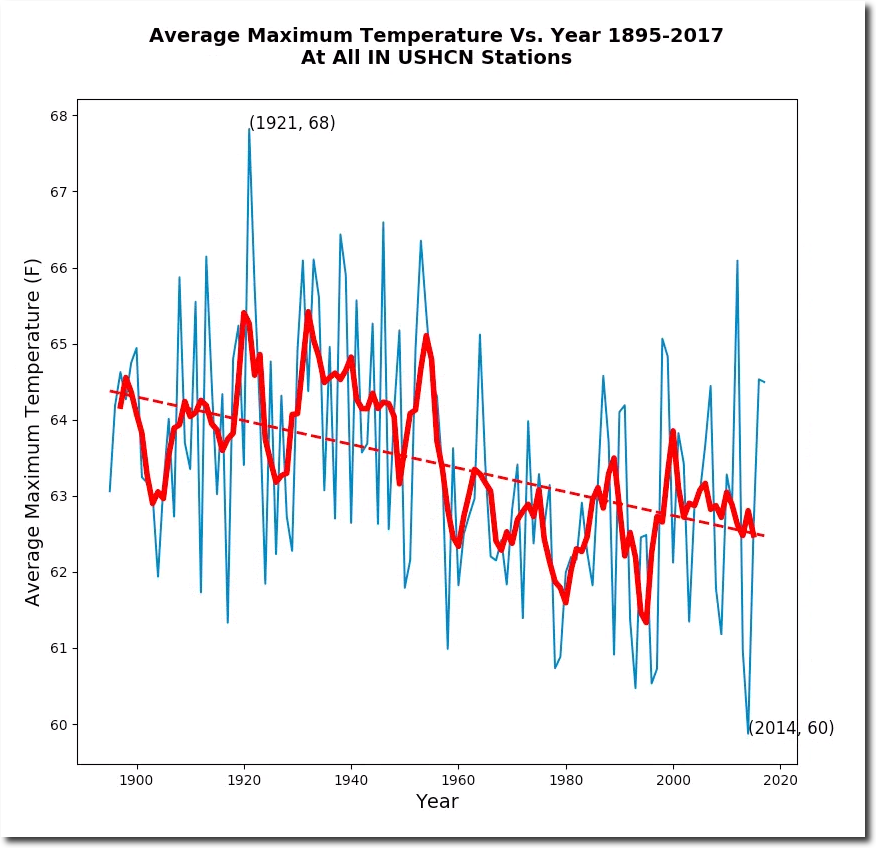
Oh well
https://wattsupwiththat.com/2018/05/12/dana-nuccitelli-support-a-carbon-tax-or-climate-will-punish-trump-voters/
For a carbon tax to reduce global emissions it must be applied globally. The US now has less than 20% of global emissions. That share has been falling for decades and will continue to fall as most countries increase their emissions.
Prof Richard Tol estimated that to be effective, such a tax would need to start at $210/tCO2 in 2020, and be increased by 4-6% a year forever. Any other sort of measure to reduce emissions will be economically less efficient.
I know of no country that has successfully implemented such a tax. In Britain a tax escalator was dropped on gasoline after a few years.
As a carbon tax would cause harms – including increasing inequalities and slowing growth – without including countries like Pakistan, Iran, Russia, China, Brazil, India etc. etc. it will not work in the objective of reducing emissions. But the alarmists are not making any attempt to persuade them. What Dana Nuccitelli is proposing, therefore, is a measure that is both harmful and logically cannot work to alleviate a prospective adverse state of affairs for which there is no robust evidence. How would most people view somebody who tried to peddle medicine based on similar criteria?
Yes, this is quite right. And this complete disconnection between what DN and the like claim to believe, and the measures they propose, is why I have come to the conclusion they don’t believe any of it.
If they really believed that there was a planetary global warming problem, they would be anxious to reduce emissions as quickly and effectively as possible. They would focus on real reductions in tons by the big emitters. Like, for instance, China. They would want China to get down from about 10 billion tons a year to something under 3 billion, and fairly fast, as part of a global program which might see the US go from about 5 billion to about 1 and the UK as a for instance go from 450 million to about 100.
But they do not in fact advocate anything like this. They don’t advocate the wholesale changes in living and working and travelling that it would require. They won’t address the real life problem of the auto industry, and the associated living and working and shopping patterns.
Instead, all they advocate is large reductions by countries that amount to no more than one third of the total global emissions. And then, even within that, they refuse to advocate the measures that it would take to deliver the reductions they claim to want.
For instance, in the UK, the goals of the Climate Change Act can only be delivered by the closure of the auto industry and the abolition of the highway system. Do any of the greens advocate it? Of course not.
So I conclude that the aim is solely to use the climate issue as an organizing tool, to make demands which they do not want to see granted. The object is not the planet at all. The object is to make changes to their own countries and global warming is a convenient excuse to demand them and to organize around them.
Its a political movement, it has nothing to do with science or concerns about global warming. If GW vanishes from view, they will find another, but the demand for de-industrialization of the West will remain, to be justified by other means.
It is the Alinsky playbook, though one doubts many have even heard of Alinsky. Pick something that cannot be granted, demand it with increasing ferocity, and use the inability to get it as the justification for endless accusations, demonstrations, demands. And at all costs avoid demanding things that are, however draconian, possible and necessary means to what you claim to want.
The last thing you want to do is solve the supposed problem. Then you would have to do all the work of finding and organizing around another one!
+97
I have over the past three years looked at the data for emissions in a number of different ways, to get some perspective on the problem. One of the earlier attempts was in January 2015 – “Global Emissions Reductions Targets for COP21 Paris 2015”

When the policy for reducing global emissions to was adopted in the Rio Declaration of 1992 the pattern of emissions was very different from today. The initial target was to maintain emissions at 1990 levels.
The chart below shows the emissions per capita in tCO2 against population in billions.
Quite clearly, a substantial cut in global emissions can be achieved by the rich countries taking on all the burden. The developing countries can join in later.
Forecasting ahead to 2020 for both emissions and population, this is what I believe the picture will look like.
The picture has changed dramatically. Most the change is what has actually happened, rather than my forecasts. Population has increased by 2.4 billion or 45% and emissions by over 80%. Global average emissions per capita have increased from 4.1 to 5.2t/CO2 per capita. Due to the population increase, to return global emissions to 1990 levels would mean reducing average emissions per capita to 2.85t/CO2. Nearly all of the emissions increase per capita has occurred in nations where per capita emissions were below the global average in 1990. In the meantime, the timescale of emissions targets keeps reducing. Even in 1990, it was clear that reducing global emissions would involve stopping developing countries from increasing their emissions in a very short space of time. But none of the experts in 1990 would have predicted that China, the world’s most populous country would have over two decades of near 10% annual economic growth, nor that their emissions would overtake those of the United States. What has happened in China was unprecedented. The alarmists are not being very inclusive in their policy proposals.
Manicbeancounter and michel, you are both so right.
It is no coincidence that there is strong opposition to anything that would actually eliminate the supposed “problem”. If they really believed their agitprop, they would embrace nuclear power and regard fracking as a bridge through lower carbon to no carbon. Instead the push hopelessly inadequate “solutions” such as intermittent wind and solar that require much bigger impacts on land use and wildlife, while opposing any use of nuclear and trying to stop fracking.
I wonder if the tax collectors benefit in any way from a new source of tax revenue? Nah, crazy talk!
Manic,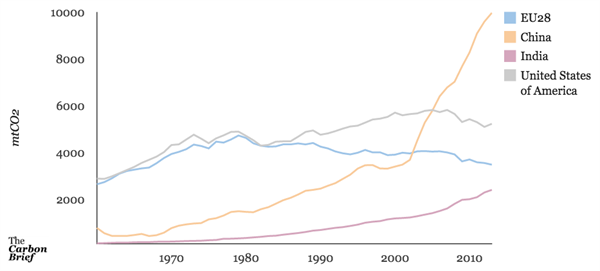
Instead of Per Capita totals (both China and India have vast numbers of both under and unenergized populations that skew their per capita figures. A truer comparison is one of total annual Gt production
This might be a better representation
Source: Data from the Global Carbon Project, Global Carbon Atlas. Graph by Carbon Brief.
USA…. 5312 MtCO2 in 2016
China.10151 MtCO2 in 2016
China is clearly the largest producer since 2006 when their total output of CO2 exceeded that of the U.S.
Bryan A
There are different ways to look at the data, an all will tell a different story. My very rough graphs show the total emissions by area. Per capita emissions I find useful as it allows for population. It also reminds us that future increases in emissions will come from the poorer nations. India will soon account for more emissions growth than China, whilst later in the century first other SE Asia countries (Pakistan, Bangladesh, Vietnam etc) will account for a large part of global emissions growth, then the combined impact of 50+ African nations will be important.
Whichever way you look at the data, Calfornia and New York targeting US oil companies and penalizing consumers in their own States will do virtually nothing to change the global picture.
We have reached a 99.9997% consensus agreement