

Guest essay by Eric Worrall
Cape Town is running very short of water – so short authorities expect to switch off the taps in July. But the problems were not caused by global warming.
Cape Town is approaching drought ‘Day Zero’, and climate change could be to blame
As water supplies run low in South African city, analysis by local scientists suggests global warming will make such ‘freak’ events commonplace in years to come
Josh Gabbatiss Science Correspondent Saturday 3 March 2018 14:00 GMT
Cape Town is in the grip of a drought widely regarded as the worst in recorded history – one that could see it become the first city in the world to run out of water.
The city is edging closer to a day – known locally as “Day Zero” – when supplies are so low authorities will have to cut off water to three quarters of the population.
Far from being a hypothetical scenario, Day Zero has a set date. It is currently expected on 9 July.
The perfect storm of conditions that led to this drought, specifically three consecutive years of extremely low rainfall, would generally be expected no more than once in a millennium.
Predicting such “freak” events is tricky for scientists, but one thing is clear: climate change appears to have played a significant role in the Cape’s current misfortune, and it is set to make such events far more likely in the years to come.
…
Back in the real world, the Cape Town water crisis has a more mundane explanation;
…
The cause of the crisis
The civil society group, South African Water Caucus, reveals that national government’s reluctance to release drought relief funding stemmed from spiralling debt, mismanagement and corruption in the national Department of Water and Sanitation.
This claim is supported by the Auditor General, which attributes “irregular and fruitless and wasteful expenditure” to the department exceeding its 2016-2017 budget by R110.8 million.
The department has no funding allocated to drought relief in the Western Cape next year. Again, provincial government will have to foot the bill.
Had systems in national government been running smoothly, Cape Town’s water crisis could have been mitigated. Appropriate water allocations would have made more water available to Cape Town. And with timely responses to disaster declarations, water augmentation infrastructure could have been up and running already.
Cape Town teaches us that water crises are rarely a matter of rainfall. Understanding disasters like droughts involves seeing the issue from many different perspectives, including politics.
Read more: https://theconversation.com/cape-towns-water-crisis-driven-by-politics-more-than-drought-88191
There is no doubt Cape Town is suffering an unusually severe drought – but unusually severe droughts occur sometimes in drought prone areas.
What is obvious is the current water crisis would have been far more manageable if the South African Government had done more to root out waste, corruption and gross incompetence.
Graft and corruption throughout Africa is scheduled to cease the day after the sun runs out of gas.
Its obviously man made, the population has tripled and without man maintaining it, it leaks like a sift, I saw somewhere over 25% of the water is lost to system leaks.
There plan is to reduce the use by getting rid of white farmers, without farming, less water will be needed..
If they get rid of the farmers then it becomes likely that natural famine and starvation will take care of any over population problem that may exist.
Taking it as read that the average rainfall across all land area on this world is 770mm. (and 990mm over the ocean?)
A quick scratch around the Wunderground PWSs for that corner of the world says that there has been anything between 300 and 700 millimetres of rain inside the last 12 months.
That’s not a drought.
Prof Alexander, a life-long professional Water Engineer, has pretty well deciphered the South African rain and drought cycles;
https://anhonestclimatedebate.wordpress.com/2009/04/03/climate-change-%E2%80%93-the-clash-of-theories-by-professor-will-alexander/
I doubt anybody in the incompetent, corrupt, smug ANC government could be bothered to look at his work and apply any long term action.
It is easier to do nothing, steal what they can, winge about the previous government and try and score something off the international climate change gravy train.
The article cited is interesting but treats the Western Cape as an entity divorced from global effects such as El Nino which expands the Hadley Cell pushing westerlies bringing rain further south and the jetstream’s mobility related to solar activity. 2013 and 2014 were seriously WET!
“climate change appears to have played a significant role in the Cape’s current misfortune” – Unsourced and unsupported. This doesn’t even get to call itself journalism.
The Alarmists are doing what they always do: issue conflation. It is deliberate, and is just one of many ways they have of lying. The two issues of drought, which is a lack of rain over an extended period, and water shortage, although certainly related, are in fact separate issues. They are also lying when they claim that droughts (or indeed, floods) “have gotten worse” along with the slight warming, and it is sheer chutzpah on their part to then “predict” that they will “get worse”.
It seems that any of these so-called ‘crises’, which are exacerbated by gross ineptitude and/or negligence, can be shrugged off by those responsible merely by throwing up the old ‘global warming’ smokescreen, e.g. in the cases of the SA and Cal droughts, wildfires, etc. The Norwegian seed vault SNAFU was another good example, albeit on a much smaller scale. In each case, the blaggers ought to be held to account.
Nick & others
there is no man made warming
however, there is the Gleissberg weather cycle
here is my analysis of a good weather station in South Africa.
Naturally, less rain can be expected this time of the curve….
Cape Town is a good example of how expansion of population (influx) was allowed to continue without proper planning for the future, i.e. pure mismanagement and corruption.
We are busy trying to sack the mayor.
It’s all political, as ANC, friendly to Palestinians actively obstructs Israeli attempts to help with desalinization. They’ve been doing it for a couple years. Wx has nothign to do with this, Politics (as usual) has everything. Cheers –
http://www.jpost.com/Opinion/South-African-stupidity-540605
yes
I noticed it was the major who was trying to blame ‘climate change’ for her own mismanagement….
She is from the DA, i.e. opposition [of the ANC]
Noted in the Wall Street Journal this past week:
“Cape Town May Dry Up Because of an Aversion to Israel: The Palestinian Authority accepts the Jewish state’s help on water projects. South Africa refuses it.” by Seth M. Siegel on Feb. 21, 2018
https://www.wsj.com/articles/cape-town-may-dry-up-because-of-an-aversion-to-israel-1519254816
“Cape Town, South Africa, has designated July 9 “Day Zero.” That’s when water taps throughout the city are expected to go dry, marking the culmination of a three-year drought. South African officials aren’t responsible for the lack of rain, but inept management and a devotion to anti-Israel ideology needlessly made the situation worse.
“[In Israel] Conservation is taught from kindergarten. Market pricing of water encourages everyone to waste nothing. Sensitive prices have driven innovation. Israelis helped create desalination, drip irrigation and the specialized reuse of treated wastewater in agriculture. Although Israel is in the fifth year of a drought, today its citizens can reliably count on abundant water.
“Cape Town is another story. Its reservoirs began receding more than two years ago. This problem turned into a crisis because of subsidy-distorted water pricing, inefficient irrigation, and a lack of desalination facilities and a long-term plan. In 2016 officials from Israel’s Foreign Ministry recognized the problem and alerted national, provincial and local governments in South Africa. Israel has trained water technicians in more than 100 countries, and it offered to bring in desalination experts to help South Africa.
“South African officials ignored or rebuffed the no-strings Israeli proposal. It would be admirable if South Africa’s rejection came from a can-do attitude, in a statement of national self-sufficiency. But it appears to have been for ideological reasons that South African officials wanted no help from Jerusalem.”
So…..THE LEFT and THE LYING BASSARD MEDIA will say GLOBAL WARMING?………the actual cause is apparently that the LEFT chased the white engineer class out of South African management, and inserted unqualified blacks?
I do believe I read recently that some 30 to 50% of the water is lost along the route from source to customer. Also known as leaky pipes not maintained by a corrupt governmental.
It’s the New Orleans Levee Board Syndrome.
I have updated my note of a couple of days ago on long-term trends in Capetown rainfall. I have now included some data since 2000 (that I didn’t have before) so now have a fairly complete temperature record since 1850.
The current (2015-2017) drought can now be compared with other historical droughts. It is clear that the 2015-2017 drought is very very similar to those of 1927-1931 and 1971-1973. Each of these were about 40 years apart! Also the current drought is still ongoing so maybe it will turn out to be another “1927-1931” event! https://briangunterblog.wordpress.com/2018/02/14/capetown-rainfall/
I tried to add a couple of in-line graphs but cannot figure out how to do it! But they in the above link. How is it done?
To add in line graphs simply post the URL of the graph file with a. JPG or PNG or. GIF extension on the end. WordPress will automatically insert the file for you in your comment
Thanks Anthony. Much appreciated.

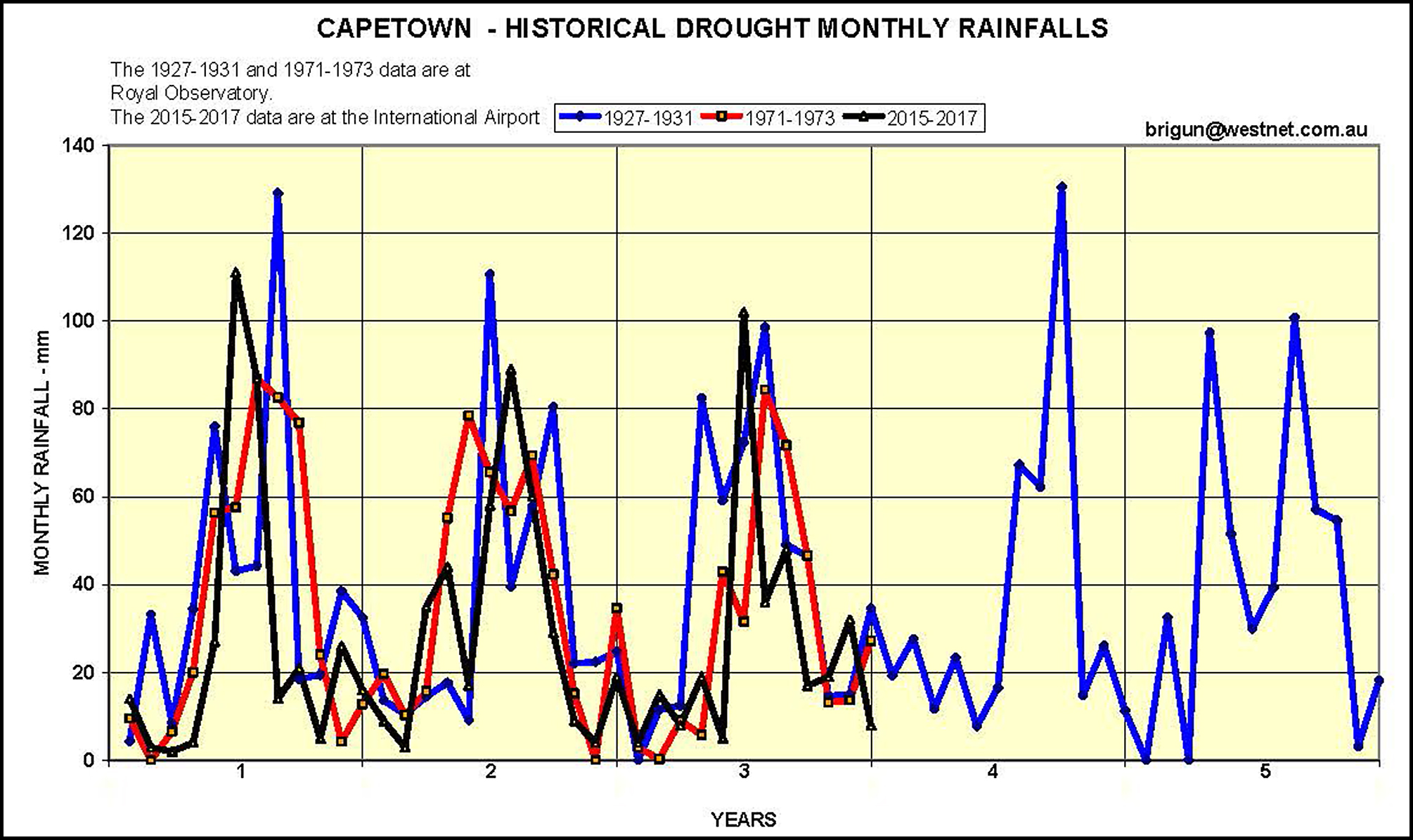
https://briangunterblog.wordpress.com/2018/02/14/capetown-rainfall/
Brian
Very good work.
I have the Potchefstroom data for you if you are interested?
https://wattsupwiththat.com/2018/03/03/claim-cape-town-day-zero-drought-caused-by-global-warming/#comment-2757189
Note the irregular pattern of the original data, and, indeed, the few times when there is less rain in a number of consecutive years.
By my various calculations the Gleissberg cycle is currently 86.5 years.
That means, comparatively, we are now in 1931.
Obviously, this is looking at the sun. What happens on earth does follow the sun but there may be some delay either way. Looking at my data from Potch I think we can expect a few more years of drought in CT
Henry. Thanks for your comments. Yes, I would like to get a copy of the Potcefstroom monthly rainfalls, particularly those since 1999. My email address is at the top of my graphs. I have checked the KNMI Climate Explorer website and they have monthly rainfall data for Potchefstroom for 1903-1999.
Brian. I am on a roadtrip now and I am not sure if and when I get excess to the relevant excel file. I will definitely send it on to you. Just dont know when.
Save Water with Short hair
For Hair Wash activity
[Woman with Long hair] needs more water
Or
[Woman with Short hair] needs less water
[Woman with Short hair] saves
30% water or more
About 2700 litre water by one woman in a year.
Short Hair means shoulder length or little more.
Applicable to [Woman with Long hair] in the world.
Credits: yourwellwisherprogram