This week marked a spectacular achievement by Elon Musk’s company SpaceX; a mostly successful (they lost the core booster) test of the Falcon Heavy booster and recovery system, along with an insertion burn to put the payload ( A Tesla electric roadster in cherry red) on a Mars trajectory.


Some have criticized it as “nothing more than a car commercial” (Naomi Klein) while others have said all that’s been done is to add to the space junk problem. No matter how you see it, you have to admire the achievement, something no private company has ever done before.
Josh has his take on it:

For those who don’t know the term “range anxiety”: it is the term for the most common worry about electric cars.
Meanwhile, in other more down to Earth news:
Back to Earth: Tesla’s losses grow on Model 3 delays
The day after Tesla and SpaceX CEO Elon Musk blasted his Tesla Roadster into space, his electric car company’s mounting losses brought him back to Earth again.
Tesla Inc. posted a record quarterly net loss of $675 million in the fourth quarter, up from a net loss of $121 million in the same period a year ago. The Palo Alto, California-based automaker is struggling to meet production targets for its first mass-market car, the Model 3 sedan. It’s also spending heavily on future vehicles, including a semi that’s supposed to go into production next year.
Tesla lost $1.96 billion for the full year, a record for the company and nearly three times its loss of $675 million in 2016. Tesla has never made a full-year profit since it went public in 2010.
arthur4563 February 9, 2018 at 6:27 am
Elon Musk promised to put the car in orbit around Mars.
* No, he didn’t “promise” anything of a sort. He said he intended to put it into an elliptical orbit around Mars and the Earth. He didn’t “promise” to put the payload into Mars orbit.
https://www.theverge.com/2018/2/6/16983744/spacex-tesla-falcon-heavy-roadster-orbit-asteroid-belt-elon-musk-mars
Instead it is now orbiting in the asteroid belt.
* No, it’s is still on its way out toward Mars. It’ll be a few months before it passes Mars; then it will go into an elliptical orbit back toward the Earth. You don’t seem to have much of a grasp of the distances involved here.
That didn’t seem to bother Musk’s claims about success.
* the successes were many: harnessing three huge rockets, each with 9 engines, and having all of them work. Demonstrating that the Heavy was capable of launching huge payloads.
Having two of those rockets—which had been used in previous launches—return and land simultaneously.
NO ONE has ever done that. Why is it important? It can cut the cost/payload by as much as a factor of 10 vs.its closest competitor,the Delta Four Heavy.
It was either a Tesla roadster or a bunch of concrete blocks. His Tesla Motors company will likely charge Spacex $250,000 for the car.
* And you know this how?
Musk is absolutely the cheapest liar on the planet.
* where did he lie?
And he’s absolutely not a CHEAP liar.
Anna, he would have to have a sweep around the sun in the plan. You can’t have an orbit just around earth and Mars.5
…Where do I plug it in…?…
Well, there’s quite a lot of charge floating around in space – Solar Wind and all that. Just park in the Van Allen belts….
Regardless of your take on this launch, there is a very interesting YouTube video on a biarual 3D audio recording of the launch and booster recovery. Very cool. Recommended:
Despite my skepticism of Tesla’s viability as a car company, I must admit to a sense of awe at Musk’s ability to achieve a technical goal I was doubtful of. The successful launch and recovery of the boosters was one of the neatest things I’ve every seen, almost up there with the Saturn V moon launch. Launching the car as a dead weight was just showmanship, but also very cool. Those two boosters returning to land near the launch pad really tops it all. So good it looked fake. Only complaint is that the damn batteries in the Tesla failed after only 4 hours!
The question remains, will Tesla ever show a profit? Losses were $675M in 2016, a little better than in 2015. SpaceX is privately held so no numbers available on that.
What was the point? This is just another stupid publicity stunt which went wrong, leaving an enormous amount of crap spinning in space. Some men have such HUGE EGOS.
Do you feel better after writing that?
and some women have such MYOPIC VISION.
I was about to react to this as chauvinism, but then, maybe Vanessa did earn all this. She’s right about some men. You’re right on some women.
The rocket did what they said it would do before hand. The only failure was failure to recover the main booster.
The point is that next year’s Super Bowl commercial will tout the Tesla as being a car that is “out of this world”.
It cost $195 billion for our government to put a man on the moon and we didn’t get any of our boosters back. 2018 dollar equivalent.
…It cost $195 billion for our government to put a man on the moon and we didn’t get any of our boosters back. 2018 dollar equivalent….
Columbus’ first voyage to America cost 2 million maravedis. That is variously estimated on the net to be between $1m and $250,000 equivalent modern money.
Today you can do the same trip for around £200.
Glad to see this.
For those who think Musk is just a subsidy farmer, recall that he put his own Paypal fortune into SpaceX and Tesla, and at one point almost had to choose which company to save. If money was his driver he had a huge stack before he started.
Secondly his declared strategy is to start out at the top of the market and work down, each new car paying for the next, The big losses at this point make sense during the ramp up to volume production from a luxury niche. How quickly did Amazon achieve profitability?
Bull[snip], pure and simple! Musk is entirely a government prop. He could not and would not exist outside of public finance!
Tesla in its current form would not exist outside of public finance. At most he would be making a few very expensive cars for the very wealthy who wish to virtue signal.
Scott – would you like to justify that assertion with some data?
Tesla received a $465 million government loan and also had large stock and bond offerings. That’s the bulk of the cash that Tesla is burning through.
Note: the government loan was paid back with money from the IPO.
Reg:
From the Tesla website dated May 2013 “Tesla Motors announced that it has paid off the entire loan awarded to the company by the Department of Energy in 2010. In addition to payments made in 2012 and Q1 2013, today’s wire of almost half a billion dollars ($451.8M) repays the full loan facility with interest. Following this payment, Tesla will be the only American car company to have fully repaid the government.
For the first seven years since its founding in 2003, Tesla was funded entirely with private funds, led by Elon Musk. Tesla brought its Roadster sports car to market with a 30% gross margin, designed electric powertrains for Daimler (Mercedes) and had done preliminary design of the Model S all before receiving a government loan….”
John, I applaud the fact that Tesla repaid the government loan, something rare in the Green energy sector. My point was that Tesla didn’t repay the loan with operating cash flow. The IPO simply sifted the debt burden from the US government to private investors.
Tesla (junk) bond offering raised $1.8 billion. How much has Musk personally invested in Tesla? A small fraction of that.
What is the cumulative total of the tax credits that Tesla and its customers have received?
It doesn’t matter what he claims. What matters is what he does.
Before each car can pay for the next, he has to first sell a car for more than it took to build that car.
That is yet to happen.
As to subsidy farmer, what part of the government paying thousands of dollars for each car sold do you not understand?
It was pretty awesome and it did double as a car commercial. He would have been stupid not to get Tesla some publicity. The only thing that would have made it better would’ve been if Naomi Klein was in the passenger seat of the Roadster.
I figure Musk intends to recover that car one day, and drive it around on Mars. What a triumph that would be. 🙂
solar EUV and xrays are going to disentegrate the carbon epoxy car shell and leather interior quite quickly. the metal frame and protected parts will last a long time – centuries to millenia.
One of the things that people seem to be missing when comparing the “disposable” boosters of the 1960’s to these reusable ones is that the early ones were paid for by the taxpayer. Here Musk is paying.
Now, that isn’t the entire difference, the control systems to do this are now much cheaper and better, but really, at the core, the different mindset is probably the real reason.
He should consider equipping each tank with emergency chutes and auto inflating flotation so He doesn’t lose more boosters or main stages
I’m pretty sure that at an impact speed of 300mph, flotation devices are completely irrelevant to survivability…
ripshin, I don’t know if the impact was 300 mph but the controlled recovery of the other 2 boosters created multiple sonic booms so their speed exceeded Mach 1.
Parachutes and flotation devices were how the shuttle’s boosters were recovered.
MarkW
True, true.
But the shuttle’s solid rocket booster shells were just that: “Nothing” but the now-hollow, burned out steel shell, the parachutes and their floats. Everything else – all the way back to the assembly nuts and O-ring gaskets – had to be removed, cleaned, replaced and repaired. Then re-packed with new solid-rocket fuel and a new solid rocket expansion cone.
There was nothing else.
A liquid-rocket engine IS an entire multi-thousands gallon per second turbo-pump and turbo-booster and control system and nozzle controls and articulating hydraulics. Plus all of the lightweight aerodynamic structures and LOX and fuel tanks and pressurization systems and their computers and sensors and electronics- not a simple hollow steel shell.
You CANNOT dunk that in saltwater after a flight and expect to get anything out of the water but a museum exhibit.
mando,
According to Musk, the speed of the central core was around 300mph at impact with the ocean.
Regarding the controlled descent of the two side boosters, it would be interesting to get a speed vs elevation chart. They detached at several thousands of kph, and had to decelerate through that same range of speed, so…yeah…sonic boom sounds about right.
rip
RACook – thanks for explaining the difference between NASA recovering the solid rocket boosters, and having to rebuild them, to what SpaceX is doing. We don’t know how much refurbishment is required, but the two boosters recovered the other day at the Cape had already flown before, been refurbished to the extent needed, and were being reused.
Yes, Elon is a master at PR, and some of the early SpaceX errors with the Falcon 1 were cringeworthy, but hats off to all of them for improving their game, quickly, and pulling off this truly unprecedented event.
Do you think that being in Space, its a good place to get an awesome view of the stars? Ever since the moon landings and with this spaceX, why, why, why, are no stars visible.. its all fake!
Once again…
No stars are visible because of the Shutter speed needed due to surface brightness. If you slow down shutter speed to try and image the stars, the surface brightness would overwhelm the CCD and you would have a picture of just brightness with no surface features visible and likely still no stars.
The surface of the moon is about as dark as asphalt paving.
Try this
Go to your grocery store parking lot at night and lay down on the ground under the lit parking lot light.
Look up…
How many stars do you see? (3, 4, 5, 8??)
Now take a camera and take a picture of the nighttime parking lot at an ISO speed to allow for the ground to look as bright as it does to your eyes.
Now how many stars are in your picture? (hint zero)
To image the stars from the hypothetical parking lot, your ISO speed would cause the Parking Lot Lights to overwhelm the camera CCD (imager)
It is all about what you are trying to take a picture of and the Aplool Astronauts didn’t go to the Moon to take Pictures of Stars
And the Moon Sufrace would be brighter than the Parking Lot Lights at night because those pictures were taken in Full Daylight
Sorry not buying it.. We need to see all the camera setting,, Iso, F stop and shutter speeds.https://www.youtube.com/watch?v=TTtlcT4OKeU
Here you go
https://sterileeye.com/2009/07/23/the-apollo-11-hasselblad-cameras/
Again, the reason there are no stars in the images is that they didn’t go there to take pictures of the stars.
Craig, why do you need those details?
It is obvious that an exposure that shows the car will not show stars, and an exposure that shows stars would show the car massively overexposed. Since the pictures do show the car (which is what they are intended to do) it is obvious that they will not show stars.
The details of how that exposure is achieved are not relevant.
Here is a great image of an Astronaut orbiting a big blue marble. In the front end, small scale image you see the blackness of space, the bright blue Earth below and no apparent stars. But if you click through to the full size image and blow it up to it’s full size, you would be able to count over 50 faint stars…washed out by the brightness of the Earth in the background
https://apod.nasa.gov/apod/ap171231.html
Here is the link
And here is one from Apollo 11 Tranquility Base. There is one star visible at the rear of the lander near the upper right corner
https://apod.nasa.gov/apod/ap170722.html
It’s not fake. The stars are not really much brighter in space. However, spacecraft, spacesuits etc are very white – titanium oxide white. That is done to help prevent overheating. Getting the exposure right for brightly lit pure white objects, so that they don’t over expose means that you are not going to see stars in a simple, single exposure.
Interesting thing to consider while thinking about star brightness: they are all very bright, som more than the sun, some less, but all bright. There are enough of them that you would expect them to appear side by side, overlapping as you look into the night sky, so wherever you look, you should be looking directly at the surface of a star. The whole sky should be as bright as the surface of the sun. But it’s not. Why not?
Blame dust. Huge quantities of interstellar and intergalactic dust (and maybe dark matter) that are between us and most of the stars. The more distant the star, the more chance of dust between us. For the really distant star and galaxy clusters you have to peer through gaps in the dust clouds to see them.
Another reason is the vastness of empty space.
The light source varies from a scant <100,000 miles accross for small stars to 432,200 miles for our sun to an astonishing 17,398,000,000 miles diameter for the largest while the space between is vast. Our nearest neighbor is 23,462,784,000,000 (23.5 trillion) miles away. A lot of empty space. While Andromeda is 12,904,531,200,000,000,000 (12.9 quintillion) miles away. A lot more empty space
Philip,
You are referring to Olbers’ paradox.
Dust between stars and galaxies doesn’t resolve it, the dust would be glowing as bright as the stars.
In fact, the sky glows as bright as the surface of the sun but, due to the expansion of the universe, the temperature of the glow is red-shifted to 2.7 K.
Astronomer Philip Plait answers this well:
“Bad: The first bit of actual evidence brought up is the lack of stars in the pictures taken by the Apollo astronauts from the surface of the Moon. Without air, the sky is black, so where are the stars?
Good: The stars are there! They’re just too faint to be seen.
This is usually the first thing HBs talk about when discussing the Hoax. That amazes me, as it’s the silliest assertion they make. However, it appeals to our common sense: when the sky is black here on Earth, we see stars. Therefore we should see them from the Moon as well.
I’ll say this here now, and return to it many times: the Moon is not the Earth. Conditions there are weird, and our common sense is likely to fail us.
The Moon’s surface is airless. On Earth, our thick atmosphere scatters sunlight, spreading it out over the whole sky. That’s why the sky is bright during the day. Without sunlight, the air is dark at night, allowing us to see stars.
On the Moon, the lack of air means that the sky is dark. Even when the Sun is high off the horizon during full day, the sky near it will be black. If you were standing on the Moon, you would indeed see stars, even during the day.
So why aren’t they in the Apollo pictures? Pretend for a moment you are an astronaut on the surface of the Moon. You want to take a picture of your fellow space traveler. The Sun is low off the horizon, since all the lunar landings were done at local morning. How do you set your camera? The lunar landscape is brightly lit by the Sun, of course, and your friend is wearing a white spacesuit also brilliantly lit by the Sun. To take a picture of a bright object with a bright background, you need to set the exposure time to be fast, and close down the aperture setting too; that’s like the pupil in your eye constricting to let less light in when you walk outside on a sunny day.
So the picture you take is set for bright objects. Stars are faint objects! In the fast exposure, they simply do not have time to register on the film. It has nothing to do with the sky being black or the lack of air, it’s just a matter of exposure time. If you were to go outside here on Earth on the darkest night imaginable and take a picture with the exact same camera settings the astronauts used, you won’t see any stars!
It’s that simple. Remember, this the usually the first and strongest argument the HBs use, and it was that easy to show wrong. Their arguments get worse from here.”
http://www.badastronomy.com/bad/tv/foxapollo.html
Craig, this the central point you keep missing:
“So the picture you take is set for bright objects. Stars are faint objects! In the fast exposure, they simply do not have time to register on the film. It has nothing to do with the sky being black or the lack of air, it’s just a matter of exposure time.”
I used to take a few photos of the Moon and Sun, using a Celestron 11″ F10 Telescope, that are very bright which forced me to use the fastest shutter time the old camera had, the stars never show up even though I can see the stars with me eyes easily.
I personally knew people who would use split second shutter speed to take pictures of the Moon, but take 30 minutes exposure with shutter saying open the entire time for faint objects like a Galaxy, stars show up well in them, sometimes there is bright star in the area of the chosen Galaxy that limits exposure time, otherwise the star will overwhelm the photo with too much accumulated light.
You need to stop making a fool of yourself here, you are arguing with people who have real experience in this. I was with Richard Berry when he was taking LONG exposure times with his CCD camera and a 10″ F10 Telescope back in the mid 1990’s Table Mountain Star Party. Have his CCD Cookbook to learn how to make good images, that was indeed highly dependent on how you set exposure times in line with intrinsic brightness of the selected object and contrast factors.
I used to have a 25″ Obsession Telescope that was too big to see the moon well since it was so bright! Had to use a 2″ variable polarizing Moon filter, to see it safely, even my homemade 10″ Off Axis was used to transform the F5 ratio to about F15 spreading the moon image out to make it look a lot larger and dimmer.
Sigh. Some of the other replies are good, I won’t parrot them. Craig, I imagine you have never tried to photograph a star yourself. Spend some time with that, and then you’ll have a better appreciation of the difficulty and the limit range of brightness cameras can record.
Another good exercise is to look for Venus during the day time. I’ve done it twice, both times when Venus was bright, the air was dry and near lunar conjunction. You need to know where to look, and try to do shaded from the sun. Just finding the moon is difficult, but it’s a good stepping stone to Venus.
Finally, consider what it takes to photograph a star. While a star’s surface is as bright as the sun’s, it appears to be a point source of light. That’s best utilized when focused on a single pixel – be it a silver halide grain or CCD cell. In any case, it won’t be a point, just the physics of lenses will see to that. So you’re dealing with a light flux far below the brightness of the sun, and that’s why we need time exposures of some of the recent super sensitive imagers.
The thing that really blows me away is that human eyes can see stars. Some thing that small, lasts for a century or so, and can deal with everything from sunlit snow to thousands of stars and a few nebula. And it’s all thanks to several million years of evolution and natural selection. Amazing.
Take a picture of the sky with whatever camera you have tonight and see how many stars you see
Good thing it wasn’t a real car, like a 1957 Cadillac. They’d have never got it off the ground!
This looks so fake, LIVE footage.. Look at the earth, see any continents, the should be rotating right??? No stars.. https://www.youtube.com/watch?v=y3niFzo5VLI
Well it’s not. Go take your conspiracy theory someplace else.
Craig, you apparently have no concept of exposure time coupled with the amount of light exposure.
Earth is BRIGHT, stars are faint, thus camera has to have very short exposure time to have Earth be seen well. If Earth was dim, then a longer exposure time would pick up some of the brighter stars.
You also wouldn’t notice rotation because you are orbiting a planet at 17,000 mph or one orbit every 90 minutes approximately, you aren’t stationary. The Earth IS also rotating at 1000 mph so you are traveling far faster than the rate of rotation to notice it. Again, If you were stationary you would observe the Earth rotating very slowly (and yes relatively speaking) 1000 MPH is slowly turning for a body that is 24,000 miles in circumference. If you were stationary though, you would need a constant thrust of around 1G to maintain your altitude or Gravity would pull you back down before you were able to observe the rotation.
It was not supposed to be in orbit around the earth,, heading towards Mars right? Where are the land masses?? The earth looks fake.. CGI
I read from the Deimos sky survey that the payload is tumbling, apparently faster than the video from payload. I wonder if the video is slowed down to some 10% of real time. Also, the payload spent some time in a parking orbit, that and the wide angle lens will further reduce the motion of the Earth’s surface. Finally, the part of Earth both best lit would be over the southern Pacific – lotsa water, very little land.
It would be nice to know more about where the images were recorded an the orbit at the time. Perigee would be no higher than the cutoff point in the boost phase, apogee would likely be much higher and hence the payload slower than a circular orbit. That and the rotation of the Earth would greatly slow down progress relative the surface of the Earth.
Need more information.
Craig
I do see land masses but mostly I see cloud, which is normal, look at the weather satellite views; or do you think they are CGI as well?
If someone wanted to do CGI it would be trivial to show a cloud free earth. Look at SpaceX’s own CGI https://youtu.be/Tk338VXcb24 it has stars and continents which apparently are what you need as proof it is real.
Craig,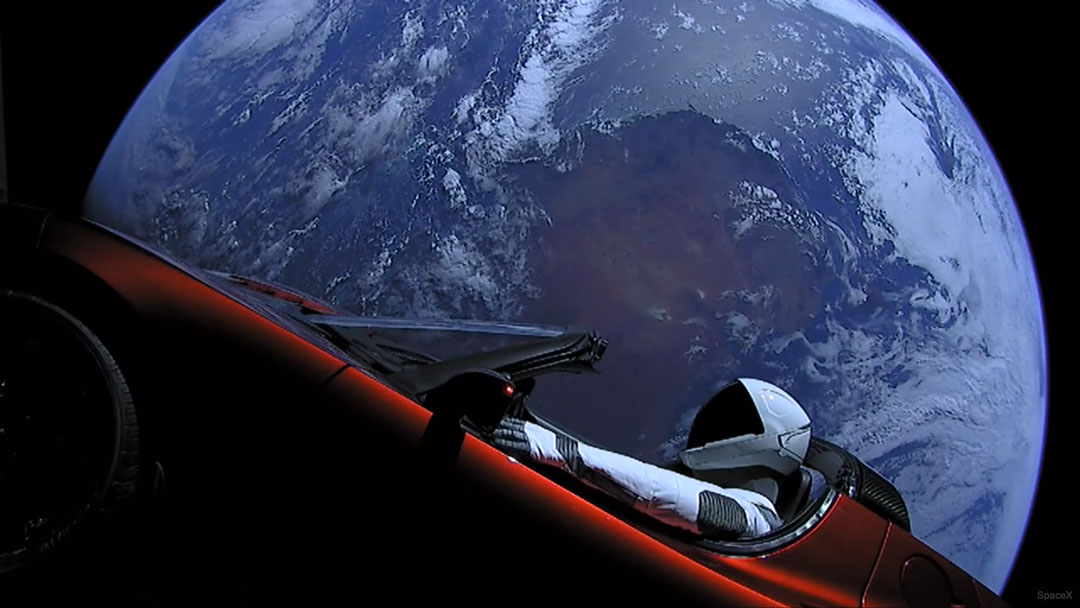
If you are still following this thread, APOD has a great shot of the Starman/Tesla Payload prior to leaving orbit traversing the blue marble over a nice clear image of a very recognizable continent
https://apod.nasa.gov/apod/ap180213.html
showing the eastern coast of Australia and Tasmania
Australia is relatively clear most of the time
These are huge losses. Where is the money coming from to cover them?
Tonyb
Reusable, autonomous control and landing rocket technology is not ‘new’. Tesla and other modern launch competitors stand on the shoulders of experimental rocket programs that went before them. Witness….
McDonnell Douglas Delta Clipper Reusable Rocket Program
https://youtu.be/JzXcTFfV3Ls
https://en.wikipedia.org/wiki/McDonnell_Douglas_DC-X
Xerox to Musk’s Apple.
Analogy Fail.
How so? I am not denigrating Xerox by any stretch. Their guys were unsung heroes who ignited the revolution. But, they didn’t get any credit because of blinkered management that failed to see what Jobs saw. Isn’t that exactly what we’re talking about here?
Kind of resembles the ship in Charlton Hestons movie Planet of the Apes
In engineering terms the range limitation is easy to solve. On long journeys just hook up a trailer with a generator. Most of the time you won’t need it, but if you ever decide to drive cross country you can, You don’t even need to own the trailer since you won’t need it most of the time. Just rent as needed.
But Tesla won’t use this extremely practical and workable solution. The Tesla doesn’t even have a tow bar let alone the electrical hookups that would be required to do this. The problem is it clashes with the marketing. The Tesla is being sold to rich virtue signallers; people who want to show the world that they are not only richer but also better and more virtuous than everyone else. A trailer, especially one with a CO2 emitting generator, isn’t part of the image.
The roadster is a two seater sports car, not the most practical of vehicles at the best of times. A lot of fun to drive no doubt, but you’ll need another car. Most people who buy one will have a more ordinary car for those ordinary trips.
The real funny out of this was a post on Facebook by the author John Ringo.
“Dear Mister Musk:
“It has come to our attention that the Tesla Roadster, VIN ///, that was reported as ‘lost’ on your insurance claim has been found. While currently unrecoverable, the vehicle is nonetheless in a known, if continuously moving, location. Therefore, your insurance claim has been denied.
Thank you for using Progessive.
Flo
PS: Nice try, asshole!
Would like to see the face of the next civilization roaming the Earth in 1 million years when they find the Roadster 🙂 with their first space exploration missions…
The Tesla won’t spend a million years in space – or even a thousand. In 400 years or so, some asteroid miner is going to find it and bring it back home to display in they Museum of Luna City or Marsopolis.
And why launch a car into space? WHY NOT! Yes, it’s a stunt. It’s a stunt that is great advertising for Tesla, great promotional material for science, and perhaps even a way to get kids interested in STEM degrees. And it’s exactly the sort of stunt that we might have expected from the P.T. Barnum of the 21st Century.
I love it.
I wonder what he could have charged to mount a bottle of Coke in the cup holder?
When will he give back the money he stole from California by committing a fraud on the state and claiming to have fast battery swap station running?
As usual with Elon Musk, all hype little substance. The Falcon Heavy is supposedly “state-of-the-art” but it’s inferior to the old Space Shuttle. Falcon can deliver 53 tonnes to Low Earth Orbit but the Space Shuttle Orbiter weighed 109 tonnes, more than twice. Falcon produces 3.8 million lbs. thrust but the Space Shuttle produced 5.6 million lbs. Even the ‘ancient’ Saturn V produced 7.89 million lbs. in 1967. But Elon succeeded in getting rid of his Tesla Roadster junk permanently
That alone would explain how these rockets could still contain enough fuel and LOX to land themselves with retro-rocketry. Up-scaling to achieve larger payloads might be difficult, given the weight of extra fuel, LOX and necessary structural enhancements to the vehicle to contain the increases. Part of the weight that could be propelled into orbit is tied up in the fuel for the braking and landing burns.
We are stuck here still without a much denser source of propulsion (or a better understanding of the space-time continuum?).
That alone would explain why no rocket engineer tried rocket propulsion for braking and landing. It’s wasteful consuming lot of fuel. You trade off payload for fuel. They all knew it from Tsiolkovsky in 1903 to Goddard to von Braun to Burt Rutan except Elon. That’s why he’s a ‘genius’
As pointed out by J Mac (above) this is not the first attempt to build a rocked that works like this.
Basically any reusable space launcher is going to be heavier and more expensive than a non-reusable one; however, if you can reuse it enough times it is a better deal.
Personally I like the aircraft launch idea, but that is partially because I am British and launching a space rocket from Britain would not work very well.
DCXA was an experimental rocket. Why didn’t they commercialize it? Because they don’t have Elon Musk who don’t mind exploding rockets as long as it’s cheap. BTW the Space Shuttle Orbiter was reusable and also the SpaceShipOne of Burt Rutan
Dr. Strangelove
Plenty of things did not work well the first time they were tried but became common after a bit of technical progress. There was politics involved as well, see https://en.wikipedia.org/wiki/McDonnell_Douglas_DC-X
Space Shuttle Orbiter was reusable, but just like the the SpaceX rockets it was heavy and expensive compared to a disposable rocket with the same payload. It only really made sense if you wanted to bring something back from space. Also it is now out of use.
SpaceShipOne is sub-orbital and so completely useless for lunching satellites.
It didn’t work because it’s a bad design to begin with. Between 1968-1972, Saturn V launched 10 manned missions to the moon with zero rocket explosion. 38 years later after all the technological innovations. Between 2010-2015, Falcon rocket launched zero mission beyond Low Earth Orbit with 8 failures or explosions. That’s one giant leap by Von Braun and one step backward by Elon Musk. And fans think he’s a great innovator LOL He builds cheap rockets that explode
Correction: Falcon had one unmanned flight beyond geostationary orbit in 2015
Dr. Strangelove said:
“Falcon can deliver 53 tonnes to Low Earth Orbit but the Space Shuttle Orbiter weighed 109 tonnes, more than twice.”
I don’t get that logic. What’s impressive about launching way more stuff into space than what you need, at a massively inflated price, if you can’t save money on the reuse of that stuff?
That’s the trick spacex are pulling/
The payload will overshoot Mars’ orbit because the central booster fired for too long. Aphelion will be close to (in?) the asteroid belt, perihelion will be close to Earth’s orbit.
http://i.dailymail.co.uk/i/pix/2018/02/07/09/48F5356800000578-5361789-image-a-21_1517996582460.jpg
Thanks Ric. Somebody suggested SpaceX purposely burned the final stage empty to get the largest possible orbit.
I like that cartoon by Josh, but I think the better title would be – “Recalculating…”
😎
(It did miss Mars, after all.)
You can find lots of skeptical (and some favorable) articles on Tesla on theirs Seeking Alpha financial site, here:
https://seekingalpha.com/symbol/TSLA/analysis-and-news?analysis_tab=focus&news_tab=latest-news
Nice to see someone do something, although I’m not so happy to see a taxpayer subsidized roadster wasted——to say nothing about the wasted launch.
But let’s be clear. This booster has about one half the power of the Saturn 5 (developed in the 60’s), and although the cost is a lot less, one would hope that we could improve SOMETHING after 50 YEARS.
As for the car, I expect a 10-times improvement in a car touted to be next generation—which we do not see. The thing is that Musk is great at integrating old technologies others developed while pretending he’s accomplished something (but only after collecting billions from taxpayers). An electric car that I would consider buying would be using a fuel cell (probably solid oxide) that can be refueled using a traditional gas station and that can drive from coast to coast on a tank full of fuel.
SpaceX is already working on the successor to the Falcon Heavy – the BFR (officially Big Falcon Rocket, but the real name is obvious). The BFR is expected to be able to lift 150,000 kg to LEO (Low Earth Orbit). The Saturn V could put 140,000 kg into LEO. Compared to practically every other puny rocket in the below list of launchers, the BFR and Saturn V are/were in a class by themselves.
https://en.wikipedia.org/wiki/Comparison_of_orbital_launch_systems