From STANFORD UNIVERSITY and the “pie in the sky dreams” department comes this study
Stanford engineers develop a new method of keeping the lights on if the world turns to 100% clean, renewable energy
Researchers propose three separate ways to avoid blackouts if the world transitions all its energy to electricity or direct heat and provides the energy with 100 percent wind, water and sunlight. The solutions reduce energy requirements, health damage and climate damage.
BY TAYLOR KUBOTA
Renewable energy solutions are often hindered by the inconsistencies of power produced by wind, water and sunlight and the continuously fluctuating demand for energy. New research by Mark Z. Jacobson, a professor of civil and environmental engineering at Stanford University, and colleagues at the University of California, Berkeley, and Aalborg University in Denmark finds several solutions to making clean, renewable energy reliable enough to power at least 139 countries.
 Stanford’s Mark Z. Jacobson says a new study shows that it is possible to transition the entire world to 100 percent clean, renewable energy with a stable electric grid at low cost. (Image credit: Getty Images)
In their paper, published as a manuscript this week in Renewable Energy, the researchers propose three different methods of providing consistent power among all energy sectors – transportation; heating and cooling; industry; and agriculture, forestry and fishing – in 20 world regions encompassing 139 countries after all sectors have been converted to 100 percent clean, renewable energy. Jacobson and colleagues previously developed roadmaps for transitioning 139 countries to 100 percent clean, renewable energy by 2050 with 80 percent of that transition completed by 2030. The present study examines ways to keep the grid stable with these roadmaps.
“Based on these results, I can more confidently state that there is no technical or economic barrier to transitioning the entire world to 100 percent clean, renewable energy with a stable electric grid at low cost,” said Jacobson, who is also a senior fellow at the Stanford Precourt Institute for Energy and the Stanford Woods Institute for the Environment. “This solution would go a long way toward eliminating global warming and the 4 million to 7 million air pollution–related deaths that occur worldwide each year, while also providing energy security.”
The paper builds on a previous 2015 study by Jacobson and colleagues that examined the ability of the grid to stay stable in the 48 contiguous United States. That study only included one scenario for how to achieve the goals. Some criticized that paper for relying too heavily on adding turbines to existing hydroelectric dams – which the group suggested in order to increase peak electricity production without changing the number or size of the dams. The previous paper was also criticized for relying too much on storing excess energy in water, ice and underground rocks. The solutions in the current paper address these criticisms by suggesting several different solutions for stabilizing energy produced with 100 percent clean, renewable sources, including solutions with no added hydropower turbines and no storage in water, ice or rocks.
“Our main result is that there are multiple solutions to the problem,” said Jacobson. “This is important because the greatest barrier to the large-scale implementation of clean renewable energy is people’s perception that it’s too hard to keep the lights on with random wind and solar output.”
Supply and demand
At the heart of this study is the need to match energy supplied by wind, water and solar power and storage with what the researchers predict demand to be in 2050. To do this, they grouped 139 countries – for which they created energy roadmaps in a previous study – into 20 regions based on geographic proximity and some geopolitical concerns. Unlike the previous 139-country study, which matched energy supply with annual-average demand, the present study matches supply and demand in 30-second increments for 5 years (2050-2054) to account for the variability in wind and solar power as well as the variability in demand over hours and seasons.
For the study, the researchers relied on two computational modeling programs. The first program predicted global weather patterns from 2050 to 2054. From this, they further predicted the amount of energy that could be produced from weather-related energy sources like onshore and offshore wind turbines, solar photovoltaics on rooftops and in power plants, concentrated solar power plants and solar thermal plants over time. These types of energy sources are variable and don’t necessarily produce energy when demand is highest.
The group then combined data from the first model with a second model that incorporated energy produced by more stable sources of electricity, like geothermal power plants, tidal and wave devices, and hydroelectric power plants, and of heat, like geothermal reservoirs. The second model also included ways of storing energy when there was excess, such as in electricity, heat, cold and hydrogen storage. Further, the model included predictions of energy demand over time.
With the two models, the group was able to predict both how much energy could be produced through more variable sources of energy, and how well other sources could balance out the fluctuating energy to meet demands.
Avoiding blackouts
Scenarios based on the modeling data avoided blackouts at low cost in all 20 world regions for all five years examined and under three different storage scenarios. One scenario includes heat pumps – which are used in place of combustion-based heaters and coolers – but no hot or cold energy storage; two add no hydropower turbines to existing hydropower dams; and one has no battery storage. The fact that no blackouts occurred under three different scenarios suggests that many possible solutions to grid stability with 100 percent wind, water and solar power are possible, a conclusion that contradicts previous claims that the grid cannot stay stable with such high penetrations of just renewables.
Overall, the researchers found that the cost per unit of energy – including the cost in terms of health, climate and energy – in every scenario was about one quarter what it would be if the world continues on its current energy path. This is largely due to eliminating the health and climate costs of fossil fuels. Also, by reducing water vapor, the wind turbines included in the roadmaps would offset about 3 percent of global warming to date.
Although the cost of producing a unit of energy is similar in the roadmap scenarios and the non-intervention scenario, the researchers found that the roadmaps roughly cut in half the amount of energy needed in the system. So, consumers would actually pay less. The vast amount of these energy savings come from avoiding the energy needed to mine, transport and refine fossil fuels, converting from combustion to direct electricity, and using heat pumps instead of conventional heaters and air conditioners.
“One of the biggest challenges facing energy systems based entirely on clean, zero-emission wind, water and solar power is to match supply and demand with near-perfect reliability at reasonable cost,” said Mark Delucchi, co-author of the paper and a research scientist at the University of California, Berkeley. “Our work shows that this can be accomplished, in almost all countries of the world, with established technologies.”
Working together
Jacobson and his colleagues said that a remaining challenge of implementing their roadmaps is that they require coordination across political boundaries.
“Ideally, you’d have cooperation in deciding where you’re going to put the wind farms, where you’re going to put the solar panels, where you’re going to put the battery storage,” said Jacobson. “The whole system is most efficient when it is planned ahead of time as opposed to done one piece at a time.”
In light of this geopolitical complication, they are also working on smaller roadmaps to help individual towns, many of which have already committed to achieving 100 percent renewable energy.
Additional co-authors of this paper are Mary A. Cameron of Stanford and Brian V. Mathiesen of Aalborg University in Denmark.
-30-
South Australia is the leading test-case for this sort of insanity. As ‘renewable’ sources of power take over in South Australia, the cost of electricity rises inexorably, industry moves out and relocates interstate or overseas.
South Australia and the National Energy Market for all of Australia is a prime example of how this would not work. We cannot get our State/Federal governments to agree on how the system should work, never mind expecting 100+ individual governments to work together in harmonious, joyful, happy-clappy nirvana.
Recently, operating theaters in a hospital in Adelaide, South Australia, lost power. More of this to come as South Australia goes full stupid on renewabeles.
http://www.abc.net.au/news/2018-02-07/power-failure-at-royal-adelaide-hospital-disrupts-surgery/9406270
so if I use all renewable energy, I will have actually less out of pocket expenses because I will have health savings and climate change savings? The energy in kwh will be more but my doctor will be cheaper? Hows that work? how do I see personal savings in climate change costs? I’m just trying to figure out in what scenario I’m going to see 75% reduction in costs? Will my taxes go down? How will society save money or reduce costs, how will that be given back to the users and how and in what for will I actually see more dollars in my pocket.
That’s all assuming that there are actual, real, defineable health and climate savings if we go all in for renewable energy.
Cause if that all works, renewable energy is reliable and can provide my electricity even when its dark or the wind stops, and if businesses don’t just get cut off due to lack of power and we can all save 75% in the combined energy, health and climate change costs…..lets do it!
Just show me the money.
the scheme relies on us paying money today to reap the benefits in 2050.
32 year payback on investment. comes will an ironclad no money back guarantee.
Hi ferd; good to see you’re still around injecting some common-sense.
One thing to watch out for in all these renewable energy scams is they never compare the return on investment in RE to the return if you invest in something else. As an example, when I compared investing in solar PV to investing in the stock market, it took 18 years for $10,000 invested in solar PV to break even. By that time a $10,000 stock market investment would have generated ~$40,000 of income. This result was predicate on the feed-in tariff remaining constant. Since then the FIT has fallen to less than half.
If you borrow money to install the system, it won’t generate enough money to pay the interest on the loan.
Squaw Valley / Alpine Meadows ski complex (Tahoe) claim they will be “100% renewable energy” by December 2018. Because Tesla battery. Yet today they admit the get 75% of their electricity from natural gas.
ok, good for them. How will they charge the tesla battery? How much per kwh does nat. gas cost and how much per kwh will the combined tesla battery and assumed wind/solar power charging cost?
Will their net energy costs go up or down, or stay the same between the two options (1) natural gas or (2) solar energy costs plus battery costs?
Its great to say they are 100% sustainable but if lift tickets go up to pay for the extra costs then the consumer gets to pay for their virtue.
Global energy use is about 18 TW = 18,000,000 MW = 24 million wind turbines (3MW turbine at average of 25% of capacity). A 3MW wind turbine costs about $5m, so total cost would be about 120 TRILLION DOLLARS just for the turbines. That is TWO TIMES all the money there is in the world.
And then there’s all the rest of the infrastructure for energy storage, transportation, etc…
I’m not from Missouri…but close enough. Don’t tell me. Show Me. Start with Berkely, then Oakland, then San Francisco. If you can do those then I’ll listen.
He’s from Stanford. Start with Palo Alto.
Start with all of the emergency services in the bay area. Convert all to “renewable” (without buying exceptions from someone else), including the fire boats & helicopters, and I’ll start to pay attention.
Get the Coast Guard off hydrocarbons and I’ll be impressed.
“Overall, the researchers found that the cost per unit of energy – including the cost in terms of health, climate and energy – in every scenario was about one quarter what it would be if the world continues on its current energy path. This is largely due to eliminating the health and climate costs of fossil fuels. ”
“Health and climate costs” = fudge factors added to fossil fuel costs
It is a true and tried method of “adjustments”.
Article: “cost per unit of energy – including the cost in terms of health, climate and energy – in every scenario was about one quarter what it would be if the world continues on its current energy path. This is largely due to eliminating the health and climate costs of fossil fuels.”
I’ve seen that sort of BS before. Here’s another example:
How Large Are Global Fossil Fuel Subsidies? by David Coady, Ian Parry, Louis Sears, Baoping Shanga, World Development, Volume 91, March 2017, Pages 11-27.
It is astonishing how blatantly dishonest the propaganda is. The “subsidies” of fossil fuels which Coady et al totaled up in their paper, like the “costs” in Jacobson’s dishonest accounting, aren’t actually subsidies at all, according to any dictionary. Instead, Coady’s “subsidies” represent the authors’ assessment of the value of governments’ failure to tax fossil fuels by as much as the authors think they ought. This is from the abstract:
Of course that’s ridiculous. Both papers are pure, peer-reviewed, pseudo-scientific, 100% pig manure.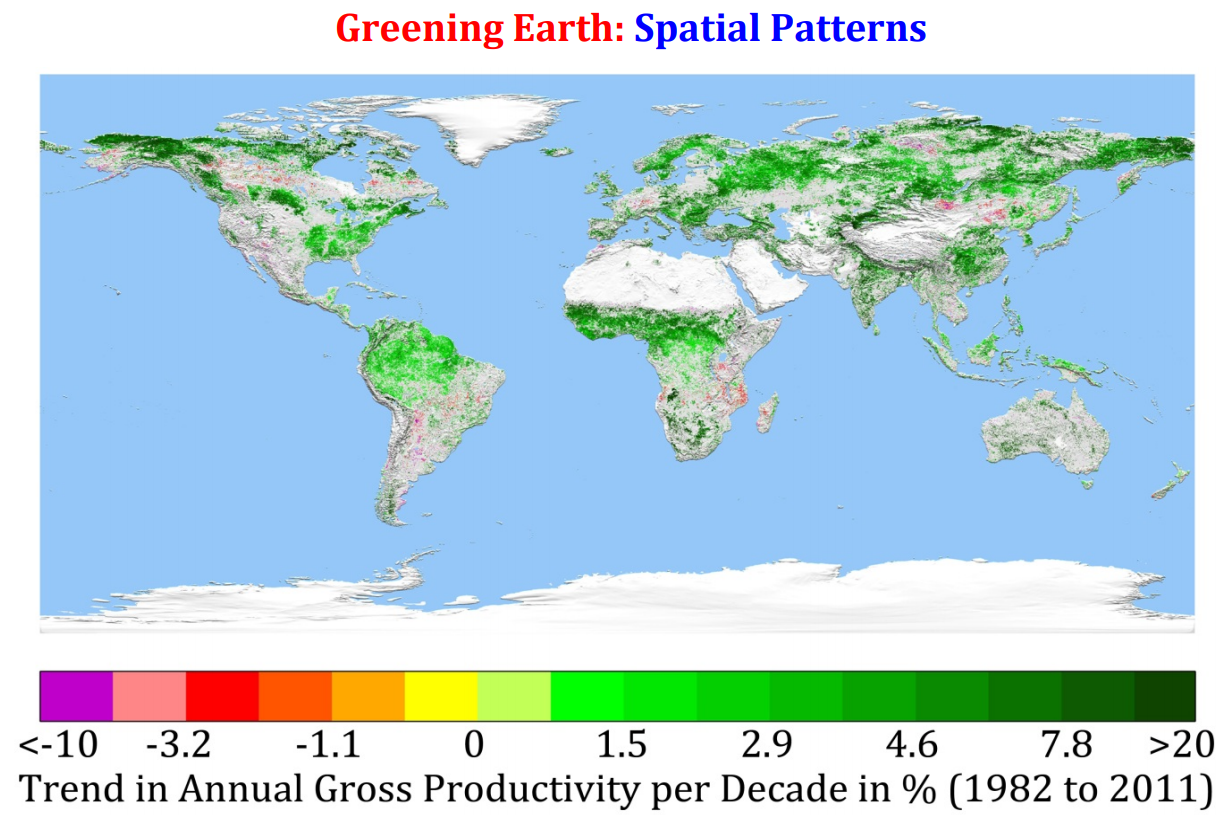
With a high enough mythical “social cost of carbon” you can make almost anything appear to be cheaper than fossil fuels. But the reality is that the human health and environmental costs of fossil fuels are both negative, in striking contrast to the human and environmental costs of the “mitigation” strategies advocated by these charlatans, which are enormous.
Scientific American once called anthropogenic CO2) from fossil fuels “the precious air fertilizer,” because it is so extraordinarily beneficial to plants. Here’s what it actually does to the Earth’s environment:
https://www.sealevel.info/greening_earth_spatial_patterns_Myneni.html
Do you see that broad, green swath over central Africa? That’s the Sahel retreating, at the southern limit of the Sahara Desert. National Geographc reported about it in 2009 (though they managed to avoid mentioning that CO2 is the cause):
Unfortunately, the news is not all good. In the United States, there are now about 50 million acres devoted to growing Roundup-ready, monoculture corn, to make “renewable fuel,” to reduce fossil fuel use. That’s more than the combined land area of the nine smallest U.S. States — land which could otherwise be wildlife habitat.
Similar campaigns are displacing wildlife and subsistence farmers from their farms in the tropics, to make way for giant monoculture palm oil “renewable fuel” plantations.
It’s not just wildlife dying, either. The human body count is piling up — not from climate change, of course, but from misguided efforts to mitigate climate change.
Most obviously, “the war on coal” impoverishes people in coal mining States like West Virginia, where huge numbers of them are now out of work.
But “renewable energy” boondoggles also impoverish everyone forced to pay their exorbitant cost. They cause thousands of people living “on the edge” to sometimes have to choose between eating and staying warm.
Either choice can be deadly. In Europe, where there have been enormous price hikes for energy because of “renewables” scams, “energy poverty” is killing tens of thousands of mostly-elderly people:
http://www.independent.co.uk/news/uk/home-news/fuel-poverty-killed-15000-people-last-winter-10217215.html
What’s more, most of the energy used to produce solar panels, and much of the energy used to produce wind turbines, came from soot-belching, coal-fired power plants in China, and most of the energy replaced by these devices would have been produced in clean power plants with state-of-the-art “scrubbers” in North America, Europe & Australia.
So, Chinese workers get emphysema, American workers get to collect unemployment (until it runs out), and people like Mark Jacobson and David Coady get to feel self-righteous. Such a deal… not.
“Health and climate change costs included.”
I haven’t been to Beijing since since 1999. When I was there, it had the dirtiest air
I had ever seen, absent US forest fires.
Pictures from the China olympics and research indicate that the city has gotten much
worse. Particulate is soo bad that they advise travelers not to wear light colored
clothes. Yet life expectancy in Beijing continues to rise.
Beijing life expectancy nears 82 years – Xinhua | English …
news.xinhuanet.com/english/2016-02/29/c_135141376.htm
Feb 29, 2016 · BEIJING, Feb. 29 (Xinhua) — Life expectancy in Beijing rose slightly from 2014 to reach 81.95 years in 2015, according to an annual report by the Beijing Municipal Commission of Health and Family Planning.
What health and climate change cost?
Most of the pollution in Beijing isn’t coming from power plants anyway.
Didn’t the UK convert the Drax power station from coal to wood pellets so they could burn the eastern united states forest’s instead of coal? That is considered renewable energy, if the forests grow fast enough.
Yes, that’s part of the renewables confidence game. Wood pellets produce 15-20% more CO2 than the coal they replaced, but CO2 emissions from wood pellets are not included in total CO2 emissions for Britain because wood pellets are considered renewable by EU rules. So they say going renewable has reduced CO2. Total scam.
What also is not factored in emissions is the emissions from machinery used to harvest wood and create pellets nor is the emissions from the ships used to transport them to the UK. Total scam indeed!
This is of no concern for me, because I have a study based on a computer model that projects that I will be living on an idyllic planet about 20 light years from here by 2030. Like the models in the study above, my model does not bother with minor engineering problems (like traveling faster than the speed of light), because such concerns are truly beneath the superlative, academic nature of my being. I will fund this voyage with the proceeds of never having to hear about another idiotic horrible ‘solution’ to a non-existent problem from a disconnected-from-reality professor who thinks he knows how the rest of the world should be; which, of course, is priceless.
Jclarke, that was excellent!! Best summary of situation ever! I may need to borrow part of that, hope you do not mind.
The calls for some practical demonstration of these claims appear reasonable.
Australia would be an excellent test site, a small relatively clustered population, lots of open spaces and plenty of sun and wind. Admittedly, hydro is less available, but that should not be a show stopper.
Happening right now in South Australia. The good people of the State of South Australia have have volunteered to be the renewable crash test dummies for the world.
Please don’t treat the people of South Australia like a joke. Their government is already doing that.
yarpos:
“The good people of the State of South Australia have volunteered to be the renewable crash test dummies for the world.”
Ummmm.
“The good people of the State of South Australia have volunteered to be the crash test dummies for the world.”
FIFY
Auto – sad, as I am sure many South Australians are decent folk. But – no, not renewable . . . . .
In a good year, out of total generation fo about 250TWh Australia produces nearly 20TWh of hydro (mainly in Tasmania, but also from the Snowy scheme). There is also the Snowy 2 scheme (2GW generation/350GWh storage), and a number of other opportunities in pumped hydro – although probably only another 200GWh of PHES storage that can be developed at halfway reasonable economic cost.
Pumped storage is a worthwhile goal, but it’s also a Holy Goal (er, Grail) that is all too often unobtainable and unsustainable.
For pumped storage to work “naturally” without artificial fuels you need those unique attributes of downstream AND upstream of Niagara Falls. Unlimited clean, useable water upstream NOT limited by season, ice cover, time of day, fishing or enviro restrictions such as minimum flow, maximum flow, or refill due droughts. Floods have to be “manageable” – All of ANY maximum possible floods (even tsunami’s or mudslides and avalanches) have to be able to be safely and controllably bypassed by the downriver hydro suction and generator tunnels. For example, fresh clean water river flow in the US south, US far west, and US southwest are often REQUIRED to be dumped out of dams regardless of the need for future or current drinking water, future or current irrigation, actual dam heights and actual stored water levels, future or current power needs, and future flood reserves BECAUSE certain fish in the tidal pools downriver “might be” affected by low or restricted fresh water flows from the drinking water lakes. Lake Eire, at least so far, has an inexhaustible water supply that is at a usable-constant lake water height.
2. You need room for the stored water lake; and that lake MUST be several hundred feet (dozens of meters) ABOVE the generator discharge INTO a suitable river that can accept the flow at irregular intervals. Even at Lake Eire, the enviro-Indian rights-ecologists fiercely fought the lake, canals, tunnels, and dams. Regardless of what you may think of their opposition to flooding traditional burial grounds, they did bitterly fight the new lakes and dams.
Third. The stored water lake, must be below the source water lake by enough meters (dozens of feet) to ensure nature flow to refill the stored water lake. If you cannot find such a location of “natural refill” such as Lake Eire, then you MUST be able to ALWAYS ensure generated power is available from ?????? sources cheaper than the power you are going to “sell” when you discharge the stored water lake.
Easy to “wave your hands” and claim “we will use cheap energy at night”, “we will use daylight solar power to refill the lake and discharge it at night”, or “we will use wind power to generate the pumping power so we can use the stored lake hydro power when there is no wind” …
But the pump in-efficiencies, hydro generator in-efficiencies, generator inefficiencies (wind or solar or fossil or nuclear), transmission inefficiencies, and water flow inefficiencies require you generate 20% MORE power to generate and power and pump and move the water than you get back out of the water flowing downhill.
Any one of those problems makes pumped stored difficult to realize in practice and design. All three means there are very, very few pumped storage sites worldwide.
A worthy Grail, but only the pure and innocent will “Chose Wisely.”
I am all too aware of the economics and conditions required to make pumped hydro work. What turns out to be the real killer on the economics of storage is when you move from being able to turn the storage over daily, to having to keep it full to cover seasonal variations, or longer spells of unfavourable weather that may occur rarely, but often enough to cause major problems if you can’t keep the grid going (at a minimum, rotating power cuts). In Australia and Chile there are some opportunities to use depressions atop seaside cliffs as an upper reservoir for a pumped storage scheme. Here’s a look at a real proposal in Chile, and how it might be expanded:
http://euanmearns.com/how-chiles-electricity-sector-can-go-100-renewable/
But few countries are as conveniently endowed with areas of desert they can sacrifice at seaside cliffs. Even so, the economics of this highly favourable site look challenging. Better not flood the Lithium salt pans…
Hmmmn. Egypt has the Qattara Depression conveniently deep and only a 80-odd kilometers from the Mediterranean Sea. Have to guage water evaporation rates against water flow rates to see if one-way flow might work. That idea has been discussed for a while.
Doubt Israel would get permission to flood the Dead Sea from the Med though.
And California’s Death Valley would be off-limits to flooding by distance.
How about building several (As many as could be placed there without affecting navigability) Undershoot Water Wheel generators under each and every bridge on every major river throughout the US. No dams, lots of Green Jobs, and lots of dependable electricity.
RACook:
For California, look instead across the border to Baja:
http://euanmearns.com/how-californias-electricity-sector-can-go-100-renewable/
When wind shuts down it does so over large areas Many people and papers have show this.
https://ontariowindperformance.wordpress.com/2010/09/24/chapter-3-1-powering-ontario/
No problem, the smoothly integrated and diverse virtual grid takes over, seamlessly sourcing power from batteries, hydro, micro grids, solar thermal, and ranks of diesel/gas generators. What could possibly go wrong? They will build gas factory complexity and wonder why its fragile.
This “study” attempts to address only one of the many reliability issues of renewables that being the non-dispatchability of these resources. The “study” fails to address other critical electric grid reliability and stability issues including system regulating margin, spinning reserve, standby reserves, frequency control, voltage control and system synchronization control none of which can be supplied by the non synchronous generators which are used by renewables.
These people are not Electrical Engineers they are Civil Engineers. No idea of how the grid work or what users expect!
The same Jacobsen suing the peer reviewed authors that thoroughly debunked his previous fantasy paper. This professor is as bad news as Mann.
But, in a way, very useful for skeptics. Shows how warmunists have really lost the plot line.
Ok, I thought it was the same cretin.
Wow, what chutzpah he has.
“For the study, the researchers relied on two computational modeling programs. The first program predicted global weather patterns from 2050 to 2054.”
Are their “computational modeling programs” able to predict weather from today to next week, 2018?
Neil,
You and I both know the answer to your query is ‘No.’
Certainly, in the UK, three days out is about as far as forecasting – rather than guessing, or saying “There is one chance in three of higher than average doo-dah; one chance in three of below average doo-dah; and about a fifty percent chance of average doo-dah.” – will get you.
‘Doo-dah’ – rain, sun, temperature, moon-beams, snow accumulation, wind, unicorn flatulence and the rest.
A week out – in the UK – is still not possible.
In Singapore, and some other places, a week may be good [albeit with a little charity].
“The first program predicted global weather patterns from 2050 to 2054.” – GIGO.
Certainly over a third of a century!
Auto.
We often talk here about models and the real world not matching. This paper seems to be about models, which can be a valuable way to consider a lot of possibilities at minimal cost. But the real test is the real world. I think of the state of South Australia. Continuous power has been a problem there with their heavy dependence on wind power. The authors need to find real examples to verify their model – but in the climate world we continue to see that the money and press goes to those who write ever more models, not to the tedious work of verifying models.
They seem to be assuming that we have developed room temperature super conductors.
The problem with the “wind is blowing somewhere, the sun is shining somewhere” scenario is that where the wind is blowing and the sun is shining often is not the same place where electricity is needed.
As a result they are planning on shipping power hundreds or even thousands of miles from where it is produced to where it is needed. They are not calculating transmission losses into their projections.
But on *average* the “wind is blowing somewhere, the sun is shining somewhere” – and AGW proponents are very good at averaging!
I wish AGW proponents were at least average.
Fast, good or cheap, pick any two.
Electrical grid no different from any other large project. Trying to optimize for everything doesn’t work.
The biggest insanity is that the same people who are demanding more renewables, are also dead set against all hydro-electric power and try to have it removed whenever they can.
You know, way back in the 60’s visions of the future were about domed cities with perfect weather control, perfectly clean air and water with air cars that had no emissions. People didn’t seem to work and had everything they needed. What the hell happened?
We were supposed to have thriving colonies on Mars by now also.
Somebody dropped the ball.
Indicator of some thumbs on scales? “Overall, the researchers found that the cost per unit of energy – including the cost in terms of health, climate and energy – in every scenario was about one quarter what it would be if the world continues on its current energy path.”
I wonder who’s payroll he is on? Someone is definitely greasing his palm.
Tom Steyer
Sounds like “The Music Man” for the 21st century.
There are no large scale tidal power generators. And none are likely.
The delusion that wind power is actually working is persistent but still dekusional.
The paper appears to be very circular in its,rationalizations.
And there are no large scale storage technologies…so other than the unphysical nature of the solution the authors offer to a non-priblem, it is pretty much ok, I guess.
https://youtu.be/LI_Oe-jtgdI
Tidal power is in any event highly cyclical – not only the not quite twice daily tide with its shifting times, but also the substantial variation every lunar month between spring and neap tides. So you need a fortnight’s storage to even it out for a start.
“This solution would go a long way toward eliminating global warming and the 4 million to 7 million air pollution–related deaths that occur worldwide each year, while also providing energy security.”
There are no bodies to count, that 4-7m figure is so inexact as it is because it is an estimate based on an estimate based on an estimate based on an estimate based on an estimate of an estimate. Six levels deep. No kidding. Plus, the speaker pretends that electricity generation causes deadly air pollution. Air pollution is a risk, not a cause of death.
Bring out the BS button.
watch out, the author sues those who dare to disagree with him.
The article implies that two of his scenarios will utilize a large-scale storage technology. If he has one that works, he should give some details on that, because it would be world-changing. But it no info is given, and it seems to be an assumption that one will be developed. That’s cheating.
So he deals with the critiques about too much hydroelectric capacity by dropping that solution, and perhaps even the underground storage at solar plants. But did he deal with the corresponding demand side issue?
In the paper, he suggests that factories and other industrial consumers would change their consumption to match when the power is available. So for example, the factory will demand all it’s power over one hour instead of 10 hours.