From STANFORD UNIVERSITY and the “pie in the sky dreams” department comes this study
Stanford engineers develop a new method of keeping the lights on if the world turns to 100% clean, renewable energy
Researchers propose three separate ways to avoid blackouts if the world transitions all its energy to electricity or direct heat and provides the energy with 100 percent wind, water and sunlight. The solutions reduce energy requirements, health damage and climate damage.
BY TAYLOR KUBOTA
Renewable energy solutions are often hindered by the inconsistencies of power produced by wind, water and sunlight and the continuously fluctuating demand for energy. New research by Mark Z. Jacobson, a professor of civil and environmental engineering at Stanford University, and colleagues at the University of California, Berkeley, and Aalborg University in Denmark finds several solutions to making clean, renewable energy reliable enough to power at least 139 countries.
 Stanford’s Mark Z. Jacobson says a new study shows that it is possible to transition the entire world to 100 percent clean, renewable energy with a stable electric grid at low cost. (Image credit: Getty Images)
In their paper, published as a manuscript this week in Renewable Energy, the researchers propose three different methods of providing consistent power among all energy sectors – transportation; heating and cooling; industry; and agriculture, forestry and fishing – in 20 world regions encompassing 139 countries after all sectors have been converted to 100 percent clean, renewable energy. Jacobson and colleagues previously developed roadmaps for transitioning 139 countries to 100 percent clean, renewable energy by 2050 with 80 percent of that transition completed by 2030. The present study examines ways to keep the grid stable with these roadmaps.
“Based on these results, I can more confidently state that there is no technical or economic barrier to transitioning the entire world to 100 percent clean, renewable energy with a stable electric grid at low cost,” said Jacobson, who is also a senior fellow at the Stanford Precourt Institute for Energy and the Stanford Woods Institute for the Environment. “This solution would go a long way toward eliminating global warming and the 4 million to 7 million air pollution–related deaths that occur worldwide each year, while also providing energy security.”
The paper builds on a previous 2015 study by Jacobson and colleagues that examined the ability of the grid to stay stable in the 48 contiguous United States. That study only included one scenario for how to achieve the goals. Some criticized that paper for relying too heavily on adding turbines to existing hydroelectric dams – which the group suggested in order to increase peak electricity production without changing the number or size of the dams. The previous paper was also criticized for relying too much on storing excess energy in water, ice and underground rocks. The solutions in the current paper address these criticisms by suggesting several different solutions for stabilizing energy produced with 100 percent clean, renewable sources, including solutions with no added hydropower turbines and no storage in water, ice or rocks.
“Our main result is that there are multiple solutions to the problem,” said Jacobson. “This is important because the greatest barrier to the large-scale implementation of clean renewable energy is people’s perception that it’s too hard to keep the lights on with random wind and solar output.”
Supply and demand
At the heart of this study is the need to match energy supplied by wind, water and solar power and storage with what the researchers predict demand to be in 2050. To do this, they grouped 139 countries – for which they created energy roadmaps in a previous study – into 20 regions based on geographic proximity and some geopolitical concerns. Unlike the previous 139-country study, which matched energy supply with annual-average demand, the present study matches supply and demand in 30-second increments for 5 years (2050-2054) to account for the variability in wind and solar power as well as the variability in demand over hours and seasons.
For the study, the researchers relied on two computational modeling programs. The first program predicted global weather patterns from 2050 to 2054. From this, they further predicted the amount of energy that could be produced from weather-related energy sources like onshore and offshore wind turbines, solar photovoltaics on rooftops and in power plants, concentrated solar power plants and solar thermal plants over time. These types of energy sources are variable and don’t necessarily produce energy when demand is highest.
The group then combined data from the first model with a second model that incorporated energy produced by more stable sources of electricity, like geothermal power plants, tidal and wave devices, and hydroelectric power plants, and of heat, like geothermal reservoirs. The second model also included ways of storing energy when there was excess, such as in electricity, heat, cold and hydrogen storage. Further, the model included predictions of energy demand over time.
With the two models, the group was able to predict both how much energy could be produced through more variable sources of energy, and how well other sources could balance out the fluctuating energy to meet demands.
Avoiding blackouts
Scenarios based on the modeling data avoided blackouts at low cost in all 20 world regions for all five years examined and under three different storage scenarios. One scenario includes heat pumps – which are used in place of combustion-based heaters and coolers – but no hot or cold energy storage; two add no hydropower turbines to existing hydropower dams; and one has no battery storage. The fact that no blackouts occurred under three different scenarios suggests that many possible solutions to grid stability with 100 percent wind, water and solar power are possible, a conclusion that contradicts previous claims that the grid cannot stay stable with such high penetrations of just renewables.
Overall, the researchers found that the cost per unit of energy – including the cost in terms of health, climate and energy – in every scenario was about one quarter what it would be if the world continues on its current energy path. This is largely due to eliminating the health and climate costs of fossil fuels. Also, by reducing water vapor, the wind turbines included in the roadmaps would offset about 3 percent of global warming to date.
Although the cost of producing a unit of energy is similar in the roadmap scenarios and the non-intervention scenario, the researchers found that the roadmaps roughly cut in half the amount of energy needed in the system. So, consumers would actually pay less. The vast amount of these energy savings come from avoiding the energy needed to mine, transport and refine fossil fuels, converting from combustion to direct electricity, and using heat pumps instead of conventional heaters and air conditioners.
“One of the biggest challenges facing energy systems based entirely on clean, zero-emission wind, water and solar power is to match supply and demand with near-perfect reliability at reasonable cost,” said Mark Delucchi, co-author of the paper and a research scientist at the University of California, Berkeley. “Our work shows that this can be accomplished, in almost all countries of the world, with established technologies.”
Working together
Jacobson and his colleagues said that a remaining challenge of implementing their roadmaps is that they require coordination across political boundaries.
“Ideally, you’d have cooperation in deciding where you’re going to put the wind farms, where you’re going to put the solar panels, where you’re going to put the battery storage,” said Jacobson. “The whole system is most efficient when it is planned ahead of time as opposed to done one piece at a time.”
In light of this geopolitical complication, they are also working on smaller roadmaps to help individual towns, many of which have already committed to achieving 100 percent renewable energy.
Additional co-authors of this paper are Mary A. Cameron of Stanford and Brian V. Mathiesen of Aalborg University in Denmark.
-30-
If wishes were unicorns……
Isn’t this the guy suing other scientists for showing his previous paper was crap?
I do believe you are correct.
I bet this work is up to the same standard as that.
Yes – they found basic errors in his work. When they pointed it out, in a peer reviewed paper, in the Proceedings of the National Academy of Sciences, the same prestigious journal that released Jacobson’s study, he freaked and sued them for libel ($10 million in damages).
The big disagreement was Jacobson’s use of hydropower, which backs up the proposed grid system by dispatching power when wind and solar can’t cover demand. Jacobson’s supplementary details list an installed hydropower capacity of 87.5 gigawatts for 2050, essentially the same as it is today. But elsewhere, he includes a chart showing 1,300 gigawatts of hydropower dispatched, which is roughly 15 times the installed capacity. The modeling error makes the entire system fall apart. Jacobson described this as an “intentional assumption.” His idea is that the annual flow of water through U.S. hydropower facilities has to be held constant, but it is possible to increase the power by upgrading turbines at existing dams.This explanation, and associated costs, do not appear anywhere in the original article or its supplement. But Jacobson says he explained his thinking to the journal, they went ahead and published a critique of the hydro modeling anyway. Jacobson says that amounts to a false claim.
As a person who has actually worked on such projects, Jacobson’s assumption and explanation was ….childish, and displayed a basic misunderstanding on how hydro power works, and the potential for upgrades. I’d say, if we were lucky, we might squeeze out another 10 GW from the existing hydro system. That only leaves us around 1200 GW short of our goal.
I’d have peruse the paper thoroughly, but given the fact that Jacobson previously beclowned himself, first by his poor modeling and assumptions, then filing a lawsuit when challenged, my guess the new paper will show similar deficiencies.
I think the problem with Jacobson is fairly basic – he sets forth with a conclusion (100% renewable power is both feasible and desirable) and then tries to fit the data to the conclusion. When you have decided your conclusion, you are prone to making elemental mistakes in logic and math as part of your analyses.
My observation is fairly simple 1) if 100% renewable power is both feasible and desirable then certainly some country or state will implement such a system. So far no one seems to think it can be done, except on a small scale. 2) Penetration of renewable power into the marketplace gets exponentially more difficult the closer you get to 100% renewable. Because of that, it is easy to think, after the first 5 or 10 or 30%, that the rest will be easy. It is much more likely that it will be hard, very very hard. And very costly. And probably unnecessary – I am perfectly happy with a system that is 60-80% renewable, and that would likely accomplish most of our goals.
Funny comments about the guy in this tweet. Might have to click on the date to see them.
https://twitter.com/MITEnergyConf/status/958052964656173056
I believe that a large part of his Hydro Assumptions lay in his belief that they would be able to Add Additional Hydro generators to existing facilities. One major problem to this non-solution is that it takes additional water supply to turn the additional turbines. Most Hydro facilities are designed with the amount of water behind the dam as a major factor to release rates needed to turn the generators over a period of time. If you quintuple the generator count, you also quintuple the amount of water flow to produce electricity. This effectively causes the water behind the dams to drain 5 times faster so the dams would only be able to produce power for 20% of the time they normally would or run out of water 5 times faster. (Glad I proof read this, I missed my “o” in Generator Count”. Dangerous misspelling)
I would assume that when they built the dam, they sized the tube that carries water from the dam to the turbines based on the number of turbines being built at the time.
To add more turbines, they would need to increase the size of that tube.
I’m guessing that at most dams, this will not be easy or cheap.
Mr Dismal, thanks. Nice analysis. However i take exception to your 60%-80% goal as feasible. as you point oit it gets exponentially more difficult as you go from 10%-20%-30% etc. Add to the dispatchable spiinning reserve that the grid operator must maintain and the costs to the consumer and economy skyrocket.. And without dispatchable backup (fast spinup or spinning) then blackouts are certain during heavy loads periods.
But back to Jacobsen, it is my opinion that someone (with a sizeable investment agenda and portfolio) must be paying him nicely to publish such easily rebutted junk.
Someone suggested solar to replace the power in Puerto Rico. Image what would happen to their grid with even a cat 3. Power lines wouldn’t be a problem because there would be no power generation left.
Even if they could quindectuple the flow of water through hydroelectric dams (Sue me, I never get to use that word), there’s the problem of flooding downstream. You would literally be opening the floodgates to near-disastrous levels. The devastation would be horrifying.
You would need to build a lower containment lake that pumps the water back into the dam during low cost times
Let me clarify – I would be thrilled to get to 60-80% renewable. Likely? Not really. Beyond 30% things start getting pretty ugly. Personally I think 100% is…insane. but I think 60 to 80% might be possible…barely.
Re. hydro power, there is about 10 GW we could get from powered dams, and perhaps another 10 GW from powered dams that are upgraded (more efficient new generates and what not). And that is pretty much it.
One thing Jacobson doesn’t get – renewable power is a lot like farming. Or gold mining. If I were to calculate out all the gold in the united states, and then assume it will all be someday mined, you’d say I am nuts – some of the gold (most of it actually) is not concentrated to be worth mining. or it is located in places I can’t mine, Or too deep. Actual recoverable resources are a much much smaller number. Jacobson always starts his calculations off from the size of the total resource, not acknowledging that a very large fraction of that resource will never be exploited.
Dream on at our expense and peril. These Warmers are a danger to civilization and all aspiring human beings or as Unicorn brain PM Trudeau said all “People Kind”
PS – Effective Immediately – All Manhole covers are now Peoplehole covers. Coming soon to your home town!!!
hupeople?
Michael Peopple?
Manhole covers? What we used to call pantyhose? Geoff
If Jacobson actually knew what he was talking about, most every utility company would be trying to hire him since his expertise would generate millions in profits for the utility company.
There would actually be an extremely high demand for his expertise
+1
another instance of “i don’t know how to do it, so I teach”
I thought there were over 205 countries in the world.
I guess he can supply 100% erenewable energy for 67% of the world. What about the other 33%
Calling all unicorns, much help needed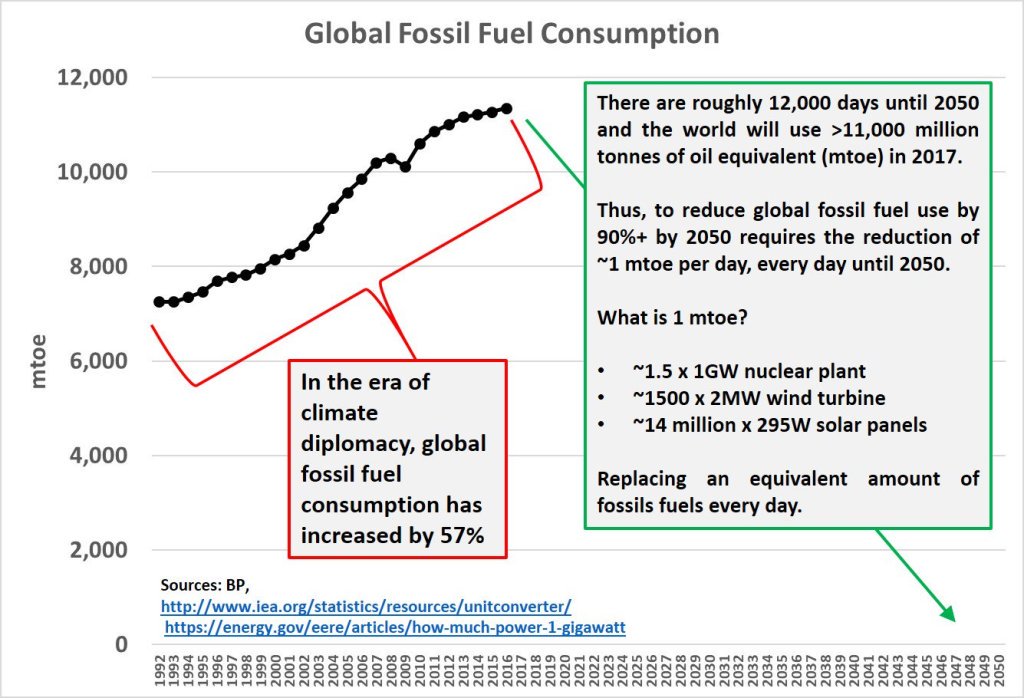
Hey… Not quibbling too much, but the MTOE calculations are kind of wrong … or at least misleading. If for instance, 1 TOE is by definition, 41.868 GJ of thermal energy, computed with the 38% OECD “world average thermal energy plant” heat→electricity conversion, it is 4,419 GWh. This is a good reference point, since for the most part, we’re working with electrical power. Yes, there are process heating and other direct heating uses, but relatively small compared to electricity.
Working with that, 4,419 GWh/MTOE, then backward calculating the various other energy sources
1,000,000 T oil, 41.868 GJ/T, 38% Carnot conversion to elec… = 4,419 GWh 0.531 GW nuclear plant, 95% uptime/full production is 4,419 GWh/year630 ea, 2 MW wind turbines, 40%-of-full-power duty cycle. Wind caprice. 4,419 GWh/year6,835 ea, 295 W panels, 25% insol/weather/diurnal production, year average… 4,419 GWh/year.
That — at least to me — seems more rationally normalized. ESPECIALLY in a world-of-the-future (which is the point of this article) where we go 100% to renewable / storable / pipe-able. Just saying.
GoatGuy
Another problem is that his model assumes that you can ramp up hydropower output on a moments notice.
This may be true for some dams, but not for all of them.
Many dams have recreational sites downstream from them. At such sites you have to put out a warning telling those downstream to get to higher ground before water flow can be increased.
The unbelievable complexity of attempting to make all of these unreliable or semi-reliable energy sources try to cover each other would make this overall system entirely unworkable and a net failure. We would be spending half our time repairing the multiple, complex, widely separated systems Just imagine the infrastructure!) and the other half of the time in the dark. No thanks.
My first thought on this daydream was it would require a world organisation and control of the grid and us little ones for it to work, meaning that even if it didn’t work we’d never hear about it.
James Bull
James Bull –
” . . . . meaning that even if it didn’t work we’d never hear about it. ”
Too right.
If it didn’t work [and it will not work], we will, at best, be in the dark, with the Net dead.
Worst case scenario – WE will be dead.
WE – ‘us little ones’ (beautiful phrase); not the global elites and their few hundred million slaves and concubines.
I certainly hope never to have to keep warm – even in South London – for a winter on renewables.
It’s dark a lot in winter.
And if the winds aren’t too great for generation, there may be a blocking high and no discernible wind at all, even during the day.
Auto – amazed at what unutterable piffle can be published!
[Is it because his middle initial is ‘Z’? So was John DeLorean’s – John Zachary DeLorean] [De Lorean?]
I think we need to separate the ‘Is it possible to achieve at any cost?’ from the ‘What will it cost?’
Is it possible? Yes. Arizona takes up 114,000 sq mi. With average insolation of about 6 KW per sq meter per day, that’s about 74,000 GW per hour average. Put in a 10% factor and you still have over 7,000 Gigawatts (per hour averaged over 24 hours).
As for storage, forget the batteries pipe dream. But you can store heat and you can store electricity through raising weight up a mountain (WUWT had an article on this). Storage might ‘use up’ half, so now you’re down to 3,500 GW.
Current US usage of electricity is around 500 GW. So, at least it is possible to generate the electricity, storing the excess until it’s needed. Possible – Yes. This is nice to know, since in a couple of hundred years we may run out of fossil fuels.
As to what it would cost, there are several possibilities, although I can’t imagine it being economically worthwhile in today’s real world.
(I think my numbers are correct. Please tell me if I’m wrong.)
I guess they live in the Matrix. Models, models based on models and more models creating a virtual reality. At current energy growth rates I think the entire land masses of the Earth will have to covered with solar panels to make this work.
But then, we only need to run air conditioning since heating will no longer be required anywhere, especially in the tropical north and south poles.
My question on the modeling is why he felt it necessary to create fictional weather projections to determine how much energy renewables could be producing.
What is wrong with using existing weather data? not good enough?
Did his weather prediction model provide more sunshine, wind or rain?
According to models weather will become more extreme. Maybe he thinks he can harness all that energy from hurricanes and such.
Now, I will say he does need a model to find the worst case. I’ve been burned before by running on existing data and then finding that it wasn’t representative of how bad things can get.
Good call. Modelled weather has an interesting habit of producing convenient spatial and temporal anti-correlations and lack of extended periods of low wind/clouds that don’t hold up with real weather data, which leads to a gross under-estimate of the amounts of backup capacity required. I found this looking at AEMO’s 2012/13 100% renewables study with input from RAM consulting, which has also been used as the foundation of much work by Blakers.
Still, I don’t suppose the data are available for proper examination.
A few years ago, I looked at actual data coming in from Germany’s energy efforts as there was quite extensive documentation being kept, in the best Germanic fashion. The numbers were discouraging, with long periods in which solar and wind combined for pitifully low output. The only real hope for 100% “sustainable” sourcing would have to rely on very-long-distance transmission lines.
Folks like Jacobson thought that undersea cables would be a rather straightforward solution for this need, I tried to point out that there are reasons why the US, Russia, and China are in a race to develop remote underwater vehicles and this is one of those reasons. But these academics don’t want to hear such objections. Meanwhile, national security types understand these vulnerabilities.
Its just models, all the way down
ROFL
If we all work together, and we build renewables all over the world and connect them. and everyone cooperates and turns stuff off at the right time, and there are no glitches, and the weather is as we modeled it 35 years into the future, there are at least 3 scenarios where blackouts did not occur in our model over the time period we choose to run it over.
Wow! This is a breakthrough. Who knew that a person could just imagine technology to work exactly as they want it to with no issues, side effects, or breakdowns. Let’s implement this into ALL of our technology.
Sorry, but this is one of the dumbest articles I have ever read.
Ditto. Trite.
Tritto, Quadritto and Quintitto
And a Terrorist Hacker’s dream.
So we develop a system that covers immense areas of land with expensive high maintenance eyesores and requires vastly expensive battery and pumped hydro backup and long distance inter-connectors – what could possibly go wrong? Looking at data from the highly renewable German grid you find many 4 to 7 day intervals in which solar and wind are producing less than 10% of the electrical and they are turning on their lignite plants. Imagine the costs of providing a weeks worth of backup battery or pumped hydro and then what happens if the wind dies again before the backup is recharged? When the power goes out people die. The inanity of the 100% renewable religion threatens all of our futures.
Odd that all the wind and solar promo pictures I’ve seen were shot in ideal weather. That doesn’t happen here very often.
If someone is trying to sell you any other outdoor functional item, they will most likely expound upon its ability to operate in all weather, day or night, for many decades. Merchants of the so-called renewables can only keep mum about the limits of their wares and promise breakthroughs in energy storage (someday) when those limits are cited.
The insanity is ridiculous. How does one maintain frequency and phase controls with 100% renewables. do these people not know how industry relies not only on power but controlled power where the frequency and phase are constant? Do they expect people to install converters and inverters and do their own controlling of electricity?
Here’s a very simple example I have been working on recently, inspired by the work Roger Andrews has been doing looking at the practicalities of backing up high levels of renewables penetration with storage:
http://euanmearns.com/wind-and-solar-on-thursday-island/
Roger’s work can be found under this tag:
http://euanmearns.com/tag/100-renewables/
1. Try installing the transmission lines to perform the interconnections needed. NIMBYs come out and swarm like a hive of bees to fight them.
2. Did you see the pictures of the solar farm in Puerto Rico post-Maria? Looked like a giant child stomped all over it.
How about when one country threatens to shut off an interconnector? Would you trust Russia to keep the power flowing?
If this were written 20 years ago, there might be an excuse for an amateurish blurb. But not today. These researches should relocated to some luxurious place and write nothing. It would be cheaper than paying them for these silly research and resulting proclamations.
And when major storms hit…..
Without the use of fossil fuels major storms will be a thing of the past. It’s all there in the models!
AYUP, The sky would always be clear during the day with a breeze of 5MPH (8KPH) during the day. It would always rain at night and only over the watershed basins and aquifer zones with winds of no more than 10MPH (16KPH). The Arctic/Antarctic jets would always remain a non-undulating curve restricted to above 60deg N or S. Snow would only fall on Ski Slopes and Water sheds during Winter with 25′ per year on those places but only 2′ on any house. Sleet, Icing, Hurricanes, Tornados, Cyclones would never happen. There would be NO named storms, summer or winter as storms of that scale would never manifest.
LOL
+1 would read again
Bryan A,
You’re describing Camelot!
@Phil R;
“It’s true! It’s true! The Crown has made clear!
The climate must be perfect all the year!
A law was made a distant moon ago here,
July and August cannot be too hot.
And there’s a legal limit to the snow here,
In Camelot…”
Might work if there was only max 100 million population.
They are working on that.
Look, the equation is dead simple: if it’s cheaper than fossil fuels, companies will queue up to do ir. So just put that idea out there, and make sure you can handle the flood of applicants. Best of all, you won’t need any subsidies. So just go for it – but not with my money.
This is unsustainable energy if it requires a trillion dollars in tax credits off the tax due amounts of green greed.
And they paid for it claiming to find a “health and climate cost” of fossil fuels greater than that replacing ALL of the world’s current electrical grid AND fossil-fueled transportation network AND manufacturing systems!
But, you see, instead of mythically just increasing the power generation capacity of every dam now built worldwide (as was done in the first study), they “found some other ways” …. which are cleverly NOT detailed.
Heh, you beat me to it.
That’s where they lost me.
If they engage in that kind of funny accounting on the cost of energy, they’ve cooked the books elsewhere too.
Even if they say that the energy will cost a quarter as much, your actual bill will be four times as much.
As our trolls keep telling us, it doesn’t matter how much it costs, because when it costs a lot, people will use less and this drop in use keeps their total expenses down.
Nope. Consumption goes down so the companies increase prices to maintain profits.
That only works if you are government created monopoly. Otherwise your competitors will undercut your prices.
@MarkW;
That pretty much doesn’t work anywhere, as electric utilities are government regulated monopolies. Every time PSEG wants to raise their prices in NJ they have to go before the NJ Board of Public Utilities. Every. Single. Time. They may still get the rate increase, but it’s not a foregone conclusion.
Happened with our water system in Maryland. They said they’d have to increase their capacity if we didn’t conserve our water usage. People did conserve water and they raised our rates because “we weren’t using enough water”.
Water is a government regulated monopoly. Where it isn’t a government owned monopoly.
Imagine a commercial operation feeding scrap steel into electric arc furnaces running 24/7 using only wind and solar power sources.
SA has been testing that. Looks likes those operations are moving out.
It could only be true in someone’s imagination.
You can never tun an advanced economy (semiconductor FABs and steel mills) in unreliable intermittent energy.
How big is the battery that can run an arc furnace? What does that cost?
OK,
hmmmm
My imagination is seeing a ruined foundry with half finished slag solidified in the core because the wind died during a night time run. Not optimal…
OweninGA
And, one week later, the same thing happens.
And 5 days later, the same thing happens.
But that’s OK. The semi-conductor fabrication shop across town lost its “controlled atmosphere” dust and pollen filters the same three times. They can’t start back at all. Lost 2 months production and retesting time.
Seems like a scene from “Atlas Shrugged”.
Or an aluminum pot or, for that matter, a silicon furnace.
Do,
It is sad that we knew about frozen potlines and power failures and how to avoid this, 50 years ago.
Then ignorance started to erode wisdom and people built what should not be built.
Why? Why? Why? Geoff
Jacobsen is also the author of the PNAS paper on renewable energy that got thoroughly rebutted by another group in PNAS. The rebuttal was so thorough a dismantleing of Jacobsen methods, it has led him to sue the other group and PNAS in an attempt to get a retraction. WUWT threads have extensively covered this story.
What is clear IMO is that Jacobsen, funded by Tom Steyer funded groups, needs people to believe his rubbish.
Furthermore, Jacobsen’s flawed use of civil engineering threatenes to do to public works engineering the same thing that climate science has done to science.
Engineers think about liability. Sometimes you can find a young stupid engineer to stamp some shoddy scary crap that has been cobbled together for political reasons, but eventually you run out of stupid engineers.
That’s good point Don. I wonder if Jacobson is even a licensed professional engineer being an academic. If he is would he stamp his work and accept liability? He will be 85 in 2050.
I doubt seriously he is a PE. A PE would risk losing his license over such junk that his peers would sanction him.
@DCA
It appears he is not licensed in California. Try looking up here:
http://www2.dca.ca.gov/pls/wllpub/wllqryna$lcev2.startup?p_qte_code=ENG&p_qte_pgm_code=7500
“Those who can, do; those who can’t, teach” and “Those who can do. Those who can’t bully.”
Thanks, about to make the same point when I spotted yours. Interesting in view of the previous post on academic freedom and censorship.
‘…The group then combined data from the first model with a second model…..” what a bunch of wishful thinking crap. There is no reality in this paper at all.
But notice the use of a group to avoid any one person having to take responsibility.
I really like the model that can predict the weather in 2050-2054. I wonder how he verified that model?
Yep. If he really wanted to “proof” his grid reliability study he’d have used as series of historically documented weather patterns, cited the weather data sources, and compared his results to actual electrical system dispatch as a baseline. But then that would have underlined the infeasibility of his hydro assumptions. For example, the unpredictability of annual hydro generation due to seasonal variations in rain fall and the need to plan for that substantial variation.
If “consumers would actually pay less”, as claimed, there is no need for intervention — market forces will naturally drive towards the lowest cost solution. Although I doubt the vast damages claimed for coal-burning particulates (especially in countries like the USA with significant emissions regulation), and suspect their damages from electricity-generated-climate-change are at least as speculative, I have no objection to cost-effective use of unsubsidized renewables.
Pity the press release didn’t summarize the path of how a particular well-known region (say, within the US) can accomplish the miracle of providing reliable baseload power for less money with 100% renewables.
Sooooo, wind and solar currently provide less than 1% of global energy needs per the IEA. Soooo, back in the caves to burn your wood and dung, for everyone, is the solution!
Stanford is in California, right? Have these dreamers not noticed that the price of electricity in CA, with all of their lovely wind, solar, geothermal and the rest, is double that of the nation as a whole.
It’s a fact the world over: he who has the most cheap renewables, has the most expensive electricity!
Expense is not something they worry about in the Palo Alto/Menlo Park areas surrounding Stanford University.
Nor are they so confident of the reliability of solar and wind assets to use these assets locally.
You see, the Palo Alto/Menlo Park/Stanford area (like most of the San Francisco (SF) bay are area) is powered primarily with natural gas. The occasional the “biofuels” combustion units can be seen thrown in here and there is in for appearances sake — as is a single commercial solar unit located within San Francisco itself (The 4.5 Mw Sunset Reservoir North Basin solar plant). But naturally those nasty looking, nosily, and unreliable wind mills are no-where in sight.
Berkeley, powered by natural gas only (The 28 Mw PE Berkeley plant), suffers from the same level of hypocrisy.
This is easily seen by simply looking at EIA’s energy state profile interactive map for California and zooming into the Bay Area. (See here https://www.eia.gov/state/?sid=CA).
At a glance I did not find in the study how exactly to avoid blackouts. Such an important result should have been given a better prominence.
He’s assuming that when the sun and wind stop blowing in Miami, you can increase hydro-electric production in Seattle to make up for it.
Use of the term “blackouts” appears to be totally misleading. The paper seems to only be concerned at best with matching supply and demand in real time. The cost, challenges and complexity of running a transmission grid that maintains frequency, supports voltages and provides “Essential Reliabiltiy Services” from asynchronous intermittent resources appears to have been neglected entirely. The paper seems to be only concerned with having enough power in MW to meet load. How we get that power reliabilty disperesed across the grid is a huge question mark (or falsley assumed non-problem).
Excellent point. Avoiding blackouts requires detailed models of the grid with all of the power sources, transmission lines and loads included, and then running a contingency analysis every 15 minutes.
Who will light all of the millions of candles, immigrants?
Illegal immigrants would be paying people smugglers to get them out of the country.
Musk’s flamethrowers?
Has EPRI been silenced or what?
EPRI is drinking the kool aid. No electric utility wants to show that the emperor has no clothes lest they be labeled as deniers.
The Electric Power Research Institute (EPRI) is financed by a many utilities and its financing structure tends to lead to a watering down conclusions critical of renewable assets in documents provided to the public.
To understand why this occurs you have to understand how EPRI’s research activities are financed. EPRI research is financed in topic related “programs” with each program financed solely by utilities interested in specific the topic. So, for example, utilities with heavy with mature coal assets tend to fund maintence-related “programs” critical to keeping ageing coal assets running while utilities with State mandated renewable mandates tend to fund the renewables programs.
While those companies in States with renewable mandates need to know just how bad the situation really is, they are reluctant to have their names associated with any criticisms made publically. Not withstanding the appearance of cowardice, I sympathize, because the State rate-setting boards these companies have to deal with are packed with radical leftist nut cases.
To get the an unfiltered assessment, you either have to be a paying member of a specific program or be wiling to pay a substantial sum for specific studies after the research is complete (If paying members agree to release the data for a fee). When your a paying member, its best to take good notes during the periodic program updates so you know what didn’t go into a report AND to insist that data covering unfavorable characteristics be included in the confidential reports paying members will see.
In addition, to ensure the industry gets the information it needs, there a informal gentleman’s agreement whereby publicly released statements are vetted take the sharp edges off politically incorrect criticisms. This is not to say the information provided to the public is not true or that unfavorable information is withheld – it is simply worded in a “neutral” tone or simply “hinted” at in the summaries provided to the public.
Also keep in mind that the companies in each “program” pay substantial sums to finance the research programs and are not keen to have business critical-insights given to utilities that did not finance the research. So there is a bit of keeping things “close to the vest” unless paying members have a common interest in seeing the full story gets out.
As its name states, EPRI is a research organization that supports all forms of power generation, including renewables. It is not an advocacy group. Now EEI is an advocacy group, but they also have members that are embracing renewables so they would not come out against them.
Concur with the view that EPRI is “not an advocacy group”. Moreover I’d add, having dealt with EPIR for over 30 years both as a researcher and as a financer of EPRI research programs, that I’ve never seen them ever drift into advocacy, act unprofessionally, or intentionally mislead anyone .
If anything, in my view, they take extraordinary pains not to engage in advocacy or even provide the appearance of engaging in advocacy. So, while there have been points when I’d have wished they aired their conclusions more forcefully, I also recognize the reasons why they didn’t.
EPIR has to carefully walk the line between the business they are in (research and development) and where their research conclusions should be used to influence policy in the political arena. Keep in mind that the various parties that fund EPRI are a diverse group and frequently have very different views of how EPRI’s research results should be interpreted. Moreover, keep in mind that Federal Law prohibits competing companies from colluding and these joint ventures are an natural magnet for accusations of crossing the legal lines. So, EPIR and its members take extraordinary measures to ensure there is not even the appearance of anything that could be construed as collusion or joint influence peddling.
For the record, and in the spirit ethical discloser, please note that (prior to my retirement) I’ve periodically been a voting member in a number of EPRI’s research programs involving (but not limited to): Advanced coal technologies, power plant maintence, coal gasification, carbon sequestration, clean air technologies, generation & capacity planning/forecasting, chemical co-production, renewable technologies, and green house gas issues.
Ivory tower climate cuckaloos at work, spewing total nonsense.
Amazing what you can do with models. Color me very skeptical. Economical, efficient, virtually fail-safe, doable in 15 to 30 years, healthy, green, non-polluting, etc., etc. . . . Wow!
Seems to me that all you need to implement one of these options is an absolute dictator with the ability to assign all resources, including humans in all phases of life.
Pielke’s graphic above proves that 100% renewable even by 2050 is impossible. At current energy usage it would require the installation of one 1.5 GW nuclear power plant, or the equivalent in solar/wind, per day until 2050.
If you look at the BP world energy statistics, you find that fossil fuels share of total primary energy declined by 0.5% in 2016 (85,5%) over 2015 (86.0%). At that rate, it would take over 150 years to eliminate.
These folks are not energy experts. If they were, they wouldn’t speak as though the only choices are “continue as usual” or renewable energy. They also claim renewable energy cheaper than fossil fuel only if the (unknown.unknowable) health and climate change costs are included. In other words, they can’t claim anything. And the idea that we will reach 2050 with only those primitive renewable energy generators producing carbon free power is also as energy ignorant as it gets. Small modular molten salt nuclear reactors can produce power cheaper than any renewable power generator, especially so when side effect costs are included for renewables to render them reliable
(which batteries CANNOT do) . No changes to the existing grid are required. Those reactors are safer, have a environmental footprint that is a tiny fraction of renewables and can act as peak load generators as well as baseload generators.
These reactors will commercialize after 2020 and replace everything that produces power. You heard it here, folks
I wish the proponents of these schemes would dumb it down for me. Just show me how to make steel with only renewables. If they can make that case I will listen to the rest.
+10
Translation: They made up some numbers that balance the equation in their favor and then tried to use clever wording to hide those numbers.
Reality will have a different story to tell.
Is this real? “the Stanford Precourt Institute for Energy”
The “Precourt” institute – where this guy just launched a court case for challenging his silly work???
There’s also Postcourt, sometimes referred to as jail.
From the abstract …
WWS [Wind, Water and Solar] requires ∼42.5% less energy …
I look forward to reading about how switching to WWS will require less energy. I’m pretty sure my eight watt LED lights will continue to use eight watts.
Further, WWS social (energy + health + climate) costs per unit energy are one-fourth BAU’s [Business As Usual].
Here is where the big savings comes from. WWS will prevent and/or reduce “global warming” and “pollution” thereby cutting health care costs by reducing and preventing illness. More speculation.
Abstract here.
https://www.sciencedirect.com/science/article/pii/S0960148118301526
The full version of this important and earth-saving article is available for $34.95.
If they sent me $100 I would gladly buy and read the paper. Why $100? – Well I need some remuneration for my wasted time.
What is so evident about the abstract, and I have read thousands in several subjects, is that it is a sales pitch. Back in the drought of the 50s and I am told also in the 30s, there were these rainmakers.
Because people will simply hibernate on evenings when the wind isn’t blowing. With the OTA TV transmitters off the air, the Internet down, and no electric light, what else is there to do other than sleep?
Don K
With the OTA TV transmitters off the air, the Internet down, and no electric light, what else is there to do other than sleep?
Birthquake!
Auto
This sounds like the bogus “social cost of carbon” BS.