
Guest essay by Eric Worrall
Fifteen years of satellite measurements have unexpectedly shown that parts of Greenland are getting colder. But the scientists who produced these results urge people to believe that this cooling trend is a blip, because climate models say Greenland should be warming.
Greenland’s recent temperature drop does not disprove global warming
January 29, 2018 – 09:55
Unfortunately, the planet is still getting warmer.
By: Charlotte Price Persson
Using satellite data, a group of scientists has studied the development of temperature over the past 15 years in a large part of Greenland.
More precisely, they looked at surface temperatures (the temperature close to the Earth’s surface) in a part of the country that is not covered by ice—around one fifth of the surface area of Greenland.
Intuitively, you may think that temperature throughout all of Greenland has been increasing, but that is not the case. When you look at the yearly average, the ice-free parts of Greenland show a slight drop in temperature between 2001 and 2015. With swings in temperature from year to year.
However, these results should not be interpreted as “proof” that the Earth is not warming, say the scientists behind the research, which is published in the journal Scientific Reports.
This is weather, not climate
You need to have thirty years’ worth of data before you can “talk about climate,” says Professor Bo Elberling, an environmental geochemist and senior scientist on the study.
So we should be wary of discussing these results in the context of climate change, says Elberling, who is head of the Center for Permafrost (CENPERM) at the Department of Geosciences and Natural Resource Management at the University of Copenhagen, Denmark.
“What’s interesting here is that with these new data we have a unique description of the spatial distribution of surface temperatures across the entire ice-free part of Greenland, which we couldn’t pull out of the approximately 45 weather stations that cover Greenland today,” he says.
Read More: What makes the climate change?
Global warming is real
Professor Michael Tjernström, a meteorologist from Stockholm University, Sweden, agrees with this assessment.
The time series is too short to say anything about climate trends, he writes in an email to our sister site, Videnskab.dk.
“Give me a specific location and a short time series and you could get almost any trend. Over a large area and over longer time I’m sure Greenland is warming,” writes Tjernström, who was not involved in the study.
The results should be seen as a part of the natural swings in climate. While you might find a small drop in temperature at individual locations, the overall development is in one direction, he writes.
All scientists interviewed for this article agreed that the new study does not question the inescapable reality that the planet is getting warmer.
…
Read more: http://sciencenordic.com/greenland’s-recent-temperature-drop-does-not-disprove-global-warming
The abstract of the study;
Contrasting temperature trends across the ice-free part of Greenland
Andreas Westergaard-Nielsen, Mojtaba Karami, Birger Ulf Hansen, Sebastian Westermann & Bo Elberling
Temperature changes in the Arctic have notable impacts on ecosystem structure and functioning, on soil carbon dynamics, and on the stability of permafrost, thus affecting ecosystem functions and putting man-built infrastructure at risk. Future warming in the Arctic could accelerate important feedbacks in permafrost degradation processes. Therefore it is important to map vulnerable areas most likely to be impacted by temperature changes and at higher risk of degradation, particularly near communities, to assist adaptation to climate change. Currently, these areas are poorly assessed, especially in Greenland. Here we quantify trends in satellite-derived land surface temperatures and modelled air temperatures, validated against observations, across the entire ice-free Greenland. Focus is on the past 30 years, to characterize significant changes and potentially vulnerable regions at a 1 km resolution. We show that recent temperature trends in Greenland vary significantly between seasons and regions and that data with resolutions down to single km2 are critical to map temperature changes for guidance of further local studies and decision-making. Only a fraction of the ice-free Greenland seems vulnerable due to warming when analyzing year 2001–2015, but the most pronounced changes are found in the most populated parts of Greenland. As Greenland represents important gradients of north/south coast/inland/distance to large ice sheets, the conclusions are also relevant in an upscaling to greater Arctic areas.
Read more: https://www.nature.com/articles/s41598-018-19992-w
Why do the scientists who published this data seem so skittish?
One reason may be that this study potentially undermines confidence in the methodology of the NASA GISS temperature series, one of the world’s major global temperature resources.
From the NASA website;
… Handling the Arctic
There are several reasons for the small discrepancies that exist between the three records. Most important, subtleties in the way the scientists from each institution handle regions of the world where temperature-monitoring stations are scarce produce differences.
While developed areas have a dense network of weather stations, temperature monitoring equipment is sparse in some parts of the Amazon, Africa, Antarctica, and Arctic. In the Arctic, particularly, the absence of solid land means there are large areas without weather stations.
The Met Office and the NCDC leave areas of the Arctic Ocean without stations out of their analyses, while GISS approaches the problem by filling in the gaps with data from the nearest land stations, up to a distance of 1200 kilometers (746 miles) away. In this way, the GISS analysis achieves near total coverage in the Arctic.
Both approaches pose problems. By not inferring data, the Met Office assumes that areas without stations have a warming equal to that experienced by the entire Northern Hemisphere, a value that satellite and field measurements suggest is too low given the rate of Arctic sea ice loss.
On the other hand, GISS’s approach may either overestimate or underestimate Arctic warming. “There’s no doubt that estimates of Arctic warming are uncertain, and should be regarded with caution,” Hansen said. “Still, the rapid pace of Arctic ice retreat leaves little question that temperatures in the region are rising fast, perhaps faster than we assume in our analysis.” …
Read more: https://www.giss.nasa.gov/research/news/20110113/
Infilling attempts to correct for absent temperature data in sparse regions like the Arctic. But this latest study has demonstrated … recent temperature trends in Greenland vary significantly between seasons and regions and that data with resolutions down to single km2 are critical to map temperature changes …. The NASA technique of using a single temperature station to represent up to 1200 kilometres of Arctic wilderness, then using climate models to help fill in the blanks, may be a lot less reliable than previously thought.
The world has warmed since the 1850s. But if parts of the Arctic have been cooling, when climate scientists assumed those regions were warming, the real warming trend might be less than some analysis suggest.
Pay no attention to that man behind the curtain!
Exactly. If this is a blip (or a little dog) then just make a few adjustments after-the-fact and everything will stay under control. Nobody lives in frickin’ Greenland anyway.
(And, my sympathy for those living in Oz.)
“Only a fraction of the ice-free Greenland seems vulnerable due to warming when analyzing year 2001–2015, but the most pronounced changes are found in the most populated parts of Greenland.”
no shit sherlock, uhi at work.
bit chilly
The most populated parts of Greenland are cooling – it hints that it might be warming, but that implication permitted the reader is incorrect.
“Keep Believing in Global Warming” reminded me of another scene from the Wizard of Oz:
The Cowardly Lion: I Do Believe In Spooks!
https://youtu.be/4sKzPBu2M8A
https://en.m.wikipedia.org/wiki/Kriging
Apart from 2010 which was a very warm year very probably caused by the strong El Nino of that year, Greenland temperatures are today no warmer than they were in the late 1930s/early 1940s.
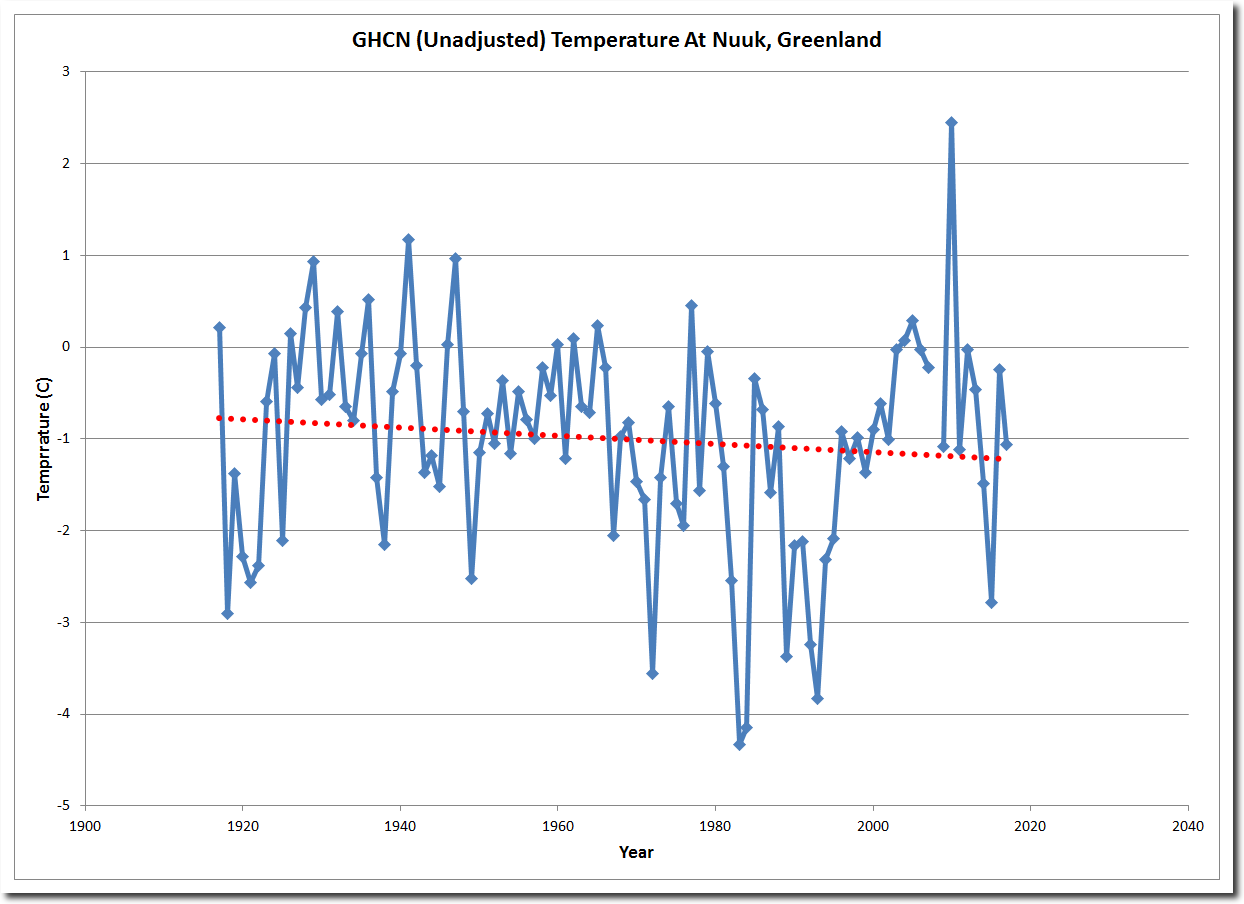
In fact, when one looks at unadjusted temperatures, the temperature in Greenland have been falling for more than 30 years. The same is so in Iceland. See for example:
AND:
https://data.giss.nasa.gov/cgi-bin/gistemp/stdata_show.cgi?id=431042500000&dt=1&ds=7
Look at the fall in temperatures (unadjusted) from 1930s to 1998, where folowing the Super El Nino of 1997/98 there has been some recovery (with 2010 being exceptionaly warm).
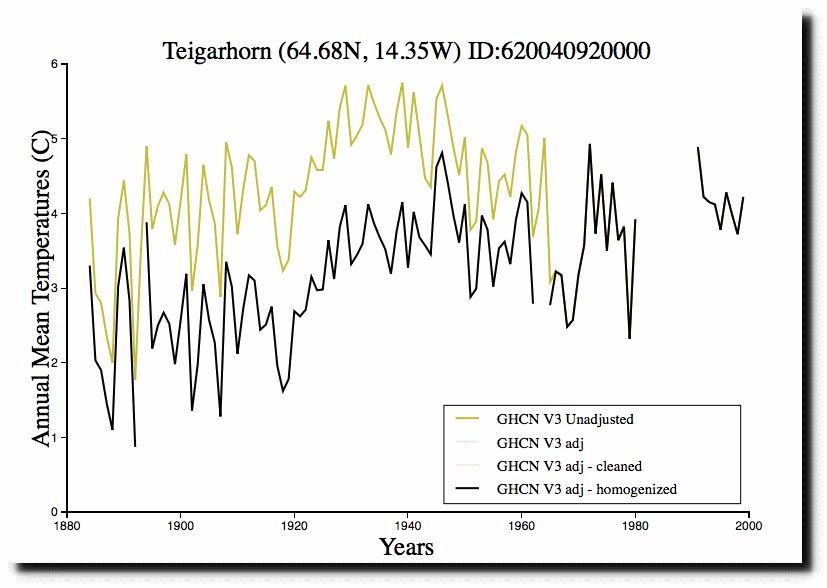
See unadjusted temperatures in Iceland that also show the late 1930s/early 1940s as the warmest period. For example: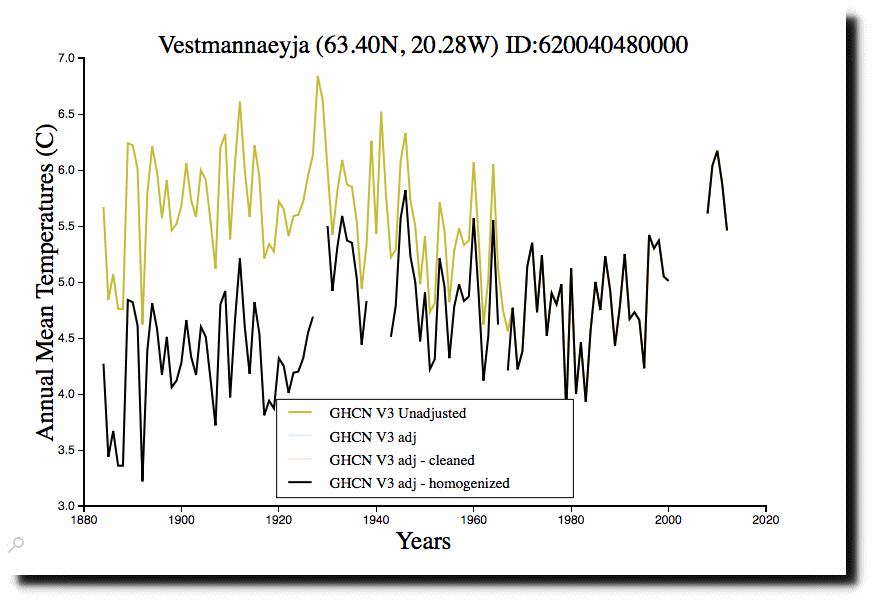
Yes, yes, where it said:
“the ice-free parts of Greenland show a slight drop in temperature between 2001 and 2015. With swings in temperature from year to year.
However, these results should not be interpreted as “proof” that the Earth is not warming,”
It should have read: IS “proof” that the Earth is not warming.
There’s a name for someone who sees something work in practise, but refuses to believe it because it shouldn’t work in theory.
It sure wasn’t “scientist” in the good old days…
BTW, I’ll have to remember “You need to have thirty years’ worth of data before you can “talk about climate” next hurricane season. Or tornado season. Or flood season. Or. Or . Or…
Agreed x1,000. Every time some idiot mouthpiece starts talking about how “hurricane {fill in the blank} was made worse by climate change, they need to be b!tch slapped with “show us 30 years of worsening hurricanes, or STFU.”
How dare Greenland not follow the script of the AGW scam.
I agree that 30 years is just a blip. Now will somebody please relay that information to the scaremongers who blame every 30 minute change in the weather on climate change.
It is not just Greenland, Iceland is the same. See for example the unadjusted temperatures:

And:
Just think of the savings available. Close down all those regional weather stations they can be 2,400km (1,500miles) apart. That means less than 10 sites and you have the entire USA covered. GISS shows it is easy to ‘accurately’ provide the the temperature in Orlando by using observations in Washington DC.
Strange that it is these estimated stations that seem to have all the warming, must be coincidence.
It is 1378 miles from Miami, FL to Chicago, IL by road.
It is 1387 miles from Orlando, Florida to Portland, Maine by road.
It is only 844 miles from Orlando to Washington D.C. by road.
So the climate is the same in Chicago as in Miami. ROFLMAO
Instead of guessing what the temperature is over 1200 km, why can’t they use the radiosonde balloon technique in reverse and drop temperature sensors from aircraft passing over these areas which could provide some checking as to whether their guesses are in agreement with actual temperatures. Or don’t they want their figures checked?
Would they get the results that they wanted by that method?
They won’t ever do that, because figures don’t lie – but liars figure.
The beauty of the GISS approach is that all their stations are on land and they extend them out over the Arctic Ocean.
Now anybody with even the slightest practical experience of the Arctic knows that the climate on land and at sea are completely different. In summer weather at sea is much colder and foggier than land, in winter it is moderately milder.
Not just the arctic, those who leave near large bodies of water know that climate onshore and climate offshore are two entirely different beasties.
And, of course, The Warming shows up on the faked maps most consistently in the Arctic where they have almost no real data.
I also suspect – but do not know – that most if not all of these Arctic weather stations are impacted by buidlings, etc.
Yes, funny how that works. The “overheated” parts of the Earth always seem to be the ones requiring that temperatures be “inferred” from data collected at UHI polluted sites hundreds of miles away.
40 years ago these results would have “proven” Global cooling.
Looks like they may have been right then, as the Sun diminishing output seems to be agreeing!
“Infilling attempts to correct for absent temperature data in sparse regions like the Arctic. But this latest study has demonstrated … recent temperature trends in Greenland vary significantly between seasons and regions and that data with resolutions down to single km2 are critical to map temperature changes …. “
No, this paper does even more derivation and infilling. They are telling you the temperature where there are no thermometers. From the abstract:
“Here we quantify trends in satellite-derived land surface temperatures and modelled air temperatures, validated against observations, across the entire ice-free Greenland. “
Just a taste of what they do:
“The trends are filtered to include values between the 5th and 95th percentiles only, with a statistical significance (p-value, Mann-Kendall test) lower than 0.05. Areas with statistically significant temperature trends are filtered with a moving 20 × 20 pixels window, in which only areas with more than 80 significant pixels within the window are accepted as having a temperature change (corresponding to 20% of the analyzed window area).”
“Recently, a method to use LST to assess ground temperatures in a larger North Atlantic region was presented, but scarcely validated for sub-regions such as Greenland13. Here we use a gap-filled version of MOD11A1 (following20), due to otherwise missing data in cloudy conditions that can cause a significant cold bias21.”
Satellites tell us how sea level changes where there are no tidal gauges. Do you believe satellite sea level measurements more than satellite surface temperature measurements?
“Do you believe satellite sea level measurements more than satellite surface temperature measurements?”
Yes. Sea level is measured by altimetry, basically geometry. Satellite surface measurements involves a lot of modelling and assumptions, especially about the nature of the surface. Plus clouds.
[Edited to correct formatting for clarity. -mod]
Yes. Sea level is measured by altimetry, basically geometry…..gravity, temperature, degradation, magnetic field, and rotation
“Edited…mod”
Thanks.
“Sea level is measured by altimetry, basically geometry…..gravity, temperature, degradation, magnetic field, and rotation”
Sea level is measured by altimetry. The other issues relate to its interpretation, not measurement.
so….even with all those caveats….more than temp measurements….you believe the sea level measurements more?
Yes. As I said, what you listed are not caveats on the measurement.
“Yes. As I said, what you listed are not caveats on the measurement.”
Of couse they are and you know better….
“Of couse they are and you know better”
Nope. From Wiki:
“Satellites such as Seasat and TOPEX/Poseidon use advanced dual-band radar altimeters to measure the height of the Earth’s surface (sea, ice, and terrestrial surfaces) from a spacecraft.”
It’s just counting wavelengths (and knowing where the satellite is). The rest is trying to figure what it means for the mass and volume of water. But that doesn’t affect the actual altimetry.
“Sea level is measured “….measured….you can’t figure out the measurement without knowing what it means
@Nick – yes, sea level is measured by altimetry – specifically, dual-band radars. Electromagnetic waves.
Temperature is measured by infrared and microwave emissions. Electromagnetic waves.
Both are “adjusted” by reference to known factors that make those measurements not the same as measurements taken directly on site.
Your argument that one measurement of electromagnetic waves is invalid, while the other is perfectly valid, is disingenuous at best. The base data is equally valid (I am assuming no fiddling with the instruments themselves, of which I have seen no evidence on either side of the debate, at least here and in Europe – Australia is a different matter).
Present reasoned arguments about the methods used to turn data into information – I know you are capable, you have shown yourself to be so in the past – and you will cease to be lumped in with Griff in my mind. Until then…
“Your argument that one measurement of electromagnetic waves…”
Altimetry is straightforward. You send down a wave, pick up the reflection, and figure out the elapsed time. The main issue then is whether the medium varies the speed of sound. You need some proper way of averaging to allow for unevenness of surface (eg waves). Radar is well established technology.
Temperature is not simply related to electromagnetic waves received. If you measure surface IR emission directly, you have to infer by identifying a peak in the spectrum, or some other parameter of the profile. But the surface is not at anything like uniform temperature locally. On land there are sandy parts, vegetated parts, wet parts etc. Moisture and vegetation vary in time. Also, of course, different emissivities, which you don’t actually know. It’s a very messy inverse problem.
WO,
“Your argument that one measurement of electromagnetic waves…”
Altimetry is straightforward. You send down a wave, pick up the reflection, and figure out the elapsed time. The main issue then is whether the medium varies the speed of sound. You need some proper way of averaging to allow for unevenness of surface (eg waves). Radar is well established technology.
Temperature is not simply related to electromagnetic waves received. If you measure surface IR emission directly, you have to infer by identifying a peak in the spectrum, or some other parameter of the profile. But the surface is not at anything like uniform temperature locally. On land there are sandy parts, vegetated parts, wet parts etc. Moisture and vegetation vary in time. Also, of course, different emissivities, which you don’t actually know. It’s a very messy inverse problem.
I don’t see how satellites really could measure sea depth to any accuracy which is then often modelled in to get the worserer sea level increases.
But really, I find these results so relieving. Despite some willingness to witness for GHE ie. global warming aka AGW known as climate change, climate distruption and climate cancer, the researchers did not find the trend they expected. Thus, more advanced statistical methods are needed to squeeze out the underlying trend we know based on an emsemble of models. This means more funding is needed and the work can continue.
The satellites give you data with altimeters…….not a measurement
….you don’t get a measurement until you apply all those other things
Nick, I don’t believe that the sea surface is flat.
stokes,
Once again, don’t you have anything better to do with your time? This site must be your career now, sad I call it…
Because, of course, it couldn’t be cooling.
Yes using weather data gathered at an airport to cover a much wider ares nothing like an airport is a ‘great idea ‘
or in others , we had to make it up because we did not have the data and by ‘lucky chance ‘ when we made it up it support out ideas .
You didn’t emphasize a key-portion of your quote…I wonder why…
“Here we quantify trends in satellite-derived land surface temperatures and modelled air temperatures, VALIDATED AGAINST OBSERVATIONS, across the entire ice-free Greenland. “
Nick doesn’t want us to think satellite temperature measurements are accurate at the surface. If he were to admit that, then he would have to admit that all the land surface temperature charts of NASA and NOAA are invalid and inaccurate.
I think Nick just disagrees. But it is true that measuring the polar regions is a huge challenge. Satellite or not.
“measuring the polar regions is a huge challenge” AND perfectly useless. I mean: who cares?
Data for Earth except Polar region would be just as fine, and even more, actually
Measuring Sea level has HUGE error Bars
https://www.youtube.com/watch?v=q65O3qA0-n4 (sea Level)
and Gravity variation effects, well your error bars are even larger
https://www.youtube.com/watch?v=V2V68rFyutg GRACE
It looks like there is going to be a lot of weather over Greenland over the next few years, but very little Climate.
Heh, +1.
On the other hand, if that “trend” were to become “warming” instead of “cooling,” it would magically transform from “weather” to “climate” faster than you can say “Rumpelstiltskin,” 30-year “standard” be damned.
Fifteen years of data indicate a slight cooling trend (with some annual variation) But it takes 30 years to denote an actual trend…
This is because it takes 15 years to realize their mantra isn’t being followed by nature and an additional 15 years to slowly adjust the data so the it appears that Nature is following suit
Also because 30 years is the length of a career, so this means no one will ever be held accountable.
Love the bright red Dash 7s on the tarmac.
At least we now two clear, scientific definitions for this whole subject: when it gets colder its weather and climate change when it gets hotter.
That’s confirmation bias in action. We know that the climate is warming, so all cooling has to be weather.
Ice melts largely because of water temperature. Air temperature is a bit player.
Surely these self declared experts on the arctic knew that already.
Any idiot knows that an instrument measures only its immediate environment. An instrument 10m away measures its own immediate environment. Therefore, everything else is in-filled and modelled.
Therefore we need only one thermometer to measure the average temperature of the globe
-Mosher
Learn something every day. “-Mosher” is the new /sarc tag, apparently.
I think that I shall need to abbreviate to “mosher,” though, on particularly sarcastic days. The pinkies seem to be the first to succumb to severe arthritis.
Cooling Arctic is Killing Caribou
https://co2islife.wordpress.com/2018/01/30/cooling-arctic-is-killing-caribou/
The polar bears are next – but they’ll blame the “reduction in bear populations” on human-induced warming anyway, or come up with some tail-chasing argument about how global warming caused Arctic cooling. Whatever the meme, guaranteed it’ll be OUR fault.
We should just pick one thermometer somewhere on the globe and use it to Infill the entire 4pi steradians.
It would save a hell of a lot of money and mean about as much scientifically as the crap that NOAA and GISS spews out from their Bias Machine.
No need for a thermometer, just use tea leaves.
Alarmists claim the Earth has fever due to 1 extra CO2 molecule per 10,000 molecules.
Moms everywhere just put their hand on their kid’s forehead to see if they have a fever. So use 1 point sampling for the entire body. Saves a doctors visit when the kid is fibbing. Similarly, the Alarmists do a lot of fibbing.
I drilled a hole in the local lake this morning. Sat there all day with nary a bite. But I’m sure the fish are biting! They are really struggling with the mantra of being honest versus being on the team.
Hope you plugged the hole up when you were done. Wouldn’t want all the water to leak out.
The old ‘cooling is weather but warming is climate’ trick, yet again.
If it’s been warming faster and it’s now cooling perhaps it is a leading indication of a global cooling trend.
NASA – What’s causing the poles to warm faster than the rest of Earth?
https://www.nasa.gov/topics/earth/features/warmingpoles.html
Apr 6, 2011 – Decades of NASA data show the Earth is warming. According to NASA’s Goddard Institute for Space Studies in Manhattan, the Earth has warmed about 1.44 degrees Fahrenheit during the last 40 years. But the poles are warming even faster; the Arctic has warmed by more than 3.5 degrees Fahrenheit …
That is a most deceptive way of stating the difference in warming as related to latitude. Why don’t they include the fact that the tropics refuse to warm? It’s all just spun to look scary.
The poles are Earth’s radiators. The tropics are the collectors. Heat transported through the oceans via ocean currents concentrates at the poles for release to the cold of space during polar winters before the ice forms. Less ice mean more heat is being vented, like the shutters set to open on a radiator. More sea ice slows heat loss when the Earth is cold. A self-regulating system with negative feedback. The climateers understand this, but they lie anyway for money and to not be cast out of the cult.
Plus, the Hadley cell circulation sends heat pole-ward in the troposphere.
So, if I understand this, the Arctic is venting heat whenever ice cover is scarce or compacted, as now.
Conversely, during periods of high extent and/or area, the planet is conserving heat and poised to warm.
That does seem to match the historical accounts, is there any published research on this?
More sea ice slows heat loss when the Earth is cold. A self-regulating system with negative feedback.
What about if the shutters are open during summer? Less ice means positive feedback?
Joel, SH ocean currents are markedly different from those in the NH (e.g. the circumpolar current), and the south pole is a continent as opposed to an ocean. Is the Arctic a bigger or smaller radiator than Antarctica in your view?
Zazove, that does not matter because the water releases large amounts of heat to the atmosphere only during the winter, when the air temp is well below freezing and the water is in the process of doing so. The water remains near freezing all summer as summer temperatures in the Arctic have been at or below normal despite winter “heat waves” of near 0F.
The polar ocean is not heated by the polar atmosphere, the polar air temps (and pressures) are the result of the global oceanic paradigm. See Joe Bastardi for more on that – Weatherbell.com
There is quite a bit of heat advected into Artic via the atmosphere as well as oceanic. Also, if the shutters are open in summer that reduces global albedo and more open water means more wave-action mixing up of warmer water from below. There are feedbacks in both directions and maybe they are net zero, but they are being overwhelmed by heat from elsewhere at the moment.
Btw because Antarctica is so much colder it radiates less.
So the case that Arctic warming is been over stated is looking stronger. ?
lf that is the case then it would help to explain why the NH snow extent has been tracking sidewards since the early 90’s. Also of more interest to me at least, it would explain why l have seen very little change in the trend of my 40 year recording of the first winters snow. Here in England in the early winter season its the Arctic where we get our cold air from rather then Russia. So by rights a warming Arctic should have caused a under laying delay in the timing of the first snow over the last 40 years. Which as l have posted before this has not been the case. A further note is that here in the UK the average means temps have been going sidewards since 2005.
Whether this is true or not it makes no practical difference.
The fact that Greenland has had a temperature drop lasting half a generation shows with certainty that climate change is not significant for policy making.
The weather overwhelms climate change over the time that infrastructure is replaced. Therefore adaptation to weather is always necessary.
Therefore adaptation is always necessary.
Therefore other approaches to climate change are redundant.
Game over for newsworthy climate change.
M Courtney
How about this: It is often said that some or other heat wave affecting a locale is caused by AGWarming. Well, if that can be held true, so can its opposite. The efforts to ‘do something’ like put up solar panels and offset warming, are working! It is just that the effect of these measures is regional and locale-specific in its influence!
All the reductions in coal burning in the USA are manifesting as lowered temperatures in the populated areas of Greenland. It is really quite simple. No one expects the cooling effect of renewable energy policies to appear evenly all over the world. Global warming is just like global cooling – it happens in patches.
There is a lot of mileage to be had with this interpretation. Anytime it is cooling, that is proof of the effectiveness of the policies offsetting GHG emissions. Anytime it is warming, that is the patch caused by GHG emissions making things worse.
And you thought there was no theory of everything!
+1 Courney
The time series is too short to say anything about climate trends, he writes in an email to our sister site, until it has been ‘adjusted’ to the right results at which time it will be more than long enough to ‘prove ‘ climate doom.
By the way the ’30 year ‘ claim has not actual validity , its a number pluck from thin air designed to deal with the issues of realty failing to support the models . Has in this case .
“…….Give me a specific location and a short time series and you could get almost any trend. Over a large area and over longer time I’m sure Greenland is warming…”
There’s the old problem again “…almost any trend…” is ok when it suits your argument and if not well you can always resort to that scientific method called “…I’m sure Greenland is warming..”. I’m convinced (not).
Oh, Greenland is a dreadful place
A land that’s never ever green
Where there’s ice and snow and the whale-fishes blow
And daylight’s seldom seen, brave boys
And daylight’s seldom seen
“Greenland Whale Fisheries” Trad.
Performed by P,P,&M verse at 2:54
Thanks Walter – a big P,P&M fan since forever – but somehow never caught this one! Love it! (Forget about the climate!)
Methinks they doth protest too much.
Nonsense, thirty years is only about half of the smallest ocean cycle detectable and either warms or cools naturally.
James Hansen first raised global warming concerns after just 8 years of warming.
What it shows is the fact that weather rules over a number of years confirms that any AGW only has minor effect and bigger local natural environmental changes are taking place.
Unfortunately, the increasingly adjusted estimated so called data is still getting warmer. The planet might not be warming over recent years with the exception of a recent strong El Nino (2016). Still debatable because there was very little difference between it and the strong El Nino back in 1998. (within error range)
Nothing disproves global warming because it’s not based on science. Global warming recently does not disprove Greenland’s recent temperature drop. Greenland’s recent temperature drop is likely a sign of future trend to come and with a less active sun, the AMO is expected to turn negative soon in future years. Greenland’s recent temperature drop does not disprove this could be a new trend despite any recent warming.
Why do so many people make empty assertions like, “Greenland’s recent temperature drop is likely a sign of future trend to come” as if they knew what they were talking about. They read a few blogs and papers and think they’re an expert, a scientist.
Global warming cannot be disproved because it’s not based on science, your’e right – it’s part of the physical world. I’d rather try to disprove the theory of gravity than disprove gravity itself.
Yet again I am struck dumb in amazement :
What is this ‘gravity itself’ that exists outside of the ‘theory of gravity’?
@ur momisugly Kristi…the question should be why did these scientists make this assertion “… But the scientists who produced these results urge people to believe that this cooling trend is a blip…”?
“…urge people to believe…” is that a new scientific methodology? I mean where is their proof that this was only a blip? How can they state with so much certainty as to request belief from others, when it appears as if the scientists never considered the opposite position that it may not be a blip?
“…why did these scientists make this assertion…”
Because you don’t get grant money if you don’t kowtow to the global warming religion.
goldminor – You are confusing an allegation of what scientists do with what they actually do. If you want to blame someone for urging people to believe something, blame the media and bloggers.
From a scientific standpoint the “hiatus” is interesting, but it doesn’t detract from the evidence for AGW – in that sense it is a blip. Natural variation, normal and expected.
It seems hard for people to grasp that even if humans have a dominant in increased global temps, that doesn’t mean that there will be no natural variation underlying it.
My gosh!
Kristi, is completely unaware of the miserable Per Decade warming trend predictions/projections from 1990 as published by the IPCC. It has never been close in ANY decade to their guesses.
You are babbling again in ignorance.
Kristi you are probably already aware that anyone who is rude here is not really interested in the substance of your comments…and should be duly ignored.
Passive-aggressive faux politeness is the worst kind of rudeness.
“From a scientific standpoint the “hiatus” is interesting, but it doesn’t detract from the evidence for AGW – in that sense it is a blip. Natural variation, normal and expected.”
But according to AGW theory, the atmosphere’s reaction to more CO2 is instantaneous and it overwhelms natural variation, which was not expected to assert itself more strongly than the CO2-warming effect.
“Why do so many people make empty assertions like, “Greenland’s recent temperature drop is likely a sign of future trend to come” as if they knew what they were talking about. They read a few blogs and papers and think they’re an expert, a scientist.”
The AMO is part of an ocean cycle that is expected to become negative soon. The AMOC plays a key role in this and effects especially the Arctic ocean and Greenland.
The AMOC partly effects the North Atlantic ocean and Greenland first before effecting the Arctic ocean. Signs of Greenland cooling are part of this expected process, but you seem to know better.
Why do people make empty assertions like “Global warming cannot be disproved because it’s not based on science, your’e right – it’s part of the physical world.”?
Pick your period, pick your trend – it doesn’t provide any evidence of causation if you’re trying to intimate that “climate change” (as in, “caused by human fossil fuel burning”) is factual, and there have been much larger swings in climate before there was any “human activity” to blame it on. In short, we’re not witnessing anything beyond the rate OR amount of historical, natural variability. So the burden of proof is on the “believers,” not on those who dispute the empty assertions of the “believers.”
“zazove January 30, 2018 at 10:41 pm Edit
Kristi you are probably already aware that anyone who is rude here is not really interested in the substance of your comments…and should be duly ignored.”
Ha ha,
have you been reading her comments, and her avoidance in defending them when asked questions over what she writes?
People like her eventually get the ridicule for being a terrible debater as her comments are lacking substance and coherence.
Here are samples of a confused mind:
“I’d rather try to disprove the theory of gravity than disprove gravity itself.”
Huh?
“But debating whether the world is warming and whether we have anything to do with it is a waste of time.”
Snicker…..
“One reason may be that this study potentially undermines confidence in the methodology of the NASA GISS temperature series, one of the world’s major global temperature resources.”
GISS was founded in 1970 by Robert Jastrow to support Space Exploration, not to play games with Earths temperature data. This a full 12 years AFTER this report mentioned in her link:
“The documents include a 1957 study, “Radiocarbon Evidence on the Dilution of Atmospheric and Oceanic Carbon by Carbon from Fossil Fuels,” published by scientists working for Humble Oil, a precursor of ExxonMobil.”
and 2 years after this report from her link:
“Inside Climate News reported on the documents today, which also included a 1968 report commissioned by the American Petroleum Institute (API).”
GISS is a terrible source of temperature data. The fault lays at the feet of James Hansen and his predecessor. Dr. Jastrow never intended GISS to work this way.
Shall I go on…..?
Roger Knights: “But according to AGW theory, the atmosphere’s reaction to more CO2 is instantaneous and it overwhelms natural variation, which was not expected to assert itself more strongly than the CO2-warming effect.”
I disagree. The theory of AGW asserts that human effects overlay the natural variation, not overwhelm it. There will still be ups and downs and outliers, but at warmer levels overall. The climate models take natural variation into account, though that doesn’t mean their predictions show the stage in a particular oscillation at a future date – they are not constant enough to do so. It’s always long-term trends the models are interested in, although they may analyze short-term ones in the process of testing.
Matt G: “The AMO is part of an ocean cycle that is expected to become negative soon. The AMOC plays a key role in this and effects especially the Arctic ocean and Greenland.
The AMOC partly effects the North Atlantic ocean and Greenland first before effecting the Arctic ocean. Signs of Greenland cooling are part of this expected process, but you seem to know better.”
You remind me that I should not make broad assumptions about the people here and their level of knowledge. It seems highly variable.
Still, I maintain it is an assumption that the cooling seen in the last 15 years is tied to the AMOC, which it would have to be if it were a sign of things to come. It could be an effect of the Greenland Blocking Index, for example. I don’t know. Some scientists suggest the AMOC will weaken as a result of climate change.
When it comes to climate science, I know more than average, but that’s diddlysquat compared to what there is to know… I see a great deal of oversimplification around here. Sometimes I suspect that denial is partly due to a gut feeling that the climate is far too complex to predict, which is understandable, but just because something seems incredible doesn’t mean it’s impossible.
My main argument is that climate science and scientists have been unfairly maligned, and they deserve a hearing..
GRAVITY – for those who don’t understand my comment, the theory of gravity is a scientific statement, and thus open to debate. Saying that gravity doesn’t exist is another matter. See the difference?
zazove – You remind me I need to monitor my rudeness factor, too! Thank you.
Not to worry, James Hansen will ‘correct’ the blip a few years from now.
He and Carl can do their own version of “Better Late Than Never” in Greenland.