Guest skewering by David Middleton
From Inside Climate News…
24-Hour Solar Energy: Molten Salt Makes It Possible, and Prices Are Falling Fast
Molten salt storage in concentrated solar power plants could meet the electricity-on-demand role of coal and gas, allowing more old, fossil fuel plants to retire.
JAN 16, 2018
Stay informed about the latest climate, energy and environmental justice news by email. Sign up for the ICN newsletter.
The first thing you see of the Crescent Dunes Solar Energy Facility, and you can be miles away, is a light so bright you can’t look directly at it. This sits atop a 640-foot cement tower, rising from the flat, empty Nevada desert around the halfway point on the highway from Reno to Las Vegas. The tower’s surrounded by a nearly two-mile-wide field of mirrors that send shimmering beams of light into the sky.
[…]
What people are actually seeing is a 110-megawatt concentrated solar power (CSP) plant, built and operated by SolarReserve of Santa Monica, California. It’s not from outer space, but there’s not yet anything quite like it of this size anywhere else on the planet.
SolarReserve is trying to prove that the technology that drives Crescent Dunes can make solar power an affordable, carbon-free, day-and-night energy source, dispatched on the electric grid like any fossil fuel plant. Here, concentrated sunlight heats molten salt to 1,050 degrees Fahrenheit in that shimmering tower; then the salt gets stored in a giant insulated tank and can be tapped to make steam to run a turbine.
[…]
If this plant and several similar facilities under construction, or soon to be, prove reliable, the technology is poised to take off. Solar photovoltaic (PV) panels can displace fossil fuels during the day, and wind turbines can do the same as long as it’s windy. But molten salt towers may be able to meet the challenge of electricity on demand, and push more older, dirtier fossil-fuel plants into retirement.
[…]

If molten salt was making 24-hour solar energy possible… It would be making it happen at least once-in-a-while. If the Crescent Dunes Solar Energy Facility is supposed to be an example of 24-hour molten salt solar power, it’s not a very good one.

The best month in Crescent Dunes short history was September 2016, when it averaged 9.2 hours of electricity per day.
| Source: U.S. Energy Information Administration | |||
| Series ID: ELEC.PLANT.GEN.57275-SUN-ALL.M megawatthours | |||
| Month | MWh | Capacity Factor | Hrs/d of Electricity |
| Oct-15 | 1,703 | 2% | 0.5 |
| Nov-15 | 1,831 | 2% | 0.6 |
| Dec-15 | – | 0% | 0.0 |
| Jan-16 | 1,508 | 2% | 0.4 |
| Feb-16 | 9,121 | 12% | 2.9 |
| Mar-16 | 7,099 | 9% | 2.1 |
| Apr-16 | 2,158 | 3% | 0.7 |
| May-16 | 11,485 | 14% | 3.4 |
| Jun-16 | 6,216 | 8% | 1.9 |
| Jul-16 | 25,560 | 31% | 7.5 |
| Aug-16 | 28,267 | 35% | 8.3 |
| Sep-16 | 30,514 | 39% | 9.2 |
| Oct-16 | 5,410 | 7% | 1.6 |
| Nov-16 | – | 0% | 0.0 |
| Dec-16 | – | 0% | 0.0 |
| Jan-17 | – | 0% | 0.0 |
| Feb-17 | – | 0% | 0.0 |
| Mar-17 | – | 0% | 0.0 |
| Apr-17 | – | 0% | 0.0 |
| May-17 | – | 0% | 0.0 |
| Jun-17 | – | 0% | 0.0 |
| Jul-17 | 9,420 | 12% | 2.8 |
| Aug-17 | 9,192 | 11% | 2.7 |
| Sep-17 | 13,666 | 17% | 4.1 |
| Oct-17 | 9,263 | 11% | 2.7 |
Dandy Don Meredith had “canard” for this as well…

From October 2015 through October 2017, Crescent Dunes generated 172,413 MWh of electricity. $737,000,000 divided by 172,413 MWh equals $4,274 per MWh… $4.27/kWh.
“Crescent Dunes is expected to generate 482,000 megawatt-hours of clean energy per year“… 100% output of 110 MW is 966,240 MWh/yr. They only expected a 50% capacity factor with the fracking molten salt storage.
Inside Climate News needs to edit their headline…
What your article fails to mention is that the site found out that once the “molten” salt starts to cool when the sun goes down, it rapidly crystallizes and freezes the entire circulation system. When the Sun comes up again, only the Tower remelts. They had no way to unfreeze the rest of the system. Thus a Gas Turbine Power unit was installed at the site to keep the salt molten enough to allow circulation at night. The better solution to Las Vegas Peak Power demand is NOT a Solar Furnace, but a large Scale Gas Turbine Generating Plant. So, once again, “Green, Renewable” energy depends on Fossil Fules to allow it to actually function! What a Joke!
They could have used big searchlights to keep the array warm.
Yeah, big search lights run on electricity produced by coal-fired power plants.
No, it just means they need to build another CSP plant to power the existing one.
They should install a second Sun. That would solve a lot of problems for the solar power industry.
And then Griff could write up the glowing (no pun intended) report on how successful it will be.
They can fix that easily by installing heaters…powered by electricity or gas of course….
powered by electricity or gas of course….
Powered by devoted environmentalists pedaling bicycle generators overnight for the good of mankind.
Why didn’t they use the PV to produce hydrogen, bind the hydrogen to a light metal or a chemical bond for daytime storage, and then use the stored hydrogen with a fuel cell for nighttime generation. The fuel cell exhaust could then be used to reclaim the surrounding desert?
Figuring out what to do with all the fuel cell heat could be another opportunity?
Just move parliamentary/government sittings to below the tower.
Plenty hot air. !!
Reminds me of Spain putting lights on the solar panels at night…………
What are you talking about!? We’ve created the very FIRST perpetual motion machine!? Woo Hoo!! Nobel Prizes for EVERYONE involved … handed out by former Beauty Queen, er Nobel Recipient … Barrack Hussein Obama !!
This is the first time I’ve heard of this, and I’m not finding any stories on the problems with the molten salt crystallizing and freezing the the system. What I have found suggests that a weld on one of the storage tanks was bad, thus resulting in a shutdown. Perhaps you could post a link or two, and include one referencing the Gas Turbine Power unit.
Doest it regularly take six months to re-weld a faulty weld in Nevada?
Is that documented somewhere? I just saw this on a molten salt storage website – “Heat loss is only 1⁰F per day”.
Guess that is a figure for the bulk storage tank, not the pipes. Sounds like some abysmal engineering going on here. Really, no one could anticipate the salts would cool and solidify?
If you were that stupid building a bridge you’d go to jail.
This was also my understanding – that natural gas was used to keep the system operational and the salt molten. Why are they not reporting that important input? Sorry, that’s a rhetorical question. If complete honesty was a requirement in “renewable” electricity generators there would be precious little that qualified.
But does this process generate plant-fertilizing atmospheric CO2?
If not, then it doesn’t add to the biosphere and help world-wide foodstuff production.
And so it shouldn’t be considered a step forward but a step backwards.
Millions of people have avoided starvation from a greening of the Earth made possible by fossil fuel combustion.
Let’s not be cowed into reversing this modern day miracle by Global Warming scare tactics.
Well the found to be necessary Gas Turbine Power Unit burns Natural Gas and so provides a CO2 Footprint to this “Green” Energy Facility!
It kills a bunch of birds when in operation. The birds will release CO2 as they rot, so there is CO2 release in the overall process
Spetzer86, you are right about killing birds. I watched the array and tower setup by Barstow, California and the glowing tower seemed to attract birds, and when they got close they started smoking and spiraled down tot he earth. Looked sort of like the movie versions of aerial dogfights in the Battle of Britain. The dead/dying birds will attract scavengers, like Democrats, oops, I mean vultures, and they will meet the same fate. Sort of a Ponzi-scheme of bird destruction.
Mirror arrays look like bodies of water to birds of prey. They expect to feed there and swoop in to look for game. By the time they figure it out it’s too late
They are called “streamers”,.. the birds with feathers aflame that is,…
I believe, also, that the light attracs insects, and then the birds follow the food chain. Road runners have been cut off from their normal trails by the huge amount of fencing, and make easy prey for coyotes. Among the other stats..
BTW, a Gas Turbine Generation Plant could have been built in 1/4 the time it took to build Crescent Hills and would have cost less than half as much! Additionally it would not only provide the 85MW Las Vegas was looking for for daytime peak demand, but it could also provide fast Dispatch Power to replace other sources when necessary, unlike the unreliable Solar Furnace! Oh, and another thing they found out after the plant was built – There is approximately a 30% cloud cover averaged over a weather year which further reduced the capability of the solar furnace installation. Seems they were so “lucky” to find a site just outside of Tonopah that they forgot to determine how much daylight time was available without any cloud cover. As has been mentioned here before, FORGET Label Generation Potential, look at ACTUAL Power Availability! So called “Renewables” have LOUSY available power!
Natural gas combined cycle is probably the only type of power plant that has a positive NPV.
Hydro power is pretty good. Niagara Falls, for example.
I just bet if you look a little deeper, where the plant was built provided a windfall (no pun intended) to one or more “well connected investors”. I don’t know this for a fact, but it has happened before.
The “research”, the connections for selling land, permits, the union labor to build id, run it, run the concessions and long-term operator contracts? It’s Nevada + democratic Senate head + democratic bureaucrats + democrat budgets from the toll booth operator in DC outside Dulles airport to the DOE to the elevator operator’s unions and bulldozer rental companies to the hotels and labor sites in Las Vegas.
Who needs strict economic analysis?
Birds get incinerated right in mid-flight. “Streamers”, they call them.
My favorite incident was when some mirrors misaligned, and set the tower on fire.
Great fun.
It’s not a bug, it’s a feature!
So it provides cooked lunch for the workers who are busy dusting the mirrors. Nothing wrong with that.
Please, please, please. Do not say “They taste like chicken”.
Would “they taste like bird jerky” be OK?
Haha! No, they taste like… crow?
Cleaning the mirrors … ugggh … sounds like a job for all those “undocumented” folks who will “do the jobs that limousine liberals just won’t do”
you ever smelled burnt feathers?
What do these Alarmists have against the poor birds? They think nothing of slaughtering them in their millions worldwide to produce a ridiculously small amount of electricity. We should not build more bird killers, we should be tearing them down.
It is known from ancient times that there has to be a sacrifice for our sins. So sombody has to die. But we are saving the polar bears. So bravely fly into death, little birds. Because you are dying for a good reason. You sacrifice will never be forgotten, ahem mentioned.
For every bird that get singed enough to die right there – I guess that there could be dozens if not hundreds singed only a little bit or slightly blinded. The latter could take weeks or months to die a hundred miles from the place and will never be counted.
Might be why Trump wants solar power on the top of his wall. He fancies a nice Mexican barbeque.
(P.S. A joke. If it offends you … grow up!)
One more thing that was “discovered” after the plant went operational — Instead of chopping up birds like Windmills do, the birds drawn to the bright light are incinerated once they enter the range of the mirror array. So whereas some birds might escape the whirling blades of the wind generators, the entire flock attracted to the bright light will be roasted. Nothing better than 100% “reliability” right? And Pilots are really upset at this impossible to look at Solar Beam coupled with the massive mirror array reflecting the sun’s light over an enormous amount of the sky and from almost any direction. So, in addition to unreliable power generation, Zero Dispatch capability, the area now has a Navigation Hazard covering a much wider area than the plant site for aircraft.
” the birds drawn to the bright light ”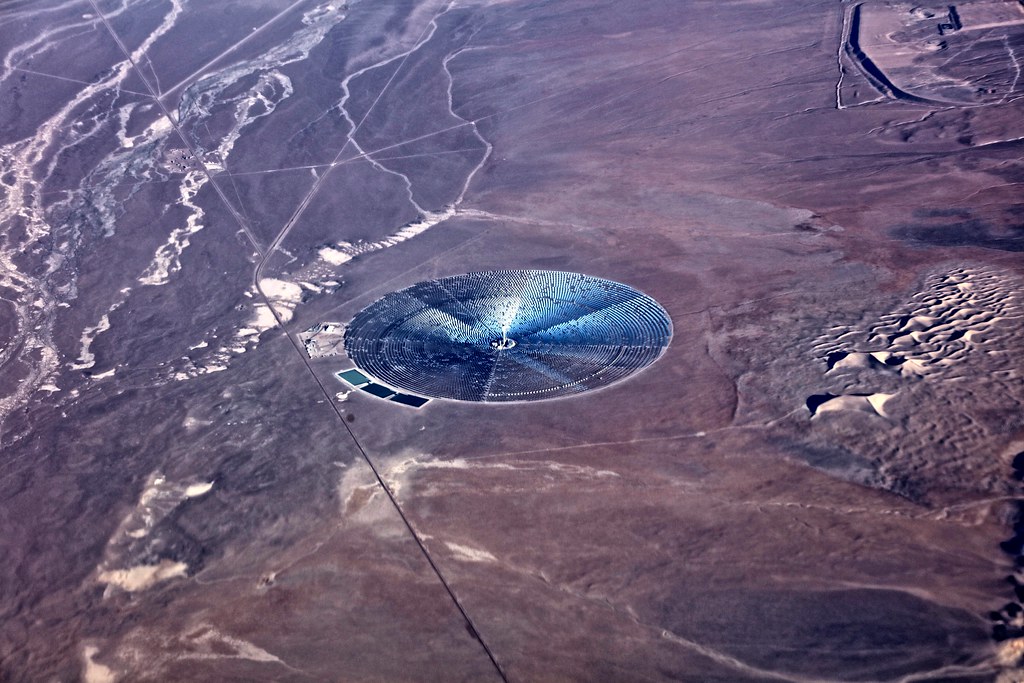
I think its more than just brightness, it’s how the thing looks like water from a distance. In a bird brain, a large area of reflected sky indicates a body of water –
Climate contortionists will likely say that the birds have to “adapt”.
kentucky fried chicken…
Ah, so birds can adapt to this, but not to a postulated very gradual increase of temperature over say, 100 years?
(Yes, I know the above was tongue in cheek….)
Bushkid
+100!
This stuff is getting well beyond farce. It is great to think of great ideas and innovations for solving problems.
But green-lighting the poor ideas is not progress; Deep-Sixing them, and kicking the idea around some more, is the proper thing to do.
It is fine to have the occasional breathless science-news story about super-long battery life or whatever, when some grad student half-way manages to produce some innovation. That is part of our overall inventiveness and creativity. But we always know that this is just the beginning of a long line of innovation that may or may not lead to the long-life battery. We should not throw out our cell phone batteries that day, but we should wait to see if it hits the market at a competitive price.
Along with all of the clever criticism of these projects, people need to examine why such projects might move ahead, despite obvious likelihood of drastically sub-optimal performance.
An explanation for doomed-from-the-start projects is: someone is making money.
Here is the money-making process:
Government spends our money, not “their own” money;
we the taxpayers are at a great arms-length from such projects –
-we have no idea they are being cooked up,
-by time they hit the news it is far too late,
-we assume the experts know what they are talking about.
The firms that serve to profit commit to being financial supporters of the politicians.
This sets up a set-up:
A small party of co-collaborators work together to develop a ruse to use the apparatus of government to get a huge stream of this tax money flowing their way. The apparatus of government is such that it is most likely that NO ONE will ever get in trouble, and never have to pay back any money. [As noted above: if it were reasonably commercially viable, investors would be eager to take the risk and fund it.]
We the taxpayers need a way to break this cycle.
For these “innovative” public projects, the proposal should regularly call for – not only an “ecological impact statement,” but an assessment of the existing government entities required to approve the project, what individuals are involved to give approvals, an explanation of the ENTIRE chain of approval, and, in private-investigator style, a presentation of any ways that the individuals on the political side might profit from the money side. Ex: Solyndra, in retrospective analysis, would have shown political-contributor connections.
Require for that analysis to be publically posted, and criticized. If the story is not entirely told, there would be enough clues for the various Erin Brokovichs out there in the world to dig deeper.
Here is what we need to think:
Who is making money?
What political forces must align to approve such a project?
The whole Solyndra project evokes the play/movie “The Producers”. The connected Friends-of-Obama that got the multi-million dollar grants to construct Solyndra made a lot more money by going bankrupt than they would if the project succeeded. If successful, the owners would have had to eventually invest their own money, pay taxes, be audited, actually run a business, deliver a product at a reasonable price, etc. When you are bankrupt, nobody cares about the accounting, the money is just—-gone. This was the objective of the raid on the Treasury that Obama and the press characterized as “shovel-ready projects”.
Shovel ready! Ha ha ha! That’s great. Shoveling the money into the sewer, the blender, some back pockets. Great investment programs all need a shovel. Musk has several.
Do folks have any notion how much money Harry Reid off this scam? And previous scams (think “Indian vote”, gaming licenses, etc.) Like may Democrats in congress, Harry should be in jail. They might yet get Menendez.
… Reid made off …
Hopefully the data from the Crescent Dunes and Ivanpah concentrated solar power projects will be used to kill this concept. Neither one is providing the power the promoters claimed. Both have proved that bright lights attract insects, insects attract birds, birds attract raptors and they all get incinerated in the bright lights. Moreover my understanding is that even in the desert it does not take much of a cloud to disrupt the power – even contrails can be a problem. Then again we still have biofuels and Great Britain is importing wood in the name of the CAGW crusade so logic may not prevail.
Exactly! Ivanpah was the “prototype” which was Scaled Up to provide the Engineering basis for Tonopah. Unfortunately, they leaped to Molten Salt in the expectation of providing enough heat to boil water for the steam generator to produce power even after the sun went down. BUT, nobody tested the concept in a smaller scale first. Like most minerals when melted, once the heat source is removed and a seed of crystallization forms, then entire mass RAPIDLY crystallizes! They actually destroyed Positive Displacement pumps when the crystallization happened.
PD pumps do not do well pumping chunks. 🙂
Even if they had limited the molten salt to the role of a thermal mass for overnight storage, they would find that as the heat exchange system shift from store, to retrieve, the salts (not matter which one you pick) crystallize on the exchange pipes become a nearly perfect *insulator* slowing retrieval of the vast majority of the stored energy due to the low conductivity of the crystalline state of the salts.
(this from a spacecraft design project, the heat of fusion, and the specific heat are amazing for these salts, but the engineer… utterly impractical unless they are keep above the freezing point at all times)
You know, even the 482,000 MWh (50% capacity factor) is just plain wrong. If you do the math (and I’ve done so dozens of times), integrating insolation over a “big round spot on the desert floor” yields only 31.8% of the potential noon insolation day. Tops.
So, if it is a 110 MW plant then
110 MW • .318 = 35.0 MWh/h average
35 × 24 = 840 MWh/d, average
840 × 365 = 306,700 MWh/year … average at 100% clear-sky days
that would be the absolute max. Not 482,000 MWh. When your source says “expected production”, either they’re smoking goat chips, or they’re ignorant of trigonometry. Which most advocates are. Trig is “hard”, right?
IF ‘they’ were being somewhat realistic, giving 80% as the number of equivalent clear-sky ‘perfect conditions’ days per year, then their plant ought to, in practice, yield about 245,000 MWh/a or 672 MWh/d. And that’s not bad. Not bad at all.
Thing is… they got to hit 80% equivalent perfect-day insolation.
The plant needs to be OPEN and not undergoing repair 365 day/y
The mirrors all need to be almost perfectly clean.
GoatGuy
The expected 482,000 MWh/yr included the molten salt storage.
Still doesn’t work. You cannot get more megawatt hours OUT than was put IN. Now, if the plant has a backup fossil-fuel fired salt heater, then of course they can get more OUT than the sunlight-provided energy going in.
My calculations were just taking “110 MW” plant “nameplate” factor, and multiplying by the amount of available insolation available over the course of 365 days, 24 hours a day, seasonal daily insolation pattern.
GoatGuy
They weren’t expecting to get more MWh out than was put it. They were expecting something in the 30-40% range from the CSP and the rest to come from steam turbines driven by heat stored in the salt…
https://www.energy.gov/lpo/crescent-dunes
Dave,
Assuming 12 hours of sunlight and 12 hours of darkness. This kind of plant would require 50% of the heat generated to go to the turbines for electricity during the day and 50% of the heat to go to storage in salt. This ignores any inefficiencies in either process. My guess is that for a 100 Megawatt plant, you would be lucky to have a capacity of 25% over 24 hours and that is assuming 100% sunlight for 12 hours.
I’m not saying their 50% assumption was a good assumption. I’m just explaining how they probably got there.
The plant’s performance pretty well says their assumptions were ridiculous.
However, the point is that the dufus writing for Inside Climate News said that Crescent Dunes established the possibility of 24-hr/d solar power, when the plant’s assumed maximum output was 12-hr/d and it has averaged 3.5-hr/d, when it’s been running.
@David Middleton
STILL doesn’t work. The maximum one can get is 1/π (one over pi). And that’s a maximum possible, trigonometrically. 1/π = 0.31831…
That means, over the course of a completely averaged day (whole year), 31.8% is the maximum duty cycle possible for any “perfectly oriented” solar system, firmly emplanted on the desert floor. Necessarily rotating, vectoring mirrors cannot exceed this, either. Moreover, if you take the yearly seasonal angle-of-Sun calculations into effect, the number 31.83% is lowered in turn. But not lowered necessarily: one can north-south space the (reflectors, PV cells, etc.) so as to NOT shadow each other on the least-favorable day of the year, too. This counteracts the geometric part of seasonal specific insolation. The part that cannot be cured by spacing is the atmospheric extinction column effect.
For example: sunlight at high noon carries far higher heating value per m² than sunlight penetrating the much greater atmospheric column an hour before sunrise or sunset. Remembering that 1363 W/m² is the sunlight power hitting the top of the atmosphere, and “only 1,000 W” nominally gets thru at high noon, clearly the atmosphere absorbs/reflects/diffuses the other 363 W/m², at its “thinnest” (overhead) position.
Indeed, if one uses αsin(θ) … the nominal transmission (0.7337) times sin(θ) angle of the sun relative to the hour-of-day, that’s a pretty good proxy for air-column absorption overall. Matches instrumental on-the-ground metrology to within 5% or so. So the net equation is
E = ∫P(t)dt;
P(t) = αsin(θ)sin(θ)
P(t) ≈ ∫1000 sin(θ)² dt
P(t) ≈ 0.25 × 24 × 1000
P(t) ≠ 6 kWh/kW of plate.
This is very close to reality for most PV operations that work in the desert, averaged out over all the “good days” they are getting unimpeded sunlight. If 80% “good” and 10% “hazy” and 10% “fully cloudy” are a desert’s parameters (some are better, most aren’t) then you get
80%(100%) + 10%(50%) + 10%(20%) = 87% insolation for PV.
80%(100%) + 10%(25%) + 10%(0%) = 82.5% insolation for CSP systems
CSP depends on specular sunlight. it doesn’t work at all with diffuse sun.
GoatGuy
I must say Goat Guy is right.
This is an ongoing problem with solar power project a vast overestimation of the amount of power they will actually produce. It is a curious phenomena. At times it appears the engineers are simply ignorant about how the sun and sky actually works.
Problem is insolation values are highly variable – all sorts of things adversely impact it. The values are idealized – they are what you should be reviving at that latitude, at that season. But a cloud, contrail, anything at all really, reduces the actual insolation from that idealized number. And there is always something, every day, even in the desert, that slightly reduces insolation. How many times do you look at the sky, even in the desert, and find it perfectly clear? And each of these small reductions adds up to a very big loss in efficiency.
And that, more than anything else, is the consistent problem with solar power – vastly overestimating efficiency, and underestimating losses.
I’m not convinced a CSP can’t work, just that it is unlikely to work very well.
@ur momisugly GoatGuy
That’s exactly my thought as soon as I read the 50% stuff.
Let’s be generous, maybe the nameplate 110MW was NOT the peak power (sun at mid-day, shining with no cloud) as it is always calculated by the PV peddlers. Maybe.
So the “estimated” energy output may end up be 50%, maybe.
On the other hand, the money lost to finance this 110MW scam is a certitude.
Yes, that could be (not defining “nameplate megawatts” the same way as the entire engineering industry uses the term). But that’s silly, too. I just think they missed on their trigonometric assumptions. It happens. Its why we have seasoned engineers in charge of checking marketers claims. Someone has to actually do the math with more depth than the calculator on one’s smart phone. LOL GoatGuy
The expected 50% capacity factor included heat stored in the salt to run a conventional steam turbine…
http://www.solarreserve.com/en/technology/molten-salt-energy-storage
I’ll wager they did not miss on their trigonometric assumptions. They were exactly right on their gullibility of politicians assumptions.
@Walter Sobchak
LOL – I wish I could give you a +1
Goat,
contrived extra comes from gas … not sun.
Plus the incident W/m^2 power flux fluctuates with the seasons because of the tilted axis.
yes indeed, tho that relationship is highly dependent on latitude, too. It almost doesn’t matter at the equatorial tropics. Above the arctic circle, its extreme. Of course.
However, as I noted above, for both PV and CSP, the latitude factor can be counteracted with north-south panel/reflector spacing. Enough so that panels/reflectors are not shadowing each other on the worst day of the year. Easy to compute, actually. Spacing = height/cos(latitude + 23.5°). The Earth’s tilt is 23.5°. Take as an example “San Francisco” at 37.8°. height/(cos(37.8 + 23.5)) = 2.08 × height.
For angled-toward-sun PV non-moving panels, Height = N-S width • (latitude + ½ 23.5). But let’s say it is 2 meters of height. 2.08 × 2 = 4.16 meters panel-to-panel.
Then by definition one’s going to have fully lit panels even in the dead of winter, should there be sunlight to illuminate them. The shadow from each southern neighbor won’t impinge on “my” panel. At any time of the day, either. Obviously, spacing needs to be larger the more away-from-equator you are. At the equator exactly, spacing is height/(cos(23.5)) = 1.09 × height. You can almost place the panels ‘edge-to-edge’, at a tilt of 0°.
GoatGuy
‘smoking goat chips’ Good one, GoatGuy. LMAO
Excellent. In that case it does not need subsidies any more, does it? Let market forces work.
However, environmental damages (like vaporized birds & blinded pilots) are expected to be be payed for.
Seriously… there are #not# many birds to incinerate in the desert. Damned few, actually. It is not a problem.
they surely are few, but all the more valuable. If you care about environment — which is supposed to be the whole point, isn’t it?
Perhaps, but the ones present are exceedingly rare, and in need of protection! /sarc
http://www.basinandrangewatch.org/images/Crescent-Dunes-gulls.jpg
There weren’t many to start off with.
But they were attracted by the lights, and stayed to feed on the insects that were also attracted by the lights.
So – not many birds in a real desert, but plenty of birds around a solar tower in teh desert…
Kidding?
California solar power plants ignite birds mid-flight
[youtube https://www.youtube.com/watch?v=emBY6phmn9E&w=560&h=315%5D
“Damned few, actually. It is not a problem.”
Counting HOW exactly? If a bird’s vision is only slightly impaired by extreme light as it flies through or if a bird’s flight feathers are only slightly singed, it could easily make the difference between successful hunting and starvation … weeks later … hundreds of miles away.
Who is counting them birds?
@paqyfelyc
@Marnof
@dodgy geezer
@Berényi Péter
No, I’m not kidding: modifying a landscape to “make power” is always disruptive. Put in a coal plant, and you’ve at the very least have piles of coal covering what once might have been wetlands, or pastureland. You’ve got piles, and piles, and settling ponds full of fly-ash and other waste product. Bird lands in that, and they’re dead. Period. No one to sing songs for them. Millions die every year, unheralded.
Perhaps a natural gas plant is nearly byproduct free – only a CO₂ emitting tower. Since CH₄ methane is essentially sulfur-free, CO₂ and H₂O are really the only byproducts. And a whole lot of either hot water, or steam from turbine-condensing towers. Usually not very lethal.
And perhaps the nuclear power plants are equally innocuous, nominally. Oh, when they go all Three Mile Island or Chernobyl or Fukushima, sure… then they’re glowing radiation-emitting monsters for centuries. But the rest of the time, they emit nothing. Except like all thermal power plants, either steam or heated water.
I’d put CSP (concentrated solar power) on the level of a coal-fired power plant, environmentally. I’m not completely dismissing peoples’ fried-fowl concerns, but I just don’t see “the problem” as much different from those fly-ash and scrubbing-tower settling pond environmental issues, relative to birds. And maybe CSP is less-so: its only lethality is during operation. When the sun goes down, there are no settling ponds. Coal is probably worse. Likely.
GoatGuy
@GoatGuy
your point was clear beforehand without this long comment. I don’t disagree with it.
If the goal were to produce energy, of course some damage to environment, including death of wildlife, would make sense.
BUT: since the goal is supposedly to save the planet, the wildlife etc. then it make no sense to fry / chop birds with solar furnace / windmill. That was my point.
Ever heard the term “Pacific Flyway”?
@GoatGuy January 24, 2018 at 10:22 am
I am not telling concentrated solar is a no-go, just no subsidies for it whatsoever and have it pay for all environmental damage, that’s all. If it is still economical, fine.
Cost and land use footprint of grid extension made necessary by remote siting should be included.
Did they include running the heaters at night to keep the molten salt from re-freezing?
While its “a problem”, the solution is simple, using gravity, they empty the lines. This would be for a longer-term event than overnight. Overnight, reflective shutters are erected at the focal point, and the pumps are left on, keeping the molten salt reflowing. It doesn’t freeze, and the reflective shutters keep the tower from leaking away more than 1% or so of the thermal energy retained by the salt overnight.
GoatGuy
How much energy can they extract from the salt overnight to generate electricity before the salt freezes?
https://youtu.be/EfUZofkc0Mw
@Paul Penrose
“How much energy can they extract from salt overnight to generate electricity before the salt freezes?”
Excellent question. But it has a relatively easy engineering answer. I’ll quote a good source:
A commonly used thermal salt is the eutectic mixture of 60% sodium nitrate and 40% potassium nitrate, which can be used as liquid between 260–550 °C. It has a heat of fusion of 161 J/g, and a heat capacity of 1.53 J/(g K). … Regular table salt has a melting point of 800 °C and a heat of fusion of 0.52 kJ/g.
So, the answer is related to…
• How hot is the stored salt?
• How much of it is there?
• What’s the minimum temperature margin spec?
For example: in a NON-freezing salt spec, the eutectic NaNO₃ + KNO₃ may well be heated to 400°C (above which it starts to decompose), and the minimum working temperature spec is 275°, and we have 1,000 metric tons (1,000,000 kg) of the stuff then…
E = 1530 J/(kg K) × 1,000,000 kg • ΔT
ΔT = (400 – 275)
ΔT = 125°C
E = 1,530,000,000 × 125
E = 191 billion joules (of heat) and at a Carnot efficiency of about 32%, you get
Eout = 191×10⁹ × 0.32
Eout = 61×10⁹ J. Since 3.6×10⁶ J is 1 kWh, that becomes
Eout = 17,000 kWh.
Eout = 17 MWh.
This is for a NON-FREEZING molten salt storage-and-use cycle. Clearly, if a 110 MW (plate) plant wants to ensure almost complete coverage for both the usual nightly, seasonally and weather-related sunlight extinctions, then it perhaps needs 10 or so full-days of storage capacky. Given a plate output of 110 MW, and a 0.25 kWh/kW-h plate output factor, for 6 kWh/KW plate, per day average, then it needs 10 times that or 60 kWh/kW of plate. 110 MW × 60 = 6,600 MWh of stored molten salt. At the above figures, 1,000 T gave 17 MWh of storage capacity.
Therefore
Needed = 6,600 × (1000 t ÷ 17 MWh/t)
Needed = 388,000 tons of molten salt.
If on the other hand, a safe way to have a freezing-salt storage system can be engineered (very complicated), then things could be somewhat less salt-mass dependent.
E = 1530 J/(kg K) × 125° + 75%( 161,000 J/kg heat-of-fusion) + 1250 J/(kg K) × 100° for solid
E = 437,000 J/kg thermal
E = 437,000 × 32% conversion to electricity ÷ 3,600,000 J/kWh
E = 0.0388 kWh/kg
We decided we need 6,600 MWh or 6,600,000 kWh …
M = 6,600,000 ÷ 0.0388
M = 170,000 metric tons
Which is a bit less than half the molten salt local storage requirement. It does however require ridiculously complicated freezing-salt handling and thermal conduction strategies. Not simple. In my OLD engineer’s mind, I’d just spec more molten salt, and truely keep it as a liquid at all times, and keep the whole system simple.
But that’s because I’m a practical engineer, not a group of otherwise barely-employable grad students, professors, industry fat cats and endless graft-takers trying to cop-a-buck out of the Great Greenwashing Project.
LOL
GoatGuy
The whole point of molten salt storage is to generate power 24/7. That means no freezing.
You are all missing the fact that you can’t get energy out of the salt if you don’t put it in there first. Assuming 12 hours of light and 12 hours of darkness means that if you want 110 Mw out, you need a 220 Mw plant during the day so that half goes to electricity and half goes to heating the salt. It’s the same problem with all storage of energy from renewables, a huge amount of the generation must go to charging your energy storage device regardless of what it is, salt, batteries, pumped water, etc.
Well it is worse than that. You need the power you are going to use now. The power you are going to use later. And the power to feed the entropy beast, that eats up a lot of the power you put into storage and pull back out.
I always ask – why can’t you simply have molten salt storage/batteries/pumped storage with a natural gas plant? I mean, you could run a much smaller plant, very efficient, full time, storing half the power at night for release during the day. Why don’t we do that? Why have we never done that?
Because every time you transfer, transform, and store energy you suffer losses. Plan on losing 30% of whatever you store. Overtime that cost, plus the cost of the storage, is vastly more than you will ever save by having a smaller, more efficient plant. That is WHY electricity has always been generated and used “on-demand” We don’t want to do it this way, but unfortunately the laws of physics say we must.
And this is why price parity for renewable power is such a joke. Solar and wind cannot be at parity with other power sources, they must be much, much cheaper. In fact, they need to be nearly free.
I think they use the flaming birds.
Green Capitalists want to steal $100 Trillion for Massively unsustainable RE: https://wattsupwiththat.com/2017/07/05/monumental-unsustainable-environmental-impacts/
Build Natural Gas Power and the MSR….the Case for the Good Reactor https://spark.adobe.com/page/1nzbgqE9xtUZF/
This is one of those issues that the engineers most likely knew about and the issue was not addressed until after the plant was running for a while. That way this very expensive issue is addressed after the initial great publicity and fanfare about the success of the project. The media has moved on and everyone is congratulating themselves on a great success. Also the costs for the fix would not be included in the published initial capital costs. Keeping the the already subsidized costs of the plant even lower.
They also have a bird killing problem.
Call me cynical. 🙂
Mmmm… you may want to reword that:
Cynical → bad, won’t believe the bûllsnot under any circumstance
Skeptical → good, doesn’t trust the bûllsnot, but is open to revising opinion.
Just saying,
GoatGuy
After years of dealing with the bullsnot, I’ve gone from skeptical to cynical. At least as far as certain players are concerned.
Pondering my position. 🙂
And Harry Reid walked with a lot of cash.
The maintenance and operation cost must be high. All those moving parts and automation. Keep it simple stupid principle is an old good engineering principle. This is opposite.
This would make a great monument site on the national trail of failed green projects driven by political influence outside the competitive market. Jimmy Carter’s Beulah ND needs to be on there too.
…and Rifle, CO
Rifle wasn’t “green”… Apart from the Green River Oil Shale.
True but it was a large-scale example of policy distortion and misadventure from market solutions resulting in government guarantees for oil delivered at $70 per barrel at a time when the market had rebalanced at $20
The Los Angeles Times first reported about this facility back in March of 2016, and actually went to print w/ this:
It was a battle to get them to issue a correction.
At the same time, the LAT’s which has a history of huge fawning coverage for the Ivanpah Solar Plant [Brght Star] remained silent – never reported on this news, even as other outlets were:
From the Wall Street Journal –
The article also falsely stated that, “SolarReserve has gotten around the corrosion problem by encapsulating the salt in ceramic balls.”
I spoke with the project manager of the firm, who admitted that the ceramic ball concept had only been worked on in the lab – was not associated with the project. I challenged the reporter on this, but when he filed the correction on the first item, “storing electricity,” he simply repeated the fake ‘ceramic ball,’ thing.
Needs to have his removed.
That has to be a decision designed to keep the readers uninformed on an agenda item.
LAT’s article here w/ flaky ‘fake’ correction: http://www.latimes.com/business/technology/la-fi-cutting-edge-solar-salt-20160320-story.html
I wonder if CSP is being pushed by C. Figueroa at Davos this week. She sure pushed the technology as being ready to go a few years back!
The state of Nevada, where Crescent Dunes is located, had to modify their net metering program-
https://www.greentechmedia.com/articles/read/nevada-net-metering-decision#gs.XZjfNgU
What are the odds that the free energy from the sun planned for Crescent had anything to do with the changes.
The free energy from CSP is kind of like the free water you get from the sky when you open your mouth up when it’s raining, or snowing.
If turkeys do that, they drown. Or so I’m told.
Solar-thermal plants were the technology I focused on when I sat down in a “Well let’s just see” exercise. It was what made me realize the materials problem. Solar-thermal plants take 10X the concrete and steel of an equivalent capacity of nuclear. Wind only takes 5X. But either way, we’re not going to use renewables to power the world if we want it done quickly because we don’t have the materials/labor to spare.
Robert Dieterich could start by learning the difference between cement and concrete. The tower is concrete.
Well… concrete has cement in it… 😉
and rebar.
Does that count as part of the concrete? Hopefully that tower has a lot of rebar… 😉
Is that opinion cemented in place?
The evidence is rather Concrete though
😉 Yup…and large and small aggregate and water. Sometimes there are admixtures in their to get things like air entrainment or plasticizers to make it flow better. But mostly you need the rocks and the sand for the cement to glue together.
Otherwise it’s like building a model airplane with nothing but this…
By nothing, I mean not even the model kit… LOL!
You just publish cold, heartless numbers. For enthusiasts, the Crescent Dunes is a dream come true. It works so well that SolarReserve plans to build ten more plants like that (providing that our generous support would continue).
When the towers are decommissioned, I hope conservatives do not vote the funds to dismantle them.
Leave them up as monuments to collective stupidity. Or intellectual fads.
Thermal solar died and was burried more than a year ago, and plans for additional plants were cancelled.
I thought so too , after Ivanpah’s problems , so I googled for latest news on Ivanpah and the most recent that I could find was this :(2017)
-“Beleaguered California Solar Plant Finally Produces Enough Power
California’s Ivanpah solar thermal power plant is composed of a massive number of mirrors all pointing at a central columns topped by boilers, far out in the Mojave desert, but the three-year old facility has struggled with one major problem in its short lifespan: it doesn’t produce enough power. At least, it hasn’t produced as much as it was obligated to under its contract with a utility…until recently. Bloomberg reports:
The Ivanpah Solar Electric Generating System in Southern California initially failed to meet contractual obligations, and a yearlong forbearance deal with Pacific Gas & Electric Co. expired Wednesday. After fine-tuning the complex facility that uses 170,000 mirrors, output is up and it’s no longer at risk of defaulting on the deal, according to David Knox, a spokesman for operator and co-owner NRG Energy Inc. […]
It took NRG longer than anticipated…to bring the water to just-the-right temperature each morning and position all those mirrors to optimize the power of the sun. “It took a lot of choreography to get everything just right,’’ Knox said.
Three years is a long time to spend tinkering, but according to one of the facility’s spokespeople, Ivanpah’s power output has increased dramatically since its inception. The fact that the plant was nearly shut down by regulators for breaching its contract wasn’t just bad optics for Ivanpah’s operators or the state of California, it was a blemish on the reputation of the fledgling solar thermal industry. It’s heartening news, then, that the facility has managed (apparently) to finally right the ship.
Energy sources need to be tailored to their environments, and it stands to reason that deserts are, generally speaking, good places to site solar thermal plants. That doesn’t mean that these facilities are exempt from operational difficulties, as Ivanpah has shown. It also doesn’t preclude these kinds of facilities from environmental concerns, as Ivanpah has also shown by the fact that facility is attracting and then igniting (mid-air!) up to 28,000 birds every year. Renewables have their own attendant green issues, just as their hydrocarbon-powered alternatives do.
And speaking of fossil fuels, let’s not brush past the fact that this facility relies on natural gas to start the turbines every morning that the solar-heated steam runs during the rest of the day. We’ve said it before, but it bears repeating: shale gas and renewables are natural complements to one another. The now functioning Ivanpah plant is a great example of that.”-
https://www.the-american-interest.com/2017/03/04/beleaguered-california-solar-plant-finally-produces-enough-power/
Basically the message to the general public like me is that this technology works and s being adopted worldwide.
I would simply like to know if this information is correct – although global warming will have to advance enormously before these towers become a feature in the sodden fields and under the grey skies of Cheshire and Lancashire.
I believe it is correct – except for one misleading thing. The “fine tuning” involved burning more gas – 48% more. 1.4 billion cubic feet per year. So it might be better to call this a solar assisted natural gas plant.
And Harry Reid walked with cash.
thanks for the Dandy Don thing
How old does someone have to be to remember Don Meredith, Howard Cosell and Frank Gifford on ABC Monday Night Football?
45+ most likely.
close to 50
(as old as you have to be to remember your dad cursing at the tv whenever nixon came on… ☺)
My Dad cursed at the TV when any Democrats came on… Ayyyy!
(as old as you have to be to remember your dad cursing at the tv whenever nixon came on… ☺)
My favorite Don Meridith quote happened when Cosell was talking about Joe Namath’s stats. He said something like “Namath has passed for over 40,000 yards, that’s 23 miles”. To which an astonished Meridith replied “Gosh, that’s further than Mt. Vernon to Sulfur Springs”. Coming from a good ole East Texas boy, the comparison is understandable, but I laughed until I choked to think of the reaction of a National TV audience to a natural, but completely obscure reference. I remember Cosell’s reaction was astonishment, but he kept it together. My fondness for Dandy Don was aligned with the old phrase: “You can take the boy out of the country, but you can’t take the country out of the boy”.
Taylor, you would have loved the saints’ (late) radio color analyst Hokie Gajan, who was cajun. The follow is a back & forth with him and saints’ play by play voice Jim Henderson:
Gajan: Coach Philips used to tell me, “Son, if you can read the name on the back of that jersey, don’t block that man!”.
Henderson: I’m surprised Bum knew you could read.
Gajan: Well… He actually said number.
I still have that hair style, just a different color.
Style may not be the right word. I pay for a hair cut twice a year since retiring.
How do you know need a hair cut? When a homeless person in Humboldt, Ca offers you a joint. We were heading south from Washington State later than planned because of dual cataract surgery for my wife. The weather was a challenge but we enjoyed the redwoods.
Going south you leave a beautiful state for the state of freeways.
We parked in a vacant lot next to an auto parts store checking the fluids, lights ect. A homeless guy from the nearby encampment wondered over and asked if I needed help and offered me a joint.
I am thinking of getting a sign made for the motorhome if we go back to the ‘no state’ that says ‘seeking sanctuary’.
Dandy Don was a good Singer/Philosopher: Turn out the lights, the party’s over”
And not a bad actor too!
Once Meredith, Howard, and Frank were on camera outside the Cowboys stadium, pre-game, in the rain. Meredith was holding the umbrella over the three of them as Howard delivered his pompous analysis. Meredith, grinning like a Cheshire cat, carefully positioned the umbrella to direct a steady rivulet of rain onto Howard’s toupee. Howard either couldn’t feel it, or persevered like a trooper. I watched it live, and will never forget. MNF was never the same after Don Meredith left.
@Taylor Ponlman January 24, 2018 at 9:34 am My favorite Cossell story was a Raiders game that CMG were covering. It was in the days when the raw feed was linked to the studios in New York and then up-linked to the affiliate stations. No encryption. A private individual could aim their private very large dish at the satellite and capture the network feed. A bar in South San Francisco was doing that during a very dreary Raiders game. The up-link was alive during the game at half time when Cossell said something along the lines of “Have you ever seen such a boring effing game in your life?” Of course it played live in the bar. The story made the local papers the next day. Embarrassment followed as did encryption of the signal..
RayG – Here’s another one, though not MNF related. My father had a satellite dish in those days as well. Was watching the announcers chat with Dan Marino during commercial before a post game interview. Marino: “I couldn’t hit the effin’ (he used the full f-word) side of a barn today.” Broadcast goes back live and here’s Marino now describing how his passing was “not as accurate as I might have hoped today.” Miss those old unscrambled off-air live feeds.
Facts getting in the way of a ‘good’ story. Like the GEICO ad of Washington crossing the Deleware—turnpike: surprising!
One wonders where the electricity generated was to be transported for use? Moving electricity is expensive and lossy. Tonopah is not a big power consumer. And I am not sure about the mines up the valley as markets either. They are heap leach facilities that once in place do not require gobs of power to function.
Vegas, baby.
The concept was appalling, it was proven impractical 30 years ago(*). How they could secure financing for this, with close to nil improvement over 3 decades older prototype, blows my mind.
(*)When 1973 oil crisis occurred, the world literally panicked (except Roma’s Club scaremongers, who boasted “we told you, see?”). When 1978’s crisis doubled down, engineers scrambled, and considered molten salt solar power-plant, among other solution.
https://en.wikipedia.org/wiki/Themis_%28solar_power_plant%29
Themis was ordered in 1979, completed in 1983, thoroughly tested until 1986, and proven actually not that good an idea than it could be believed beforehand. So just shut down, instead of scaling up as would had been possible. Nuclear was just way better, and fuel not that expensive, after all (nor expensive enough to make up for the hassle of solar-derrick).
It was in a most perfect place: as much sun as in Atacama desert, no cloud or wind or dust issue…
Since so many people are still nuts about this idea, well, research is going on, so they are not disgruntled (well, my guess is, they are anyhow, and believe some conspiracy theory on how big oil/evil nuclear killed the project…)
“The concept was appalling, it was proven impractical 30 years ago(*). How they could secure financing for this, with close to nil improvement over 3 decades older prototype, blows my mind.”
Here’s the caption from the picture/advertisement above which thanks Obama!
“In September 2011, the Department of Energy issued a $737 million loan guarantee to finance Crescent Dunes, a 110-MW concentrating solar power (CSP) plant near Tonopah, Nevada. It uses power tower technology that concentrates solar energy to heat molten salt, converting that heat into electricity. Upon completion, Crescent Dunes became the largest molten salt power tower in the world.” Thanks Obama! US DOE”
Is that the DOE thanking Obama or the Crescent Dunes CEO?
The Themis thing is quite famous among solar energy lovers, there is no way the DOE couldn’t know Crescent Dunes’s result: too expensive energy. Building a research facility, like, 1 MW, that would had been OK. However, spending $737 million from taxpayers for a 110 MW real world project , that is, $6.7 per W, this should have send people in jail