From the AMERICAN ASSOCIATION FOR THE ADVANCEMENT OF SCIENCE
Science has chosen as its 2017 Breakthrough of the Year the first observations of a neutron-star merger, a violent celestial event that transfixed physicists and astronomers. As the two neutron stars spiraled together 130 million light years away, they generated tiny ripples in the fabric of spacetime called gravitational waves, sensed by enormous gravitational wave detectors on Earth. This merger also triggered an explosion studied by hundreds of astronomers around the world. Researchers first picked up on gravitational waves over two years ago, when two massive black holes crashed into each other.

This space tremor was detected by the Laser Interferometer Gravitational-Wave Observatory (LIGO), a discovery that landed Science‘s Breakthrough of the Year for 2016 and won the 2017 Nobel Prize in Physics. The discovery showed that gravitational waves offer a new way of observing the universe and a major tool for astronomers. “Gravitational waves are the gift that keeps on giving,” explains News Editor Tim Appenzeller.
“Observers not only detected gravitational waves from a collision of two neutron stars; they also saw the event at all wavelengths of light, from gamma rays all the way to radio. Being able to get the full picture of violent events like this promises to transform astrophysics, and that made this year’s observation the clear Breakthrough for 2017.”
On 17 August, gamma-ray detectors and radio telescopes sensed the merging of neutron stars. Because the ripples were spotted by three widely spaced detectors, scientists acted quickly and triangulated on the pair’s location in the sky.
“Within just 11 hours, several teams had pinpointed a new source on the edge of the galaxy NGC4993. The explosion was easily the most-studied event in the history of astronomy: Some 4,156 researchers from 953 institutions collaborated on a single paper summarizing the merger and its aftermath,” says Science staff writer Adrian Cho. He further notes, “Astrophysicists say the neutron-star merger only whets their appetite for more data.”
Plans are already underway to improve LIGO’s sensitivity at higher frequencies. Scientists will begin such efforts by manipulating the laser light circulating in the detectors, though such an endeavor might take a few years.
###
Whether neutron stars or black hole candidates, the signals detected by LIGO occur at the orbital frequencies of two massive, compact objects as they circle their common center of mass. As they lose energy via gravitational radiation, the orbital period shortens. This produces a “chirp” signal at increasing frequency until the objects merge. Neutron star pairs orbit more rapidly and produce higher frequency gravitational waves than the more massive black hole candidates. So far there is nothing other than the larger masses to indicate that any of the objects might be black holes; i.e., there is as yet no evidence for the existence of event horizons. The designation of an object as a black hole candidate is presently based solely on the presence of a mass in excess of three times that of the sun. That is the limit calculated for neutron stars using general relativity. Eventually there should be some mergers detected for a neutron star and a black hole candidate. That might reveal some differences that would tell us whether event horizons exist. I would offer a wager that they do not.
I will wager that event horizons do exist, because the math of general relativity says so and the theory has been validated in so many other ways.
I hate to disagree with someone whose comments are so often correct, but there has never been any published confirmation of an event horizon in any observations. They are artifacts of a flawed interpretation of general relativity. Although attributed to Karl Schwarzschild’s 1916 solution of the general relativity equations for a point mass source, his solution did not actually predict the occurrence of the event horizon. It is still a perfectly acceptable solution without the excess baggage of an event horizon.
An event horizon is a singularity in space, at which the gravitational force on a test particle would become infinite. There is neither a curvature singularity nor any mass at that location. Recent work by Hawking and others have shown that such a singularity is incompatible with quantum field theory. I do not believe that singularities exist within physics. When found within theories they always involve a failure to understand some essential feature of the problem.
Among the things remaining to be understood are the compact objects that are called black holes without any proof of the existence of an event horizon. They are certainly massive, compact and dark, but that is merely a consequence of having gravitational redshifts so large that they emit almost no detectable radiation. The brightness of quasars and x-ray novae arises from exterior accretion disks.
Although general relativity is the most widely accepted theory of gravity, it is not lacking for rivals that explain all of the same observations that support it. It was merely the first to get many things right, but it will not likely be the final word on gravity theory. General relativity encompasses a very meager list of phenomena compared to quantum theory. It has been tested far less severely and yet remains incompatible with quantum theory. One or both of these currently dominant theories will need to be changed. My bet is that the much more extensively and severely tested quantum mechanics will survive, but general relativity in its current form will not.
>>
I hate to disagree with someone whose comments are so often correct, but there has never been any published confirmation of an event horizon in any observations. They are artifacts of a flawed interpretation of general relativity.
<<
You can get an event horizon using Newton. The formula for escape velocity from the surface of a body is: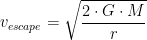 (simple Newton derivation). If we set
  , the speed-of-light, and solve for r we get:
  . The event horizon is where the escape velocity is equal to the speed-of-light.
There’s a star, S2, that is orbiting a central mass in our galaxy in 15.2 years. From the orbit, S2 is orbiting an object equivalent to 4.1 million solar masses. S2’s closest approach (periapsis) is about 17 light-hours. 17 light-hours is about the orbit size of Uranus. There’s no way that S2 can orbit a 4.1 million solar mass object and it not be as small as the Schwarzschild radius.
If it’s not an event horizon we are observing, then you’ll need to invent some new physics to explain it away.
Jim
Come on man.
1. What is or is not a Breakthrough?
This is a breakthrough if one changes the definition of breakthrough.
A breakthrough is something that changes civilization, some that has real implications, something that fundamentally changes our understanding of the physical world.
A check mark for the standard physics theories/models is not a breakthrough.
Quantum mechanics was a breakthrough.
Almost every electronic device which we use, most of our advanced technology – is directly or indirectly – possible due to the quantum mechanics phenomena and the application of the quantum mechanics model. That’s a breakthrough.
2. Gravity Wave Detection
The detection of gravity waves has been predicted for 30 years.
Gravity waves are not new.
We have known for 30 years that the orbiting period of binary pulsars slow – it was assumed by emitting gravity waves – with slowing in period being in accordance to the applicable standard model (general relativity) calculations within 0.2% of what General Relativity predicts.
https://arxiv.org/pdf/astro-ph/0407149.pdf
3. Why the heck has there been no real breakthrough in Physics?
There has been no breakthrough in physics, for 30 years.
See:
The Trouble With Physics: The Rise of String Theory, The Fall of a Science, and What Comes Next
by Lee Smolin
https://www.amazon.com/Trouble-Physics-String-Theory-Science/dp/061891868X
A scientific breakthrough is being able to do something in science that hasn’t been done before, William. If you’d check the discipline in which the award was given (science), this would certainly qualify.
A signal. One day, when we reach beyond the solar system, its characterization may be confirmed or rejected.
“The prompt arrival of the gamma-ray signal also confirms that gravitational waves travel at the speed of light, while the ability to observe light and gravitational waves arriving from distant objects will allow physicists to perform more stringent tests of Einstein’s general theory of relativity.”
Hmm…
Einstein’s theory of relativity states when velocity increases the time slows down.
If “the gamma-ray signal also confirms that gravitational waves travel at the speed of light” the time for the gravitational waves slows down to ‘zero’, i.e. the time stands still, i.e. there is no time.
The universe is meant to be a spacetime continuum, spacetime is a mathematical model whereby the three dimensions of space and the one dimension of time are merged into a single four dimensional continuum.
I’d like to know if there is no time (as far as the gravitational wave is concerned) what happens to the ‘spacetime’ thing.
I’m also a bit puzzled about the effects of gravitational waves travelling at SoL.
My issue comes from the failure to detect the Higgs – although the hype was remarkable, the fact is SUSY and Multiverse models postulated 2 very different energy levels. IIRC it was 140 GeV and 115 GeV. The ‘findings’ of the 2 experiments invalidates BOTH models at 126 GeV.
Also confusing is Einstein’s ‘dimples’ in spacetime causing gravitational effects – if the SoG = SoL then we have a situation where the dimple is causing an effect after the mass has moved on.
e.g. The Sun orbits the barycenter and the Earth orbits CoG of Earth-Luna. At a given instant the Earth is at point A in its orbit, and the Sun is at point B but when the gravity ‘arrives’ at earth, it is 8.3 minutes later so the attraction is to a point that is no longer where the Sun is centered.
With the Higgs issue, how does gravity get transferred from a place where it isn’t? And reach a place where there was nothing at the time of origin?
If the Higgs is valid, the information contained is incorrect for the system in time A+8.3 when it arrives because gravity is 2-way. i.e. the Earth is pulling on the Sun just as the Sun pulls on the Earth, but when the gravity arrives the information is for a time 8.3 minutes prior to ‘now.’
Your problem is that you are shifting your frame of reference. Either your frame is centered on Earth, or it is centered on the Sun. Switching between the two causes you to think there is an 8.3 minute difference when in fact there is none.
@C. Paul Pierett – “Your problem is that you are shifting your frame of reference. Either your frame is centered on Earth, or it is centered on the Sun.”
Maybe I am not explaining it well, but I don’t think that’s the case.
From earth reference, the Higgs arriving ‘now’ is coming from a point in space 8.3 minutes ago – the Solar centre of mass is not there now and the information in the Higgs is based on a point 8.3 minutes back in Earth orbit.
It seems to me, in such a case, the Earth would be continually slowed down by being influenced by gravity back along its own track.
For it NOT to be, wouldn’t the Higgs have to update its information store along the path from Sun to Earth? And it’s a 2-way interaction, making things even more confusing.
It may mean that as the velocity of a mass approaches an upper limit, time (or motion) becomes irresolvable or imperceptible for observers inside the system (e.g. universe). The implication is that time is not a separate dimension, but rather a property of kinetic energy. So, time does not exist in a perfect stasis, or in a frame of reference where the processes are undifferentiable.
If I were a gravitational wave (which I’m not) there is no time–I’d expand endlessly across the universe in one instant. The problem, as I see it, with “space-time” is that time is not at all like space, but we treat it mathematically as if it was just another dimension. Time is a phenomenon we experience in our minds, and maybe that’s all it is. But at this point we depart physics into philosophy.
Max Born said that theoretical physics is philosophy, not science. It tends to be bad philosophy, too.
Speculation and Fantasy
Nothing was observed.
They have yet to prove what the detected wasn’t a temporal wave.
I just spent half an hour looking for the article I’m about to talk from… If anyone can point me in the right direction I’d appreciate it.
The thing that concerns me about the LIGO results (and like ‘ggm’ I am concerned about models that just pop out the required data) is a report from a few years back about jitter in the system.
Basically the article talked about LIGO having tuning issues due to jitter in the beams and how they’d tried to negate all possible sources. Then along came a guy working in hologram universe areas and he showed the jitter was at the correct scale to be caused by a hologram ‘magnification’ like seeing dots in a newspaper photo that aren’t visible in the original photo.
He suggested the jitter was from the expansion of planck measurements because of the effects of the hologram at the boundary of the universe being magnified into the volume of the universe.
So if LIGO is measuring at a scale so tiny, I wonder what the models did to compensate for the jitter?
It’s important to note that any signals announced must have been seen at each of the widely spaced, independently run LIGO sites before being considered legitimate.
As an obstacle to any single detector, jitter is certainly one of several issues needing to be resolved to gain higher & higher levels of sensitivity (studying the deformation of space caused by the orbit of the Jovian moons about Jupiter, e.g.). However, this jitter naturally appears differently to the separate detectors involved because of their separation in space, & since any signal received at a given detector is compared to those received at the other detectors as well, those types of artifacts are fairly easily filtered out as “noise” at the scale of events currently being observed.
As a side note, plans are afoot to take some excess (for lack of a better word) materials from the Hanford, WA site to construct a 3rd LIGO site in India in addition to the one in Louisiana. (The VIRGO site in Italy is technically a separate project, though collaboration is understandably frequent.) This will among other things allow better directional sensitivity when it comes to locating these events in the universe relative to our world, as well as further filtering of ambient regional & local noise sources.
“As the two neutron stars spiraled together 130 million light years away, ”
——–
Talk about old news.
this is lol. Neutron stars defy the laws of physics
I understand they defy the laws of known physics, Mark. It isn’t neutron stars that are behind–it’s us mere mortals who haven’t a clue yet.
“Neutron stars defy the laws of physics”
A lot like climate scientists then.
Perhaps it’s something to do with their infinite density.
A ‘Breakthrough’ is:
1. A breakthrough is the discovery of a physical observation that if correct, absolutely disproves a theory.
2. The discovery of a new theory that supersedes the old theory.
3. A breakthrough is also the discovery of why we are not getting a breakthrough(s). i.e. Where to look for the breakthrough, It is not an argument.
A breakthrough is something exciting and interesting.
A jump up and down breakthrough is the discovery of something which we could not have imagined before the discovery of the physical phenomena which led to breakthrough and/or a breakthrough that leads to other breakthroughs.
Quantum mechanics is an example of a jump up and down breakthrough.
The detection of what we assume are ‘gravity waves’ is in accordance with our General Relativity model/theory.
There is no breakthrough. The finding is absolutely very interesting. It appears there are ‘gravity waves’ created from the interaction of neutron stars, and the wave travels at the speed of light.
Ironically it is a fact that there are now a couple of jump up and down breakthroughs.
There is now an absolutely hard paradox in the astronomical data. It is physical not possible for the old theory to explain the two population of stars in globular clusters.
Normally when there are a hundred or so observation anomalies (many close to physical paradoxes) and now a hard paradox (the multiple populations of stars in globular clusters are absolutely physically impossible to make with collapsing gas clouds and nuclear synthesis) with the old theory. There would have been the announcement that the theory in question is in crisis, followed shortly by the announcement that there is a new theory to replace the old.
Our Big Bang Theory has been incorrectly called a theory. It is more than a theory. It contains assumptions which observations now unequivocally show are absolutely incorrect at a very basic, fundamental physical level.
We made the most important fundamental physical choice in physics (affects everything in physics and metaphysics) 40 years ago when we selected the BB Fixed Time Universe based on the observations at that time. The natural physical alternative to fixed time universe was an Infinite Time Universe.
The unavoidable conclusion regarding an infinite time universe is that God(s) is an absolute certainty.
The metaphysical questions are interesting however the place to start is the key physical observations and the basic logical structure of the problem.
Part of the problem is the Coles Notes summary in textbooks concerning the BB fixed time universe is not critical and is inaccurate.
For example:
The BB fixed time universe CMB paradox.
Based on the BB theory the small angle variance of the 2.7k signal (CMB) which is assumed to be cosmic determines the lumpiness of matter distribution in the BB universe.
To get stars to form that microwave signal needs to vary on small scales no less than around 1/3000 to 1/5000.
The signal which we assume is the CMB varies on small scales as 1 part in 100,000, a factor of twenty too smooth.
The problem is based on BB theory a very smooth CBM that varies as one part in a 100,000 would result in matter being very eventually distributed in the universe. If that was true there would be no galaxies or stars formed.
The route of that problem in terms of observations is there is a great deal of empty space between the clusters of galaxies.
The theoretical solution to the BB CMB paradox, was the creation of new physics to Inflate the entire universe at 100,000 times faster than the speed of light. The problem with inflation event is it must only happen once. If it happens again the universe expands.
The BB theory would be in crisis without the addition of the inflation event. Inflation is a forced change in the laws of physics to keep the BB theory alive.
The argument for adding the Inflation event is it was believed at the time when the Inflation event was hypothesized that the other logical pillars of the BB theory were sound and would remain sound, with more advanced observations.
There are other issues with the CMB.
More than half of the raw signal is removed. There is a large unexplained cold spot. In addition, there is alignment of the large features of the signal with the axis of the solar system which would imply that more signal needs to be filtered out.
At the time when the 2.7k signal was discovered there was no alternative explanation for its existence. Text books state that there is no physical method to create the 2.7 k signal beyond a big bang event 13.8 billion years ago.
Obviously, it might now might be possible to come up with a local explanation for its existence, particularly as there is a hard paradox that the BB theory is incorrect and a hundred observations that are anomalies, close to paradoxes with the BB theory.
Some people are now arguing that the BB event could occur without the creation of the CMB, to avoid the bad inflation problems which come if we assume eternal inflation.
If that is true, the BB event occurred without a CMB, the signal which we observe is local not cosmic. We would then not require inflation and the inflaton field to explain the CMB too smooth anomaly.
The Inflation event is however still required to explain the universe is flat observation. One of logical pillars for the BB theory was the belief that observations would show the universe was either open or closed, as the BB theory without inflation naturally produces either an open or a closed universe.
The point is the Inflation event does not appear naturally from standard physics. It was specially created for the BB theory. At this point in time it appears, that the inflation add-on to standard physics will not lead to a breakthrough in fundamental physics.
http://physics.princeton.edu/~cosmo/sciam/
Science gets its ‘life’ so to speak from solving problems on a live path.
If you are on a dead path, it does not matter how smart you are or how long you work on the problem. It is impossible to make any real progress. I.e. To get the breakthroughs.
I did not take the time to elaborate, but I did not mean “God” in any religious sense.
There was a Star Trek episode involving an encounter with being shacking up with an earth woman on his very own planet. Turns out the being is a god, and the woman is facsimile he created because the original, which he loved greatly, was killed by a some faceless race of belligerents.
The salient point for me in this episode was that, in response to his wife’s death ( let’s assume common law principles in that part of the universe for the moment), this small g god willed the perpetrators entire race out of existence, from the entire universe, as if they had never happened, which is a profound concept, especially if the reverse is possible.
I really hesitate to even broach this discussion due to the risk of endless anthropomorphic gobbledygook,
but given an infinite amount of time, anything is possible, the god factor may not be all that metaphysical.
I really appreciate you comments, the BB theory was always a bridge too far for me.
Don’t we all love those paintings, so dramatic, so beautiful. Surely a front cover?… of? Ligo , the acronym says it all really. Utter nonsense. Well done boys, more dollars to fund the heliocentric whirl, where unproveable science is your god. Rock on Santa..
Got me thinking of Starquake by Robert L. Forward. A successor novel to Dragon’s Egg where humans meet the Cheela, inhabitants of a neutron star. They are the size of a sesame seed and live a thousand times faster than humans. How would they have perceived this event?
Wonderful series.
One day the house of cards will fall. Then we can get back to the way things actually work. Faraday, Tesla, and Heaviside had a much better understanding of physics. But it will take the effort of a fringe scientist to make the next leap. We spend billions on complete nonsense. But there are signs that the house built by particle physics is coming to an end.
Where are the visible light pictures???
I do not know about breakthroughs in terms of detecting gravitational waves.
What I do know is that vast improvements in technology made the discovery possible. Go to the LIGO website and read about the care which has been taken to filter out extraneous noise. Read about the mirrors which are mounted on an incredible series of vibration-damping devices. Read about the laser which is carefully monitored so as not to introduce noise. Read about the thousands of times the light is reflected from mirror to mirror. We see reports about four mile tubes. But the signals travel some 4,000 miles because of the multiple reflections.
Read about the extraordinary tubes, evacuated to a very hard vacuum. When one seeks a dimensional shift of 1/100 the diameter of a proton, one is seeking a very small shift. All kinds of advances in technology have had to be made to build these devices. Another entire topic is the ability to synchronize the timing used in the evaluation; atomic clocks are flown back and forth to bring the timing down to the femtosecond level.
It has been a long journey since Joe Weber first wired up piezoelectric detectors to a large chunk of aluminum to do this search. And the double neutron star collision is important, because of the observations at all wavelengths (these observations have not occurred with black hole mergers).
As for event horizons, there is most certainly a region from which electromagnetic energy cannot emerge. What else would you call it than an event horizon? And there is little agreement on the situation within the boundary (how can we possibly observe what cannot radiate)? The discovery that Hawking made about energy leaking from a black hole is another amazing discovery. You may not be a believer in quantum foam, but there certainly must be an explanation as to why small black holes are not found. And the pair production in quantum foam is certainly believable.