As the sun gets successively more blank with each day, due to lack of sunspots, it is also dimming. According to data from NASA’s Spaceweather, so far in 2017, 96 days (27%) of the days observing the sun have been without sunspots. Here is the view today from the NASA Solar Dynamics Observatory satellite:

Today at Cape Canaveral, SpaceX launched a new sensor to the International Space Station named TSIS-1. Its mission: to measure the dimming of the sun’s irradiance. It will replace the aging SORCE spacecraft. NASA SDO reports that as the sunspot cycle plunges toward its 11-year minimum, NASA satellites are tracking a decline in total solar irradiance (TSI).
Across the entire electromagnetic spectrum, the sun’s output has dropped nearly 0.1% compared to the Solar Maximum of 2012-2014. This plot shows the TSI since 1978 as observed from nine previous satellites:

In the top plot, we drew the daily average of measured points in red (so there are a lot of points, 14187 to be precise). On the left is a red vertical bar showing a 0.3% change in TSI. The black curve is the average of TSI over each year. The dashed horizontal line shows the minimum value of year-averaged TSI data. The vertical black bar shows the 0.09% variation we see in that average. The bottom plot shows the annual sunspot number from the SIDC in Belgium in blue. Source: NASA Solar Dynamics Observatory Mission Blog.
What do we learn from these plots? First, TSI does change! That’s why we stopped calling it the solar constant. Second, as the sunspot number increases, so does TSI. But the converse is also true. As the sunspot number decreases so does TSI. We have watched this happen for four sunspot cycles. This waxing and waning of TSI with sunspot number is understood as a combination of dark sunspots reducing TSI below the dashed line and long-lived magnetic features increasing TSI. SORCE has even observed flares in TSI.
Third, the horizontal dashed line is not an average, it is drawn at the lowest value in the year-averaged TSI data (that happened in 2009). When there are no sunspots the Sun’s brightness should be that of the hot, glowing object we always imagined it to be. We would expect TSI to be the same at every solar minimum. There is much discussion over whether the value of TSI at solar minimum is getting smaller with time, but it is not getting larger.
These data show us that the Sun is not getting brighter with time. The brightness does follow the sunspot cycle, but the level of solar activity has been decreasing the last 35 years. The value at minimum may be decreasing as well, although that is far more difficult to prove. Perhaps the upcoming solar minimum in 2020 will help answer that question.
The rise and fall of the sun’s luminosity is a natural part of the solar cycle. A change of 0.1% may not sound like much, but the sun deposits a lot of energy on the Earth, approximately 1,361 watts per square meter. Summed over the globe, a 0.1% variation in this quantity exceeds all of our planet’s other energy sources (such as natural radioactivity in Earth’s core) combined. A 2013 report issued by the National Research Council (NRC), “The Effects of Solar Variability on Earth’s Climate,” spells out some of the ways the cyclic change in TSI can affect the chemistry of Earth’s upper atmosphere and possibly alter regional weather patterns, especially in the Pacific.
NASA’s current flagship satellite for measuring TSI, the Solar Radiation and Climate Experiment (SORCE), is now more than six years beyond its prime-mission lifetime. TSIS-1 will take over for SORCE, extending the record of TSI measurements with unprecedented precision. It’s five-year mission will overlap a deep Solar Minimum expected in 2019-2020. TSIS-1 will therefore be able to observe the continued decline in the sun’s luminosity followed by a rebound as the next solar cycle picks up steam. Installing and checking out TSIS-1 will take some time; the first science data are expected in Feb. 2018.
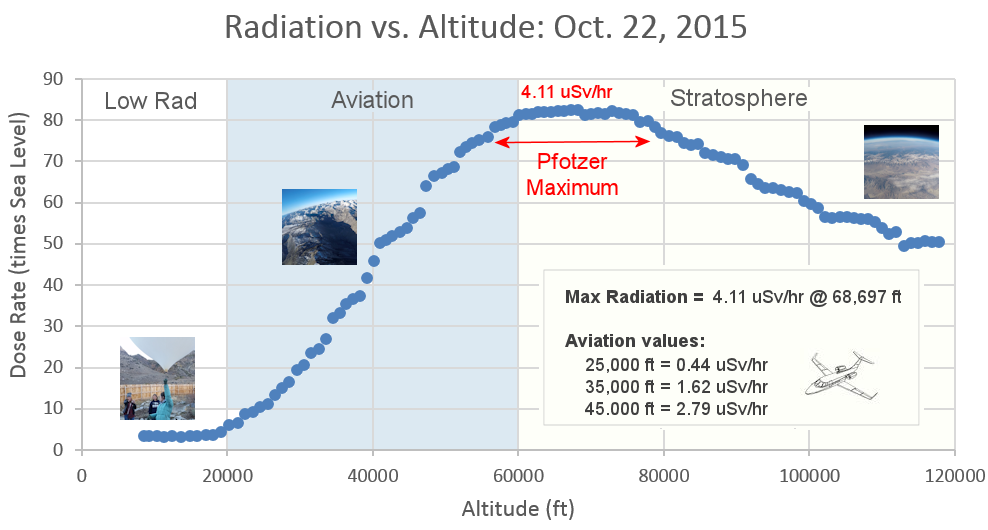
In other news, as the magnetic activity of the sun decreases, influx of Galactic Cosmic Rays (GCR’s) increase as has been observed by balloon measurements over California:

Why are cosmic rays intensifying? The main reason is the sun. Solar storm clouds such as coronal mass ejections (CMEs) sweep aside cosmic rays when they pass by Earth. During Solar Maximum, CMEs are abundant and cosmic rays are held at bay. Now, however, the solar cycle is swinging toward Solar Minimum, allowing cosmic rays to return. Another reason could be the weakening of Earth’s magnetic field, which helps protect us from deep-space radiation.
The radiation sensors onboard our helium balloons detect X-rays and gamma-rays in the energy range 10 keV to 20 MeV. These energies span the range of medical X-ray machines and airport security scanners.
The data points in the graph above correspond to the peak of the Reneger-Pfotzer maximum, which lies about 67,000 feet above central California. When cosmic rays crash into Earth’s atmosphere, they produce a spray of secondary particles that is most intense at the entrance to the stratosphere. Physicists Eric Reneger and Georg Pfotzer discovered the maximum using balloons in the 1930s and it is what we are measuring today.
NASA’s spaceweather.com website follows the progress of the sun on a regular basis. Our WUWT Solar Reference Page also has data updated daily.
We are fortunate that the Sun is as stable as it is, but could it be defined as a Variable Star and if so would that mean that ALL stars have a degree of variability? If this is the case extra-terrestrial life would be much rarer than we think.
I hope Leif will update his many graphs soon. No data for the last 9 months, sad!
The climate does not change much in nine months…
Which graph in particular are you interest in?
Active Region count, Recent Solar activity (hi-def), and WSO polar fields.
Active Region count, Recent Solar activity (hi-def), and WSO polar fields.
Working on the two first ones. Here are the polar fields:
http://www.leif.org/research/WSO-Polar-Fields-since-2003.png
http://www.leif.org/research/Polar-Fields-HMI-WSO-for-SC25.png
http://www.leif.org/research/WSO-Polar-Fields.png
Wp strikes again. One cannot update a graph. I have to create a new one with a different name:
http://www.leif.org/research/WSO-Polar-Fields-since-2003x.png
Here is the Active Region Count. There are no hi-res details yet as there really hasn’t been any new-cycle active regions. It is clear that we are not at minimum yet.
http://www.leif.org/research/Active-Region-Count-now.png
The update has been delayed by David Hathaway’s retirement for NASA. His database at NASA was not updated for many months. But, now he has teamed up the Lisa Upton and they have a wonderful new website, which I can warmly recommend http://solarcyclescience.com/home.html
and
http://www.leif.org/research/TSI-SORCE-Latest-1712.png
http://www.leif.org/research/TSI-SORCE-Cycle-24-1712.png
Outstanding, Leif, three out of three ain’t bad. Your graphs are the best. And thanks also for the solarcyclescience reference, very interesting indeed. Happy holidays!
On the ball as usual Leif.
What bet this upcoming Phaethon “Meteor” is really the real Planet X that’s been affecting our weather so much and the authorities just cover it up to avoid panic? It’s real effect upon Earth would not be by striking it, but the hordes of meteorites that we already see daily preceding and following it. Then, again, it will be a big rush if indeed we do get a pole shift. Like Jesus says in the Bible, “Go to high ground.” So much for California even as the Red Chinese plan to exploit the destruction and invade the US “To restore civil order” in white UN tanks.
Whiskey or Vodka?
peyote
A Russian troll bot.
Spam from an AGW true believer to make this site look bad.
Most of what we have been told about the sun is a mythical lie. All is centered around the false notion that a star’s output has a “main sequence” phase, where it burns hot briefly at ignition, then settles down for a few billion years, and so on. This notion violates what we know about energy conservation and stellar fuel consumption. According to everything I know about the subject, a star’s fuel consumption is linear. Stellar output declines in a linear fashion. The notion that “oh, we have a few billion years blah blah” it nonsense. This leads to my theory of “Planetary Migration of Species due to Solar Output Reduction”.
In all likelihood, we started on Mars as a species. The sun was younger and hotter, of course. As it cooled, over thousands of years a great project is undertaken by our species. The creation of a ship big enough to move a planet full of people. The asteroid belt, where gravity seemingly failed to create a planet (because of Jupiter, because Jupiter’s gravity can somehow disrupt planet formation, but not of its own satellites apparently, and the sun can’t disrupt planetary formation due to its gravity, this ONLY happens between Mars and Jupiter…k?) is actually the leftover refuse of that project. That project created our moon, for which only half cocked guesswork explains the presence of, and brought us here.
Next, it will take us to Venus (likely not nearly as hot as we’re told) where we will exist until the sun has almost exhausted its fuel and we will then head for another star somewhere.
Why wouldn’t we know? Well for one, the slaves don’t need to know their true history. They just need to work. With a little beer and tv, humans forget what they did 5 minutes ago. 5000 years ago is easy. For another, we’re poor record keepers.
Its my belief that planetary migration is ubiquitous throughout the cosmos. As a star gradually cools, the “Goldilocks zone” moves constantly inward, forcing civilizations to migrate or freeze.
What if this is absolute truth? It certainly explains a lot of things with relative ease that otherwise need convoluted theories and outlandish formulas to guess at.
that is truly the weirdest theory I have ever heard…
I’m not sure it can qualify as a ‘theory’. If it does, then the ‘Moon is made of green cheese’ also qaulifies
letme,
Can you provide specific evidence to support your assertion that:
1) “In all likelihood, we started on Mars as a species.” Edgar Rice Burroughs notwithstanding,
2) That Venus is “likely not as hot as we’re told”,
3) The asteroid belt is the debris of “a ship big enough to move a planet full of people”,
4) That the ‘project to build a planetary population moving ship’ created the Moon,
5) That we were all ‘slaves’ during the relocation.
Your assertions make for good scifi, if you’re willing to engage in a good bit of ‘suspension of disbelief’. It is pretty similar to “When Worlds Collide” a novel I enjoyed when I was 12.
Pretty sure you mean “laughably bad scifi”. No science. Pure fantasy.
I had to double check to see if I was still on WUWT. I thought Disney had hacked in with one of their fair tales.
The biggest bummer is that less sunspots = less rain.
What data do you have for that?
Great story . . . reminds me of the SciFi I used to read as a kid. I’d work it as people on a cold and dying Earth preparing the move to Venus looking for a way to make the move. Then they discover that it’s been done before as Earth’s human ancestors migrated here from Mars. This opens their eyes to the fact that eventually humankind will have to find a new planet orbiting around a different star. The pen name Arthur C. Clarke is already taken.
So why is it that comments that mention Theodore’s surname are blocked ?
OMG! It’s all our fault! All our CO2 and global warming are causing the sun to cool, bringing about a new global ice age! Just like they said back in the 70s! What to do? What to do????
This is a True Chicken LIttle Apocalypse! Send Money to the Liberals!!
La Niña and the polar vortex will work during the coming winter.
Damn Global Warming!!!
What struck me most about the TSI plot (aside from the fact that it took me almost an hour to find the “dashed horizontal line – you should really make that in another color) were the huge, high frequency excursions. There are changes of 4 W/m^2 in extremely short periods. That has to be significant.
There are changes of 4 W/m^2 in extremely short periods. That has to be significant.
Most of these are simply due to solar rotation and the emergence of large spots. If a large spot rotates onto disk, decreases. When the large spot two weeks later rotates onto the backside TSI increases back to ‘normal’ again.
Doesn’t a 0.1% drop in the sun’s luminosity (1.36 W/m2) over a 45 year period represent a change in radiative forcing which is relatively similar to the change in radiative forcing from the total increase in atmospheric CO2 of approximately 120 ppm since per-industrial times?
According to International Journal of Atmospheric Sciences, Volume 2017 (2017), Article ID 9251034, “Radiation Transfer Calculations and Assessment of Global Warming by CO2 ”, a clear-sky atmosphere with 280 ppm CO2 produces an Iabs of 323.02 W/m2, while under same conditions an atmosphere with 420 ppm CO2 produces a Iabs of 325.38 W/m2, or an increase of 2.36 W/m2 . Where Iabs is the intensity of the absorbed long wave radiation flux in the atmosphere.
Thus the reduction of solar luminosity effectively cuts increased GHG concentration’s warming affect by 50%.
No, because as the Earth receives solar radiation it re-radiates what it gets so there is a balance between what comes in and what goes out.
Leif says;
“…the Earth receives solar radiation it re-radiates what it gets so there is a balance between what comes in and what goes out.”
Sometimes the Earth receives more solar radiation and it ‘re-radiates’ more of what it gets. Sometimes less!
We have only observed Earth receiving solar radiation during a period of time when we began to put satellites into orbit,
There is only one half of a story being told, the later half of the 20th century had solar cycles with increased intensity in solar activity.
Sometimes the Earth receives more solar radiation and it ‘re-radiates’ more of what it gets. Sometimes less!
It radiates back to space just what it gets. And in any case, what happens over a month is not relevant for the 30-yr climate.
Global warming is solved!
I remember several years ago that our star had a very strange fluxuation it kind of freaked me out. I’m no expert but have spent some time as an amateur astronomers. It was so unusual. The sun actually looked like it expanded and contracted on one side.At the time there was no explanation for it. Also I have noticed there have been some surprise discovery of asteroids. If our galaxy I’d colliding with another galaxy couldn’t the local fluff be affecting our star?
don’t think so.
Well, two nuclear FUSION reactors are under construction, in Asia and Europe, so…
“I can’t explain why yet, but some way, somehow, this is Trump’s fault.”
– Every person who watches MSNBC
Oh c’mon, it’s just gonna get warmer and warmer forever. Sheesh. Send me $$ and I’ll do what I can to make it colder. Thanks.
Further supporting the idea that anthropomorphic climate change is just a giant scam. The sun will cause greater change to the climate in the next decade than another 1 Billion people occupying this blue marble in that same decade. Bundle up. It’s going to get a lot cooler wherever you are right now.
Leif,
You responded, “No, because as the Earth receives solar radiation it re-radiates what it gets so there is a balance between what comes in and what goes out.”
Right. At equilibrium, an “average” earth atmospheric temperature is established. Moreover, under constant solar input to earth, an increased concentration of earth’s GHG’s (especially CO2 & CH4) does reduce the earth’s power-output to space. Meaning, a new, higher equilibrium temperature for the atmosphere will eventually be established, right?
Not quite sure what you driving at. But an increased concentration of gases with more than two atoms per molecule [e.g. H20, O3, CO2, etc] will increased the temperature. The only question is by how much? The current values means an increase of 33 degrees over the case where those gases were not present. More here: http://www.leif.org/research/Climate-Change-My-View.pdf
Just attempting to “drive” to what is known and what is not known about human induced climate change and the sun’s role. Read your link, “Climate Change: Evidence, Models, and Speculation”, thanks much for the broad coverage of this topic. Prior to reading it, I was going to respond with something like, so what is there to be skeptical about? Turns out, a bunch more than just water vapor feedback. The Alkenone series vs. instrument series divergence, to me, is shocking.
Now back to my original question. Looking at what is currently understood, it would seem that at least on shorter time scales (50 years or so), that the human contribution to atmospheric warming via GHG’s must be very low, right? If true (not sure it is), then shouldn’t the short term (within normal long term solar cycle(s)) reduction in solar output (as pointed out by Anthony) counteract the coincident warming impact of human induced GHG? Sorry if i’m not getting your point, yet.
then shouldn’t the short term (within normal long term solar cycle(s)) reduction in solar output (as pointed out by Anthony) counteract the coincident warming impact of human induced GHG
Except that the influence of less active Sun is too tiny to make any difference. It is so small that we cannot hardly see the 11-yr sunspot cycle signal above the noise.
Wait a minute, I think I get it now. The uncertainties in all these concepts, are just too large to make my point. I think that’s what you likely to say.
something like that, yes
The climate change scammers are using climate change for more political power. The sun has more to do with climate change than man does. This is proof. Man-made climate change is a SCAM.
So far now..Almost 20yrs….The Models call for Man-Made Global Warming. The Data, however, shows that the Earth has actually been cooling these last almost 20yrs
Man Made Global Cooling
you heard it here first
We can all be sure it is cooling because people are hip to NASA/NOAA tricks and mechanical engineer /comedian Bill Nye is no longer taking bets on claims of record temperature on earth .
Don’t see the climate “experts ‘ suggesting added CO2 will help reverse the forthcoming cooling trend .
Funny how that works . More people and animals will lose their lives due to cooling but not a peep .
Guess it was all about wiping out people after all . Well that and fleecing tax payers .
Crap I’m 72 years old. I remember the global ice age coming in the 70’s, the global warming in the late 50’s , early 60’s. Damn will you people get in on before I go please/
Hang around for at least another decade – it’ll be an interesting one with great tools to watch the sun!
What I have yet to see graphed or charted is the correlation ( or not ) between GCR’s and cloud cover. That is the crux of Svensmark’s theory and he mentioned there was one in The Cloud Mystery. Is there anywhere that people have been tracking this?
correlation ( or not ) between GCR’s and cloud cover.
There isn’t any that held up over time:
http://www.leif.org/research/Cloud-Cover-GCR-Disconnect.png
The dimming is being caused by man from all the satellites we have put in orbit …
Fukushima daiichi will get us before any climate change from the Sun or carbon. Computer models show that at the current rate of discharge of radioactive material into the groundwater and sea, most of the Pacific Ocean will be Radioactive by 2021. This could lead to massive starvation because already in the last 2 years over 300 ocean species have gone extinct. Google; starfish melting off the coast of Oregon YouTube. What on Earth were the children of the world thinking when they put 30 nuclear reactors on an island that has a earthquake practically every other day?
Wow.. reading science fiction?
The oceans have been radioactive for their entire existance from dissolved uranium, thorium, and potassium. Perhaps you could post some actual data.
You would think after all the Godzilla movies Japan would have learned that they shouldn’t mess with nuclear stuff or something very bad would happen.
But then again there is beneficial radiatio when rares of cancer dropped by 97%.
https://www.ncbi.nlm.nih.gov/pmc/articles/PMC2477708/
Maunder Minimum. Predicted, now it is a reality and we should see the impact over the next 30-50 years.
Note that none of the global warming crowd owes up to the fraud by NASA, NOAA, take your pick of universities in the U.S. and Europe to push a liberal agenda that is failed. Models did not take into account solar radiation variations and tectonics–spreading zones and volcanoes. Weather data was either outright falsified, changed, or ignored. Sensors were in urban areas, skewing the data–asphalt and concrete jungles are about 10F higher than rural areas. Man hasn’t a clue and our arrogance gives us a false sense of security that is a fool’s paradise. Remember the frozen Mammoth’s found on Wrangell Is. with the flowers in their mouths?
Weather patters are cyclical and as a 63 Alaskan, things are getting back to where they were when I was a kid in the late 50s, 60s. Weather changed about 1984 with a shift in the jet stream that now dips will into CONUS allowing the arctic air mass to hit the U.S.
One day it is going to snow and keep snowing. That’s when this civilization ends and the ice age comes back.
You can’t ignore the sun. The sun drives the weather on every planet in the solar system. And, don’t forget solar EMP potential . . . the end of civilization may not come by the sun’s diminishing activity.
What’s gonna happen will happen. God’s plan, not man’s.
Lawrence
interesting comment.
Funny you should mention Alaska. Back in 2013 I did look at some data there once. Sometimes it is better to focus on only one weather station and analyse all the data that you know you can trust. [Unless you balance your data set based on a number of factors]. In this case I looked at the data from a military base station and I looked specifically at maxima. Basically there is nothing that can wrong there as a thermometer gets stuck on a maximum and is read once a day. I looked at all maxima recorded since 1942. Here was my final result on that:
http://oi60.tinypic.com/2d7ja79.jpg
notes:
1) the data shows exactly what you are experiencing personally: things in Alaska are going back to how it was in the past.
2) I predicted the minimum [for maxima] at 2016 but this was based on the assumption of the wave length being 88 years. It turned out that we already passed the minimum at 2014 [looking at the solar polar magnetic field strengths]
3) The Gleissberg SC is in fact 87 years and it consists of 4 full Hale cycles in a row. A Hale cycle is equal to 2 Schwabe SC ‘s. So there won’t be any prolonged minimum now. We already made the switch and the solar polar field strength is strongly rising. The planets were all in time for throwing the relevant [electrical] switch on the sun in 2014.
I hope you can live with the cold up there? God bless you.
We are not getting Maunder Minimum type conditions on the sun, there will be longer weaker solar cycles for a few decades.
A cooling period should be the overall result of weaker solar cycles.
The reasoning is; Shorter more intense solar cycles produce more energy than, weaker less intense solar cycles over the same period of time.
A period of time we can confirm, through planetary mechanics.