From the UNIVERSITY OF NEW SOUTH WALES and the “coming to a power plant near you in 30 to 50 years” department
A laser-driven technique for creating fusion that dispenses with the need for radioactive fuel elements and leaves no toxic radioactive waste is now within reach, say researchers

Dramatic advances in powerful, high-intensity lasers are making it viable for scientists to pursue what was once thought impossible: creating fusion energy based on hydrogen-boron reactions. And an Australian physicist is in the lead, armed with a patented design and working with international collaborators on the remaining scientific challenges.
In a paper in the scientific journal Laser and Particle Beams today, lead author Heinrich Hora from the University of New South Wales in Sydney and international colleagues argue that the path to hydrogen-boron fusion is now viable, and may be closer to realisation than other approaches, such as the deuterium-tritium fusion approach being pursued by U.S. National Ignition Facility (NIF) and the International Thermonuclear Experimental Reactor under construction in France.
“I think this puts our approach ahead of all other fusion energy technologies,” said Hora, who predicted in the 1970s that fusing hydrogen and boron might be possible without the need for thermal equilibrium. Rather than heat fuel to the temperature of the Sun using massive, high-strength magnets to control superhot plasmas inside a doughnut-shaped toroidal chamber (as in NIF and ITER), hydrogen-boron fusion is achieved using two powerful lasers in rapid bursts, which apply precise non-linear forces to compress the nuclei together.
Hydrogen-boron fusion produces no neutrons and, therefore, no radioactivity in its primary reaction. And unlike most other sources of power production – like coal, gas and nuclear, which rely on heating liquids like water to drive turbines – the energy generated by hydrogen-boron fusion converts directly into electricity. But the downside has always been that this needs much higher temperatures and densities – almost 3 billion degrees Celsius, or 200 times hotter than the core of the Sun.
However, dramatic advances in laser technology are close to making the two-laser approach feasible, and a spate of recent experiments around the world indicate that an ‘avalanche’ fusion reaction could be triggered in the trillionth-of-a-second blast from a petawatt-scale laser pulse, whose fleeting bursts pack a quadrillion watts of power. If scientists could exploit this avalanche, Hora said, a breakthrough in proton-boron fusion was imminent.
“It is a most exciting thing to see these reactions confirmed in recent experiments and simulations,” said Hora, an emeritus professor of theoretical physics at UNSW. “Not just because it proves some of my earlier theoretical work, but they have also measured the laser-initiated chain reaction to create one billion-fold higher energy output than predicted under thermal equilibrium conditions.”
Together with 10 colleagues in six nations – including from Israel’s Soreq Nuclear Research Centre and the University of California, Berkeley – Hora describes a roadmap for the development of hydrogen-boron fusion based on his design, bringing together recent breakthroughs and detailing what further research is needed to make the reactor a reality.
An Australian spin-off company, HB11 Energy, holds the patents for Hora’s process. “If the next few years of research don’t uncover any major engineering hurdles, we could have prototype reactor within a decade,” said Warren McKenzie, managing director of HB11.
“From an engineering perspective, our approach will be a much simpler project because the fuels and waste are safe, the reactor won’t need a heat exchanger and steam turbine generator, and the lasers we need can be bought off the shelf,” he added.
###
Wow ! This sounds extremely interesting ! Great news ! 🙂
Yes, the work of Dr. Hora and his international collaboration has provided the first experimental demonstration of large numbers of fusion reactions with hydrogen-boron fuel. We and two other groups will be seeing in 2018 if the avalanche effect that his group first reported lat year also enhances fusion in our device, the dense plasma focus. See more information and how you can participate in helping this work at lppfusion.com.
Focus Fusion
https://lppfusion.com/
No Neutrons No Radioactive waste!
Brief History of Fusion Power
“In the 1930’s scientists, particularly Hans Bethe, discovered that nuclear fusion was possible and that it was the energy source for the sun. Beginning in the 1940’s researchers began to look for ways to initiate and control fusion reactions to produce useful energy on earth. From the start, the task was difficult, because fusion reactions required temperatures of hundreds of millions of degrees, too hot to be contained by any solid chamber. Instead, physicists sought to contain the hot plasma with magnetic fields, using, for example, the pinch effect where electric currents moving in the same direction attract each other through their magnetic fields. This approach was called “magnetic confinement”.
Initially this work in the U.S., UK and USSR was secret. However, by the mid-1950’s administrators and scientists alike were convinced that controlled fusion research had no military applications, and in particular had nothing to do with the development of thermonuclear weapons.
The first thermonuclear weapons had been detonated in the early 1950’s. In an H-bomb, or thermonuclear weapon, the tremendous energy of a fission-based nuclear weapon is used to heat up a large amount—tens or hundreds of kilograms—of a fusion fuel to release fusion energy in an explosion. By contrast, in controlled fusion research—and in a future fusion generator—not even one gram of fuel would be heated to high temperature at any one time. This tiny amount of highly heated fuel is far too small to serve as a “spark” for the kilograms of fuel needed for a weapon. In fact, any contact between the tiny amount of hot fuel plasma and a larger object, such as the fuel for a bomb, would immediately douse the fusion reaction by lowering the plasma’s temperature. (Thus the conversion of a fusion generator into bomb, sometimes portrayed in science fiction, is impossible.)
Since fusion research had no military applications, it was declassified by the major participating nations, and cooperation in fusion began between the U.S. and the USSR.
Starting in the 1960’s, after the invention of the laser, other researchers sought to heat fuels with a laser so suddenly that the plasma would not have time to escape before it was burned in the fusion reaction. It would be trapped by its own inertia. This newer approach was thus named ”inertial confinement”.
During this first period, scientists realized that the key problem for controlled fusion was the tendency of plasma to develop instabilities that led to plasma escape from the magnetic confinement. While most fusion approaches struggled to suppress these instabilities, which occur in all plasma, in 1964 U.S. and Soviet scientists simultaneously developed the plasma focus device, which sought to exploit the instabilities to compress energy, instead of trying to suppress them.”
https://lppfusion.com/fusion-power/brief-history-of-fusion-power/
Lot more in the link
Sunsettommy’s post on history of fusion is at least a bit misleading. The post leaves one with the impression that fusion in a thermonuclear weapon is directly responsible for the increaesed yield. It is only indirectly responsible as most of the extra yield directly comes from fusion. See any number of web pages on these things, such as this Wikipedia entry: https://en.wikipedia.org/wiki/Thermonuclear_weapon
PIcky, picky, picky 😉
LPPFusion has created an ingenious experimental reactor that’s within striking distance of a near-term commercial design. Here are Eric Lerner’s explanatory videos:
How it works
Reaching ignition
Complete Album of Videos
Neaat. it can be used for generating Helium
ingenious … striking … near-term commercial
Press-releasy words. Sarastro is the astroturfing account number 92? I understand money is needed but if you are writing behalf of the company, please spell it out. It might be even illegal in some jurisdictions to do misleading marketing efforts while crowdfunding. I bet it is.
wxobserver: What? Fusion is or is not? You said twice that fusion is the source of the extra energy, as though there was a contradiction.
The energy of the sun and of all stars is powered by gravitation; by far the weakest force in the universe. But gravity sucks, so everything attracts everything else, and you don’t need any can to put it in. Just put enough massive matter together and it just sucks itself together. If it’s the right stuff it will eventually lead automatically to fusion reactions. But it’s the gravitational force that makes it work, not electromagnetic forces which is what laser radiation is, but electromagnetic forces don’t suck they blow, and they like to blow things apart, not squeeze them together.
G
What George writes is of course true, but I think he overlooks the fundamental equation of the 20th century; E = mc².
It seems obvious (as in “from observation”) that fusion is a mass related event. But by the formula above, energy is mass. If you put enough energy into a small place at the right time, you’ll get mass effects, which is how this device works.
The problem is with the second law of thermodynamics, which precludes the idea o perpetual motion. This design, and all cold fusion designs I’ve seen, violates the second law. Stars convert mass to energy by gravitation. The conversion isn’t net positive; it’s also subject to the second law and is a fine example of entropy in action.
TANSTAFL. There ain’t no such thing as a free lunch.
Well Bartleby, I am not overlooking anything.
And by the way, Albert Einstein also said : E = hf, so that means that energy is actually frequency.
And of course you have to use h or hbar depending on whether you count frequency in CPS or radians per second.
In certain fields scientists use a system of units where c=h=1 (I think e=1 , the electron charge also)
So they simply put E=m=f
I see nobody has answered my question about the pulse repetition rate of these petawatt lasers.
Anybody know how much time elapses between shots of the Lawrence Livermore whack-a-mole machine.
Charles H. Townes warned laser aficionados in a keynote speech, that laser confinement might be interesting for studying very dense plasmas, but that they were kidding themselves if they thought it was a practical way to fusion energy availability.
I’ve seen nothing to change that situation.
I think I have said before that I was detecting the 14 MeV neutrons, with a Stilbene crystal scintillation counter from DT fusion experiments circa 1959/60. 80% of the fusion energy is in the KE of the neutron, so you have to deal with those neutrons to access that energy in the form of heat, and that means radioactive materials problems. The p-B path may lead directly to Electricity, but how do you make it a smooth continuous process, with pico-second laser pulses.
It’s not like you have a continuous boron string passing through a hydrogen stream and being continuously fused by lasers.
The automobile IC engine is about the only pulsed energy system that has been made practical.
Hydro gives smooth continuous mechanical (potential) energy to electricity conversion with smooth output control, and many fuels do continuous chemical to thermal conversion which is restrained by the Carnot efficiency.
G
So it’s another whack-a-mole machine.
After you whack your mole you have to clean the whole thing out an go and buy another fuel pellet to put in there and whack it.
So how much electric power or energy does it take to get each of those lasers to put out one whack each ??
How big does this thing have to be to replace an ordinary coal fired regular steam turbine power station ??
Gravity works better, but gravity is so weak, you have to build very big reactors, somewhat bigger than a brown dwarf star.
But then gravity sucks, so that is a big advantage, you don’t need that -1.4 megavolt can. Don’t even need any can.
G
Thanks for this George. See my earlier reply to the author above and to the experimenters at NSWU; you can’t get something for nothing. By injecting well focused energy they will eventually, and with the the right tools, achieve fusion. This was demonstrated decades ago by the Lawrence Livermore Labs Shiva project; it is possible to attain fusion in low gravity through the use of large amounts of energy, but the reaction isn’t net positive. I doubt very much this experiment will be any more successful at producing a net energy gain.
I don’t see the clamor for 11/5B + 1/1H > 3x 4/2He +8.47MeV.
It has the lowest reaction cross-section of any of the light atom reactions. And those three 4/2He are going to split the 8.47 MeV to get 2.8233 MeV each, so I can see that a bit over 1.4 MV can stop them all from reaching the “bottle”.
But why not use the other similar option: 6/3Li + 2/1D > 2x 4/2He + 22.4MeV .
So you need four times the voltage or 5.6 MV but the reaction cross-section is smaller than the B-H option. Deuterium is plentiful as ores go.
I don’t quite get the double laser pulse ignition process. The D-T laser implosion was hampered by low absorption of the laser pulse.
It would seem to me that if you are going to extract the fusion energy as an electric current, then why not use that electric output to accelerate the input Deuterons in the Lithium process, or the protons in the Boron reaction, and be done with the lasers and their paraphernalia.
You would gave good clean fusion electricity in to the accelerator, along with a steady flow of Deuterium; no lasers, and Helium coming out the end.
Lithium wire in plus Deuterium, accelerate the Deuterons to 5.6 MV and collect the fused Helium current at 5.6 MV output , so one fourth of the current at four times the Voltage.
And you could use trashed Tesla batteries for you Lithium source to get rid of that junk.
G
This sounds exciting and practical. It is the first time I have heard of generating the electricity directly from a nuclear reaction.
Amazing.
I’m definitely in favour of looking at fusion with other elements and other isotopes. There has to be a combination that works easier and doesn’t produce radiation.
Deuterium and Tritium fusion produces Helium and energy but it also releases a high energy neutron in the process. ie. it produces extreme levels of harmful radiation that will also contaminate and eventually slowly disintegrate the containers it is held in. They are pretending that a lithium shell will absorb the neutron radiation but that is very limited and could never withstand a functioning reactor for very long. ie. fairy tale.
https://static1.squarespace.com/static/577c4377579fb35f946dc281/t/577d835e9de4bb0a826e1f56/1484893929686/
Image that shows up.
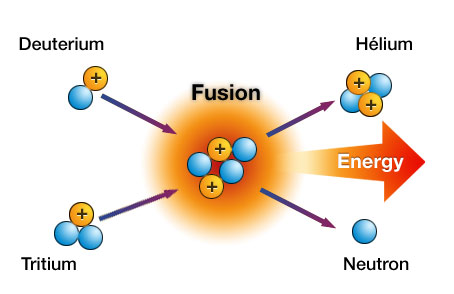
There is a few grams of tritium available at Fukushima Daiichi and it makes more every year, they will even pay you to remove it 🙂
Bill, their picture shows an emerging 4He nucleus, and a neutron and then …. ENERGY ….
So just what is this …. energy ….
Well most of the energy is in the kinetic energy of the neutron; 14 MeV, and about the only way to access that 14 MeV is in the form of heat by slowing the neutron in materials which will get hot, and radioactive.
The 4He nucleus will recoil at about 1/4 of the neutron velocity, but the energy splits according to 1/2mv^2, so 80% of the KE is in the neutron, and 20% in the He nucleus recoil.
G
Bill:
Good graphic, but you left out the essential component of this reaction; mass (gravity). All known naturally occurring fusion reactions are a conversion of potential energy (gravity) to free energy. All of them. Accept no substitutes.
In the example experiment described in this article, energy is used as a proxy for mass according to the recently derived formula E = mc². No magic, just a direct conversion of mass (gravity) to energy. Potential energy (gravity) is converted to free energy, but absent gravity (mass) the reaction isn’t net positive in energy.
This experiment demonstrates the well understood relation between mass and energy by using energy as a proxy for mass. But it will never be net positive. It can’t be.
>>
All known naturally occurring fusion reactions are a conversion of potential energy (gravity) to free energy. All of them.
<<
There’s no potential energy conversion in the Sun. If there was, then the Sun would be shrinking. The Sun’s size is due to a balance between nuclear processes trying to blow it apart and gravity trying to make it smaller. The Sun’s current energy source is proton-proton fusion. The Sun’s not massive enough for CNO cycle fusion.
Jim
That 14 MeV neutron is where most of the released fusion energy is, in the D-T reaction, so you have to deal with than neutron to get access to that energy in the form of heat, which is the trash can of the energy spectrum.
G
All of these reactions you mention are, in practice, derived from a conversion of gravity to energy. Attempts to simulate the effects of gravity by injecting energy as a proxy (which is exactly what this team is doing) will fail to produce net positive energy.
The fusion reaction you observe in a star such as Sol (our star) is driven by gravity; it is a direct conversion of potential energy (in the form of gravity) to free energy and there are losses in that conversion. It’s not a free lunch. Injecting energy as a proxy for mass will never, can never, result in a net energy gain, else you would have perpetual motion.
The mistake these experimenters make is in believing they’re using a hydrogen/boron fuel; it isn’t a fuel it’s merely a reagent. The seconf law precludes this reaction being net positive.
So what is the fuel in a hydrogen bomb, and why do they produce net positive energy?
Greg Goodman asks: “So what is the fuel in a hydrogen bomb, and why do they produce net positive energy?”
This is a very good question. With a hydrogen fusion weapon, the energy release of a fission reaction primer is amplified by the hydrogen reaction, but you aren’t getting “something for nothing”, you’re making the energy release more efficient than it would be. The fusion reaction is essentially pumped by the fission reaction.
What these folks are doing is pumping the fusion reaction with a laser, which results in fusion but at a net energy deficit.
Another way to think of it Greg is to replace the hydrogen/boron “fuel” with wood; you can use a laser to light a wood fire in a combustion chamber, igniting it, then capture the released heat from the wood to boil water and convert that heat to electric energy via a steam turbine. It works, but it costs more (in energy) to light the wood than you’ll recover in steam power.
My toy example isn’t really a good one since it uses energy to prime a chemical reaction in the wood, which actually uses oxygen to burn the wood.
It’s likely the hydrogen/boron fusion reaction would release more heat than a wood fire, but it would still be a net negative conversion.
Bartleby writes: “All of these reactions you mention are, in practice, derived from a conversion of gravity to energy. Attempts to simulate the effects of gravity by injecting energy as a proxy (which is exactly what this team is doing) will fail to produce net positive energy.”
This is just pure nonsense. Both fission and fusion work because the end products have less mass than the starting ingredients. In the case of the hydrogen-boron reaction discussed here, we have one proton and one boron nucleus converted to three helium nuclei:
Element Atomic mass
1-Hydrogen 1.007825
11-Boron 11.009305
Total: 12.01713
Converts to:
4-Helium 4.002603
4-Helium x 3 12.007809
Difference: 0.009321
That lost mass difference has been converted to energy according to E=mc^2. There is a potential barrier between the starting and ending states, so you have to push the ingredients over the barrier somehow. Maybe (as in the sun) infalling material generates the needed temperature from conversion of potential to kinetic energy. Maybe, as in the experiment discussed here, it is enabled by laser beams. But the energy that results is not from gravity (in the sun) nor from the laser (in this experiment). It is from the lost mass that was converted to energy.
Ron; It’s hardly nonsense and as I mentioned, you can overcome the boundary for energy release in wood using lasers too. That doesn’t allow you to harvest more energy than is put into the reaction, nor does producing a fusion reaction using the same methods.
The boundary energy for initiating the reaction equals or exceeds the energy harvested. That’s been the failure of these attempts throughout history. Natural thermonuclear reactions depend on gravity as I explained, you can call it mass if you like or express it as energy using the classic formula, it changes nothing. It’s essentially the conversion of potential energy to kinetic.
Greg,
With a H-bomb, you get one shot, which produces a lot of energy; but unfortunately it blows your fusion “reactor” to smithereens.
The general idea here is to contain the energy of that H-bomb inside a bottle, and the only successfully demonstrated way of doing that is gravitational confinement, which is automatic, but impractically large.
There is a theorem in electro-magnetism called Earnshaw’s theorem, which in essence says there is no EM bottle. No configuration of electric charges or magnetic poles, produces a field with a point of equilibrium where another charge or pole can be captured.
Every containment bottle has outward bursting forces that require another bottle outside that to contain it. Gravitation needs no such bottles because it sucks instead of blowing (pushing).
G
Bartleby: “Ron; It’s hardly nonsense and as I mentioned, you can overcome the boundary for energy release in wood using lasers too. That doesn’t allow you to harvest more energy than is put into the reaction,…”
You clearly don’t have the foggiest understanding of physics, made all the more infuriating by your supreme confidence in your faulty ideas. If your comment about wood were correct, then a forest fire could emit no more heat than the arsonist put in with the match used to start it. In both chemical and nuclear reactions, bonds in a high energy state are converted to ones in a lower energy state. The difference actually reduces the mass of the components, and that mass is converted to some form of energy, either heat or electricity or something. Some reactions go fast (explosions), some go slower, and in some, the potential barrier between the high and low energy states is so high that a continuous input of energy is needed to drive the components over the barrier. But as they go down the other side, any energy input is recovered, and more. Of course, you can also contrive to drive reactions the other way, in which case you do lose energy because the final state locks up more energy than the initial state did.
The only difference between chemical and nuclear reactions is the much larger difference between initial and final states, and the larger height of the barrier separating them. So you need more energy to get a nuclear reaction going, and more energy is obtained from the reaction.
This is where Holdren should have spent the money he wasted on 20+ bankrupt renewable energy firms.
“This is where Holdren should have spent the money he wasted on 20+ bankrupt renewable energy firms.”
Wasted or stolen? Considering how fast those companies went belly up and the money disappeared, some are convinced the investment in those renewable energy firms was a scam all along. It’s more likely the money squandered on Obama’s trillion-dollar stimulus (stealfromus) went exactly where it was intended to go: into the pockets of Democratic party cronies. It’s classic Democratic “wealth redistribution”
To refresh memories: From “Obama’s Taxpayer-Backed Green Energy Failures”
http://dailysignal.com/2012/10/18/president-obamas-taxpayer-backed-green-energy-failures/
1. A123 Systems ($279 million)*
2. Abound Solar ($400 million)*
3. Amonix ($5.9 million)
4. Azure Dynamics ($5.4 million)*
5. Babcock and Brown ($178 million)
6. Beacon Power ($43 million)*
7. Brightsource ($1.6 billion)
8. ECOtality ($126.2 million)
9. EnerDel’s subsidiary Ener1 ($118.5 million)*
10. Energy Conversion Devices ($13.3 million)*
11. Evergreen Solar ($25 million)*
12. First Solar ($1.46 billion)
13. Fisker Automotive ($529 million)
14. GreenVolts ($500,000)
15. Johnson Controls ($299 million)
16. Konarka Technologies Inc. ($20 million)*
17. LG Chem’s subsidiary Compact Power ($151 million)
18. Mascoma Corp. ($100 million)
19. Mountain Plaza, Inc. ($2 million)*
20. Navistar ($39 million)
21. Nevada Geothermal ($98.5 million)
22. Nordic Windpower ($16 million)*
23. Olsen’s Crop Service and Olsen’s Mills Acquisition Company ($10 million)*
24. Raser Technologies ($33 million)*
25. Range Fuels ($80 million)*
26. Satcon ($3 million)*
27. Solyndra ($535 million)*
28. SpectraWatt ($500,000)*
29. Stirling Energy Systems ($7 million)*
30. SunPower ($1.2 billion)
31. Thompson River Power ($6.5 million)*
32. Vestas ($50 million)
33. Willard and Kelsey Solar Group ($700,981)*
*Denotes companies that declared bankruptcy.
Total: $4,376,470,000.00
I don’t get it. Why go for the more difficult target (hydrogen / boron) when the easy target has not yet been achieved? I understand the attraction of hydrogen / boron, but surely a proof of concept demonstrating viable net energy producing tritium / deuterium would be a good stepping stone.
A major tritium / deuterium success would be Nobel Prize material, and would generate an endless supply of funding for further research, even if the researchers didn’t consider it the final goal.
“working with international collaborators on the remaining scientific challenges”
Anyone know what the ‘remaining scientific challenges’ are? Seems to be a huge ‘gotcha’ to me.
+1
Exactly my feelings.
“remaining scientific challenges” = “we have no idea how to do this in principle, never mind in practice” 🙂
Where does the energy for the lasers come from? Probably a bit of a challenge.
@ur momisugly Jim
Ultra Short duration pulses = high POWER with low input energy
sub picosecond laser pulses are only possible due to the continued development of Chirped Pulse Amplification CPA and other ultra short pulse optical technologies
https://en.wikipedia.org/wiki/Ultrashort_pulse
“Where does the energy for the lasers come from? ”
Chirped Pulse Amplification CPA via hamster wheel driven generators (with a cat thrown in for extra power).
@ur momisugly Louis
How much energy is used by a 1000 joule laser emitting for 1 picosecond @ur momisugly 10 Hz rate for 1 hour?
36,000 pulses @ur momisugly 1000 Joules per pulse =
36 Million Joules
How many joules are in a Kilowatt-hour? 3.6 million
So 10 Kilowatt-hours to operate a PETAWATT LASER for 1 hour — about $1.50
You won’t get a Nobel science prize for it as it is nothing more than an engineering challenge not a science knowledge challenge. We have theories for how it works, just the condition controls you require is extreme.
Who knows. Nobel Science prize were awarded for devices, like bubble chamber and multiwire proportional chamber, or “contribution to the development of [insert name of important device/method]”
A working fusion device WOULD get some Nobel prize, for sure.
The bubble chamber didn’t win the prize Donald Glaser did 🙂
Eric: The reason to look at P-B fusion instead of the lower energy D-T reaction is because the D-T reaction yields high velocity neutrons. That means anything near the reaction will get transmuted by neutron capture. The D-T folks mostly reduce this effect bu lining the reactor with lithium, which is the source of the tritium needed in the reaction. But the reactor walls WILL become radioactive with time.
D + T -> 4He + n + 17.59 MeV with the
Neutron carrying 79.87% of the energy
(that’s bad)
Think of how many atoms need to be fused every second to produce the fusion energy in a working reactor.
That is how many neutrons will come flying off at near the speed of light from this reaction.
In just testing, the national ignition facility produced 300,000,000,000,000 neutrons per second. Particles with mass flying off at near the speed of light.
If a person was anywhere near this without 10 feet of lead shielding in the way, that person would literally be disintegrated within seconds. The human race has been sold a bill of goods on the D-T fusion potential. There is nothing that is going to hold this kind of radiation in.
Sorry, there are a few things that could hold this type of radiation in. The centre of a star, or a black hole.
Dan, the D-T fusion energy released in the “fusion” is simply the KE of the 4He nucleus and the n flying apart, with equal and opposite momentum (mv) But the energy is 1/2 mv^2, so the 4x velocity of the neutron wins over the 4x mass of the 4He ion. It’s the old rocket efficiency problem.
Nearly all of the energy is in the exhaust; not in the rocket.
So in a D-T fusion, I’m guessing you can have an exhaust hot helium stream, and you can moderate the 14 MeV neutrons with light atoms that get heated (and likely radio-active).
But those pesky neutrons are where the fusion energy is.
G
The problem with using deuterium and tritium is that they are relatively rare isotopes and difficult to separate from ordinary hydrogen nuclei (a proton without neutrons). Since they are both hydrogen atoms, which are gaseous except at extremely low temperatures, high pressures are needed to get the atoms close enough together to fuse.
The major benefit of using boron is that it is a solid up to about 2300 C, so that boron nuclei can be tightly packed at high temperatures, and a common hydrogen (H-1) nucleus, or proton, can fuse with it. The most common isotope of boron is B-11, and of hydrogen is H-1, so there wouldn’t be an expensive purification step needed to get equal and high concentrations of the rare deuterium and tritium isotopes.
Well they say that all the fusion energy the planet needs is contained in the top 1/16th of an inch of the water in San Francisco bay. So Deuterium is not rare as ores go.
The D-D fusion can give rise to 3He + p or T + n. I forget what the ratio of those reactions is, it’s been nearly 60 years since I was around any fusion experiments.
G
Because it is a completely different type of fusion. And a different type of energy production.
1. High intensity short pulsed laser induced plasma jet fusion
2. Alpha particle cascade magnetic field interaction creation of current
This is not a thermal system.
The fusion is caused by an extremely short laser pulse (picosecond in the paper, potentially femtosecond) which allows for a multi petawatt incident power density,
This creates a high energy plasma that interacts via alpha particle cascade with a second laser induced magnetic field to create an electric current.
https://arxiv.org/ftp/arxiv/papers/1704/1704.07224.pdf
“About four times more neurons per gained energy are produced than from uranium and other fission reactions” in the linked article.
Besides the error, says a lot about the “promise” of fusion compared to fission.
Yes Karl. And Dense Plasma Focus (ie the LPPFusion team approach) is yet a third option for designing a fusion energy reactor… right now the Dense Plasma Focus technique is the one with the most mojo behind it. Tokamaks look to be a dead end; ITER won’t even start experiments until 20132; and the large laser- fusion program at Lawrence Livermore National Lab has been terminated.
Where is Tritium mined ??
G
The moon
Fukupshima
Color me skeptical, though I’m as keen as the next person for it to work. Even if all the energy really is produced as electricity, there aren’t any known materials that can conduct that electricity away at power station-sized currents without getting extremely hot. Or does the suite of technical advances still required include high temperature superconductors?
I’m wondering how much energy is required to power the lasers?
Hopefully, less than the power being generated.
My thoughts, too. Do we have an energy balance on this process?
1 kiloJoule Laser @ur momisugly .17 picosecond pulse @ur momisugly 10 HZ
That is 60 Petwatts
Very little energy — extremely high incident POWER which is the reason it works
Karl, you are dreaming.
Almost ALL or almost almost ALL of the time the laser is doing nothing, while they clear out the ashes from the explosion, before they can put in a brand new shiny boron pellet, and then whack that one.
The sub pico-second laser pulse will at best produce maybe electric current pulses of a few nano-seconds long depending on how large the sphere is, at no more than one foot per nano-second, and then you get to clean the apparatus of the ashes, and get ready to fire the lasers again.
Sub pico-second laser pulses without tera-herz repletion rates will not generate a continuous electric current.
G
@ur momisugly George
Only a very small portion of the surface of the boron target is vaporized — per shot
we are talking micrograms
It won’t happen in my lifetime.
I’ve given up worrying about things that aren’t going to happen in my lifetime.
I dunno. Do petawatt lasers need cooling? BTW, Amazon doesn’t seem to sell petawatt laeers. I did find a 20 watt unit elsewhere for about $12000 USD. I think we need 2*2*10**14 of those to build a power station.
And if we’re putting two petawatts into the two lasers and we’re getting a positive return of energy, I think we’re going to need some pretty thick wires in parts of the power station. 1.4Pw is equivalent to the estimated total energy transported by the Gulf Stream.
It IS interesting, but I think there are a few small technical problems to be resolved before we’re ready to build one of these.
Think ULTRA-SHORT PULSE — and now you understand how we have terawatt, petawatt, and soon exawatt lasers.
picosecond = E-12
femtosecond = E-15
put those in the denominator (where time goes in the power = work/time equation) and you get
PETAWATT LASERS from a 1kj laser
15 joule (watt) laser on amazon for $559
https://www.amazon.com/SHUOGOU-15000MW-Engraving-Engraver-Personal/dp/B075K7JFWW/ref=sr_1_1?s=arts-crafts&ie=UTF8&qid=1513294233&sr=1-1&keywords=laser&refinements=p_36%3A2638330011
The laser in this case is the spark plug – sure it takes a little energy, but there is far more in what results.
This could actually work…
“””””…..
Leo Smith
December 14, 2017 at 10:43 pm
The laser in this case is the spark plug – sure it takes a little energy, but there is far more in what results.
This could actually work… …..”””””
Leo, what is the spark repetition frequency in your automobile engine, and how long does it take to remove the ashes from your cylinders and replace them with a new fuel pellet, so you can fire another spark into it to get along down the road.
This is the process these dreamers are talking about.
Complete nonsense.
G
@ur momisugly George
you are uninformed
very small amounts of the target are turned into plasma per shot micrograms
Seems you can find one here:
http://www.dailymail.co.uk/sciencetech/article-3179045/The-Death-Star-weapon-Japan-just-fired-world-s-powerful-laser.html
My point was not about the net energy balance, but about the ability of the materials to remain thermally stable under allegedly non-thermally-taxing conditions. They have to be able to both absorb the laser pulses without decomposition, and then conduct away an even larger amount of electrical energy through what must be a relatively tiny mass of something that is probably a poor electrical conductor. I’m not yet persuaded.
The petawatt pulse turns a microgram portion of the target material into a plasma.
Remember it is only 1000 Joules or so — which would only heat 1 gram of boron to 1000K
It is the high incident power which causes a very small amount of the target to become plasma
theyve been spinning this nonsense since the 70s with JET
spent tens of Billions and still no where near breakeven or a reaction longer that a few minutes
time to pull the plug
If I were king, I would cut the support for ITER in half and use that money to fund the more promising small scale fusion projects, both hot and cold. Yes, there are some serious researchers working on “cold fusion”. Here’s a recent paper from Tadahiko Mizuno. http://lenr-canr.org/acrobat/MizunoTpreprintob.pdf
Cold fusion and LENR are not the same thing.
http://newenergytimes.com/v2/reports/LENR-is-Not-Cold-Fusion.shtml
Just trying to keep it simple.
Wrong technology — read the paper
the lasers we need can be bought off the shelf
I cannot find any petawatt-scale lasers on Amazon. I wonder where he buys them?
Aliexpress, probably.
Harbor Freight.
I’m sticking with cold fusion.
“I’m sticking with cold fusion.”
Wouldn’t it be a(another) black eye for scientific-consensus thinking it that’s where the breakthrough occurred?
Oh you can’t make this up.
+++
The lppsite is crowdfunding, so read everything thinking they’re collecting money.
Well, there’s muon-catalyzed fusion — a form of cold fusion. It actually does work. Just not quite well enough to break even. https://en.wikipedia.org/wiki/Muon-catalyzed_fusion
Hugs — your fleering remarks about LPPFusion are false and borderlineslanderous. It’s true the project is being crowd-sourced funded… yes… instead of taxpayer funded… and furthermore, the LPPFusion business model is designed to achieve very low cost electricity, and not create yet another a rent -seeking monopoly. Thgus the appeal to crowd-sourcing instead of the usual VC funding route, which often is not quite so high-minded as the LPPFusion team’s style.
Private, crowd-sourced funding reflects well on the LPPFusion team… the company is the most transparent imaginable, with results disclosed rapidly for the public as well as publsihed in the peer-reviewed literature. Progress by LPPFusion — which is quite significant— is regularly reported in the mainstream press and
professional journals.
Lasers R Us?
That’s only because “Mad Scientist and Evil Genius Supply” is a member’s only store and memberships are by invitation only.
Darkweb. Bitcoins only.
I’d like to buy a petawatt-class industrial laser for Christmas. I’m sure it’s a consumer product and safe to kids. /sarc
I’m told Elon Musk shops there. Must be reputable.
It’s weird that you probably could buy a petawatt-class industrial laser for your kids for Christmas.
But as far as being a good idea, it’s probably right up there with lawn darts.
They are a little specialist in nature so would have to be acquired under contract. Similar have been used in research projects before. I just wonder what the duty cycle on them is. I imagine they would have to cool down after each pulse for quite a while even with some sort of active cooling system.
Acme, same place the coyote gets his stuff.
Sorry Bear. I said the same thing not knowing you beat me to it. Snap. 🙂
Actually you can build your own fusion devices at home, people have done so for years some as young as 14 .. just google “fusor”. They just don’t generate more energy than they consume but they are pretty 🙂
+1
B
You can’t buy an aircraft carrier there either. Not even a used B747 jet.
If you are in the market for Aircraft Carriers, the UK has a couple at the moment. The only problem is that there are no aircraft to fly off them and won’t be for many years. This is the biggest ****-up in years, but no-one seems at all worried and everyone seems proud of these completely useless. A great example of military planning!! SARK
ACME – That’s where Wylie Coyote gets all his stuff. 🙂
It’s the chirped pulse technology that allows for sub picosecond pulses.
A 100 joule laser at .1 picosecond = a PETAWATT LASER
Acme, same place Wiley Coyote gets his equipment.
Not the only game in town for aneutronic fusion proposals. See https://lppfusion.com/ for example
A great way to convert more power into less? Can anybody explain where I am going wrong?
OTOH “a petawatt-scale laser pulse, whose fleeting bursts pack a quadrillion watts of power”
OTOH “…. alpha particles, converting their kinetic energy into more than a gigajoule (280kWh) of electric energy per shot”
The pulse is in the picoseconds, so converting to Watt seconds is:


Converting this into kWh:
messed up my latex on the conclusion: $latex 280kWh>>2.8 \times 10^{-7}kWh
Does that latex really work? $ latex 10^{-7}$
Obviously difficult. But there’s the test page to play with. The laser works at petawatt scale, but how much it needs to run, i.e. what is the average power to run the laser at? Is it possible?
You are not differentiating between Watts and Watt hrs (one is a measure of power, the other a measure of energy).
How much radiation in the form of gamma rays from the quantum realignment of nuclear shells will be released? That still seems to be a large bit of potential radiation they aren’t mentioning. Though I suppose one could place the whole apparatus at the bottom of a lake and let the water absorb the gammas.
Radiation containment should be easily accomplished for gammas as they tend to not degrade the structures the way neutrons do.
I don’t know about the big ITER ones but if you google “Lockheed Martin Compact Fusion Reactor” they have the details on a baby one (well if you call 20 tons a baby). They funded it’s phase 2 in 2016 so they must be getting results and there is rumors it powered a navy rail gun for a test fire.
It is probably the only fusion generator we are likely to see in our lifetime assuming it gets out from the military 🙂
Sounds a lot like perpetual motion to me
Not perpetual as one must add fuel.
How will they store, and then distribute at the grid level, such a huge pulse of electricity?
Super-capacitors or even lots of regular ones.
Then they have to convert the DC pulse to AC so there is a lot of room for smoothing. (If the scheme works at all.)
Don’t need them — it is the ultra short (sub-picosecond) pulse that makes the high incident power
READ the paper — the laser pulses are extremely short .17 picosecond
Femtosecond pulses are around the corner
What is the pulse repetition frequency of these soon to be femtosecond lasers. I assume that each laser pulse will destroy one each of those tiny fuel pellets so they will need to buy another one to replace it before they fire the next laser pulse.
It’s like an internal combustion engine. You inject a wad of fuel into the can (cylinder) then you whack it, and it moves something at high speed (the piston) then you clean out the effluent, and inject a new fuel pellet.
No much difference that I can see.
G
@ur momisugly George
and your assumption would be wrong
read the paper — a very small portion of the target is turned into plasma at each shot.
The paper posits A 1000 Joule Laser at 10 Hz — which would take 10Kwh to operate per hour
@ur momisugly George
I was incorrect regarding the proposed technology.
This paper does identify destruction of the target.
However, there are other high intensity short laser pulse plasma fusion experiments where only small portions of the target was vaporized.
https://www.nature.com/articles/ncomms5149?message-global%3Dremove
https://str.llnl.gov/str/MPerry.html
Conservation of energy????? What is the theorectical conversion ratio between energy in versus energy out???
100 x more out than in.
The back of the envelop is 10^7 from above. The key for conservation of energy is to look at the mass defect of the the reactants and the products. That difference in mass is where the energy comes from. That is the key to all nuclear power. In this case you create 10^7 kWh in mass defect for every kWh you put in in laser energy.
When he says “mass defect” he’s talking about the amount of mass converted into energy. Remember that E = MC^2.
I wonder if this technology could be adapted to power spacecraft?
.
Small version google “Lockheed Martin Compact Fusion Reactor”
Yes.
https://spectrum.ieee.org/aerospace/space-flight/a-fusion-thruster-for-space-travel
That is only a thruster, for manouvering in space you aren’t going anywhere far using that Anthony.
What? Maneuvering in space is ALL about thrust. And the higher the isp, the better. (Well, not always. But usually)
If it actually worked, it woulf be an ideal thruster for getting things into different orbits where long, slow thrusts could be done.
Paul,
You will need a very big starter battery.
I’ll be giving a talk on high power for spacecraft at NorWesCon in Seattle in March. There are several small fusion efforts, including TriAlpha who also are working with P-B that is aneutronic.
http://www.trialphaenergy.com
To get cynical, when they have a working device, not just a design proposal, I will regard it as an advance.
What a joke – “30 to 50 years” I’ve got news. By that time the world will be powered by small modular molten salt reactors, which are every bit as safe as a fusion reactor. Damage from
radiation is impossible. And those “toxic wastes” are not wastes at all -they represent enormous amounts of free energy that can do many things – desalinating huge quantities of seawater being but one. Now can that fusion reactor produce power for less than 4 cents per kWhr? I doubt it.
If it can compete economically, it might very well eventually supplant other generation technologies, but those molten salt reactors which I am predicting have a very long lifespan, produce very cheap electricity, and, so far no data has been produced to support any claim by fusion advocates of any cost advantages with respect to molten salt reactors.
I find it suspicious that no cost estimation of these fusion reactors is forthcoming. Don’t these people know by now? They certainly should, I would think.
The engineering problem with molten salt reactors is the plumbing materials. Molten salts tend to corrode the pipes after a short while (less than 2 years). Once that has been licked you may be correct.
Most MSRs using graphite moderators are quoted as requiring a complete graphite replacement every 7 to 8 years
Owen,
I can’t find the reference, but I remember reading some docs from ORNL that suggested that pipe wall corrosion due to molten salts was NOT an issue. Something along the lines of “All the engineers in the program understood that xxxx was the real issue, not corrosion by the salts.” This was surprising to me since I felt like the intuitive thing was that, yes, molten salts would be highly corrosive and the piping would be difficult to maintain.
I could be remembering this incorrectly, though. My reason for perusing those documents was for a project unrelated to MSRs…
rip
Rip,
That may be. The salts used are a little different, but that was the take I got from the engineering students working on a test unit. The professionals may have already worked that bit out.
@Owen
They put 20,000 hours or almost 3 years on the test bed with no issues. Who told you there was a corrosion issue?
D.J
These weren’t working on the DOE project, it was a molten salt process that some of the Georgia Tech Nuclear Engineering students worked on. They probably weren’t working with the same materials and I think their heat source was actually natural gas and were working on molten salt heat exchanger design. They kept having problems, but as seniors in nuclear engineering, they probably still had a great deal to learn.
Art, I’ll believe that when I see it. The technological hurdles on MSRs have been overcome, but the bureaucratic ones are MUCH higher.
I don’t know if the NRC has drawn Trump’s attention. We shall see…
From what I understand about the technology, continuous outgassing of radioactive xenon and krypton is required for MSR to work. That doesn’t sound like a good idea unless they intend to capture and sequester those gases.
OK, it looks like that concern would be addressed
https://en.wikipedia.org/wiki/Liquid_fluoride_thorium_reactor
Superman won’t be happy about that Krypton stockpile. LOL.
I wonder if anyone has calculated the amount of [Kr-85] storage that would be required for one MSR reactor? And the cost? Seems like there’d have to be some sophisticated filtering and compression technology at each plant.
Kr-85, not K-85
The noble gases released by fission reactions are not incorporated into the body (inert after all) and are of little consequence if accidentally released. The isotopes I-131 (half life 8 d) and Cs-137 (30 y) are of greatest concern, the I-131 because it is concentrated in the thyroid and Cs because it is long lasting. Even so the molten salt designs hold the inert gases in pressure vessels or cold traps until they have largely decayed. The MSRs have the advantage of holding ions such as I-131, Cr-137 and Sr-90 in the molten salt where they do not vaporize. The Moltex reactor uses a simple sacrificial cathode to protect its molten salt tubes from corroding. Thorcon plans to switch out reactor vessels every four years, then a few years cool down before they are refurbished.
Why did the American’s beat the Russians to the moon?
Because the Americans’ Germans were better than the Russians’ Germans.
Now the Aussies appear to be ahead on the German front.
Plus ca change plus c’est la meme chose…
Err… in line one, read ” Americans’ “
I give up. I hate spell corrector programs.
No, American’s is possessive. It was Russians’ that was wrong.
In line one, I’d prefer to read “Americans” without an apostrophe.
Chronic misinsertion of an apostrophe before a trailing “s” is a mental disease known as misapostrophosis, which is apparently transmitted by reading the text of infected persons.Grammatically-ignorant conformists are most susceptible.
Mr. Fusion . . . is that you?
What do they intend to do with the carbon byproduct from this fusion of H with B?
Burn it to make CO2?
In the middle of the next Dalton Minimum, the MSN will be begging us to release MORE CO2…
Don’t be silly. Just like in the 60’s and 70’s, they will decide that now burning Fossil Fuels causes cooling.
And just like now, they will say with a straight face that no true scientist ever said anything different. It’s Fake News that we thought back at the turn of the millennium that burning Fossil Fuels caused Warming.
Then they will call you names.
(not sure if sarc. <¿<)
The carbon immediately breaks into three alpha particles that then become 4He.
Gee, could that be the cure for our helium shortage?
Phillip Eklund runs an entertaining and informative web site y’all might like:
http://www.projectrho.com/public_html/rocket/fusionfuel.php
Oops, at first glance I thought the title of this article was, “Laser-bourbon fusion now ‘leading contender’ for energy” 😉
I think I need another coffee this morning.
Haha…now THERE’S a technology I could get behind!
rip
Or some bourbon.
I’m putting my money on Molten Scotch Reactors
From past and current experience, it’s becoming evident that fusion energy will always be “30 to 50 years” in the future.
Imagine for a moment that instead of trying to shove CAGW down our proverbial throats and requiring the spending of hundreds of billions, if not trillions of dollars chasing false solutions, that they took a more positive and realistic approach and supported such research at a higher level. Or if they helped the world plan for environmental catastrophe natural or manmade instead of ending the security of cheap and reliable present sources of energy. When Hurricane Andrew hit Florida we were totally unprepared. While we certainly didn’t fix all our problems or raise preparedness to the highest levels we did make significant enough changes.
For those interested, Tri Alpha Energy (tae.com) has been working the hydrogen-boron fusion challenge with some success. They use a Field-Reversed Configuration in a linear accelerator that creates two elongated plasma toroids and slams them against each other at extreme velocities.
A comical irony that WUWT readers may appreciate is that, of course, fusion is “carbon-free” energy, carbon dioxide-free, that is; but the H-B fusion produces – a carbon atom as its first product, which then fissions into three alpha particles. This carbon exists only for, what, picoseconds, and never enters the environment, and never combines with two oxygens to form the dreaded carbon dioxide – BUT IT’S CARBON!!! The horror!