Guest Post by Willis Eschenbach
Short answer? Of course not, that would violate the Second Law of Thermodynamics … BUT it can leave the hot object warmer than it would be if the cold object weren’t there. Let me explain why this is so.
Let me start by introducing the ideas of individual flows and net flows. Suppose I owe you twenty-five dollars. I run into you, but all I have is a hundred dollar bill. You say no problem, you have seventy-five in cash. I give you the hundred, you give me the seventy-five, and the debt is paid.
Now, there are two equally valid ways to describe that transaction. One way looks at both of the individual flows, and the other way just looks at the net flow. Here they are:

Figure 1. Net flows and individual flows. The individual flows are from me to you, $100, and from you to me, $75. The net flow is from me to you, $25.
What does this have to do with cold and warm objects? It points out a very important distinction, that of the difference between individual flows of energy and the net flow of energy, and it relates to the definition of heat.
Looking at Figure 1, instead of exchanging dollars, think of it as two bodies exchanging energy by means of radiation. This is what happens in the world around us all the time. Every solid object gives off its own individual flow of thermal radiation, just as in the upper half of Figure 1. We constantly radiate energy that is then being absorbed by everything around us, and in turn, we constantly absorb energy that is being radiated by the individual objects around us.
“Heat”, on the other hand, is not those individual flows of energy. Heat is the net flow of energy, as represented in the bottom half of Figure 1. Specifically, a heat flux is the net flow of energy that occurs spontaneously as a result of temperature differences.
Now, the Second Law of Thermodynamics is only about net flows. It states that the net flow of thermal energy which we call “heat” goes from hot to cold each and every time without exception. However, the Second Law says nothing about the individual flows of energy, only the net flow. Heat can’t flow from cold to hot, but radiated energy absolutely can.
When an object emits radiation, that radiation goes on until it hits something that absorbs it, whereupon it is converted to thermal energy. The individual temperatures of the emitting and absorbing objects are not significant because these are individual energy flows, and not the net energy flow called “heat”. So there is no violation of the Second Law.
Here’s the thing that keeps it all in balance. If I can see you, you can see me, so there are no one-way energy flows.
Which means that if I am absorbing radiation from you, then you are absorbing radiation from me. If you are warmer than me, then the net flow of energy will always be from you to me. But that says nothing about the individual flows of energy. Those individual flows only have to do with the temperature of the object that is radiating.
So how do we calculate this net energy flow that we call “heat”? Simple. Gains minus losses. Energy is conserved, which means we can add and subtract flows of energy in exactly the same way that we can add and subtract flows of dollars. So to figure out the net flow of energy, it’s the same as in Figure 1. It’s the larger flow minus the smaller flow.
With all of that as prologue, let me return to the question that involves thermal radiation. Can a cold object leave a warm object warmer than it would be without the cold object?
While the answer is generally no, it can do so in the special case when the cold object is hiding an even colder object from view.
For example, if a person walks between you and a small campfire, they hide the fire from you. As soon as the fire is hidden, you can feel the immediate loss of the radiated energy. At that moment, you are no longer absorbing the radiated energy of the fire. Instead, you are absorbing the radiated energy of the person between you and the fire.
And the same thing can happen with a cold object. If there is a block of wood between you and a block of ice, if you remove the wood, you’ll get colder because you will be absorbing less radiation from the ice than you were from the wood. You no longer have the wood to shield you from the ice.
Why is all of this important? Let me offer up another graphic, which shows a simple global energy budget.

Figure 2. Greatly simplified global energy budget, patterned after the Kiehl/Trenberth budget. Unlike the Kiehl/Trenberth budget, this one is balanced, with the same amount of energy entering and leaving the surface and each of the atmospheric layers. Note that the arrows show ENERGY flows and not HEAT flows.
These ideas of individual flows, net flows, and being shielded from radiation are important because people keep repeating over and over that a cold atmosphere cannot warm the earth … and they are right. The temperature and the radiation are related to each other by the Stefan-Boltzmann equation. When we apply the S-B equation to the 321 W/m2 of downwelling “back radiation” shown in the graphic above, it tells us that the effective radiating level is somewhere around freezing, much colder than the surface.
BUT a cold atmosphere can leave the earth warmer than it would be without the atmosphere because it is hiding something even colder from view, the cosmic microwave background radiation that is only a paltry 3 W/m2 …
And as a result, with the cold atmosphere shielding us from the nearly infinite heat sink of outer space, the earth ends up much warmer than it would be without the cold atmosphere.
To summarize …
• Heat cannot flow from cold to hot, but radiated energy sure can.
• A cold atmosphere radiates about 300-plus W/m2 of downwelling radiation measured at the surface. This 300-plus W/m2 of radiated energy leaves the surface warmer than it would be if we were exposed to the 3 W/m2 of outer space.
My best regards to all,
w.
My Usual Request: When you comment, please QUOTE THE EXACT WORDS THAT YOU ARE DISCUSSING, so that we can all understand the nature of your objections.
My Second Request: Please keep it civil. Speculation about the other person’s motives and cranial horsepower are greatly discouraged.
Further Reading: My post entitled “The Steel Greenhouse” looks at how the poorly-named “greenhouse effect” work, based on the principles discussed above.
Math Notes: There’s an excellent online calculator for net energy flow between two radiating bodies here. It also has the general equation used by the calculator, viz:

with the following variables:

and Q-dot (left-hand side of the equation) being the net flow.
Now, when the first object is totally enclosed by the second object, then area A2 is set to a very large number (I used a million) and the view factor F12 is set to 1. This is the condition of the earth completely surrounded by the atmosphere. For the general case, I’ve set area A1 to 1 square metre. Finally, I’ve made the usual simplifying assumption that thermal IR emissivity is 1.0 for the surface and the atmosphere. The emissivity values are greater than 0.9 in both cases, so the error is small. With those usual assumptions, the equation above simplifies as follows, courtesy of Mathematica:

But sigma T ^ 4 is simply the Stefan-Boltzmann radiation for the given temperature. That is why, in the energy budget above, we can simply add and subtract the energy flows to produce the budget and check to see if it is balanced.
Interesting analogy — the atmosphere, of course, is not “cold”, nor is the surface “warm” (or “warmer”) — they are only relatively in that relationship. It only confuses the issue to think in terms of cold and warm. It is not the temperature of the material between the two objects that is the primary factor — only the case that there IS something that interacts with radiant energy between them. If the interceding object were entirely transparent to radiant energy, there would be no effect — because the object in this case, the atmosphere, is made up of gases and particles that do interact with radiant energy, the atmosphere both absorbs and radiates that energy and becomes part of the energy flow equation.
The very principle of atmospheres acting as protection from the mind-numbing coldness (there is something that can be called cold) of space itself has long been know — anyone camping on the high, dry deserts of the American Southwest has experienced the speed and efficiency of sky “sucking” the heat out into space when the atmosphere is (relatively) thin and dry, denying us that protective blanket.
The same is true in the opposite case — on the tropical islands, where altitudes are low (and the atmosphere thick) and humidity is high, less of the energy delivered by the Sun during the day escapes to space during the night — thus we lie on our boats, praying for a breeze to cool the sweltering night.
The moon (and Mars) lacking an appreciable atmosphere is hot in the direct Sun and very cold (all my our measure) in the shade or on the darkside.
A blanket itself is not “warm” — it is simply fairly efficient at slowing energy flow through it — which is what the atmosphere does. The highly efficient silvered plastic emergency “space’ blankets used by Emergency Rescue squads is prime example — the allow very little body heat to pass through and reflect back a great deal of the radiant energy (TV shows often make the error of placing these around the victim with the shiny side out which makes a better picture, but is incorrect in use).
“A blanket itself is not “warm” — it is simply fairly efficient at slowing energy flow through it”
An atmosphere is not “warm”, it simply increases the transfer of heat into it. The cause of increasing rate of transferred energy is reduced emissive power, observed as reduced T^4.
A blanket, or any other type of thermal insulation, causes reduced absorption of heat in the colder surroundings. Which is equal to reduction of the rate at which heat is transferred.
An atmosphere, and co2 in particular, causes increased transfer of heat, by adding heat absorbing molecules the its heat source.
This means, that an atmosphere acts exactly in the opposite way to how insulation affects temperature of a body.
Would you care to explain why your model is based on a violation of proven and applied physics?
Willis (Anthony), Thanks. This is an excellent article. Kudos to you gentlemen.
” In the case of the Earth, the solar irradiance of 1,368 W/m^2 has a Stefan Boltzmann black body equilibrium temperature of 394 K, 121 C, 250 F. That’s hot. Sort of.”
OK
“The Earth’s albedo reflects away about 30% of the Sun’s 1,368 W/m^2 energy leaving 70% or 958 W/m^2 to “warm” the surface (1.5 m above ground) and at an S-B BB equilibrium temperature of 361 K, 33 C cooler (394-361) than the earth with no atmosphere or albedo.”
You forgot to divide by 4 as 1368 is TOA.
The Earth is a rotating oblate speriod.
So that’ll be 342 W/m2 x 0.7
=239 W/m2 available (on average) for each m2 of the sunlit surface of Earth.
That gives a S-B temp of 255K
But we live on a planet at 288K
33K warmer.
Why?
Doh
The earth surface is not 33K warmer. The atmosphere is 33K colder.
This is caused by heat absorption=cooling of the source(earth surface)
Surface temp: (TSI/2pi*r^2)/(4/3pi*r^3)^2=383W/m^2=287K
In questions of science, the authority of a thousand is not worth the humble reasoning of a single individual.
Galileo Galilei
The ONLY^3 reason RGHE theory even exists is to explain how the average surface (1.5 m above ground) temperature of 288 K/15 C (K-T balance 289 K/16 C) minus 255 K/-18C , the average surface (now ground) temperature w/o an atmosphere (Which is just completely BOGUS!) equals 33 C warmer w/ than w/o atmosphere.
That Δ33 C notion is absolute rubbish and when it flies into the nearest dumpster it hauls RGHE “theory” in right behind it.
The sooner that is realized and accepted the sooner all of us will have to find something better to do with our time and the taxpayers’ money. Maybe that’s what keeps RGHE staggering down the road.
The genesis of RGHE theory is the incorrect notion that the atmosphere warms the surface (and that is NOT the ground). Explaining the mechanism behind this erroneous notion demands some truly contorted physics, thermo and heat transfer, i.e. energy out of nowhere, cold to hot w/o work, perpetual motion.
Is space cold or hot? There are no molecules in space so our common definitions of hot/cold/heat/energy don’t apply.
The temperatures of objects in space, e.g. the Earth, Moon, space station, Mars, Venus, etc. are determined by the radiation flowing past them. In the case of the Earth, the solar irradiance of 1,368 W/m^2 has a Stefan Boltzmann black body equilibrium temperature of 394 K, 121 C, 250 F. That’s hot. Sort of.
https://science.nasa.gov/science-news/science-at-nasa/2001/ast21mar_1/
But an object’s albedo reflects away some of that energy and reduces that temperature.
The Earth’s albedo reflects away about 30% of the Sun’s 1,368 W/m^2 energy leaving 70% or 958 W/m^2 to “warm” the surface (1.5 m above ground) and at an S-B BB equilibrium temperature of 361 K, 33 C cooler (394-361) than the earth with no atmosphere or albedo.
https://springerplus.springeropen.com/articles/10.1186/2193-1801-3-723
The Earth’s albedo/atmosphere doesn’t keep the Earth warm, it keeps the Earth cool.
Bring science, I did. (6,200 views and zero rebuttals.)
http://writerbeat.com/articles/14306-Greenhouse—We-don-t-need-no-stinkin-greenhouse-Warning-science-ahead-
http://writerbeat.com/articles/15582-To-be-33C-or-not-to-be-33C
http://writerbeat.com/articles/16255-Atmospheric-Layers-and-Thermodynamic-Ping-Pong
” In the case of the Earth, the solar irradiance of 1,368 W/m^2 has a Stefan Boltzmann black body equilibrium temperature of 394 K, 121 C, 250 F. That’s hot. Sort of.”
OK
“The Earth’s albedo reflects away about 30% of the Sun’s 1,368 W/m^2 energy leaving 70% or 958 W/m^2 to “warm” the surface (1.5 m above ground) and at an S-B BB equilibrium temperature of 361 K, 33 C cooler (394-361) than the earth with no atmosphere or albedo.”
You forgot to divide by 4 as 1368 is TOA.
The Earth is a rotating oblate speriod.
So that’ll be 342 W/m2 x 0.7
=239 W/m2 available (on average) for each m2 of the sunlit surface of Earth.
That gives a S-B temp of 255K
But we live on a planet at 288K
33K warmer.
Why?
Toneb
A sphere of radius r has 4 times the surface area as a disc of radius r. The incoming sees the earth as a disc the outgoing sees the earth as a sphere. In the bucket of warm poo model the incoming 1,368 discular W/m^2 is simply spread over the spherical ToA, i.e. divide by 4. Simple and dumb. K-T diagram.
The incoming is NOT actually spread evenly over spherical ToA to get an evenly heated 342 * .7 = 240. or what I refer to as the earth as a ball suspended in a warm bucket of poo.
The incoming strikes the ToA at an oblique angle so the perpendicular to ToA W/m^2 is 1,368 *cos latitude which ranges from 1,368 at the equator to zero at the poles.
The outgoing sees a sphere 24/7 with the heat leaving per Q = UAdT same as the walls of a house. Even Pierrehumbert recognized this in his 2011 paper.
Here’s an animated power point.
nr65:
“The incoming sees the earth as a disc ”
Yes, it does BUT we are calculating the energy budget for the whole Earth NOT just the sunlit side.
Hence a /4 factor is needed.
“Averaged over the entire planet, the amount of sunlight arriving at the top of Earth’s atmosphere is only one-fourth of the total solar irradiance, or approximately 340 watts per square meter.”
https://earthobservatory.nasa.gov/Features/EnergyBalance/page2.php
(I replied to this further up, but I see the same post is repeated here.)
Toneb, you write:
“That gives a S-B temp of 255K
But we live on a planet at 288K
33K warmer.
Why?”
As mentioned by others, Earth’s surface is not a blackbody. A blackbody is an object that only exchanges energy with its surroundings through radiative heat transfer.
The surface also exchanges heat with the troposphere via conduction (and subsequently convection).
Earth together with its troposphere, however, is a reasonably good approximation of a blackbody. The tropopause just above the troposphere ensures that there is no convective heat flow between the troposphere and the stratosphere. Conductive heat flow at this boundary is also small.
The average temperature of the troposphere is around 255K. Coincidence?
Back to the question, why is the surface 33 K warmer than 255 K?
Going further, why is the temperature at the tropopause 33 K colder than 255 K?
This is due to the lapse rate. Hot air rises and cools off. Cold air drops and warms up. The end result is a temperature gradient with 33K warmer than the average near the surface, and 33K colder than the average at the tropopause. The average, 255 K, stays the same.
You’ve got the Sun going round and round the Earth, Toneb . The Sun never sets in space, and space is right there, just at the TOA….where satellites measure it as 1368w/sq.m. End of story…no division by 4 or anything. Yearly global average, non directional, covering whole globe at the TOA.
Toneb November 25, 2017 at 9:35 am
As any planet with one sun only one half of the Earth is illuminated, so better to divide by 2
(no concept of heat storage for BB’s)
Without atmosphere no clouds, so most probably a more moon like albedo (~0.11)
684 W/m^2 x 0,89 = 609 W/m^2
Dark side 0K ( ~3K if you insist)
SB gives (322K + 0K)/2 = 161K
Actual moon ~197K, actual Earth ~288K.
Why?
The area perpendicular to sunshine is PI R², this flow is spread to half the surface 2 PI R² for half the time, so the factor is roughly four. Your largest mistake is to use surface temperature in S-B law. The Earth radiates and reflects a lot from colder atmosphere, putting TOA exit flow at 340W/surface m², but giving a much higher surface temperature due to the lapse rate.
By the way, what is the approximate surface temp as a function of amount of air in the atmosphere? The less air, the colder it is.
Or, if I make a hole 200m deep, how much that affects temp down there when conduction, convection and wind are not taken into consideration? I think it is about 1K. There’s a greenhouse.
What’s RGHE? At least, what’s R in R… GreenHouse Effect.
Stands for Radiative, I think.
Radiative GreenHouse Effect. As opposed to CGHE Convective GreenHouse Effect which is how it actually works.
Try this thought experiment…
Imagine a cool surface emitting, say, 3 watts per square meter of IR SMACK in the middle of the CO2 emission spectrum. Now focus this IR WITH a magical lossless 1 square meter lens into a 1 square millimeter beam and aim it at a surface emitting 300 watts per square meter.
Does the beam heat up that spot?
Paul Bahlin, this thought experiment is about the question if it is possible to concentrate black body radiation with static lenses above 100% saturation. Well, it is not possible. For example, if you concentrate sunlight on an object by using as much mirrors and lenses as you like, the temperature of that object will never exceed the surface temperature of the sun.
Interesting.
So, if you had a 1 million mile wide lens and placed it near the sun and your lens was able to focus all the radiant energy from that side of the sun onto one tiny point of a solid object, that object could never be heated up to more than the 5000 or so degree temp of the sun?
I am not doubting it, but it sounds like a surprising result.
How do you know?
I explained this before. Forget all these analogies, well, the one with the blow torch and the candle is correct, forget all the others.
The easiest way to understand this is a simple industrial boiler such as is found in power plants. From cold start-up, with pipes and walls at ambient, we light the combustors. The blue natural-gas flame is at 4,000 degrees F. After equilibration the pipes and walls come up to the max for the particular metallurgy involved, typically 1,100 or 1,200F. Guess what? Blue flame is still at 4,000F, has not varied even a tenth of a degree.
Another easy one is binary stars, ubiquitous in our Galaxy. All have orbits with apogee and perigee. Guess what? The hotter star does not change its temperature AT ALL at perigee.
Go to engineering school, pass Heat Transfer and all related pre-requisite courses, then we can talk.
Michael please see my above post about Hottel charts and CO2 emissivity.
As a matter of fact radiative interaction between close binaries is a well established phenomenon.
I think the real greenhouse effect is our rapid heating by a high-energy, small-wavelength source and the slow cooling from our low-energy, long wave emissions. The rates of energy transfer are very different and fortuitously beneficial to our life on Earth.
BTW you can not calculate electromagnetic energy budgets that way shown above.
If you have a (cold) object emitting 2W/m2 and a (warm) object emitting 5W/m2 You can not simply add both objects to get an electromagnetic energy budget of 7W/m2.
You have to work out what’s known as a differential between a (cold) object emitting 2W/m2 and a (warm) object emitting 5W/m2 which is known as potential.
This is done by adding together each object 2W/m2 and 5W/m2 and divide by 2
This will give you a differential value of 3.5W/m2 if there are other objects in the system we have to work out their differential values too, so lets say there were another objects with a potential of 4W/m2 and 6W/m2 we will get a differential value of 5W/m2
To work out our electromagnetic energy budget we then add both differential values of 5W/m2 and 3.5W/m2 and we get 8.5W/m2
The electromagnetic energy budget for this system is 8.5W/m2 with a potential of 15.5W/m2
at the molecular level depending on the angle of collision a hot molecule can cool a cold molecule and a cold molecule can heat a hot molecule.
this can easily be seen from the speed of balls on a pool table before and after a collision.
conduction is the elephant in the tea house overlooked in favor of sexy radiation.
I find this a bit frustrating that so many well educated people in here can struggle with this.
When we calculate T1-T2 we find the difference between the objects. We then can se how much warmer T2 can become.
The value T1 is the energy radiating from object 1 and since it’s already radiated away that energy has already left object 1
So we can find how much T2 can absorb but we can NOT find out how much energy that’s left in object T1. Remember once again that object 1 has already radiated away all the T1 value.
Removing T2 or adding a T3 will not change T1. T1 will always be T^4 of object 1
There will always be a T0 that any object can radiate to. (Space)
Remember the radiation window to space is not 100% closed so the surface can radiate to space.
And please don’t start counting photons. It’s not the number of photons that sets the temperature but the wavelength or frequency of the energy.
Using the money example it’s not the number of coins passed over the table, but the value of each coin that sets the balance of your account.
But I will say it’s nice to see this being discussed here at wattsupwiththat.
Not puny.
All the PE required to keep the entire mass of the atmosphere off the surface against gravity is involved.
That PE reservoir is the source of additional kinetic energy at the surface providing the observed surface temperature enhancement above S-B.
If only everyone who disagreed with Willis first went through the examples he generously provided!
This thread does show why it’s good practice to be courteous- There’s nothing wrong with being incorrect, but being incorrect and indignant really makes you look foolish.
Have done. Those examples are not adequate since they ignore conduction and convection as per my explanations above.
Ric,
Thanks, do you have a reference/ link on this ?
It just seems terribly counter-intuitive to me, that 4 molecules should be able to warm 10.000.
So, I would like to know the reasoning behind, in detail..
Willis,
How many ‘objects’ are there in the atmosphere ?
And how do they transfer energy ?
AFIK the atmosphere is mostly made of molecules and atoms.
Also, is it not true that the molecules near earth are compressed by the weight of the atmosphere, and therefore warmer
“Also, is it not true that the molecules near earth are compressed by the weight of the atmosphere, and therefore warmer”
No. There is no relation between pressure and temperature. It is only changes in pressure that causes heating and cooling.
tty,
Re the atmosphere, you say: There is no relation between pressure and temperature. It is only changes in pressure that causes heating and cooling.
Imagine that a suitable absorbing gas, initially at ambient temperature, is contained in a non-absorbing transparent container and that the gas is always at atmospheric pressure due to an escape valve in the lid.
I now aim a constant strength beam of EMR at the enclosure (e.g. from the Sun). Are you saying that the gas will not heat up to a steady-state level above ambient while remaining at the same pressure?
Your experiment only shows that a gas expands when heated and heats when absorbing EMR.
What you say is true.
Now consider this: gravity adds CONSTANT compression of the atmosphere. It is a constant force, so it adds a constant amount of energy by constant compression.
But there is. It’s called the lapse rate and it not caused by the pressure gradient only by itself.
Compression alone does not create ‘extra’ warmth at a planetary surface. You first need energy moving from an irradiated surface to the mass of an atmosphere via conduction. Then It is the surface variations in density that move energy to or from PE and KE via convection which ultimately produces that warmth once hydrostatic equilibrium has ben achieved and KE is being brought back from PE in descending columns of air.
The denser the atmosphere the more conduction can occur at a given level of insolation hence Venus having a very hot surface even after adjusting for distance from the sun.
Compression alone can generate heat on very large scales such as within stars and maybe gas giants but that is a phenomenon on a far larger scale.
Pressure allows the atmosphere to retain more heat.
The pressure/temperature gradient is a measured facet of all planets with atmosphere, up to a level of approximately 0.1 atm.
IRRESPECTIVE of atmospheric gas constituents.
Correct.
There seems to be a universal rule that at densities commensurate with pressure of less than 0.1atm allow too little conduction and convection to significantly affect radiative fluxes.
Planets with such thin atmospheres tend to closely match the S-B equation.
Excellent primer, Willis, except that I would not have said this in quite the same way: “Can a cold object leave a warm object warmer than it would be without the cold object? While the answer is generally no, it can do so in the special case when the cold object is hiding an even colder object from view…”
The answer is not “generally no.” Counterexamples abound. One such counterexample is you, if you’re wearing clothes.
Moreover, instead of “even colder” I’ve have said “even colder, or less emissive, or more reflective, or less thermally conductive.” There are many ways in which the presence of a cooler object can make a warmer object warmer than it otherwise would be.
I assume that you’re attempting to educate some confused “sky dragon slayer(s),” who stubbornly persist in the erroneous belief that GHGs cannot warm the Earth because they think that the 2nd Law of Thermodynamics forbids a cold atmospheric gas from warming an already warmer planetary surface.
Good luck with that. Been there, done that, got frustrated. Like many folks at the opposite end of the opinion spectrum, evidence is irrelevant to slayers, because don’t want to understand it. Like the White Queen, they’d rather believe as many as six impossible things before breakfast than learn something which requires admitting, even to themselves, that they were wrong.
Here are some other folks who’ve also tried their hands at educating sky dragon slayers: Dr. Roy Spencer in July 2010 & April 2014, mark4asp on April 30, 2017 at 9:44 am, Frank on May 1, 2017 at 11:58 am, Ed Bo on April 30, 2017 at 9:02 am & May 1, 2017 at 10:38 pm, commieBob on April 30, 2017 at 8:55 am, Roger Sowell on April 30, 2017 at 9:09 am & May 1, 2017 at 6:28 pm, davidmhoffer on April 30, 2017 at 1:16 pm & April 30, 2017 at 2:02 pm, matthewrmarler April 30, 2017 at 8:05 pm, and MarkW on May 1, 2017 at 8:03 am..
An example I sometimes use is space blankets. They work. It works, in part, by reflecting IR from the body being warmed, back to the same body, which helps to warm it.
Space blankets actually work two ways. The more important mechanism is by blocking air movement (and thus convective and evaporative cooling). But the other way is by reflecting IR. That’s why they’re silvered, and that’s the feature which is somewhat analogous to the misnamed greenhouse gas effect.
The space blanket, itself, can be much colder than the body which it helps to warm, and it still works quite well.
GHGs added to the atmosphere are somewhat similar. They are colorants, which tint the atmosphere in the far infrared part of the light spectrum, which causes the air to absorb more LWIR radiation than it otherwise would.
The warm surface of the Earth glows in the far infrared, and those IR emissions represent radiant energy escaping from and thus cooling the surface. GHGs in the atmosphere absorb some of that energy, preventing it from escaping to higher altitudes or outer space. That recaptured energy warms the air a bit.
Those same GHGs also emit LWIR “back-radiation,” some of which makes it back to the surface, where it is absorbed, warming the surface a bit, which is one of several mechanisms by which warmer air warms the surface.
Clouds have a similar effect. On a cloudy night, the ground temperature will cool more slowly than on a cloudless night, even if the clouds, themselves, are much colder than the ground. The reason for that is that clouds reflect and re-radiate LWIR back toward the ground.
Your characterisation of the atmospheric gravito-thermal effect is as false as the warmista’s.
What the blanket doesn´t do, is increasing absorption of heat in the colder surroundings.
Which is a proof of the flawed argument of the greenhouse-unicorn: that increasing heat absorption in the increasing amount of dry ice, cause increasing power density of its own heat source.
The blanket does the opposite of what co2 does, and what the atmosphere does. It insulates by reducing/preventing transfer of heat to the absorbing cold air.
Good example. Another one is multi-layered insulation, used in space vehicles. https://en.wikipedia.org/wiki/Multi-layer_insulation
Thanks, nate, for the interesting reference.
Interesting to think of CO2 as colourants.
I have used another example of a colourant to counter the assertion that the amount of CO2, being what it is, could not possible have much effect on the entire atmosphere.
This seems at first glance plausible, in a horse sensey kind of way, but I happen to be aware of a very real example of something completely altering the optical properties of a fluid in even tinier concentration that CO2 exists in the air.
I have worked in the lake and wetlands management industry, and an oft-used product is a type of dye which is added to lakes and ponds to block light from penetrating the water and thus it inhibits the growth of unwanted algaes and aquatic plants.
There are a lot of brands of the dye that is used, and the remarkable thing is how small of an amount will dye an entire lake so dark it blocks all but a narrow band of visible wavelengths.
One quart of a product like Blue Lagoon, for example, will block light from getting to the bottom of an entire lake one acre in area and four feet deep. It will even do twice that volume but not quite as dark.
Most of the quart is not even the pigment.
As an aside, one might wonder what happens to the light?
If the “blue lagoon” prevents the light getting to the bottom of the lake it must be either reflecting or absorbing it.
If it is absorbing it, presumably it is making the upper depths warmer than the would normally be and the bottom colder.
Has anyone done any measurements to find out?
What an interesting comment, menicholas! I had never heard of Blue Lagoon and products like it. Thank you for teaching me something.
Let’s do the arithmetic. Four acre-feet = 5,213,616 gallons. So 1 qt / 4 acre-feet = 0.1918 ppmv, blocks enough light from passing through 4 feet of water to prevent algae growth on the bottom. Impressive!
A column of the Earth’s atmosphere has about the same mass as a 30 foot column of water. So blocking the light through just four feet of water should require an even darker tint than blocking the absorbed shades of light through the Earth’s atmosphere.
A C Osborn, a four-foot-deep pond is all “upper depths.” It matters not a whit whether the light is absorbed in the top one foot or by the dirt at the bottom.
Do you really wonder “ff it [the dye] is absorbing it [the light]”? And can’t you think of any better way to find out than with a thermometer?
Quarts! Four acre-feet = 5,213,616 quarts.
and
s/ff/if/
Sigh.
daveburton, it is apparent from your condescending, dismissive and disparaging tone that you have been around Mr Eschenbach for much too long.
Or is it a prerequesite for being a CAGW adherent?
So let me tell you where I am coming from, I am just a lowly Engineer who did basic Thermodynamics 50 years ago.
But at that time I worked in a UK Metrology lab where they were measuring to 1 millionths of an inch and also in an Optics lab.
So I know about light and also heat transfer, which is a real problem when working at such fine measurements.
I was Trained to take measurements compared to Certified masters, not take anything for granted and not make assumptions and use Verification.
The absorptiuon of the light is an obvious conclusion, but I have not assumed what happens to the Light and the lake water, all I know is that the light has reduced at the bottom enough to inhibit algae and plants.
So in response to Menicholas’s muse “what happens to the light” I would test the temperature of the water at various depths before and after adding the dye to see if any areas changed temperatures.
If it is hotter at the top than before then that would strongly suggest that the dye was absorbing more of the incoming Radiation than before.
Obviously you have a superior method, presumably involving measuring the light itself, but that does not tell you “what happened to it”, just absence of it.
Please enlighten us, but without the condescension.
Oh, fer Pete’s sake, A C. It’s dye, not glitter. Dyes absorb light, they don’t reflect it.
http://maxpixel.freegreatpicture.com/static/photo/1x/Twinkle-Glimmer-Glitter-Blue-Sparkles-Pink-Party-1752823.jpg
If all warm things radiate heat, does oxygen in the atmosphere radiate at ambient temperature? If it does is it not a greenhouse gas too?
O2 radiates/absorbs in the UV and higher spectrum

Thanks Toneb
It also absorbs/emits in the microwave part of the spectrum. Satellite temperature measurements are based on this.
http://nvlpubs.nist.gov/nistpubs/jres/69D/jresv69Dn9p1201_A1b.pdf
327 posts on this & 966 posts on Radiative Heat Transfer of CO2 so far.
all top quality Q & A + discussions, learning lots & that’s what we come here for, well done Anthony for hosting.
(who said science was boring…. or settled)
Would be really useful if all posts were numbered to stop getting lost, is that possible ?
I’m not talking about changes in temperature or pressure.
I’m just talking about the fact, that the pressure at say 1 km above msl is higher than at 3 km above msl.
And that this in and of itself implies a higher temperature.
No matter how many CO2 molecules there are in the air.
Can we agree on that ?
The thicker a planets atmosphere is, (having more atmospheric mass) the higher its pressure will be. The higher the pressure, the more energy needed to move it around and the more energy that can be absorbed and stored in the system.
Venus’ atmospheric composition has nothing to do with its atmospheric pressure or temperature any more than Mars does, Their ratio of carbon dioxide may be similar, it is a thicker atmosphere on Venus absorbing more energy.
If you strip both Venus and Mars of their atmospheres, their planetary temperature will be equal, allowing for the distance of the sun.
Density is the key. Thickness can also relate to depth.
The greater the density at the surface the higher the proportion of a given level of insolation that can be transferred to the atmosphere by conduction and the hotter the surface will become once convection creates a hydrostatic equilibrium.
Density is a product of mass and gravity alone because they alone create the pressure that forces molecules closer together.
Thus the surface temperature enhancement must also be a product of mass and gravity alone at any given level of insolation.
You should finally get rid of Kiehl & Trenberth energy balance figure and fluxes because they are obsolete and based on the wrong atmosphere. The balance by Stephens et al. is much better:

Where is the component for the non radiative return of KE to the surface in descending air to offset sensible and latent heating of the atmosphere in thermals (rising air) ?
Stephens et al also miss that out and increase DWIR to offset that omission in order to achieve apparent balance.
Not only in descending air, also in descending rain and snow.
Correct. As rain and snow fall they warm up with the surrounding air as they descend the lapse rate slope. Nonetheless they still are cooler than ambient at each point in the journey.
“Nonetheless they still are cooler than ambient at each point in the journey.”
Not always, but mostly (ever heard of freezing rain?). And nevertheless they carry a lot of heat down to the surface since they are way above absolute zero,
Ok tty
There are exceptions but one should try to keep it simple. Sometimes rain falls through a freezing inversion layer on the way down but that is a local short lived event.
Radiative flux is not a conserved quantity. You cannot add 2 (or more) radiative fluxes from different sources and use the resulting algebraic sum to derive the sink temperature via S-B. It’s a complete bastardisation of physics and all diagrams, posts and comments assuming you can IN THE ENTIRETY OF THIS WHOLE BLOG SITE deserve to be thrown in the trash.
This is so fundamental I cannot believe it has not been understood properly.
Badger:
You keep repeating this completely erroneous argument. If you had taken and understood the first few weeks of a decent thermodynamics course, you would not be trying to argue that.
Energy IS a conserved quantity. Radiative fluxes transport energy. The necessary corollary to the fact that energy is a conserved quantity is that you can add the energy inputs to any defined system or subsystem, and subtract the energy outputs, to calculate the change in the energy of that system or subsystem.
A decent introductory thermo course will make you do dozens, if not hundreds, of problems like this.
This concept is no more difficult than balancing your checkbook using the principle of “conservation of money”, adding the inputs and subtracting the outputs to calculate how much your bank balance has changed.
Ed,
You need to obtain a refund from MIT. Radiative fluxes are not a conserved quantity. If you cannot grasp this simple concept, then you have no business making comments here. (hint: radiative fluxes are not measured in Joules)
SGW:
Radiative fluxes integrated over area and time are energy transfers. These most certainly can be added and subtracted, as indicated and required by the 1st LoT.
Where on Earth did you get that misconception, Badger & SGW? Seriously, what is your source?
Ed, I am impressed. You are a most patient man.
There it is, aveollila! The risible 0.6 +/- 17.
Has anyone done any better measurements; say a figure less than 28 times the measured value.
How do the Watts relate to time? Are they Watts per second as in Joules?
Thanks, Willis, for an excellent article. As usual, Willis explains things clearly and simply.
It would have been helpful if the Second Law of Thermodynamics had been clearly stated up-front, so that we all knew exactly what the article was explaining. Unfortunately, in recent years the 2nd law has been re-stated in a way which renders it almost useless for general dicussion. The law as currently used says that entropy increases. That’s about as useless as “before present” being used to mean “before 1950” – it renders normal discussion almost impossible.
So, let’s go back to a meaningful version of the 2nd law: In the absence of work, there cannot be a net transfer of energy from a cooler object to a warmer object.
What “absence of work” tells you is that things very quickly get complicated if you don’t actively keep them simple. Willis actively kept his explanation simple, and his demonstrated conclusion was therefore clear: a cool object can make a warm object warmer than it would have been if the cool object had not been there. That’s all he set out to demonstrate, and demonstrate it he did.
What this means is that the 2nd law cannot be invoked to “prove” that CO2 (or GHGs) cannot warm Earth’s surface [*]. That’s all it means. It doesn’t mean that CO2 does or doesn’t warm the surface, only that one particular argument is invalid.
[*]_Sorry about the double negative, but it’s the best I could do.
These discussions have been exceptional for me in that they’ve forced me to find out things for myself rather than accept what are often myths repeated on various blogs. The most shocking thing I’ve realised is that as sceptics we are a disorganised rabble who often disagree with each other more than we do the MMGW establishment. We know that they purvey poor science but we have no coherent response to their incorrect but coherent position. I truly believe now that the Lukewarmer position is a complete cop out like being agnostic rather than atheist. Radiation flux does not represent the transfer of heat and radiation received doesn’t always raise the energy level of a body, once this is understood everything falls into place.
“Radiation flux does not represent the transfer of heat and radiation received doesn’t always raise the energy level of a body, once this is understood everything falls into place.”
Better thus:
Radiation flux does not adequately represent the transfer of heat when there are also non radiative processes going on.
Radiation received doesn’t raise the energy level of a surface when non radiative processes can adjust to neutralise any INTERNAL radiative imbalances.
“In the absence of work, there cannot be a net transfer of energy from a cooler object to a warmer object.”
Correct, but work is done against gravity in lifting the atmospheric molecules off the surface in the first place.
The presence of that work does allow a colder atmosphere to heat a warmer surface but only by non radiative means involving conduction and convection and only after the lifting of the atmosphere has been completed and hydrostatic equilibrium achieved.
Willis completely omits non radiative processes.
Stephen
See my comment below at 1:11 pm.
Thanks ptolemy2
Convection always reorganises to eliminate internal radiative imbalances.
Otherwise no hydrostatic equilibrium and no atmosphere.
For those who ask “How does a warm body know to ignore a colder photon?”
There are lots of resources on the web documenting quantum mechanic processes where:
“The electron can be excited only if hν corresponds exactly to an allowed electron
transition in the atom. “ http://www.ntec.ac.uk/Phys/pdfs/6-Emission%20Absorption.pdf
and
“The energy levels for all physical processes at the atomic and molecular levels are quantized, and if there are no available quantized energy levels with spacings which match the quantum energy of the incident radiation, then the material will be transparent to that radiation, and it will pass through.” http://hyperphysics.phy-astr.gsu.edu/hbase/hframe.html
There are some heavy duty books on the subject for those who want to delve further into this.
In a nutshell, if the IR radiation from the earths surface progressing upwards, is not at one of the precise frequencies that CO2 responds too, then those photons of that frequency just carry on towards space unchanged. (disregarding broadening/wings/shoulders for now)
The range of spectral lines (frequencies/wavelengths) transmitted from the earth’s surface will be many due to the wide range of surface material, coverings etc varying from location to location. We can assume that it is going to be very difficult come up with a value with any accuracy.
The energy contained in a photon depends upon its frequency/wavelength. If the frequency is ‘correct’ it will be absorbed into a CO2 molecule. If the frequency/wavelength is incorrect, it will pass through it.
Just to add confusion, a photon excited CO2 molecule will ‘relax’ to its ‘ground’ state within a few nanoseconds, like all other excited molecules, the decay happens at an exponentially. However, researchers are finding some molecules can exhibint ‘non-exponential decay!: http://iopscience.iop.org/article/10.1088/1742-6596/538/1/012008/pdf
So, going with the theories of a couple of years ago, decaying to ‘ground’ state within a few tens of nanoseconds, thermal IR emitted from the earths surface, some excites a CO2 molecule, say 20nS later, the photon is re-emitted from the molecule and travels elsewhere. What effect does this have on any temperature of CO2 and surrounding gas?
So much to learn.
“The electron can be excited only if hν corresponds exactly to an allowed electron
transition in the atom.“
Quite true, which is the reason gases (with relatively simple, relatively isolated molecules) have line spectra instead of continuous “black body” spectra like solids. Even so there are lots of possible transitions even in fairly simple molecules.
“disregarding broadening/wings/shoulders for now”
Which you most certainly can’t do as soon as you are dealing with more than one isolated molecule.
Also note that even in the ideal case (=isolated atom in vacuum) the lines are a bit fuzzy due to the uncertainty principle
Steve quoted, “The electron can be excited only if hν corresponds exactly to an allowed electron
transition in the atom…” and tty agreed, “Quite true.”
Not true, if we’re talking about 15 µm LWIR. Electron transitions are much too high energy. 15 µm IR photons correspond to a CO2 molecular bending mode, not an electron transition.
The word “exactly” isn’t correct, either. Other sources of energy, such as interactions with nearby molecules and the motion of the CO2 molecule as a whole, can add to and subtract from the “exact” quantum of energy, creating pressure/temperature broadening and hence the “wings” of the spectral lines.
.
Steve also wrote, “a photon excited CO2 molecule will ‘relax’ to its ‘ground’ state within a few nanoseconds…”
Actually, in the case of 15 µm LWIR absorbed by CO2, the mean time for it to give up the absorbed energy by emission of another photon is on the order of one second!!!
Are you startled by that? So was I!
Atmospheric physicist Will Happer mentioned it in a UNC Physics Colloquium three years ago, and kindly explained it to me in a subsequent email exchange.
At 1 Atm and typical temperatures, that’s more than a hundred million times longer than the average time for a CO2 molecule to lose its absorbed LWIR photon’s worth of energy by collisional transfer to another air molecule. So, regardless of how much or little LWIR the CO2 molecules in the atmosphere are absorbing, they remain at almost exactly the same temperature as the other air molecules.
It also means that this lovely animated picture, from the NSF, which even illustrates the correct vibrational mode, is wrong more than 99.999999% of the time: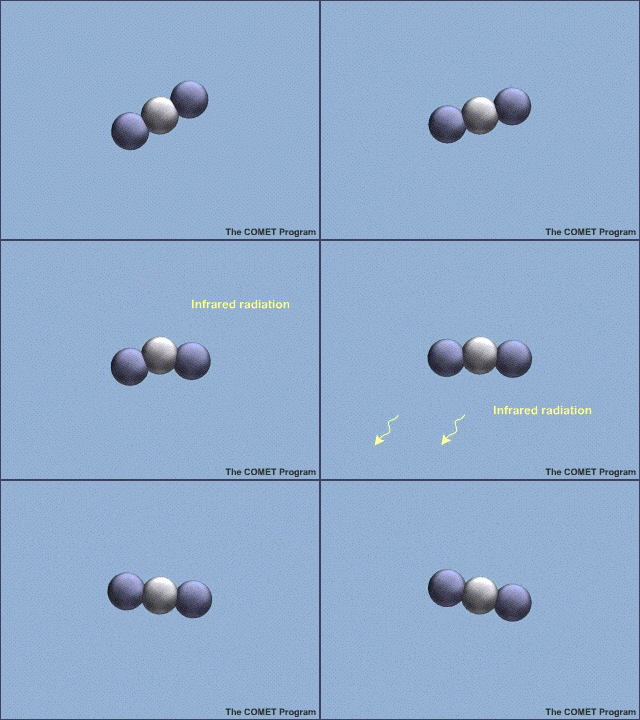
It also means that when a CO2 molecule in the atmosphere emits a LWIR photon, the energy to do was almost always acquired bu collision with another air molecule, rather than by absorbing a photon.
That implies that the amount of ~15 µm LWIR emitted by atmospheric CO2 depends only on the atmosphere’s temperature (and CO2 partial pressure), not on how the air got to that temperature. Whether the ground is very cold (and emits little IR) or very warm (and emits lots of IR) will not affect the amount of IR emitted by the CO2 in the adjacent atmosphere (except by affecting the temperature of that air).
Thanks Dave for the interesting and educational email exchange!
Hi daveburton! You have raised a point that, with few exceptions like Will Happer, is not understood by the majority of CAGW scientists and commentators. The radiative lifetime of a vibrationally excited CO2 molecule is of the order of 1 second, during which time approx. 10^9 to 10^10 collisions with the air molecules (mostly N2) will occur. So most of the energy of 667 cm^-1 photons emitted from a 288 K Earth surface and absorbed by a ground state CO2 molecule will be transferred during radiationless collisions to the non-radiating molecules of the troposphere. This is the mechanism by which greenhouse gases warm the troposphere.
In a previous posting in this thread, I gave a simple analogy of a black metal plate containing a 100 W heating coil (representing the solid and liquid surface of the Earth which absorbs incoming visible radiation from the Sun) and a similar black metal plate parallel to the first, but a passive absorber/emitter (with no internal heating coil) representing a layer of CO2 greenhouse gas. The bulk of the atmosphere consisting of non-radiating N2, O2 and Ar molecules can be represented by a large insulated tank of water or antifreeze connected by a well-insulated heat pipe to the passive plate. The rise of incoming Solar radiation during the daytime can be modelled by increasing the current in the heating coil in the first plate. The IR emitted from the first plate is then absorbed by the passive plate, which also warms up, but most of the heat energy is stored in the tank of water or antifreeze. There will be a lag in the temperature rise in the passive plate/storage tank, but if the current in the heating coil is shut off, simulating nighttime, the rate of cooling of both plates is reduced as heat is now transferred from the contents of the storage tank to the passive plate, which exchanges photons with the first plate. Another analogy could be an electronic power supply converting AC to DC with a single rectifier and a humongous filter capacitor which smooths out the ripple in the half-wave rectified DC output.
Prof. Happer correctly explained that the emission of IR from CO2 to outer space depends on the temperature of the emitting layer, which at 10 km is 220 K. However, this is strictly true only for frequencies close to 667 cm^-1 which are completely saturated all the way through the troposphere and into the stratosphere. Because there is a temperature inversion from 10 to 45 km due to absorption of incoming Solar UV and visible radiation by ozone in the stratosphere, doubling CO2 will cause escape to outer space to occur at higher altitudes where the temperature actually is higher. So the central 667 cm^-1 emission increases above 20 km, requiring less emission from the Earth’s surface for energy balance. Thus doubling CO2 will mean global cooling, not warming, when only these central frequencies are considered. Jack Barrett has run MODTRAN spectral calculations to 70 km, instead of truncating at 20 km (which on average is at 220 K), showing this increased stratospheric emission [see the section “The hard bit” at http://www.barrettbellamyclimate.com/ ].
Of course, doubling CO2 does result in net global warming, not cooling, because frequencies on the far wings of the CO2 absorption ditch are not totally saturated, even in the entire 10 km path length of the troposphere. This shows up as an increase in the area of the CO2 absorption ditch in the spectrum available at https://en.wikipedia.org/wiki/Radiative_forcing . To understand this net absorption, one must go to the integrated Schwarzschild Equation [see the section “Schwarzschild’s Equation” at Jack Barrett’s website].
The radiation intensity for a frequency in the wing of the CO2 absorption ditch is the sum of a Beer-Lambert absorption term and an emission term. Because the emission at 10 km occurs at 220 K instead of at 288 K, the emission term moderates the net absorption by a factor of 0.659 [the signal I = 1 – 0.659A , where A is the Beer-Lambert absorbance, and signal = 1 – A in the absence of the emission term]. This means that the literature value for climate sensitivity is too high, since it doesn’t include the factor 0.659. It is also too high because it was derived for absorption in a cloud-free sky. Clouds are composed of liquid water droplets or ice crystals which act as miniature Planck black bodies which absorb 100% of the IR emitted from the 288 K surface, and then re-emit at the lower temperature of the cloud top. Doubling CO2 beneath and inside the clouds will not increase the absorption because it is already 100%. So only the smaller path length from the cloud top to 10 km will have CO2 molecules that will increase absorbance on doubling CO2.
The increased absorbance on doubling CO2 occurs in sidebands centered at 618 and 721 cm^-1 [see the MODTRAN spectrum referenced above]. This occurs as photons emitted from the 288 K surface are absorbed by CO2 molecules in the v=1 first vibrationally excited state [for the energy level diagram showing the transition, see Diagram 3 in the section “Spectral transitions” at Jack Barrett’s website referenced above]. At 288 K, only 3.2% of CO2 molecules are in this v=1 excited state, and the percentage goes down as temperatures decrease with increasing altitude. The bottom line is that when the 62% of the Earth’s surface which is covered with clouds is considered, the climate sensitivity (not counting feedbacks) is not 1 K, but closer to 0.6 K. And water vapor feedback has been grossly overestimated. Even if it were 50%, this would raise climate sensitivity to 0.9 K, and increased cloud cover would be expected to bring this back down closer to 0.6 or 0.7 K. The literature value of 3 K is way too high. Therefore wrecking the economy to try to keep the effect of doubling CO2 to 2 K is unnecessary, wasteful, and foolish.
I don’t want to bore others with more details in this Forum, but if you contact me at rtaguchi@rogers.com , I can send you pdf files with extended discussions. Willis, too, might be interested, and I respect his intelligence and fair-mindedness.
rogertaguchi
“This is the mechanism by which greenhouse gases warm the troposphere.”
And the surface?
Hi, RogerTaguchi. I’m glad you enjoyed the video of Prof. Happer’s colloquium. I made the video by combining his PowerPoint slides with an audio recording that I had made with my smartphone, which is far from ideal. But I think the result is serviceable.
I didn’t understand the black metal plates analogy, sorry.
I don’t think that the Effective Radiating Level (ERL) (or Effective Emission Height, or any of several similar names) is above the tropopause, except, perhaps, right at the 667 cm^-1 (15 µm) absorption peak. From what I’ve read, the ERL is within or below the tropopause over most of the 15 µm absorption/emission band. Various sources give the average ERL for CO2’s 15 µm band as being somewhere between 4 km and 12 km altitude, which is well below the ~20km altitude at which atmospheric temperature increases much with increasing height.
http://eesc.columbia.edu/courses/ees/slides/climate/atmprofile.gif
So the net effect of adding CO2 to the atmosphere and thus raising the ERL for the 15 µm absorption/emission band is to lower the average emission temperature, leading, as you noted, to net surface warming.
An interesting tidbit is the contrast between the calculated emission profile viewed at 20km, as shown in the Wikipedia article, and the actual satellite-measured emission profile.
Here’s the Wikipedia calculated profile:
Here’s a measured profile (part of Prof. Happer’s slide #16, for the Tropical western Pacific):
http://sealevel.info/slide16_excerpt2_FTIR_data_from_a_satellite_tropical_western_pacific.png
Look at the center of the CO2 “absorption ditch” — do you see the difference? The narrow spike in the middle of the measured spectrum is apparently emissions from CO2 in the warm but extremely thin stratosphere (above 20 km altitude).
http://sealevel.info/slide16_excerpt2_FTIR_data_from_a_satellite_tropical_western_pacific_annot3.png
You can also see it in Jack Barrett’s simulated spectra, looking down from 70 km (the last figure on his “hard bit” page†).
http://sealevel.info/barrett_calculated_70km_spectra.png
†Note to future readers: the links on BarrettBellamyClimate.com are numbered pages, and the numbers occasionally change. So if the link doesn’t take you to the correct page, go to the main page, ctrl-F, and search for “hard bit”.
daveburton November 26, 2017 at 1:38 am
“So the net effect of adding CO2 to the atmosphere and thus raising the ERL for the 15 µm absorption/emission band is to lower the average emission temperature, leading, as you noted, to net surface warming.”
Why do you say that when the only Actual Measurements we have show that adding CO2 Inreases the Cooling of the Atmosphere and therefore of the Earth’s Surface.
Nasa have shown that inreasing CO2 increases cooling.
see the 2013 AGU Presentation starting at about 15 minutes on this Video.
I do not see the same correlation between Raw Surface Temps and CO2 increases.
1. Sorry, for some reason Wikipedia’s calculated 20 km spectrum graph didn’t show up in my 1:38am reply to RogerTaguchi (above). It should have been:
http://sealevel.info/ModtranRadiativeForcingDoubleCO2.png
2. A C Osborn, thanks for the link.
(a) In that talk, Marty Mlynczak says that he’s discussing the thermosphere, above 100 km altitude. Cooling in the thermosphere/ionosphere does not imply cooling down in the troposphere.
(b) Here are his slides: https://fallmeeting.agu.org/2013/files/2013/12/PressConfMlynczakFinal.pdf
(c) For future reference, you can link directly to any starting point in a YouTube video using any of several syntaxes, like this (these all start that AGU video at the beginning of Dr. Mlynczak’s talk):
http://sealevel.info/youtube_starting_point_syntaxes.png
For example, here’s a direct link (using the “#t=19m49s” syntax) to the presentation immediately following M’s — which happens to have been by friend-of-WUWT Leif Svalgaard, on the topic of predicting solar cycles:
3. A C Osborn and The Reverend Badger, please note that in these “indented threads” there’s no way to tell who you’re talking to or what you’re taking about when you say things like, “Does this apply to…” or “Try talking about…”, unless you tell us. That’s why Willis always says, “When you comment, please QUOTE THE EXACT WORDS THAT YOU ARE DISCUSSING, so that we can all understand the nature of your objections.”
Pretty please!
Try talking about e-m radiation, don’t use the word “photon” and don’t say “frequency/wavelength”, just “frequency”. When you do this the argument can take on a different “flavour” which MIGHT just help in the learning.
So Badger, the last hundred years of EMR physics has been a complete mistake, and you are the only super-genius who recognizes this?
Does this apply to all materials, or just CO2?
Steve Richards November 25, 2017 at 1:04 pm
So, going with the theories of a couple of years ago, decaying to ‘ground’ state within a few tens of nanoseconds, thermal IR emitted from the earths surface, some excites a CO2 molecule, say 20nS later, the photon is re-emitted from the molecule and travels elsewhere. What effect does this have on any temperature of CO2 and surrounding gas?
So much to learn.
Indeed, the decay to the ground state in tens of nanoseconds is due to collisional deactivation and transfers energy to the surrounding molecules (about 10 collisions per nanosecond near the surface) thereby warming up the atmosphere. The radiative decay has a much longer characteristic time so doesn’t become the dominant process until higher in the atmosphere.
Energy Balance\resulting temperatures
At the fundamental level, how much kinetic energy is created from input, how much is retained after output
what happens to the KE retained, well we know, it makes the flipping weather, the oceans move, and so much more, including life, we are full of kinetic energy ourselves.
But can we master this problem? of course not.
Temperature is just an average measurement of kinetic energy, right off the bat we lose accuracy.
But sciency jargon or whatever.
An elegant clarification, thanks Willis.
Radiation is far from being the whole story of heat movement in the atmosphere. The body of theory of Ilya Prigogine concerning nonlinear thermodynamics and dissipative structures is important, though often overlooked. Changes to the thermal structure of the atmosphere may well – according to principles of self-organisation – result in rearrangement of dissipative and oscillatory structures which could establish a new equilibrium with minimal or no overall change to thermal fluxes.
The Benard or convection instability is manifest in a situation in which a fluid layer is heated from below and kept at a fixed temperature above so as to create a temperature gradient in opposition to the effects of gravitational force. At small values of this gradient heat is transported from lower to upper regions by conduction [and radiation] and macroscopic motion is absent. Random motions of the molecules and a damping of convection currents characterise the state of the fluid. However, when the gradient exceeds a critical value a convective, macroscopic motion occurs generally in the form of rolls or hexagons (for variations see Koschmeider 1977). In short, out of an initial state that is completely homogeneous there arises a well ordered spatial pattern. Moreover, with further increases in the gradient the spatial pattern becomes oscillatory.
Kugler PN, Kelso JS, Turvey MT. 1 On the Concept of Coordinative Structures as Dissipative Structures: I. Theoretical Lines of Convergence. Advances in Psychology. 1980 Dec 31;1:3-47.
Most scientists hate to talk in simplistic terms, sadly, the like to sound oh so smart
Mark
Essential chaos theory is much less complex than it sometimes looks. I’m a mere biologist. Hint – ignore the maths, just look at the pictures.
“ignore the maths, just look at the pictures”
Not recommended. You don’t necessarily have to do the mathematics but you need to understand the underlying principles and assumptions. Look at Mann and his hockey stick for a prime example of what can happen when you try to apply mathematics you don’t understand.
ptolemy2, I just taught this subject to a class of biologists this week, differential equations in a bio class! For an example of order from chaos check out the cell cycle and cyclins.
Stephen, I didn’t want to be so provocative as to say that any atmospheric model that omits the heat engine effect of the troposphere isn’t complete but you’re correct that it must.
I would also ask the following if radiation dominates atmospheric temperature:
How is it that the temperature at any point on earth can be determined by incoming solar radiation and surface emissivity with no reference to back radiation?
If radiation dominates how come the derivation of lapse rate does not include any radiation inputs?
If we have a downwelling heat source of 340 W/m2 why can’t we recover this at the surface as we can recover heat from solar radiation.
Martin Mason
I assume you are addressing me but I don’t accept that any radiation other than external radiation dominates surface temperature.
Any internal radiative imbalances are neutralised by convective adjustments.
Thus I raise the same questions as you.
As regards the apparent irrecoverability of DWIR as additional surface heat over and above S-B plus the mass induced surface temperature enhancement I suggest that any DWIR from the atmosphere is already merged into the surface temperature created by insolation, conduction and convection via the lapse rate slope.
As DWIR descends through lower levels of radiatively active material it distorts the lapse rate slope and reduces convective vigour so that warmed radiative material of any description finds itself at a lower height and warmer temperature than it otherwise would be so that it radiates more to space and the radiative capability for warming the surface is neutralised.
If there is to be a radiative balance with space all outgoing radiation must emanate either from the surface or from within the bulk of the atmosphere. If too much is going out from one source then the other adjusts accordingly. Could never maintain long term hydrostatic equilibrium otherwise.
“If we have a downwelling heat source of 340 W/m2 why can’t we recover this at the surface as we can recover heat from solar radiation.”
Very good question. The answer is simple: You need a GHG panel at 0K (-273.13°C).
Paul, it is much worse than that.
There is ZERO Empirical Data to show that there are 340 W/m2 hittng and “Warming” the surface.
There are simple tests where you can MEASURE the ACTUAL POWER of Sunlight hitting the surface.
Simple measurements with simple calculations that confirm the Satellite measurements of the Real Watts coming from the Sun.
see as an example
https://www.bing.com/videos/search?q=how+to+measure+the+power+of+sunshine&qpvt=how+to+measure+the+power+of+sunshine&view=detail&mid=1CE167A1295F871DFC441CE167A1295F871DFC44&FORM=VRDGAR
There are no such tests to show the Actual Power coming down as “Back Radiation”.
The closest they get is the sort of Experiment that Dr Spencer did and when the Target got COLDER and he said that proved that it was being warmed by the DWLIR because it would have been even colder if it wasn’t.
Does that sound like 340 Watts to you?
A C Osborn,
There are several stations on earth measuring downward IR radiation, some of them already from the 1950’s:
https://scienceofdoom.com/2010/07/17/the-amazing-case-of-back-radiation/
And specific for CO2:
http://newscenter.lbl.gov/2015/02/25/co2-greenhouse-effect-increase/
Ferdinand Engelbeen November 26, 2017 at 11:09 am
Looking forward to something similar to the Solar Challenge
https://www.worldsolarchallenge.org/dashboard/timing
but this time using cars driven by backradiation panels, and let’s make it a night race 😉
The pyrgeometers used in measuring backradiation calculate the radiation using emissivity 1.0 according a spec sheet I saw. Seems unrealistically high to me.
Ben Wouters,
The problem is converting IR to power: conventional cells transform visible light to power, with some yield, but as IR photons have a lot less energy, that doesn’t work (yet).
Read some years ago the possibility to recover low temperature waste heat by an array of micro thermocouples on a chip, where one side was heated by waste water, the other side cooled with ambient air.
Problem here is that the surface at night is loosing more energy than what is coming in as backradiation. Thus the “warm” side is the car/panels, so you need a lot of mass/weight to give some power…
Radiation is only basic knowledge (of about 50 years ago…) for me, so I can’t directly discuss your point about an emissivity of 1 (for the atmosphere?).
A C,
It’s even “worser” than you think. According to the Trenberth energy balance diagram, at the earth’s surface, backradiation from the atmosphere is over twice as powerful as the sun. Yet backradiation is powerless to heat up your pool at night as sunlight does during the day. Backradiation does not warm surfaces in the shade. Yet Trenberth assumes that 1 W/m2 of backradiation is equivalent to 1 W/m2 of solar radiation. Absurd.
The reason backradiation is powerless to perform work is simple. A colder atmosphere cannot transfer heat to a warmer earth surface.
The earth and atmosphere are purely passive. The only energy source available to heat the earth is the sun. And the sun has an average power of 341 W/m2 at the TOA. It is thermodynamic horse manure to indicate that this 341 W/m2 of solar energy gets magnified to 494 W/m2 at the earth’s surface.
Yes, they have less power, but how much less?
Why aren’t 340 LWIR watts = 340 sunshine watts?
This is the part I am trying to establish, I have seen at the bottom of this post that there is 1/40th of the energy for the radiation, so there is either 40 times as much dwi radiation or this whole back radiation thing does not work as advertised.
Everything I have seen up till now says it is not able to prove to work.
Thanks for the link to that CO2 ARM paper I remember it when it came out and it got a lot of stick at the time not least for having the last 5 years of data missing.
I may try and register with ARM to try and get some downloaded data as that paper only shows anomalies, which do not tell yo very much.