Guest cheer-leading by David Middleton
U.S. Senate passes bill that offers a chance to open Arctic National Wildlife Refuge to drilling
Author: Erica Martinson clock Updated: 3 days ago calendar Published 3 days ago
WASHINGTON — The U.S. Senate passed a budget resolution Thursday that could provide Alaska’s congressional delegation its best shot in four decades to open part of the Arctic National Wildlife Refuge to oil and gas drilling.
The Senate voted 51-49 to pass the budget resolution, along party lines. Republicans defeated a Democratic amendment to strip the ANWR-allowing provision from the budget resolution, by a vote of 52-48.
It’s not a slam-dunk yet. But Alaska Sen. Lisa Murkowski has been granted the opportunity to attach an ANWR drilling provision to a tax reform bill that is considered “must-pass” legislation if Republicans want to retain their control of Congress in 2018. That bill — known as “budget reconciliation” — will only require a simple 51-senator majority vote. House and Senate leaders have said they hope to pass tax legislation before the end of this year, though that may be an overly optimistic timeline.
The budget resolution passed Thursday instructs the Energy and Natural Resources Committee to write legislation that raises $1 billion in federal revenue. The House passed a budget resolution earlier this month with a similar provision.
Opponents of Arctic drilling read between the lines and declared this a move that would allow that committee’s chairwoman, Murkowski, to open ANWR to drilling with a simple 51-senator majority vote.
[…]
Fracking awesome!!!
In addition to being a boon to the US Treasury, the development of ANWR, NPR-Alaska and the Beaufort and Chukchi OCS areas are critical to maintaining the operation of the Trans Alaska Pipeline System (TAPS) and avoiding the stranding of billions of barrels of crude oil.
The failure to open ANWR-1002 soon will eventually force the premature shutdown and dismantling of the Trans Alaska Pipeline System (TAPS).
A premature end to TAPS would strand about 30 billion barrels of oil and 137 trillion cubic feet of natural gas under Alaska and its OCS (outer continental shelf).
• The Trans Alaska Pipeline System’s (TAPS) minimum flow rate of about 300,000 barrels of oil per day will be reached in 2025, absent new developments or reserves growth beyond the forecasted technically remaining reserves. An Alaska gas pipeline and gas sales from the Point Thomson field and the associated oil and condensate would provide another boost to oil production and extend the life ofTAPS for about one year to 2026. A shut down of TAPS would potentially strand about 1 billion barrels of oil reserves from the fields analyzed.
Page ix
• For the complete study interval from 2005 to 2050, the forecasts of economically recoverable oil and gas additions, including reserves growth in known fields, is 35 to 36 billion barrels of oil and 137 trillion cubic feet of gas. These optimistic estimates assume continued high oil and gas prices, stable fiscal policies, and all areas open for exploration and development. For this optimistic scenario, the productive life of the Alaska North Slope would be extended well beyond 2050 and could potentially result in the need to refurbish TAPS and add capacity to the gas pipeline.
• The forecasts become increasingly pessimistic if the assumptions are not met as illustrated by the following scenarios.
1. If the ANWR 1002 area is removed from consideration, the estimated economically recoverable oil is 29 to 30 billion barrels of oil and 135 trillion cubic feet of gas.
2. Removal of ANWR 1002 and the Chukchi Sea OCS results in a further reduction to 19 to 20 billion barrels of oil and 85 trillion cubic feet of gas.
3. Removal of ANWR 1002, Chukchi Sea OCS, and the Beaufort Sea OCS results in a reduction to 15 to 16 billion barrels of oil and 65 trillion cubic feet of gas.
4. Scenario 3 and no gas pipeline reduces the estimate to 9 to 10 billion barrels of oil (any gas discovered will likely remain stranded).
Some combination of these hypothetical scenarios is more likely to occur than the optimistic estimates.
Page viii

Recent large discoveries on the North Slope can only be developed if TAPS remains operational. The opening of ANWR Area 1002, is the fast track to keeping TAPS operational for the next 30-50 years.
When Alaska became a state, it was widely understood that Alaska would be run by Alaskans. This was done to appease the indigenous population which feared control from a very distant DC.
Been down hill ever since.
For our none US readers (and, unfortunately, some of our younger US readers), Alaska and Hawaii were US territories. In 1959 they became “States”.
And, yes, EW3, It’s been downhill for the rest of also.
Considering that the National Petroleum Reserve – Alaska (NPRA green area on the left) would need transportation of the Petro, The TAPS viability is also a U.S. Federal issue, right?
Is Canada using the TAPS to ship their Petro from the development just to the east in Beaufort Sea/Mackenzie delta?
I know there has been a proposed Canadian pipeline, but really doesn’t it make more sense to pipe it 200 miles west to TAPS?
Let’s call it the Alaskan Natural Wealth Resource from now on.
It’s about fracking time……
Breaking news! Fracking is going to be wound down in the US:
http://edition.cnn.com/2017/10/23/politics/gao-report-climate-change/index.html
Nothing in that article says anything remotely similar to “Fracking is going to be wound down in the US.”
Fracking is a ticking health time bomb in the US.
https://mankindsdegradationofplanetearth.com/blogs/
Nothing in that article says anything remotely similar to “Fracking is going to be wound down in the US.”
Snowflakes see only what they want to see, they are blind to the real world around them…
The GAO report is a joke. It’s a rehashing of Obama maladministration crap and it doesn’t even address the costs of what it proposes…
https://www.energy.senate.gov/public/index.cfm?a=files.serve&File_id=90ECDE3F-38AF-47DB-8326-D38046D1E87E
Using the GAO’s bogus climate-related damages through 2100 and a discount rate of 7%, the present value of the prognosticated climate-related damages is just under $21 billion. The cost to deeply decarbonize the US economy is in the neighborhood of $20 TRILLION.
This leads to a net present value (NPV) of -$19.9 TRILLION for deep decarbonization.
Ivankinsman, don’t you know fake news when you see it?
Visit his web page, it’s hilarious “Snow Flake” dribble !
Yep when I have to listen to a sceptic trying to justify their pisition – about as fake as it comes.
Ivan, now that David has slapped you down, which you have yet to make a cogent reply,what other nonsense will you push that make “skeptics” laugh about?
You ain’t seen nothing yet… H/T BTO
More like brainless news.
From US History: The agreement was signed in March 1867 and transferred Alaska to the United States in return for a payment of $7.2 million, amounting to a price of about 2.5 cents per acre for an area twice the size of Texas.
The treaty was ratified by the U.S. Senate by a single vote.
Criticism in the press was harsh, portraying the newly acquired wasteland as “Seward’s Folly,” It was not until the 1890s with the discovery of gold that public attitudes regarding Alaska began to change.
2.5 cents per acre, And now oil.
It’s not as simple as many like to think.
Here’s the result of a study of Caribou calving grounds. Note that most calving takes place in area 1002: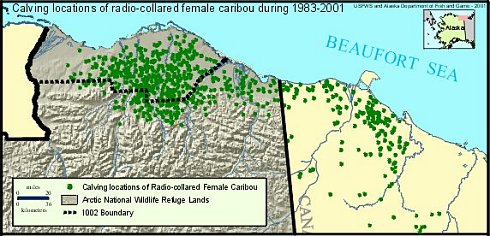
And musk oxen locations: http://1.bp.blogspot.com/_y1obSLk0ax4/TGvtXWda_3I/AAAAAAAAGP0/S-TaRnREsy0/s1600/anwr+1002+muskoxen+herds.jpg
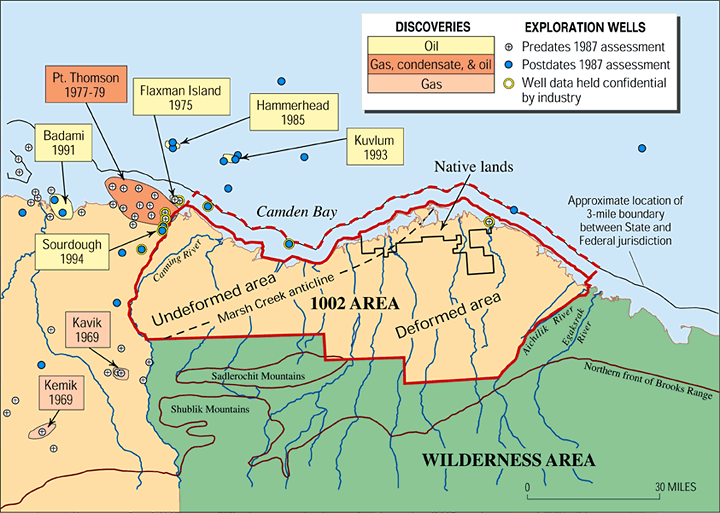
The good news: the vast majority of recoverable resources is estimated to be in the “Undeformed” area of 1002, ie the northwest portion. This is not a heavy calving area.
My sense (personally) — with care, the drilling can be done and provide great benefit without destroying the environment.
The oil reserves in the designated development area ANWAR are considerable. Without them the existing pipeline would be underutilized as it is currently operating at one third capacity. The existing oil drilling has had zero negative effect on Caribou or any other wildlife. More importantly opening up this area for drilling will allow for the development of a pipeline that will give access to the huge underwater oil reserves in the Artic that are so coveted by the Russians. With these resources the US would dominate the oil markets and we would never again be held hostage to OPEC or any other country or group of countries. There are zero real objections possible on any wildlife or other grounds. These have all been debunked by the successful operation of the existing North Slope oil operations.