Guest Post by Werner Brozek, and Edited by Just The Facts

| Source | UAH | RSS4 | Had4 | Sst3 | GISS |
|---|---|---|---|---|---|
| 16ave | 0.510 | 0.778 | 0.773 | 0.613 | 0.99 |
| 6mave | 0.746 | 0.542 | 0.94 | ||
| 7mave | 0.306 | 0.532 | |||
| need | 0.796 | 1.12 | 0.80 | 0.684 | 1.04 |
In order to determine if records are possible in 2017, one must know the previous records as well as the average to date and what is required for the rest of the year in order for a particular data set to set a new record.
For the five data sets I cover, records were set in 2016. For now, I am not concerned about the statistical significance of the records, nor the number of decimal places. I merely want to know if the record can be beaten this year. At the end of the year, I plan on reporting any records and how statistically significant they are.
The above table shows the average 2016 anomaly for the five data sets. For the two satellite data sets, we have anomalies to July giving a seven month average, but the others only go to June as indicated giving a six month average. Then beside “need”, calculations were done to see what is needed for the remaining five or six months to set a record.
For UAH6, an average of 0.796 is needed. There is no way that this can occur. That number was surpassed only once in February 2016 with an anomaly of 0.856. A very strong El Nino would be needed and it is too late in the year for one to form and affect things for the next five months. I expect UAH6 to end up in fourth place for 2017 where it is now.
For RSS4, an average of 1.12 is needed. There is also no way that this can occur. That number was surpassed only once in February 2016 with an anomaly of 1.132. As with UAH6, a very strong El Nino would be needed and it is too late in the year for one to form and affect things for the next five months. I expect RSS4 to end up in fourth place for 2017 where it is now.
For HadCRUT4, the last six months require an average of 0.80 to set a new record. While it is a bit of a jump from the present six month average of 0.746, a new record cannot be ruled out at this time.
For Hadsst3, the last six months require an average of 0.684 to set a new record. Only strong El Ninos are capable of giving these kind of numbers for Hadsst3, so there is no way that the last six months can achieve this average.Hadsst3 seems destined to end up ranked in third place.
For GISS, the last six months require an average of 1.04 to set a new record. While it is a bit of a jump from the present six month average of 0.94, a new record cannot be ruled out at this time.
If you are wondering about RSS3, it is in the same boat as RSS4 with respect to rankings and will likely end up in fourth place. While there is no change in the yearly rankings between RSS3 and RSS4, I think that RSS4 has made the possibility of a return of a long pause virtually impossible, even with a long and strong La Nina.
Of course I could be wrong here, but we are not likely to find out for years since it looks like neutral ENSO conditions will prevail for the rest of the year at least. As well, the length of time for lack of statistically significant warming has been greatly reduced for RSS4 versus RSS3. It used to be over 22 years, but now it is only 16 years. By the way, WFT only shows RSS3 at the present time.
In the sections below, we will present you with the latest facts. The information will be presented in two sections and an appendix. The first section will show for how long there has been no statistically significant warming on several data sets. The second section will show how 2017 compares with 2016, the warmest year so far, and the warmest months on record so far. The appendix will illustrate sections 1 and 2 in a different way. Graphs and a table will be used to illustrate the data.
Section 1
For this analysis, data was retrieved from Nick Stokes’ Trendviewer available on his website. This analysis indicates for how long there has not been statistically significant warming according to Nick’s criteria. Data go to their latest update for each set. In every case, note that the lower error bar is negative so a slope of 0 cannot be ruled out from the month indicated.
On several different data sets, there has been no statistically significant warming for between 0 and 23 years according to Nick’s criteria. Cl stands for the confidence limits at the 95% level.
The details for several sets are below.
For UAH6.0: Since April 1994: Cl from -0.010 to 1.748
This is 23 years and 3 months.
For RSS4: Since August 2001: Cl from -0.020 to 2.755 This is an even 16 years.
For Hadcrut4.5: The warming is statistically significant for all periods above five years.
For Hadsst3: Since February 2001: Cl from -0.016 to 2.500 This is 16 years and 5 months.
For GISS: The warming is statistically significant for all periods above five years.
Section 2
This section shows data about 2017 and other information in the form of a table. The table shows the five data sources along the top and other places so they should be visible at all times. The sources are UAH, RSS, Hadcrut4, Hadsst3, and GISS.
Down the column, are the following:
1. 16ra: This is the final ranking for 2016 on each data set. On all data sets, 2016 set a new record. How statistically significant the records were was covered in an earlier post here: https://wattsupwiththat.com/2017/01/26/warmest-ten-years-on-record-now-includes-all-december-data/
2. 16a: Here I give the average anomaly for 2016.
3. mon: This is the month where that particular data set showed the highest anomaly. The months are identified by the first three letters of the month and the last two numbers of the year.
4. ano: This is the anomaly of the month just above.
5. sig: This the first month for which warming is not statistically significant according to Nick’s criteria. The first three letters of the month are followed by the last two numbers of the year.
6. sy/m: This is the years and months for row 5.
7. Jan: This is the January 2017 anomaly for that particular data set.
8. Feb: This is the February 2017 anomaly for that particular data set, etc.
14. ave: This is the average anomaly of all available months.
15. rnk: This is the 2017 rank for each particular data set assuming the average of the anomalies stay that way all year. Of course they won’t, but think of it as an update 30 minutes into a game.
| Source | UAH | RSS4 | Had4 | Sst3 | GISS |
|---|---|---|---|---|---|
| 1.16ra | 1st | 1st | 1st | 1st | 1st |
| 2.16a | 0.510 | 0.777 | 0.773 | 0.613 | 0.99 |
| 3.mon | Feb16 | Feb16 | Feb16 | Jan16 | Feb16 |
| 4.ano | 0.856 | 1.132 | 1.070 | 0.732 | 1.34 |
| 5.sig | Apr94 | Aug01 | Feb01 | ||
| 6.sy/m | 23/3 | 16/0 | 16/5 | ||
| Source | UAH | RSS4 | Had4 | Sst3 | GISS |
| 7.Jan | 0.326 | 0.593 | 0.740 | 0.484 | 0.92 |
| 8.Feb | 0.387 | 0.667 | 0.842 | 0.520 | 1.09 |
| 9.Mar | 0.230 | 0.474 | 0.871 | 0.550 | 1.11 |
| 10.Apr | 0.274 | 0.476 | 0.736 | 0.598 | 0.94 |
| 11.May | 0.440 | 0.605 | 0.656 | 0.564 | 0.88 |
| 12.Jun | 0.208 | 0.388 | 0.641 | 0.542 | 0.69 |
| 13.Jul | 0.28 | 0.524 | |||
| 14.ave | 0.306 | 0.532 | 0.746 | 0.542 | 0.94 |
| 15.rnk | 4th | 4th | 3rd | 3rd | 2nd |
| Source | UAH | RSS4 | Had4 | Sst3 | GISS |
If you wish to verify all of the latest anomalies, go to the following:
For UAH, version 6.0beta5 was used.
http://www.nsstc.uah.edu/data/msu/v6.0/tlt/tltglhmam_6.0.txt
For RSS, see: ftp://ftp.ssmi.com/msu/monthly_time_series/rss_monthly_msu_amsu_channel_tlt_anomalies_land_and_ocean_v03_3.txt
For Hadcrut4, see: http://www.metoffice.gov.uk/hadobs/hadcrut4/data/current/time_series/HadCRUT.4.5.0.0.monthly_ns_avg.txt
For Hadsst3, see: https://crudata.uea.ac.uk/cru/data/temperature/HadSST3-gl.dat
For GISS, see:
http://data.giss.nasa.gov/gistemp/tabledata_v3/GLB.Ts+dSST.txt
To see all points since January 2016 in the form of a graph, see the WFT graph below. Note that it shows RSS3.

As you can see, all lines have been offset so they all start at the same place in January 2016. This makes it easy to compare January 2016 with the latest anomaly. The thick double line is the WTI which shows the average of RSS, UAH, HadCRUT4.5 and GISS.
Appendix
In this part, we are summarizing data for each set separately.
UAH6.0beta5
For UAH: There is no statistically significant warming since April 1994: Cl from -0.010 to 1.748. (This is using version 6.0 according to Nick’s program.)
The UAH average anomaly so far is 0.306. This would rank in fourth place if it stayed this way. 2016 was the warmest year at 0.510. The highest ever monthly anomaly was in February of 2016 when it reached 0.856.
RSS4
For RSS4: There is no statistically significant warming since August 2001: Cl from -0.020 to 2.755.
The RSS average anomaly so far is 0.532. This would rank in fourth place if it stayed this way. 2016 was the warmest year at 0.777. The highest ever monthly anomaly was in February of 2016 when it reached 1.132.
Hadcrut4.5
For Hadcrut4.5: The warming is significant for all periods above five years.
The Hadcrut4.5 average anomaly for 2016 was 0.773. This set a new record. The highest ever monthly anomaly was in February of 2016 when it reached 1.070. The HadCRUT4.5 average so far is 0.746 which would rank 2017 in third place if it stayed this way.
Hadsst3
For Hadsst3: There is no statistically significant warming since February 2001: Cl from -0.016 to 2.500.
The Hadsst3 average so far is 0.542 which would rank 2017 in third place if it stayed this way. The highest ever monthly anomaly was in January of 2016 when it reached 0.732.
GISS
For GISS: The warming is significant for all periods above five years.
The GISS average anomaly for 2016 was 0.99. This set a new record. The highest ever monthly anomaly was in February of 2016 when it reached 1.34. The GISS average so far is 0.94 which would rank 2017 in second place if it stayed this way.
A Personal Note
With rare exceptions, I wrote a monthly piece for the last four years. However over the last few months, I stopped writing as I went through a dark valley. As far as I know now, I had bone cancer since last December. However there was little sign of it for several months.
Then the pain got worse with each passing month. Before my 16 hour operation on June 8, I was taking 12 strong pain killers a day. However that does not mean I was always pain free before the operation. Often the pain would come back before I was supposed to take the next pills. Then it would take a half hour for the pills to kick in.
Fatigue was another issue. Before the operation, I always seemed to be tired no matter how much I slept. As well, the things that I was told to expect as a result of the operation are not for the faint of heart. Many people prayed for me and I thank Jesus for His help getting through it all. I am still recovering, however I am thankful that my right eye was spared, although it was close!
Even for an experienced audience, I think that you should specify EXACTLY what you are dealing with.
At first glance, nowhere do I see the word, “degrees” or the word “temperature” (or which temperature).
Record what? Where are the labels on the graphs and in the table? Where is the word, “temperature”, in the title.
I know, for a writer accustomed to a specific knowledge base of his readers, that these can seem like idiotic concerns, but it boils down to clarity for everyone, … immediate clarity, even for a casual viewer or a casual reading or quick reading.
I give the following information:
I would hope that it is clear from the above that I am talking about possible record high anomalies. Anomalies are departures from a baseline (in degrees C).
For the satellite data sets, I have no clue what the actual temperature is, and besides, it has a range of values from the bottom to the top of the troposphere.
If someone wants to talk about temperatures in the troposphere, be my guest. My intention was to only analyze anomalies which is why the word “temperature” is not in the title.
Good luck on your recovery, Werner.
I follow ENSO data from .http://www.cpc.ncep.noaa.gov/data/indices/wksst8110.for I use a 4-week running mean to smooth things out a bit, and also give something resembling a monthly value. Nino34 appears to have peaked in the first half of July and has been falling ever since. A couple of things to consider…
1) If Nino34 peaks in November/December, the fall after that can be huge. If Nino34 peaks in mid-year, the subsequent fall is not so major. So I expect it to hang around zero anomaly for the next while. If it shows a major drop, that’ll break the pattern.
2) A dropoff in Nino34 generally leads global temperature falls by 3 months. Given the Nino34 peak in first half of July, I expect global anomalies to start a moderate drop after the first half of October.
The indicies I follow for my monthly projections, to mid August, indicate all data set anomalies will be higher than July. The surface (1000 mb) data is approximately equal to August 2016, while UAH and RSS are higher. Of course, there’s still quite a bit of August left to go.
So despite what may happen in August, a record on any set seems out of the question.
(P.S. Despite my report here, I hope you do not change anything in your latest monthly reports.)
Does your analysis include the ability to unilaterally adjust the past and present data, to yield the desired result?
My analysis is strictly based on what the various data sets say this month. In June, GISS said 2016 was 0.99. In July, they say 2016 was 1.00. So in my update for July earlier, I had to switch GISS from 0.99 to 1.00. Who knows what 2016 will be next month?
Thank you, Werner for all you have contributed and God will be with you knowing you are receptive
.
Good luck to you, Werner.
Thanks Werner. Good to have you back. Best wishes. Robin
Wishing you a smooth recovery.
CRU and GISS will deliberately set 2017 record by tampering with their data. The real record set in 2017 is the one not reported by the biased media – the coldest temperature in Greenland and the Northern Hemisphere!
Citing the Danish Meteorological Institute, the -33°C reading earlier this month was “the coldest July temperature ever recorded in the northern hemisphere“
https://bazonline.ch/wissen/natur/ab-nach-groenland/story/28363255
Walter Dnes is keeping a very close eye on things! The monthly changes for GISS seem bizzare. In one month, 2014 changed from 0.734 to 0.752.
Werner, I wish you the very best in your recovery.
God Bless, from Allan
Allan MacRae. P.Eng., Calgary
So, here in the southern plains of the U.S. we have had the coolest August in a very long time. Average high temps for our part of the country in August is 93-94F with 20-25 days over 90F. So far this month we have had 9 days over 90 with only maybe 2 or 3 more possible. We are already at 3.9F below average for the month and have a string of 5 or 6 days forecast with temps below 85F. We have had 4 more inches of rain than normal and are expecting more in the coming days.
We all know that this is just weather (especially here on the southern plains where our motto is ‘Don’t like the weather? Wait an hour’), but I have researched most of the weather service stations between the Rockies and the east coast and a vast majority of them all show similar lower averages.
I’m currently taking side bets as to whether or not our Overlords at the NOAA tell us that August was the Hottest Month Evah!!!!
As a fellow survivor I wish you the very best in your recovery. 22 years and counting. I believe it gave me a better perspective on life and I hope it does so for you. You are valued here and I’m sure that a man of integrity and honour such as yourself is important in many people’s lives.
At:
http://www.cpc.ncep.noaa.gov/products/analysis_monitoring/lanina/enso_evolution-status-fcsts-web.pdf
Nino3.4 came in at -0.5 C today for its latest weekly departure.
So ENSO neutral conditions are being predicted for the remainder of the year, and into the beginning of 2018.
If ENSO remains neutral then it is rather unlikely that much warming will be seen in the satellite data set in the next few months.
As well, the other data sets should not set records in 2017. The only question now seems to be if the new 2017 anomalies will be at least 0.1 C below 2016 and be statistically insignificant.
Magic Climate Information
Finland June 2017
Have you contacted Tony Heller with this information? He might be very interested.
mwhite: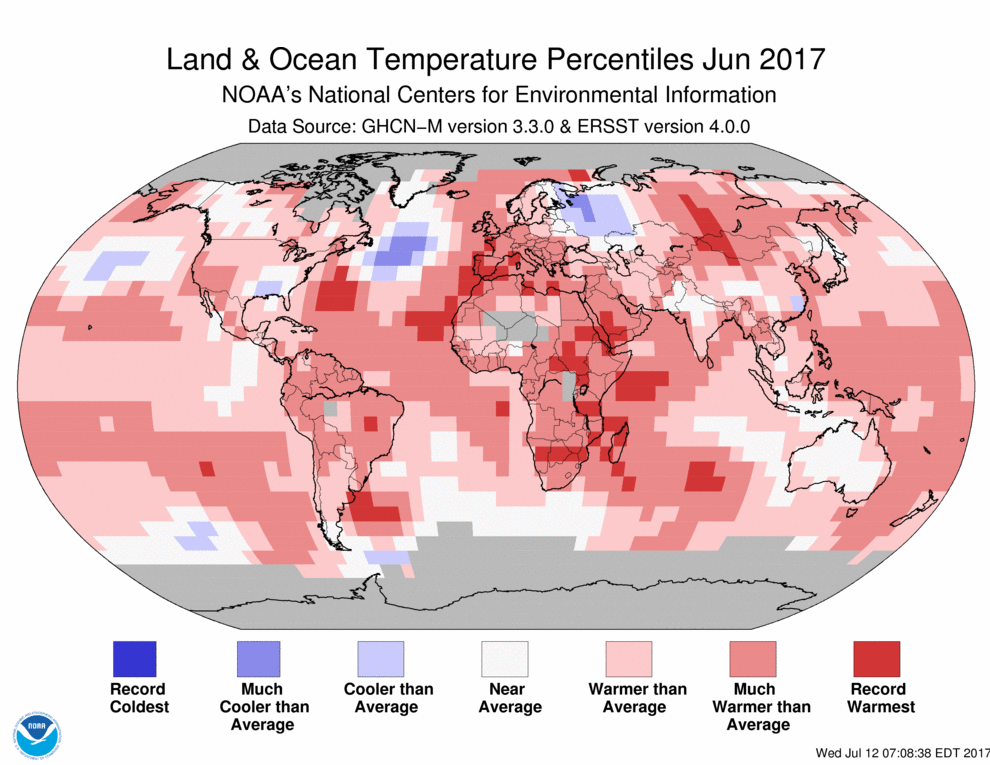

2 things…
The grid size (2degx2deg) means that pixels overlapping sea/land have the SST anomaly (ERRSTv4 “includes anomalies computed with respect to a 1971–2000 monthly climatology”) added in proportion to area. Thence given the small size of Finland, a lot of the@ur momisuglyJeffWhitman@ur momisugly appears to go.
https://www.ncdc.noaa.gov/data-access/marineocean-data/extended-reconstructed-sea-surface-temperature-ersst
More catastrophically (for the maker of the video) he has mixed up 2 graphs – the anomaly and the percentile.
Both are depicted side by side here…
https://www.ncdc.noaa.gov/sotc/global/201706
In MN this has been a pretty miserable summer for hot weather 🙁
Talking of current temperatures here’s a story with an interesting subtext.
http://www.telegraph.co.uk/news/2017/08/21/matt-dawson-neededheart-surgeryafter-catching-lyme-disease-london/
The English rugby player Matt Dawson is among many in the UK who have recently had the misfortune to contract Lyme disease. This is caught by being bit by the kind of tick ✅ that lives on deer.
It turns out that there are about 1.5 million deer 🦌 in the UK currently, the highest number for a thousand years. People conditioned to believe in endless environmental apocalypse might find that surprising. It is linked to the equally heretical fact that more trees are growing, faster, because of rising CO2; and that this is generally good (including for ticks).
Now with all these deer running around, a reservoir for the Lyme-carrying ticks, Lyme disease is on the increase; you don’t even need to go to remote forests to contract it, Mat Dawson received the infection while walking in a London park.
The plot thickens. This year Lyme disease incidence has risen especially sharply. The reason, we are told, is because of the unusually “mild” summer we are having. Ticks are most active in Spring, declining in the heat of summer. But this summer has been mild: and here, curiously, mild means cold. So spring-like temperatures have persisted into summer.
That use of the word “mild” is odd. Normally, winters are either “cold” or “mild”. And summers “hot” or “cool”. How can you have a “mild” summer? The answer is if you are a journalist who fears for his/her career if he/she so much as mentions cold or cool weather. To do so is enough to be labelled a dunaia. To have a Lyme disease like target on one’s skin for all to aim at with eco-denunciation. So what to do? The anxious confusion in the journalist finding themselves having to comment on less than warmest evah weather, is evident in the garbled and tortuous phrase “mild summer”.
This peculiarly traumatised journalist should best get over this disconcerting incident by going to watch Al Gore’s Inconvenient Truth 2, and reassure her/himself that the end, after all, is still nigh.
With the GISS past in continuous revision there will always be new records in the future, it is just a question of time.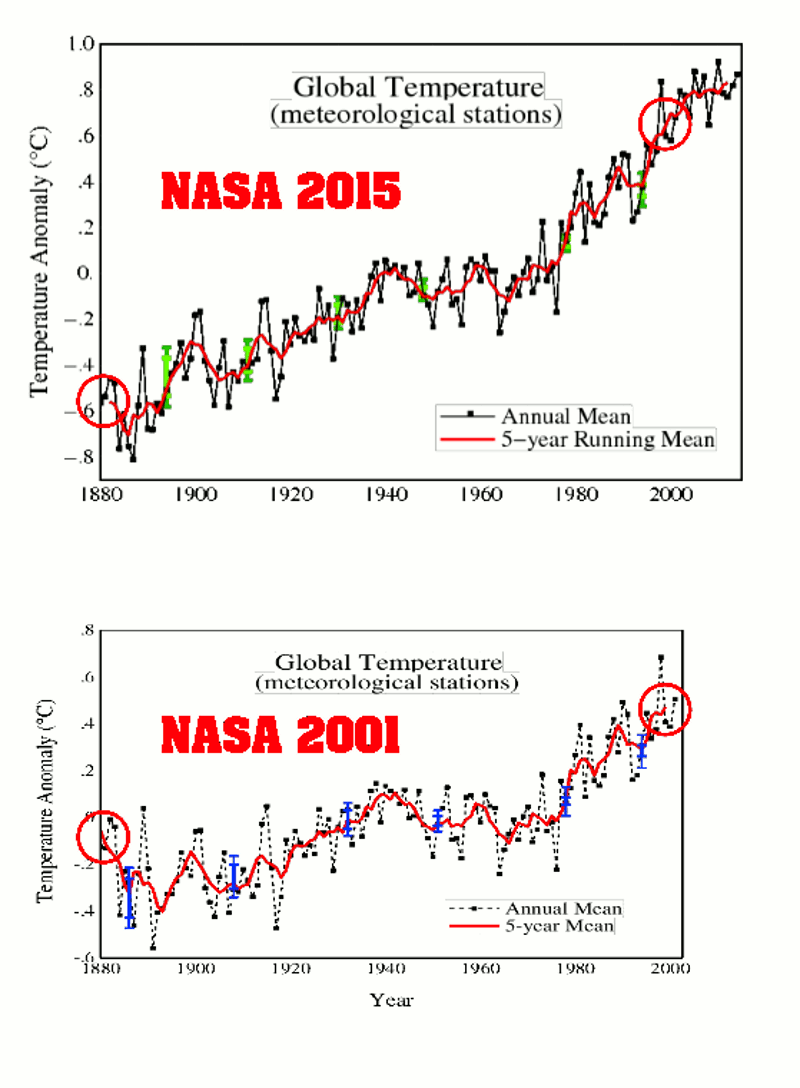
Tony Heller has on his blog a nice collection of GISS charts comparison. Each time when I hear of any GISS data I have one of these pictures in front of my eyes:
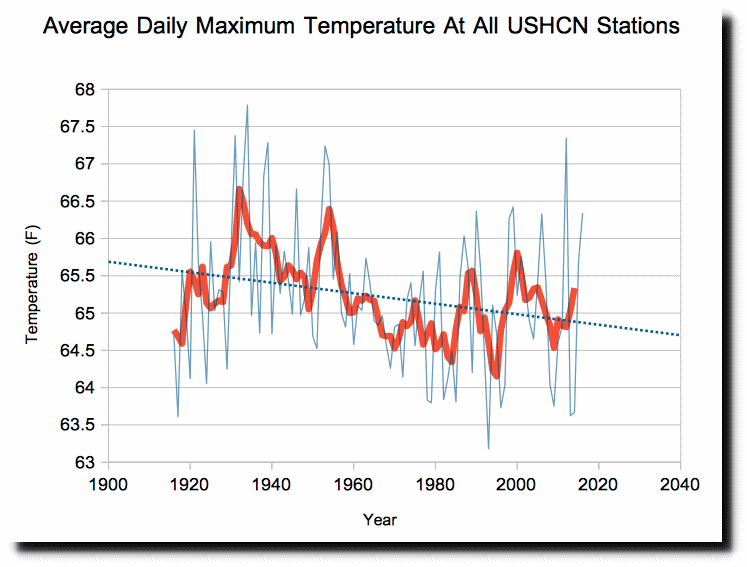
Funny how the average daily maximum temperature at all USHCN stations does not show record heat:
It is long since I lost any trust and interest in what GISS temperature data shows. Why should I care for what some biased paid high priests paint on a canvas?
Take care, wishing you all the best!