By Roger Sowell (1)

Figure 1 Artist’s Depiction – Hywind Scotland credit Statoil ASA Environmental Statement
Background
This article is the result of a request by Charles The Moderator (ctm) for me to write a more in-depth piece on my views of wind energy systems. About one week ago, WUWT had an article bashing the Hywind Scotland wind farm (7/28/2017, see link) on which article I offered a few comments. I also added a link on the Tips and Notes page to the Hywind Scotland project’s Environmental Statement (ES). That ES is the rough equivalent to an Environmental Impact Report in the US. Many technical details are included in the ES. That note in Tips and Notes prompted ctm to ask me to write this article.
Having withstood for several years the slings and arrows (including libel) of many commenters and guest bloggers at WUWT, I was reluctant to write a positive piece on wind energy. I reserve such articles for my own blog. But, ctm is a persuasive and charming fellow, and I agreed to write this. I have attempted to use plentiful references and citations throughout, and those only from reputable sources. For example, Statoil’s claims to 40 years offshore experience, built and operated more than 40 offshore oil and gas structures, some of those offshore structures are powered from shore by undersea cables, and the details of their Troll platform, are from Statoil’s own documents online. If those facts are in error, the fault is theirs. However, those facts also align with my memories of working with Statoil guys over the years.
Forging ahead, it should be remembered that another article of mine is online at WUWT (and my own blog), on the serious consequences of breaking the libel laws online. See link to “Climate Science, Free Speech and Legal Liability – Part 1.” In plain English, it is OK to disagree, but argue your points with facts, and argue politely.
Introduction
This article’s overall topic is part of the questions, what should a modern civilization do to look to its future electrical energy needs? Then, what steps should be taken now to ensure a safe, reliable, environmentally responsible, and cost-effective supply of electricity will be available in the future? These questions have no easy answers; they occupy a very great deal of time, energy, and written words.
More to the point, what should an advanced society do in the present, when it is very clear that two of the primary sources of electric power will be removed from the generating fleet with 20 years, and half of that removed within 10 years?
Two scenarios are discussed: first the world electric generating situation, then that in the United States.
The basic facts are these: at present, worldwide electricity is provided by six primary sources: coal burning, natural gas burning, nuclear fission, hydroelectric, oil burning, and a mix of renewable energy systems. Of the renewables, most of the power is from wind turbine generators (WTG), second is solar power, and the rest is from a few other sources that include geothermal, biomass, biogas, and others. (source: EIA and other reputable entities). For approximate percentages, in 2012 the world’s electric power was provided by Coal 39.6, Natural Gas 22, Hydroelectric 17.6, Nuclear 10.7, Oil 5, Wind 2.4, Solar 0.5, and Other 2.1. Figures for different countries are available from various references.
In the United States, however, the mix of energy sources is changing rapidly over the next two decades. The essential facts in the US are a great number of nuclear plants will retire; many coal-fired plants will retire, many natural gas plants will be built; and a great number of wind turbine generators will be built. Within 20 years, almost every one of the 98 nuclear plants in the US will retire. Half of those will be shut down within 10 years. That is most significant, because coal plants produce 30 percent and nuclear plants produce 18 to 19 percent of all the electricity in the US. With most of those shut down in 20 years, the US is facing a deficit of almost one-half of the electricity supply. In energy terms, coal and nuclear provide approximately 2,000 million MWh per year. (EIA for 2016). For the shorter term, ten years from now, one-half of those shutdowns will occur, leaving a shortfall of 1,000 million MWh per year.
An aside to look more closely at coal burning power plants and their rapid closures in the US. Coal is no longer king, no matter what anyone says about the matter. The fact is, as I have long stated and written, that coal burning power plants were intentionally given a pass on environmental issues. They were not forced to comply with many of the environmental requirements of the US Clean Air Act. Instead, the coal industry found ways to “perform maintenance” that added capacity, while retaining the grandfathered status. Only a few coal burning power plants were required to comply with the pollution laws. Recently, that all changed. Now, coal burning power plants are closing in record numbers because the owners cannot afford to install the expensive pollution control equipment. (Reference: MIT paper, 2016, MITEI-WP-2016-01; also see http://www.law.nyu.edu/sites/default/files/2016-ELI_Grandfathering.Coal_..Power_.Plant_.Regulation.Under_.the_.CAA_.pdf) I am aware that this is a controversial statement at WUWT, having made this statement before and receiving blistering comments on that. Yet, facts are very stubborn things; they do not care one bit what anyone thinks of them. Facts just are.
The facts of US nuclear power plants are just as plain: the fleet of 98 plants is aging. Almost half, 47 out of 98 still running, are between 40 and 47 years old. (reference: https://www.eia.gov/nuclear/spent_fuel/ussnftab2.php ) Within 10 years, it is almost certain that all of those reactors will be shut down permanently and retired. Many of the nuclear plants are losing money and have done so for a few years. Some have received direct government subsidies recently to keep running. These direct payments are in addition to the numerous other subsidies that US nuclear plants receive, such as for indemnity from radiation releases, federal guarantees on construction loans, softening of safety regulations, laws prohibiting lawsuits during construction, and others. .
In the arena of electricity generation at grid-scale, conventional and new technologies contend for market share. Over the past decade, new technologies that use renewable energy as the motive force have become more prevalent. Wind and solar technologies are two that are presently at the forefront of market share and development effort. As the traditional mix of generating technology changes in the next two decades, wind energy will certainly play a greater and greater role. In early 2017, combined output from hydroelectric and renewable sources slightly exceeded nuclear power plant output (Figure 1 from EIA, figures in billion kWh per month). Also notable from Figure 2 is the almost complete absence of energy from wind (dark green area) before 2010.

Figure 2 US Renewables with Hydro v Nuclear
The growth of wind energy has been substantial in only 7 years, from almost zero percent to 7.5 percent of US total electricity. The growth in wind energy is shown also in Figure 3, where wind energy, for the first time, was the same as the output of hydroelectric plants in 2014-2015. As an aside, Figure 3 is the real hockey stick. The data is from EIA, but the graph is my own. This graph made quite a splash on Twitter on 5/2/2016 among the #windenergy crowd. (@rsowell is my handle)

Figure 3 US Hydro v Wind Energy
The US has more than adequate wind resources and natural gas resources to fill the generating gap from retired nuclear and coal power plants. Onshore wind capacity at present stands at a bit more than 84,000 MW, (windexchange reference) with another 25,000 MW under construction. Natural gas power plants of 190 GW could easily be built to meet the need. Wind turbines of 170 GW could be installed and remain well below 20 percent of all electricity generated annually. The added 170 GW of wind is well below the estimated 11,000 GW of wind capacity that exists onshore in the US.(Lopez, A. et. al. Technical Report NREL/TP-6A20-51946, July 2012) These figures, 190 GW for natural gas, and 170 GW for wind energy are found as follows. The need is for new natural gas power plants to generate 1,000 million MWh per year. By dividing 1000 million by 8766 hours per year we obtain 114,076 MW (and multiply by 1 million). By then dividing by 0.6, the natural gas power plant capacity factor, we obtain 190,127 MW or 190 GW to install.
The 170 GW of wind capacity to install over the next decade is found similarly, but using 0.35 as the capacity factor. The desired result is to have wind energy make up 20 percent of the total electricity in the US annually, the “penetration” as it is known. With existing wind energy already at 7 percent penetration, the need then is for 13 percent from new wind turbines. Multiplying 0.13 times 4,000 million MWh/y we obtain 520 million MWh/y. As before, we divide by 8766 and multiply by 1 million to obtain 59,320 MW. This divided by the capacity factor of 0.35 gives 169,486 MW, which is rounded nicely to 170 GW of new wind capacity.
The nice result here is that total installed natural gas power plant capacity would exceed wind plant capacity. Therefore, when wind speed declines below generating speed, the natural gas power plants have plenty of capacity to make up the power deficit. Wind generating capacity at present is approximately 84 GW, and the new capacity to install is 170 GW. The total of 250 GW is less than existing natural gas power plant of approximately 260 GW. When the new natural gas power plant is added, there is 260 (old capacity) plus 190 (new capacity) which yields 450 GW of natural gas power plant capacity.
This gives a viable solution for the first ten years. Natural gas capacity would be 450 GW total, wind would be 250 GW total, and wind penetration would be a nice, round figure of 20 percent.
The second decade would require similar added capacity. An additional 170 GW of wind capacity would add 13 percent more to the penetration. That would then be 20 plus 13 for 33 percent total. That would present almost zero problems on the national grid. Total wind capacity would then be 250 GW plus 170 GW, which yields 420 GW. (reference DOE Wind Vision site states slightly more than 420 GW can be added by 2050 in their analysis. https://energy.gov/eere/wind/maps/wind-vision ) Natural gas capacity would be another 190 GW, for a total then of 450 plus 190 to yield 640 GW. With 640 being comfortably greater than 420, there is adequate natural gas power plant capacity to take over when the wind speed declines.
One question arises, then; can wind turbine generators be added at a rate necessary to achieve 170 GW over ten years? That is an average of 17 GW per year. From actual history, it is noted that in 2012, US wind capacity of a bit more than 13 GW was added. Also, 10 GW was added in 2009. It is clear, then, that 17 GW per year should be no problem. The US wind energy supply chain would be required to increase output by 4/13 or approximately 30 percent.
A second concern sometimes is expressed, as the land area required for a large number of wind turbines. That is not a problem, however. Studies of actual, modern, efficient wind farms found that on average, total land required is 85 acres per MW installed capacity. (Reference: Land Use for Wind Farms Technical Report NREL/TP-6A2-45834, August 2009 http://www.nrel.gov/docs/fy09osti/45834.pdf ) The study used hectares, giving 34 h per MW. Converting appropriately, we obtain 85 acres per MW installed. The total land area, then, for 420 GW or 420,000 MW of wind capacity is 85 multiplied by 420,000 and divided by 640 acres per square mile. The result is then 55,800 square miles when rounded up a bit. For perspective, that is almost exactly the area of the state of Iowa, which has 56,272 square miles. Of course, the wind parks would be spread out over the states and not all concentrated in Iowa. Another consideration is almost all of the land with wind turbine generators can and would be used for its original purpose.
Why the focus on wind and natural gas? One might prefer to build sufficient nuclear plants or more coal power plants instead of wind and natural gas power plants. Nuclear and coal power plants are discussed below.
It would be extremely difficult, if not impossible to build a sufficient number of nuclear power plants – 40 to 50 of them – in the next decade to replace those that retire. Recent news (7/31/2017) shows that the two new nuclear plants under construction in South Carolina at the V.C Summer plant have been halted with no intention to finish building them. (see https://www.bloomberg.com/news/articles/2017-07-31/scana-to-cease-construction-of-two-reactors-in-south-carolina ) The South Carolina plants are approximately 35 percent complete, many years behind schedule and several $billion dollars over budget. The projects were halted when the revised estimate to complete showed $26 billion. In order to start up 40 to 50 nuclear plants ten years from this date, the 40 to 50 plants must be approved and under construction today also. Clearly, that has not happened. New nuclear plants also have a very high price for electricity produced.
It would also be unwise to build new coal-burning power plants since the remaining amount of US coal that can be mined at a profit is limited to 20-30 years or less at current prices. (Reference: Luppens, J.A., et al, 2015, Coal geology and assessment of coal resources and reserves in the Powder River Basin, Wyoming and Montana: U.S. Geological Survey Professional Paper 1809, 218 p., http://dx.doi.org/10.3133/pp1809 ) If coal prices rise, perhaps by increased demand or subsidies, more coal can be mined. However, high coal prices require a coal burning power plant to have higher electricity sales prices. That simply would not occur with natural gas and wind power at such very low prices as today. New coal-fired plants would lose money, just like the new nuclear plants would.
World-wide, the numbers are similar. Coal production is limited to no more than 50 years, unless some force increases the price at the mine-mouth. (Rutledge, David, “Estimating long-term world coal production with logit and probit transforms,” International Journal of Coal Geology, 85 (2011) 23-33 http://www.its.caltech.edu/~rutledge/DavidRutledgeCoalGeology.pdf )
Why onshore wind?
Why, then, the big push for wind technology? Below are listed a few reasons in support of wind power. Following that is a description in some detail the new 30 MW Hywind wind park being installed off the northeast coast of Scotland by Statoil.
Onshore wind farms have benefited greatly from private and public funding over the past decade. The wind turbine generators are already low-cost to install and operate. Projects are profitable in the Great Plains region of the US where the sales price for power is 4.3 cents per kWh. (source: 2015 Wind Technologies Market Report https://emp.lbl.gov/sites/default/files/2015-windtechreport.final_.pdf ) The federal subsidy is to end in 3-4 years. Most importantly, the installed cost has steadily decreased over the years, by a factor of 3 in the past 7 to 8 years. The low capital cost is the primary reason that wind power is being installed at 8 to 13 GW per year in the US. It must be acknowledged that the reductions in capital cost per kW occurred only because the federal and state subsidies for wind technology allowed developers to design, build, and install better and better designs. Whatever arguments there may be against subsidies, wind turbine generators have benefitted substantially from the subsidies.
Installed costs will continue to decrease as more improvements are made. Designers have several improvements yet to be implemented such as larger turbines, taller towers, and increased capacity factor. Oklahoma just announced a 2,000 MW project with 800 turbines of 2.5 MW each. Onshore wind farms will soon have the larger size at 4 MW then 6 MW turbines similar to those that are installed now in the ocean offshore.
Wind repower projects have even better economics. Repowering is the replacement of old, inefficient wind turbine generators with modern, usually much larger, and much more efficient systems. The wind will not have changed, was not used up, in the same location. In fact, the taller turbines reach higher and into better wind that typically has greater speed and more stability. The infrastructure is already in place for power lines and roads. Repowering may be able to incorporate legacy towers as the upper section of new, taller towers for larger wind turbine generators.
Wind power extends the life of natural gas wells. Wind power creates less demand for natural gas. This reduces the price of natural gas. That helps the entire economy, especially home heating bills, plus the price of electricity from burning natural gas. But, this also reduces the cost to make fertilizer that impacts food, since natural gas is the source of hydrogen that is used to make ammonia fertilizer.
Wind power is a great jobs creator. Today, there are more than 100,000 good jobs in the US wind energy industry. Many of the wind industry jobs are filled by aeronautical engineers. Instead of designing airplanes with two wings that fly in a straight line, they design wind rotors with three wings that turn in a circle. There are approximately 1.2 jobs per MW of installed capacity, with 84,000 MW and 100,000 jobs. That’s approximately the same ratio as in nuclear power plants, with 1 job per MW.
Wind provides security of energy supply. No one can impose an embargo on the wind. There are no foreign payments, and no foreign lands to protect with the US military.
Wind provides a good, drought-independent supplemental income via lease payments to thousands of families nationwide, due to the distributed nature of wind turbine projects. Almost 100 percent of the land can continue in its original activity, grazing cattle or farming. Marginal land with no economic activity now produces income for the landowner. 85 acres is required for 1 MW of WTG.
Wind power promotes grid-scale storage research and development. Wind energy generated at night during low demand periods can be stored then released when demand and prices are higher. As always, some losses occur when energy is stored and released later. Storage and release on demand has spinoff into electric car batteries. EVs will reduce or eventually eliminate gasoline consumption, and that will spell the end for OPEC. The entire world’s geopolitics will change as a result. Recently, the CEO of BP, the major international oil company, predicted that the next decade or two would bring such a surge of EVs that oil demand would peak, then decline. The CEO is right, too. When it becomes patriotic to drive an EV rather than a gas guzzler, EV sales will zoom. A gas guzzler will be seen as an OPEC enabler.
Wind power hastens nuclear plant retirements as electricity prices decline. Nuclear plants cannot compete with cheap electricity from cheap natural gas. As stated above, wind energy keeps natural gas prices low by reducing the demand for natural gas.
Power from wind is power without pollution. Wind power has no damaging health impacts from smoke, particulates, or noxious sulfur or nitrogen oxides. The American Lung Association encourages clean, pollution-free wind power.
Summary to this point.
The utility-scale power generation mix in the US will change substantially, even dramatically over the next ten and twenty years. Nuclear power will be almost non-existent. Coal power will also be greatly reduced or almost absent. Wind power will be four to five times as much capacity and generation compared to today. Natural gas power will grow to replace the nuclear and coal production, but will loaf along as wind generation occurs. Only when the wind dies down will natural gas power plants roar to life at full throttle. This describes the US situation.
Several other nations also have similar issues to face. Of the approximately 450 nuclear power plants still operating world-wide, roughly one-half will retire within 20 years, and for the same reasons as do those in the US. Old age, inability to compete, and safety concerns will shut them down. A similar analysis can be done for each major nuclear power country with aging reactors, including Japan, France, Canada, UK, and Germany. On average, with 20 years being exactly 240 months, that is roughly 1 reactor per month to be retired. The booming business of the future will be reactor decommissioning.
Next is part two, the specifics on offshore wind and the Hywind Scotland wind park.
Why, then, offshore wind?
In addition to all the benefits of onshore wind power listed above, offshore wind farms have a few benefits of their own. First, a couple of drawbacks that exist with offshore wind power. It is well-known that offshore wind power has higher costs to install, and higher operating costs due to accessibility issues when compared to onshore wind farms. However, these drawbacks are somewhat offset by the much larger wind turbine generators that can be installed, taller towers, and better wind as measured by both velocity and stability. Lease payments do not flow to private landowners, typically, but to the government that controls the local part of the ocean.
For areas that do not have the very good onshore wind that exists in the interior of the US, offshore may be an ideal place to develop wind energy.
Larger turbine designs for offshore wind projects can be evaluated and adapted for onshore projects.
Much of the world’s population lives in cities near the ocean. Transmission lines to bring the energy from the offshore wind turbine generators to the cities may be shorter, compared to running long distances overland.
For those who cannot see the beauty in a technologically advanced wind farm, an offshore wind farm can place the systems out of sight.
The marine industries get a boost with offshore wind farms.
Offshore wind farms are ideally situated for a few forms of grid-scale storage. In particular, one of those is pumped storage hydroelectric with the ocean as the lower reservoir and a dedicated lake higher up onshore. Another form is the MIT submerged storage spheres.
Offshore wind farms very recently, Spring of 2017, won an auction in Germany that contained zero government subsidy as part of the bid. With more and more advances in the technology, the era of subsidized offshore wind farms may be over. Time will tell.
Offshore wind farms bring additional capacity to play. Using the US for example, the government estimates 11,000 GW of wind capacity is economically feasible onshore. An additional 4,000 GW of wind capacity is economically feasible offshore. Offshore wind power increases the US total by a bit more than one-third.
Finally, offshore wind power brings affordable electricity to islands that presently have very expensive electricity due to burning oil in power plants, or diesel in piston-engine generators. Offshore wind power is a mainstay of Hawaii’s plan to obtain 100 percent of the electricity in the islands from renewable sources. Some storage will be necessary to balance out the fluctuations in demand.
The Hywind Scotland floating wind farm uses the moored spar technology, appropriately modified for the single-tower system of a wind turbine generator.
Hywind Scotland Project

Figure 4 Conceptual Layout From Hywind Environmental Statement
Technology
As depicted in Figure 4, Hywind Scotland has five floating, seabed-moored spar-type wind turbine generators rated at 6 MW each for 30 MW installed capacity. Note, these are the same size as the offshore wind park in Rhode Island in the US. Block Island system offshore Rhode Island started production in 2016. Note, however, the Block Island system’s towers are not floating, but are anchored to the ocean floor.
Each Hywind Scotland WTG has three mooring lines anchored to the seabed. These mooring lines split into two, so there are six anchor points on the floating tower. (ES 4-5) see Figure 5 below.

Figure 5 Undersea Mooring Schematic – from ES
WTG has a proprietary motion compensation system to ease the load on critical bearings. (ES 3-1)
WTG has three rotor blades. The rotor blades are pitch-controlled. Rotating speed varies with wind strength, from 4-13 RPM (ES 4-19).
The WTG are provided by Siemens, a major vendor of offshore wind turbine generators. The model is SWT-6.0-154. Access is available by boat and a ladder system inside each tower.
Hub height for the WTG is 101 meters above sealevel.
Cut-in wind speed where power generation begins is 3-4 m/s. Cut-out wind speed for WTG protection is higher than 25 m/s. (6.6 mph – 55 mph) (ES 4-19) See Figure 6 for wind direction and range of speeds at the site. Wind speed is higher than cut-in speed more than 95 percent of the time.

Figure 6 Wind Rose Showing Direction/Speed – from ES
Power is collected from the 5 WTGs and brought to shore via a single cable along the seabed, length approximately 25 to 35 km. The power is tied into the national grid. Power is at 33 KV, 50 HZ and AC. Undersea power cable to shore is armoured and 0.5 m diameter. Power can be drawn from shore if the need arises. Diesel-powered generators can also be used at any WTG (ES 4-6)
Each WTG is connected via inter-array cable, 33 kV at 50 HZ and AC. Cables are armoured and approximately 0.5 m diameter. The temporary loss of any one WTG for repairs or maintenance will not affect the output of the others. (ES 4-5)
A smaller floating WTG prototype operated 10 km off the west coast of Norway since 2009 to 2014 and withstood 20 m waves and 40 m/s winds (approximately 88 mph). The prototype was a single WTG with 2.3 MW capacity. (ES xi and 3-1)
Seafloor area required is 15 km-2. With capacity of 30 MW, the ratio is 2 MW per km-2. (ES 4-2)
Water depth is 95 – 120 meters (ES 8-8)
Each of the WTG Units will be equipped with code-compliant navigational lights for marine operations and aviation that will automatically turn on in the dark. (ES 4-7)
Statoil ASA, a Norwegian oil and gas company, is the designer, and investor. Statoil has more than 40 years of offshore oil and gas experience with more than 40 separate offshore installations, most of which are in the harsh conditions of the North Sea. Statoil designed and built the world’s largest object that was ever moved over the Earth’s surface, the Troll A platform. Troll A was designed in the late 1980s, approximately 30 years ago. It began operating in 1996. Troll A is a complex concrete and steel structure that sits on the ocean floor in more than 300 meter deep water. The platform itself is far above the ocean surface. Troll A is more than 470 meters from top to bottom. Statoil also has long experience with power cables along the ocean floor from shore to offshore structures.
Hywind Economics
Economics are improved over the initial one-turbine, 2.3 MW prototype. The prototype generated 40 GWh over several years and demonstrated a 50 percent annual capacity factor during one year. Lessons learned at Hywind Scotland’s 30 MW system will be employed in future, large-scale wind parks. Hywind Scotland’s installed cost is GB £210 million (approximately US$276 million. $/kW = 9210.) But, this includes undersea cables. Note, this is just a bit less than the Block Island 30 MW system in the US, which cost US$300 million.
The unsubsidized economics for the small, 30 MW Hywind Scotland system gives a sales price of electricity at $215 per MWh sold for a 12 year simple project payout. This is based on 45 percent annual capacity factor and investment as above. Revenue would be an average of $23 million per year. With public funding sources as described in the Environmental Statement, the economics are very likely substantially better. This price point, $215 per MWh, is competitive with peaker power prices.
With economy of scale and 60 percent reduction in installed cost for a larger 600 MW park, and 12 year simple project payout, no subsidies, the electricity could be sold at $89 per MWh. At that price point, offshore wind becomes competitive with baseload natural gas power with LNG at $10 per MMBtu as the fuel used.
Bird Collisions
The environmental impact on numerous species are included in the Environmental Statement. The impact on birds is summarized here.
Avian collision mortality was predicted in the Environmental Statement for species that commonly fly at rotor height (101 m) using a range of modelling scenarios. This showed that the predicted additional mortality was negligible compared to the numbers of birds that die from existing background mortality causes. (ES 11-1)
With one exception, predictions of the size and duration of potential impacts shows that for all species for all times of year effects would have negligible impact on receptor populations. The exception is razorbill, for which a potential disturbance effect of low impact for the breeding population is identified owing to the very high densities sometimes present in August, a period when individuals of this species have heightened vulnerability to disturbance. This impact is nevertheless judged not significant. (ES 11-1)
The negligible impact conclusion is consistent with studies in the US on bird mortality from wind turbines. In the US, approximately 1 billion birds die annually from various causes. Ninety-six percent of those are caused by collisions with buildings, power lines, automobiles, and encounters with cats. Less than 0.003 percent were due to wind turbine impacts. (Erickson et.al, USDA Forest Service General Technical Report PSW-GTR-191 (2005), Table 2 https://www.fs.fed.us/psw/publications/documents/psw_gtr191/psw_gtr191_1029-1042_erickson.pdf ) In addition, bird fatalities decline as older, truss-style support towers are demolished and modern, monopole support towers are installed.
Conclusion
There is a need for electric power generation technologies to replace the rapidly aging and retiring nuclear power plants in several countries within the next decade. Also, coal at today’s prices has a limited horizon of 20 to 50 years. In the US, coal power plants are shutting down due to pollution equipment costs. It is prudent to develop safe, reliable, and affordable means of generating power. Wind power has improved dramatically in the past decade to take its place as such – safe, reliable, and affordable. More improvements are identified and already in the pipeline. In addition, wind as an energy source is eternally renewable and sustainable. The benefits of reduced natural gas demand, lower natural gas price, less air pollution, improved human health from lung diseases, economic benefits for land owners with wind farm leases, increased jobs, increased domestic manufacturing and service businesses, all make wind energy desirable.
The offshore, 30 MW Hywind Scotland floating spar wind energy system is built and backed by the very experienced Norwegian company, Statoil ASA. Even though it has subsidies, the project’s unsubsidized economics would make it attractive against peaker power plants. The improved economics due to economy of scale will make this competitive with main gas-powered plants where LNG is imported for fuel. The Hywind Scotland technology for wind turbine generators, floating moored spar supports, and undersea power cables is already proven. The location chosen, off the eastern seaboard of Scotland, has excellent wind with 40 to 50 percent capacity factor.
A 600 MW or larger offshore wind farm using the Hywind Scotland design can be expected in the next decade. Wind energy technology continues to improve with demonstrated, year-over-year reductions in cost to install.
Additional References:
http://www.4coffshore.com/windfarms/hywind-scotland-pilot-park-united-kingdom-uk76.html
Abbreviated in this article as ES: https://www.statoil.com/content/dam/statoil/documents/impact-assessment/Hywind/Statoil-Environmental%20Statement%20April%202015.pdf
Footnotes
(1) Roger Sowell is an attorney in Science and Technology Law. Since earning a BS in Chemical Engineering in 1977, he has performed a great many engineering consulting assignments worldwide for independent and major energy companies, chemical companies, and governments. Cumulative benefits to clients from his consulting advice exceeds US$1.3 billion. Increased revenues to clients are at least five times that amount. He regularly makes public speeches to professional engineering groups and lay audiences. He is a regular speaker on a variety of topics to engineering students at University of California campuses – UCLA and UC-Irvine. He is a founding member of Chemical Engineers for Climate Realism, a “red-team” style think-tank for experienced chemical engineers in Southern California. He is also a Council Member with the Gerson Lehrman Group that provides advice to entities on Wall Street. He publishes SowellsLawBlog; which at present has more than 450 articles on technical and legal topics. His widely-heralded Truth About Nuclear Power series of 30 articles has garnered more than 25,000 views to date. Recently (2016), he was requested to defend climate-change skeptics against an action under the United States RICO statutes.
All the talk of the economics of wind in excrutiating detail misses the point.
Wherever there is penetration of wind and solar into the “market” * the price of electricity rises sharply. There was a post on this recently on WUWT.
Australia is a world champion in this regard as our cost went up twice as much relative to percentage of “renewables” as the average of the rest of the world.
Wind isn’t ever going to get much better from an efficiency pov. The devices are already close to the theoretical limit on how much energy you can extract from the wind going by. IIRC it is just under 60%. This makes sense as you cannot stop the wind completely and extract all the kinetic energy from the area intercepted by the device.
Solar is always limited by the rotation of the Earth and clouds, well Earth based is.
Grid scale storage doesn’t seem to be happening with any great speed. Note that if it was economically feasible there has been great economic incentive to develop and use it as power stations would not have to be so large to cope with fluctuations in demand. After 100 years or so of grid electricity we haven’t developed it.
I notice Willis’s EIA table doesn’t show the capacity factor or cost of coal with no carbon dioxide capture and sequestration. I prefer that the CO2 be “sequestered” in the atmosphere where it can be recycled by plants.
Further evidence of the uselessness of wind is the fact that in the first world wind powered boats are for the main, for pleasure only. The commercial world, as soon as steam engines became good enough breathed a sigh of relief and said “thank god we can get rid of the damned sails”. Likewise natural energy powered aircraft (sailplanes, hang gliders, paragliders) are just for fun.
Sorry Willis, I am truly sick of the green scam which is damaging our civilization economically and morally while enriching the likes of Al Gore and associated hangers on. It gets enough oxygen elsewhere, ad nauseum.
* I use the word “market” advisedly as except in a few niche applications nobody would bother with wind or solar on a large scale unless governments hold guns to people’s heads (it’s what they do, otherwise nobody would take notice of them) . The experiments have been done (see South Australia, Denmark, Germany etc) and these are uneconomic electrical energy sources compared to coal.
Mr. Sowell, in many cases the escalating costs of nuclear power plants are related to the numerous lawsuits which are brought (my opinion, with nothing at hand to back it up, other than direct work-related experience). If wind farms become common across America, it is possible that there could be lawsuits brought against them, perhaps while in the planning stage. Some towns have already had problems with even one or two wind turbines, because of complaints about noise, vibration, light pollution, and the killing of various winged creatures. Do you foresee there being any legal problems with expanding wind farms throughout the US, especially if they are located near dwelling areas?
For Janice The American Elder, re August 5, 2017 at 8:34 pm
“Mr. Sowell, in many cases the escalating costs of nuclear power plants are related to the numerous lawsuits which are brought (my opinion, with nothing at hand to back it up, other than direct work-related experience).”
I heard that, too.
“If wind farms become common across America, it is possible that there could be lawsuits brought against them, perhaps while in the planning stage. Some towns have already had problems with even one or two wind turbines, because of complaints about noise, vibration, light pollution, and the killing of various winged creatures. Do you foresee there being any legal problems with expanding wind farms throughout the US, especially if they are located near dwelling areas?”
Wind farms are already common across America, with more than 84,000 MW of capacity installed. I believe the average turbine is approximately 1 MW, some larger and many are smaller. Per the AWEA, American Wind Energy Association, the number is approximately 52,000 turbines already in place. The turbines are usually welcomed by the ranchers and farmers, who obtain extra cash income from leasing a very small portion of their land for as much as 25 years.
My law practice does not include defending nor filing lawsuits against wind turbine generator projects, so I really cannot comment on your question. I addition, I never address a legal issue on a public forum such as this. I must give you the stock answer every attorney is bound to give, that is to gently suggest that you contact an attorney with experience in that particular matter for any legal advice. Your local Bar Association can assist you in finding an attorney.
Roger Sowell August 5, 2017 at 11:04 pm Edit
Roger, she did not ask a legal question. Nor did she ask you to “address a legal issue”.
She asked whether in your opinion increasing wind farms would lead to increasing lawsuits. She didn’t ask about laws, or whether they were or are being broken. She asked NOTHING about the law.
Your refusal to answer such a simple, non-legal question highlights why people hate lawyers—you hide behind the law when you are unwilling to answer, and you threaten with the law when it doesn’t go your way.
The question is quite simple to answer. There have been an increasing number of lawsuits against wind farms. Any fool can see that if wind farms increase, it is very probable that lawsuits will also increase.
Anyhow, I’ve answered since you were too scared to reply.
You’re welcome,
w.
PS—For someone claiming to never address a legal issue on a public forum, it’s hard to see how you justify publicly threatening legal action against people who point out that Emperor Sowell has no clothes … surely that’s a legal issue, no?
Mr. Sowell, I appreciate your time in formulating a response to my question. Since I specifically asked about wind farms that are located near dwellings, and you obfuscated by replying about farms and ranches, I can only assume that there have been increasing amounts of lawsuits against wind farms, when they are located close to dwellings. This will most likely, as it as done in the case of nuclear power plants, raise the costs associated with producing power, and thus price themselves out of the market. Having seen this done quite successfully by the various environmental groups, it seems quite entertaining to see the same environmental groups assail the supposedly “green” wind farms for similar problems.
Sometimes, when someone beats-around-the-bush in an answer, it is more telling than if they simply answered the question in a straightforward manner. Thank you for answering my question.
Roger Sowell;
I never address a legal issue on a public forum such as this.
You mean other than right in your own article? Did you forget what you wrote already?
You make it SO easy to mop the floor with you.
Sitting in the back of Hearing Room 4, Lois Lane of The Daily Planet listened intently, taking copious notes. Back at her desk, after a wistful glance at Clark Kent, she typed her article:
WUWTland — August 5, 2017 — Today, at the county courthouse, California attorney Roger Sowell argued for adoption of The Big Wind Plan. After a 2-hour opening statement, he rested his case largely skipping the fact-finding stage, only making an offer of a few pieces of evidence (perhaps it is classified information?) and addressed some of the concerns raised in the energetic public forum which followed.
Several people stood up and warmly praised Mr. Sowell, but the majority of the highly educated audience vigorously disputed his claims. At the end of the evening, the commissioners voted 4 to 1 to reject his proposal. “The figures just didn’t add up,” said Commissioner Cruncher, “and ‘I’m sure that’ and ‘it’s bound to happen’ just didn’t cut it.”
The Planet talked with some of those present:
“Over and over he just kept making conclusory statements citing no, and I mean NO evidence for them. Oh, sure, he had a few cites, but mostly he just pounded the table,” said John Applebee. “I’m an engineer and I can tell you that what he said was not convincing.”
“He’s a pretty slick talker,” said Portia Pound, “he could make a good living selling stuff. As far as convincing anyone who has read about this topic at all, however, he fell far short.”
“I don’t think he counted on so many informed, technically saavy, people being here today,” said Yosemite Sam, “they shot so many holes in that windjammer of his, they blasted him to smithereens!”
“But, he did write a really good essay, there, you know,” said Shipley Pith. “He knows a lot, that’s for sure, and he is right about cats killing birds, you know.”
“And he just really, really, seemed to care. That’s why I voted for his idea,” Commissioner Luke Warner said.
In response to The Planet’s asking Mr. Sowell for his reaction to some quotes taken from the public forum today, he would only say, “I can sue anyone here for libel if I want to. That’s all I have to say.” Asked if he was having second thoughts about any of his presentation, he said, “Absolutely not.” Asked for “any final words?” he replied, “Nuclear power is evil. That’s all I have to say.”
Lois Lane
The Daily Planet
#(:))
Well done Janice.
Aw, U.K.. Thanks, so much, for that. You encouraged me that first day I commented, back in April, 2013, and you are still doing it. What a guy. Take care, out there, James C..
You know you hit a chord, when even Willis is backing your play 🙂
Correction to our article about The Big Wind Plan of last week: Roger Sowell wrote to tell us that he said, I can sue anyone here {at the hearing} for slander, not libel as we mistakenly reported.
For Ms. Moore, herself an attorney:
Very funny. Nice try, actually.
Go Wind!!!! When the Wind Blows, The Power Flows!!!!
(And did I somehow miss all the astute words from you on the substance of this post, the facts, the economics, nuclear plant closures, the more than 450 pages of evidence provided by Statoil ASA in their Environmental Statement, or any other material matter? Who is the one actually pounding the table here?)
Surely the real Lois Lane would not have missed such a golden opportunity to show the world how smart she really is, and strive desperately to impress her Clark Kent?
Roger Sowell August 5, 2017 at 10:28 pm
Dude, you are truly losing the plot. People have posted dozens of objections to your foolish claims, objections which you have somehow neglected to answer. For example, I’ve shown that offshore wind is the second most expensive way to generate electricity, with only solar thermal being a larger pile of overpriced moose droppings … but nooooo, that doesn’t merit an answer.
Instead, you apply your massively stupendous intellect to oppose Janice’s satire because it didn’t contain citations … miss the point much? That’s like objecting to Gulliver’s Travels because it didn’t contain verifiable evidence that tiny Lilliputians actually exist … it’s SATIRE, son, not a factual exposition.
The ugly truth is that people are pointing and laughing at you for being an officious, pompous, legalistic, paternalistic, threatening jerk. My suggestion? Quit while you’re behind, remember the first rule of holes.
w.
LOL
the above in response to satire from Janice , well done! sorry but threading made the comment appear out of context.
Thank you!
Lois, is this the guy? Is it Roger or Lex?
http://images.fandango.com/MDCsite/images/featured/201402/hackmanluthor.jpg
Heh. No (smile). I think its more like this guy…..
http://www.adventuresinpoortaste.com/wp-content/uploads/2016/02/snake-oil.jpg
(btw, Strangelove, how’s that trick right arm of yours these days 🙂 )
I’m fixing it 🙂
Roger Sowell says:
Extremely doubtful, I can find no supporting evidence. Citation?
w.
http://www.idph.state.il.us/cancer/ERS12-05_Childhood_Cancer_Incidence_Nuclear_Power_Plants.pdf
Childhood Cancer Incidence in Proximity to Nuclear Power Plants in Illinois
November 2012
[Abstract]
The objective of this study was to examine childhood cancer incidence in proximity to nuclear power plants in Illinois. Cancer cases diagnosed among Illinois children 0 to 14 years old from 1986 through 2005 were included in the study. Standardized incidence ratio (SIR) was calculated for the geographic zones defined by the proximity to nuclear power plants.
The results show that children living within 10 miles of any nuclear power plant did not have significant increase in incidence for
leukemia (period 1986-1995: SIR=0.85 [95% confidence interval,
CI: 0.54-1.26]; period 1996-2005: 1.23 [0.91-1.64]),
lymphomas (period 1986-1995: 1.38 [0.77-2.27]; period 1996-2005: 0.77 [0.37-1.42]),
or other cancer sites.
Neither did the children living 10 to 20 miles or 20 to 30 miles from any nuclear power plants. This study did not find any significant childhood cancer excess among children living near nuclear plants and did not observe any dose-response patterns.
Thanks, Janice, that’s what I figured. It’s just Roger telling porkies again and hoping that no one notices … or if they do notice he’ll sue them.
Pathetic.
w.
My thoughts based on a history in the utility industry on the environmental side.
I disagree with the presumption that prices will remain the same. In my experience in the utility industry one the primary drivers to keep prices low was fuel diversity. As long as there were options utility companies could play one fuel off the other to keep the price down. When natural gas is the only game in town that can provide dispatchable power then they can charge whatever they want and the price will go up. Most importantly when renewables make up a large percentage of the power provided prices have gone up sharply.
I disagree with the position that pollution costs were the primary driver for coal plant retirements. I know of two plants in NY that met all the control limits on the books but could not make money with the gas prices. That is the primary thing preventing new coal units. As long as there is no CCS requirement a super critical unit with FGD, SCR and baghouse can meet all the control requirements.
I agree that nuclear power’s days are numbered because new plants using the existing paradigm for construction are far too expensive.
In my opinion the fatal flaw in the wind argument is dispatchability. At some point wind has to be paired with storage to support the system and there is no sign that adequate storage is going to be available at a reasonable price anytime soon. The presumption that gas units will be built to provide backup to wind is not based on a rational business plan. Who is going to build gas that can make money doing that?
1. What incentive would there be for an entity to build, maintain, and staff a backup generating facility if that facility only has access to the market during times when the wind doesnt blow?
2. Would the backup facility be compensated at the same rate as wind generated power?
3. If the same entity owns both wind AND fossil fuel assets, what incentive would there be for that entity to NOT to simply use the asset with the lower operation and maintainance cost?
Steve R:
With respect, you miss the point.
Electricity generation, costs and efficiencies are not relevant because windfarms ONLY exist to reap subsidies,
Richard
http://drp-images.nettavisen.no/images/article/2017/02/07/3423310453/1/w1024/3394036.jpg
Source for the above graph and more:
https://www.energy-charts.de/index.htm
I’m not sure what that chart purports to show but here is the gross electricity generation by fuel source for Germany as of 2015 (Energy Information Agency):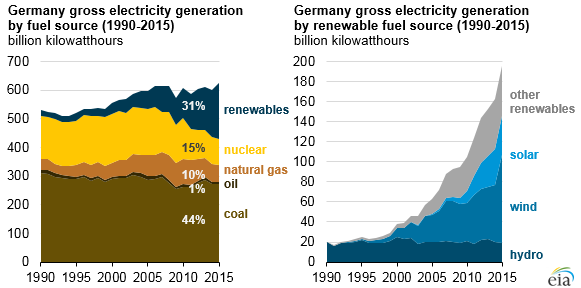
As you can see the ‘renewables’ in Germany are simply replacing nuclear with no net reduction in fossil fuels, if that’s the concern.
And here is the cost:
http://www.euanmearns.com/wp-content/uploads/2015/08/europeelectricprice.png
Well Chris, the decision to suddenly switch off nearly half of Germany’s reactors mid way through 2011 probably shaped that chart a little.
(The renewables percentage went to 32.5% in 2016 and 35% in first half 2017)
I have no problem with wind, except
1.) no subsidies or preferential purchase price whatsoever
2.) cost of backup generating/temporary storage capacity due to varying output
3.) and cost of grid upgrade necessary should be included
4.) the full environmental impact should be acknowledged and paid for, including
a.) insanely high level of low frequency (~1 Hz) infrasound noise
b.) dense network of heavy duty roads necessary for construction and maintenance
c.) environmental impact of wind turbine production &. road network construction
However, if these costs are included, wind power is not competitive. Especially if CO2 output of coal burning is not considered a pollutant, only sulfur, dust &. such.
There is another good paper in the European Physical Journal Plus (2016) by F. Wagner titled “Surplus from and storage of electricity generated by intermittent sources” which comes to a similar conclusion that the VGB Powertech study I mentioned in my previous comment. Link to this open-access paper in English is here: https://link.springer.com/article/10.1140/epjp/i2016-16445-3
The author concludes that “A back-up system is necessary with the power of 89% of peak load” and “By 2022, an extremely oversized power supply system has to be created, which can be expected to continue running down spot-market electricity prices”.
I’ve not seen such a good looking pig for….. well………years maybe…………….EVAH.
So the windmill is offshore but not far and lot’s of people live by the seaside.
=Two quite disconnected facts – people do not live where it is as windy as he11.
The electricity therefore has to be moved huge distance to get to the consumers.
Cor gee whizz wow! “Cables are 0.5M in diameter” Yeah right, my willy is bigger than a big thing.
(Do pay attention out there, The Girls are NOT impressed)
And cables are made of what apart from copper (you are gonna go and bring it home when you’ve finished?)
There’s no polythene/polypropylene or ‘oil’ involved by any chance?
So Statoil have epic experience of ‘structures in the North Sea’?
(Hello girls, impressed yet? Thought not.)
So why are these things so goddam expensive. Its a floating thing (=ship: been around for millennia) with a windmill attached. Permanently anchored ship at that. Experience at milkiing taxpayers although to be fair, governments shamelessly milk the oil-companies.
Then add punitive duty to the refined product the punters buy & use – stuff they use to keep the entire economy going hence and able to buy crocks like these.
Cronyism at its finest.
At 21cents/kWh it is competitive with current peaker-plant?
But these are not peakers. They are given priority access to the grid, people are FORCED to pay for every watt of energy these things make while much cheaper stuff natural gas is ‘saved’
Are you *completely* nuts?
By example here in UK, Hinckley Point (HP) nuclear is expected to produce electricity at half that price and most people are raving about how expensive that is.
And HP is only expensive because all the safety obsessed and generally paranoid bizzies make it so, by a factor of 4 or 5.
Then, it goes from bad to utterly appalling, you want to store the windmill’s energy in an underwater bubble.
So bang goes half your power: hence you have to double the price.
Save in the knowledge that the cost will soon come down by 60%
When, where (apart from arguably semiconductor tech – which this thing is NOT) did such a thing ever happen?
In all, what we see here is Magical Thinking at its very finest.
Those pin-dancing faeries are all perfectly made-up, wearing immaculate costumes, not a hair out of place and with impeccable timing, go through their complicated choreography.
And we all hopefully by now recognise a socialist crock when we see one – just need to count the words.
Roger: Let me offer another viewpoint on the economics of wind power – but by starting with the peaker plants in CA that used to be OC-Gas. Since a peaker plant may run only 10% of the time, the most important aspect of a peaker plant is its fixed cost – which must be paid for during 10% of the year. Therefore the most economical way to meet peak demand is with a plant with the lowest capital cost. Their high fuel cost is relatively unimportant, because customers are only paying that high cost 10% of the year. In THIS market, replacing OC-Gas with CC-Gas nearly doubles the real cost of electricity to customers, because they are paying most for fixed costs. Here the LCOE is grossly misleading. The cost of switching to CC-Gas may be much high than the SCC of the CO2 emission that is mitigated.
The opposite is true for plants meeting base load demand: Their high fixed costs can be spread over nearly the whole year and it is most important to pay a low cost for fuel. This is the market where nuclear is an attractive low-carbon technology. The optimal mix of fix and capital costs for generation plants changes with the fraction of time a plant is producing to meet demand.
Finally, because long-distance transmission lines are very expensive and have limited capacity, the electricity market place is mostly a series of LOCAL MARKETS shaped by the existing demand, production, transmission lines and supply networks (natural gas is delivered by pipeline, coal by train). Now, what happens when naive legislators distort what may have been a somewhat optimal mix of generating technologies by demand use of wind and solar. And the DoE starts publicizing LCOEs that don’t reflect local economic factors.
First, let’s recognize that wind and solar compete in the high capital cost / low fuel cost segment of the marketplace. They are most likely to displace nuclear power, which is under assault from regulators and the low cost of natural gas. To the extent they reduce the incentive to keep nuclear plants operating, wind and solar do nothing to help reduce CO2 emissions!
This brings us to the problem many others have focused on: WInd is not dispatchable and therefore can’t meet base load demand on its own. Customers need to pay the capital cost of having a fossil fuel plant standing by to meet base load demand when the wind is weak. To the extent that wind is variable from hour to hour, that back up fossil fuel plant needs to be running in spinning reserve mode and emitting CO2! The remaining marketplace shifts from minimizing fuel cost to minimizing capital cost.
So customers end up paying far more than the LCOE for wind power: 1) The capital cost of the fossil fuel backup plant that replaces wind when wind is weak. 2) The fuel and other variable costs of the fossil fuel backup plant operating in spinning reserved wind output can’t be forecast with the accuracy that meeting demand requires. 3) The cost of new transmission lines that would otherwise be unnecessary. That doesn’t include the other costs that don’t show up on customers bills: feed-in tariffs paid by the government, the PTC, financing incentives, etc.
All kWh of electricity are not equally valuable. If the law of supply and demand operated in this market, one would quickly see that wind power is not worth its levelized cost of production. The owner of an older, now decommissioned, wind farm was asked by the local paper why he wasn’t installing new efficient turbines at his site that already contained valuable infrastructure. He said: “Nobody wants to buy electricity in Alberta when the wind is blowing! This is the law of supply and demand operating and its consequences get more severe as market penetrance increases. The owner said he was waiting for government incentives and regulations to guarantee a market and price for his product that currently doesn’t exist. And probably still wouldn’t exist with a carbon tax.
Europe is increasingly not a local market, but a single market of countries connected with HVDC interconnectors.
More of these are being built all the time..
http://blogs.platts.com/2014/02/27/single-eu/
Tell how the failure of the interconnects will affect local electrical consumers. Please don’t tell me how reliable they are. They are mechanical and will fail at some point in time. What happens when they are not available? Todays generators and transmission lines have been designed to handle some of these failures. Are these capable of that or are we walking toward a cliff?
Read: dependent upon the State.
For Frank, re August 6, 2017 at 3:25 am
Long, but I will try to respond to some of your comments.
“Roger: Let me offer another viewpoint on the economics of wind power – but by starting with the peaker plants in CA that used to be OC-Gas. Since a peaker plant may run only 10% of the time, the most important aspect of a peaker plant is its fixed cost – which must be paid for during 10% of the year. Therefore the most economical way to meet peak demand is with a plant with the lowest capital cost. Their high fuel cost is relatively unimportant, because customers are only paying that high cost 10% of the year. In THIS market, replacing OC-Gas with CC-Gas nearly doubles the real cost of electricity to customers, because they are paying most for fixed costs. Here the LCOE is grossly misleading. The cost of switching to CC-Gas may be much high than the SCC of the CO2 emission that is mitigated.”
Switching to CCGT is a moot point in California, where simple cycle plants were outlawed a few years ago. In addition, having CCGT allows the plants to run as either peaker or load following, even baseload as the grid operator chooses. Finally, grid-scale batteries are already the right choice instead of a simple cycle gas turbine.
“The opposite is true for plants meeting base load demand: Their high fixed costs can be spread over nearly the whole year and it is most important to pay a low cost for fuel. This is the market where nuclear is an attractive low-carbon technology. The optimal mix of fix and capital costs for generation plants changes with the fraction of time a plant is producing to meet demand.”
That is only true where the installed costs of nuclear are reasonable. Here in the US, the installed cost of new nuclear is demonstrated to be more than $10,000 per kW. There is no scenario in which such expensive baseload power is justified. Hence, the Four Fiascos either already stopped construction (South Carolina) or will soon make that decision (in Georgia at Vogtle)
“Finally, because long-distance transmission lines are very expensive and have limited capacity, the electricity market place is mostly a series of LOCAL MARKETS shaped by the existing demand, production, transmission lines and supply networks (natural gas is delivered by pipeline, coal by train). Now, what happens when naive legislators distort what may have been a somewhat optimal mix of generating technologies by demand use of wind and solar. And the DoE starts publicizing LCOEs that don’t reflect local economic factors.”
The legislators may not be as naive as you believe. The fact is, the US had major national policy issues in the 1970s and 80s that were responded to. See my comment of an hour or so ago , look for the keyword “PURPA”.
“First, let’s recognize that wind and solar compete in the high capital cost / low fuel cost segment of the marketplace. They are most likely to displace nuclear power, which is under assault from regulators and the low cost of natural gas. To the extent they reduce the incentive to keep nuclear plants operating, wind and solar do nothing to help reduce CO2 emissions!”
No, wind and solar do not compete, they enjoy government mandates such as PURPA and other state laws.
Nuclear power is displacing itself due to outrageously high capital costs. It needs no assist from wind or solar. Regulators do not assault nuclear, quite the contrary, they coddle and nurse it along to keep the existing plants operating. See my earlier comments on this.
Reducing CO2 emissions is not the point of this article. Wind and solar produce no real pollutants. CO2 is not an issue.
“This brings us to the problem many others have focused on: WInd is not dispatchable and therefore can’t meet base load demand on its own. Customers need to pay the capital cost of having a fossil fuel plant standing by to meet base load demand when the wind is weak. To the extent that wind is variable from hour to hour, that back up fossil fuel plant needs to be running in spinning reserve mode and emitting CO2! The remaining marketplace shifts from minimizing fuel cost to minimizing capital cost.”
Another statement that confuses baseload with dispatchability. Wind energy is not baseload energy, not until economic grid-scale storage is widespread. That is not yet available (widespread grid-scale storage), but will soon be. Even then, wind with storage will rarely be baseload because it is far too valuable as peak load.
Baseload is the capacity that runs steadily, day and night. Variable load is what the dispatcher calls to have various power plants either ramp up, ramp down, start up and stand by, or shut down. Load following is a high-end form of variable load. Wind energy is in a class by itself, although possibly with solar.
Again, a false statement, this one about spinning reserve. Yes, a conventional power plant with a rotating generator that runs at part load has some spinning reserve, that is the difference between maximum output and actual output. For example, a 500 MW plant at 60 percent load will have 300 MW output, and 200 MW of spinning reserve. If called upon, the plant can ramp up output to provide another 200 MW of power.
What is commonly mis-stated is the CO2 emissions from a part-loaded power plant. The CO2 is from the power that is actually produced. Very, very little CO2 is due to the spinning reserve portion. A power plant has a very slight efficiency reduction when load is reduced from full to part-load. In no case that I have ever seen or heard of, has efficiency cut in half when load was cut in half.
You are also confusing daily operations with long-term utility planning and economics. On a daily basis, the grid operator does not care about the fixed costs that are or are not allocated across power plants. The grid operator strives to minimize the variable cost of energy at that moment, while being prudent in his choices to continue to operate the grid safely and reliably. Also, he must plan ahead at least several hours to ensure sufficient power is ready and running when he calls for it.
“So customers end up paying far more than the LCOE for wind power: 1) The capital cost of the fossil fuel backup plant that replaces wind when wind is weak. 2) The fuel and other variable costs of the fossil fuel backup plant operating in spinning reserved wind output can’t be forecast with the accuracy that meeting demand requires. 3) The cost of new transmission lines that would otherwise be unnecessary. That doesn’t include the other costs that don’t show up on customers bills: feed-in tariffs paid by the government, the PTC, financing incentives, etc.”
No. The customers end up paying less when wind turbine generators are on the grid. At least until this point, utilities pay a fraction of what the wind plant owner receives. Recently, wind auctions in the Great Plains went for 2 cents per kWh from the utility, and 2.3 cents per kWh from government tax credits. So, the utility pays 2 cents for power, and can back down his highest cost incremental power plants. Those most definitely have more than 2 cents per kWh in fuel costs.
As I wrote above, spinning reserve costs very, very little. Another fact is that the grid operator must have a certain amount of spinning reserve anyway, to allow for sudden shutdowns of the largest plant on the grid. All the wind turbine plants do is slightly increase the amount of spinning reserve that is already there.
“All kWh of electricity are not equally valuable. If the law of supply and demand operated in this market, one would quickly see that wind power is not worth its levelized cost of production.”
That first part is finally something I can agree with. All kWh are not equally valuable. The value of wind energy is superb when it can offsets a peaker power plant from running. Wind energy power is also superb when it reduces the entire amount of natural gas the utility must purchase. Wind energy is even more valuable as the knock-on effects of cheaper natural gas percolate throughout the economy.
In fact, wind power is worth far, far more than the 2 cents per kWh the utility pays for it. That is exactly why utility companies are eager for wind farm owners to build more wind capacity.
The presentation of regulatory burdens on coal generation as a “fact” suggests that these rules are independent externalities. They are not. Similarly, the assessment of economically recoverable reserves based on current pricing is a non sequitur.
Renewables will dominate when the marginal cost of producing renewable energy drops below the marginal cost of non-renewable energy. Leave it to the ingenuity of individuals to figure out the rest. No collection of bureaucrats and academics, no matter how many conferences they speak at or letters they place after their names, can engineer a solution.
For D P Laurable
“Renewables will dominate when the marginal cost of producing renewable energy drops below the marginal cost of non-renewable energy.”
That point has already occurred. The highest-cost non-renewable energy, electricity, is the peaker power plant that has a simple cycle gas turbine. Wind turbine generators, and solar PV at grid-scale where sun is adequate (such as Western Arizona and Southern California) already provide renewable energy at costs far below the gas turbine.
The problem of not having the renewable power when it is needed is also solved economically. Southern California Edison, one of three major utilities in California, reduced overall operating costs by purchasing and installing a stationary battery that is charged by solar in the day, or wind at night. The battery then discharges when needed, to let a peaker plant sit idle.
“Leave it to the ingenuity of individuals to figure out the rest. No collection of bureaucrats and academics, no matter how many conferences they speak at or letters they place after their names, can engineer a solution.”
Bureaucrats and academics usually get it wrong, but in the case of wind turbine generators, they got it right. The decade or longer support for research and development allowed great progress in reducing costs and increasing output. Installed costs today are one-third that of just 7 years ago, while capacity factors have increased. The breakeven price to attract investors has declined from 30 cents per kWh to less than 5 cents.
Peaker plants may be expensive but steady load natural gas or coal is cheap. Cherry picking does not make your scientific argument stronger.
I have had this debate elsewhere, but lithium ion battery storage facilities are very expensive and not true utility scale. They simply do not have the capacity to “let a peaker plant sit idle”. They may bridge brief interruptions, but nothing more. Also batteries have limited lifespans, and nominal capacities are far higher than available capacities because deep drawing lithium ion cells dramatically shortens their lifespan. It will always be cheaper to run the peaker plant than replace the batteries. On top of a high installation cost, there is a short useful life. Even Tesla batteries have to be replaced after a few years.
Moreover, the hazard of true utility scale battery storage, even if it can be a achieved, cannot be overstated.
I would be more receptive to renewables if there was less clever wordplay and more dispassionate factual analysis. But the vast majority of the wordplay comes from proponents, and it makes it difficult to accept anything they say on faith.
I am a lawyer, and so are you. I recognize the techniques of the trade. Time to go back and reread the file.
D P Laurable
Your conclusory statements are not based on the facts in evidence, here in Southern California. Southern California Edison, one of the big utilities in California, obtained approval from the California Public Utility Commission to purchase and install just such a grid-scale battery in Los Angeles to allow the idling of a gas-fired peaker plant.
Furthermore, two even larger grid-scale batteries are either in use or soon will be near San Diego.
In addition, as I have made the points on other comments, the economics for grid-scale batteries are improving rapidly year-over-year. With demonstrated improvements, government is correct in approving such projects.
But, opposing counsel will of course disagree.
The facts will show which side is right.
My side has 84,000 GW of wind turbines installed in the US, with cost reductions and output improvements demonstrated by actual installations over several years. The wind turbine generators have reached grid parity and no longer require government assistance.
Data on Grid scale battery installations can be viewed at the well-known DOE database, https://www.energystorageexchange.org/projects
Over to you, counselor.
Many commenters mention the issue of intermittency and backup, but that’s not the whole story. The electricity network needs reactive power for voltage control, and active response for frequency control. These services cannot be transported long distances where the network has bottlenecks. Renewables do not provide these services (in fact they may even increase demand for them), and this is one of the reasons why renewable penetration is inherently limited.
Practical networks will therefore rely on a satisfactory distribution of power stations which can provide these ancillary services, and renewable penetration will be limited at some “nodal” level unique to each network.
On the topic of fossil-fired generators being relegated to a backup for renewables, this is highly questionable. This can be characterised as holding a mission-critical option. There is a big difference between the cost of gas supply in the context of a “base load” fuel, and the cost of gas supply as a mission-critical option which may be exercised intermittently. Gas supply would therefore be risky and expensive.
Storage is discussed a lot, but pumped storage and batteries only provide for a few hours’ of demand at best.
When considering how much energy will be available from storage to secure supply, we should not assume capacity (as though fully charged). The maximum option value of pumped storage and batteries is achieved at partial charging as this maintains maximum flexibility to respond to emergent requirements.
Storing energy involves losing at least 20% of the energy put in for large scale practical devices. Pumped storage and batteries are quite an expensive form of storage due to turnaround efficiency.
Coal fired power stations have the ability to store huge amounts of energy an can provide storage to cater for weeks or months. And they only convert the energy once, so do the do not suffer cost of turnaround loss.
For this reason, at least some level of coal fired capacity will continue to have a place in the energy mix for the foreseeable future. And given the need to secure MW (not just GJ) it will be a lot more than one or two power stations.
“and active response for frequency control.”
This is how the UK’s National Grid is responding to the need for frequency response in an environment with high levels of renewables:
http://media.nationalgrid.com/press-releases/uk-press-releases/corporate-news/national-grid-brings-forward-new-technology-with-enhanced-frequency-response-contracts/
“National Grid is responsible for managing energy supply and demand across Great Britain and to do this system frequency must be maintained at 50Hz. The fast changing energy landscape and increasing amount of renewable generation on the system that results in frequency volatility has required National Grid to develop new and innovative ways to manage frequency to ensure that energy keeps flowing to where it is needed.
The Enhanced Frequency Response tender has been developed to bring forward new technologies that support the decarbonisation of the energy industry by providing a fast response solution to system volatility. Previously the fastest frequency response was delivered in under ten seconds, however, a new class of technology means this response can now happen in under a second.
This enhanced ability to control variations in frequency almost immediately will result in reduced costs of approximately 200 million pounds and streamline services to make them as efficient as possible meaning reduced costs for the end consumer.
Bids have been received from 37 providers, the majority of which are from battery assets and of these eight have been accepted, the details of which can be found on the National Grid website. Of the 64 unique sites taking part, 61 are for battery assets, 2 from demand reduction and one from thermal generation”
So we are now adding even more capital and expense costs in order to use wind and solar power. Are these costs going to be directly paid for by the wind and solar suppliers, the gas, coal, and nuclear plants, or the consumers?
Tell us how many poor are going to go without power for each additional dollar required to allow wind and solar on the electrical grid. To me, this should be the most fundamental calculation done before any more is done.
The noise thing with wind turbines off-shore “might” be better, “might” be worse for the aquatics. On-shore wind turbine noise is, to me, absolutely horrible.
Radio frequency transmission from these (insert expletive here), is created at height and disrupts other radio transmissions that are desirable very well. I can see why they would want to put them off-shore.
Efficiency of the power created, (by whatever means) by the end-user is going up as well and makes many of these numbers of no consequence. My much larger and nicer tv than the one I had as a youth only uses 10% of the energy than the latter.
In my opinion, hydro-electric is the only renewable worth investing in.
I’m for wind production articles that argue for rolling back the already built-in disincentives for its competitors and the subsidies and competitive advantages to wind and letting each compete in the market place fairly. Didn’t see a lot of that here on first and only read. Carbon dioxide is not an existential threat, but lowered levels of it is. Pollution is also not the reason for wind. Most favorable comparative economic factors for wind are generated externally by decades of publicity and actions already taken. As far as the thousands and millions of requisite wind turbines obliterating our vistas, there isn’t any other building or structure for which this would receive remote consideration.
Wind is not a necessity. It’s current implementation everywhere consists of preferences and subsidies that are causing the economic disability of all other alternatives, which will force us – eventually with no alternative – to not only have to subsidize and preference wind, but to subsidize its backups and/or vastly more costly and environmentally problematic storage systems, So we can pay ever more for electricity. Because wind was the best?
A miles long comment section that can be boiled down to one thing; central planning, which is what this article entails, never works.
Want to solve a problem? Put in place a few reasonable regulations that protect from 90% of a problem [we are well past this point with clean air regs], eliminate all subsidies, which are merely a method by which the state picks approved winners and losers, and unleash the free market.
Problem solved.
05 August 2017
09:02
When the water doesn’t flow, when the wind doesn’t blow, when the sun doesn’t shine, unreliable renewables do not produce electricity. Renewables produce power at a fraction of their name plate capacity: Hydro 50%, Wind 30%, Solar 10%. Only Ideologically driven governments would spend tax payers money to operate at such low capacity factors. Who would invest in an apartment or office building that could only count on 10 percent occupancy and corresponding revenue. NO ONE. There is no positive economic, financial, investment case for renewable energy. The Alberta electricity wholesale pool price for 2015/2016 was less than two than cents per KWH (look up AESO stats). The 2016 Ontario 100 mw Kingston Solar project has a subsidized feed in tariff of 46 cents per KWH. Solar wouldn’t be economic at our latitude location even if the solar panels were free!! I challenge the Pembina Institute to put forth their economic case for renewables; tell us how many staff members have hybrid cars and solar panels on their homes. Show us the institutes analysis of renewable energy for Alberta.
For Jack E., re August 6, 2017 at 10:02 am
So much here with which I disagree. The facts just don’t support that.
“When the water doesn’t flow, when the wind doesn’t blow, when the sun doesn’t shine, unreliable renewables do not produce electricity.”
The same is true for all power plants, when they are shut down, they don’t produce electricity. Everything requires backup.
“Renewables produce power at a fraction of their name plate capacity: Hydro 50%, Wind 30%, Solar 10%.”
Actually, no. The annual average capacity factors for US power generating plants are quite different. The EIA has the following:
Average and range, In descending order:
Nuclear ………….89-90 (range 75 to 95)
Geothermal …….70 (very stable)
Coal ……………….60 (range 48 to 72)
Natural Gas CCGT…50 (range 38 to 62, seasonal, inverse of hydroelectric)
Hydroelectric…….40 (range is 30 to 55, varies by season)
Wind……………….35 (varies by region and month, 23 to 41 is the range)
Solar PV………….26 (in the best area, Southern California near Death Valley)
see http://www.eia.gov/todayinenergy/detail.cfm?id=14611#
or see http://sowellslawblog.blogspot.com/2016/06/us-monthly-power-generation-capacity.html
“Only Ideologically driven governments would spend tax payers money to operate at such low capacity factors.”
Actually, a modern electricity grid is REQUIRED to have low capacity factors due to the legal requirement to provide reliable electricity. Having the capacity ready to produce power on the peak day and at the peak hour is what reliable means. That, and every other day of the year. But, meeting that high load on the peak day has a natural consequence of much of the generating fleet sitting idle or running at a very low rate. The capacity factors above demonstrate this.
“Who would invest in an apartment or office building that could only count on 10 percent occupancy and corresponding revenue. NO ONE. There is no positive economic, financial, investment case for renewable energy. The Alberta electricity wholesale pool price for 2015/2016 was less than two than cents per KWH (look up AESO stats). The 2016 Ontario 100 mw Kingston Solar project has a subsidized feed in tariff of 46 cents per KWH. Solar wouldn’t be economic at our latitude location even if the solar panels were free!! I challenge the Pembina Institute to put forth their economic case for renewables; tell us how many staff members have hybrid cars and solar panels on their homes. Show us the institutes analysis of renewable energy for Alberta.”
Canada is at too high latitude to have much economic success with solar, that is clear.
It simply amazes me how so many analyses refuse to address the effects more expensive electricity will have on poorer people. Will they receive subsidies like the ACA health plan does today in order to receive power? This analysis takes as it starting position that coal and nuclear will disappear, yet uses flawed economics to justify replacing them with wind power.
I would ask the author to reassess his assertions upon the basis of providing the LEAST EXPENSIVE POWER TO ALL with the cheapest mix of power generation types. Doing otherwise is simply insuring that there will be more and more class warfare in the future, i.e. the haves and have nots.
The elites in the U.S., both politicians and rich, are leading us toward a society famously depicted in the Hunger Games and sometimes I wonder if they even realize it.
For Jim Gorman, re August 6, 2017 at 10:28 am
OK, I’ll give an answer.
“It simply amazes me how so many analyses refuse to address the effects more expensive electricity will have on poorer people. Will they receive subsidies like the ACA health plan does today in order to receive power? This analysis takes as it starting position that coal and nuclear will disappear, yet uses flawed economics to justify replacing them with wind power.”
The flaw in that argument is that renewables have NOT increased electricity prices in many places. I wrote on this at length on my blog, SLB. http://sowellslawblog.blogspot.com/2016/07/a-perfect-correlation-us-electricity.html
A summary here:
Average US residential electricity prices are an exact function of use per customer, expressed as kWh/year/customer. The correlation coefficient, r2 for this is an astonishing 0.9997.
Furthermore, I analyzed California residential electricity price changes over the past decade. Figure 1 from the link below shows zero increase in residential prices after adjusting for inflation. It should be noted that California obtained almost zero electricity from renewables 10 years ago, and now is up to almost 10 percent from combined wind and solar. There has been zero increase in the average residential electricity price.
http://sowellslawblog.blogspot.com/2016/06/california-electricity-rates.html
If the crazy California government can do this, than anyone else can, too.
And yes, the poor have a number of subsidies for electricity, and have had for decades.
“I would ask the author to reassess his assertions upon the basis of providing the LEAST EXPENSIVE POWER TO ALL with the cheapest mix of power generation types. Doing otherwise is simply insuring that there will be more and more class warfare in the future, i.e. the haves and have nots.”
That, striving to bring the cheapest power without compromising safety and reliability, is exactly what I do. Hence my stance for the US is anti-nuclear, and pro-wind.
” The elites in the U.S., both politicians and rich, are leading us toward a society famously depicted in the Hunger Games and sometimes I wonder if they even realize it.”
That may be true. I see the internet as a good means to putting forth good information to counter the false facts and fake news that the elites have used for years. This blog, WUWT, is a good example. I hope others say the same about my modest little blog, sowellslawblog.
http://www.sfgate.com/news/article/PG-E-rate-plan-would-cost-15-6-more-typically-3680344.php
http://www.mercurynews.com/2015/07/02/pge-and-california-electricity-customers-face-sweeping-changes-in-bills/
http://abc7news.com/news/electricity-rate-hike-approved-to-impact-most-ca-residents/826398/
http://www.cpuc.ca.gov/uploadedFiles/CPUCWebsite/Content/About_Us/Organization/Divisions/Office_of_Governmental_Affairs/Legislation/2017/SB%20695_Master%20Draft_final_5-12-17.pdf
The big idea for peaking power in the UK is load shedding by using smart meters. Unfortunately they reckon to spend about £11 billion on smart meters. They could build all the CCGT capacity that they need for that amount and we could go back to being a 1st world country with reliable, readily available power instead of a potential third world banana republic. Some hope with the pillocks that are in control of the Country at the moment. Farage for President!!
Generally well written, but I found this comment a little off the mark: “EVs will reduce or eventually eliminate gasoline consumption, and that will spell the end for OPEC. The entire world’s geopolitics will change as a result. Recently, the CEO of BP, the major international oil company, predicted that the next decade or two would bring such a surge of EVs that oil demand would peak, then decline. The CEO is right, too. When it becomes patriotic to drive an EV rather than a gas guzzler, EV sales will zoom. A gas guzzler will be seen as an OPEC enabler.”
OPEC’s sway over the oil market ended with the development of tight oil in the U.S.The average WTI price in 2016 was about $43, about where it was in 1980 (inflation adjusted). True, growth in EV’s should help keep the price down by reducing demand for gasoline. However, it has nothing to do with OPEC. Look at the car population in the U.S. and you’ll soon see that patriotism has little to do with the choice of manufacturer. The idea that “gas guzzlers” will inspire patriotic purchases of EV’s is ludicrous.
The end of OPEC? Not quite
http://www.iea.org/media/news/2017/170327OIldemandbysector.png
For Tom, thanks for the “generally well written” comment.
Stay tuned on that one about EVs and OPEC.
Watch the news for the slogan, “It’s Patriotic To Drive Electric!”
Here’s my problem with the wind power advocacy. I live in CA and often drive by some of the large wind farms (San Gorgonio, Altamont, Tehachapi). Based on my admittedly anecdotal observations, most of the turbines are stationery, most of the time. Common sense tells me that efficiency and effectiveness are rather poor whenever the turbines fail to spin.
One problem with wind is the simple fact that sometimes we have no wind. But, again, I typically observe 5-10% of turbines spinning. This seems to suggest that wind is available. So why aren’t the turbines spinning?Some (quite a few) are obviously broken (e.g. laying on the ground). But what about the rest? Do we simply not need the power?
For Mike Smith, August 6, 2017 at 11:50 am
There are a couple of usual reasons why those are not turning when you drive by. First, the Altamont Pass turbines are very old and probably cost too much to repair for the electricity they would sell. Second is the wind usually blows best at night, when people are not driving by. The wind turbines typically require wind of 7 to 8 miles per hour before they can begin generating.
You can track the hourly California wind output at the CAISO site at this link:
http://www.caiso.com/Pages/TodaysOutlook.aspx
and scroll down to the third graph.
Agreed on the old Altamont Pass turbines. If we can’t afford repairs, I doubt we can afford the decommissioning and removal of the scrap. But destroying the landscape is just fine when the cause is oh-so-noble.
Driven by San Gorgonio a couple of times recently. Both times, there was a decent breeze and a few of the turbines were turning nicely. I don’t believe lack of wind accounted for the 90+% of the stopped turbines.
And having generators that produce maximum power at night when demand is at the minimum… you don’t see a problem with that? Especially since we have virtually no industrial scale storage.
Roger Sowell August 6, 2017, at 3:45 pm
Oh, man, more horsefeathers. Surely if the turbines were worn out, it would be much cheaper to replace them (only needs new generator and blades) rather than install that same generator and blades in a new site (also needs a tower, tower foundation, service roads, transmission lines, etc).
My friend, I fear that you don’t spend enough time outdoors … winds, in general, are driven by the sun, and in most locations, they peak in the late afternoon. Here’s data from the LLNL tower, right near the Altamont Pass in question. This is summertime data when the sun sets somewhere around 8 PM. The source document is interesting, you should take a look at it … or not … you might not want to overturn your preconceptions …

SOURCE: LLNL
“Wind usually blows best at night”? Only a city lawyer-boy could be that out of touch with nature …
Once again you prove Mark Twain’s adage, “It’s better to remain silent and be thought a fool than to speak and remove all doubt”. That is NOT a graph of when the wind blows. It is a graph of the highly regulated and controlled amount of power that is carefully fed into the grid from the wind. That is very different from the wind speed.
I find it hilarious how you have pointedly avoided replying to my scientific, observationally based, well-supported objections to your nonsense. Keep it up, amigo, the lurkers notice such things … truly, my best advice is for you to quit while you’re behind.
Smiles,
w.
The economic arguments in this article are almost unbelievably misinformed or willfully wrong.
What it boils down to is an argument that it is better for society to use taxpayer funds to build massive wind farms and to have them backed up with nat gas base load plants. And then the tautological argument is advanced that the massive wind farms will be beneficial because they’ll reduce demand on nat gas.
It is impossible to even take this argument seriously.
The obvious path that a free market would take is to simply buy gas for the nat gas plants that will exist either way and generate electricity. The decades of gas that could be bought with the sunk costs of those idiotic propeller beanies would get us far beyond such primitive, ugly, inefficient technologies.
If at some point in what looks like an increasingly distant future, nat gas becomes uneconomical, the market would then select from whatever technologies were available to replace it and almost certainly gigantic inefficient expensive eyesore windmills would not be it.
For BrianB, re August 6, 2017 at 1:05 pm
“The economic arguments in this article are almost unbelievably misinformed or willfully wrong”. and “The obvious path that a free market would take is to simply buy gas for the nat gas plants that will exist either way and generate electricity. The decades of gas that could be bought with the sunk costs of those idiotic propeller beanies would get us far beyond such primitive, ugly, inefficient technologies. “”
Perhaps you are not old enough to remember the events from the 1970s and a bit after.
The US government (and a few other countries, but this comment discusses only the US) made a number of steps to reduce consumption of various energy forms. I won’t give citations and exact details, but the general points below are true. My engineering colleagues and I lived through this and participated in much of it.
The 1973 and 1979 oil embargoes led to oil price shocks that the US government could not live with. One consequence was mandates for improved automobile engine efficiency, the CAFE standards (corporate average fleet standards). CAFE “standards are regulations in the United States, first enacted by the United States Congress in 1975, after the 1973-74 Arab Oil Embargo, to improve the average fuel economy of cars and light trucks (trucks, vans and sport utility vehicles) produced for sale in the United States.” (quoting a well-known internet source)
In 1978, the US passed the Public Utilities Regulatory Policies Act, PURPA, which mandated (among many other things) utilities must purchase renewable energy from qualifying generating entities. This was a response to the widely held view that natural gas was in very short supply and would soon be depleted. Luckily for all involved, gas drilling and exploration companies found ways to find tremendous amounts of natural gas. President Carter made a famous televised speech from the White House, wearing a sweater instead of a coat and tie. (February, 1977) His purpose was to encourage all Americans to conserve energy because we were running out.
The US government, via the Department of Energy, also funded research and development into alternative energy sources of several types, including wind energy, the focus of this article. The entire point of that funding was to reduce the use of natural gas for power generation. That effort required several decades of support, a point that is much-touted and shouted by the anti-renewables crowd. However, the research finally made sufficient improvements that, as this article discusses above, wind energy recently provided almost 6 percent of all the electricity sold in the US. (Wind contributed 8 percent in the past couple of months) Renewable energy of all types, but not including conventional hydroelectric power, provided just over 10 percent of all electricity in 2016, again US figures only.
It is a solid fact that the fuel that is reduced is natural gas, when wind energy is sent into the grid. The research funding achieved the goal: renewable energy is increasing, and natural gas use is less.
The concept of a free market is widely held, but seldom seen in actual practice. The government sees it has a duty to use public funds for the public good. Whether the steps the government takes are the right steps is a different question. In the case of government-funded wind research to reduce natural gas use, the outcome was positive. The evidence is clear: wind turbines produced power at approximately 30 cents per kWh only a decade ago. The wind energy generated was a tiny percent of all the electricity in the US. Per US EIA data, wind contributed only 0.83 percent a decade ago, in 2007. It was even less in 2001, at only 0.18 percent.
Roger Sowell August 6, 2017 at 3:23 pm
I was going to let it go, but this is too cray-cray to let pass. Renewable energy is indeed increasing … but there has been no reduction in natural gas use. To the contrary, it is going up.
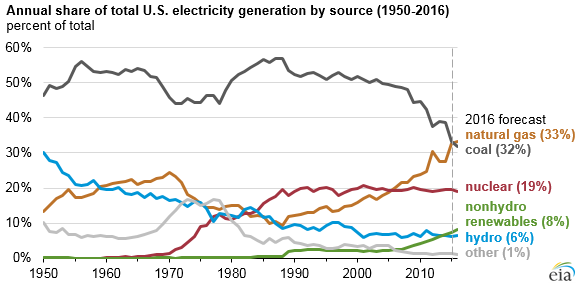
My rule of thumb is that when a man says “It is a solid fact” … it isn’t.
Your endless, endless rubbish and misdirection, bogus claims, and patently visible ignorance are risible …
w.
Troll platform
Don’t be down on yourself Roger – that’s not how one should see this article at all! It’s WUWT trying to be open minded and better informed 😀
/sarc
After we’ve all finished going round the houses of available technologies like the children of Israel round the walls of Jericho, we’ll end up at one place and one place only for electrical power. Nuclear. Modular reactors will get smaller, cheaper, more reliable and safer to the extent that our great grandchildren will drive nuclear cars, and will only ever have known such cars 🚗. Nuclear batteries are the only ones with the power intensity to be really useful and economical. And since they generate their own energy and don’t need charging, the uneconomically low intensity energy sources such as wind and solar can be relegated to a peripheral role.
Dream on..
I suspect you failed in your search, to read the dozen or more articles under my name, and hundreds more articles on which I left comments. Nor, I suspect, did you read many (if any) of the thousands of comments over nearly 10 years of participating on WUWT.
That would take up far too much of your time, of course.
Let me put it this way: the blog owner saw fit to delete a number of libelous statements. Others are still there.
The fact that you cannot find any evidence is not evidence of its absence.
Okay Sowell bring up the examples. You got my ire by the implied threats made by you right at the beginning.
There was the interesting case of the disappeared comment
https://wattsupwiththat.com/2014/04/21/elements-of-the-mann-steyn-case-climate-science-free-speech-and-legal-liability-part-1/#comment-1618564
Note how roger refers to a comment will made by time and date.
Now go find that comment.
Read the whole thread.
Steven Mosher August 6, 2017 at 6:37 pm
Mosh, I’m perplexed. I answered Roger’s comment here, discussing the comment in question, but at some point in the last three years my comment seems to have disappeared. I have no memory of the situation, and I don’t think I’ve ever deleted one of my comments. Nor am I happy about it being gone. I blame it on the cosmic rays …
However, your comment seems to be a red herring carefully designed to draw attention away from Roger’s utter failure to back up his claim with an actual citation.
Nice try,
w.