Guest Post by Wim Röst
Abstract
Glacial cycles show a gradual diminishing temperature during the slide into the glacial period, but a steep increase of temperature at the start of an interglacial period. As argued here, both ‘ocean upwelling’* and the temperature of the deep ocean might play an important role.
Introduction
The temperature profiles from interglacial to glacial and the one back into an interglacial is are very unequal. After a short and steep rise of temperatures into the interglacial, there is a much slower and stepwise fall of global temperatures lasting some 100,000 years. It is interesting to consider the role of the oceans in this process. Ocean upwelling and deep-sea absolute temperatures may play important roles.
The unequal temperature profile of a full glacial cycle
As figure 1 shows, after the rapid rise into an interglacial there is a long cooling period. So, how do we explain the following?
- The rapid rise of temperatures at the start of an Interglacial
- The more gradual / stepwise cooling to the lowest temperatures of the glacial cycle
Figure 1: 400,000-year δ18O
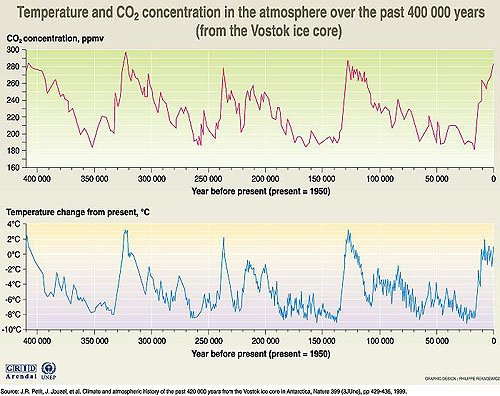
temperatures from the Vostok ice core

Thick blue lines are added. Source for the original
For the rapid rise into an interglacial, some possible explanations include the role of obliquity, insolation, albedo and ‘dust.’ All are already well described. The role of the deep sea and the role of ocean ‘upwelling’ are (as far as I know) not mentioned as a main factor. Which is surprising, as both forces are impressive in their potential effects.
The role of ocean upwelling
Upwelling is a massive force. One million cubic kilometres of water yearly rise from the deep ocean to the surface layer. A one-year halving of this upwelling makes sea surface temperatures, world-wide, rise nearly a tenth of a degree (0.09 °C). This is a huge increase. Diminishing wind diminishes upwelling. And very important: wind is quite variable.
Theoretically it is possible that at the deepest point of a glacial a weather pattern develops that diminishes wind, resulting in less upwelling and/or less mixing. As a result, the warm surface layer would rise quickly in temperature, strongly enhancing the ice melt, decreasing the albedo and so on. This could result in an interglacial.
During the interglacial the pattern of ‘less wind / less upwelling’ could have continued and the interglacial could have stayed warm for a while, at least in some cases. As figure 1 shows, some interglacials only last for a short time, others continue for a longer period. Less wind, less upwelling and mixing could have played an important role in the time an interglacial exists. More wind will activate the huge cooling potential of the deep oceans. This might start the definite cooling process of the surface of the oceans, leading to the next glacial.
The role of the deep seas
Our deep seas are ice cold. Of the total volume of the oceans, 95% have a temperature of less than 5°C. The deepest and coldest waters are near zero degree Celsius. With nearly 1.3 billion cubic kilometres of cold water, the oceans have an apparently endless cooling potential. The variable factor in upwelling and mixing is ‘wind’. Uncontrollable by man.
As argued above, there could be an important role for ‘upwelling’ in the explanation of the rapid rise into an interglacial. But what could the role of the ocean be in the cooling down into a deep glacial period?
First of all, during our current interglacial (MIS 1) the temperature of our deep ocean has risen. A rise that seems to be small, but nevertheless considerable, given the enormous mass and heat capacity of the water involved. The deep ocean temperatures, during the Holocene, have risen around two degrees Celsius (see Figure 2).
Figure 2: Deep Sea temperatures in the last 200,000 years

Source Hansen, et al., 2013.
A rise of the deep-sea temperatures of two degrees Celsius means that during the interglacial all upwelling water is two degrees warmer than during the end of the glacial period. The surface layer of the oceans only contains 72.4 million cubic kilometres of relatively warm water. Yearly one million cubic kilometres of the surface layer is ‘refreshed’ with less cold water, this means that the surface layer soon became two degrees Celsius warmer than the surface layer was during the colder glacial upwelling. This is only because of the difference in the temperature of the upwelling water.
The warmer surface layer deep ocean is one of the reasons that the Holocene can last some time. Even as other ‘interglacial promoting factors’ diminish. The cooling down of the deep sea will take time due to the enormous heat content and capacity of the oceans. There will be a big delay. Upwelling waters therefore will only slowly show lower temperatures, affecting the temperature of the surface layer more gradually.
The enormous heat content of the deep ocean is a massive potential cooling factor as well as a massive potential warming, depending on the actual temperature of the deep seas and the average surface temperatures.
At the start of a new glacial the cooling deep oceans cool the surface but slowly because the heat capacity of the oceans is almost a thousand times higher than the atmosphere’s heat capacity and expelling that much heat takes a long time. But, in the case of warming at the start of an interglacial, only the surface layer – no more than 5% of the ocean volume – must be warmed. Therefore, warming can be quick.
The fast rise of surface temperatures at the start of an interglacial suggests that diminished upwelling did play a role.
Conclusions
Upwelling can play a very important role in creating interglacials. A changing weather pattern resulting in less wind results in less upwelling. Since only the thin surface layer of the oceans must be warmed, a diminished inflow of cooling deep water will have huge warming effects on the surface layer.
The observed warming of the deep sea during the Holocene results in a warmer surface layer. The starting temperature of the upwelling water is two degrees higher and raises the final temperature of the surface layer by two degrees.
Because cooling the remaining 95% of the ocean water takes a long time, this (stepwise) cooling during the glacial period will take a very long period.
With regards to commenting: please adhere to the rules known for this site: quote and react, no personal attacks.
In commenting: please remind you are on an international website: for foreigners, it is difficult to understand abbreviations. Foreigners only understand words and (within the context) easy to guess abbreviations like ’60N’ or ‘SH’.
About the author: Wim Röst studied human geography in Utrecht, the Netherlands. The above is his personal view. He is not connected to firms or foundations nor is he funded by government(s).
Andy May was so kind to read the original text and improve the English where necessary. Thanks Andy!
* For more info about (the effect of) cold ocean upwelling, see my earlier posts here and here.
Discover more from Watts Up With That?
Subscribe to get the latest posts sent to your email.
The upwelling is an idea to check….. however, it does not produce additional energy fast
to produce an interglacial as result… plus what should be the timing mechanism that it
occurs every 100,000 years?
The mechanism is different, it is the solar movement: The Sun moves back and forth from
Focus to the Center into the opposite Focus, turms around there and goes back to the first
focus via the solar system center…….
The Interglacial is the Sun´s RETURNING Movement within each focus: During this 3-D
movement, the planets fly more elliptically (spring and fall), thus receiving additional heat
from the Sun. The fast increase of temps at the beginning of the interglacial is due to the
Sun in its path now reaching the focal turning point, attracts her planets closer (interglacial)
and turns around 3x 90 degrees in 3-D fashion to get onto the propoer return path. Once
this is completed, the planetary orbits are slowly released and temps slowly
descend (since 80 AD by 0.53°C per millenia). More on this in
http://www.knowledgeminer.eu/climate-papers.html, See Holocene paper part 1
and 6 with details. JS.
Upwelling doesn’t cause warming to occur in producing additional energy fast. Upwelling prevents the surface water from being warmed by solar energy and therefore no upwelling causes water to pool at the surface that solar energy warms quickly.
Wim, one overlooked clue may be the lag in co2 behind temperature in ice cores. During the warming phase the lag is 800 years, but during the cooling phase it is thousands of years. There is a school of thought out there that the lag is not really co2 behind temps, but rather global temperature (which is represented by global co2 levels) behind temperatures at the poles. If that is the case, the mechanism would be thermohalin circulation keeping global temps cooler (or warmer) than temps at the poles. As the earth warms coming out of a glacial, surface temps grow faster than the deep ocean. Walker trades thus speeds up, which in turn gives us the faster (800 years) turnover of the THC. As the earth cools coming out of an interglacial, the opposite happens. Surface temps are not quite as warm relative to the upwelling waters. Thus walker trades are slower and so also the (thousands of years) turnover of the THC. So, the lag in ice cores may be telling us that coming out of a glacial the ocean is working harder to cool the atmosphere and thus is not the mechanism for warming the atmosphere…
i certainly am not trying to say anything definitive here (i’m hardly capable of doing that… ☺). i just thought i’d run it by you to see what you think.
Afonzarelli, I must think about that. One of the things is, that I am not CO2 focused. I think it is a relatively weak force compared to other forces like the oceans or ‘clouds’. As I already wrote here: Wim Röst July 17, 2017 at 12:33 pm, because of rising evaporation, water vapour is reacting directly (!) on sea surface warming and because H2O is by far the most important greenhouse gas, it will play the most important warming role of all greenhouse gases too.
The same for the Thermohaline Circulation, THC. The THC is about deep (!) cold water. The THC helped me to discover the role ‘upwelling’ has in climate. Because ‘what goes down, has to go up’. And estimations of downward movements in relation to the THC were available and so I could do a simple calculation. And then I understood what a massive force upwelling had to be.
But later, I discovered the less known ‘mixing’ and ‘intermediate water’. I must make a post about those subjects also, because I suppose their role is perhaps outnumbering the influence of the THC, at least in the range from ten years to five hundred years.
Furthermore, the role of temperature changes of the deep ocean is nearly kept out of the attention of climate scientists. While it is of the utmost importance. I will surely inform you more about my thoughts about this subject in one of my following posts.
So what is happening in the oceans especially at the end of a glacial is more complicated than in the picture you gave us. And, we don’t know enough about how oceans work. In fact we need a three dimensional model in which we know from every cubic kilometre of sea water, what her behaviour is and how her behaviour was. And there are more than 1.3 billion cubic kilometres of ocean water. We hardly know anything at all.
I am working on my next post. There is more to come.
Hi Wim. In the charts shown in this article by Javier the obliquity starts increasing 20000 years BP. The temperature makes a sudden jump up about 6,500 years later with the Bollinger alerod jump. He states that the reason for the delay is the thermal inertia of the Earth’s oceans.
He does not go into how exactly the energy in the oceans causes the rapid temperature rise like you are studying. I think the land mass north of 35 degrees must also contribute something. It is not all covered in ice at this time. So maybe to a depth of one meter it can also increase temperature slowly.
This from the article …
But unlike precession changes, obliquity alters the amount of annual insolation at different latitudes in a 41,000 year cycle. This is represented by the background color of figure 34, that shows how the polar regions received increasing insolation from 30,000 yr BP to 9,500 yr BP. Since then, and for the next 11,500 years, the poles will be receiving decreasing insolation.
https://judithcurry.com/2017/04/30/nature-unbound-iii-holocene-climate-variability-part-a
Minister of Future
Hello Ministerofuture, I studied the same graphs and it is clear that in this cold Pleistocene it is very dificult for the Earth to get out of the Glacial State. Everything (!) has got to be perfect for the Earth to be able to make ‘the big jump’ into the Interglacial State that is the anomaly in the Pleistocene. The Earth needs a long run-up and only then and when all other factors are OK, the Earth changes it system to an Interglacial System. I suppose that in the Interglacial State wind patterns are quite different, wind will be less (also because of the vegetation which is diminishing it’s speed) and I suppose that the diminished wind partly ‘puts off the cooling from below’.
Because of the exponential effects (wind stress is an exponential factor) you don’t need too much change in the wind patterns. Some percents change might even be enough, since the effect of less cooling water counts up every year. If no cooling water from below at all, already has an 0.19 °C effect in one (!) year, a century with only one percent change has the same (initial) effect. Not to speak about 5%. Many of us experienced during life time a change in wind pattern that is much stronger than 5%. I myself (Holland, Western Europe) did so too. Much less wind here compared to 40 or 50 years ago when I was at my bike to highschool, 15 km away. We were very aware of ‘weather’, especially rain and wind.
The oceans must be ‘loaded’ with energy until the effect of this energy rise, translates into different weather patterns that favour the Interglacial State. Therefore there is a delay of some 6500 year. The oceans have to be warmed.
The oceans explain why the top of obliquity might be before (!) the Interglacial. You don’t need the direct effect of obliquity, but you need it’s indirect (!) effect. And even after the obliquity effect started diminishing, it is still adding energy to the oceans. For that, the Holocene could develop and remain in the more stable warm period for a 10.000 years.
But unfortunately, the oceans already are cooling down. Already some 6500 years or so. Preparing for the next Ice Age. The big question is whether ‘man’s influence’ is able to keep the oceans and the Earth from returning to the ‘normal state’ in the Pleistocene: the Glacial. 9 Out of every 10 years in the Pleistocene are glacial years. We are now living in the Pleistocene Anomaly. Humanity thrived in that Anomaly. We should be scared about returning to that Glacial State. Don’t think about what happens to the agricultural production as soon as the Earth start cooling seriously! Cold and dry will be the result.
Wim just a small point on one way for carbon dioxide (CO2) to get back into the sea. (This was discussed earlier on.) Consider a raindrop. It formed high in the atmosphere where it is cold. It has a large surface area for its volume. The water it’s composed of is about as fresh as water can be. When it’s time comes it heads towards the ocean picking up CO2 along the way (if it’s not already saturated). At any one time there are lots of them heading into the sea. Although when it is relatively cold and dry (ice age) there will be fewer of those little CO2 suckers scrubbing the sky of the dreaded CO2 there will also be less outgassing as the sea surface will be cold (relatively speaking). Obviously, this is not the only mechanism at work here. My point is it may be bigger than people think!
Michael,
CO2 and water vapor are mainly emitted from the warm equatorial waters, where also the main upwelling is. Thus any extra absorption of CO2 by the raindrops is from the extra releases. CO2 levels up to the stratosphere are near the same everywhere within +/- 2% of full scale, including seasonal changes and the NH-SH lag.
Further, solubility of CO2 in fresh water is very low, as fresh water has no buffer capacity, pH around 4 at saturation. Solubility gets even lower – for lower pH – with contamination by stronger acids: SOx, NOx,..
From the engineering toolbox:
http://www.engineeringtoolbox.com/gases-solubility-water-d_1148.html
At 1.0 atm CO2, the solubility is about 3.3 g/l; at 0.0004 atm that is 1.32 mg/l.
You need a lot of foggy m3 air to form 1 liter of rain, that makes that what is absorbed high in the atmosphere is not even measurable in the local CO2 levels. Where the drops fall, if all water evaporates, you can get 1 ppmv CO2 extra in the first 1 m3 of air…
Moreover, as most of that is CO2 from the oceans, it is just CO2 transport from the oceans to the oceans, as also most water transport via the atmosphere is…
Which still may be enormous quantities, as lots of water are transported that way.
If it falls on land, it will dissolve any carbonate rock it will encounter on its way back to the oceans, but even that is a very slow process…
Great article Wim, I fully agree with its conclusions about upwelling. A cold hand from below that can snatch away our surface warmth any time it wants.
This recent figure from one of Javier’s articles at Judith Curry’s site shows that obliquity Milankovich forcing drives the cycling of glacial-interglacial with a consistent 6,500 year lag. This is probably the time it takes to warm the whole ocean down to the bottom.
Ptolemy2 “This recent figure from one of Javier’s articles at Judith Curry’s site shows that obliquity Milankovich forcing drives the cycling of glacial-interglacial with a consistent 6,500 year lag. This is probably the time it takes to warm the whole ocean down to the bottom.”
WR: Agree. I am not sure whether the whole ocean needs to be warmed. At least important upwelling areas should be provided with warmer upwelling water. Later I will explain more about more types of deep ocean water. For now: ‘intermediate water’ is less deep than ‘cold deep water’ and it’s ‘circulation rate is faster. It is produced in warmer area’s and salinity plays an important role in the formation of that intermediate water. I suppose this intermediate water can play an important role in rapid warming.
Javier is wrong, because precession is also required. Look at MIS 7e 250 ky ago, where the interglacial was late. The interglacial here was produced via precessional assistance.
But even if you champion obliquity, Javier has still not explained why many obliquity cycles are missed out, and do not produce an interglacial. Like 170 ky ago.
The answer lies in albedo and dust.
Ralph
Ralfellis: “But even if you champion obliquity, Javier has still not explained why many obliquity cycles are missed out, and do not produce an interglacial. Like 170 ky ago.”
WR: So far, Javier explained a lot. In one of my next posts I will try to give an answer on the question why not all cycles produce an interglacial. The answer might be more simple than we think. And if I am right, we can find the answer in the oceans.
Hi, Wim, I was wondering how to contact you.
The answer to the missing interglacials is given in my paper.
Basically, the climate is now always biased towards glacial conditions, because albedo trumps CO2 and every other feedback mechanism. And the more polar ice, the higher the world albedo. But the Achillies heel of a glacial world is that same albedo – darken the ice, and you will get an instant interglacial. And the mechanism for darkening the ice is LGM dust.
Modulation of ice ages via precession and dust-albedo feedbacks.
http://www.sciencedirect.com/science/article/pii/S1674987116300305
It is a simple theory and cycle, that explains every aspect of the interglacial cycle. The only problem for climatologists, is it demonstrates that CO2 plays little or no part in interglacial warming.
However, your oceanic overturning may well be useful in explaining why CO2 levels drop so far at the LGM. Current calculations suggest a 30 ppm drop, rather than the 100 – 120 ppm fall that actually happens. For the oceans to be responsible for lowering CO2 concentrations by 110 ppm, there would have to be deep oceanic overturning – but an overturning that can release 110 ppm within 5,000 years.
Ralph
Ralf
The explanation for the “missed peaks” of obliquity forcing is extremely simple. You said it yourself – it’s precession together with eccentricity (which two oscillations are so closely linked that they are almost a unified phenomenon).
When an obliquity peak coincides with the right precession/eccentricity setup, you get an interglacial. Every time. Without exception, when an obliquity peak coincides with a peak of eccentricity and a peak of the modulation of precession (not precession per se), then you get an interglacial. When an obliquity peak falls at a different precession / eccentricity setup, then you get an abortive stump of a quasi-warming event rather than a full blown interglacial. It is desperately obvious tgat this is a simple resonance related reinforcing/cancelling phenomenon. It’s that simple.
You don’t need to fear Milankovich as a threat to your beloved dust hypothesis. It is not a zero sum game, it’s not an either or. Dust linked to CO2 starvation is a real and important feature of glacial maxima just before interglacial initiation. But the inherent instability of large ice sheets extending to low latitudes is what allows rapid albedo-driven warming excursions that terminate glaciation. Dust is not uniquely causative of this and you don’t need to launch a CAGW like crusade attacking every other scientific observation connected with glacial cycling that is not about dust.
Ralph, I tried to send you my email adress through Academia. I hope I succeeded.
I think I already had a look on your article before, but with my present knowledge I will read it possibly with different eyes, I suppose. I will try to find some time to do so. Thanks for your comment.
>>When an obliquity peak coincides with the right
>>precession/eccentricity setup, you get an interglacial.
But that is not true. Precession and obliquity were in synch many times, when there was no interglacial. Which is obvious, because the glacial cycle is composed of four or five precessional cycles – and two or two and a half obliquity cycles. So there are many occasions when obliquity-precession unions produce little or no warming.
I will get a graph for that.
R
Modulation of precession, not precession itself.
Curiously, while this also coincides with “local” peaks of eccentricity, thus amplifying the effect of precession, the absolute amplitude of eccentricity seems to be unimportant – due to the wide modulation of eccentricity, some peaks have a much larger amplitude than others. Such that with the larger waves, most of the waveform is above the eccentricity value of the smaller peaks. But nonetheless the pacing of the interglacials follows the local peaks of eccentricity (which also coincide with the precession modulation peaks), and conspicuously not the absolute amplitude of eccentricity.
I find this puzzling, and it suggests that there is a strong adaptive property of the climate system, so that it is the local oscillations and relative maxima that are more important than absolute values of Milankovich pacing cycles such as eccentricity.
Sound more like a guess, than a science paper.
The evidence from the Loess Plateau in China confirms that if anything, winds increase during the glacial maximum period. (Aeolian dust grain size increases at the LGM.). Which stands to reason.
Contrary to AGW received wisdom, wamer temperatures do not produce higher winds. Witness the decline in tropical cyclones over the last two or three decades, as oceans have warmed slightly.
To produce stronger winds you need a temperature differential, and polar apmplification provides that amplification. (During glacial periods, the poles cool by some 12 degrees c, while the tropics only cool by about 3 degrees.). So the glacial maximum produces a greater temperature differential, and so stronger winds.
Ralph
Ralfellis: “Sound more like a guess, than a science paper.”
WR: if this means that the paper is easy to digest, than that is a compliment. That’s how I wanted it to be.
Ralfellis: “To produce stronger winds you need a temperature differential, and polar apmplification provides that amplification. (During glacial periods, the poles cool by some 12 degrees c, while the tropics only cool by about 3 degrees.). So the glacial maximum produces a greater temperature differential, and so stronger winds.”
WR: The fact that a glacial shows stronger winds, includes that an interglacial shows weaker winds. Weaker winds result in less upwelling and less upwelling enables the surface to warm more and to extend the warm surface layer, both in depth as horizontally.
The question that remains is whether orbital changes were enough to create weaker winds in upwelling sensitive regions. Matt G July 17, 2017 at 4:49 pm had an interesting comment which draws attention from the well known tropical upwelling areas to the less known northern upwelling areas. When orbital changes warm 65N, the temperature gradient between 65N and the tropics in the south will diminish. This will result in less cooling (by upwelling and mixing) of the seas south of Iceland. As I read somewhere that sometimes the sea ice reached Spain during a glacial, this is exactly the region where a big switch can/will be made. And because of the influence of the Westerlies, the Eurasian land ice could melt rather easily as soon as sea ice disappeared and a Warm Gulfstream could extend her influence northward. The Lauresian ice sheet which is much more isolated from warm western winds (by the Rockies) melted thousands of years later, I read. Which shows the key role the Northern Atlantic must have had.
So perhaps the above gives the mechanism for how ‘orbit’ and ‘less upwelling’ worked together to create the start of an interglacial.
And as soon as melting started, things like dust facilitate the melting process and because during the Pleistocene it seems to be more and more difficult to reach an interglacial state, dust is needed too.
Laurentide Ice Sheet
Thank you for adressing the role of oceans on termination of ice ages. I think that ocean temperature stratificatin, ocean circulation system and the enormous lid of sea ice played a major role. One question is how oceans can build up energy over thousand of years before it is released into the atmosphere. Some of this is discussed in Science of Doom. There are many posts on glacials and interglacials, called Ghosts-of-climate-past.
https://scienceofdoom.com/2016/01/26/ghosts-of-climates-past-twenty-note-on-emics/
From the discussion there:
Temperature Gradient between Low & High Latitude. George Kukla, Clement, Cane, Gavin & Zebiak (2002):
“..At first glance the implications of our results appear to be counterintuitive, indicating that the early buildup of glacier ice was associated not with the cooling, but with a relative warming of tropical oceans.”
So one theory would be that tropical oceans take up a lot of heat, while ocean currents over higher latitudes fade out. This would build up warm currents at lower latitudes. Combined with ocean temperature and salinity stratification at higher latitudes there cuold be a homeostatic stability for a many thousand years, which at some time would break down.
Tine L. Rasmussen, Erik Thomsen, Matthias Moros. North Atlantic warming during Dansgaard-Oeschger events synchronous with Antarctic warming and out-of-phase with Greenland climate. Scientific Reports, 2016; 6: 20535 DOI: 10.1038/srep20535: ” During the coldest periods of the last ice age the Nordic seas were covered with a permanent layer of sea ice. The pump stopped transporting the heat northward. The heat accumulated in the southern oceans. However, the warming was not restricted to the south.
” Our results show that it continued all the way to Iceland. The warming was slow and gradual, and happened simultaneously in both hemispheres. Little by little the warm Atlantic water penetrated into the Nordic sea underneath the ice cover. It melted the ice from below. Once the ice was gone, the pump started up again, bringing additional warm water into the Nordic seas. And we got a warmer period for 50 years. ” says Rasmussen.
Large ice sheets continued however, to cover the continents around the Nordic seas. In contact with the warm ocean water they started calving. This delivered icebergs and fresh water into the sea and caused a cooling down of the surface water. The seas were again frozen. And the pump slowed down.
The warm ocean blob of the ice ages rewrites the understanding of the ocean circulation systems, and how they affected the extreme climate changes of the past. The seesaw was actually more of a ‘push and pull’ system.
“There are no symmetrical processes in the north and the south — the climate changes were principally governed by simultaneous warming and the constant closing and re-opening of the sink pump in the Nordic seas” says Tine Rasmussen”
Jenny Roberts, Julia Gottschalk, Luke C. Skinner, Victoria L. Peck, Sev Kender, Henry Elderfield, Claire Waelbroeck, Natalia Vázquez Riveiros, David A. Hodell. Evolution of South Atlantic density and chemical stratification across the last deglaciation. Proceedings of the National Academy of Sciences, 2016; 201511252 DOI: 10.1073/pnas.1511252113: A new study reconstructing conditions at the end of the last ice age suggests that as the Antarctic sea ice melted, massive amounts of carbon dioxide that had been trapped in the ocean were released into the atmosphere.
“Before this study there were these two observations, the first was that glacial deep water was really salty and dense, and the second that it also contained a lot of CO2, and the community put two and two together and said these two observations must be linked,” said Roberts. “But it was only through doing our study, and looking at the change in both density and CO2 across the deglaciation, that we found they actually weren’t linked. This surprised us all.”
Through examination of the shells, the researchers found that changes in CO2 and density are not nearly as tightly linked as previously thought, suggesting something else must be causing CO2 to be released from the ocean.
Like a bottle of wine with a cork, sea ice can prevent CO2-rich water from releasing its CO2 to the atmosphere. The Southern Ocean is a key area of exchange of CO2 between the ocean and atmosphere. The expansion of sea ice during the last ice age acted as a ‘lid’ on the Southern Ocean, preventing CO2 from escaping. The researchers suggest that the retreat of this sea ice lid at the end of the last ice age uncorked this vintage CO2, resulting in an increase in carbon dioxide in the atmosphere.
One question is how oceans can build up energy over thousand of years before it is released into the atmosphere.
What reason is there for believing that water under the ice around Antarctica was trapped in place and did not circulate away from that region, and instead stayed put for…what, hundreds of years?
Thousands?
Even if the water did not move, what about diffusion?
Someone is gonna have to ‘splain this to me a little better before I even think about believing it.
Looking for systems that cause stepped cooling and fast warming in short term time lengths would be logical areas to consider when determining long term time lengths. I am of the opinion that oceanic/atmospheric teleconnected relationships such those posited by the author of this post have so far been ignored for the far sexier solar and CO2 groups. The KISS principle is elegantly boring since it means all systems normal, there is nothing to see here.
With so many things unexplained about the dynamics that produce interglacials, it’s natural that attention should turn to another little-explored domain: the deep oceans. But in seeking explanations, we should avoid positing mechanisms that have not been observed or contradict available oceanographic knowledge. The notion that there is wholesale “overturning” of the oceans, with bottom-water rising to the surface in the tropics, is the unsupported invention of “climate science” desperate for an explanation. Carl Wunsch, the leading expert on oceanic circulation, dismisses the oft-conjectured “global conveyor belt” as “a fairy tale for adults.” See: http://ocean.mit.edu/~cwunsch/papersonline/thermohaline.pdf
While oceanic upwelling is a common phenomenon, it is restricted largely to shallower coastal waters subject to seasonally varying winds whose Ekman drift carries the surface layers away from the coast, thereby exposing the cooler subsurface layers that rise hydrostatically. In deep tropical waters, there is no such true upwelling that can eventually bring deeper layers to the surface, but only the shallow circulation of horizontal Langmuir vortices due to mass convergence within the ITCZ. By comparison, the much-misunderstood thermohaline circulation is a snail-paced process, which does not involve any wholesale subduction of surface currents, but only of denser strands that mix turbulently with surrounding subsurface waters. The AMOC, for example, thus cannot preserve the sigma-t of water parcels throughout its circuit, as is often mistakenly assumed.
Certainly, conjectures for the quasi-periodic appearance of interglacials should not exclude the role of oceans as the principal heat reservoir of the planet. It is doubtful, however, that upwelling–particularly of truly deep waters–can play a globally dominant role.
A few years back there was a thread here at WUWT in which was had a long discussion of deep water formation, and where and when it happened, and where and when such cold deep water could even come to the surface again…being very cold and salty it is very dense. Dense water will not rise through less dense water.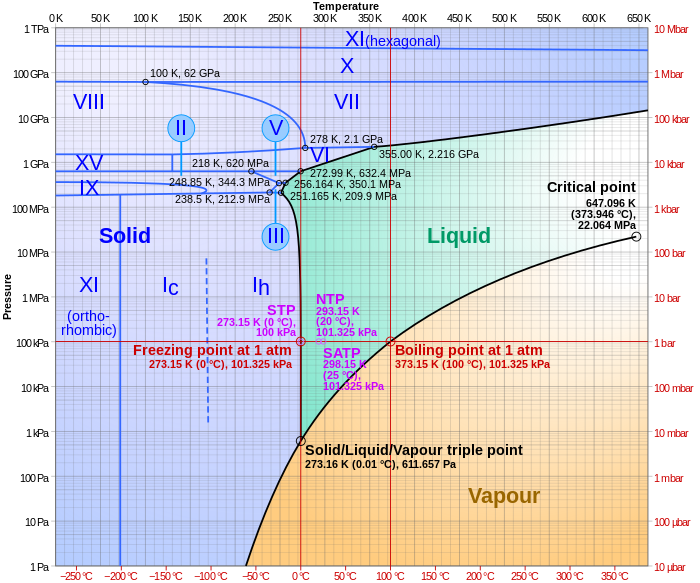
Many graphs were posted involving the physical chemistry of water, and how different salty water behaved than fresh water. And water of varying salinities behaves in changing ways as salinity increases.
Many frequent commenters here said they had never seen several of the graphs I posted.
And it seemed to emerge from the discussion that in the Arctic, where it seems that most or all of the new deep water forms (deep as in sinking all the way to the bottom), as surface water freezes in the fall, salt is expelled from the freezing water as it freezes, and this has several very interesting and unintuitive consequences.
Anyway, by the end of the discussion, I was deep in thought, pondering the phase diagram of water, which is published in incredible detail.
And I realized for the first time exactly how cold the water at the bottom of the ocean really is. It is below the freezing point of fresh water, and it may even be below the freezing point of saline water…under lower pressure.
In other words, at the bottom of the ocean exists water in a supercooled state…massive amounts of it.
Physical chemistry can get weird under certain conditions, and extreme pressure and supercooled fluids are some of those conditions.
A supercooled fluid exists in a state that is like building a house of cards, standing on the edge of a cliff…one nudge and a process is set in motion that is self-perpetuating.
So, anyhow, if a bunch of water at the bottom of the ocean should, even for a short time, undergo some change in condition, some shock, or dilution, or change in chemistry, and it should freeze…well, what would happen then?
What would happen if several cubic miles of water and the bottom of the ocean suddenly froze?
Could it expel its salt, become extremely buoyant (because water expands when it freezes and becomes less dense) and rise explosively to the surface. It would, in the process, drag by entrainment a whole lot of other water with it. It might even cause a sort of chain reaction. Phase changes and chemical reactions are funny that way, especially the coiled spring type where the entire bottom of the ocean is supercooled water.
So, leaving aside the question of what could start something like that, if it did start, it could be very large and very dramatic and not stop for quite a while.
What could start it?
Who knows…lots of possibilities.
Farfetched?
Yup.
Impossible?
*shrugs shoulders*
Have a careful look at this phase diagram…particularly the upper left hand corner of the green section…the part that represents liquid water. That nose that juts out. It note that thee pressures in that section of the phase diagram happen to include the range of pressures at the bottom of the ocean in some places.
Now…anyone know where to find this same diagram for saline water? Does it also have that nose?
One last question…I have looked for the thread…anyone remember it and have the title or link?
I and several others posted a bunch of very interesting graphs and charts and the discussion was great.
Sorry: “…cubic miles of water AT the bottom of the ocean …”
Menicholas, “One last question…I have looked for the thread…anyone remember it and have the title or link?”
WR: You posted the above graph also on: https://wattsupwiththat.com/2017/04/25/researchers-solve-the-century-old-mystery-of-blood-falls/
I don’t know whether this is the thread you were searching for. If not, try this way of searching:
– go to Google Images
– type words like: “phase diagram water vapour liquid solid WUWT menicholas”
– search
If the above thread is not the right one and you remember the content of other graphs, use their characteristics to find them back in the same way as above
Menicholas: “A few years back there was a thread here at WUWT in which was had a long discussion of deep water formation, and where and when it happened, and where and when such cold deep water could even come to the surface again…being very cold and salty it is very dense. Dense water will not rise through less dense water.
Many graphs were posted involving the physical chemistry of water, and how different salty water behaved than fresh water. And water of varying salinities behaves in changing ways as salinity increases.”
WR: I was trying to understand the behaviour of salty water in the oceans. It is of the utmost importance to understand the behaviour of oceans. When you find back the discussion above, I am interested in what you think that was most important for the behaviour of salt water.
I am preparing another post (it is one of the concepts that are waiting for finalizing) in which the specific properties of salt (!) water play an important role. It will be very interesting to discuss the consequences. I will keep it simple, but nonetheless, because of its far reaching consequences (in my eyes) it might give interesting views on ‘climate’ and on the development of our climate system in the last 50 million years. Interesting for our view on the future of climate as well.
Menicholas, sorry I used the wrong link above at Wim Röst July 18, 2017 at 9:52 pm.
You posted the same graph in this discussion: https://wattsupwiththat.com/2015/04/14/advection-the-forgotten-weather-factor/
HeyHey Mr Rost!
It worked on my first search, right at the top of the list!
BTW, I always use Bing. Google is crooked.
I used “menicholas WUWT salinity phase change”
And found this.
I have to get some sleep, will not be able to get back here much until about 14-15 hours from now.
Here is the link:
https://wattsupwiththat.com/2015/05/15/things-in-general/
Here are some of the charts that I wanted to look over, but the whole thread is worth reading from start to finish I think…
http://linkingweatherandclimate.com/ocean/figs/density2.png
http://www1.lsbu.ac.uk/water/images/maximum_density.gif
If I put too many on one comment it will get kicked into a moderation bin.
“Crispin in Waterloo:
“The freezing temperature vs salinity curve is amazing. I never saw that before. I would like to pursue this further to see where water is and the condition and the influence of ice cycles.”
Yes, very interesting indeed. Boiling point elevation/freezing point depression is of course a very extensively covered subject in most chemistry and physics courses, and indispensable knowledge when covering physical chemistry.
It does seem to have been overlooked I many of these discussions, which, in retrospect, is odd.
I found one more chart that gives a better perspective, since the temp vs freezing point chart is in different units than the other chart.
Since ice does form at the surface, it must be the case, as you point out, that the process is rather more complicated, and that as the freezing progresses, salt is excluded gradually and allows the ice to remain on the surface.
(Unless one is to think that the ice forms at the bottom, or somewhere in the water column, and floats up to the surface, which I have seen no evidence to believe is the case)
Otherwise, water would sink before it froze and sea ice would have a hard time ever forming in open water, no matter the temp. It would seem that the whole water column would get very cold and then freeze all at once from top to bottom!
Here it is, and I agree that this needs a closer look.”
http://www.fondriest.com/environmental-measurements/wp-content/uploads/2014/01/360x300xwatertemp_salinity.jpg.pagespeed.ic.yheIMC6nSN.jpg
Your provocative conjecture that buoyant ice may form from bottom water has never had any empirical indication. On the contrary, what is found in certain isolated locations are hot-water vents (‘smokers”) that send traceable plumes to the surface.
Menicholas: “Now…anyone know where to find this same diagram for saline water? Does it also have that nose?”
WR: I googled ‘images’ on “salt water phase diagram”. You will find some results, for example this one (I did not study this one, just to show):
More information I saw here: http://www.phasediagram.dk/invariant_points.htm
Possibly the extreme low elevation (and hence the raised atmospheric pressure) at the sea water surface
has a major impact on the temperature equilibrium of the surface water due to the reduced rate of evaporation at low elevations. During glacial periods sea water levels are > 100 metres lower than present levels and therefore, because the rate of evaporation is reduced by the raised atmospheric pressure, the equilibrium sea water temperature (taking all other factors into account) will eventually be raised.
The average annual temperature of water at raised elevations, even at equatorial latitudes, is influenced in large measure by the elevation of the water surface. The comparison of annual average water temps of fresh water lakes in Africa (Victoria, Tanganyika & Malawi) indicates that the major factor influencing water temp appears to be elevation and not latitude.
Andean tropical lakes at extreme altitude ( above the clouds and therefore subject to unimpeded solar radiation ) are paradoxically colder than temperate seas such as the Dead Sea. The annual average water temp of the Dead Sea is possibly the highest on the globe for a large body of water. The water surface of the Dead Sea is below sea level.
Therefore it is postulated that during glacial maxima the sea water surface temperature at the equatorial regions will be considerable warmer than the present average of +/- 30C because of the lower elevation and so could be a major factor in the eventual rebound to the next interglacial.
1sky1: “Carl Wunsch, the leading expert on oceanic circulation, dismisses the oft-conjectured “global conveyor belt” as “a fairy tale for adults.” See: http://ocean.mit.edu/~cwunsch/papersonline/thermohaline.pdf”
WR: in this paper “What Is the Thermohaline Circulation?”, the sentence “a fairy tale for adults.” can’t be found. On the contrary. Prof. Wunsch concluded in his Science article:
“The ocean is thus best viewed as a mechanically driven fluid engine, capable of importing, exporting, and transporting vast quantities of heat and freshwater. Although of very great climate influence, this transport is a nearly passive consequence of the mechanical machinery.”
1sky1, the expression you use, ‘global conveyor belt’, is not even found in the article.
The words ‘fairy tale for grown ups’ we can find back in a description of a complaint from Prof. Wunsch against programme makers. See https://climateaudit.org/2008/07/22/the-carl-wunsch-complaint/. The document is published by Steve McIntyre, Jul 22, 2008. It is about a complaint from Prof. Wunsch against programme makers for being misrepresented in their programme.
The programme makers told Prof. Wunsch in an initial mail:
“that they had read reports about the “effects of climate change on the Great Ocean Conveyor Belt and the Gulf Stream and wanted to ask if you agree with the conclusions that they are in imminent danger of shutting down”.
Wunsch promptly replied on Sept 18, 2006 referring to a popular representation of the Gulf Stream as a “fairy tale for grown ups”: “He responded that this was “absolutely not” the case, stating that “you can’t turn the Gulf Stream off as long as the wind blows over the North Atlantic and the earth continues to rotate!” and went on to describe the ‘conveyor’ as a kind of fairy-tale for grownups”. Professor Wunsch said that “I’m willing to talk about these things. I believe that there are all kinds of things happening in the oceans, many highly troubling, but I also believe that one should distinguish what the science tells us and what is merely fantasy”.
So far what I have read at Climate Audit..
Mr. 1sky1, the words you put in the mouth of Prof. Wunsch are nowhere in the paper you mentioned . On the contrary, he said about part of the thermohaline circulation: “you can’t turn the Gulf Stream off as long as the wind blows over the North Atlantic and the earth continues to rotate”
I can not conclude otherwise than that in your comment you are completely misrepresenting what Prof. Wunsch really said and what he intended to say.
Your own final statement “It is doubtful, however, that upwelling – particularly of truly deep waters – can play a globally dominant role.” missed any evidence. You nowhere presented the proof that there aren’t many Sv (Sv = Sverdrups = 1 million cubic meters water per second) going down deeply into the ocean. And what goes down has got to go up. And what goes up in the ocean, is called upwelling.
Can we identify you as a troll, mr. 1sky1?
One of the long list of facts of nature that warmists deny is indeed the role in climate of the oceans and their cast heat capacity. For them the ocean is a passive puddle 100 forced in real time be the atmosphere. The absurdity of this position is not important to them.
Wim Rost;
It’s my failing that, in directing readers’ attention to Wunch’s professional views of thermohaline circulation, the impression was created that the words I quoted from memory were contained there. In fact, they come from his monograph on “The Ocean Circulation Inverse Problem,” published by Cambridge UP in 1996. There, in a footnote on p.324, he writes
Nowhere do I question that denser surface water sinks, sometimes all the way to the ocean bottom. Of course it displaces lighter water upward. But that is not what we oceanographers call “upwelling.” And the really important aspect that is almost universally missed in “climate science” is that the physical properties change through turbulent mixing. Denser water is always negatively buoyant and as such cannot simply rise to the surface, as fanciful diagrams of “the global conveyor belt” depict. Nothing is more important in determining density than temperature. The idea that near-freezing bottom waters rise buoyantly to the surface to cool it, creating very long climate cycles corresponding to the “overturning,” is risible. There simply is no oceanic overturning in corpore, such as is experienced seasonally in fresh-water lakes.
Can we identify you as an oceanographic novice, Mr. Rost?
1sky1
There is one extremely simple and conclusive proof that the deep ocean water circulates and exchanges with surface water, albeit on long time scales.
It is oxygenated.
Where does this oxygen come from? Volcanic sources? I don’t think so. It comes from the surface. If there is downwelling of deep saline cold water (please don’t say that you deny this also) when by simple mass balance there must be – and is – deep upwelling also.
Deep upwelling BTW off Peru 🇵🇪 is what drives ENSO.
That this simple fact of deep ocean circulation can even be in dispute is depressing indeed about the failed state of knowledge and scholarship about the climate system.
Look at this previous article here on WUWT. It shows that in hotter periods of earth’s history, like the Jurassic-Cretaceous, the lower layers of the ocean were partly anoxic. This is the consequence of the absence of cold downwelling at the poles.
Today the deep water is oxygenated. It is MOVING at about 4 mph, the speed of a brisk walk. It is circulating. It downwells and upwells, and is cold. Please start thinking seriously about the climatic implications of this.
https://wattsupwiththat.com/2017/07/17/the-mother-of-all-dead-zones-fossil-site-shows-impact-of-early-jurassics-low-oxygen-oceans/
There’s a wide continental shelf off Peru where most of the coastal upwelling takes place. It is by no means “deep” in any oceanographic sense. At any rate, the surface temperature in the Humboldt Current never approaches that of the bottom waters, on or off the shelf. And it is not upwelling, as such, that “drives ENSO,” but atmospheric pressure differences that regulate the trade winds that induce upwelling. ENSO does not involve the deep ocean.
Nowhere do I dispute deep ocean circulation per se–only the egregious oceanographic misconceptions that abound especially in blog discussions of “climate science.”
BTW, where do you have empirical evidence that “deep water…is moving at about 4 mph” That’s a brisk rate even for a surface current, such as the Gulf Stream, which is driven by winds–not by thermohaline factors.
I never thought of searching like that.
I was just searching on this site using search terms like sea ice and deep water, but I do not recall if the original article was closely related to that part of the discussion thread.
Thank you for that idea.
That thread was most definitely not the one I was looking for.
I had forgotten about that one, with the guy who insisted that there was no such thing as water vapor, and no such thing as convection, and that dry air was lighter than moist air.
Reading over it, I cannot understand why on Earth I wasted all that time.
I wonder if maybe it was a warmista troll sent over to hijack threads by pretending to be a crank.
No, the one I was thinking of had a very long discussion with dozens of people and had lots of charts of various iterations of the AMOC and the thermohaline circulation, and lots of physical chemistry charts.
I cannot even be sure how long ago it was.
Here is another nice graph with interesting information:
http://player.slideplayer.com/24/7399195/data/images/img32.jpg
And for properties of seawater this document is interesting: http://pordlabs.ucsd.edu/ltalley/sio210/DPO/TALLEY_9780750645522_chapter3.pdf