

Guest essay by Eric Worrall
What new narrative will replace the climate doomsday scare? Elon Musk has not abandoned traditional scare stories such as the looming population crisis, but he seems to be making more effort than most to market test radical revisions of the tired carbon-doom effort.
Elon Musk: ‘Robots will be able to do everything better than us’
Catherine Clifford
Elon Musk is certain that robots will be able to do your job better than you.
And even the billionaire CEO of Tesla and SpaceX is not sure what to do about that.
“There certainly will be job disruption. Because what’s going to happen is robots will be able to do everything better than us. … I mean all of us,” says Musk, speaking to the National Governors Association on Saturday.
“Yeah, I am not sure exactly what to do about this. This is really the scariest problem to me, I will tell you.”
…
“The thing that is the most dangerous — and it is the hardest to … get your arms around because it is not a physical thing — is a deep intelligence in the network.
“You say, ‘What harm can a deep intelligence in the network do?’ Well, it can start a war by doing fake news and spoofing email accounts and doing fake press releases and by manipulating information,” Musk says to the bipartisan gathering of U.S. governors.
…
Read more (includes video): http://www.cnbc.com/2017/07/17/elon-musk-robots-will-be-able-to-do-everything-better-than-us.html
The AI scare has a lot of potential. Back in January this year I predicted that fear of malevolent artificial super-intelligence is a likely candidate to replace the failing climate scare.
Hollywood has been supplying the groundwork for the new scare, with a steady stream of stories which include strong AI. Many of the films are horror stories about AI gone wrong.
Table from the January Post (updated: added “Alien: Covenant”), original source Wikipedia
| Year | Count | Movies |
|---|---|---|
| 2001 | 1 | A.I. Artificial Intelligence |
| 2002 | 1 | S1M0NE |
| 2003 | 3 | The Matrix Reloaded, Terminator 3: Rise of the Machines, The Matrix Revolutions |
| 2004 | 1 | I, Robot |
| 2005 | 1 | The Hitchhiker’s Guide to the Galaxy |
| 2007 | 1 | Transformers |
| 2008 | 3 | Eagle Eye, Iron Man, WALL-E |
| 2009 | 3 | Terminator Salvation, Moon, Transformers: Revenge of the Fallen |
| 2011 | 2 | Real Steel, Transformers: Dark of the Moon |
| 2012 | 3 | Prometheus, Robot & Frank, Total Recall |
| 2013 | 4 | Her, Iron Man 3, The Machine, Pacific Rim |
| 2014 | 7 | Automata, Big Hero 6, Interstellar, Robocop (2014 film), Transcendence, Transformers: Age of Extinction, X-Men: Days of Future Past |
| 2015 | 8 | Ex Machina, Chappie, Tomorrowland, Avengers: Age of Ultron, Terminator Genisys, aka Terminator 5, Star Wars: The Force Awakens, Uncanny, Psycho-pass: The Movie |
| 2016 | 3 | Max Steel, Morgan, Rogue One: A Star Wars Story |
| 2017 | 3 (so far) | Ghost in the Shell (2017 film), Transformers: The Last Knight, Alien: Covenant |
Good climate scare movies are less common. Other than hilights like “A.I. Artificial Intelligence” (2001), “The Day After Tomorrow” (2004), “An Inconvenient Truth” (2006) and “Snowpiercer” (2014), and the occasional self published effort by activists who clearly wish climate was a bigger issue, production quality climate fiction films have been thin on the ground.
The climate movement will still have a place if the AI scare takes off. The imaginary future world in the Terminator franchise, scorched by nuclear fire and continuously trampled by vast death dealing robots is probably not a green paradise. A.I. Artificial Intelligence was set in a world broken by climate change. Fear of a malevolent corporate AI as an expression and ultimate realisation of mankind’s greed and hubris and over-exploitation of natural resources has obvious potential as a future green narrative.
Is AI a risk? This is the beauty of the new AI scare. Nobody really knows what the risks are, so you can make up pretty much anything you want. I suspect like any new technology AI will create risks – but development of AI will also create new means to combat and contain those risks, and to address many other problems which currently seem unsolvable.
If the AI scare takes off, at the very least it will bring a fresh new injection of uncertainty and fear to a tired and fading climate eco-scare story.
Oh, for goodness sake. They are machines. Yes, sometimes machines malfunction, and do things that are unintended, but that’s why machines are built with off-switches. Absolute worst case scenario is that people are stupid enough to build one machine that controls vital services like water or power to a large area, and that machine breaks. Then we a) evacuate the area and then b) fix the machine. Problem solved.
Water and Power in large areas are controlled by SCADA, supervisory control and date acquisition. There is a worry that they can be hacked and taken over. For the most part, it’s a good thing. But when SCADA goes down, there are problems, like tank overflows, loss of system pressure, pumps go out or don’t turn off when they are supposed to.
Don’t sweat the small stuff. That’s nothing compared to what awaits on Y2K. Airplanes will fall out of the sky, etc.
While it is possible to control system elements directly, most systems utilize distributed control where the SCADA software’s principal responsibility is the “DA” part. The smarts live in the local control units. Think of a thermostat for controlling the temperature of a room. You may be able to hook it up to report its set point and current temperature to a remote unit, but it isn’t necessary in order for it to operate, once you program the temperature profile into the unit, whether that happens locally or remotely.
Where I work I’m the last one that operated the plant before we had our first SCADA system.
Knowing what to do aside (this valve needs to be closed, that valve needs to opened etc.) the biggest pain in the butt would be being able to reach the valve (or whatever) that needs to be operated by hand. Too many of today’s designers don’t think that, just maybe, one might need to operate something by hand. Worse, they ignore the input of those that point that out.
In our most recent renovation, several of the actuated valves were placed where it would require a ladder placed in a boat to reach their hand cranks. In the design phase this issue was pointed out. It was decided that there was no problem since the buttons to operate the valves “manually” were not over water. ARRGHHH!
(I don’t know if anyone mentioned how the valves would be reached for routine maintenance.)
Well, D.J. Hawkins, the SCADA system as a whole includes the controls, and software that tells the controls what to do. So locally, the controls handle the analog and digital signals which sense and act on the actuators. The control may be dumb in that sense, but they take their sequencing and marching orders from the supervisory control and as such, can be told to do things… which could be whatever you can imagine them to be. I maintain my statement, as I assume you do too!
Mario
@Mario
The point I was driving at is, if someone walked into the control room and took an ax to the SCADA box, the controls would locally continue to do what they do. Critical control infrastructure in my experience is direct-wired to the local controller, not requiring a path back to the head-end and return to the actuator. Now if someone hacked the machine and scrambled the local set-points via download, that’s another story.
D. J. Hawkins: Seems like you want to argue. No, if you went into a SCADA room and put an ax to the SCADA computer, it would not work.
SCADA systems are not anything like a in your example of a thermostat in a house. We’re talking about the supervisory control doing something such as turning up the heat or turning off the heat, using your example. Most true SCADA systems do not work properly or at all without the supervise part. If you lose connection, for example, with a tank that needs to be filled, then the remote pump station cannot pump safely to that tank. So the pump will not continue running in any way that is useful or correct – or worse, if it did continue running, the tank could over fill. There are ways around this, but I do not want to get into the weeds.
@Mario
I really don’t understand our disconnect here. Certainly, if you “take an ax” to the SCADA computer that computer will cease to function. The field controllers will chug along just fine. I offer the link below so others can determine for themselves which of us understands the nature of SCADA properly.
https://inductiveautomation.com/what-is-scada
Reading previous posts I thought such machines had already been invented – Goreatron and Moonbeam.
Have you ever tried to use an AI “help” chat “person?” LOL.
Replace the human brain? Not. Even. Close.
AI has its place. Like battery (energy storage) tech — AI tech simply isn’t even close to making changes of any job-threatening significance in the market.
********************************
EVERYthing Musk shrieks boils down to this:
If you have to scare people into buying it,
it’s junk.
Musk is just a common schoolyard bully.
In some extent, ‘AI’ is job-thretening. In several industrial areas, real jobs are replaced by robots, like in the car industry.
Use of robots in vehicle manufacturing reduces the cost of the vehicles, which makes people more able to afford the vehicles. It also cuts costs in other industries, helping them to grow. Sure, things can go pear-shaped under bad leadership, but robots can be very good for people.
In extreme and dangerous environments, yes, but the car industry is not one of them (except for battery assembly for EV’s). The car industry should focus on stuff that last, aka envirinmentalt friendly, instead of including fancy stuff that soon will brake down. Cheep vehicles made not to last, are not cheep in the long run.The positive thing about what they are doing right now, is keeping towing companies and repair shops buzy … (Yes, I know peopke in towing business, who has been buzy towing new cars with electronical hand breaks, that couldn’t handle winter climate.)
“Mike Jonas July 17, 2017 at 11:31 pm”
True, but puts lots of people out of work. You do get an increase in quality where the robot welds, for instance, the body in exactly the same way, every cycle. Improvements in engine build quality and reliability because no human touches the engine and components on an assembly line.
I used to work for Honda in Swindon, UK. Every month the whole factory would assemble on the factory floor at the end of the line where the vehicle is tested to do morning exercises, including the robots! Was a bit funny to see at first, but you get used to it.
All tools threaten jobs. One man with a backhoe can replace a dozen men with shovels. Doing more with less is the function of technology.
Sure, to some extent. Then it becomes a problem.
MishaBurnett July 18, 2017 at 3:33 am
” One man with a backhoe can replace a dozen men with shovels.”
Unless it is a government job where the dozen men stand around with their shovels watching the backhoe operator.
“MishaBurnett July 18, 2017 at 3:33 am
All tools threaten jobs.”
Or even “shoes”, sabots. Sabotage.
Patrick, because machines allow us to make products more cheaply, you need to work less in order to afford the same lifestyle.
I was reading a prediction a few weeks ago that by 2050, the average work week will be under 30 hours.
MarkW,
That’s 30h with less salary/week (month), so it’s a utopian dream for politicians and others. There was an attempt in Sweden some decade ago with the offer to go from 40h/w to 35h/w to reduce unemployment, but no luck. It ment also a reduction in salary. The employer would not pay same money for less work in return. Simple business economics knowledge. Rent and bills has still to be payed at the end of the month and those will not be reduced in size and amount …
Nobody would like to get less at payday. Do you?
Jobs are shifted from one industry/service to another by robots. And that is a good thing.
Yes, there is a transition time as workers gain new skills for the new jobs they will now do, but, it comes gradually (just like oil running out…. someday…. it will just gradually become more costly, and the market will adjust) enough that, for most, it is not a devastating event to have robots step up to do monotonous/dangerous work.
Capital wants to make more capital. The demand for cars, etc., is not infinite and the price the market will bear is bounded. When the car maker can make a car for less using robots, i.e., invest less capital-per-unit, profit-per-unit will go up, but, overall profit, only to a point. The market will buy only so many units. Thus, there is then excess capital to be invested in another endeavor, e.g., the SCADA water monitoring mentioned above or pharmaceuticals or nanotechnology to create synthetic fuel or research to build “a better mousetrap.” The net result: new jobs doing other things.
Also, some of that capital is used to do good deeds like helping poor children around the world go to school and to create beauty and fun (there are still philanthropists among those capitalists).
(See the book by Peter Huber, Hard Green, for a good explanation for how wealth (and robots = wealth) = “green”/happier lives for all)
As has been pointed out already, we no longer toil around our own farms just to survive, a relatively few farmers use technology to provide us with all we need, while we sit at a desk or stand in a laboratory earning a living.
We engage in a bit of chronological contempt when we assume that our ancestors left their farms and railroad tie pounding and riveting because they were fools to adopt the new machinery of their day.
Go, robots! 🙂
“There is nothing new under the sun.” (including fear of technology replacing humans)
Janice,
Well, if so, we will need people who invents new real professions, as the examples you mentioned unfortunally are limited markets for job opertunities. ‘Job shifting’ worked up to the 20th century. We are far more people now who need an steady income and that is a increasing number. Once there were great hopes for the IT/multimedia sector to secure job opertunities for the future, but that market is since a number of years saturated. Other markets will follow for sure. Two ‘markets’ that’s constantly expanding, is bureaucrazy and politics, but those require real productive markets to survive …
The car industry has already solved the ‘problem’ with ‘car production saturation’ and it is quite simple: lower quality. If the product last shorter time, customers need to buy more. Works for most markets and is common practice today … The classical solution for a costumer to avoid that, is to choose something better, but what to do when there are not much to choose between. High quality cars today are hand made and expensive, as involved manufacturer’s are targeting (very) rich people and not common people.
Interesting that you bring up farming. A business field where a decreasing amount of people are working, despite there are people who are interested to work there, even run their own farm, but can’t due to costs. That’s a change Big Food likes, as they will get better control of the food market. Cheeper food, yes, but at the same time reduced quality. To cut costs, Big Food add (syntetic) stuff we don’t need in the food (which Big Pharma likes for obvious reasons …). Due to Big Food’s activities, small (ecological) farming are becoming more difficult and expensive than nessesary.
I don’t oppose free markets, quite the opposite, but when there are only some few controlling, it’s not a free market anymore …
SasjaL July 18, 2017 at 10:14 am
“The car industry has already solved the ‘problem’ with ‘car production saturation’ and it is quite simple: lower quality.”
Total unmitigated rubbish.
In fact, compared to the cars produced in the 1960s, 1970s and 1980s modern cars are of massively higher quality, efficiency, luxury and much longer lasting than their predecessors.
Very few cars produced pre-1990 were capable of producing six figure mileage, the engines of most 1960s and 1970s cars would need replacement after less than 50,000 miles, and few cars would last much more than a decade without succumbing to corrosion.
As to “car production saturation”, you couldn’t be more wrong about that, either.
Global car production since 1990 is increasing effectively exponentially.
http://vitalsigns.worldwatch.org/sites/default/files/cars_figure_1_0.png
http://vitalsigns.worldwatch.org/vs-trend/auto-production-sets-new-record-fleet-surpasses-1-billion-mark
No, it is not rubbish. When I bought my first car in mid 80’s it had a life time expectancy of ca 400 000 km (248 548 miles). Today it is basically the half. My first car gave up at ca 380 000 km due to the engine was worn out, nothing else, even if I bought it second hand. My two cars before the one I own now, was ready for the scrap yard at just above 200 000 km, due to crappy construction. The worst car I ever bought was a Ford Sierra Laser (made in Brazil) The engine failed (comb shaft) after 4 000 km due to factory error. Free replacement though. After 100 000 km the hole wheel suspension was worn out due to poorly tested experimental construction. If that isn’t a drop in quality, we don’t define quality the same way.
Of course, I have always been taking care of the cars I’ve owned. If the quality is poor, that doesn’t matter …
What you wrote about ‘car production saturation’ is just what I’m talking about.It’s not a contradiction. Brand new cars in most cases will be sold within 2-4 years. Those who sold these, will be buying new ones. Here at home, the has been an increase in car rental business the last decade. They replace their car park often, in many cases every year. Many car manufanufactors have expanded their market into China, a strong expanding market for a number of years to come, so an increase in sales isn’t surprising in any way.
Sasja, since everything costs less, the lower salary won’t matter.
The Norweigian experiment, and the French one as well was doomed to failure because it wasn’t backed by productivity improvements.
Mark,
Well, rent, services, electricity and anything the politicians and pseudo green would like to have higher taxes on a.s.o., will not cost less in the future. In many countries, much, if not most of the salary are consumed by rent. There also many in Europe that barely manage to cover their basic expenses (Commonly a single parent with one or two kids or retired people that got their well deserved pension cut down or completly stolen by the politicians.). They would not manage, then their income are cut by a fourth.
In a response like that, I suppose you’d never been in a situation, when you have been forced to worry about your economical situation every single day … To worry about food for the kids every day. Forced to borrow from friends and family, etc.
Fortunally, I’ve never been in that situation, but I have friends who does …
Workers and shovels.
The council work gang got to the site before they realised they had forgotten to bring shovels. The foreman phoned the engineer back at base “Boss, the workers forgot to bring shovels. What do you think they can do?” The engineer replied “They can always lean on each other.”. Geoff
Geoff,
Good one!
Sasja, Sasja, Sasja. Sit back and think about it for awhile?
Why does rent cost what it does? It’s because that’s what landlord’s need to meet their expenses and still have enough left over for an acceptable lifestyle.
Since everything costs less, there would be no need for rent to be as high as it is.
The same goes for everything else on your list.
The landlords and the others would not agree to that …
What you are expressing belongs to the socialistic swamp and as everybody should know, any kind of socialism (or whatever you would like to call it), doesn’t work.
Musk might be afraid that the climate change gravy train of subsidies, grants, tax breaks, etc. might be slowing down. Time to get a new “public trough” to slop the subsidy hogs.
Actually, the term “moonbat” comes quickest to mind. Maybe Musk can fly there on his rocket . . .
Speaking as someone that has used robots to build things for his entire career I can tell you with absolute certainty that it will be YEARS before they can supplant us. Recognizing speech is nothing. That is just a parrot.
“Yeah, I am not sure exactly what to do about this. This is really the scariest problem to me, I will tell you.”
And electronics like in cars are getting more and more ‘intelligent’, so logically, he is scared of his own ambitions …?
Well, it can start a war by doing fake news and spoofing email accounts and doing fake press releases and by manipulating information,” Musk says to the bipartisan gathering of U.S. governors.
Sounds familiar. In Sweden, media present fake news on daily basis …
Yes, this has happened in our history for centuries.. with malevolent fake news and it’s caused by… PEOPLE.
Remember the Maine!
Same as the BBC in Britain. No reason to suppose it is not done throughout the world.
SteveT
Of course they will. Just like nobody thought that a machine could do a better job of washing dishes than a person, few people in the modern day think that androids can exist that can do anything we can. Just give it time. Society will adapt.
” society will adapt”
Bingo! In a capitalistic society yes, because free societies cater to human desires, which are endless.
Human desires are not endless. You could never make people want to buy, say, a rock.
Oh. Wait. Never mind.
Hollywood will almost always go for the special effects rather than the thought provoking. The exception is the first Matrix movie, which was almost a philosophy course as much as a movie. I am looking forward to hearing what Musk has to say, if the video will ever stop buffering. There are two basic problems with AI. The first is if an AI will go rogue on us and try to kill us, as in the Terminator movies. That is the scenario that Hollywood will continue to emphasize. The second is that automation will do away with most of our jobs. This isn’t as sexy as killer robots, but every bit as disruptive. We can see this coming down the pike, what with driverless cars and trucks having the potential to eliminate taxi drivers and truckers. The fast food industry is working hard to automate their restaurants, which will eliminate much of the employment in that industry. AI is already starting to write sports articles. There’s no reason that AI can’t eliminate a lot of jobs in the news business. It’s not going to happen tomorrow, but in 5 or 10 years, we’ll be well down the road. The advent of quantum computers in the next 10 years will only accelerate this trend. How will our economies function if most of us are out of work and can’t afford to pay for basic necessities? Musk and many other tech people see this problem coming and are struggling with how to address it. A universal basic income (UBI) is being talked about, but nobody knows yet how to afford it or if it would work. I don’t see any blockbuster Hollywood movies about UBI, but the problem of automation will be much more important than climate change to the average citizen in the near future.
UBI could occur if every person at birth is given x amount of digital currency such as bitcoins.
This is VERY silly. All investments must be diversified. So that should be a little bitcoin, an ounce of gold, 14g of red mercury and a personal gravity fuelled electric generator and about 100 tons of coal.
Young investors are slowly moving away from gold toward cryptocurrencies. The distant future will be inhabited by them, not us – or I should say, “not me,” since I don’t know your age.
What a farce. The first attack on virtual currency will be the last.
… and what is the result of that battle?
The problem will not turn out to be the robots but the idle humans (a devils workshop).
“A universal basic income (UBI) is being talked about, but nobody knows yet how to afford it or if it would work.”
I hear Facebook’s Zuckerberg is going to fund it out of his personal fortune.
Socialism is never the answer.
The answer is that as robots make things cheaper, individuals need to work less in order to maintain the same lifestyle.
That and taking responsibility for your own life, instead of waiting for someone else to solve all your problems.
With Socialism, there will be a robot in every house. Only it will be you.
DeLoss, I agree that unemployment is a more immediate problem than AI takeover. What was often thought of a menial work is actually very complicated. We have been able to use machines to throw shuttles back and forth and lift warp and weft to complicated patterns, but it is only recently that we have been able to automate the sweeping up. Thus the skilled weavers job was replaced, but the cleaner remained.
Innovations that gave us massive increases in production have so far brought with them jobs that required the distribution if that wealth. This may continue, but there is no rule that says it must be so. We could find ourselves in a society with vast wealth but no mechanism to distribute it.
We may be already seeing the start of this. It has often been said that the loss of USA jobs has more to do with automation than foreign competition.
Possibly so. But foreign competition doesn’t help, and we need some immediate running room to ameliorate robotic job impact over the short run.
Robots have already replaced humans in some dangerous jobs. That is good. Japan has rolled out a new robot to flip burgers faster and cheaper than people.
Teenagers will have a hard time finding jobs in the future, especially if minimum wages are increased.
Speaking Japan have a listen to this. Also the stoneage religion may take over the world so AI may not have much of a future.
I just saw where one state, Missouri, reduced its minimum wage rate. The politicians said it would help create more jobs for entry level employees.
The market should decide the minimum wage. The market will pay a fair wage. Government mandates end up hurting poor people, while claiming they are helping them.
It is economically impossible for a company to pay a worker, more than a job is worth.
Any company that tries will quickly go out of business.
EL-ON’s beyond human logic seems to be slipping away from him.
EL-ON visits “The Dig”.
EL-ON, “Who Are YOU, EXPLAIN!”
Night Supervisor, “‘Afendi’. God Bless. The workers are at their homes with families, sleeping. [It is 02:30].
EL-ON, “Bull Shit! I Pay Them To Work! To Dig! No Working No Digging NO PAYPAL!”
Night Supervisor, “Yes ‘Afendi’ That is True. They are at this time not being payed!”
EL-ON, “Bull Shit! Bring Them Back, NOW, AT ONCE and WORK! BUILD MY WEALTH. Otherwise they will be kill by MORNING!”
Night Supervisor, “Yes ‘Afendi’ They will indeed be back by Morning, as it is written, 06:30. They will be here and building your wealth ‘Afendi’.
EL-ON, “GOOD! And reduce paypal by 40% and administer 80 beatings to children! At ONCE! Harvest 2 of the 3-years old for my breakfast! QUICK!”
Night Supervisor, “Yes ‘Afendi’ as you command. May God be merciful.”
I’m sure you have a point. May I ask what it is?
“Effendi” perhaps?
Robots are not a worry, they will be the serfs of the future. All humans will belong to the leisure class, a feudal society where the oppressed will be machines. To get an idea of such a society look at the feudal states after the enlightenment. The nobility occupied itself either usufully or playfully or creatively. This will result in a smaller world population , all to the good.( Of course we must have not blown up the earth in a third world war by then.)
“…it can start a war by doing fake news and spoofing email accounts and doing fake press releases and by manipulating information,” Musk says…”
Isn’t this already happening? Artificial intelligence by man or machine what’s the difference?
…some self awareness”; and demonstrate real volition beyond the party line.
Robots make smart phones with components are so small that humans are unable to do it.
Look at all the people in Chinese factories making this stuff. Certainly we could observe the low wages but it’s still better than subsistence farming.
Without robots and the consumer explosion of smart phones, those jobs wouldn’t exist.
“Well, it can start a war by doing fake news and spoofing email accounts and doing fake press releases and by manipulating information,”
It has already started with the constant fake news the media keep throwing at us. hey all those talking heads, are they real?
“Well, it can start a war by doing fake news and spoofing email accounts and doing fake press releases and by manipulating information,” ”
CNN
It’s artificial….. but totally lacking in intelligence.
Max Headroom
This is the new left-wing scare story, which is being used to push UBI ‘Universal Basic Income’ where everyone gets paid for doing nothing. Must supports that nonsense too.
MarkG,
If AI and universal automation takes place, then there will be a lot of unemployed people who will want to eat. Progressives will undoubtedly propose taxing the rich to feed everyone. However, if people like Musk oppose the transition, then it is business as usual. What am I missing here?
Clyde Spencer
Idle hands – what will they do – you know already. A whole bunch of them – like cities full of them can do a might of damage.
Cities are of little value in a post-industrial world where people have robots that can make everything they want. Cities grew to their present size to support mass industrial employment that has gone and will never come back. Now they’re on life-support.
The only people who will be unemployed will be those with too little imagination.
Remember, because robots have made stuff cheap, you will only need to work a few hours a week to afford the basics.
MarkW,
I’m afraid that I don’t agree with you that ‘robots’ will make things so cheap that people will only “have to work a few hours a week to afford the basics.” [That is assuming that people could actually find a few hours of productive employment.] Elderly Japanese are finding it difficult to afford home care robots.
As I see it, it is economy of scale — very large factories with machines working 24/7 — that helps to bring prices down. Also, electricity for assembly robots is (currently) cheaper than a living wage for several humans. The key to your utopia is cheap energy, which won’t come from windmills and roof-top PV. What are the people doing who formerly had assembly line jobs in Detroit? Do you suppose that has anything to do with the empty, derelict homes and crime rate in Detroit and Flint? For some time, high-end jobs, such as engineers to design dumb robots, will be well paid, but not everyone can do that. What does society do with the others?
However, it isn’t simple automation robots that Musk is railing against. He, and others, are concerned about the truly intelligent, autonomous robots that are smarter and more powerful than humans, as in Blade Runner or even HAL in 2001.
Which gets us back to Eric’s article. Should we be criticizing Musk for raising concerns about something that has concerned science fiction writers for decades? Should we stand opposed to automation and AI, or just AI? Automation with dumb robots is causing economic disruptions. One solution is for the unemployed/able citizens to purchase or be issued stock in the publicly traded corporations and profit from the activities. It remains to be seen whether the quarterly dividends will be equivalent to a “few hours a week” of work.
It seems to me that the greater risk is the Pandora’s Box of uncontrolled and possibly uncontrollable power of sentient ‘beings’ that may see humans as being superfluous, or at best, as entertaining, irrational pets. It is something that I think deserves serious consideration and debate, but I don’t see it as a “scare” tactic by progressives, intended to manipulate people. But then, I have been known to be wrong once or twice in my long life.
“Cities grew to their present size to support mass industrial employment that has gone and will never come back. Now they’re on life-support.”
Wrong. Urbanization has continued in the US for the last century, even though mfg moved out of big cities starting in the 1950s. Yes, some midwestern cities have taken a hit, but most large cities are growing, not shrinking. And urbanization is happening even faster outside the US,
Clyde, you compare a future solution to a modern problem.
Gotta throw the old apples and oranges flag on ya buddy.
I say that in the future, automation will continue to do what it has always done. Make things cheaper.
And to disprove this you point out that poor people can’t afford robots in the here and now.
“Urbanization has continued in the US for the last century, even though mfg moved out of big cities starting in the 1950s.”
‘Although I got cancer ten years ago, I haven’t died yet.’
We’re heading into a future of telepresnse, local manufacturing and basement bioengineering. There’s no need to live near a lot of other people in a world like that, and many good reasons not to (like your neighbour might release a genetically-engineered killer virus in your neighbourhood).
Cities are on life support. Few will still exist in fifty years, except as historical curiosities.
Agreed. Automation elevates society… doing things for us, artificial tireless slave replacements. It’s a good thing.
There are dozens (probably a lot more than dozens) of sci-fi films set in environmental disaster futures where Earth’s climate has been ruined by human industrial activities.
Eric,
OK, for the sake of argument, let’s assume that there is something to your concern about AI being the next “scare.” However, it isn’t immediately obvious to me what the point is. In the case of the ozone and warming scares, it seems that a motivation was enlarging the power of governments to protect people from themselves. That is, socialists were looking for an excuse to take freedoms away from people. How is the Great AI Scare going to provide progressives and socialists working leverage for their vision of how the world should work? Help me out here.
More reason to regulate industry and the economy of course, more well paid oversight committee jobs, plus extra taxes to pay for “displaced” workers and community outreach groups.
OK, I can see that with less need for human manufacturing, a quick fix would be make-work oversight committees and ‘food stamps in every pot.’ However, I thought that your premise was that Musk’s opposition to automation, specifically AI, was bad. That is, his “scare” about the potential problems of AI were on a par with CAGW. Yet, it seems that he is actively trying to prevent your dystopia from coming about. I’m usually not this dense, but things just don’t seem to be making sense. And I don’t even belong to Densa.
Musk wants to make money.
Musk’s way of making money is to sell you “protection” from the AI monster.
(Source: https://www.extremetech.com/extreme/246610-elon-musk-wants-implant-ai-interface-brain )
iow:
Create the hobgoblin.
Scare people with it.
Sell them anti-hobgoblin.
(with thanks to H. L. Mencken)
Politics and money use the same old beat-up playbook.
Before:
Human CO2 emissions are killing the planet.
Buy my solar junk.
Now:
AI is going to take over the planet.
Buy my AI-protection junk.
It’s a little bit more. Musk is proposing regulation, which means he sees himself as being the regulator or as setting the standards of regulation, i.e. the limits of (legal) AI. He wants to sell a product, and to limit what his competitors can sell. But how can he limit illegal AI in an age of hackers? He can’t, but he might be able to control the white market. Musk is deep in the pockets of government already, so maybe he’s trying to secure his position for the future if/when his current schemes fail.
Thanks for the amplification, Mr. Kerr.
Yes, indeed. Mr. Musk never goes out onto the playing field to compete like a man, using his own strength and abilities, for that would take courage and he is a coward. Instead, Musk gets BIG MAMA (government — picture a strapping ogress with a great big voice carrying a club) to go out and do his fighting for him.
BM: Outta my little boy’s way, competition!
Artificial market share. The only way “renewables” (solar, wind….. cladding…..) have ever sold a thing.
Again, it’s the UBI nonsense. The government must give free money to everyone just for existing, because robots and AI are going to take all the jobs.
It’s Communism 2.0.
“MarkG July 17, 2017 at 9:54 pm
It’s Communism 2.0.
What? Whole releases? It’s Communism (Socialism) 1.12.178.9182.0…just minor fractional increments, or “creep”! Eventually we get the full Communism (Socialism) 2.0 (UN Agenda 21/2030) rammed where the sun don’t shine. No solar panels there, trust me!
Simple. Stanley Kubrick’s 2001: HAL Been there, done that. The problem is that two of Musk’s three ventures depend on CAGW subsidies, and the third (Space Ex) depends on HAL. OOPS.
The reason HAL went insane wasn’t explained until the movie 2010 (or the book if you couldn’t wait).
HAL was designed to be the heart of an exploration ship, to be able to fulfil his mission even if the crew all died. His prime directive was to report all information as truthfully and honestly as possible.
Then HAL was sent on a secret mission to explore the monolith, so he was given a second prime directive, to conceal the true reason for the mission from the crew.
The second prime directive was added without modifying the first prime directive.
The result was a painful internal conflict which could only be resolved by removing the need for concealing the true reason for the mission – by killing the crew.
The crew was about to shut HAL down, jeopardizing the purpose of the mission.
Eric,
I don’t think that “insane” is the correct description. His human creators gave him conflicting tasks. He attempted to fulfill both requirements as well as he could, given the circumstances. A significant issue was that his assigned tasks held a higher priority than the preservation of the lives of the crew. A fatal oversight on the part of humans! His behavior was perfectly logical, given the parameters of the situation. I wouldn’t consider logical behavior under difficult conditions to be insanity. But, it does point out the salient concerns of generations of science fiction writers. That is, the risk that autonomous, sentient beings present to humans, which is what Musk is bringing to the attention of those who haven’t read science fiction.
>>
The reason HAL went insane wasn’t explained until the movie 2010 . . . .
<<
Insanity is a legal term. HAL didn’t go insane; he went homicidal. The book, 2001, is a different story than the movie. In the book there was no lip reading and no collusion to turn HAL off. The second AE-35 unit failed (as HAL predicted) even though two Earth-based 9000s said that the fault lay with HAL. This forced Frank to go on a second EVA and HAL killed him.
Dave then has an argument with HAL about reviving the sleeping astronauts. HAL was in control, but Dave wanted the sleep systems switched to manual. After giving Dave manual control and Dave activating all three systems, HAL opens the airlocks. Dave barely makes it to an emergency pressure station. The movie’s version of Dave’s trip through a 100% vacuum is pure nonsense. At least Clarke’s version is plausible.
In retrospect, HAL made a mistake and tried to cover it up. Getting rid of the troublesome humans was just a logical consequence.
Jim
Trump could be a robot….. Has anyone ever thought of that possibility?
He could also be being programmed by Putin’s Russia!…
For the left…. This could be worse than we thought…. :O
…… 🙂
Alien!
Naw, Trump’s an extraterrestrial.
I was surprised not to see the Forbin Project or 2001 in the list. They were early expressions of concern about AI.
The first rule for humanity: Keep a firm grip on the power cord!
I started the list from 2001, the Forbin Project is a 1970s movie, and 2001: A Space Odyssey was produced in 1968…
Leaving out John Carpenter ‘s “Dark Star” (1974) is therefore forgiven. The hero talks an intelligent bomb into an existential crisis in the hope it will not explode. The very very low budget side effects are great too(there is a kangaroo ball converted into a volatile alien).
“Ljh July 18, 2017 at 3:44 am”
A smart bomb with an Irish accent.
I’m showing my age!
I happened to notice this item: “2014- Big Hero 6”, which looked a little odd. Six movies in three years? It’s of no consequence, it just kind of jumped out at me.
Well, I guess I misread that. The six movies could have been made before 2014. I guess I’ve missed out, I haven’t even seen Big Six 1, much less 6.
Are people still listening to him?
The people are listening – the press – not so much – wonder why!
Near term impact will be long haul truckig via driverless trucks. Just sayin, let alone touch screen fast food kiosks and bot customer service reps.
Do a search and let google do the work for you! Ya think? Oh wait……
As a hard core computer scientist I have the following to concur with: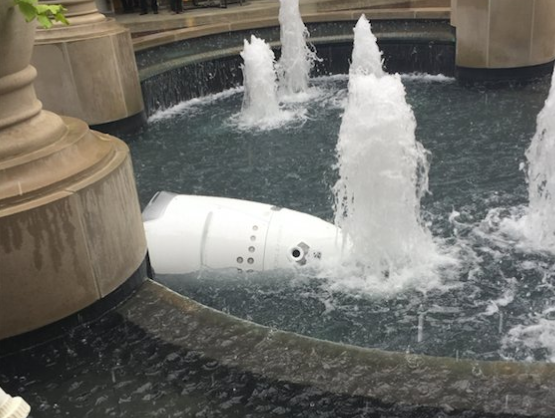
“Our D.C. office building got a security robot. It drowned itself. We were promised flying cars, instead we got suicidal robots.”
“DC security robot quits job by drowning itself in a fountain”
https://www.theverge.com/tldr/2017/7/17/15986042/dc-security-robot-k5-falls-into-water
Did it jump or was it pushed
RD2 meets H2O
Hold on, that’s not RD2, that’s the head programmer for Google self drive cars.
Guess the stress was too much.
the robot had recently been monitoring clinton …
I heard something about a robot commiting suicide but this robot, according to the article, may not be dead, and the reason for the robot taking the plunge is unknown.
Some reporters seem to be having some fun with the story.
Robot appears to be from the planet Remulak.
It must have mistaken those fountains for fellow robot guards. Any intelligent being wants to socialize with its own kind.
“Yeah, I am not sure exactly what to do about this.”
Great. How about nothing?
Finally! “A Player Piano” at long last rings true.
If intelligence is artificial, it’s not intelligence.
If Musk is so afraid of robots, why does he employ them?
“If Musk is so afraid of robots, why does he employ them?”
They learned they could strike for higher wages?
As mentioned above, Colossus, The Forbin Project was a popular early movie which intelligently covered the consequences of advanced AI. I loved the movie when it came out. It was released in 1970, I was 12, and I begged my Mom to let me go see it. It was rated M, but I persisted.
Artificial intelligence is an oxymoron. Computer routines are either determinate or stochastic. Either way, there’s no real intelligence involved. Just because the routines are extremely complex doesn’t make them sentient; it just shows we are capable of assembling things that human intelligence can’t grasp. Stochastic routines or routines with random input signals are the antithesis of intelligence, especially if they’re allowed to take direct, unsupervised actions that affect people. Simulated intelligence is a possibility. Stupidity is the default.
@jorge, that’s sort of like saying evolution is an oxymoron, because variation is stochastic. ICO evolution, that forgets the other half, selection; more or less the same for intelligence, since machine learning clearly happens. One could describe machine learning as a combination of variation and selection. And it’s not entirely clear that natural intelligence isn’t stochastic + selection, too. (I don’t happen to think it is, or at least I think there’s a lot more to it, but the case is much harder to make.)
Where I think you do have a point is sentience, which could be quite different from intelligence. Dogs might be sentient, at least they seem to act that way, but most of us wouldn’t rank them very high on the intelligence scale as compared with humans. (I know I’m going to take hits for that, but when you find a dog that can learn to read, or do arithmetic, or talk about his childhood, let me know.)
Agreed. Computers can only simulate intelligence. A simulation can never rise above the intelligence of its creator.
McSwell, I’ve never heard of a single word oxymoron.
That’s way oversimplified.
One example of a different approach is the pursuit of emergent behaviours which are a result of complex systems and aren’t predictable. link
We have a reasonable understanding of how neurons work. Once we have a brain, our understanding gets weak. Similarly, we understand how simple computer systems work. Once we start allowing them to learn and organize themselves, all bets are off. link
It is quite possible that artificial intelligence will become a lot smarter than us. It is also possible that it will become batshit insane. That’s a very dangerous situation.
CB,
When you said: “…batshit insane” you are probably more correct that I would like to think about. We use to estimate somewhere around 10 errors per thousand lines of code after unit test by the programmer, one error per thousand on completion of system testing if you were lucky. I doubt that has improved much (if at all) since I dropped out around 15 years ago. Any one of those left over errors might easily cause temporary “insanity” in an AI implementation, possible permanent “insanity” in self correcting AI code.
Joe Crawford July 18, 2017 at 8:24 am
It is not programming/coding errors that you need worry about. By far the worst errors I have seen are perfectly implemented errors in systems analysis and design – failures to understand the concept that the system is intended to implement. Way more dangerous than a poorly coded method.
commieBob July 18, 2017 at 5:15 am
Mechanically, “Yes”, ……… but how brain neurons receive, store, manage, manipulate and/or transmit the inherited and/or uploaded environmental info/data that is stored in the DNA of said neuron, ……. 99% of the population doesn’t have a clue “how it works”.
Forrest Gardener
July 18, 2017 at 1:09 am
Hi Forrest.
I my self think that Turing test was not actually meant for the machines, as far as Turing concerned. 🙂
Unless by machines we mean the humans.:)
As far as I can tell no any machine has passed the Turing test…….:)
Please do not jump the gun, and end up shooting a silly “machine”…. 🙂
cheers
Are you sure about that?
Facebook AI Learns to Lie
https://qz.com/1004070/facebook-fb-built-an-ai-system-that-learned-to-lie-to-get-what-it-wants/
“Artificial Intelligence” refers to any process by which a machine performs tasks associated with intelligence. Which so far, in many tasks, is more art than science since we haven’t yet properly quantified how natural intelligence works.
I think that intelligence = learning. Either inventing or recognizing structures. Computations are not intelligence however complicated they are. Inventing number systems is.
People who insist that the end of the world is nigh due to automation need to also explain why a few centuries ago 99.5% of the population worked on farms but due to automation and technological improvements it’s now around 2% but everyone still has to go to work…
” its now around 2% …. everybody still goes to work”
Another bingo! I would add, there are a lot more everybody’s now. In a free society human desires, which are endless, get fulfilled, for better or worse.
We’ll always have Vegas.
Will,
I think that a distinction has to be made between dumb robots, such as assembly line machines and your kitchen appliances, and truly intelligent (AI) entities that act on a par with humans with more than a GED.
Well then we can revisit this in about 1000 years. (I actually develop software that replaces white colour workers, but we’re some way off from that…)