‘The permafrost is dying’: Bethel sees increased shifting of roads and buildings
Author: Lisa Demer
Updated: 1 day ago calendar Published 2 days ago
Chief Eddie Hoffman Highway, seen on June 28, is the main thoroughfare in Bethel, and one of few paved roads. It has become a roller coaster of a ride over the past couple of years. The state Department of Transportation is studying whether heaving from the thaw-freeze of permafrost is a factor. (Lisa Demer / Alaska Dispatch News)
BETHEL — Along the main thoroughfare here, drivers brake for warped asphalt. Houses sink unevenly into the ground. Walls crack and doors stick. Utility poles tilt, sometimes at alarming angles.
Permafrost in and around Bethel is deteriorating and shrinking, even more quickly than most places in Alaska.
Since the first buildings out here, people have struggled with the freeze and thaw of the soils above the permafrost. Now those challenges are amplified.
“What they are saying is the permafrost is dying,” said Eric Whitney, a home inspector and energy auditor in Bethel who has noticed newly eroding river banks, slanting spruce trees and homes shifting anew just weeks after being made level. “I’m just assuming it is not coming back while we’re around here.”
[…]
Above the permafrost in Southwest Alaska, an active layer of soil, often peat, freezes and thaws each year. With air temperatures warming too, the active layer is growing bigger, consuming what had been thought of as permanently frozen.
Thirty years ago, crews would hit permafrost within 4 to 6 feet of the surface, Salzburn said. Now they typically find it 8 to 12 feet down. To install piling deep enough into permafrost to support a house, they used to drill down about 18 feet.
“Now we are going to depths of 35 feet,” Salzbrun said.
“There is a definite change,” said another Bethel contractor, Rick Hanson of T and H Leveling.
“Thirty years ago, crews would hit permafrost within 4 to 6 feet of the surface, Salzburn said. Now they typically find it 8 to 12 feet down.”
Funny… Apart from this past year, Bethel AK is no warmer than it was in the 1930’s. However, thirty years ago, Bethel was definitely colder than it is now or was in the 1930’s…
Figure 1. Bethel AK Annual Mean Temperature, GHCN v3 (adj) + SCAR data. (NASA GISS)
There is no statistically meaningful trend in the annual, summer or winter temperatures at the Bethel AK station:
Bethel’s permafrost may be problematic due to the fact that the average annual temperature is just below freezing and gets well above 0°C in summer and it may thaw to a deeper depth than it did 30 years ago… However, there’s no evidence that the permafrost is dying any more than it would have been dying in the 1930’s.
Any structure which is exposed to the Sun and sits atop, or penetrates the permafrost, would transfer heat into the permafrost.
What kind of thawing does the permafrost experience, 5 miles from town?
Permafrost Nittty Gritty
To really understand permafrost, it helps to listen to people dealing with Arctic infrastructure like roads. A thorough discussion and analysis is presented in Impacts of permafrost degradation on a road embankment at Umiujaq in Nunavik (Quebec), Canada By Richard Fortier, Anne-Marie LeBlanc, and Wenbing Yu. https://rclutz.wordpress.com/2017/04/11/fear-not-for-permafrosty/
Well I drove over just about every piece of interconnected road in the whole State of Alaska in July 1967, and even the freeways were buckled by permafrost, back then. At speeds above 25 mph , my car just became airborne while driving on what looked like superhighways. I destroyed six brand new tires while driving in Alaska. Never had a problem driving the rock roads of the AlCan getting up to Alaska, but once inside the State, everything started breaking. (Including my car’s Jack).
G
Tom Halla
July 10, 2017 9:56 am
Just how much of that infrastructure is newer than the 1930’s? If it was built in the 1950’s or 60’s, perhaps it was stable then.
As an Alaskan and a Engineer that has taken some Artic Engineering I know a little bit about both Bethel and permafrost. I was in Bethel in 1980 or 81 (a couple of days and I don’t remember a lot of it) it had some paved roads, it is a remote city only barge or plane access. I would say the pave roads were less than10 years old then and the city was a lot smaller. I am assuming that the permafrost there is relic permafrost left over last ice age. The thing with relic PF is that it will stay frozen if left alone, but if disturbed by almost anything it will start to melt. If its frozen gravel no big deal but on the other hand if its frozen mud get out the snorkels.
Driving a heavy load over permafrost cracks it, allowing water penetration and a melting-collapse that keeps on going and going. It is not a surprise that they are having a problem with roads. The impact of melting is highly localised. In Ulaanbaatar, which is similar in conditions to Bethel, housing built on the East End by the Tuul River is shifting around each year. In the city centre and surrounds the permafrost is about 24 ft down. In the North End it is near the surface and buildings are moving about.
If all of the permafrost under Bethel melts, so what? Trees will get much bigger and farming will be more productive.
Where’s the downside? The old ‘methane scare’? The methane scare is based on the fact that the permafrost is full of old biomass. Well, where did it come from? Duh! It grew there during some previous warm period. The biomass-methane scare is a mirage.
Living on the tundra sucks. May we all have more warm periods in the far north.
Alan Robertson
July 10, 2017 9:59 am
Here’s an aerial view of Bethel, AK, population ~6000- 6300:
Its called weather.
In Canada, sometimes after a hard winter, we would have frost into June, down a foot or two. Some years, none. Note this was in Southern Alberta, not a permafrost zone.
The same mechanism applies. The transition zone thickness in permafrost is determined mostly by the summer and the preceding winter weather. Snow cover, or lack thereof, is also important in the preceding winter.
Correct. It makes a big difference if truly cold weather arrives without any snow cover early in the winter. Heavy snow cover reduces the freezing depth tremendously but then also melts more quickly in the Spring. The specifics and timing are all important in how this plays out.
What about 1931-60 and 1961-80?
What do you imagine happened to permafrost during the Holocene Climatic Optimum, the Minoan, Roman and Medieval Warm Periods?
Not that Berkeley Earth has the lease sliver of credibility in the first place.
Geoengineering…?
[wpvideo ZoxVr6gt] Source: Kottek, M., J. Grieser, C. Beck, B. Rudolf, and F. Rubel, 2006: World Map of the Köppen-Geiger climate classification updated. Meteorol. Z., 15, 259-263. DOI: 10.1127/0941-2948/2006/0130.
Lovely. The last thing I want is nearing permafrost. The ordinary frost is enough to warp alphalt.
By the way, the map you posted is obviously misleading and I know it since I happen to live near the permafrost areas. As many pointed out, local conditions like draining, trees, moss, alphalt have a much larger effect on frost – of the natural variation, amount of snow has a huge effect.
Where’s your pal Griff?
Jeff in Calgary July 11, 2017 at 1:24 pm
Thank the good lord that it is warming up a bit here in the winter. Our winters are killer, a 1 or 2 degree warming helps a little.
Glad you can see the bigger picture.
Sounds like an effect from more and more activity. Put a road through the middle of anything that doesn’t have a solid base and it will get more and more wash-boarded overtime, not to mention the sub-strata will get more and more “squishy” …
Take a ride on Card Sound Blvd. sometime, it’ll rattle your teeth. As far as I know that part of Southern Florida/ Upper Keys does not have much permafrost. 😉
There is a road from Queenstown going East (Eastern Cape, South Africa) that has such huge whoop-de-dos and it is so difficult to tame, that the roads department has given up and instead put up a sign announcing that this highway is an example of the effect of expansive clays. When they get wet, the expand dramatically and dry, they shrink as much.
There is nothing at all wrong with permanently melting the permafrost. It used to be melted and grew forests. Now it is dead ground with a film of life clinging to the surface. In what way is that good?
The same applies to a bone-dry Sahara. When it is warmer all over, it rains in the Sahara and it is farmable. There is just no downside to greening of the deserts.
Crisp as always, the most apparent downside is that all coastlines, apart from those formed by precipitous cliffs, would be lost along with coastal towns. Other downsides include inland regions which currently have ideal conditions for human activity will be disrupted and their economies upset.
But we will have trees replacing the tundra!
Mark from the Midwest, the same thing happens here in New Zealand, and elsewhere, when you build a road over peaty-swamp country. Differential slumping is common, meaning two hands on the steering wheel and concentration for the drivers. There was one road in our area that developed a wave pattern over time. In my old station wagon you had to do a certain speed (70kph/40mph) to stay out of sync with the wave tops, otherwise if you got into sync you would bang your nose & tail on the wave peaks every time!
Just like the road from Adelaide to Alice Springs, before it was fully sealed.
Alan Robertson
July 10, 2017 10:11 am
OT, but the article’s accompanying picture of a frost- heaved road reminds me of my misspent young adulthood, in Massachusetts. I loved to ride my motorcycle around the twisty back roads of MA and always knew when I’d cross the state line into New Hampshire. The frost- heaved and rough roads of Massachusetts, suddenly gave way to smooth pavement, which was a lot easier on both my machine and me.
The most striking thing for me, back then, was that MA had one of the nation’s highest tax rates and rough roads, while New Hampshire was state tax free and had smooth roads.
Duncan
July 10, 2017 10:12 am
Asphalt paths and roads have been a poster child of thawing permafrost for some time. We all know road surfaces can be much hotter than surrounding grass/shrubs/tree’s. There is no evaporative cooling that foliage provides. If posts (telephone poles) are driven into permafrost the poll will transport heat below the surface more efficiently. This effect is a well known, permanent building installations often place “heat pipes” in around the building to keep the permafrost frozen. The problem is man-made, just not AGW induced.
Heat pipe on buildings
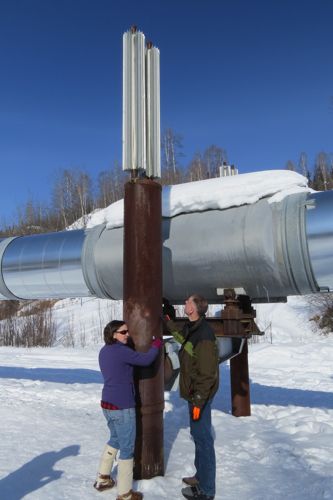
Heat pipe on pipeline support
Duncan,
Don’t know where the picture of the pipe support, but a colleague of mine worked on the Aleyska Pipeline design, and the pipe supports were carefully engineered to minimize the heat input into the soil supporting the pipe, this may be a picture of one of those supports.
The heat pipes do more than “minimize”, like thermal insulation around the hot pipe in the picture, they ‘actively’ transport heat based on phase transition of a fluid. Your smart phone or laptop probably has one to cool the CPU/Graphics card (I have a couple aftermarket ones on mine). They are old technology but are really cool in there simplicity/effectiveness nonetheless. See below explanation.
Duncan: So i don’t get it. Surely if you wish to stabilise the permafrost the very last thing you want to do is have heat pipes anywhere near it because all they could conceivably do is conduct heat from the surface into the frozen ground.
@ur momisugly cephus0 July 11, 2017 at 6:22 am
“… the very last thing you want to do …”
… is to get turned upside down when you are inspecting a heat pipe.
My house is heated or cooled using an air-sourced heat pump [ours is not ground-sourced]. In summer the unit takes heat outside and puts it into the air. In winter, the unit takes energy from the outside air and releases it into the interior of the house. [When really cold outside, there are resistance heaters within the inside unit.] Heat pump or heat pipe involves the same physics — but direction is important. https://en.wikipedia.org/wiki/Heat_pipe#Thermosyphons
Bob boder
July 10, 2017 10:20 am
Oops that pesky 1930s warmth shows up again
Myron Mesecke
July 10, 2017 10:23 am
That asphalt road looks a lot like the ones in central Texas.
The heavy clay soil shrinks and swells depending on if it is dry or wet.
I’ll blame it on the loss of Texas permafrost.
This is the case in areas of Southern Saskatchewan as well. We call that soil type “gumbo” and it is like plasticene when it is wet and hard as concrete when dry. In between it moves and heaves with hydraulic effect.
The Becker thermal piles (thermal VSM’s) have heat pipes that are filled with anhydrous ammonia. They range in depth from 30ft to 80 ft from the surface depending in terrain and seismic loading. There are other types of VSM’s depending on terrain.
Latitude
July 10, 2017 10:24 am
“Warming of air temperatures in the late 1800s and early 1900s in North America
may have preceded warming of the permafrost. How-ever, Zhang and Osterkamp (1993) showed that,
at Barrow, air temperature variations alone (since1923) couldn’t account for the observed warming of the permafrost thus implicating changes in snow cover or perhaps an earlier warming” http://www.arlis.org/docs/vol1/ICOP/55700698/Pdf/Chapter_151.pdf
Gary Pearse
July 10, 2017 10:25 am
You have to insulate structures and paved roads over permafrost or provide air circulation below roadbeds and buildings (on stilts) . This was known when I got my engineering degree in 1961.
I believe that. Trying to find anything written rather than a YouTube video or a news video is nigh unto impossible at times. Videos are all people seem to pay attention to. Reading is just too hard, I guess.
Sheri, at my school we did the three r’s
r .. r .. reading.
Old gag but still good.
RWturner
July 10, 2017 10:34 am
They’ve always had to deal with it, but dealing with it has become more of a problem because the latest generations only want to sing. I have exclusive video of the situation:
Ron Long
July 10, 2017 10:50 am
My first job in geology was as a geological assistant for Hanna Mining Company, at the Egnaty Creek mercury prospect on the lower Kuskokwim River, below Red Devil, in Alaska. Part of the project was a cooperative experiment with the US Bureau of Mines on how to defeat permafrost, to remove enough of the frozen soil and bedrock to see relevant geological exposures. We had the help of John Miscovich, the inventor of the Intelligent Monitor. We bulldozed, hit with water cannons, and drilled holes and put dynamite down the holes in an attempt to defeat the permafrost. Nothing worked. We drilled several deeper holes and put all of the remaining dynamite down the holes. Our Eskimo helpers took off running, and when we touched off the dynamite I wished I had run with them (exceeded some sort of critical threshold). If global warming really is winning against permafrost I’m all for it.
Yeah, and all the methane released by the melt will accelerate the warming and ecosystems will change more quickly than they can adapt and the remediation costs will be huge. It’ll be great. But at least drilling will be cheaper.
Ss, you have apparently not read the recent biological studies that show that IF the permafrost top thaws more in summer yhis can be done experimentally using warming frame enclosures, the result is more methanogen bacteria and not more methane release. Most Arctic methane seeps are from thermogenic not biogenic sources, especially in Siberia and Alaska.
ristvan
“the result is…not more methane release”
Citation?
There seems to be evidence of the contrary. http://adsabs.harvard.edu/abs/2006Natur.443…71W
From the abstract:
We find that thawing permafrost along lake margins accounts for most of the methane released from the lakes, and estimate that an expansion of thaw lakes between 1974 and 2000, which was concurrent with regional warming, increased methane emissions in our study region by 58 per cent.
etc, etc, etc.
We drilled several deeper holes and put all of the remaining dynamite down the holes. Our Eskimo helpers took off running, and when we touched off the dynamite I wished I had run with them.
Yeah, that’s a geologist talking. Did you drop your beer when you ran?
BS Geology, West Virginia University, 1979
Middleton ==> Nice job on this — but the averages offered are not adequate to evaluate the conditions in Bethel to solve the mystery (if there is one) of the buckling roads.
What would be more appropriate, if you have it, would be the spring, summer, and fall daily HIs and LOWs, for the last few years.
The averages are obscuring the information needed to see what is really going on.
Kip,
The averages obscure a lot of things.
More often than not, the warming exhibited by average temperatures is due to higher lows.
Unfortunately, the NASA GISS station data consist of monthly, seasonal and annual averages.
David ==> If you wish to fool with it, the data is available from this link: https://www.weather.gov/climate/index.php?wfo=pafc (the page shows Anchorage, Ak at the top, but it contains the Bethel data below as follows:)
You must select from the drop-downs:
1. Product » Preliminary Monthly Climate Data (CF6)
2. Location » Bethel
3. Timeframe » Archived Data: then the month and year
The “Go”
The data opens in another small window. Gives the daily highs and lows.
The data is available back to July 2012.
I placer mined in permafrost in the Klondike for 10 years. The natural ground cover is moss. Where the moss is, there is permafrost at the surface, when the moss is removed the permafrost melts. If it is in a wet area the permafrost does not recede. The water refreezes every winter and protects the underlaying ice. If the ground is allowed to drain and dry the permafrost will slowly disappear ever summer. This has nothing to do with global warming.
richard
July 10, 2017 11:31 am
1954- “CANADA WILL SHIFT ARCTIC DWELLERS
OTTAWA. Tuesday.—Canada’s largest Arctic
community, threatened with sinking through melting
permafrost terrain at Aklavik, 70 miles south of the
Arctic Ocean. will be moved to a new location”
richard
July 10, 2017 11:41 am
Melting permafrost has always been a problem where there are roads and buildings-
1946- “When the Russians build on frozen ground they sink piles deep into the “permafrost,” melting holes with steam jets. The piles are then wrapped in tar paper and greased so that the top soil freezing and thawing with the seasons cannot stick to them and heave them. But piles are scarce in much of Alaska and army engineers think they know something better – thick insulating mats to keep the “permafrost” always frozen.
Near Fairbanks the Army has laid down 20 runway sections insulated from “permafrost” by layers of cellular concrete, asphalt, foam glass,. gravel, moss, and spruce boughs. Under each runway are thermometers to measure the heat penetration for buildings. The trick is to rest the walls on thick mats
of insulating material or allow cold air to circulate freely under the heated floors”
Went and researched Bethel permafrost. There is an old 1957 USGS report. Bethel lies at the extreme southern edge of the Alaska permafrost zone, so dicey. The permafrost across Bethel is quite variable in thickness based on several boreholes. The city has grown from a small Eskimo village/trading outpost in 1900 to the ninth largest in Alaska with about 6500 people in 1700 households. 91 taxies, per capita the taxi cab capital of the US. Got to be substantial UHI. There is a lot more to the Bethel story than AGW.
UHI was my guess too. Roads and buildings certainly absorb more solar energy and heat the ground below. The article also says that it’s going away faster than in other parts of Alaska. Is it even going away at all once you get away from civilization?
James at 48
July 10, 2017 12:30 pm
Yep, dig into the permafrost and it will melt. Put stuff on it, it will flow. Nothing new here.
To the true believer the present is always warmer than the past and the future will always be warmer than the present. Thus states the fundamental axiom of the church of global warming and the data may never be allowed to contradict it. If the data ever even looks like doing so then it is wrong and must be adjusted so as to bring it line with the fundamental axiom which cannot ever be wrong.
Compared to NOAA temps.
note areas of missing data.
David Long
July 10, 2017 1:04 pm
When I was in Alaska in the 80’s we observed that the more recently built roads were built up on thick pads of mostly gravel so that the asphalt surface was maybe 6 feet above the surrounding permafrost. These roads seemed to be faring much better. They had their own problems though: if you were pulling a trailer and you let it’s outer wheel get onto that gravel slope you could be in for a world of hurt.
Earthling
July 10, 2017 1:31 pm
You would think that the general public, after seeing the above photo of the highway, would instantly put 2+2 together and realize that the highway and black asphalt are what is causing the highway to deform. It was well known in the early 1960’s if not sooner, that the housing ground that was sitting on piles were also deforming, not from AGW, but because the building sitting above the permanent frost didn’t allow the same cold to penetrate the ground every winter. It was actually causing the melting and subsidence of the permafrost under the building. This was a well understood fact long before anyone was talking about global cooling or global warming. I am at a loss to explain how some devious publishers will show these pictures of deformed highways and buildings, and then claim it is global warming/climate change. Well, actually I do know why they do this, and it is very deceptive to the very message they are trying to convey. But you would think everyone would figure this out in 3 seconds or less. The masses can’t be this gullible, can they?
Or we could rely on recent, first-hand accounts from locals who probably know a fair bit about it: https://www.adn.com/alaska-news/rural-alaska/2017/07/07/the-permafrost-is-dying-bethel-sees-increased-shifting-of-roads-and-buildings/
“Permafrost in and around Bethel is deteriorating and shrinking, even more quickly than most places in Alaska.”
“Permafrost here is considered “warm,” maybe a fraction of a degree below freezing, so it’s sensitive to just a slight warming of the air, said Vladimir Romanovsky, geophysics professor and permafrost researcher at the University of Alaska Fairbanks.”
Is trusting him being gullible? Or should we just confirm our biases and put 2 and 2 together from the photo?
The children just aren’t going to know what permafrost is.
accordionsrule
July 10, 2017 3:05 pm
http://w2.weather.gov/aprfc/breakupDB?site=271
2016 was an unprecedented early river breakup, but otherwise there doesn’t appear to be a trend. I think the problem might be APM- anthropogenic permafrost melting. There’s a lot of asphalt at the airport, and the dump has its own micro ecosystem.
M Seward
July 10, 2017 3:12 pm
Look at the world through a drinking straw and an ant will seem like a monster from mars.
Unfortunately cheap jack science generally only uses drinking straws for data gathering. Its cheap as chips and you can always get a ‘least publishable unit’ peer reviewed and into print so the economics always stacks up.


Any structure which is exposed to the Sun and sits atop, or penetrates the permafrost, would transfer heat into the permafrost.
What kind of thawing does the permafrost experience, 5 miles from town?
How is the permafrost about 100 yards away from the black asphalt heat sink roadway?
I bid 1 million dollars to do that one day study 😉
Maybe they should pour concrete and paint it white, instead of emulating road building practices from sunny southern California.
Highways, byways and roadway are, in actuality, UHI (urban heat islands).
Permafrost Nittty Gritty
To really understand permafrost, it helps to listen to people dealing with Arctic infrastructure like roads. A thorough discussion and analysis is presented in Impacts of permafrost degradation on a road embankment at Umiujaq in Nunavik (Quebec), Canada By Richard Fortier, Anne-Marie LeBlanc, and Wenbing Yu.
https://rclutz.wordpress.com/2017/04/11/fear-not-for-permafrosty/
Well I drove over just about every piece of interconnected road in the whole State of Alaska in July 1967, and even the freeways were buckled by permafrost, back then. At speeds above 25 mph , my car just became airborne while driving on what looked like superhighways. I destroyed six brand new tires while driving in Alaska. Never had a problem driving the rock roads of the AlCan getting up to Alaska, but once inside the State, everything started breaking. (Including my car’s Jack).
G
Just how much of that infrastructure is newer than the 1930’s? If it was built in the 1950’s or 60’s, perhaps it was stable then.
As an Alaskan and a Engineer that has taken some Artic Engineering I know a little bit about both Bethel and permafrost. I was in Bethel in 1980 or 81 (a couple of days and I don’t remember a lot of it) it had some paved roads, it is a remote city only barge or plane access. I would say the pave roads were less than10 years old then and the city was a lot smaller. I am assuming that the permafrost there is relic permafrost left over last ice age. The thing with relic PF is that it will stay frozen if left alone, but if disturbed by almost anything it will start to melt. If its frozen gravel no big deal but on the other hand if its frozen mud get out the snorkels.
Paved roads causing massive heat transfer to the permafrost and nearby soil.
Driving a heavy load over permafrost cracks it, allowing water penetration and a melting-collapse that keeps on going and going. It is not a surprise that they are having a problem with roads. The impact of melting is highly localised. In Ulaanbaatar, which is similar in conditions to Bethel, housing built on the East End by the Tuul River is shifting around each year. In the city centre and surrounds the permafrost is about 24 ft down. In the North End it is near the surface and buildings are moving about.
If all of the permafrost under Bethel melts, so what? Trees will get much bigger and farming will be more productive.
Where’s the downside? The old ‘methane scare’? The methane scare is based on the fact that the permafrost is full of old biomass. Well, where did it come from? Duh! It grew there during some previous warm period. The biomass-methane scare is a mirage.
Living on the tundra sucks. May we all have more warm periods in the far north.
Here’s an aerial view of Bethel, AK, population ~6000- 6300:
Looks like groundwater penetration may be affecting the “perma” frost.
The .jpg link you included goes to a HTML page, not an image. This should work: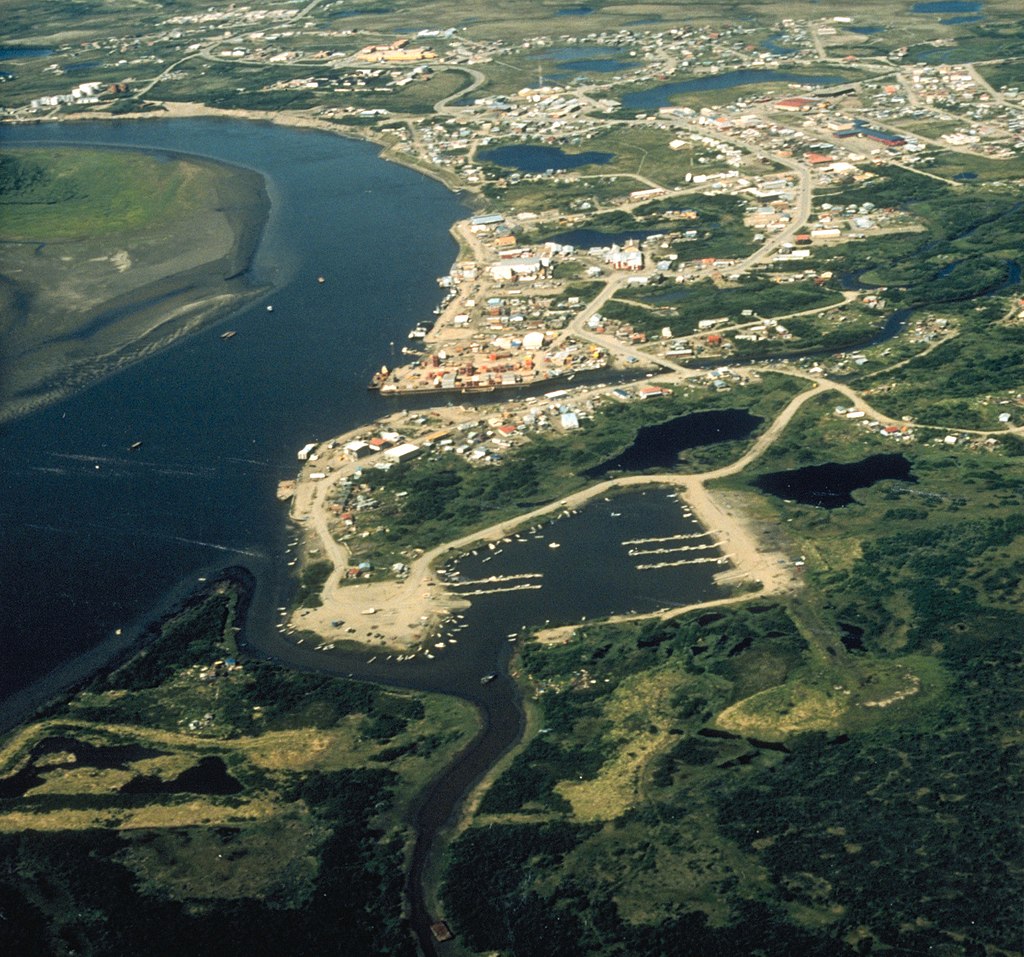
Its called weather.
In Canada, sometimes after a hard winter, we would have frost into June, down a foot or two. Some years, none. Note this was in Southern Alberta, not a permafrost zone.
The same mechanism applies. The transition zone thickness in permafrost is determined mostly by the summer and the preceding winter weather. Snow cover, or lack thereof, is also important in the preceding winter.
It’s called weather…until the change appears year after year after year and then its called climate.
Year after year? How about century after century. Year to year is too short of time period.
Slipstick: However, the accompanying charts show no change in climate, only year to year variability. ie; weather.
Correct. It makes a big difference if truly cold weather arrives without any snow cover early in the winter. Heavy snow cover reduces the freezing depth tremendously but then also melts more quickly in the Spring. The specifics and timing are all important in how this plays out.
This isn’t weather, it’s geo-engineering.
http://static.berkeleyearth.org/graphics/permafrost-melt-since-1900.png
caused by:
http://berkeleyearth.org/wp-content/uploads/2015/02/global-warming-since-1900-winter-northern.png
http://berkeleyearth.org/graphics/physical-effects-of-warming/
What about 1931-60 and 1961-80?
What do you imagine happened to permafrost during the Holocene Climatic Optimum, the Minoan, Roman and Medieval Warm Periods?
Not that Berkeley Earth has the lease sliver of credibility in the first place.
Estimates again.
Geoengineering…?
[wpvideo ZoxVr6gt]
Source: Kottek, M., J. Grieser, C. Beck, B. Rudolf, and F. Rubel, 2006: World Map of the Köppen-Geiger climate classification updated. Meteorol. Z., 15, 259-263. DOI: 10.1127/0941-2948/2006/0130.
Lovely. The last thing I want is nearing permafrost. The ordinary frost is enough to warp alphalt.
By the way, the map you posted is obviously misleading and I know it since I happen to live near the permafrost areas. As many pointed out, local conditions like draining, trees, moss, alphalt have a much larger effect on frost – of the natural variation, amount of snow has a huge effect.
Where’s your pal Griff?
Tag team trolling.
Thank the good lord that it is warming up a bit here in the winter. Our winters are killer, a 1 or 2 degree warming helps a little.
Jeff in Calgary July 11, 2017 at 1:24 pm
Thank the good lord that it is warming up a bit here in the winter. Our winters are killer, a 1 or 2 degree warming helps a little.
Glad you can see the bigger picture.
Compare this: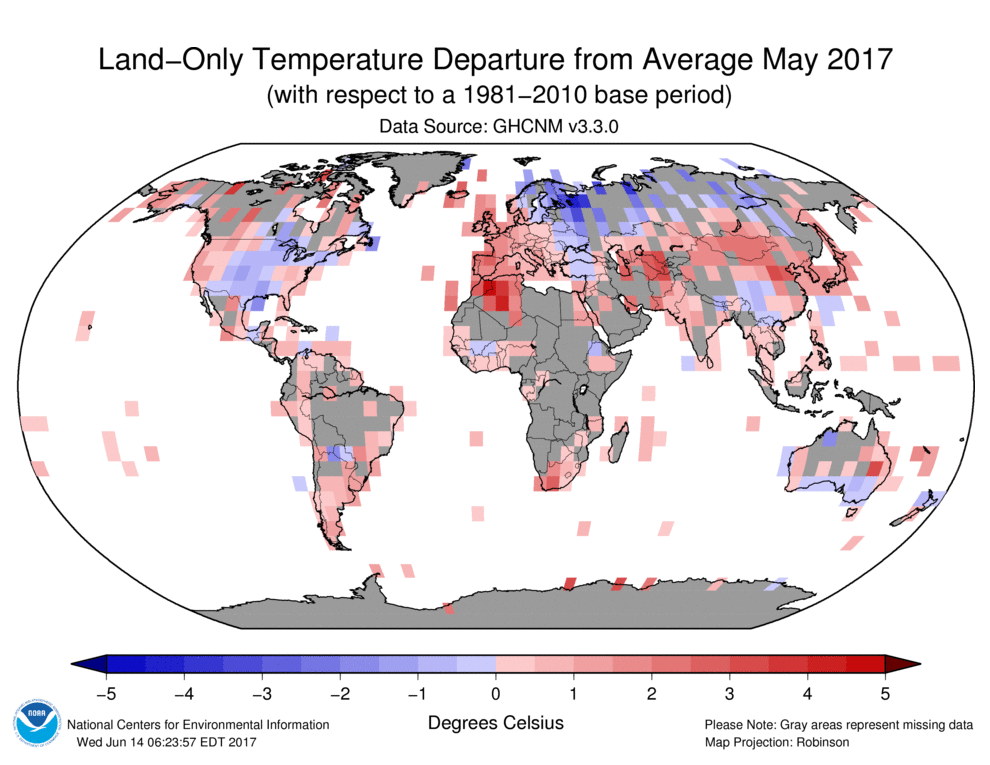
http://berkeleyearth.org/wp-content/uploads/2015/02/global-warming-since-1900-winter-northern.png
with this:
Please note the ‘missing data’ from the NOAA map
Sounds like an effect from more and more activity. Put a road through the middle of anything that doesn’t have a solid base and it will get more and more wash-boarded overtime, not to mention the sub-strata will get more and more “squishy” …
Take a ride on Card Sound Blvd. sometime, it’ll rattle your teeth. As far as I know that part of Southern Florida/ Upper Keys does not have much permafrost. 😉
“that part of Southern Florida/ Upper Keys does not have much permafrost.”
But it is sand with a rising watertable?
There is a road from Queenstown going East (Eastern Cape, South Africa) that has such huge whoop-de-dos and it is so difficult to tame, that the roads department has given up and instead put up a sign announcing that this highway is an example of the effect of expansive clays. When they get wet, the expand dramatically and dry, they shrink as much.
There is nothing at all wrong with permanently melting the permafrost. It used to be melted and grew forests. Now it is dead ground with a film of life clinging to the surface. In what way is that good?
The same applies to a bone-dry Sahara. When it is warmer all over, it rains in the Sahara and it is farmable. There is just no downside to greening of the deserts.
Crisp as always, the most apparent downside is that all coastlines, apart from those formed by precipitous cliffs, would be lost along with coastal towns. Other downsides include inland regions which currently have ideal conditions for human activity will be disrupted and their economies upset.
But we will have trees replacing the tundra!
Mark from the Midwest, the same thing happens here in New Zealand, and elsewhere, when you build a road over peaty-swamp country. Differential slumping is common, meaning two hands on the steering wheel and concentration for the drivers. There was one road in our area that developed a wave pattern over time. In my old station wagon you had to do a certain speed (70kph/40mph) to stay out of sync with the wave tops, otherwise if you got into sync you would bang your nose & tail on the wave peaks every time!
Sounds like the highway between Kopu and the Piako River bridge. 🙂
Talk about a tuned suspension!
Just like the road from Adelaide to Alice Springs, before it was fully sealed.
OT, but the article’s accompanying picture of a frost- heaved road reminds me of my misspent young adulthood, in Massachusetts. I loved to ride my motorcycle around the twisty back roads of MA and always knew when I’d cross the state line into New Hampshire. The frost- heaved and rough roads of Massachusetts, suddenly gave way to smooth pavement, which was a lot easier on both my machine and me.
The most striking thing for me, back then, was that MA had one of the nation’s highest tax rates and rough roads, while New Hampshire was state tax free and had smooth roads.
Asphalt paths and roads have been a poster child of thawing permafrost for some time. We all know road surfaces can be much hotter than surrounding grass/shrubs/tree’s. There is no evaporative cooling that foliage provides. If posts (telephone poles) are driven into permafrost the poll will transport heat below the surface more efficiently. This effect is a well known, permanent building installations often place “heat pipes” in around the building to keep the permafrost frozen. The problem is man-made, just not AGW induced.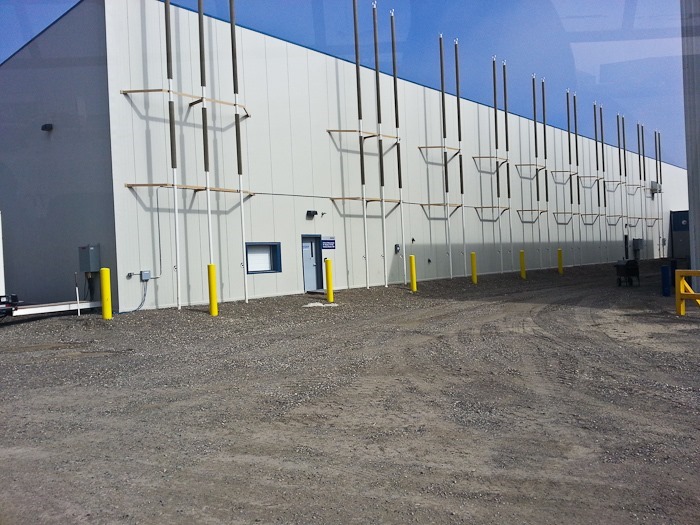
Heat pipe on buildings
Heat pipe on pipeline support
Interesting! +10
Duncan,
Don’t know where the picture of the pipe support, but a colleague of mine worked on the Aleyska Pipeline design, and the pipe supports were carefully engineered to minimize the heat input into the soil supporting the pipe, this may be a picture of one of those supports.
The heat pipes do more than “minimize”, like thermal insulation around the hot pipe in the picture, they ‘actively’ transport heat based on phase transition of a fluid. Your smart phone or laptop probably has one to cool the CPU/Graphics card (I have a couple aftermarket ones on mine). They are old technology but are really cool in there simplicity/effectiveness nonetheless. See below explanation.
It is called a Long pile, after the name of the inventor.
Duncan: So i don’t get it. Surely if you wish to stabilise the permafrost the very last thing you want to do is have heat pipes anywhere near it because all they could conceivably do is conduct heat from the surface into the frozen ground.
@ur momisugly cephus0 July 11, 2017 at 6:22 am
“… the very last thing you want to do …”
… is to get turned upside down when you are inspecting a heat pipe.
My house is heated or cooled using an air-sourced heat pump [ours is not ground-sourced]. In summer the unit takes heat outside and puts it into the air. In winter, the unit takes energy from the outside air and releases it into the interior of the house. [When really cold outside, there are resistance heaters within the inside unit.] Heat pump or heat pipe involves the same physics — but direction is important.
https://en.wikipedia.org/wiki/Heat_pipe#Thermosyphons
Oops that pesky 1930s warmth shows up again
That asphalt road looks a lot like the ones in central Texas.
The heavy clay soil shrinks and swells depending on if it is dry or wet.
I’ll blame it on the loss of Texas permafrost.
Good one Myron, haha.
The Texas jackalopes don’t miss the permafrost.
We all know jackalopes are extinct, a victim of global warming.
This is the case in areas of Southern Saskatchewan as well. We call that soil type “gumbo” and it is like plasticene when it is wet and hard as concrete when dry. In between it moves and heaves with hydraulic effect.
Gumbo soil is called bentonitic volcanic ash. It has an enormous swelling/drying effect.
In regina its 37% roughly volume change from dry to saturated.
As I recall, many of the vertical pipe supports on the trans-Alaska system (TAPS) are actively refrigerated to ensure stable permafrost.
They are passively refrigerated with thermal siphons. http://www.arcticfoundations.com/index.php/news/78-using-passive-refrigeration-to-stabilize-foundations-in-cold-climates
The Becker thermal piles (thermal VSM’s) have heat pipes that are filled with anhydrous ammonia. They range in depth from 30ft to 80 ft from the surface depending in terrain and seismic loading. There are other types of VSM’s depending on terrain.
“Warming of air temperatures in the late 1800s and early 1900s in North America
may have preceded warming of the permafrost. How-ever, Zhang and Osterkamp (1993) showed that,
at Barrow, air temperature variations alone (since1923) couldn’t account for the observed warming of the permafrost thus implicating changes in snow cover or perhaps an earlier warming”
http://www.arlis.org/docs/vol1/ICOP/55700698/Pdf/Chapter_151.pdf
You have to insulate structures and paved roads over permafrost or provide air circulation below roadbeds and buildings (on stilts) . This was known when I got my engineering degree in 1961.
Yeah, but no one remembers 1961 engineering any more as they can no longer read. Engineering has been replaced with shaman rattles.
I believe that. Trying to find anything written rather than a YouTube video or a news video is nigh unto impossible at times. Videos are all people seem to pay attention to. Reading is just too hard, I guess.
Sheri, at my school we did the three r’s
r .. r .. reading.
Old gag but still good.
They’ve always had to deal with it, but dealing with it has become more of a problem because the latest generations only want to sing. I have exclusive video of the situation:
My first job in geology was as a geological assistant for Hanna Mining Company, at the Egnaty Creek mercury prospect on the lower Kuskokwim River, below Red Devil, in Alaska. Part of the project was a cooperative experiment with the US Bureau of Mines on how to defeat permafrost, to remove enough of the frozen soil and bedrock to see relevant geological exposures. We had the help of John Miscovich, the inventor of the Intelligent Monitor. We bulldozed, hit with water cannons, and drilled holes and put dynamite down the holes in an attempt to defeat the permafrost. Nothing worked. We drilled several deeper holes and put all of the remaining dynamite down the holes. Our Eskimo helpers took off running, and when we touched off the dynamite I wished I had run with them (exceeded some sort of critical threshold). If global warming really is winning against permafrost I’m all for it.
I agree. FREE THE PERMAFROST!
Yeah, and all the methane released by the melt will accelerate the warming and ecosystems will change more quickly than they can adapt and the remediation costs will be huge. It’ll be great. But at least drilling will be cheaper.
Ss, you have apparently not read the recent biological studies that show that IF the permafrost top thaws more in summer yhis can be done experimentally using warming frame enclosures, the result is more methanogen bacteria and not more methane release. Most Arctic methane seeps are from thermogenic not biogenic sources, especially in Siberia and Alaska.
ristvan
“the result is…not more methane release”
Citation?
There seems to be evidence of the contrary.
http://adsabs.harvard.edu/abs/2006Natur.443…71W
From the abstract:
We find that thawing permafrost along lake margins accounts for most of the methane released from the lakes, and estimate that an expansion of thaw lakes between 1974 and 2000, which was concurrent with regional warming, increased methane emissions in our study region by 58 per cent.
etc, etc, etc.
Yeah, that’s a geologist talking. Did you drop your beer when you ran?
BS Geology, West Virginia University, 1979
“Hold my beer. Watch this . . .”
Most frequently quoted phrases by Darwin Award recipients.
Middleton ==> Nice job on this — but the averages offered are not adequate to evaluate the conditions in Bethel to solve the mystery (if there is one) of the buckling roads.
What would be more appropriate, if you have it, would be the spring, summer, and fall daily HIs and LOWs, for the last few years.
The averages are obscuring the information needed to see what is really going on.
Kip,
The averages obscure a lot of things.
More often than not, the warming exhibited by average temperatures is due to higher lows.
Unfortunately, the NASA GISS station data consist of monthly, seasonal and annual averages.
David ==> If you wish to fool with it, the data is available from this link:
https://www.weather.gov/climate/index.php?wfo=pafc (the page shows Anchorage, Ak at the top, but it contains the Bethel data below as follows:)
You must select from the drop-downs:
1. Product » Preliminary Monthly Climate Data (CF6)
2. Location » Bethel
3. Timeframe » Archived Data: then the month and year
The “Go”
The data opens in another small window. Gives the daily highs and lows.
The data is available back to July 2012.
David ==> For the last year, last winter, this image shows one month of above average temperatures, and three months well below average:
http://www.cpc.ncep.noaa.gov/products/global_monitoring/temperature/tn70219_1yr.gif
Well… That must be the month that the permafrost died! LOL!
Or edged north another 10km.
There’s those nasty averages again!
I placer mined in permafrost in the Klondike for 10 years. The natural ground cover is moss. Where the moss is, there is permafrost at the surface, when the moss is removed the permafrost melts. If it is in a wet area the permafrost does not recede. The water refreezes every winter and protects the underlaying ice. If the ground is allowed to drain and dry the permafrost will slowly disappear ever summer. This has nothing to do with global warming.
1954- “CANADA WILL SHIFT ARCTIC DWELLERS
OTTAWA. Tuesday.—Canada’s largest Arctic
community, threatened with sinking through melting
permafrost terrain at Aklavik, 70 miles south of the
Arctic Ocean. will be moved to a new location”
Melting permafrost has always been a problem where there are roads and buildings-
1946- “When the Russians build on frozen ground they sink piles deep into the “permafrost,” melting holes with steam jets. The piles are then wrapped in tar paper and greased so that the top soil freezing and thawing with the seasons cannot stick to them and heave them. But piles are scarce in much of Alaska and army engineers think they know something better – thick insulating mats to keep the “permafrost” always frozen.
Near Fairbanks the Army has laid down 20 runway sections insulated from “permafrost” by layers of cellular concrete, asphalt, foam glass,. gravel, moss, and spruce boughs. Under each runway are thermometers to measure the heat penetration for buildings. The trick is to rest the walls on thick mats
of insulating material or allow cold air to circulate freely under the heated floors”
Went and researched Bethel permafrost. There is an old 1957 USGS report. Bethel lies at the extreme southern edge of the Alaska permafrost zone, so dicey. The permafrost across Bethel is quite variable in thickness based on several boreholes. The city has grown from a small Eskimo village/trading outpost in 1900 to the ninth largest in Alaska with about 6500 people in 1700 households. 91 taxies, per capita the taxi cab capital of the US. Got to be substantial UHI. There is a lot more to the Bethel story than AGW.
That’s enlightening. Damn people again! They’re always causing problems! Every time I turn my back they’re sinking into the ground or something!
UHI was my guess too. Roads and buildings certainly absorb more solar energy and heat the ground below. The article also says that it’s going away faster than in other parts of Alaska. Is it even going away at all once you get away from civilization?
Yep, dig into the permafrost and it will melt. Put stuff on it, it will flow. Nothing new here.
Yep, and raise average temp a few degrees and yer gits yerself a bit more.
When the temperature rises a few degrees, get back to me.
To the true believer the present is always warmer than the past and the future will always be warmer than the present. Thus states the fundamental axiom of the church of global warming and the data may never be allowed to contradict it. If the data ever even looks like doing so then it is wrong and must be adjusted so as to bring it line with the fundamental axiom which cannot ever be wrong.
Compared to NOAA temps.

note areas of missing data.
When I was in Alaska in the 80’s we observed that the more recently built roads were built up on thick pads of mostly gravel so that the asphalt surface was maybe 6 feet above the surrounding permafrost. These roads seemed to be faring much better. They had their own problems though: if you were pulling a trailer and you let it’s outer wheel get onto that gravel slope you could be in for a world of hurt.
You would think that the general public, after seeing the above photo of the highway, would instantly put 2+2 together and realize that the highway and black asphalt are what is causing the highway to deform. It was well known in the early 1960’s if not sooner, that the housing ground that was sitting on piles were also deforming, not from AGW, but because the building sitting above the permanent frost didn’t allow the same cold to penetrate the ground every winter. It was actually causing the melting and subsidence of the permafrost under the building. This was a well understood fact long before anyone was talking about global cooling or global warming. I am at a loss to explain how some devious publishers will show these pictures of deformed highways and buildings, and then claim it is global warming/climate change. Well, actually I do know why they do this, and it is very deceptive to the very message they are trying to convey. But you would think everyone would figure this out in 3 seconds or less. The masses can’t be this gullible, can they?
Realize most people have never lived in and may never have even visited places with permafrost. That makes them innately gullible.
Or we could rely on recent, first-hand accounts from locals who probably know a fair bit about it:
https://www.adn.com/alaska-news/rural-alaska/2017/07/07/the-permafrost-is-dying-bethel-sees-increased-shifting-of-roads-and-buildings/
“Permafrost in and around Bethel is deteriorating and shrinking, even more quickly than most places in Alaska.”
“Permafrost here is considered “warm,” maybe a fraction of a degree below freezing, so it’s sensitive to just a slight warming of the air, said Vladimir Romanovsky, geophysics professor and permafrost researcher at the University of Alaska Fairbanks.”
Is trusting him being gullible? Or should we just confirm our biases and put 2 and 2 together from the photo?
Or we could rely on science and actual data.
The children just aren’t going to know what permafrost is.
http://w2.weather.gov/aprfc/breakupDB?site=271
2016 was an unprecedented early river breakup, but otherwise there doesn’t appear to be a trend. I think the problem might be APM- anthropogenic permafrost melting. There’s a lot of asphalt at the airport, and the dump has its own micro ecosystem.
Look at the world through a drinking straw and an ant will seem like a monster from mars.
Unfortunately cheap jack science generally only uses drinking straws for data gathering. Its cheap as chips and you can always get a ‘least publishable unit’ peer reviewed and into print so the economics always stacks up.