Guest essay by Mike Jonas
“And what might they be?” – Dr. Leif Svalgaard
For a long time, I have been bitterly disappointed at the blinkered lopsided attitude of the IPCC and of many climate scientists, by which they readily accepted spurious indirect effects from CO2-driven global warming (the “feedbacks”), yet found a range of excuses for ignoring the possibility that there might be any indirect effects from the sun. For example, in AR4 2.7.1 they say “empirical results since the TAR have strengthened the evidence for solar forcing of climate change” but there is nothing in the models for this, because there is “ongoing debate“, or it “remains ambiguous“, etc, etc.
In this article, I explore the scientific literature on possible solar indirect effects on climate, and suggest a reasonable way of looking at them. This should also answer Leif Svalgaard’s question, though it seems rather unlikely that he would be unaware of any of the material cited here. Certainly just about everything in this article has already appeared on WUWT; the aim here is to present it in a single article (sorry it’s so long). I provide some links to the works of people like Jasper Kirkby, Nir Shaviv and Nigel Calder. For those who have time, those works are worth reading in their entirety.
Table of Contents:
1. Henrik Svensmark
2. Correlation
3. Galactic Cosmic Rays
4. Ultra-Violet
5. The Non-Linear System
6. A Final Quirk
Abbreviations
References
1. Henrik Svensmark
Back in 1997, when Henrik Svensmark and Eigil Friis-Christensen first floated their hypothesis on the effect of Galactic Cosmic Rays (GCRs) on Earth’s climate, it shook the world of climate science. But it was going to take a lot more than a shake to dislodge climate science’s autocrats. Their entrenched position was that climate was primarily driven by greenhouse gases, and that consequently man-made CO2 would be catastrophic (the CAGW hypothesis), and they were going to do whatever it took to protect their turf.
Those CAGW scientists were supported by remarkably little evidence. Laboratory experiments had verified the mechanics of CO2 as a greenhouse gas, but there was no empirical evidence that it was a major driver of climate. There were correlations, but inspection showed that temperature change always preceded CO2 change. The only support for CAGW came from climate models which had the assumed effects of CO2 built in. The models gave imaginary projections of what future climate would be like if CAGW was correct, but they could not reproduce past climate.
In 2003, Henrik Svensmark and Nigel Calder in the book The Chilling Stars [1] described how cloud cover changes caused by variations in cosmic rays are a major contributor to global temperature changes, and stated that human influences had been exaggerated.
Empirical evidence supported their theory, which they called Cosmoclimatology [2][3], and Henrik Svensmark had conducted an experiment to verify its mechanics. So Henrik Svensmark was fully justified in claiming that Cosmoclimatology “is already at least as secure, scientifically speaking, as the prevailing paradigm of forcing by variable greenhouse gases.”.
The next step was to publish in a peer-reviewed journal. Henrik Svensmark and his team at the Danish National Space Center (DNSC, now DTU Space) submitted a straightforward paper describing their experimental results to a peer-reviewed journal. They were stunned when the climate science tsars closed ranks and the paper was rejected. At this point, the clean-shaven Henrik Svensmark, as a kind of protest, decided not to shave until the paper was published. He had a pretty impressive beard by the time Experimental evidence for the role of ions in particle nucleation under atmospheric conditions [4] was eventually published in Proceedings of the Royal Society A. The process had taken 16 months.
Here we are, twenty years after the GCR hypothesis was first floated, and the CAGW paradigm is still in place and virtually unscathed. This is in spite of increasing evidence supporting Cosmoclimatology and in spite of the epic failure of climate models to predict climate. Paradigm protection has been seen many times in science, but I wonder whether it has ever been as corrupt and as extreme as it currently is in climate science.
I should have mentioned that there was strong opposition against experimental testing of Cosmoclimatology. Think about that – scientists trying to prevent a thoery being tested – and I think you will agree that my use of the word “corrupt” in the previous paragraph was justified.
2. Correlation
There is a strong correlation between solar activity and Earth’s climate. Jasper Kirkby wrote a wide-ranging paper, Cosmic Rays and Climate [5] in which he described the background to the planned CLOUD experiment at CERN, which would test the Cosmoclimatology theory.
In the paper, Jasper Kirkby presented a number of graphs which showed correlations between GCRs and climate. Of course, correlation is not causation, but as GCRs are controlled by solar activity the correlations do show a strong relationship between solar activity and Earth’s climate.
From the paper:
Over 500 million years:

Figure 1. Correlation of cosmic rays with temperature over the past 500 million years. [The paper’s Fig.11].
Note: The GCR flux varies as the solar system passes through the spiral arms of the Milky Way.
Over 12,000 years:

Figure 2. Correlation of GCR variability with ice-rafted debris events in the North Atlantic during the Holocene. [The paper’s Fig. 8].
The paper explains how the 14C and 10Be records are independent proxies for GCRs, and how ice-rafted debris relates to climate.
Over 3,000 years:

Figure 3. Correlation of δ18O and Δ14C with rainfall. [The paper’s Fig. 9].
The paper explains how Δ14C is a proxy for GCRs, and δ18O is a proxy for rainfall.
Over 2,000 years:

Figure 4. Correlation of GCRs with Central Alps temperature over the last two millenia. [The paper’s Fig. 3].
Over 1,000 years:

Figure 5. Correlation of GCRs with temperature over the last millenium, and also with glacial advances in Venezuela. [The paper’s Fig. 2].
The paper describes the underlying data.
In another paper, Beam Measurements of a CLOUD Chamber [6], Jasper Kirkby showed some 20th century correlations:

Figure 6. Correlation of GCRs with NH temperature. [The paper’s Fig. 12].

Figure 7. Correlation of sunspot cycle length with temperature. [The paper’s Fig. 6].
Solar cycle length probably has little to do with GCRs, but I included it here (a) to show that the sun’s effects might not be limited to just GCRs, and (b) to underline the fact that solar influence is harder to see on this timescale.
In total, the papers show that there is overwhelming empirical evidence that solar variation has a major effect on Earth’s climate on virtually all timescales from decades upwards. The main exceptions are the timescales on which the Milankovitch cycles dominate and make other influences very difficult to see. (Milankovitch cycles are caused by variations in Earth’s orbit, not by solar variations.).
Finally, Forbush Decreases provide an opportunity to test for solar impact over the very short term. A Forbush decrease is a rapid decrease in the observed galactic cosmic ray intensity following a coronal mass ejection (CME) (description from Wikipedia). Dragić et al [7] found a correlation between GCRs and Diurnal Temperature Range (DTR) during Forbush Decreases.

Figure 8. Observed DTR changes during Forbush Decreases (FD). Top panel is for FD intensity 7-10%, bottom panel for >10%. [Dragić paper’s Fig. 5].
There is typically an inverse relationship between DTR and cloud cover. NB. Although Dragić et al found correlation with GCRs, Laken et al [8] found that there was a “small, but statistically significant” influence from solar activity that was not caused by GCRs.
NB. Correlation of GCRs with climate do indicate that solar activity is involved, but not how. To link parts of climate to particular solar features such as GCRs or Ultra-Violet (UV) or solar wind or total irradiance, we will need mechanisms.
3.Galactic Cosmic Rays
The experiments that have been conducted on GCRs and Cosmoclimatology show some of the intricate complexities within Earth’s climate process. The journey of discovery was far from easy, with false starts, interacting factors, unanticipated problems, and, of course, a climate science establishment ready to throw up any obstacles they could.
In the end, Nigel Calder was able to claim that the whole chain of action from supernova remnants to variation in climate had been demonstrated, and that nearly all the breakthroughs had been made by Henrik Svensmark and the small team in Copenhagen.
The front end of the chain of action, from the stars to the solar modulation of cosmic rays, was well known. The rest of the chain, from there to Earth’s climate, had to be discovered and demonstrated.
3.1 The SKY Experiment
The 2006 SKY experiment at DNSC was aimed at testing the theory that GCRs could cause the formation of cloud condensation nuclei (CCN).
The background to the experiment is explained by Nir Shaviv in his article Cosmic Rays and Climate. After showing that empirical evidence for a cosmic-ray/cloud-cover link is abundant, he asks: However, is there a physical mechanism to explain it? In the SKY experiment, the DNSC team set up a cloud chamber to mimic the conditions in the atmosphere, in order to test for the physical mechanism. They then observed ionisation by gamma rays, and found that it did indeed lead to the formation of clusters of molecules of the kind that build cloud condensation nuclei.
This was the experimental result described in the much-delayed Royal Society paper referred to earlier [4]. As reported in the Royal Society’s press release: “Using a box of air in a Copenhagen lab, physicists trace the growth of clusters of molecules of the kind that build cloud condensation nuclei. These are specks of sulphuric acid on which cloud droplets form. High-energy particles driven through the laboratory ceiling by exploded stars far away in the Galaxy – the cosmic rays – liberate electrons in the air, which help the molecular clusters to form much faster than atmospheric scientists have predicted. That may explain the link proposed by members of the Danish team, between cosmic rays, cloudiness and climate change.”.
But there were a few more steps in the mechanism that still had to be tested.
3.2 The Link between the Sun, Cosmic Rays, Aerosols, and Liquid-Water Clouds
In 2009, Svensmark, Bondo and Svensmark [9] took a major step forward, when they used Forbush Decreases to demonstrate a complete link from cosmic rays through aerosols to liquid-water clouds.
The paper’s Conclusion begins: “Our results show global-scale evidence of conspicuous influences of solar variability on cloudiness and aerosols. Irrespective of the detailed mechanism, the loss of ions from the air during FDs reduces the cloud liquid water content over the oceans. So marked is the response to relatively small variations in the total ionization, we suspect that a large fraction of Earth’s clouds could be controlled by ionization.“.
But that phrase “Irrespective of the detailed mechanism” was a problem. They needed to know what the mechanism was.
3.3 The Aarhus Experiment
By 2006, the CLOUD experiment had been designed to test the mechanisms in the Large Hadron Collider (LHC) at CERN, a pre-experiment had been completed to check the validity of the main experiment, and by 2008 five new groups had joined the CLOUD collaboration [10], but the main experiment was taking a long time to get going. Opposition from mainstream climate scientists wasn’t exactly helping. So the DTU team decided to conduct their own experiment.
With help from Aarhus University, the team went back to the SKY cloud chamber, to conduct more advanced experiments, with the aim of demonstrating the complete mechanism by which GCRs create clouds.
The result was reported by Enghoff et al in their 2010 paper Aerosol nucleation induced by a high energy particle beam [11].
They reported: “We find a clear and significant contribution from ion induced nucleation and consider this to be an unambiguous observation of the ion-effect on aerosol nucleation using a particle beam under conditions not far from the Earth’s atmosphere. By comparison with ionization using a gamma source we further show that the nature of the ionizing particles is not important for the ion component of the nucleation.“.
3.4 The CLOUD Experiment
CERN’s CLOUD experiment reported its results in 2011. But shortly before that, the director-general of CERN made the extraordinary statement that the report would be politically correct about climate change. Nigel Calder explained it thus: “The implication was that they should on no account endorse the Danish heresy – Henrik Svensmark’s hypothesis that most of the global warming of the 20th Century can be explained by the reduction in cosmic rays due to livelier solar activity, resulting in less low cloud cover and warmer surface temperatures.“.
When the result was published in Nature [12] the next day, in Nigel Calder’s words it “clearly shows how cosmic rays promote the formation of clusters of molecules (“particles”) that in the real atmosphere can grow and seed clouds“.
Nigel Calder actually said rather more than that (read the full article). In particular: “[The new CLOUD paper is] so transparently favourable to what the Danes have said all along that I’m surprised the warmists’ house magazine Nature is able to publish it, even omitting the telltale graph.

Figure 9. The graph from the CLOUD paper.
A graph they’d prefer you not to notice. Tucked away near the end of online supplementary material, and omitted from the printed CLOUD paper in Nature, it clearly shows how cosmic rays promote the formation of clusters of molecules (“particles”) that in the real atmosphere can grow and seed clouds.”
I can only suppose that leaving such an important graph out of the printed paper is what the CERN director-general meant by “politically correct”.
3.5 The Final Link
Needless to say, the climate science gatekeepers didn’t accept the findings. Their objection was that there was no explanation for the observation that sulphuric acid persisted at nighttime, whereas all the climate models assume that it cannot persist without ultra-violet light. (From Nigel Calder).
In 2012, Henrik Svensmark, Martin B. Enghoff and Jens Olaf Pepke Pedersen [13] published the final link in the saga. Their paper, Response of Cloud Condensation Nuclei (> 50 nm) to changes in ion-nucleation, found that ionisation from GCRs maintained the required sulphuric acid. GCRs continue unchanged at night-time, of course, while UV does not.
One final quote from Nigel Calder:
“So Svensmark and the small team in Copenhagen have had nearly all of the breakthroughs to themselves. And the chain of experimental and observational evidence is now much more secure:
Supernova remnants → cosmic rays → solar modulation of cosmic rays → variations in cluster and sulphuric acid production → variation in cloud condensation nuclei → variation in low cloud formation → variation in climate.
Svensmark won’t comment publicly on the new paper until it’s accepted for publication. But I can report that, in conversation, he sounds like a man who has reached the end of a very long trek in defiance of continual opposition and mockery.“.
I hope to live long enough to see Henrik Svensmark receive the Nobel Prize for Physics.
Will climate science now recognise that it has been getting everything wrong for decades? I doubt it. Not until their leaders can be removed and replaced by scientists who will give as much critical scrutiny to CAGW as they do to competing theories.
4. Ultra-Violet
In the abstract for their 2007 book, Effects of the Solar Cycle on the Earth’s Atmosphere [14], Kamide and Chian explain that “the direct influence of the changes in the UV part of the solar spectrum (6 to 8% between solar maxima and minima) leads to more ozone and warming in the upper stratosphere (around 50 km) in solar maxima. This leads to changes in the vertical gradients and thus in the wind systems, which in turn lead to changes in the vertical propagation of the planetary waves that drive the global circulation. Therefore, the relatively weak, direct radiative forcing of the solar cycle in the stratosphere can lead to a large indirect dynamical response in the lower atmosphere.“. [I have not read the book].
In 2009, Gray et al [15], referring to improvements in SSI [Solar Spectral Irradiance] reconstructions, find a suggestion that “UV irradiance during the Maunder Minimum was lower by as much as a factor of 2 at and around the Ly‐a wavelength (121.6 nm) compared to recent S min periods and up to 5%–30% lower in the 150–300 nm region [Krivova and Solanki, 2005]. However, this work is still in its infancy.“.
The implication is that there could be at least two separate indirect solar effects on climate, namely GCRs and UV, and both might have played a role in the Maunder Minimum.
Gray et al also say “Interestingly, the large change observed by the SORCE SIM instrument was not reflected in TSI, the Mg ii index, F10.7, nor existing models of the UV variation. The implications are not yet clear, but these recent data open up the possibility that long‐term variability of the part of the UV spectrum relevant to ozone production is considerably larger in amplitude and has a different temporal variation compared with the commonly used proxy solar indices (Mg ii index, F10.7, sunspot number, etc.) and reconstructions.“. They add: “Most climate models [..] do not include the UV influence“.
Gray et al refer to GCRs too, but say that “The horizontal resolution of global climate models is tightly constrained by computing capacity since they must be global in nature and run for hundreds of years. Therefore, they do not resolve clouds explicitly, and inclusion of GCR mechanisms for assessment of their impacts requires careful parameterization“. In other words, climate models cannot include GCRs either.
If a climate model does not include GCRs or UV, is it really a climate model?
5. The Non-Linear System
Here’s a quote from a perhaps unlikely source, Christian Science Monitor: “In 1801, the eminent British astronomer [William Herschel] reported that when sunspots dotted the sun’s surface, grain prices fell. When sunspots waned, prices rose. With that, a 200-year hunt began for links between shifts in the sun’s output and changes in climate.
[..]”There are some empirical bits of evidence that show interesting relationships we don’t fully understand,” says Drew Shindell, a researcher at NASA’s Goddard Institute for Space Studies in New York. For example, he cites a 2001 study in which scientists looked at cloud cover over the United States from 1900 to 1987 and found that average cloud cover increased and decreased in step with the sun’s 11-year sunspot cycle.[..] From Herschel’s day through the early 20th century, scientists have offered correlations that “fall apart the longer you look at them,” he says“.
Faced with all the conflicting information and opinions, can we get a fuller understanding of them than Drew Shindell’s “fall apart“? I think we can.
There is one statement by the IPCC that should be displayed prominently in every climate scientist’s office: “The climate system is a coupled non-linear chaotic system, and therefore the long-term prediction of future climate states is not possible.” – IPCC TAR WG1, Working Group I: The Scientific Basis.
We are all so used to linear thinking that it’s difficult to go non-linear. But that is where we have to go.
In the climate context, “non-linear” means that the same influence (or input) can have different effects in different situations. For example, in certain conditions, the solar cycle might indeed affect the price of wheat or the US’s cloud cover for a time, but then as conditions change the effect will end. A corollary is that slightly different combinations of multiple inputs may have very different effects. An additional complication is that other influences may at times overwhelm the effects. Obviously, this makes everything a whole lot more difficult to analyse, but the idea that things “fall apart” comes from linear thinking. The truly serious problem is that it can be very difficult to distinguish between a real phenomenon that comes and goes, and a mirage. [By “mirage” I mean something that isn’t what it looks like.]. Let’s look at two of them. Are they real or mirage?
1. About the “pause” in global warming that had not been predicted by the models: “Near-zero and even negative trends are common for intervals of a decade or less in the simulations, due to the model’s internal climate variability. The simulations rule out (at the 95% level) zero trends for intervals of 15 yr or more, suggesting that an observed absence of warming of this duration is needed to create a discrepancy with the expected present-day warming rate.” – NOAA’s State of the Climate in 2008. When the “discrepancy” went past 15 years, the Met Office stretched the limit a little bit: “It is not uncommon in the simulations for these periods to last up to 15 years, but longer periods are unlikely.“. Ben Santer upped the limit to at least 17 years: “They find that tropospheric temperature records must be at least 17 years long to discriminate between internal climate noise and the signal of human-caused changes in the chemical composition of the atmosphere.” . The Met Office again: “several decades of data will be needed to assess the robustness of the projections”.
2. About the breakdown of the GCR-cloud correlation in the late 20th century: “Many empirical associations have been reported between globally averaged low-level cloud cover and cosmic ray fluxes. [..] In particular, the cosmic ray time series does not correspond to global total cloud cover after 1991 or to global low-level cloud cover after 1994 (Kristjánsson and Kristiansen, 2000; Sun and Bradley, 2002) without unproven de-trending (Usoskin et al., 2004).“. AR4 WG1 2.7.1.3 [Oct 2006]
Can you tell the difference between #1, a prediction that fails for 15 years or more but is not invalidated because there was climate noise, and #2, a correlation that fails for 15 years and is therefore invalidated in spite of there being climate noise? I thought not.
Here is a more reasonable way of looking at climate:
The sun influences Earth’s climate in various ways over various timescales. But these influences can be hard to detect at times because Earth has its own variations. Earth’s variations and the sun’s influences do not combine linearly.
Earth’s own variations include ocean ‘cycles’ like the AMO, PDO, ENSO and IOD, glaciers and ice-caps that come and go, and atmospheric shifts in the ITCZ and the Polar Vortex, to name but a very few. Man-made greenhouse gases are just a small player added to the mix (“Results suggest that from 1983-2009, cloud changes were responsible for a bit over 90% (90.6%) of global warming, man-made CO2 for less than 10% (9.4%).” – link).
When you see the correlations in section 2, you need to be aware of the timescale and the resolution. Those long timescales have poor resolution, so for example you can’t see a decade in a chart covering thousands of years. There would have been many short periods within each long period when conditions changed and the trend would break for a while. With that in mind, now look at the time when clouds broke with the GCR-driven pattern in the 1990s. Why wouldn’t they? It doesn’t alter the fact that a sun-cloud link has been firmly established. It just means that we have to keep our non-linear thinking cap on.
If we see a repeating pattern or a correlation in Earth’s climate, we can hypothesise about what caused it. If it subsequently disappears, we can’t then immediately dismiss it. In fact, until its mechanism has been firmly established and tested over time, we have to keep it under consideration and leave open the issue of whether it is real or mirage. Even when we have firmly established its mechanism, we still have to be open to the possibility that it will change under conditions that we haven’t anticipated.
The situation is made even more difficult by variable response times. For example, whenever heat is taken into the ocean, it may be any number of years before it re-emerges to influence climate.
In this very uncertain world of climate, one thing is just about certain: No bottom-up computer model will ever be able to predict climate. We learned above that there isn’t enough computer power now even to model GCRs, let alone all the other climate factors. But the issue of computer model ability goes way beyond that. In a complex non-linear system like climate, there are squillions of situations where the outcome is indeterminate. That’s because the same influence can give very different results in slightly different conditions. Because we can never predict the conditions accurately enough – in fact we can’t even know what all the conditions are right now – our bottom-up climate models can never ever predict the future. And the climate models that provide guidance to governments are all bottom-up.
6. A Final Quirk
The 100,000 year problem is a simple but striking example of how difficult Earth’s climate cycles are to interpret. The problem, as described, is that a 41,000-year cycle that had been regular for goodness knows how long suddenly changed to a 100,000-year cycle and stayed that way for the next million years, and no-one yet knows why.
But maybe even that 100,000-year cycle might be a mirage. If you look closely at it, you can see that it might actually be a 41,000-year cycle missing some beats.

Figure 10. Temperature and CO2 over the past 400,000 years, from Vostok ice cores. Temperature peaks are roughly 80,000 or 120,000 years apart, not 100,000.
How can such a strong cycle miss a beat? If Ellis and Palmer [16] are correct, then precession’s effect depends on conditions at the time. ie, it’s non-linear. And it seems that lack of CO2 is one of the conditions triggering the rapid temperature increases!
The science is settled? No way. This non-linear stuff is too much fun.
Abbreviations
AMO – Atlantic Multidecadal Oscillation
AR4 – [4th IPCC report]
CAGW – Catastrophic Anthropogenic Global Warming
CCN – Cloud Condensation Nuclei
CERN – [European Organization for Nuclear Research]
CLOUD – Cosmics Leaving OUtdoor Droplets [experiment at CERN]
CME – Coronal Mass Ejection
CO2 – Carbon Dioxide
DNSC – Danish National Space Center
DTR – Diurnal Temperature Range
DTU – [Danish Technical University]
ENSO – El Niño – Southern Oscillation
FD – Forbush Decrease
GCR – Galactic Cosmic Ray
IOD – Indian Ocean Dipole
IPCC – Intergocernmental Panel on Climate Change
ITCZ – Intertropical Convergence Zone
LHC – Large Hadron Collider
NASA – [The USA’s] National Aeronautics and Space Administration
NOAA – [The USA’s] National Oceanic and Atmospheric Administration
PDO – Pacific Decadal Oscillation
SIM – Spectral Irradiance Monitor
SORCE – SOlar Radiation and Climate Experiment
TAR – [3rd IPCC report]
TSI – Total Solar Irradiance
UV – Ultra-Violet
WG1 – Working Group 1
WUWT – wattsupwiththat.com
References
(These are the formal references. Others are just inline links.)
[1] Henrik Svensmark, Nigel Calder, The Chilling Stars, Totem Books, 2003, ISBN-10: 1840468157 ISBN-13: 9781840468151
Updated version: The Chilling Stars; A New Theory of Climate Change, Totem Books, 2007, ISBN-
[2] Svensmark, H. (2007), Cosmoclimatology: a new theory emerges. Astronomy & Geophysics, 48: 1.18–1.24. doi:10.1111/j.1468-4004.2007.48118.x
[3] Henrik Svensmark, Cosmic Rays, Clouds and Climate, DOI: 10.1051/epn/2015204
13: 9781840468151
[4] Henril Svensmark et al, Experimental evidence for the role of ions in particle nucleation under atmospheric conditions, Proceedings of the Royal Society A, DOI: 10.1098/rspa.2006.1773
[5] Jasper Kirkby, Cosmic Rays and Climate, Surveys in Geophysics 28, 333–375, doi: 10.1007/s10712-008-9030-6 (2007).
[6] Jasper Kirkby, Beam Measurements of a CLOUD (Cosmics Leaving OUtdoor Droplets) Chamber, CERN.
[7] Dragić et al, Forbush decreases – clouds relation in the neutron monitor era, Astrophys. Space Sci. Trans., 7, 315–318, 2011 www.astrophys-space-sci-trans.net/7/315/2011/ doi:10.5194/astra-7-315-2011
[8] Laken et al, Forbush decreases, solar irradiance variations, and anomalous cloud changes, Journal of Geophysical Research Atmospheres DOI: 10.1029/2010JD014900
[9] Svensmark Bondo and Svensmark, Cosmic ray decreases affect atmospheric aerosols and clouds, Geophysical Research Letters, Vol. 36, L15101, doi:10.1029/2009GL038429, 2009
[10] 2008 Progress Report on PS215/CLOUD, European Organisation for Nuclear Research, CERN-SPSC-2009-015 / SPSC-SR-046 06/05/2009
[11] Enghoff et al, Aerosol nucleation induced by a high energy particle beam, Geophysical Research Letters DOI: 10.1029/2011GL047036
[12] Kirkby, J. et al, Cloud formation may be linked to cosmic rays, Nature 476, 429-433 (2011).
[13] Svensmark, H., Enghoff, M. B., & Pedersen, J. O. P. (2012). Response of Cloud Condensation Nuclei (> 50 nm) to changes in ion-nucleation. arXiv.org, e-Print Archive, Condensed Matter.
[14] Kamide and Chian, Effects of the Solar Cycle on the Earth’s Atmosphere, Springer Berlin Heidelberg DOI 10.1007/978-3-540-46315-3_18
[15] Gray et al, Solar Influences on Climate, Rev. Geophys.,48, RG4001, doi:10.1029/2009RG000282
[16] Ralph Ellis, Michael Palmer, Modulation of ice ages via precession and dust-albedo feedbacks, Geoscience Frontiers Volume 7, Issue 6, November 2016, Pages 891–909
The Title on the Home Page has a typo: “Indirect Effects of the Sun of [on] Earth’s Climate
The 22-year sunspot cycle (a 11-year “positive” magnetic field, a 11-year negative) has been well established. There may be other cycles, not yet confirmed. If there are direct or indirect effects, there should be a correlation of “earth’s climate” with a 11- or 22-year cycle.
Not necessarily. That’s an assumption. The effect might be slow and incremental and require more than 11 years to reach n appreciable level.
Agreed in principal but fig 7 ( which originates from Friis-Christensen and Lassen in 1991, reproduced by Kirkby 1998 ) shows a pretty good match on decadal scale.
BTW that is NH land SAT , thought the graph is poorly labelled.
Greg, note the graph (figure 7) ends in 1986, after which the correlation completely falls apart. (i had thought that skeptics had abandoned that graph long ago) Either the correlation is spurious or something different has been going on the last thirty years…
Dalton minimum – associated with a low temperature – ended in 1820. Any “slow effect” had 200 years to get noted; we only see a slow warming. Any “slow” effects should not be associated with a 22 year cycle.
Dalton minimum was not a grand solar minimum. It is just close to us, but many such decreases in solar activity from the past have taken place and none is considered a grand minimum. The cold in the 1795-1840 period was coincident with an unusually high volcanic activity, so it should not be attributed exclusively to solar activity decrease.
afonzarelli June 10, 2017 at 4:40 pm
Greg, note the graph (figure 7) ends in 1986, after which the correlation completely falls apart. (i had thought that skeptics had abandoned that graph long ago) Either the correlation is spurious or something different has been going on the last thirty years…
That graph by Friis-Christensen and Lassen was shown to be in error years ago, the uptick at the end was the result of ‘arithmetic errors’.
https://stephenschneider.stanford.edu/Publications/PDF_Papers/DamonLaut2004.pdf
As Laut has pointed out elsewhere:
“Regrettably, it took some years before a careful analysis of the article revealed that the conspicuous steep rise of the solar curve actually had nothing to do with the behavior of the sun, but had been created (accidentally?) by a change of the mathematical procedure used to calculate the points creating the steep rise.”
Just like the last and current sunspot cycles?
Without the forced use of an average sunspot cycle, it would be tough to find exact 11/22 year sunspot correlations.
Man has the ability to recognize obvious cycles, even when those cycles fail to meet exact lengths and depths.
Now, perhaps you can explain why a “sunspot cycle” affects climate?
Go into exact details. Otherwise it is hand waving.
This would be a good time to read the article. The mechanism is explained and experimentally supported by Svensmark, and supported by historical observation.
Do you mean this?
Correlating the length of a solar cycle does not show correlation for 11/22 year cycles.
It does cause one to wonder if there is an intensity relationship for solar cycles? Are all short solar cycles intense? All long solar cycles weak? Or are those an assumption overlooking less obvious factors?
Nor does a very limited amount of cycles, e.g. 1959-2004 is roughly 4 cycles, 1880-1984 is 11.5 cycles adhering to a strict 11 year dividend; establish any sense of a correlation. Especially when people are “smoothing” solar cycles to erase long/short solar cycles.
What was that about reading?
“e.g. 1959-2004 is roughly 4 cycles”
ATK, i guess that you are referring here to the graph that i presented. As the lowliest of laymen, i’m kind of like a dog that steals scraps from beneath the table of climate scientists. So i’m somewhat relegated to whatever i can find (until i find something better). This was a spencer critique of a study that used that particular amount of data. So he went no further than that. It’s not too difficult for us to go further though. Since we have essentially been stuck in a trend free mode since the end of the time series, all we have to do is look at the data and imagine enso smoothed to three years. That would give us high temps at the max of SC23, low temps at the following min, and high temps once again at the max of SC24. (some school of thought just goes ahead and yanks the large el ninos altogether) i’ve done some detrending over at WFT going backward in time as well. The correlation continues to stand out. There seems to be a unanimous consensus here at wuwt that the temp change from solar min to max is about .1C (yes, even svalgaard and mosher, too!) i think more needs to be done to bring that out in the open. Too bad that i’m not exactly the guy to do it…
My apologies for taking so long to respond afonzarelli.
Your scraps are the jewels left scattered around the internet for conscientious readers and researchers to find, learn and bring home.
I am in full support of bringing in the work of others, with attribution!
My beef is not with your general results.
What bother me is smudging a roughly 10 to 13 year solar cycle with a three year smoothing. That is a 25% to 30% sliding of the goalposts.
Plus a significant portion of the “solar cycle” knowledge is reconstructed from proxies.
I am unconvinced that ENSO proxies are well tested and verified. Outside of the few satellite tracked ENSOs we are guessing historical ENSO cycles.
Take for example, this past year we are slightly in an El Nino mode. Identifying mild ENSO cycles appears dubious.
That does not mean there is not a a cycle that your are proposing. Just that the cycles are a long way from solidly proven correlation.
I doubt I’ll live long enough to see how well the next few solar cycles play out, other scientists certainly will.
I am not a confirmed global average anomaly believer. To me, the data has been serially abused, improperly collected and fails to even represent Earth.
That said, Earth warming and cooling during a solar cycle is near absolute. Only, we haven’t exactly identified and all of the mechanisms in full detail. Yet the progress made during the past couple of solar cycles is impressive and inspiring.
On a personal slant, I have suspicions that the sun’s solar magnetic cycle is also a player in Earth’s temperature.
Watch any use of an induction coil. Then remember that Earth is composed of a significant portion of iron and nickel. The interplay of Earth’s magnetic field, Sol’s magnetic field and a big ball of iron must have some effect.
The question becomes, how much energy input does that compute to and does that energy ever show up in the surface temperatures?
It does beggar the question, is Earth’s declining spin and magnetic fields connected in any way to glacial epochs? Cooling oceans enabling deep freezes?
Significant warming of ocean deeps would serve as significant deterrents to advancing polar ice.
http://www.drroyspencer.com/wp-content/uploads/TSI-est-of-climate-sensitivity2.gif
Curious, here’s your correlation with the 11 year solar cycle. (imagine what a more active sol could do given more time than just half a decade)…
(dr roy’s graph; detrended, smoothed 3 years to average out enso with pinatubo cooling removed)…
Thanks. I only said there should be a correlation. Your graph uses too many adjustments for my taste.
“Your graph uses too many adjustments for my taste.”
The data should be detrended because anything could be causing the longer term trend. And with a longer time series, pinatubo cooling could be safely ignored. That would leave only those pesky el ninos which oft seem to occur at solar mins. (it should be noted that if you simply ignore the el ninos the temp difference from solar min to max looks to be more like .2C)…
IMO, the effects of UV are direct, not indirect, unless “indirect” means any factor other than TSI.
Here’s another correlation. Michael Mann’s 2008 temperature reconstruction from 1200AD vs integrated Steinhilber et al solar reconstruction based on 10Be
Interesting review of possible solar effects. There are things affecting the climate other than GHG levels, obviously, given the weakness of the models relying on them.
It’s not TSI, it’s sunspots/coronal ejections in combination with lunar cycles, axial tilt, procession and other variables.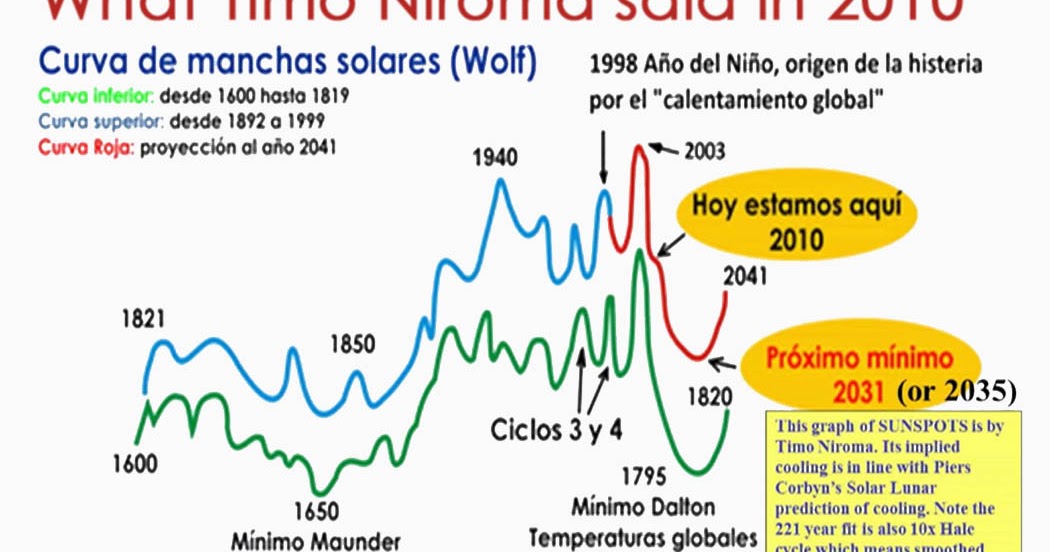
Piers Corbyn’s predictions are on point largely and waaaaaay more accurate than the IPCC’s GCMs.
A graph to show the solar/lunar driver of climate.
Very good article. Worthy of a bookmark.
In Fiji we found some surprising solar effects on sea level….
PMK
Did you really? Why don’t you share this invaluable information then?
fiji sea level change (op too lazy to include)
not sure what the surprise is
http://www.psmsl.org/data/obtaining/rlr.monthly.plots/1805_high.png
Paper is about to go to press, will share when I return from Portugal.
Is there a rise in the sea level or a lowering of the land mass? Fiji’s proximity to seismic regions would suggest the latter.
Jesus, if that’s the case New Zealand will be disappearing into the Ocean any time soon. They are right on top of a seismic region. Fiji is a long way from a seismic region, So it must be rising sea levels then.
@ur momisugly Steve…the USGS daily quake map regularly shows strong quake activity around Fiji.
Um, I’d look first at tides. They change on all sorts of time scales, even 1600 and 5000 years. Any one place can have rising, falling, or static sealevel with zero change of mean sealevel.
What Mike terms a ‘lopsided blinkered attitude’ I use the phrase ‘blithe and measured ignorance’.
It’s not a copyrighted phrase so feel free to employ it in future. 😉
In addition to Linear Algebra, Statistics, Calculus, and courses in Ordinary and Partial Differential Equations which form part of the curriculum for the applied sciences, math departments also need to incorporate beginning courses in chaos theory. Mathematicians are still in the stages of infancy when it comes to fully understanding and applying chaos theory.
How about one year of calc and some statistics as prerequisites for law school and journalism majors, particularly journalism graduate school?
All that applied maths is very good, but if common sense and logic are not part of the process it can be GIGO, old engineer.
Good comments RayG & Wayne J. Logic and critical thinking skills are a part of most law school curricula, but unfortunately journalism programs are taught by faculty who tend to have left leaning agendas. Classes in Debate where students are forced to debate both sides of issues might be better for students arriving at “the truth,” but the mind is quite adept at holding contradictions when it wants to.
Good souls,
All well-intentioned; indeed all citizens need some mathematical skills beyond totting up the cost of two fish and chips, one with curry sauce.
Crucially, estimation needs to be taught – and practised – so you know if your device [there are so many] has had a significant data entry error.
Chaos theory is, perhaps, not needed – provided estimation, with error bars, and their multiplier effect, especially when large, is taught and understood; critical thinking would be a wonderful innovation on so many ‘graduate’ courses.
Auto, knowing that I may dream.
More important is basic quantitative physics of heat transfer including radiative heat transfer .
That is enough to demonstrate the impossibility of any spectral phenomenon being the cause of the bottoms of atmospheres being hotter than their tops .
Excellent article Mike….thank you!
If I graph a system’s outputs vs its inputs, and I get a straight line, the system is linear, otherwise it isn’t.
If I apply a certain input to a system today and get a certain output, and if the same thing always happens, then the system is probably time-invariant. If the same input produces different outputs at different times, then the system is time variant.
The prerequisite for using the most common signal analysis tools (eg. Fourier analysis) is that the system to which they are applied is LTI ie. Linear Time-Invariant. The climate is not LTI but that doesn’t keep folks from throwing every tool in the LTI toolkit at it. GIGO
That might be all well and good but I reserve the right to kvetch about the weather when the mood strikes me.
I can use the word kvetch, can’t I?
I’m pretty sure kvetching about the weather is the national sport where I live.
“I can use the word kvetch, can’t I?”
I believe on this site you can use almost any word, as long as it’s not too rude. I once saw here the word “grok”, which quickly validated my opinion of the high quality of scientific thought here at WUWT. (NOT sarc)
“If I graph a system’s outputs vs its inputs, and I get a straight line, the system is linear, otherwise it isn’t.”
That holds only for memoryless systems. In general, a linear system is one which preserves addition and scalar multiplication. I.e., it produces a linear map f for which
f(x+y) = f(x) + f(y)
f(k*x) = k*f(x)
So, e.g., a simple transport delay is a linear system, but if you input cos(omega*t) and get out cos(omega*(t-d)) and plot them against one another, you will not generally get a straight line but an ellipse.
I want to digress a little here, because it is something that really annoys me. Papers have been published (e.g., Dessler, 20??) that purport to show positive water vapor feedback based on estimating the best fit slope of a scatter plot of input and output variables. But, this slope is fundamentally dependent upon the phase lag of the system in question. E.g., in the example above, if d is less than pi/(2*omega), the plot will generally exhibit a positive slope of the major axis of the ellipse. But, if it is greater than that, it can exhibit a negative slope.
Dessler assumed negligible delay in his paper, despite the fact that there was a very apparent and significant phase lag in the output data, and this paper gets cited all the time by idiots who claim it proves water vapor feedback is positive.
” The climate is not LTI but that doesn’t keep folks from throwing every tool in the LTI toolkit at it.”
To the degree the system is smoothly nonlinear, a linearized system model can generally be constructed, and behavior projected within some local neighborhood.
That’s true if the system and its components are well understood.
If you don’t understand a system very well, attempting to linearize it will result in a godawful mess. On the other hand, if you can’t linearize it, the analysis will be intractable.
Bartemis,
I share your frustration with Dessler’s paper. I think your point was well noted by several people in the discussion of the paper on CA.
A similar and perhaps more common error is when people cross-plot time-varying forcing and average temperature and say – hey look, there’s a correlation (climate scientist) or there’s no correlation (skeptic). There are numerous variations on this theme – cross plot and abstract sensitivity (first BEST paper), cross-plot and estimate efficacy from gradient term (Hansen, Marvel et al).
However, there should be a special place in hell reserved for authors who want to examine “time-dependent climate sensitivity” – which manifests itself as a non-linear relationship between net flux and temperature for a constant forcing model run – and they start off by saying “We consider the model Net Flux = F – lambda*T”
The climate may not be LTI, but the vast majority of AOGCMs are, at least in terms of their aggregate behaviour.
Yep, if the only tool you have is a hammer …
The conventional theory is that, if you model all the parts of a system, you will have modelled the system. The finer grained you can make the parts, the more accurate will be the model.
There is reason to believe that doesn’t actually work. link For any given system there may be an optimum granularity which will allow the system’s behaviour to be accurately modelled. Too granular, or not granular enough and it won’t work.
Aside from the fact that the climate is chaotic anyway, there may be a mathematical proof that the climate models can’t work.
Solar variation makes the atmosphere expand and contract. That alone should have some climatic effect.
cannot back down from malware infested religion
must reboot from clean distribution DVD and re-install Science
or face the Blue Earth Of Death
The sun causing climate change?
How could that be?
Everyone knows in 1975 about 4.5 billion years of natural climate changes suddenly died, and man made CO2 took over as the climate controller.
That is similar to the change of leadership in a mob family.
Someone dies.
Someone else becomes the boss.
While natural climate change was a rough fellow, man made CO2 is far worse — it will cause our planet to get hotter and hotter until all life is ended with runaway warming.
Now some people might say the sun is still there, so why does it now have no effect on the climate?
Well, after years of research on why, how and when CO2 became the climate controller, it appears that the CO2 Obsession Science Task Force has the answer, and everyone on the Task Force agrees, but hold on to your hat because this miracle transition from natural climate change to CO2 climate change, and the coming runaway warming, has a complicated scientific explanation with high level math:
“Because we are big shot government bureaucrat scientists, and we say so!”
Climate blog for non-scientists:
Over 10,000 pageviews so far
Leftists with high blood pressure should stay away
http://www.elOnionBloggle.Blogspot.com
I forgot to add this is a very good summary of solar studies and we need more articles like this.
Twenty years ago when I started reading about global cooling , I mean global warming , or it that climate change? … I assumed the sun, other planets, moon, cosmic rays, extraterrestrial dust in our atmosphere and forces/things we don’t even know about yet caused climate change.
I have never bought into CO2 controls the climate because there is no evidence in the temperature record that natural climate change ever stopped — some warming in the first half of the 20th century is almost identical to some warming in the second half of the century — why claim they had different causes with absolutely no scientific proof of that?
Global cooling was the fashion of 1970s, followed by a global warming fashion. Something to do with the Club of Rome, an exclusive club of people with clairvoyant abilities (and a lot of money, to prove it). Now they are making lot more money based on that proven clairvoyance.
“There are known knowns. These are things we know that we know. There are known unknowns. That is to say, there are things that we know we don’t know. But there are also unknown unknowns. There are things we don’t know we don’t know.” – Donald Rumsfeld
… and the CAGW proponents need to “unknow” what they ‘know’ about CO2.
What about unknown knowns? Things that we don’t know we know.
Certainly – I never knew that I didn’t know what I knew – and now I do – err…
Unk Unks were well known in the aerospace industry and the DoD well before Donald Rumsfeld became Secretary of Defense and brought that concept to the general public.
Unknown knowns sometimes work like this:
Once upon a time (early ’60s?) the US lost (!!) four H-devices in the Mediterranean. Three were recovered promptly; the search for the 4th dragged on and on.
Finally one bright soul recalled [ok, I need help here — a 16th or 17th century guy famous for gambling & statistics]. Based on Gambling Guy, Bright Soul laid out a grid of the seafloor around where they’d been searching, and invited all the searchers to bet on where the device would be found, with the prize a case of champagne.
The search had been focused on a small cluster of squares of the grid, but the bets centered on a different square, outside that cluster. And that’s where the 4th device was found.
The submarine USS Scorpion was found with the same technique.
This isn’t magic; it’s rather that we can overthink ourselves. We might get a hunch, and can’t explain (can’t immediately access our background information that would provide a tidy verbal/mathematical explanation) it, so we discount it and go along with the next guy who seems more sure of himself. But in a more relaxed context — like a bet for champagne — we go ahead and play the hunch.
Honest to goodness, sometimes we don’t know what we do indeed know. Gavin de Becker’s great book, The Gift of Fear, talks about another context in which we know something but ignore it, downplay it, deny it — dangerously.
Mellyrn,
I’m pretty sure that the Rev. Thomas Bayes (1701-61) wasn’t a gambler.
The missing H-bomb and Scorpion were found using Bayesian search theory, derived from Bayes’ statistics theorem.
The first three bombs were found on land, near where the B-52 crashed in Spain. The fourth had drifted out to sea after its parachute opened.
They should use that technique with the missing Malaysia Airlines Flight 370. Were you thinking of Pascal?
I thought that Georg Beck’s findings about Gobal CO2 measurements since the 1850’s and his findings that temperatures leads CO2 on time scales of a few hours (after sun rise in the mornings as measured by German scientists) and over 800 years in ice cores would be sufficient to kill the CO2 nonsense without going to thermodynamics and heat& mass transfer theory and data.
For Beck’s work go here http://www.biomind.de/realCO2/realCO2-1.htm and on theory and engineering data look at the work of the late Prof (at MIT) Hoyt Hottel in Marks Mechanical Engineering Handbook or Perry’s Chemical Engineering Handbook. Please note evaporation at ocean surfaces involve heat transfer (convection, phase change and maybe radiation -although radiation is not necessary) and mass transfer. Dr Gavin Schmidt (of NASA/GISS) admitted on another blog he did not understand mass transfer. One could readily conclude that anyone calling themselves a climate scientist has no idea of how the climate works.
” some warming in the first half of the 20th century is almost identical to some warming in the second half of the century — why claim they had different causes with absolutely no scientific proof of that?”
That almost identical warming is a major part of the uncertainty monster that Judith Curry has voiced to Congressional committees several times now. It was confirmed in the Phil Jones interview by the BBC in 2009:
http://news.bbc.co.uk/2/hi/8511670.stm
(my summary)
1860 – 1880 0.16 C 20 years of warming, followed by 30 years of cooling.
1910 – 1940 0.15 C 30 years of warming, followed by 40 years of cooling.
1975 – 1998 0.16 C 20 years of warming followed by nearly 20 years of next to no warming(the so called “hiatus”).
It has always been my experience that the temperature of the tea in the tea kettle is most directly effected by the height of the flame under it and the distance of the kettle from the flame rather than the brand of tea one is brewing.
… and if you apply the flame to carbonated tea, the CO2 leaving the tea is increased AFTER the flame is applied – it doesn’t heat the tea itself. (I know, it’s not a very good scientific analogy.)
Carbonated tea comprised of 97% CO2 will boil almost instantly.
I’ve tried this with normal tea and it doesn’t work.
So it must be the CO2.
A luminous photosphere of energy radiates from our sun in all directions out across the cosmos. When that sphere expands to the average orbital distance to the earth its dispersed luminous surface radiates a power flux of 1,368 W/m^2 (S-B BB 390 K). But the earth does not orbit in a nice average circle, but in an ellipse with perihelion being closer and aphelion being farther. So how much difference does that make?
At perihelion (closer) the power flux is 1,415 W/m^2. At aphelion (farther) the power flux is 1,323 W/m^2. The total annual range/change/fluctuation is 92 W/m^2. Yes, 92 W/m^2.
According to IPCC AR5 the radiative forcing added to the atmosphere by the CO2 increase in the 261 years between 1750 and 2011 is 2 W/m^2. Yes, 2 W/m^2. IPCC’S worst^4 case scenario is RCP 8.5, 8.5 W/m^2.
So if an annual 92 W/m^2 fluctuation does not cause catastrophic climatic consequences what possible reason have we to believe that 2 W/m^2 or even 8.5 will?
The annual ToA ISR fluctuation because of the tilted oblique incidence at 40 N is 670 W/m^2. From that we get summer and winter. Who’s afraid of 2 W/m^ or for that matter, 8.5 W/m^2?
(A sphere of radius r has 4 times the area as a disc of radius r. 1,368 / 4 = 342 W/m^2. That’s exactly where that number originates! It’s the planar ISR spread evenly over the entire ToA sphere. That’s not even close to how the earth actually heats and cools.)
When it is cold outside, I must add energy/heat to my house to keep it warm inside. When it is hot outside, I must add work to move energy/heat from inside the house back outside by using an air conditioner.
Energy moves by itself from high energy/temperature to low energy/temperature. Energy cannot move from low energy/temperature to high energy/temperature without adding work.
Is it hot out in space or cold?
The space station out there in space has a sophisticated radiative cooling system to move excess energy, i.e. adding work, from inside to outside. If space is cold, why is that needed?
A luminous photosphere of energy radiates from our sun in all directions out across the cosmos. When that sphere expands to the average orbital distance to the earth its dispersed luminous surface radiates a power flux of 1,368 W/m^2, aka the solar constant, with a S-B BB equivalent temperature of 390 K, 17 C higher than the boiling point of water under full atmospheric pressure.
That’s hot.
Without an atmosphere the surface of the earth would be much like that of the moon, barren, dusty, pock marked, blazing hot on the lit side, sub-sub-sub-freezing cold on the dark side.
Earth’s atmosphere doesn’t keep the earth warm, it keeps the earth cool.
So what would the earth be like without an atmosphere?
The average solar constant is 1,368 W/m^2 with an S-B BB temperature of 390 K or 17 C higher than the boiling point of water under sea level atmospheric pressure, which would no longer exist. The oceans would boil away removing the tons of pressure that keep the molten core in place. The molten core would rupture flooding the surface with dark magma changing both emissivity and albedo. With no atmosphere a steady rain of meteorites would pulverize the surface to dust same as the moon. The earth would be much like the moon with a similar albedo (0.12) and large swings in surface temperature from lit to dark sides. No clouds, no vegetation, no snow, no ice a completely different albedo, certainly not the current 30%. No molecules means no convection, conduction, latent energy and surface absorption/radiation would be anybody’s guess. Whatever the conditions of the earth would be without an atmosphere, it is most certainly NOT 240 W/m^2 and 255K.
At 1323 W/m2 the CO2 concentration falls rapidly, to rise even more rapidly at 1415 W/m2.
So stated: Nicholas Schroeder June 10, 2017 at 3:12 pm
So responded: Curious George June 10, 2017 at 3:25 pm
Now Curious George, me thinks you were getting too “rambunxious” with your above claims of “rapidity”.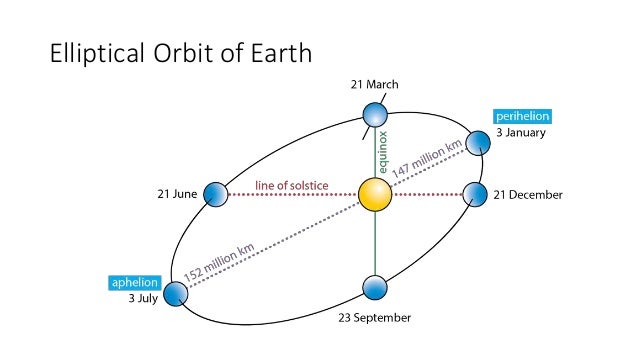 ?cb=1475064997
At perihelion, with an average power flux of 1,415 W/m^2, the atmospheric CO2 ppm is still increasing, but not rapid or rapidly, ……. and it will continue to increase, but not rapid or rapidly, until about mid-May, which is after the Spring or March equinox. (see graphic below)
And at aphelion, with an average power flux of 1,323 W/m^2, the atmospheric CO2 ppm is still decreasing, but not rapid or rapidly, ……. and it will continue to decrease, but not rapid or rapidly, until the about the 1st of October, which is after the Fall or September equinox. (see graphic below)
And the Mauna Loa CO2 ppm Record, to wit: ftp://aftp.cmdl.noaa.gov/products/trends/co2/co2_mm_mlo.txt ….. is testament to the above stated facts.
this graphic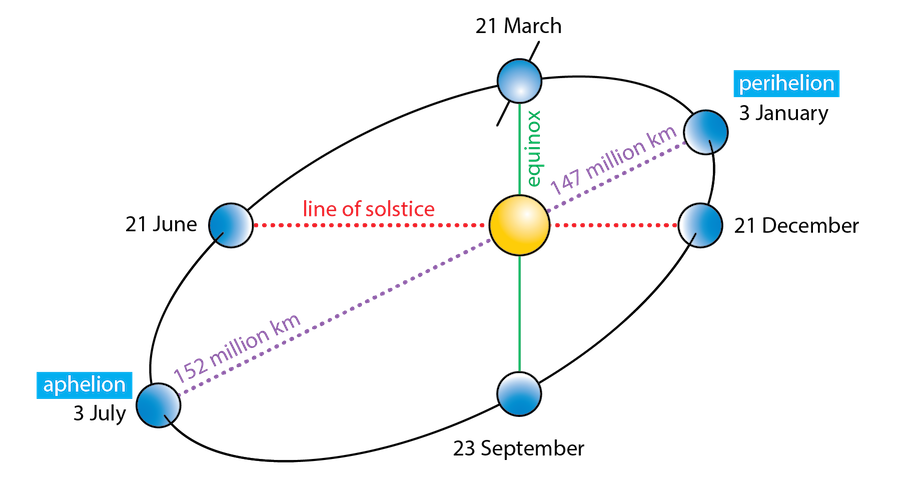
“So if an annual 92 W/m^2 fluctuation does not cause catastrophic climatic consequences what possible reason have we to believe that 2 W/m^2 or even 8.5 will?”
I would like to hear an answer to that question.
Agreed, but I see the two being entirely different. 92 is a new, additional energy source/change. The 2 is merely a swap/exchange from an internal/closed system source. So I’d suggest tge later may only influence weather.
There is a new restaurant on the moon.
The menu/food is OK, but there is just no atmosphere.
trm
Thanks.
Is it because Booze is Banned?
Auto
Not much atmosphere to transfer thermal energy in space. On the other hand, the oceans transfer a great deal of radiant energy. Also, if a rotating round sphere of earth’s size had a logarithmic averaged surface temperature of 390C, the watts per meter squared of that perfect black body would be 390^4*5.67e-08 w/m2. Except that earth receives that only half of that energy, i.e. no energy on the dark side, and the earth is a sphere, not a sun-facing circle, so the energy is halved again.
Yes, it is amazing all the fuss about irradiance at 1 AU when the earth is rarely near that radius.
jonesingforozone
” Except that earth receives that only half of that energy, i.e. no energy on the dark side, and the earth is a sphere, not a sun-facing circle, so the energy is halved again”
The Earth’s atmospheric layers are plugged into the sun 24/7 and the Earth’s surface rotates inside a electromagnetic plasma bubble . Earth’s first line of resistance the Bowshock does not rotate with the surface , it stays in place 24/7 and deflects most of the suns energy around us. Leif could jump in now and remind us how important magnetic reconnection is to life on Earth.
I’m scared.
Nicholas Schroeder June 10, 2017 at 3:12 pm
“The space station out there in space has a sophisticated radiative cooling system to move excess energy,”
Nicholas Apollo 13 they were cold maybe not freezing but dumping excess heat was not an issue. Maybe the reason that the space station has excess heat is because of all the equipment running or that it is orbiting within the highest reaches of the atmosphere.
not sure, just thinking about such things as the 4 degree back ground radiation in space.
Now I’m going to have to do some reading.
michael
(Nearly) all those watts of solar energy generated in the massive solar arrays are piped inside the station where it is converted to heat.
NS: You raise a good point about the elipticity of the earth’s orbit, which is 3.5% in distance and 7% in distance squared. However, when temperature anomalies are calculated, seasonal changes associated with elipticity are removed from the temperature signal. That is why climate scientists believe they see warming from 2+ W/m2 of CONTINUOUS forcing (less than 1% change), but you see no sign from a 7% oscillation every year.
If one looks at real temperature without anomalies, GMST rises and falls 3.5 K every year. However, it is currently warmest when we are FURTHEREST from the sun! This happens because the effective heat capacity of the NH, with less ocean, less wind and shallower mixed layer, is about half of the effective heat capacity of the SH.
In temperature terms that works out to a gray body temperature ( gray is the same as black ) in our orbit of about 278.6 +- 2.3 from perihelion to aphelion . That temperature seems to be confirmed by the ~ 5c specification for instrumentation modules in satellites ( confirmed in conversation with some of the OCO-2 crew at the recent https://www.esrl.noaa.gov/gmd/annualconference/ ) .
I have seen very few studies demonstrating detection of even that 4.6c annual cycle .
“To link parts of climate to particular solar features such as GCRs or Ultra-Violet (UV) or solar wind or total irradiance, we will need mechanisms.”


Mike Jonas I appreciate the work you did here and your POV. In lieu of a more detailed comment, I offer some general points about solar effects.
****
Variable solar activity creates weather events via UV, TSI, and the solar wind, events that define the weather and climate record.
The frequency and magnitude of solar warming and cooling events control the weather & climate, and vary uniquely through each solar cycle, but with predictable effect once the mechanisms are understood.
Long-term solar cycle changes lead to long-term weather changes eventually leading to climate change.
Examples:
Forbush Decreases via the Solar Wind cause cooling
These events are focused on the effect on CRs of the solar wind, when in actuality the real earth effect of FDs manifest as cold weather fronts being pushed southward off the Arctic by atmospheric dynamics associated with the charged particles in the solar wind, wrt the proton density, and solar wind speed.
These events are somewhat irregular but predictable, and are time-limited. Many times this cold air clashes with very warm air also just driven off the tropics by a very recent TSI spike, creating US weather events.
Rising and high UV and TSI cause warming, low TSI causes cooling
The warmth has finally made it to Michigan today. 86 wonderful degrees now after a very cool spring.
Why? Clear skies, ie high solar insolation, and high UV, due to being 11 days from the summer solstice.
Abundant clear skies from diminishing tropical evaporation due to a drop in TSI last week under 1360.8:
The US 58 city NOAA UVI average for today was 8.6. Tomorrow it’ll be 9.1, the highest in 2017 yet. Keep your babies out of the sun!
Just wait until TSI bumps back up into the 1360.94 range again for several days, as it did twice in the last 30 days, driving tropical evaporation, creating atmospheric rivers that will dump heavy rain, creating floods, hailstorms and tornadoes when that warm solar blasted water vapor clashes with the cooler northern air.
Where those clashes and weather events occur are defined by the southward extensions of the northern cold air. After a very strong FD, the cold air movement can be very intense, deep, and widespread, and if the TSI spike is high the number and intensity of extreme events caused by those clashes will be large.
The gross relative movements of these cold and warm air masses define the jet stream location, and are responsible for it’s meridional flow shape, prominent during these FD caused polar vortex outbreaks.
Today the warm/cold line in the US is fairly well north, as there has been no FDs for a week or more, so no big cold outbreak in sight, and since we’re near the solstice therefore no chance of hail or tornadoes for a few days.
If the solar equatorial coronal holes remain small and infrequent, moderating the solar wind speed, unlike earlier this year, and the CMEs and solar flares stay low, keeping geomagnetic activity low with infrequent or no FDs, there will be fewer cold blasts no matter what the level or variations are in TSI this summer, so maybe it’ll calm right down to be a very nice NH summer.
ENSO/PDO/AMO are solar heating/cooling phenomenon on different time scales ultimately all caused by variable TSI. They are said to be a forcing of their own, but in reality they’re just time-delayed solar forcing on different circulation schedules due to geography.
There are other direct and indirect aspects to solar supersensitivity worthy of discussion such as high-TSI-spike driven tropically evaporated clouds (water vapor) that affect albedo and UVI, usually referred to as ‘feedbacks’.
Low TSI and high UV for a few more years through the solar minimum could lead to overall less evaporation and more ground dessication, ie drought, before the next solar cycle’s ENSO. Something to watch.
If anybody sees Lief around please ask him what the effects of an extended period of time of no solar wind would have on the heliosphere/pause/terminal shock and what the likely resultant CGR counts here on earth would be if this condition, as outlined by NASA below, persisted for any considerable length of time.
My guess is that we don’t even have to wait for a supernova outside of the solar system to occur before an appreciable effect in cloud cover on earth would be experienced.
“Dec. 13, 1999: From May 10-12, 1999, the solar wind that blows constantly from the Sun virtually disappeared — the most drastic and longest-lasting decrease ever observed.”
“Starting late on May 10 and continuing through the early hours of May 12, NASA’s ACE and Wind spacecraft each observed that the density of the solar wind dropped by more than 98%. Because of the decrease, energetic electrons from the Sun were able to flow to Earth in narrow beams, known as the strahl. Under normal conditions, electrons from the Sun are diluted, mixed, and redirected in interplanetary space and by Earth’s magnetic field (the magnetosphere). But in May 1999, several satellites detected electrons arriving at Earth with properties similar to those of electrons in the Sun’s corona, suggesting that they were a direct sample of particles from the Sun.”
https://science.nasa.gov/science-news/science-at-nasa/1999/ast13dec99_1
It might also be interesting to take a deeper look into the Laschamp Event which was the last time the earth’s magnetic field strength collapsed and the magnetic poles flipped for just over 400 years 41,000 years ago.
“The Laschamp event was a short reversal of the Earth’s magnetic field. It occurred 41,400 (±2,000) years ago during the last ice age and was first recognized in the late 1960s as a geomagnetic reversal recorded in the Laschamp lava flows in the Clermont-Ferrand district of France.[1] The magnetic excursion has since been demonstrated in geological archives from many parts of the world. The period of reversed magnetic field was approximately 440 years, with the transition from the normal field lasting approximately 250 years. The reversed field was 75% weaker whereas the strength dropped to only 5% of the current strength during the transition. This reduction in geomagnetic field strength resulted in more cosmic rays reaching the Earth, causing greater production of the cosmogenic isotopes beryllium 10 and carbon 14.[2]”
https://en.wikipedia.org/wiki/Laschamp_event
http://www.iflscience.com/environment/evidence-rapid-reversal-geomagnetic-field-41000-years-ago/
The Laschamp event also appears to have coincided with the collapse of Neanderthal populations in Europe and Asia as climate conditions in Europe deteriorated into a semi-arid desert state.
“In research published in Nature in 2014, an analysis of radiocarbon dates from forty Neanderthal sites from Spain to Russia found that the Neanderthals disappeared in Europe between 41,000 and 39,000 years ago with 95% probability.”
https://en.wikipedia.org/wiki/Neanderthal_extinction
Fairy tale time?
With a little specious correlation = causation sophistry?
We do have plenty of climate proxies that span the 41,000±2,000 year period. Would you care to point to us what climatic effect did the Laschamp event have? None? Then, if it didn’t have any perceptible climate effect, why would it have finished off the Neanderthals that have survived just fine the huge climate changes that had taken place for over 150,000 years?
Idle speculation is fun. Perhaps Neanderthals had, like some birds, built in magnetic compasses, and when the magnetic reversal took place they all moved northward in the winter towards the ice sheets. Oops. Magnetic extinction.
Javier & ATheoK
Laschamp Event 10Be / magnetic reversal. There was quite a bit happening at that time. Though you would be already be aware of it. Plenty more out there for you two if you want me to pull it for you.
(2010)
“For the first time, we have identified evidence that the disappearance of Neanderthals in the Caucasus coincides with a volcanic eruption at about 40,000 BP. Our data support the hypothesis that the Middle to Upper Paleolithic transition in western Eurasia correlates with a global volcanogenic catastrophe. The coeval volcanic eruptions (from a large Campanian Ignimbrite eruption to a smaller eruption in the Central Caucasus) had an unusually sudden and devastating effect on the ecology and forced the fast and extreme climate deterioration (“volcanic winter”) of the Northern Hemisphere in the beginning of Heinrich Event 4. Given the data from Mezmaiskaya Cave and supporting evidence from other sites across the Europe, we guess that the Neanderthal lineage truncated abruptly after this catastrophe in most of its range.”
http://www.jstor.org/stable/10.1086/656185?seq=1#page_scan_tab_contents
Javier & ATheoK
There was quite a bit happening at that time. Though you would be already be aware of that. Plenty more out there for you two if you want me to pull it for you.
(2010)
“For the first time, we have identified evidence that the disappearance of Neanderthals in the Caucasus coincides with a volcanic eruption at about 40,000 BP. Our data support the hypothesis that the Middle to Upper Paleolithic transition in western Eurasia correlates with a global volcanogenic catastrophe. The coeval volcanic eruptions (from a large Campanian Ignimbrite eruption to a smaller eruption in the Central Caucasus) had an unusually sudden and devastating effect on the ecology and forced the fast and extreme climate deterioration (“volcanic winter”) of the Northern Hemisphere in the beginning of Heinrich Event 4. Given the data from Mezmaiskaya Cave and supporting evidence from other sites across the Europe, we guess that the Neanderthal lineage truncated abruptly after this catastrophe in most of its range.”
http://www.jstor.org/stable/10.1086/656185?seq=1#page_scan_tab_contents
Javier & ATheoK
You are kidding me right?
“For the first time, we have identified evidence that the disappearance of Neanderthals in the Caucasus coincides with a volcanic eruption at about 40,000 BP. Our data support the hypothesis that the Middle to Upper Paleolithic transition in western Eurasia correlates with a global volcanogenic catastrophe. The coeval volcanic eruptions (from a large Campanian Ignimbrite eruption to a smaller eruption in the Central Caucasus) had an unusually sudden and devastating effect on the ecology and forced the fast and extreme climate deterioration (“volcanic winter”) of the Northern Hemisphere in the beginning of Heinrich Event 4. Given the data from Mezmaiskaya Cave and supporting evidence from other sites across the Europe, we guess that the Neanderthal lineage truncated abruptly after this catastrophe in most of its range.”
http://www.journals.uchicago.edu/doi/abs/10.1086/656185
I would love to point this out Javier. This is hardly speculative.
Significance of Ecological Factors in the Middle to Upper Paleolithic Transition
Liubov Vitaliena Golovanova, Vladimir Borisovich Doronichev, Naomi Elansia Cleghorn, Marianna Alekseevna Koulkova, Tatiana Valentinovna Sapelko, and M. Steven Shackley
“For the first time, we have identified evidence that the disappearance of Neanderthals in the Caucasus coincides with a volcanic eruption at about 40,000 BP. Our data support the hypothesis that the Middle to Upper Paleolithic transition in western Eurasia correlates with a global volcanogenic catastrophe. The coeval volcanic eruptions (from a large Campanian Ignimbrite eruption to a smaller eruption in the Central Caucasus) had an unusually sudden and devastating effect on the ecology and forced the fast and extreme climate deterioration (“volcanic winter”) of the Northern Hemisphere in the beginning of Heinrich Event 4. Given the data from Mezmaiskaya Cave and supporting evidence from other sites across the Europe, we guess that the Neanderthal lineage truncated abruptly after this catastrophe in most of its range.”
http://www.journals.uchicago.edu/doi/abs/10.1086/656185
As I said recently,
https://wattsupwiththat.com/2017/06/06/solar-update-june-2017-the-sun-is-slumping-and-headed-even-lower/#comment-2521510
Svensmark’s hypothesis is incorrect. The main factor affecting cosmic rays in the earth is the earth’s dipole, whose changes account for >90% of changes in cosmic ray intensity. Solar wind changes only produce a small <10% change in cosmic rays.
The upper panel shows the measured change in 14C production rates. This is the one that reflects changes in cosmic rays. The bottom panel has the earth's dipole effect subtracted. As we can see in the upper panel cosmic rays were much higher a few thousand years ago, with a warmer climate, than during the LIA. Just the opposite of what Svensmark’s hypothesis predicts.
As climate evolution doesn't look like the earth's dipole evolution Svensmark’s hypothesis cannot be correct.
Javier,
“Solar wind changes only produce a small <10% change in cosmic rays."
Are you saying that a state of ZERO SOLAR WIND resulting in the potential collapse of the heliosphere for an extended period of time would only result in a 10% increase in cosmic rays?
https://science.nasa.gov/science-news/science-at-nasa/1999/ast13dec99_1
P.S. Love your posts!
No SC,
I have no idea of what happens during zero solar wind periods and what effect it has on climate. What I am saying is that the recorded 14C production, as a proxy for cosmic rays (CR), over the Holocene has depended for 90% of its variation on the changes in the earth’s dipole. If climate changes were linked to CR changes then climate would necessarily follow earth’s dipole changes, and it does not. It actually goes in the opposite direction. If CR have an effect on climate it has to be very small. Otherwise it would show in Holocene records.
When people check CR variations during the Holocene they make the mistake of checking ∆14C, which is the variation assigned to solar variability after subtracting the earth’s dipole changes, and this is only a small part of the total CR variation. But the climate has no way of knowing if the CR it is not receiving has been deflected by the earth’s magnetic field or the solar wind. Both have to be considered. Perhaps most referees were aware of this problem and that is why Svensmark took so long in shaving.
If, as you say, Earth’s dipole field, and not the solar field connected to the solar cycle, is the major factor regulating cosmic ray flux, then why do meteorites recently fallen on Earth record the same ~11 year cycle? Until Earth fall they were not under the influence of Earth’s dipole.
The answer is that the Earth’s dipole does not operate over a sufficiently large volume of space to effectively bend the GCR out of the inner solar system. The Sun’s magnetic field does.
Would you cite, please?
That is not correct because we do know from last 12,000 year records that most of the variation in 14C production has been due to changes in the earth’s dipole. This has been known since the early 1970’s by the people that researched carbon dating. It is pretty solid knowledge.
Javier. The literature is filled with references to effects of solar wind and its associated magnetic field on GCR. (Just use Google) Several NASA measurements across space have been made.
Here is one comment:
“the solar wind and magnetic field scattering are known to predominantly modulate the flux of galactic cosmic rays (Firoz et al. 2010; Alania et al. 2011; Modzelewska and Alania 2013). Cliver et al. (2013) also asserted that the solar wind is a solar driver of galactic cosmic ray modulation. In view of the above, this paper is mainly concerned with the effects of solar wind on galactic cosmic ray flux.”
The above is from the paper below which used a theoretical approach and concluded that even at 1 AU, the solar field effect is dominant.
Astrophysics and Space Science
January 2016, 361:44
The effects of solar wind on galactic cosmic ray flux at Earth
The theory of GCR repulsion is simple and is based on basic mass spectrometer principles. For a charged proton with 3 GeV of energy (the GCR average) the angle it can be deflected in a magnetic field is proportional to the field stringth and area over which that field is present. The solar magnetic field extends far out into space. Earth’s dipole does not.
Earth’ dipole does have influence on energetic solar particles, which have much lower energies than GCRs. And solar flare protons of a few tens of MeV are sufficient to produce basic nuclear reactions such as those that produce 14C. 10Be is a higher energy product.
I agree. Fig. 4 [by Kirby] shows a spurious [or doctored?] relationship with the GCR intensity corrected for the change of the Earth’s magnetic field [i.e. the truly solar part]. But that is not what the Svensmark hypothesis needs [as Javier points out]. The climate should respond to the actual GCR flux [as modulated by the Earth], not to the [tiny] solar part of the variation. IMHO, this is the death knell to the Svensmark hypothesis. Nothing else need be discussed.
Hi Leif. Thanks for commenting. If I understand everything correctly, then your comment doesn’t appear to be correct. You say “The climate should respond to the actual GCR flux [as modulated by the Earth], not to the [tiny] solar part of the variation.“. But as I understand it, Henrik Svensmark’s theory isn’t based on all GCRs, it’s based only on the high-energy GCRs that penetrate to the lower troposphere. And my understanding is that these ones are little affected by Earth’s magnetic field.
And are even less influenced by the Sun’s magnetic field.
The very high energy GCRs are so rare that they have no effect on the whole.
In Figure 4 Kirby shows the total flux which is much more strongly modulated by the Earth than by the Sun.
Additionally, Svensmark did not discuss nucleotide species 10,000BP.
If the solar component has increased over time (to ~75% from ~10%), it probably due to the fact that their is another variable that actually causes GCRs rather than simply modulating them.
They are called galactic for a reason.
Depends what you mean by “very high energy GCR”. The average GCR proton has an energy of 3 GeV. These do not penetrate to Earth’s surface. But, each proton produces a whole shower of energetic secondary particles that continue downward and are quite capable of producing ionization.
Lower energy protons, such as solar wind and lower energy solar flare protons, deposit their energy higher in the atmosphere compared to most cloud nucleation.
Even higher GCRs usually don’t penetrate to the surface, their secondaries do. Svensmark claims that his effect only happens for GCRs above 13 GeV. Those have very small solar modulation and are largely excluded from the equatorial regions [depending on the magnetic field strength of the Earth]
http://www.leif.org/research/GCR-Rigidity-Map.png
Leif: “Even higher GCRs usually don’t penetrate to the surface, their secondaries do. Svensmark claims that his effect only happens for GCRs above 13 GeV. Those have very small solar modulation and are largely excluded from the equatorial regions [depending on the magnetic field strength of the Earth]“. The equatorial regions are not where the clouds are affected. That happens at higher latitudes. And yes it’s the ‘secondaries’ that do that.
Put simply, the high energy GCRs are not deflected by Earth’s magnetic field and do reach the atmosphere. Their volume is therefore unaffected by Earth’s magnetic field. But once in the atmosphere they collide with atmospheric nuclei and create the secondaries. Those secondaries reach the lower altitudes where they can form clouds, but that occurs mainly at higher latitudes. The lower-energy GCRs that do get influenced by Earth’s magnetic field don’t reach the lower altitudes so don’t form clouds.
More detail here:
https://calderup.wordpress.com/2010/08/09/do-clouds-disappear-3/
Put simply, the high energy GCRs are not deflected by Earth’s magnetic field
Put too simply, as there are not enough of them to make a difference. And they are also not deflected by the Sun’s magnetic field so no solar signal there.
GCRs above 13 GeV ?
http://www.kayelaby.npl.co.uk/general_physics/2_7/2_7_7.html
Variation with latitude. The number of vertical muons above 0.2 GeV is typically about 13% lower at the equator than at high geomagnetic latitudes; above 50° the flux does not change much. The component generating neutrons by nuclear interactions (largely the neutrons below 1 GeV)—long used to monitor cosmic ray variations—falls by about 24% in going from latitude 55° to the equator.
What your graph shows is the relative decay of 14C versus 12C, with 8000BP marking 100%, in samples of unknown origin. Not the level of 14C production.
All you proven is the existence of the atom bomb.
Fortunately, for our astronauts’ safety, we consider Does the worsening galactic cosmic radiation environment observed by CRaTER preclude future manned deep space exploration?
Funny how Svalgaard was not consulted for this paper.
No. The relative decay is given in the IntCal calibration curve. The graph I have posted gives the deviations in 14C per mille from a straight decay curve. So yes, it shows the deviations from a constant 14C production. Since 14C is believed to be produced mainly by cosmic rays, that graph is our best estimation of the changes in cosmic rays reaching the atmosphere for the past 12,000 years.
And no, it does not include the atomic bomb, as IntCal data excludes dates after the bomb as 14C levels went through the roof and require a specific correction.
The purpose of the IntCal calibration curve is to test samples to find their corresponding production.
See Introduction to Radiocarbon Determination by the Accelerator Mass Spectrometry Method and INTCAL09 AND MARINE09 RADIOCARBON AGE CALIBRATION CURVES 0–50,000 YEARS CAL BP for more.
An interesting application of IntCal09 is found in the paper 9,400 years of cosmic radiation and solar activity from ice cores and tree rings
This UVI map gives a great indication where it’s going to be hot every day
http://www.cpc.ncep.noaa.gov/products/stratosphere/uv_index/uvi_map.gif
My prior comment did not post & no moderation notice.
Must be the ‘lakeside and sunshine effect’ … forgot to logout of WP.. have a nice day
I’m one of those 12’s…..and we are solid socked in clouds for at least a month…..it’s the monsoon season in So Florida….our index for tomorrow is 2
Yesterday was sunny all day here in Fort Myers.
Yes, we will have lots of cloudy weather, and for more than a month, but it is not continuous.
Most days have either cloudy mornings or cloudy afternoons.
I think it is relatively unusual to have as many cloudy days in a row as the past week or two.
Once the winds shift to a more easterly fetch, tropical waves typically give alternating periods of above average and below average rain chances.
Correct. The 100 kyr interglacial cycle is an artifact. See:
https://judithcurry.com/2016/10/24/nature-unbound-i-the-glacial-cycle/
and:
Tzedakis, P. C., et al. “A simple rule to determine which insolation cycles lead to interglacials.” Nature 542.7642 (2017): 427-432.
http://eprints.esc.cam.ac.uk/3856/1/nature21364.pdf
Javier
June 10, 2017 at 4:04 pm
Javier…
A simple question. If the ice core data is not good enough to be considered as proper confirmation of the length of the glacial periods, how would the M. cycles theory can be considered to explain the climate change due to such mechanism?
As far as I can tell you do consider the problem with the ice ages, and to a point recognize that ice core data are no good enough for the purpose intended when it comes to the proper description of climate cycles and glacial periods…..
Especially when considering your own work and research,,,,,,, it, your own work, contradicts your own position,
assuming that you are the “failed intrglacial ” periods guy……
You see we still base analyzes and tend to conclude by relying in ice core data graphs that show clearly an climatic swing of an average ~10C, in long term, the range of which does not even overlap with the range of the temps swing for the shorter term data and other proxis, and also does not overlap with the range estimated, the official range is of an average of ~6C.
In your own work and research you have an even lower value at ~4C for the climatic temp swing.
That is a huge discrepancy that needs an explanation. Till than we simply have sloppy data and a sloppy theory holding each other tightly AND WRONGLY with no much value….
You are the guy who has produced the other ice core data graphs showing these other significant enough events, the failed interglacial periods, are you not?
cheers
Hi Whiten, if i’m reading you correctly, the poles warm more than the globe on the whole. Since the tropics don’t warm much, it’s thought that the south pole warms about double that of the global average. (at least that’s what i’ve been told)…
afonzarelli
June 10, 2017 at 5:27 pm
Still ice core data represent global climatic temp swing, not the regional one, as Javier very well knows it.
The graph that shows the glacial period length is and does represent a global climate variation, not a regional one…..:)
whiten,
I don’t know what you consider “that ice core data are no good enough for the purpose intended.”
I would think that less than 5% is as good as it gets. The error is so small that it is very easy to see that temperatures follow the obliquity cycle and not the eccentricity cycle.
Not sure you are comparing apples to apples. Ice core temperature swings during the interglacial cycle are wider because those are the changes that take place at the poles. Global average temperature swings are calculated much smaller because the tropical band doesn’t change its temperature much and it contains 50% of the surface. The global mean change from the last glacial maximum to the Holocene is estimated by several authors at 4-5°C.
Javier
June 10, 2017 at 6:32 pm
Thank you, for your reply Javier.
First please do understand my intention, which is really connected as far as I can tell to your on position and that of your own work that contradicts your own possitiont very clearly…that is why I am engaging with you in this conversation.
So lets clarify first the point about my consideration about ice core data………it is not about the raw data and the measurements, but about the product ice core data, which is the outcome of the raw data going through the process, like in your case with your work and the ice core data product you get by a different method than the previous ones.
When at this, I can confirm you that I accept in general that ice core raw data is the best there in comparison to any other data as far as the climate assessment and understanding considered, especially in long term and while considering the Antarctica ice core data…..
So you may consider now that the sloppiness about the ice core data is about the product data when trying to represent the global climate signal…..not the ups and downs about the raw data.
That is actually from the point of view that you imply in your reply to me, the equivalence of actually comparing apples to oranges, or even more precisely, comparing apple juice to orange juice….
But still the 100K years glacial periods are considered as such, very strongly, through and due to the ice core data product, aka the connection and the upholding of the M. cycles as a hypothetical causation of climate change.
In the other hand your own work directly contradicts this, by clearly showing significant problems with long term ice core data and the length of glacial periods….
Now considering your statement:
“The global mean change from the last glacial maximum to the Holocene is estimated by several authors at 4-5°C.”
First, the way that statement stands it is a dud…….in the way you try to support your position
As it stands, the 4-5C climate swing to the Holocene, is equivalent to a 4.5-7.5C of the climate temp swing from the last glacial maximum to the interglacial optimum..
It will be the same as claiming that that temp swing from the last glacial maximum to the interglacial is 1.5-2.5C…….Can you spot the problem there with your statement?
In the other hand if you meant to say a swing of 4-5C from glacial maximum to Holocene optimum, still I can not see how that will justify your extraordinary hammering and extraordinary axing of a 8-12C temp swing in long term ice core data to a very round up and 3 times lower of 4C, while the last interglacial swing or the last temp swing from the glacial maximum to Holocene has no weight or value what so ever in the long term data that you use in your work, which makes your approach extremely arbitrary, especially when also considering that the 4C temp swing is not even put in a kinda of ranged expression,,,,, but just it, a 4C…. and above all not supported by the statement you use about these other authors and their take in the temp climatic swing these authors suppose to establish or whatever……..
In any way you turn it, your reply to me does support my points, the ice core data sloppiness about global climatic signal, and also the point that your own work does directly and clearly contradicts your own position and the belief that glacial length is accurately represented by the ice core data…
Now if you could try and be honest and take it to your heart to answer these three simple question to me:
-Why did you have to axe and hammer down so drastically the 8-10C swing in temps to a mere 4C swing with no even a range offered there?
(your data in question is still long term ice core data, is it not!)
-Why did you have to go to the pain of redefining the glacial periods meaning to your hearts content?
-What made you, pushed you or forced you to resolve to these approaches?
(when considering your own work and what it stands for)
cheers
withen,
I simply have no idea what you are talking about. I don’t accept any contradiction in my position, and I do not do any work on this subject, as I am not a climate scientist. I just read the scientific bibliography and look at the evidence, and then write review articles with just what the evidence shows.
First something very clear:
No ice core data represents global data. Ice core data only gives information about past conditions at a single location in a place that has been continuously frozen. CO2 and methane data at that location are assumed to reflect global conditions since we know they are relatively well mixed gases. Whoever uses ice core data as representative of global data (except in those instances) is wrong.
Now with your questions:
I didn’t. Read the relevant bibliography. Start with:
Schneider von Deimling, Thomas, et al. “How cold was the last glacial maximum?.” Geophysical Research Letters 33, 14 (2006).
Annan, J. D., & Hargreaves, J. C. (2013). A new global reconstruction of temperature changes at the Last Glacial Maximum. Climate of the Past, 9(1), 367-376.
http://www.clim-past.net/9/367/2013/cp-9-367-2013.pdf
I didn’t. Read the relevant bibliography. Start with:
Berger, André, et al. “Interglacials of the last 800,000 years.” Rev. Geophys., 54, 162–219, doi:10.1002/2015RG000482. (2015).
https://www.repository.cam.ac.uk/bitstream/handle/1810/252679/Berger_et_al-2016-Reviews_of_Geophysics-VoR.pdf?sequence=5&isAllowed=y
Sorry, that question is not meaningful to me. My English is limited.
Javier
June 11, 2017 at 9:43 am
Thank you again Javier for your time..
I think there is a huge misunderstanding here, most probably because of my misunderstanding and confusing you with some other guy, as it was assumed in my first reply to you.
In that case let me sincerely apologize to you.
Besides I considered that long and very lengthy blog posts at “judithcarry.com” could be considered as work of some kind…but you seem to be a different Javier than the one I thought you are….So sorry about it Javier.
Sorry for contemplating that you some where during the lines had jumped to redefine the glacial periods and the ice ages and also had worked with ice core data and produced ice core data graphs where the temp swing happens to be ~4C..
It seems that that was not you……
Just for the sake of this exchange of ours up to this point, even when you happen to be a different Javier, the wrong one so to speak, I still have to say that when it comes to ice core data (the product data), from my point of view, regardless of the claim that it is not global data, the signal represented there, especially in the long term data, it supposes to be considered more like the global climatic signal than the regional one.
The underlining process, as far as I can tell takes in consideration the temp-ppm coupling.
The data represent both variations, that of temperatures and CO2 concentrations, in a coupling.
All data in one way or another are regional, but the point is that the raw data are process as to actually give the best representation of the global signal versus the regional one, that is what allows for consideration of M. cycles in relation to long term ice core data, other wise would not be feasible to.
Ok, that is my understanding, which as you may very well, in all your right, could consider it wrong and flawed…
But if you had just said in your first reply to me that you were not the assumed “failed interglacial” guy we would have spared each other this headache and misunderstanding…..
thanks again Javier.
Thought you were the guy who produced that “work” that I like it very much…:)
But you see misunderstandings and confusions do happen……really sorry.
cheers
For those interested in Javier’s opinions’… a HUGE caveat…they are largely dependent upon CLIMATE MODELS.
http://www.clim-past.net/9/367/2013/cp-9-367-2013.pdf
Here is a comment which I was going to post on Andy May’s Holocene reconstruction post. It didn’t go through, but maybe it is better placed here as solar plays a major part of the comment.
Once again a post and the following comments sparked a thought in me which has led to as insight. An insight which I think has merit for holding further clues to the answers we all seek. I reead the comments around 1 am this morning. As I did a new thought popped up in regards to the graphs which I have viewed hundreds of times before in attempts to find clues/meaning of some significance. So here we go.
As some of you likely know, I am interested in the possible flood cycle pattern of the West Coast of US. This is the base which has allowed me to gain footing in the world of climate change. I also have several memories from my younger days of the major floods of 1955/56 and 1964/65. Wim Rost’s 11:38 pm comment was the spark for this. His comment on the importance of understanding regional influences was the key as I have come to think the same in that regard. It made me think of the summer of 1957. In that year my father took my brother and myself on our first fishing trip for steelhead on the Trinity River in Northern California, an exciting venture for us boys.
We went in late July as that is when the earliest of the runs would form up to move in off of the ocean. The weather was hotter than a firecracker, the hottest weather which I had ever felt with temps hitting into 110 to 116 degrees F. It is the heat/hot spell that is key here. The flood of 1955/56 had struck around 20 months prior to this heat wave hitting the same region. That made me wonder “Can I find other examples of a similar pattern of flood winter followed by heat wave within 2 years”. The answer is a resounding Yes. I should have seen this before, but the dots never connected. Here is what I see.
Almost every solar minimum produces an above average wet winter on the West Coast which will range anywhere from moderately heavy to flood level rains as we saw in this last winter. The process is solar minimum + heavyrains/floods+within 2 years of this there will be a temperature peak on global temps. To follow along with the following references please open a copy of the UAH temp graph as that is what I am using here. UAH starts in 1979 so the mid 1970s solar minimum is missing. There is also something there in the mid 1970s which may be unique, will have to think further on that.
The start then is the winter of 1985/86 and solar minimum = low temps on UAH and moderately heavy rains in that winter= leads to a peak temp on UAH in Dec/Jan 1988. Next is the winter of 1996/97 +solar minimum= low UAH temp + semi biblical rains/flooding= leads to a temp peak around March 1998. The next is 2007/08 close to solar minimum= UAH low temp + moderately heavy rains/light flooding= leads to a peak temp around February of 2010.
Now going back prior to UAH I went to the Hadley[1850/2010} to see if I could see the same pattern, and sure enough it can be plainly seen. Working backwards in time the winter of 1964/65 close to solar minimum= low temp on Hadley+ massive flooding= leads to a temp peak around Jul/Aug 1966 and an interesting quick zig zag afterwards. Next is the winter of 1955/56 close to solar minimum= low temp on Hadley+severe flooding= similar to 1964/65 rapid upswing in temps, an initial temp peak around Jul/Aug {my steelhead fishing trip} 1957, although this is also followed by a quick zig zag and a higher peak around 6 months later. Next is the winter of 1946/47 {this is the pivot point to cooling 1946/47 to 1976/77, imo} several years after solar minimum but right after a rapid rise to a max, an equally quick drop occurs close towards minimal conditions= low temp on Hadley+heavy rains and moderate area flooding=temp peak on Hadley around Sept of 1948. An interesting peak as otherwise temps drop steadily from early 1945 to early 1951. Looking back further just exposed another clue to this puzzle. I have been assuming solar/flood correlation, although there is to a certain degree. However, now that I look into the 1930s and the 1920s I see what now appears to be a 9 year cycle running through all of this. In both decades, which is the main warming trend 1915/16 to 1946/47, the wet/flood winter cycle strikes after the solar minimum by 2 to 4 years, but always on a solar dip/Hadley low temp which is then followed by a further Hadley temp peak less then 2 years later, actually around 18 to 20 months from what I can see. Could this be a lunar cycle as a main component? I will need more time to look further back. Plus several other avenues of thought have come up as well.
Lastly, what does all of this portend for the future next several years? Is this last heavy rain winter indicating a new temp peak around mid to late 2018? Or will there be one more heavy winter coming up at the end of this year along with a subsequent drop of temps on UAH between now and then? Otherwise, if Feb 2017 is presumed to be the low temp point/flood pattern, then late 2018 would be a high temp point. That doesn’t seem right to me as the solar minimum is still approaching, but the solar minimum may now shift to arriving after the wet/flood pattern, as in 1920s/30s/40s solar minimum arrives first followed by the wet/flood pattern, 1950s/60s/70s/80s/90s/00s solar minimum and wet/flood pattern very close to each other, and now the pattern may have changed to wet/flood comes first followed by solar minimum. That is something to watch in the years to come.
Temps should be shown as dropping on the monthly UAH in the months ahead, or this might mean that we are about to see a step change in global temps in the near future, or this could also be pointing to one more heavy winter coming up. That would fit with historical patterns as there are typically 1 or 2 moderate to strong winters prior to any main flood winter, and every flood winter is followed by a moderate to strong winter. I stated this 3.5 years ago when I first was putting the pieces together on these potential correlations. The winter of 2017/18 as the main winter in this cycle would mean a temp peak would show up around mid to late 2018. The end for now. There will be a bit more to add later on.
This part { temp peak would show up around mid to late 2018} close to the end of the comment should read, the temp peak would show up around mid to late 2019, not 2018″.
Are you sure of the 46/47 event? My records and memory say major flooding on the west coast of North America in 1948 – there is a small book in my library called “Nature’s Fury, the inside story of the disastrous BC Floods, May – June, 1948.” Your 1965 flood timeline seems about right with my memory, but I’d have to go back and look. The “old” bridge in my community (Trail, BC) was closed as the river approached the underside of the deck – for the last time as dams were being built under the Columbia River Treaty with the US and went operational shortly after – and no more Columbia river floods. I worked on clearing for the dams in 1966. But there are still floods on uncontrolled tributaries but those have become few and far between.
Interesting idea, wheels within wheels.
The winter of 1948-49, I remember an inch of snow on palm trees in Southern California.
Thanks, I am searching historical flood data to give me more to go on. I will look for data for your area as BC is included as the northern end where these storms will move through when coming off of the Pacific. It does point to a direct solar effect on the climate which seems to initiate a rise in global temps emanating first from the Pacific Ocean. I wonder if this is a matter of the heavy rains washing particulates out of the atmosphere to such a degree that warming follows within that 20 month window following the heavy rains?
The graphs ‘made me’ have to check out sea ice and the Sea Ice Page NSDIC page now has Quartile shading on the sea ice main page so that we are seen as outside the 95% normal range they have.
OT I am sure but still
Except it is not 95%. They have both the interdecile and interquartile ranges shaded. There are the middle 80% and the middle 50%.