Guest post by David Middleton
The featured image is a photo of a greenschist from the French Alps.

Top 10 States Leading the Renewable Energy Revolution
By Ralph Cavanagh[…]
I just couldn’t resist comparing electricity prices to the “Clean Tech Leadership Index” (CTLI) and I was not disappointed. Six of the ten States with the most expensive electricity are in the CTLI top ten.
| CTLI | Rank | Residential ¢/kWh | Rank | |
| Hawaii | 55.5 | 10 | 29.04 | 1 |
| Alaska | 17.6 | 21.58 | 2 | |
| Connecticut | 58.7 | 6 | 20.06 | 3 |
| Massachusetts | 77.8 | 2 | 19.84 | 4 |
| New Hampshire | 44.6 | 18.98 | 5 | |
| California | 92.0 | 1 | 18.87 | 6 |
| Rhode Island | 51.3 | 18.01 | 7 | |
| Vermont | 72.2 | 3 | 17.39 | 8 |
| New York | 63.6 | 5 | 17.02 | 9 |
| Maine | 45.5 | 15.92 | 10 | |
| New Jersey | 44.7 | 15.57 | 11 | |
| Michigan | 50.1 | 15.38 | 12 | |
| Wisconsin | 34.5 | 14.51 | 13 | |
| Maryland | 46.9 | 14.16 | 14 | |
| Pennsylvania | 42.2 | 14.08 | 15 | |
| Delaware | 43.3 | 13.86 | 16 | |
| Illinois | 55.3 | 13.76 | 17 | |
| Kansas | 16.9 | 13.3 | 18 | |
| Alabama | 18.1 | 12.82 | 19 | |
| New Mexico | 48.1 | 12.76 | 20 | |
| South Carolina | 28.6 | 12.64 | 21 | |
| Minnesota | 55.9 | 9 | 12.58 | 22 |
| Ohio | 35.0 | 12.35 | 23 | |
| Nevada | 36.9 | 12.13 | 24 | |
| Indiana | 24.6 | 11.99 | 25 | |
| Colorado | 58.4 | 7 | 11.89 | 26 |
| Florida | 20.7 | 11.76 | 27 | |
| Arizona | 32.8 | 11.73 | 28 | |
| Georgia | 25.6 | 11.73 | 29 | |
| Iowa | 36.1 | 11.65 | 30 | |
| Mississippi | 12.1 | 11.53 | 31 | |
| West Virginia | 14.5 | 11.52 | 32 | |
| Virginia | 35.9 | 11.46 | 33 | |
| Texas | 40.2 | 11.31 | 34 | |
| South Dakota | 21.7 | 11.11 | 35 | |
| North Carolina | 36.5 | 11 | 36 | |
| Wyoming | 13.6 | 10.91 | 37 | |
| Utah | 38.9 | 10.74 | 38 | |
| Montana | 29.0 | 10.74 | 39 | |
| Tennessee | 25.5 | 10.63 | 40 | |
| Oklahoma | 21.8 | 10.54 | 41 | |
| Nebraska | 17.0 | 10.52 | 42 | |
| Oregon | 69.6 | 4 | 10.51 | 43 |
| Kentucky | 22.2 | 10.48 | 44 | |
| Missouri | 28.6 | 10.43 | 45 | |
| Idaho | 36.6 | 9.92 | 46 | |
| Arkansas | 23.5 | 9.85 | 47 | |
| North Dakota | 8.0 | 9.56 | 48 | |
| Louisiana | 14.1 | 9.46 | 49 | |
| Washington | 57.4 | 8 | 9.28 | 50 |
Oregon and Washington benefit from massive hydroelectric resources, while Hawaii and Alaska have expensive electricity due to their remoteness. So, I cross-plotted electricity prices vs. CTLI for all 50 States and 46 States (deleting AK, HI, OR & WA).

References
[1] 2017 U.S. Clean Tech Leadership Index
[2] US EIA Table 5.6.A. Average Price of Electricity to Ultimate Customers by End-Use Sector, by State, March 2017 and 2016 (Cents per Kilowatthour)
Alaska and Hawaii really shouldn’t be on the list, one way or the other. They are outliers. Hawaii has to import all its fuel. Renewables, if anything, will probably lower the price of their electricity in the long run. Alaska has really high transmission costs due to the size of the state, and low population.
That’s why I excluded them from the second cross-plot.
Alaska should have access to lots of oil, no?
Maybe crude oil but I am not sure about refined which is required to be usable? They may have some topping plants.
Alaska does appear to have three refineries.
And they probably do some cat cracking up there, too!
Correcting my previous error, Alaska does have a few refineries, they are topping plants which means they are basic fractionators, maybe a desulfurization capability. Some are very small at 5000 bbl/day.
One has closed recently .
Ha, Would not expect any cat-cracking units because they probably don’t need to convert heavier oils to lighter products.
http://www.newsminer.com/news/local_news/flint-hills-quiet-transition-closed-refinery-prepares-for-next-phase/article_6c252186-002c-11e4-83f1-0017a43b2370.html
Which is why Hawaii plans to transition to 100% renewable electricity by 2040: massive cost saving in importing fuel
So the airlines and cruze ships will run on electricity?
NOT
I bet the Danes and the Germans wish their electricity was as cheap as Hawaii.
As the philosopher Dylan once noted, the answer is Blowin’ in the Wind.
lol
Germans, as you know, use far less electricity than a US household and are much more likely to have solar panels and/or a share in a community renewable project. Their bills are not higher, even if the cost of a unit of electricity is…
Not according to my German relatives.
In isolation that is a fairly useless statistic Griff, because they have a different climate. You also need to know things such as the fraction of heating costs that are met by electricity vs other fuels etc…
The bottom line is that wind power is routinely shown to be more expensive where it is deployed in significant amounts, and it only does so with interventionist help from government (subsidies, feed in tariffs, penalties against ‘traditional’ fuels) distorting the electricity market in favor of wind.
Actually, Washington State enviros have managed to force the teardown of two dams on the Elwha river near Port Angeles. This was a save our fish exercise. The first major effect of tearing down the upper Elwha dam was degradation in the Port Angeles water supply. It turns out that the lake behind the dam not only provided power, but also supplied the aquifer which Port Angeles taps for its drinking water. The second major effect was that the now uncontrolled runoff is undermining a major bridge on Highway 101. This will result in either replacement of the bridge at great cost or rerouting of highway 101 to bypass the trouble spot.
“Texas 40.2 11.31 34”
Texas at 11..3 ?
Don’t let them BULLSH!T you !!!!!!
I’m paying 18.5 cents per kWH **ALL IN** which includes the Oncor delivery charge and taxes and other misc. fees.
That “11.3” figure is ONLY the electricity price per kWH and EXCLUDES the DELIVERY charge and taxes.
Delivery adds about 30 percents (give or take) more. We USED TO have NO delivery charge, but the PUC of Texas approved the “Delivery Charge” 5 or so years back.
PART of the extra delivery charges PAY FOR transmission lines to WIND FARMS in west Texas.
I have a house in Dallas and an apartment in Houston. All in, I am paying ~$0.11/kWh in Dallas and ~$0.13/kWh in Houston.
Maybe you should…
https://youtu.be/U3yVc_GEAyA
In Alberta, I just got my latest power bill today for part of April and part of May, and it was 2.744 KWH for May portion, and 2.985 for the April portion. With taxes and all the delivery charges it came to 13.9789 KWH. So far we can’t complain, but I don’t expect it last.
The claim by the faux green group is a lie.
Not one state is getting anything closer to 20% of its power on a day-to-day measure from so-called “renewable non-hydro power”.
The actual numbers day in and day out are in the low single digits of % of power.
It is long past time to effectively call green shit for the bullshit it is.
UK just got over 30% from non-hydro/nuclear for the working day yesterday….
Yes congrats on s new 1 day high. Day in and day out….the reality is it is much lower and is frequently 0 or close to it. Do you lie deliberately or just out of ignorance?
But we keep getting these new record highs (as does Germany)… solar, wind, both
http://www.telegraph.co.uk/business/2017/06/07/uk-sets-new-renewable-energy-record-wind-solar-surge/
http://www.independent.co.uk/environment/solar-power-electricity-record-uk-energy-quarter-demand-supply-renewables-green-a7757836.html
http://www.climateactionprogramme.org/news/uk-renewables-set-new-records-last-weekend
http://www.climateactionprogramme.org/news/record-breaking-quarter-for-renewables-in-the-uk
We also have had our first day entirely without coal power since the 19th century.
So what? There were record highs when electricity was deployed, when gas power was deployed, when nuclear was deployed. Meaningless really except for cheerleaders like yourself. And the fact is, percentage of these green tech vs. all power sources is still small in global scheme of things.
When you’re starting from zero-point-zero, it’s pretty easy to set new records… 😉
And going from 1% to 2% is a 100% increase
Going from 0.1% to 1.0% is a 1,000% increase… 😉
California excels at spending other peoples money on credit . But hey they keep electing Brown
… well except for those that have moved out and over 4 million illegals that are happy to be out of an even worse place .
Pop taxes , a cow fart tax , . What’s next a tax on those with the audacity to vote Republican . Call it the
Berkeley Tax after the place where free speech was encouraged then died .
Why don’t they just have a “renewable ‘ electric rate that people of the scary global warming faith can
pay for and truly be self righteous . People promoting carbon taxes like to talk about sending the right price “signal ” . How about sending a buying signal to all the hypocrites or would that be a little too much reality for the eco -pretenders .
Brown will leave 5 minutes before California debt goes junk .
One of the many things that convinced me to move myself and my company from CA was when I went to the local hardware store and bought a quart of paint. The invoice included a $.32/quart California Paint Steward Fee.
Electric prices are going to increase in Maryland because the Democrat-controlled legislature just passed a law requiring suppliers to provide 25 percent from renewable sources and the Public Service (SIC) Commission just approved subsidies for two off-the-coast wind farms.
In Mesa AZ, the past 12 months i used 20208 KWH which cost $2293.31 all in. That is 11.35 cents/KWH which is pretty close to the 11.73 cents/KWH from the chart above. My home is all electric, two A/C units, a pool and two folks recently retired using a time of use plan.
Author and commentator Matt Ridley had an article in the U.K. Spectator magazine showing that to THE NEARE6 WHOLE NUMBER wind produced zero per cent of global energy demand in 2014. Actually 0.46%. That’s the number to shove down the throats of the warmists. He reckoned to produce the globe’s annual increase of 2% wd take 350,000 windmills. It’s on line.
yes, but he is taking the whole energy demand, not electricity demand…
Germany gets 12.4% of all energy from renewables, 32% of electricity.
I don’t know where you’re getting your figures, Griff, but you’re way off base. You appear (consistently) to get your info from climate activists, not first sources, or source docs.
Germany’s Energiewende Finds the Sour Spot – The American Interest
https://www.the-american-interest.com/2015/06/30/germanys-energiewende-finds-the-sour-spot/
Need Google translate to read this.
https://www.eike-klima-energie.eu/2014/04/26/energiewende-wirkt-eingestaendnis-gabrielfuer-die-meisten-anderen-laender-in-europa-sind-wir-sowieso-bekloppte/
GERMANY: Renewable Energy Policy “Complete Failure”… Bring On The Dirty Coal Monsters
http://www.silverdoctors.com/?s=GERMANY%3A+RENEWABLE+ENERGY+POLICY+“COMPLETE+FAILURE”…+BRING+ON+THE+DIRTY+COAL+MONSTERS
More Headaches Than Power: Germany’s Wind Energy Fails To Deliver! “Energiewende Finished?”
http://notrickszone.com/2016/09/18/more-headaches-than-power-germanys-wind-energy-fails-to-deliver-energiewende-finished/
You got that 32% of electricity from some climate activist writing in a British publication. We’ve been thru this with you before. And disproved it.
Here’s another one: “Angela Merkel’s Vice Chancellor Stuns, Declares Germany’s ‘Energiewende’ To Be On ‘The Verge Of Failure’!
http://notrickszone.com/2014/04/27/angela-merkels-vice-chancellor-stuns-declares-germanys-energiewende-to-be-on-the-verge-of-failure/
https://www.bdew.de/internet.nsf/id/20161220-pi-renewables-account-for-around-32-percent-in-2016-en
32% in 2016 according to the German Association of energy and Water Industries just before end of year…
https://www.bdew.de/internet.nsf/id/EN_Home
Looks like new records in renewables pushing that towards 35% for 2017
https://www.bloomberg.com/news/articles/2017-06-08/german-renewables-record-probably-won-t-last-long-in-green-push
Notrickszone is not a reliable source on this.
And with reference to Notrickszone’s nonsense from last September ‘More Headaches Than Power: Germany’s Wind Energy Fails To Deliver! “Energiewende Finished?”’
Here are a set of stories about continued German wind expansion, on and offshore – with new lower unsubsidised costs for offshore projects…
http://www.independent.co.uk/news/business/news/germany-denmark-and-belgium-pledge-to-fivefold-the-worlds-offshore-wind-capacity-in-a-decade-a7775681.html
The governments of Germany, Denmark and Belgium backed a pledge to install 60 gigawatts of new offshore wind power next decade, more than five times the world’s existing capacity.
http://dailynewsegypt.com/2017/05/19/germany-approves-onshore-wind-farms-expansion/
German authorities have approved hundreds of megawatts in additional capacity at onshore wind farms. The price at which it awarded the projects was below expectations, pointing to stronger competition.The German Economy Ministry announced Friday it had approved 807 megawatts of capacity at onshore wind parks.
https://thinkprogress.org/offshore-wind-is-competitive-with-nuclear-c4218113f6fe
Last month, Denmark’s Dong Energy, the world’s largest provider of offshore wind farms, won a German power auction without needing any subsidies.
http://wind.energy-business-review.com/news/construction-completes-on-402mw-veja-mate-offshore-wind-farm-010617-5831090
Construction completes on 402MW Veja Mate offshore wind farm
The last of the wind farm’s 67 Siemens SWT-6.0-154 turbines has been installed. Construction on the project started in April 2016.
http://wind.cleantechnology-business-review.com/news/siemens-gamesa-to-supply-50mw-turbines-for-four-onshore-wind-projects-in-germany-5823971
Siemens Gamesa has agreed to supply 16 of its onshore wind turbines for four projects in Germany with a combined capacity of 50.6MW.
The projects will be located in Schleswig-Holstein, Lower Saxony and Saxony-Anhalt
Lots of political future “programs” of what is “promised” from “promised” future projects.
NONE of these have delivered MegaWatts yet. NONE are reliable power sources. Only political programs.
@Griff
Regarding Veja Mate, the construction costs were 2.1 billion $US for a nameplate of 402 MW. The expected capacity factor is 45%, where a fossil or nuclear plant is expected to be 85% or so. The benchmark for capital costs is $1/W, based on a capacity factor of 85%, but Veja Mate is running at about half that, so its nameplate needs adjusting to about 212 MW. So the capital cost is $9.91/MW. Someone’s getting money somewhere to cover that spread. Oh, here we go: expected generation of 1.6 TW-hr of electricity per year, and €1,000,000 per day of revenue. Move the units around a bit and that’s $0.25/kW-hr for the electricity alone. My bill is about 40% for infrastructure and fees/taxes, so customers can expect a bill of $0.42 or so per kW-hr, all in. Nice money, if you can print it.
Whoops, made a goof, that’s $9.91/W
RACOOK:
Germany had 51 GW of wind capacity installed in 2016 – 4.6 GW was installed during 2016.
There are 6.1 GW of approved plans entering the building stage…
Expected 4to 5 GW new in 2017, plus 3 to 4 in 2018
looks to me they have them up and working and more definitely being built???
Nameplate ratings. Not reliably produced power.
I see that Griff was very careful to avoid responding to my hard numbers. In fact, he never seems to have a rebuttal for any direct contradiction; he just moves on the the next talking point.
In OZ being an island continent it is not unusual to have a huge high pressure system over the whole of OZ, when this happens the green crucifixes stop rotating and almost zero power comes from the entire lot.
We now refer to what the green mob call renewable power as intermittent power sources.
Intermittent power this year has caused some serious problems and blackouts on some grids, aluminium smelters are the worst effected and are packing their bags to leave OZ. Pity we have the largest bauxite deposits in the world.
I believe a huge high pressure system means days of strong sunlight over OZ
Add a few grid scale batteries, pumped storage in old mines and some solar CSP to that…
Grid scale batteries…yeah, $60 billion later. See discussions on South Australia below
http://joannenova.com.au/2017/03/battery-powered-sa-could-be-100-renewable-for-just-60-90-billion/
Dear editor,
I wish to share my condolences for the bad news… that California has just barely missed the opportunity to have the most expensive electricity in the continental U.S., it is difficult to endure the embarrassment of losing the title to “off shore wind” Massachusetts. The California State Legislature must call an emergency session and impose a state-wide surcharge to put you in the lead once again. Please be sure to give it a good touchy-feely name.
Sincerely yours,
Governor of Austin, TX
“Hawaii and Alaska have expensive electricity due to their remoteness.”
Now. If only Hawaii and Alaska could harness the energy produced by vulcanism.
Actually, the average California rates are more than 0.19 per kwh. This is the price for the ‘lifeline’ tier 1 kwh which is limited to about 10 kwh per day and nobody I know doesn’t exceed this. Anything over this is 0.27 per kwh and if you use more than 40 kwh per day, there’s an additional surcharge. To put this in perspective, a continuous load of only 400 W will consume all of the tier 1 kwh. An air conditioner. electric car or a couple of 24/7 computers can easily push you above the surcharge limit.
Cost varies by location and provider. I average less than 10 kWh/day. No AC (beach), LEDs, efficient appliances, gas heating (little use), gas hot water and clothes drying, 2250 sq. ft. home two people.
At 10 kwh per day, you are at the edge of tier 1 rate. Anything more is into tier 2 which is 40% more expensive. This includes AC, pools and spas, computer servers, electric dryers, electric cars, shop equipment and all these are mostly high power loads. My average varies between about 16 and 30 kwh per day depending on how much I’m home and the time of year.
My point is that California at 0.19 per kwh is second from most expensive only for tier 1 rates which is about 10 kwh per day or less and as you pointed out, this is easy even when there are not a lot of higher power loads.
The average cost across all residential customers is easily several cents more per kwh and surely the most expensive in the contiguous 48.
“….Anything more is into tier 2 which is 40% more expensive …” Actually my tier 2 is 56% more ($.16 vs. $.25) and I usually dip into it a bit for the two months of winter. Usually the “other” charges are more than the usage/kWh charge for me and that’s the point I’ve been trying to make. Using kWh is not a good relative cost measurement.
My rates in Oregon have been going up, I wasn’t sure how much so I did a quick search and rates are up 43% since 2003. Why? Well we have to fund building those wind farms somehow… Costs are going to go up more, our one and only coal fired plant is scheduled to be closed in 2020. The date was 2030 after pouring millions into upgrading the plant but they then caved to green pressure and agreed to 2020. So we are still paying off that upgrade and will now have to also pay for a coal to gas conversion at the same time. That is, if the greens agree to allow that to happen (fat chance) without a fight.
Anyway, according to the Oregon legislature hydro is not part of our renewable mix. This decision was made when they came up with their 25 by 2025 plan where 25% of our power is suppose to come from renewables by 2025. Hydro currently produces ~45% of our power so of course it can’t be renewable, if it was renewable they couldn’t shovel millions in taxpayer funds to their friends.
They also seem hellbound on tearing out every dam they can.
Brown in California supports sustainability as long as its not financial .
What ever happened to Berkeley ? Flower power turned to black mask cowards
who won’t tolerate a different point of view .
Considering the $100 grand plus of a college education why would anyone
waste it on Berkeley . Take the courses on line and socialize with people that share your values .
Never saw a better advertisement of the down fall in a “university ” education. Holding pen rip off .
Energy Rates
——————-
Electric rates designed to punish consumers are not sustainable in the utility rate of return model
whereby reduced consumption causes higher rates . The utility is guaranteed a rate of return on equity and capital . The portion varies between utilities but that is why utilities have moved more and more of their charges into the fix portion of bills . So much for sending a price signal .
Why isn’t the whole energy tariff based on variable consumption if sending a price signal was so important ?
Fuel poverty is guaranteed when the nut job eco – evangelists bully utility commissions . Hello California .
If your business is portable why would you have it in California ?
Actually its your Bill that matters…
http://eyeonhousing.org/wp-content/uploads/2015/02/Map_2013.png
You keep posting that map as though it means something other than hot southern places with high A C needs have higher bills. It is a stupid thing to do.
My 1000 sq ft home with no AC in California does use less AC than the same priced 5000 sq ft mansion in Florida. BTW, moving there in a year or two … for obvious reasons. Won’t mind at all that I will finally be able to power a pool and be cool in summer. And that I can bake bread without the electricity costing more than the flour…
Yep…

We wouldn’t have built a very large house with 4 AC units, a pool and a whole lot of other gadgets if we were paying >$0.19/kWh, with the rate escalating with higher consumption. We also wouldn’t have been able to afford to build a large house on a 1 acre wooded lot within 10 miles of downtown San Francisco, San Diego or any other comparably sized California city.
Given a choice of paying $0.11/kWh and being able to run my AC at 75 F when it’s 105 F outside or paying $0.19/kWh and running by at 85 F because I don’t want to run my rate up to $0.34/kWh… I’ll take the former.
the point is simple.
your rate is only part of the issue.
My electricity bill in California has trended down since 1995.
choices; make some.
“My 1000 sq ft home with no AC in California does use less AC than the same priced 5000 sq ft mansion in Florida. BTW, moving there in a year or two … for obvious reasons. Won’t mind at all that I will finally be able to power a pool and be cool in summer. And that I can bake bread without the electricity costing more than the flour…”
Personally I choose to live where I dont need heating or cooling. simple.
No doubt Mosh will wonder out loud how come NJ pays more than CA if they have similar summer temps. The secret is in the dew point temperature. You’re wringing a lot more moisture out of the air in NJ than in CA at similar temps.
https://www.ncdc.noaa.gov/sotc/national/2016/8/supplemental/page-6
‘Personally I choose to live where I dont need heating or cooling. simple.’
Wow. Just wow.
Guess that pretty much limits where human beings are allowed to live, doesn’t it?
And this ‘choice’ is apparently the moral high ground.
This choice (coastal CA?) is some of the highest priced real estate, at least in the Continental U.S.
I am told this state of affairs results in high levels of “smug”?
https://energyathaas.wordpress.com/2017/02/21/breaking-news-california-electricity-prices-are-high/
Q-fracking-ED
Key quotes:
“California has this tradition of astonishingly bad decisions,” said McCullough, the energy consultant. “They build and charge the ratepayers. There’s nothing dishonest about it. There’s nothing complicated. It’s just bad planning.”
Some of the excess capacity, he noted, is in preparation for the retirement of older, inefficient power plants over the next several years. The state is building many new plants to try to meet California environmental standards requiring 50% clean energy by 2030, he said.
Some??? More like 80% of the excess capacity is due to the RPS…
https://energyathaas.wordpress.com/2017/02/21/breaking-news-california-electricity-prices-are-high/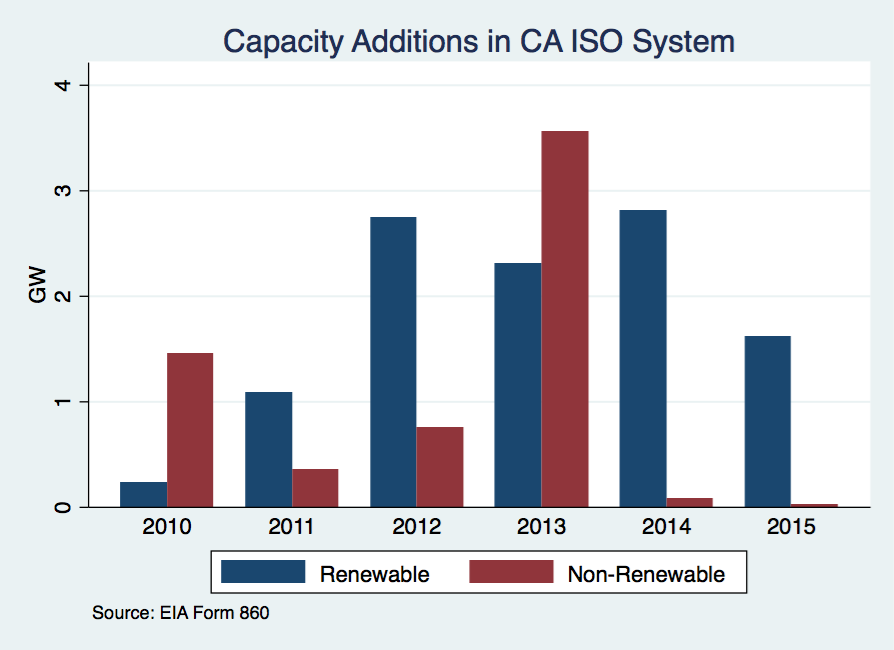
https://www.scientificamerican.com/article/world-s-largest-storage-battery-will-power-los-angeles/
Battery replaces peaker gas power plant in LA
No. A battery has not replaced a peaker gas power plant in LA…
AES also plans to build a new gas-fired plant on the site of the old peaker plant…
http://www.presstelegram.com/business/20161129/aes-proposing-to-build-largest-battery-facility-in-the-world-in-long-beach
So… California electricity consumers will have to foot the bill for a battery storage system and a new natural gas-fired power plant on the site of a soon-to-be demolished gas-fired power plant. The soon-to-be demolished power plant is only 16 years old.
https://www.eia.gov/electricity/data/browser/#/plant/315?freq=A&ctype=linechart<ype=pin&maptype=0&pin=&linechart=ELEC.PLANT.GEN.315-ALL-ALL.A&columnchart=ELEC.PLANT.GEN.315-ALL-ALL.A
“California has this tradition of astonishingly bad decisions,” said McCullough, the energy consultant. “They build and charge the ratepayers. There’s nothing dishonest about it. There’s nothing complicated. It’s just bad planning.”
That a 16 year old plant is being replaced with a battery system is a sign of that the power market and the technology has changed forever….
and that renewable energy can supply California.
There is no advantage or point in supplying California via fossil fuel plant any more… California will only move toward renewables and it will successfully supply its power that way.
It’s proof that California is governed by idiots. A perfectly functional, relatively new, already paid-for natural gas power plant will be demolished to make way for a new natural gas power plant and the most expensive battery farm in the history of the Galaxy… in a market that is already over-supplied with power and the consumers are forced to pay a premium for power they don’t need.
All of this is being done to comply with California’s RPS and other idiotic environmental regulations. The soon-to-be demolished power plant is being condemned because it draws cooling water from the ocean.
18 cents/kwh?! Where in California is it that cheap? I know it’s an average, but I didn’t think anywhere in this state had electricity that cheap. Must be areas outside of the Bay Area. Depending on the tier, where I’m at on the Peninsula, it’s 22-44 cents kw/h. It was about the same 9 years ago when I was still living in San Jose.
The average ought to include subsidy farmers of car charging stations and industrial bulk buyers with tariffs that give them discounts for disconnection (local backup generators). That is not the average for home retail, as 19¢ is the lifeline lower bound in San Jose. Just another “Lie by using averages”.
Looking at my latest bill from PG&E, I’m actually paying 23¢ per kilowatt hour once you add on all their incentives and taxes. Ugh…and that’s before peak summer AC demand hits. Damned expensive. (Tier 2 is 25¢ kwh even before all the taxes.)
The table in the article actually shows the LOWEST electric rate that I pay in CA. I’m assigned a “quota” and when I exceed it (inevitably) I get Hawaii prices. Livin’ the dream. This more than anything else makes residential solar make sense in CA. I don’t know about people in other states, but not getting penalized and guilted with every utility bill is a sweet sweet luxury.