By Dr. Susan Crockford:
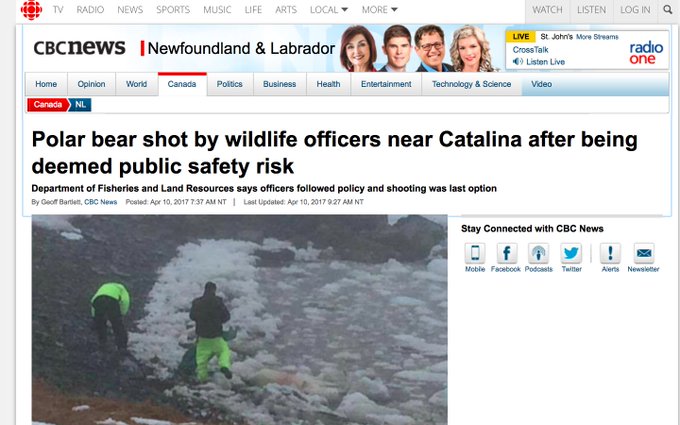
Amid reports that ice conditions between Newfoundland and southern Labrador are the worst in living memory, another polar bear was reported ashore in the area — just after biologist Andrew Derocher explained to the CBC that bears only come on land when sea ice conditions “fail.”

“Ice too thick for coast guard’s heavy icebreaker” said a 20 April 2017 CBC report on the state of ice in the Strait of Belle Isle. The pack is thick first year ice (four feet thick or more in places) and embedded with icebergs of much older, thicker ice. The ice packed along the northern shore of Newfoundland is hampering fishermen from getting out to sea and is not expected to clear until mid-May.
NASA Worldview shows the extent of the pack ice over northwest Newfoundland and southern Labrador on 19 April 2017 (the Strait of Belle Isle is the bit between the two):

The same day that the above satellite image was taken (19 April), at the north end of the Strait on the Newfoundland side, a polar bear was spotted in a small community northwest of St. Anthony (marked below, “Wildberry Country Lodge” at Parker’s Brook). It’s on the shore of north-facing Pistolet Bay on the Great Northern Peninsula, near the 1000 year old Viking occupation site of L’Anse aux Meadows.

There were no photos of the Parker’s Brook bear but lots of others have been taken this year of almost a dozen seen along Newfoundland shorelines since early March: see my recently updated post, with an updated map of reported sightings. Harp seals are now abundant in the pack ice of southern Davis Strait, providing polar bears with an ample source of food when they need it most and therefore, a strong attractant to the area.

Yet, as I reported yesterday, polar bear specialist Andrew Derocher told the CBC this week that polar bears are almost always “forced” ashore by poor ice conditions. The CBC report included his tweet from 10 April, where he suggested “failed” Newfoundland ice conditions were the cause of multiple bears onshore in Newfoundland this year.
#polarbears & people don’t mix well. Bears use land when sea ice conditions fail. We expect more events like this. http://bit.ly/2oY0Im2

Similar thick ice conditions off northern Newfoundland (perhaps even worse) occurred in 2007, see Twillingate in the spring of 2007 below:

Yet, in 2007 there was not a single polar bear reported onshore in Newfoundland (as far as I am aware) but this year there were almost a dozen. And the photos taken this year show fat, healthy bears – not animals struggling to survive.
There’s much more -full story here: https://polarbearscience.com/2017/04/22/sea-ice-off-newfoundland-thickest-ever-yet-another-polar-bear-comes-ashore/
Dr. Susan Crockford writes of the backstory:
Derocher and I were both interviewed by CBC Radio Newfoundland about the unusually high numbers of polar bears onshore this spring but CBC contacted me first. I did two interviews: the staff at the St. John’s station recommended me so highly after my interview with them that the Gander station asked if I’d do one for them too. Both aired April 11 and a print version appeared on April 12. Someone (was it Derocher? I don’t know) obviously complained that I should not have been described as an “expert” and the print article was changed the next day to remove the offensive word. The next week Derocher also did a CBC radio interview to have his say (with a print version appearing on April 21) – but did he call them or did they call him? We’ll probably never know. I’ve included some quotes from both: readers can decide for themselves what to make of all this.
“Amid reports that ice conditions between Newfoundland and southern Labrador are the worst in living memory, another polar bear was reported ashore in the area — just after biologist Andrew Derocher explained to the CBC that bears only come on land when sea ice conditions “fail.”
Top Offic, but somehow fitting, fo gigure.
https://twitter.com/pajoflynn/status/856095571827994624
/sarc for the err challenged.
Seems to me the same thing happened in Boston a few days ago! 😉
Those that have evolved to outrun lions to stay alive are bound to beat you slow white men .
We don’t have to run, we are the top of the food chain and kill the lion. 😉
I read an article a few years back that attributes it to the Kenyans not wearing shoes when they were kids. Toughened up the tendons in the feet which makes them more efficient long distance runners.
It has been put forward that Kenyans and other Central African native born runners seem to have increased lung capacity, never saw any actual scientific study on it, though. It is certain that men and women from the region do tend to dominate in marathon competition. I knew a Kenyan and an Ethiopian in US Army who could run like nobody’s business, neither enjoyed it though, they much preferred vehicular transport just like the rest of us. 😉
Fabulous! LOL
Can a person actually be so bad at his occupation that he does not know the remotest thing about the subject of his study: The Polar Bear? And instead resorts to childish cliches that are patently wrong to the most casual observer? Was this man a service station attendant before grad school? A bagger at the local grocer?
Animals adapt to conditions or change their habits to changing conditions. That the sea ice is thicker than it has been in the lifetime of these polar bear’s. It makes hunting through that ice more difficult and the seals have difficulty coming through it or returning into the sea water where they feed. The bear’s are fat because of the later, because the seals come up and have trapped themselves on top of the ice, where the bear’s feed on them. That land is now closer because of the growth of the ice they come onto it more readily. Theories can be made and still not mean they’re correct. I don’t know anything about polar bear’s but I know other animals habits are known to change with conditions.
On the contrary, the sea ice is thinner across the arctic. This is a temporary local increase due to ice transport from elsewhere.
The ice is now often further from land…
Because the sea ice has retreated far and early in the Beaufort Sea, bears are staying ashore and scavenging on Inuit whale kills.
The sea ice is not forming around Svalbard in December in time for bears to reach their denning areas. The Hudson Bay population is in decline because they are stuck on land longer before the bay freezes over.
Wow, so all you got is the same lie, just re-worded. How sad.
Boo, hisssssssss. Yuk.
Global Warming is the Natural condition of Earth. Glacial Periods are the Abnormality caused by the massive Volcanic Activities and/or massive meteors blocking out the Solar Radiation from entering the Atmosphere as well as Solar Minimums occurring during those Abnormalities. If none of those events had occurred the Earth would have a Tropical Climate Globally from Pole to Pole. Zero Ice would exist in Nature at all. Flora and Fauna wouldn’t have gone extinct from Glacations. Scientists have been showing the Sun is nearing another Minimum. Volcanic Activities have increased since 1814 to where in 2014 there were more active volcanoes in 2014 than in all of the 1900’s. The Global Cooling Aerosol Gases are balanced with all the Global Warming Gases and Atmospheric Water creating a Global Temperature Lull for over 18 year’s. This has scientists worried of another Glacial Period. While other scientists are still pushing the Global Warming and Climate Change theories of AGW. Scientists have shown that 99.95% of Carbon Dioxide is recycled Natural sources and Fossil Fuels, cement manufacturing and industry and deforestation only contribute 0.05% of Carbon Dioxide to the environment, from pre 2013 data used in a environmentalists global warming site. Your studies of the Arctic Ice and Polar Bear’s my be your life’s work. But Earths history doesn’t just go back a few hundred year’s that scientists base their theories of Global Warming and Climate Change on from computer models that have proven inaccurate to reality. Evolution occurs more in a hotter climate than a cold climate that kills more Flora and Fauna. Evolution is a cruel reality that what doesn’t adapt becomes extinct.
And what do seals eat? And what do marine invertebrates eat? Solid pack ice year round assures minimal photosynthetic life.
Seals require pack ice to breed… polar bears depend on seals for main part of their diet.
http://ocean.si.edu/blog/ice-loving-seals-and-loss-sea-ice
http://journals.plos.org/plosone/article?id=10.1371/journal.pone.0029158
Low sea ice extent and early retreat impacts seal breeding and polar bear feeding
(Also late formation of ice around Svalbard polar bear breeding areas and late formation of Hudson Bay ice impacts polar bear breeding and feeding)
Same lie, different wording. How, common.
Griff,
Same sad story – too bad that polar bears are smart and know how to walk and swim!
When ice conditions are poor around Svalbard, pregnant polar bears that need a place to den move east to the archipelago of Franz Josef Land where the ice is more dependable. Simple.
https://polarbearscience.com/2016/03/31/late-winter-surge-in-sea-ice-habitat-and-the-resilience-of-svalbard-polar-bears/
Polar bears need ice until about early to mid-May depending on the region. By then, they are finished with most of the feeding they need to do and the breeding season is almost over. If need be, they can breed on land (which sometimes they do anyway). Sea ice extent hasn’t changed enough at that point in the season to negatively impact polar bear survival.
In fact, since 2007, summer sea ice has been at levels not predicted to occur until 2050 but polar bear numbers have not plummeted – instead, the bears are thriving.
https://polarbearscience.com/2017/02/28/science-behind-the-video-polar-bear-scare-unmasked-updated-paper-now-available/
And as I pointed out above, breakup and freeze-up dates for Western Hudson Bay have not changed since at least 2001 – the big shift in dates occurred around 1998 and haven’t changed since (some variability, no trend).
https://polarbearscience.com/2017/02/09/new-paper-updates-lack-of-trend-in-w-hudson-bay-breakupfreeze-up-dates-to-2015/
Dr. Susan Crockford, zoologist
Anyone else having a problem with the double video window ad at bottom of post dragging you from comment thread back up to the post? Happened to me a couple times yesterday and it is real bad this morning.
Arctic sea ice extent is currently 2 standard deviations below 1981-2010 average.
https://wattsupwiththat.com/reference-pages/sea-ice-page/
And yet the Arctic Sea is still covered with ice, so heavy icebreakers can’t push through.
So, what are you going to do about it? Nothing. Because nature cannot be harnessed in such a way as to make more ice than she wants. I hate ice. I want the Arctic ice-free in my lifetime and I am spewing as much co2 as I can afford to make it so.
Mat, a question for you: In geologic terms, how many blinks of an eye is 36 years? Take your time.
Which has absolutely nothing whatsoever to do with an extra CO2 molecule over the past century.
The melt this year has also been a lot slower than average.
Peak ice this year was March 7, later than usual. Since then, Arctic sea ice extent has fallen 0.866 million sq km. The average decline (since 1979) for March 7 to April 23 has been 1.069 million sq km.
We were in St Anthony in the spring two years ago to do the iceberg boat tour thing, but the harbor was choked with ice and the boats weren’t going out.
We highly recommend the drive from Port aux Basques up to St A. Just watch out for moose on the road in the evenings. Those crepuscular vermin are out to get you.
From one of those old “Fitzpatrick Traveltalks” on TCM I learned that Cape Breton Island was first “discovered” by Basque whalers. Who knew?
You never know what those mysterious Basques are up to, because nobody speaks their language. My favorite theory is that they’re surviving Neanderthals.
Same thing when ice expands across from Greenland to Iceland. In years past Icelandic authorities have had to shoot bears much to the outrage of the world’s urban warming neophyte. Icelanders and Newfies, of course just do their thing as needed.
Current temperature in Canada.
http://files.tinypic.pl/i/00894/to2tz7z2lkmx.png
Here’s last week’s view of icebergs off Ferriland, NFD:
http://pasaulis.lrytas.lt/marga-planeta/ispudingas-ledkalnis-i-atoku-miesteli-priviliojo-daug-turistu.htm?foto=2
Desrocher is using imprecise, confusing language.
What does he mean by:
– Ice “failing”?? Failing to form? Failing to melt?
– “Poor” ice conditions? Can an iceberg be in debt?
– “Worst” ice conditions? Does this mean most ice? Or least ice?