
Guest essay by Eric Worrall
Global warming is apparently making it so difficult to break through thickening Baltic Ice, the Baltic Icebreaker fleet may have to be upgraded.
More Powerful Icebreakers Needed in Baltic Sea Despite Global Warming
Oddly enough, global warming and milder winters have led to more severe ice conditions in the Baltic Sea and the Gulf of Bothnia. Today, icebreakers are already struggling to get through towering compacted ice and the problem may become exacerbated in the future, unless more powerful icebreaking vessels step in.
As surprising as it may sound, milder winters don’t make life easier for icebreakers. On the contrary, thaws alternating with bouts of frost are a nightmare for icebreaker fleets, Finnish experts found. During winters with a regular cold, solid ice grows to become 50-60 centimeters thick and is easy to get through. Although milder winter temperatures at first glance make ice thinner, it also leads to the formation of an ice crust, which, with the aid of harsh winds, grows to several meters of pack ice.
According to ice researcher Patrik Eriksson of the Finnish Meteorological Institute, the Baltic ice may become 5-6 meters thick, and this phenomenon has become particularly common over the past decades of milder winters. Eriksson noted that short cold spells combined with western winds lead to ice floes clogging to pack ice, which is a bigger problem for Finland due to the wind pattern.
…
Read more: https://sputniknews.com/science/201703071051343100-baltic-sea-icebreakers/
Just as well we’re not experiencing global cooling, otherwise all the icebreaker construction workers would go out of business.
Low ice around Finland again this year.
http://yle.fi/uutiset/osasto/news/ice_cover_at_sea_exceptionally_low_this_winter/9455739
Read the article again – it is saying that the ice does not now freeze over and stay frozen at a standard thickness all winter…
bouts of cold and then wind pile it up into limited areas which are much thicker…
As with the naysayers of the early shale oil boom, the answer is to give it time and don’t be so impatient.
http://www.climate4you.com/images/NOAA%20SST-NorthAtlantic%20GlobalMonthlyTempSince1979%20With37monthRunningAverage.gif
And this means what? That things change? Of course. That the change is bad or wrong—not sufficient data to make that claim. It’s a nice observation. That’s all it is.
Have you aologised to Doctor Crockford for lying about her professional qualifications to discredit her on behalf of your paymasters, you mendacious, misogynistic liittle propagandist?
I just can’t read your stuff Cat without seeing the real Catweazle waving his arms in confusion and frothing at the mouth. He wore filthy hessian rags so I hope your better dressed at least.
 ?1425119303
I think perhaps you mistake me for someobne who could give a flying dog’s bollock for what the likes of you think.
Doctor Crockford neither studies nor publishes papers on Polar Bears. Polar bear experts can be found across the web saying she is not among their number. She receives payments, I have seen it alleged, from the Heartland institute. I submit she is an unqualified person publishing a political blog, apparently funded by political agency. I stand by the criticisms I made directly to her about the misleading nature of her posts.
Lying again Griff, you misogynistic little wannabe cyber-bully?
It was brought to your attention by Climate Otter precisely what papers Doctor Crockford has published.
You are a profoundly unpleasant little craature who appears to have no life beyond taunting and smearing folk who for incomprehensible reasons you seem to believe are somehow inferior to you, despite the fact that you exhibit no understanding or knowledge whatsoever of climate science or energy, and believe that anyone who disagrees wiith the view of yhe Leftist fake news sheet ‘The Guardian’ is in the pay of ‘Big Oil’.
I assure you, thay are anything but, each and every one of them is worth a thousand of you.
As for “apparently funded by political agency”, coming from a paid propagandist for ‘Renewables’ posting from a corporate IP, for downright hypocrisy that takes some beating.
The $1mm dollar question is how many meters high will the ice be when the arctic is ice free?
It may be impassable by any size ice breaker.
Maybe they could get UN funding for that, starting with studies.
Oddly enough.
Fortunately I am sure global warming is consistent with both thicker and thinner ice. It should, because it is supposed to be consistent with any state of affairs.
In other words: It is unfalsifiable. And if it can never be falsified, it must be true, right? Q.E.D.
ER no.
Overall. ..Over the entire arctic the ice is thinning and disappearing. ..overall. However in certain small regions the thinning ice in conjunction with high winds allows part of the ice to build up thick ridges…
Overall versus local.
It’s similar with rainfall sone places getting wetter and some more dry…that doesn’t make the theory unfalsifiable.
If you think., that is.
Steven – so when will the ice disappear?
If the thick ice exists only in “certain small regions,” why is that such a problem for icebreakers? Can’t they avoid the small regions of thick ice and travel through thin ice to get where they want to go?
In February 764 seventy feet thick icebergs were driven against the walls of Constantinople (present day Istanbul) by severe winds with such a force, that threatened to ruin them.
Now, Constantinople is but a small region and seventy feet is way more than anything currently seen in the Baltic, therefore the occurrence must have been consistent with global warming theory. Right?
“Steven – so when will the ice disappear?
Imprecise question. Try again.
1. if we define “the ice” as Ice in the arctic ( say north of 70deg)
2. If we set a threshold of say 1million sq km ( as the IPCC has done)
3. If we set a time window of Sept, or end of the melting season.
4. If want to eliminate “flukes” and demand 5 straight years of “zero ice” at the end of the season
Then Take the over bet at 2050.
you have to learn to ask precise questions
And you have to learn not to act like a condescending jerk…
“And you have to learn not to act like a condescending jerk…”
He’s not acting.
Gerald Machnee asked a very specific question-“So,when will the ice disappear?”
Steven Mosher responded with “An imprecise question. Try again.”
Um….ok. Let’s try again :
When- adverb
1.at what time.
“when did you last see him?”
2. at or on which (referring to a time or circumstance).
“Saturday is the day when I get my hair done”
will-verb
1.expressing the future tense.
“you will regret it when you are older”
2.expressing inevitable events.
the-determiner
1.denoting one or more things mentioned or referred to (in this case ice in the Arctic)
ice- noun
1.frozen water
disappear-verb
1.cease to be visible
Exact, precise, translation of the basic English words used in the question originally posed:
“So at what time, or on which date, in the future, will the frozen water in the Arctic cease to be visible?”
It’s a very precise question. It could hardly be more precise! And yet Mosher not only found it imprecise, but added a bunch of assumptions, presumptions etc that made it LESS precise, changed it’s original query, and then after complicating and changing the question Mosher could only give an answer based on modeled guessing. Oddly enough, according to the IPCC, at 1 million square kilometers, Arctic Ice ceases to be visible.
I’d tell him to “Try again”, but we all know that the only possible precise answer to that very precise question is “We don’t know”.
There seems to be a good correlation between low temperatures and greater ice thickness on the great lakes. But Arctic sea ice appears much more complicated. If the science weren’t settled I would ask why.
Take a look at the published article.
Read the article again.
This is what was written in the article:
“Today we have it much hotter than for instance in the early 1990s. At the same time we tend to have these very cold winters, which makes it hard to realize there is a global warming going on,” Hilppa Gregow told Yle, venturing that the “difficult” ice will increase in the future.
Tero Vauraste of Arctia supposed that the future will set higher demands on icebreakers, given that the climate is predicted to become gradually hotter in the following 20-30 years, together with harsher winters and more wind
“Today we have it much hotter…than in the early 1990s”? That is not even a scientific statement.
Baltic Sea-not part of the Arctic Ocean. 🙂
What are they talking about? The Baltic has been practically ice free this winter
Climate is local and seasonal.
Here is the situation at area:
http://en.ilmatieteenlaitos.fi/ice-conditions
Depends on how you define “Baltic”. There is quite a lot of ice in the Bothnian Gulf and Finland Bay, and at the moment there is five Swedish and four finnish icebreakers active in the Bothnian Gulf and one finnish in the Finland Bay.
Only ships with Ice Class IA and >2000 tons DW permitted in the Bothnian Gulf, >4000 tons DW required for the northern Gulf.
Rename one of the icebreakers the SS John Holdren.
Since this was not a peer reviewed study, and is instead a gray paper or maybe even just an interview I will give this junk speculation a pass lest I throw up trying to make anything of it except pig slop. Sorry pigs.
in 1970s global cooling caused colder climate and no warming or patterns related to warming.
now global warming causes warming, cooling, and no changes.
yeah we should go crazy and over react to it all…
This is probably a translation problem. What they are talking about is presumably what is known in Swedish as “stampisvallar” (literally “stamped ice ridges”, there is as far as I know no English word for it). This is a mixture of finely divided ice and water which can collect at the edge of a fast ice sheet when there is an onshore wind. It does not protrude much but it can extend to a depth of many meters since it has a density extremely close to water. It can be very difficult to penetrate, and if it freezes together it is about the only thing that will stop just about any icebreaker no matter how powerful, since it can extend much deeper than the keel of the icebreaker.
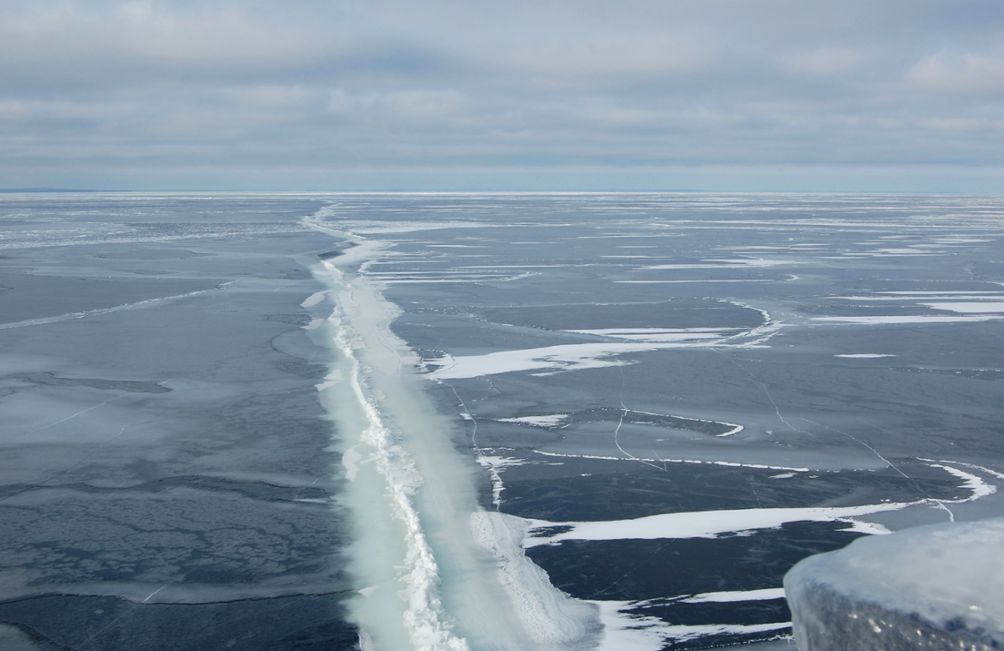
It is true that stampis is most common when there is much new ice or nilas that can be broken up finely by the wind, but it is by no means restricted to mild ice winters.
This is what a “stampisvall” looks like:
Is this the same as a pressure ridge?
https://en.wikipedia.org/wiki/Pressure_ridge_(ice)
“This is probably a translation problem.”
This sentence (particularly the last clause) is misleading, it seems to me.
“Although milder winter temperatures at first glance make ice thinner, it also leads to the formation of an ice crust, which, with the aid of harsh winds, grows to several meters of pack ice.”
Something like this seems to be what was meant;
“… leads to the formation of an ice crust, which, with the aid of harsh winds, gets driven together into several meters of pack ice.”
Yep. It’s all lost in translation….well that, and a lack of geographical knowledge. *grin*
Best solution is for Russia to give Finland back their ice-free port Pechenga on the Murmansk Sea. I suspect Vladimir won’t, though.
So we are talking here about the wrong kind of ice ??? Shades of British Rail and the wrong kind of leaves.
I’m waiting for the day that climate science proves I can freeze a pan of water in my oven with it set to 350.
There is almost no ice in the baltic see for your selves Todays ICE report :
http://baltice.org/pdf/IceChart_20170308_Baltic.pdf
Look at the top and to the right. That’s about 75 000 square kilometers of ice, a fairly large almost nothing.
tty,
Yep. And how odd….that 75,000 square kilometers of ice, is EXACTLY in the Gulf of Bothnia….exactly where the article said the problem has arisen. 🙂
It seems that the author of this blog post got tied up in the translation issues (which do indeed cause a mess) and either confused a local issue that truly is happening due to thinner ice forming (due to warmer conditions than normal recently in that area) and then being blown into the upper “corner” of the Baltic Sea by the wind (which then DOES cause thicker than normal ice to form in that particular location)…with global climate and global sea ice issues…or attempted to use the localized issue as if it relates to global climate/sea ice for some unknown reason.
The Gulf of Bothnia is only about 40,000 square kilometers. And the ice forms there, it doesn’t get blown there. And all ice isn’t there either. At the moment twenty icebreakers are active in the Baltic, nine in the Gulf of Bothnia (five Swedish, four Finnish), ten in the Gulf of Finland (one Finnish, eight Russion, one Estonian) and one (Estonian) in Riga Bay. Although actually one of the Swedish is now south of the Gulf of Bothnia in the Umeå area.
Rather a lot of icebreaking capacity is apparently being used to fight “almost no ice”.
“for some unknown reason.”
You forgot the /sarc
tty March 9, 2017 at 2:19 am
The Gulf of Bothnia is only about 40,000 square kilometers. And the ice forms there, it doesn’t get blown there. And all ice isn’t there either. At the moment twenty icebreakers are active in the Baltic, nine in the Gulf of Bothnia (five Swedish, four Finnish), ten in the Gulf of Finland (one Finnish, eight Russion, one Estonian) and one (Estonian) in Riga Bay. Although actually one of the Swedish is now south of the Gulf of Bothnia in the Umeå area.
Rather a lot of icebreaking capacity is apparently being used to fight “almost no ice”.
They’re being used in various dispersed locations, typically near ports, and routes to the ports in the north.
You can see the ice and location of shipping and icebreakers at the following site:
http://baltice.org/map/
Choose ‘Icebreaking & Traffic’ then ‘Traffic & Ice situation map’.
Note the dark red areas on the map, “compact floating ice”, which appears to be what this article is about, it’s concentrated along parts of the coast and bays (and it does get blown there).
Here’s a map from the same source showing where the ice is blowing.
http://ice.fmi.fi/polarview/latestfc.php?var=drift&area=nbs&hour=6
“They’re being used in various dispersed locations, typically near ports, and routes to the ports in the north.”
Yes, there is always a strong tendency to locate icebreakers where they are needed.
“Note the dark red areas on the map, “compact floating ice”, which appears to be what this article is about, it’s concentrated along parts of the coast and bays (and it does get blown there).”
No, it isn’t what this article is about. It is about brash ice barriers, of which there isn’t any in the Baltic at the moment:
http://www.smhi.se/oceanografi/istjanst/produkter/sstcolor.pdf
“and it does get blown there”
To some extent yes, but mostly it just grows there. It is largely a matter of water temperatures. Colder water = more ice, it’s as simple as that:
http://www.smhi.se/oceanografi/istjanst/produkter/sstchart.pdf
By the way I’ve lived most of my life on the Baltic coast so I feel fairly confident about how the ice forms and what it is like.
tty March 9, 2017 at 6:22 am
“They’re being used in various dispersed locations, typically near ports, and routes to the ports in the north.”
Yes, there is always a strong tendency to locate icebreakers where they are needed.
Exactly my point, the need for ice breakers at the ports isn’t determined by the total quantity, rather whether is at the sensitive areas, i.e. ports.
I was replying to your assertion: Rather a lot of icebreaking capacity is apparently being used to fight “almost no ice”.
“Note the dark red areas on the map, “compact floating ice”, which appears to be what this article is about, it’s concentrated along parts of the coast and bays (and it does get blown there).”
No, it isn’t what this article is about. It is about brash ice barriers, of which there isn’t any in the Baltic at the moment:
http://www.smhi.se/oceanografi/istjanst/produkter/sstcolor.pdf
So this report on the Baltic ice from yesterday isn’t accurate?
“In the northern Bay of Bothnia there is 45-65 cm thick fast ice in the archipelago. Farther out 40-50 cm thick, consolidated and ridged drift ice approximately to the line Malören – Oulu 1. The icefield is difficult to force.”
Note that coincides exactly with the dark red region on the map.
“and it does get blown there”
To some extent yes, but mostly it just grows there.
No, that’s why they call it ‘Drift ice’
This map shows where it’s drifting from and how fast (currently to the north at 0.6 knots):
http://ice.fmi.fi/polarview/latestfc.php?var=drift&area=nbs&hour=6
tty March 9, 2017 at 6:22 am
No, it isn’t what this article is about. It is about brash ice barriers, of which there isn’t any in the Baltic at the moment:
Like these you mean?
“In the northern Bay of Bothnia there is 45-65 cm thick fast ice in the archipelago. Farther out 40-50 cm thick, consolidated and ridged drift ice approximately to the line Malören – Oulu 1. The icefield is difficult to force. Farther out there is a lead, which runs from Nygrån via Farstugrunden to Merikallat and further to Ulkokalla. There is new ice and 5-20 cm thick level ice in the lead. Further south there is first an area of 10-20 cm thick close ice and then 30-60 cm thick ridged compact ice. Further south 15-40 thick very close ice mixed with thick floes of consolidated brash ice.
tty-
Let me rephrase then-
The Gulf of Bothnia, the location specified in the article, makes up more than half of that 75,000 sq km of ice.
Of course the ice is formed there. No one said it wasn’t. But sea ice MOVES based on wind direction and water currents, and CHANGES forms many times during it’s existence.
Brash ice-
“Accumulations of floating ice made up of fragments not more than 2 m across; the wreckage of other forms of ice. Brash is common between colliding floes or in regions where pressure ridges have collapsed”
Brash ice is defined by it’s width or surface area, NOT it’s thickness.
Once “brash ice” gets blown into “fast ice” and refrozen into it, it’s no longer called “brash ice”, it’s called fast ice. If brash ice becomes frozen together in large free floating masses, it’s called “pack ice”. If pack ice is pushed against the shore and freezes to the fast ice, it’s then called fast ice. Then there are pressure ridges:
Pressure Ridges-
“A pressure ridge develops in an ice cover as a result of a stress regime established within the plane of the ice. Within sea ice expanses, pressure ridges originate from the interaction between floes,[note 1] as they collide with each other.[3][4][5][6] Currents and winds are the main driving forces, but the latter are particularly effective when they have a predominant direction.[7] Pressure ridges are made up of angular ice blocks of various sizes that pile up on the floes. The part of the ridge that is above the water surface is known as the sail; that below it as the keel.[note 2] Pressure ridges are the thickest sea ice features and account for about one-half of the total sea ice volume.[2] Stamukhi are pressure ridges that are grounded and that result from the interaction between fast ice and the drifting pack ice.[8][9]” wiki
When one ice floe slides up on top of another floe, it’s called “rafting”, and that immediately changes the thickness of the floe where the rafting is.
So sea ice can change shape, density, location, and thickness due to interactions with other ice without a change in the temperature of the water necessarily being part of those processes. It’s the same amount of ice whether it’s piled on top of itself or spread out evenly. But the thicker it becomes, through whatever process, the harder it becomes for ice breakers to get through it.
Oh, and tony mcleod,
I find making assumptions and presuming things to be illogical and biased, so I try not to pretend to know why someone does something. Just like I don’t know the reason why you brought up Arctic Sea Ice when the Baltic Sea has nothing to do with the Arctic, I don’t know why the author did what he did either. I find both odd, but that’s my personal opinion, not a statement of fact about either of you.
Question is why isn’t greenpeace up there stopping ice breakers??? You would think with all their caterwauling about whales they would have already surrounded that ice breaking vessel with their cries of “save the ice”!
This is an interesting summary of Baltic Sea ice winters (around Finland)
http://en.ilmatieteenlaitos.fi/baltic-sea-ice-winters
I should really stop typing now as breaking cover never results in anything good. I think I bookmarked this site in 2008 and try to visit weekly but have never before posted.
I’m enjoying the comments by tty and Phil. I must comment as, after retirement as a biophysicist and biomedical engineer, I fell in love with a Sjöräddningssällskapet (Swedish SSRS) icebreaker. I took her from her home in Stocka (61.89N 017.33E – the economics were cruel as she was no longer up to supporting modern commerce and breaking stampisvallar.)
She and I have had fun gingerly poking around other types of ice in the Denmark and Hudson straits and Baffin Bay. Now she keeps the St. Johns River ice-free between Jacksonville and Lake Monroe, Florida.
http://i1226.photobucket.com/albums/ee412/NelsTandberg/morningfog0028thumb.jpg
Re Greenpeace – I think I’d mount an old-fashioned 2″ deck gun forward.
well done sir, that truly is a beautiful purposeful ship.
By summer there is no telling how thick the ice will be.