
From the missed target department and STANFORD’S SCHOOL OF EARTH, ENERGY & ENVIRONMENTAL SCIENCES
Without a significant effort to reduce greenhouse gases, including an accelerated deployment of technologies for capturing atmospheric carbon and storing it underground, and sustained growth in renewables such as wind and solar, the world could miss a key global temperature target set by the Paris Agreement and the long-term goal of net-zero climate pollution.
The finding, published in the Jan. 30 issue of the journal Nature Climate Change, is part of a new study that aims to track the progress and compare emission pledges of more than 150 nations that signed the Paris Agreement, a 2015 United Nations convention that aims to keep global warming below 2 degrees Celsius of pre-industrial levels — the threshold that scientists have marked as the point of no return for catastrophic warming.
“The good news is that fossil fuel emissions have been flat for three years in a row,” said Robert Jackson, chair of the Department of Earth System Science at Stanford’s School of Earth, Energy & Environmental Sciences. “Now we need actual reductions in global emissions and careful tracking of emission pledges and country-level statistics.”
In the new study, Jackson and his colleagues developed a nested family of metrics that can be used to track different national emissions pledges and thus global progress toward the objectives of the Paris Agreement.
Applying their method to the recent past, the researchers found that global carbon dioxide emissions have remained steady at around 36 gigatons of carbon dioxide for the third year in a row in 2016.
“The rapid deployment of wind and solar is starting to have an effect globally, and in key players such as China, the U.S. and the European Union,” said Glen Peters, senior researcher at the Center for International Climate and Environmental Research – Oslo (CICERO) and lead author for the study. “The challenge is to substantially accelerate the new additions of wind and solar, and find solutions for effectively integrating these into existing electricity networks.”
However, wind and solar alone won’t be sufficient to meet the goals of the Paris Agreement. When the researchers examined the drivers behind the recent slowdown, they found that most of them boiled down to economic factors and reduced coal use, mostly in China but also the United States.
In China, the decline in coal use was driven by reduced output of cement, steel and other energy-intensive products, as well as a dire need to alleviate outdoor air pollution, which is responsible for more than 1 million premature deaths annually.
The reasons for the decline in the United States were more complex, driven not only by a decline in coal use but also by gains in energy efficiency in the industrial sector and the rapid rise of natural gas and wind and solar power. “2016 was the first year that natural gas surpassed coal for electricity generation,” said Jackson, who is also chair of the Global Carbon Project, which tracks the amount of carbon dioxide emitted by humans each year.
Looking to the future, the researchers predict that the greatest challenge to meeting the goals of the Paris Agreement is the slower than expected rollout of carbon capture and storage technologies. Most scenarios suggest the need for thousands of facilities with carbon capture and storage by 2030, the researchers say, far below the tens that are currently proposed.
Jackson notes that carbon capture and storage technology will prove even more crucial if President Donald Trump follows through with his campaign pledge of resuscitating the nation’s struggling coal industry.
“There’s no way to reduce the carbon emissions associated with coal without carbon capture and storage,” Jackson said.
Jackson is also a senior fellow at the Stanford Woods Institute for the Environment and the Precourt Institute for Energy.
###
Other authors on the study, titled “Key indicators to track current progress and future ambition of the Paris Agreement,” include Robbie Andrews and Jan Ivar Korsbakken of CICERO; Josep Canadell of the Global Carbon Project; Sabine Fuss of the Mercator Research Institute on Global Commons and Climate Change; Corinne Le Que?re? of the University of East Anglia; and Nebojsa Nakicenovic of IIASA, the International Institute for Applied Systems Analysis.
Funding was provided by the Research Council of Norway and the National Environmental Science Program-Earth Systems and Climate Change (NESP-ESCC) Hub.
The cost of all this nonsense is measured in multiples of the World’s GDP. The hubris of these people is beyond comprehension. ?w=840
Just How Much Does 1 Degree C Cost?
https://co2islife.wordpress.com/2017/01/25/just-how-much-does-1-degree-c-cost/
That is pure nonsense, and if true, had zero impact on atmospheric CO2.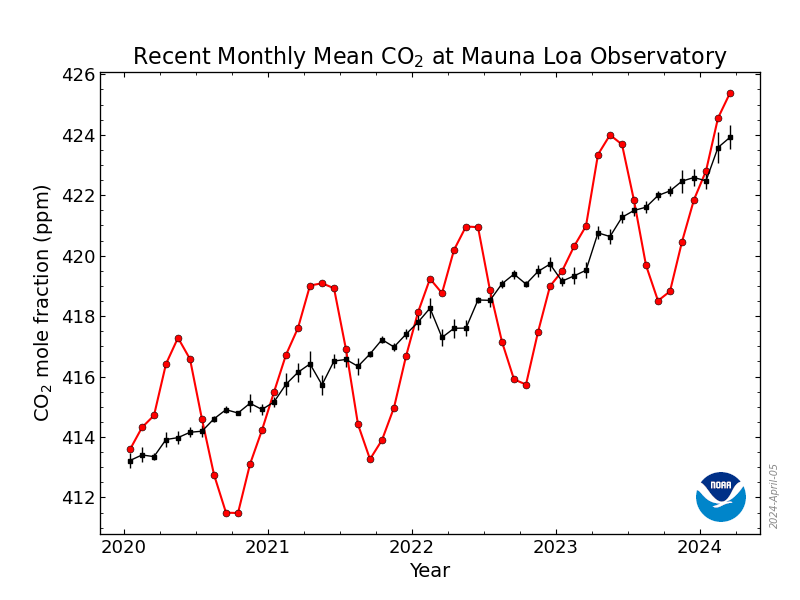
We need to take out the El Niño effect, because it may have slowed down the rate of increase. Maybe the amount of CO2 taken by carbon sinks will increase slightly as CO2 concentration rises? Do they have a limit?
Maybe, but you can go back and look at events like the Yellowstone fires, volcanoes, etc etc, and nothing seems to alter the path of CO2 much. El Nino or not, IMHO we aren’t getting any benefit for the huge costs. CO2 simply isn’t a problem, it is a huge benefit. We feed far more people with far less farmland at far less cost. Also, cheap carbon powers the world and improves the lives of everyone that uses is.
I do not agree CO2 emissions are beneficial in the long term, nor do I feel subsidizing any particular energy makes much sense. We do have to worry about running out of fossil fuel resources (I believe we discussed that extensively in a post last week).
I do want to repeat my earlier point: is it conceivable that flattening the emissions will flatten the concentration curve?
fernandoleanme:
What has been shown to reduce CO2 emissions in the past is a nice, solid recession. During the Global Financial Crisis, human CO2 emissions went down in most countries.
On the other hand, since humans only contribute about 5% of the world’s CO2 emissions, it shouldn’t surprise anybody that reductions in our emissions don’t show up in any of the measurements like Mauna Loa.
It is clear in the last 60 years that atmospheric CO2 increases have been linear, despite out rapid nonlinear increases in CO2 emissions. As we are having not effect on CO2, then we are having no effect on climate through CO2. That along obviates and negates all hyper expensive unsustainable wind, solar and biofuel money-wasting projects. It’s time to kill these programs, all subsidies, cut them lose and let them die. I would, however, not allow any bankruptcies that seek to reorganize. They need to go away and the Federal Superfund needs to be tasked to cleaning up the dead wind farms and environmentally unfriendly infrastructure.
Thanks for pointing that out about the the difference between the linear increase in co2 and the non linear production. NOAA is doing all sorts of things to cover this up. The amount of co2 missing in the environment is nothing short of astonishing. Most recently they’ve moved the production down from 38 to 36 gigatons. ” steady for the last 3 years ” … somehow they think a slight drop in US production outweighs the dramatic increase in China. It’s probably around 40 to 42 gigatons.
While they were adjusting temperature over the last 15 or 20 years, they never adjusted the co2 record. Since it has been brought to their attention (Feb 2015) that co2 follows the temperature, they adjusted the co2 record. CAGW has a very big problem in their story.
It’s just a matter of time before others start to see this. It really is the definition of fail for AGW.
World output was 37 gigatons in 2013. As if production went to 36.. in their dreams.
That same year in 2015, they started talking about production for the upcoming years as being flat. I believe I saw the first article from the chairwoman from the EEC.
There’s zero doubt CO2 emissions are beneficial in the long run. Not sure people realize the next Ice Age could lower CO2 concentrations and increase aridity to a point that could reduce overall ag yields by 90% even before we talk about the direct losses of arable land to colder temps. Humanity might not survive that, civilization probably would not.
“We need to take out the El Niño effect, because it may have slowed down the rate of increase.”
No, the El Nino accelerated the rate of increase in concentration, at the same time emissions are said to have tailed off.
http://i1136.photobucket.com/albums/n488/Bartemis/scale%200.22_zpsaybcyxnp.png
At all times, the rate of change of atmospheric concentration tracks temperature anomaly – it slowed for the “pause” in temperatures while emissions were accelerating. It accelerated for the El Nino when emissions were leveling off.
Sooner or later, people will realize that concentration isn’t actually tracking emissions at all.
Warming water is an emission source for CO2.
Chilling ocean water increases CO2 absorption.
At this rate it will take 150 years to reach 700 ppm and have a healthy forest.
The CO2 rate under any forest canopy right now is 600PPM.
Source: Climate I: Is The Debate Over?, The Agenda with Steve Paikin start at 20 min
Debate between Hadi Dowlatabadi and Richard Lindzen
• Dowlatabadi is Canada research chair and professor in Applied Mathematics and Global Change at the University of British Columbia.
• Lindzen is a professor of Meteorology at the Massachusetts Institute of Technology.
Some character from University of British Columbia claiming a 700ppm rate under trees requires detailed observations data to back his claim.
From that briefing: ?dl=0
?dl=0
Note the actual and quite normal CO2 ppm measurement.
Note, steeply increasing measured net carbon storage in forests, in this chart from that paper. ?dl=0
?dl=0
Carbon captured from photosynthesis.
When forests are net sinks for carbon dioxide, how does any forest manage higher CO2 ppm under a forest canopy?
With that question, I also have to wonder how a University known for models constructed by students, claims an incredibly high CO2 ppm level?
I suspect another unverified unvalidated model.
“Some character from University of British Columbia claiming a 700ppm rate”
Figures I make a typo on the quoted ppm: That should be;
“Some character from University of British Columbia claiming a 600 ppm rate”
1) “Flattening emissions” is not the same as reducing emissions, nor is it the same as “zero net emissions”. There is a delay in adding carbon dioxide to the atmosphere vs a response in the concentration of CO2 in the atmosphere. This has a lot to do with the carbon cycle.
2) The concentration will continue to rise as long as the mass balance of carbon dioxide to the atmosphere is positive. Worldwide 36 gigatonnes of CO2 are emitted each year. If the net removal of carbon dioxide due to rainfall and other effects is 28 gigatonnes per year, then you will still have an increase of 2 ppm per year.
3) Volcanoes add ~0.2 gigatonnes of CO2 each year. Emissions from one major volcanic eruption is negligible. For instance, MT. Pinatubo added 0.05 gigatonnes of CO2. The fires from Yellowstone are less significant.
4) CO2 concentration increases are only linear over a short period of time. The rate of removal increases with concentration, so it is not as steep a slope as would otherwise be.
There are valid arguments against climate change dogma and invalid ones. One fact is clear — humans are the primary drivers behind CO2 increases. I don’t know of anybody who disputes that.
CO2 will continue to increase as long as the oceans continue to warm. The flux between the oceans and atmosphere dwarf anything man creates.
That is also true — certainly as long as the atmosphere is gaining more CO2 than losing it, then CO2 will rise. CO2 is removed through rain and plant photosynthesis. It is gained through a number of natural and man-made processes.
The tricky part is the warming of the oceans — how much is natural and how much is a result of AGW. I tend to consider the positive feedback of AGW to be small (similar to Watts’ report yesterday that gives an ECS of ~ 1.2).
Lorcanbonda:
Those numbers are estimates solely.
From some desk bound bean counter who tallied subjectively selected sources as their confirmation bias.
Not physical measurements of CO2.
Some curiosities in USGS/NOAA carbon estimates.
A) Their estimates do not match the actual observed CO2 emissions as captured by the OCO-2 satellite.
B) Their volcanic CO2 emission estimates are, perhaps idiotic.
— a) USGS estimates of Kilauea CO2 estimates range from eruption discharges between 8,000 and 30,000 metric tonnes of CO2 into the atmosphere each day.
— b) Kilauea is not explosively violent with it’s rather fluid lava and Kilauea’s location over a hot spot, not a tectonic locations where extensive carbonaceous material is folded deep into the Earth.
— c) Kilauea’s mild CO2 emissions still rate at 2.92 million metric tonnes to 10.95 million metric tonnes of CO2 per annum.
— d) Whoever tallied up a CO2 emissions volume for all active and sleeping volcanoes worldwide had trouble with their basic math skill. 100 rather sleepy volcano emissions easily reach a billion metric tonnes per year. A truly eruptive volcano makes billions of metric tonnes of CO2 per year a rather easy target.
— e) This is without an accurate estimate for tens of thousands of miles (kilometers) of rift emissions worldwide.
C) Yellowstone is an active volcano, that is not currently truly active. Even as a sleeping giant it is an immense source of CO2.
— a) Considering the size of the mud volcano and the sheer size of Yellowstone, that is likely an extremely conservative estimate. Yellowstone has several areas venting CO2 that are dangerous to wildlife when winds are mild. Suffocating wildlife with CO2 require very large volumes of CO2.
— b) There is evidence that CO2 is a key component to erupting geysers. The entire park and surrounding regions are host to thousands of hot springs and geysers. http://www.nytimes.com/1997/12/26/us/yellowstone-park-emits-tons-of-carbon-dioxide-study-finds.html
— c) Hot springs are common in the Western United States, and most if not all, bubble CO2 constantly.
— d) There are numerous mud volcano spots in the American West, several that are famous. Just as the Yellowstone mud volcano area, these are also sources for CO2.
D) Estimates for CO2 from past eruptions have been severely minimized.
— a) Mount St Helens erupted March 18th: Recent estimates for CO2 emissions during the eruption are quite small.
— b) Perhaps USGS believes it was toothpaste that blew 3.4 billion cubic yards of rock along with the volcano’s magma chamber high into the sky.
E) Expanding these considerations to worldwide volcanic CO2 emissions simply dwarfs the dismally politic USGS/NOAA volcanic CO2 emissions.
They must have cherry picked starting and ending points as is the usual methodology, starting in mid 2012 and ending in late 2016..
The Exxon 2040 report clearly shows that in Germany the increase in renewables barely compensates for the phasing out of nuclear. Renewable subsidies having priced natural gas out of the market, coal use is increasing rapidly as the German economy attempts to cope with the fall-out of the “energiewende” and keep the factory lights on in the high value-added industries in the South.
“Barely compensates” is generous. Germany has had to buy energy from neighbors.
Out of all the countries on earth, Germany is one of the least likely to be able to rely on alternative energy, especially Solar. WWII should have taught them something about the importance of fossil fuels. An industrial nation doesn’t run well without it.
So what is the red curve and what is the black curve??
They can’t both be the MAUNA LOA CO2.
I smell a rat.
Why did NOA disremember where they stashed that global pole to pole 3-dee CO2 graph that shows just how well unmixed CO2 is in the atmosphere.
G
What do the carbon cycle and climate models predict if emissions stay flat for 83 years until 2100? I could try to estimate it with my spreadsheet.
Dr John Christy discusses that idea in his video about Climate Change and politics. There is a link to it in this article.
Just How Much Does 1 Degree C Cost?
https://co2islife.wordpress.com/2017/01/25/just-how-much-does-1-degree-c-cost/
Click the link on this sentence:
Wind and solar make up less than 0.5% of the world’s energy production. It was as if we never spent a dime.
Wind and solar make up only 0.5%? How is that possible? Official data for the U.S. says wind and solar made up 6.7% of their energy consumption in 2015 (7.4% of energy production). China’s wind and solar production is supposedly at around 5% and it is not worse in Europe.
According to the BP world energy review, in 2015, renewables (wind, solar and biomass) contributed 364.9 million tonnes of oil equivalent to the world’s primary energy consumption. The total energy consumption was 13147.3 million TOE. According to my math, renewables therefore contributed a whopping 2.8% of the total . This had an effect on CO2 emissions? Can we measure things that precisely? And by the way. The contribution of renewables will grow quickly to reach about 9% by 2035, However, fossil fuel consumption will also grow, albeit at a slower rate, so in absolute terms, CO2 will continue to increase, notwithstanding the contribution of renewables.
I’m not sure demand for fossil fuel demand will taper. There are a lot of people in India and China still riding bikes.
fernandoleanme on January 31, 2017 at 12:42 am
What do the carbon cycle and climate models predict if emissions stay flat for 83 years until 2100? I could try to estimate it with my spreadsheet.
__________________________________________
No need for spreadsheet, fernandoleanme.
if that’s worth knowing it’ll be in the news in 2100.
The prediction is for a world total economic collapse.
That’s the only way that CO2 is going to go down.
g
So we employ draconian measures to gut our own industries and thus cut CO2 emissions.
But China is off the hook and will let its emissions skyrocket. All the industry that we destroy in our country will simply be taken over by China. Our likely foe. While we work overtime to knock out our own productive capability, China’s will soar and so will their military development. China will have us between a rock and a hard place, and they will laugh at our elitist driven self-destructive idiocy.
End all funding for politicized science!
No more money for the doomsaying leftists and their very dangerous climate propaganda.
I should have added this:
END the lunacy!
Yep, once again, look at the CO2 chart. It has no impact.
I see you spotted the deception: figures were quoted per capita. In other words, the gigantic Chinese population is concealed. You can always spot when you are getting screwed when the other side starts to resort to dirty little tricks like this.
Add to this, the fact that CO2 doesn’t even contribute (measurably, if not in theory) to world temperature.
All CO2 adds to the world is food and wood–two renewable resources far more beneficial than this idiotic foray into non-base-load bird-killing capital-draining panorama-destroying windmills and solar panels.
I hope I’ve made it clear how much I detest solar and wind “renewables”.
The madness is going to end with lots of drama.
http://www.foxnews.com/politics/2017/01/31/former-trump-aide-says-us-will-pull-out-paris-climate-deal-within-days.html
It was madness that the US signed the Paris Climate ‘Agreement’.
The Paris Climate ‘Agreement’ is a bad deal for the US and for the other developed countries. China has no restriction on CO2 emissions until 2030.
It will be interesting to see what happens when the cult of CAGW is forced to defend their fudged ‘science’ against unbiased data and analysis.
There are at least a dozen different observations that support the assertion that there is no CAGW problem to solve.
If your science is good. If you can fairly and honestly convince the people to vote it in you will have it
If don’t do the above we will continue to do what we are doing to you today.
Not that complicated really
“The good news is that fossil fuel emissions have been flat for three years in a row”
Well, that’s very positive progress in my books. It looks like renewables are having an effect. To be honest, if CO2 levels don’t fall, it’s probably nowhere near as serious as if they start rising again. Now and again, humanity needs a pat on the back when it is making progress, even if the progress is minor.
If CO2 levels do start to fall, so will crop yields.
and yes , that will be very serious.
The planet needs MORE ATMOSPHERIC CO2, not less.
The utter stupidity of the Anti-CO2 farce needs to stop.
“The planet needs MORE ATMOSPHERIC CO2, not less.”
YES:
http://plantsneedco2.org/html/PlantGrowthResponseToIncCO2.jpg
Don’t you just marvel at how some people seem to ignore the co2/plant-growth thing? They either refuse to give attention to it, or they admit that there is a definite relationship, BUT there COULD be negative effects, … or that the already-foregone conclusion of CO2’s making the climate unwelcoming to plants negates the relationship in their backwards circular, self-defeating logic.
Some people resort to great feats of mental gymnastics to evade reality. Now accuse me of that too. (^_^)
It’s not even that people ignore the relationship between plant growth and CO2 – some believe that higher CO2 can be bad for plant growth.
http://news.stanford.edu/pr/02/jasperplots124.html
And, of course, in Skeptical Nonsense — https://www.skepticalscience.com/co2-plant-food.htm
No, not because of renewables. Recession and gas.
renewables are having an effect. well, if they are , only because they are draining capital from productive investment.
Except renewables AREN’T having an effect. You see the scandals lately?
” …….. the world COULD miss a key global temperature target ….. ”
On the other hand, it might not.
And either way, how much would it matter?
So, in other words, cutting to the chase, could, expected, projected, Carbon Capture…Send More Money!
If CO2 reallly acts as the global warming control knob then an analysis of global temperature and CO2 and temperature over the past 500,000 years indicates that temperatures will continue to climb unless we very significantly reduce the amount of CO2 in the Earth’s atmosphere which is way beyond the Paris Climate Agreement’s effort. The Paris Climate Agreement effort will make no real difference so that rather then spending the money to reduce the increase in CO2 in our atmosphere we would be better off spending the money to better adapt to a warmer climate. However if we consider what the IPCC has actually accomplished and the true state of the science involved, one will conclude that CO2 has no affect on climate and hence the Paris Climate Agreement will have no effect on climate and we would all be better off if the money were spent on other problems. The best way to sequester carbon is to leave it in the ground and to promote more forests. The key to all of this is to gradually reduce human population and hence the human demand for energy. A smaller human population will make it easier for Mankind to adapt to future climate change. We do not need to change human population very rapidly because the climate change we have been experiencing is so slow that if takes very sophisticated instrumentation operating for many years to even detect it.
Your first word says it all, really. “If”. Measurements have shown that CO2 has no effect on the world’s temperature. The rest is just virtue signalling by moving funds from first world people into the private accounts of the world’s most corrupt.
Willhass: The best way to reduce population growth is to improve living standards around the globe. Where they are highest (Europe, America, Japan, Australia, etc.) the population growth isn’t sufficient to maintain population levels. The best way to improve living standards is to make cheap, reliable energy available to all. Cheap, reliable energy means fossil fuels and/or nuclear.
“The key to all of this is to gradually reduce human population and hence the human demand for energy. A smaller human population will make it easier for Mankind to adapt to future climate change.”
Yes, and fortunately, no one needs to do anything because this ( populations deceleration/decline ) is already happening as a result of economic development ( The irony being that environmentalists have worked against economic development when that actually reduces human footprint ).
As I posted below, (more than)72% of CO2 emissions are occurring from countries with below replacement fertility rates.
the unending sequence of “worse than previously thought” announcements is sufficient proof that the science is not settled.
But Al Gore said that the science is settled and if Al Gore said it then it must be true. Hence the statements in this article must be wrong so the entire article must also be wrong. Long life Al Gore.
We are squandering the natgas bonanza on electricity. Use coal. 1,500ppm should be our target level of CO2, the average for the late Phanerozoic. As we develop new nuclear power, promote concrete construction as a way to keep CO2 at a healthy level. In any event, the interglacial is ending and CO2 may drop back to depletion levels no matter what we do, especially if the Left succeeds in destroying industrial civilization.
including an accelerated deployment of technologies for capturing atmospheric carbon and storing it underground,
WHen should we stop? When all lif is dead?
I think that is what many of these morons would like. Having read millions of words about climate and warming I have come to the conclusion that we need to do nothing, except to live our lives freely and comfortably, with cars, and heat and air conditioning.
Never understood their plans of storing carbon in the ground. Do they not realize CO2 will be expelled when they build said facilities? Do they really think a trace gas is going to stay locked in the ground? It’s as if these lads have never tested a science experiment in their lives.
They are not storing it as a trace gas in the ground. Sounds like you haven’t been involved in much science during your lifetime.
What I don’t understand is why fools who actually WANT to sequester CO2 think this is a difficult or expensive, highly technical problem. All we would need to do is bury unwanted biomass and unwanted woody plants in a dry hole. Millions if not billions of tons of this stuff are burned along roadsides and ditches every year. Of course, it would require an organized effort of cutting and baling and moving the biomass over long distances, which would not be free and which would use valuable energy and labor to solve a non-problem. But we’re already doing this in part, via the wood pellet program that sends wood to England to be burned in former coal generating plants. We would not need to capture gaseous CO2 or store CO2 gas underground under high pressure. Burying biomass would be akin to making future (renewable) coal. I’m NOT advocating for doing this. I’m only pointing out that this would be a smaller, simpler, less technological idiotic folly than are all the other scalable CCS plans I’ve seen.
The graph shows CO2 emissions from the “EU28” from 1990 to the present day. But the EU has only had 28 states since 2015, so I’m guessing the data is for states that happened to be in the EU at each particular year. As poorer states were admitted over the years it doesn’t appear to be a consistent way to measure EU emissions per capita to me!
I’m interested to know how much the graph line has been affected by states gradually joining over the years. Maybe a better graph from them would have been CO2 emissions per capita from only states that were in the EU in 1990?
“Explosive and policy-driven growth in wind and solar has contributed to the global emissions slowdown, but has been less important than economic factors and energy efficiency. … the continued lack of large-scale carbon capture and storage threatens 2030 targets and the longer-term Paris ambition of net-zero emissions.”
and
“It is uncertain whether bioenergy can be sustainably produced and made carbon-neutral at the scales required. Compounding this, without large-scale CCS deployment, most models cannot produce emission pathways consistent with the 2 °C goal. Despite its importance, CCS deployment has continued to lag behind expectations. Emission scenarios require a rapid ramp-up of CCS facilities, potentially 4000 facilities by 2030 … compared to the tens currently proposed by 2020. ”
The paper also shows that hydro is maximized already, nuclear in most scenarios should grow as well, as should traditional biomass. Furthermore, bioenergy + CCS should simply explode in 25 years from nowhere/near zero to become the dominant energy source.
In summary: RE has remained minor in controlling CO2 recent emissions, and the future looks bleak.
http://www.nature.com/nclimate/journal/vaop/ncurrent/full/nclimate3202.html
There is no manmade technology that captures CO2 out of the atmosphere and stores it underground to deploy. Unless one counts planting trees. The authors of the Stanford article should apologize. Stanford should be ashamed.
The Eemian interglacial 128,000 years ago was 2.5C warmer than the pre-industrial, let’s say about 1.8C higher than today’s temperatures.
Did the world end? Most of the evidence says that it was quite nice. CO2 peak 285 ppm.
That’s a way of trimming a little co2 here a little co2 there, see none missing. When did it become 36 instead of 38 gigatons ? Do you really believe that world production remained flat ? So for the offical record they were able to use magic numbers to account for an additional 6 gigatons by reducing the amount produced over 3 years. … I think the real production is between 40 and 42 gigatons.
Pretty quick to jump to the ‘tangled web’ conclusion there. No other possible explanations?
tony mcleod
January 31, 2017 at 4:59 am
Pretty quick to jump to the ‘tangled web’ conclusion there. No other possible explanations?
Please present your other explanations in detail
In 2013 it was 37 and 38 in 2014, and close to 39 sometime in 2015. Perhaps if I drink the same acid laced cool aide I’d see it at 36 too.
I have one Tony, co2 follows temperature.
The point is that I don’t believe that world production fell to 36 gigatons. It was 37 in 2013, and was increasing and has been increasing a gigaton a year, 38 in 2014 and was close to 39 in the middle of 2015. And all of a sudden, it fell to 36 ? CAGW theory has a big problem with co2. ..
Why did I stop in the middle of 2015 ? The offical numbers started changing AFTER they were shown that co2 follows temperature.
Yes, it was published. On the NOAA websites, and further referenced from argument on this site and others. Also the world Almanac quotes the original sources, as well as the Economist sends out a little booklet every year with the amounts and source of reference.
You have to work with what you have. It’s their data, and my analysis of it showed co2 following temperature. They’ve changed both co2 and temperature. 2005 the ppm stood at 2.52 ppm until 2015 until it magically became 3.10 ppm. Why is that important ? First, it didn’t follow the temperature and second, no where in the record for the last 60 plus years did the co2 record exceed the record of the sunspot lows where cosmic rays where a factor. Notably in 1962/1963. 2005 all of a sudden exceeded 1998. All of their records show that there has been an underlying warming trend and co2 follows. That’s wha
As someone else has pointed out the rise is linear while the production has been non linear.. I just responded to that this morning. And to Pam as well.
They put what I was thinking into words that I think most can understand.
Because the amounts are small, temperatures are measured in tenths of a degree and ppm are measured from 1 to 3, on a yearly time scale. It’s a good fit. A really good fit. With multivariable it’s even better with solar cycles and cosmic rays.
I haven’t seen the cosmic ray activity lately. However, if last year 2016 came in at just 3. Something … that’s too low. Either a combination of cosmic rays and temperature or they are telling stories about the temperature and co2 levels. Since NOAA has started to change the data, it’s difficult to know. But the count of co2 is too low for the temperature they claim. Only an increase in cosmic ray activity would lower it.
Once upon a time the method used was using the published data for fossil fuel extraction, they had a pretty good estimate on how much co2 was produced from each ton of coal, barrel of oil or natural gas. Each of the fossil fuels could be further refined by type of product and type of plant burning it. In the absence of anything else, I believed the numbers to be reliable until recently. I really don’t think the world consumed less fossil fuels. Part of that is the massive amounts of oil and gas produced in the US.
There are a lot of variables in the concentration of co2 per anthropogenic in the atmosphere. One of which is forest fires. It was discovered that one forest fire produces as much as California does in a year. That wouldn’t be a problem if the number of fires from year to year were about the same. In the climate circles it is assumed that burning wood is carbon neutral. That’s why Germany is burning so much of it from the US.
There is a disconnect between the assertions and how much AGW and associates are guessing. Directly, the difference between 1998 and 1999 that didn’t make it in to the atmosphere was 2 ppm which is 12 BMT… and if the sink is included is 24 BMT. CAGW likes to say that’s variation. Each and every year the co2 never comes up to what it should be.
Don’t take my word for it, download the data into a speadsheet, and analysis it. The simplest is in one column temperature anomolies for each year, and co2 ppm for the year and graph it. You can produce more sophisticated graphs with interdependent variables.
The co2 increase is from an underlying warming trend. From solar cycle to solar cycle it peaks a little higher nothing is/was higher until a new solar cycle. NOAA is working very hard to change that. CAGW has a big problem.
The most deranged notion in this article is Stanford’s press for “an accelerated deployment of technologies for capturing atmospheric carbon and storing it underground.” We’re talking baby vs. bathwater on a vast scale. Both carbon AND oxygen separately, and carbon and oxygen together are necessary for life. Every CO2 molecule has two oxygen atoms buttoned to each carbon. That means “storing it underground” throws out two babies each time you empty the tub.
On top of that is the NIMBY problem. Who’s going to vote for a gigantic “carbon dioxide sequestration facility” located under their town or county? CO2 in parts per million is no big deal. Venting high concentrations of it in the event of a storage leak, could be a big deal. In view of the worst-case scenarios “deployed” by activists against spent nuclear fuel, ordinary garbage dumps, pipelines, factories and ordinary power plants, what’s the likelihood anyone’s going to favor sequestration?
Just another indicator that enviros prefer arguing how many eco-angels can dance on the heads of pins, rather than reality.
And there are no technologies to sequester CO2 that can be deployed in an accelerated fashion.
Maybe human emissions have plateaued but the environment has become a larger source or a smaller sink or both in that time.
Obviously these people are pretty damn ignorant about the coming nuclear power revolution in the form of molten salt reactors, which can be deployed very quickly and eliminate any ideas of using solar/wind for power. Do these people live on Mars?
They live in Grauniad horror-fantasy land, a so miserable world, where children are world-destroying pest, more awful than gremlins, that women have rather not giving birth.
I could be wrong here, if so please correct me gently.
Regarding Portland cement and concrete, making Portland cement releases carbon dioxide from two sources. The first is the source of heat required to drive the chemical reactions, the second is the carbon dioxide liberated from the lime or chalk BY those chemical reactions. Most if not all of the second category of carbon dioxide is taken up again by the concrete or mortar curing process. Does the emission data quoted in the post account for this?
If I’m right, surely making Portland cement by using nuclear power for heating would be largely ‘carbon neutral’.
The hydration (curing) of Portland cement in concrete does not take up carbon dioxide. The hydration process uses water to form calcium silicate hydrates as the main reaction product and creates a by-product in the form of calcium hydroxide, which can be brought to the surface of the concrete by water movement through the concrete. There, the calcium hydroxide can combine with carbon dioxide to form calcium carbonate, that undesirable whitish substance that forms on concrete called efflorescence. Additives such as fly ash and metakaolin can stop or greatly reduce even that reaction by reacting with the calcium hydroxide to form more cementitious material within the concrete, thus dramatically reducing or preventing its reaction with carbon dioxide and, thus, eliminating efflorescence on the surface.
Thank you, Don Perry, for putting me right and for doing it gently. Can I now claim that my theory/hypothesis/conjecture has been falsified?!?
Pete W. Your “theory” is not entirely without merit. The reaction that takes place on the surface of concrete to cause efflorescence also, over time, will take place within the concrete mass itself and is dependent on a number of variables that influence how much carbon dioxide is introduced into the concrete matrix. The same production of calcium carbonate within the concrete matrix does occur and carbon dioxide is thus taken up by concrete, but over a long time period. The concrete slowly is returned to its original calcium carbonate “limestone”. The actual degree to which this takes place and over what period of time is not well-documented. The cement industry would like to tout concrete’s “carbon neutral” nature, but there just is no enough data to support that. Also, modern concretes, as I have said, work to eliminate the carbonation reaction, as it is called, as that is a source of the long-term deterioration of concrete. So, your hypothesis is not totally falsified at this time, as the data are scarce. From a practical standpoint, however, there is not a strong argument for “carbon neutrality:.
Or even worse :
Without a significant effort to reduce greenhouse gases, the world could REACH the key global temperature target set by the Paris Agreement (very unlikely that temperature rise by 2 K).
That would disprove the theory and expose the CAGW scheme.
So you must make every effort to prevent this catastroph, that is, curb CO2, so it can be pretended that the effort succedeed when temperature won’t rise.
Here’s the thing. A decrease in CO2 emissions is baked in the cake even without any policy.
Why? Population fall is baked in the cake in the emitting nations:
http://climatewatcher.webs.com/TFR_CO2.png
Birth rates are not the whole story. Germany just raised population by ~1M for instance.
Families of women without child just disappear, leaving way to families bearing more children.
While per capita consumption increase.
Birth rates are not the whole story. Germany just raised population by ~1M for instance.
Yes, because of immigration.
When that stops, will Germany’s population continue decreasing?
While per capita consumption increase.
No. Most economically developed countries have falling per capita CO2 emissions:
That includes China( the projected bubbles on the chart failed to materialize and China has falling national CO2 emissions now as well ).