Neutral Fact Finder Points to Melting Glaciers as the Cause of Global Warming, Rising Sea Levels and Rising CO2 in Atmosphere
President Elect Trump and incoming EPA director Pruit rightfully skeptical of consensus climate scientists claims says Brian Kelleher, Engr.
SAN JOSE, Calif., Jan. 10, 2017 /PRNewswire/ — The following is the opinion of Kelleher & Associates Environmental Mgmt LLC regarding rising CO2 levels and Global Warming and their interrelationship with fast melting glaciers:
Dear President Elect Trump, NOAA, EPA and interested parties:
I am among the country’s top environmental engineers and have been used extensively over the past several decades by the California Courts as a neutral fact finder who helps case special masters and litigating parties resolve legal disputes over who is liable for legacy pollution of contaminated properties without the need for trial. Within this role I am provided many linear feet of technical reports, pleadings, case summaries, expert witness reports, etc. I conduct a dispassionate unbiased review of the data and provide the case special masters and litigating parties with concise unbiased conclusions and recommendations that cannot be used at trial. In so doing, I have developed an uncanny ability for quickly seeing the forest through the trees when it comes to assessing massive amounts of technical scientific data. Given all that is at stake and because it is right up my alley, I felt a moral and professional obligation to apply my special talent and experience to the vitally important question at hand. In conducting my review over the holidays, I reviewed data published on the NOAA website and many others.
Background – Data from polar ice cores shows that the earth’s climate going back many millions of years is aptly described as the cycling of major and minor advances and retreats of glaciers from the poles separated by brief interglacial periods of relatively warm weather. During the past 420,000 years there have been four major ice ages with a frequency of about 100,000 years with the prolonged cold intervals in between comprised of roughly 20,000 or 40,000-year cycles of minor advances and retreats. According to NASA, the natural cycle of ice ages is triggered by perturbations in the earth’s axis and its elliptical orbit around the sun as they relate to the amount of thermal energy the earth receives from the sun. In about 1860 A.D. global temperatures started rising, rapidly marking the end of what is referred to as the Little Ice Age which commenced in about 1300 after a period of global warming called the Medieval Warm Period that commenced in about 1000. Commencing in the 1860s atmospheric CO2 levels began to slowly rise concurrent with sea levels indicating that glaciers were melting/retreating toward the poles picking up steam in the late 1800s and 1900s. According to EPA, CO2 emissions from burning fossil fuels did not reach levels of concern to climate scientists until about 1950.
Conclusions – The collective climate data is telling me that rapidly rising atmospheric CO2 is a signature identifier/direct result of rapid glacial melting and is not the cause of either today’s or historic rapid global warming. In my opinion, NOAA has failed to produce any factual evidence that would stand up in court supporting its claims that the current period of global warming is out of the ordinary much less the result of human activities. As I see it, the only way that NOAA could possibly substantiate its controversial claims that current temperature increases are a cause for major concern is by restricting its analysis to the current and immediately preceding interglacial periods and providing hard scientific proof that current data differs significantly from the parallel data for the handful of very similar past intervals when CO2 levels suddenly took off and spiked—with the focus on temperature. I predict that any attempts to provide such proof will be frustrated by accuracy and resolution limitations in using ice-core data. Moreover:
1. The start of the current period of rapid global warming coincides very closely with an ultra-giganormous sized solar flare striking the earth in 1859 strongly suggesting a relationship with solar storms/solar activity. The glaciers were already in full retreat from this or some other cause circa 1950 when fossil fuel CO2 emissions reached levels of concern to climate scientists.
2. There is nothing unusual about CO2 spiking during interglacial periods. This is the second major interval of CO2 spiking that has occurred during the current interglacial period and CO2 spiking occurred at frequent intervals during the immediately preceding interglacial period about 120,000 years ago. I found the published ice core data for the prior periods of rapid change to be of grossly insufficient resolution and reliability to draw meaningful comparisons with current data. I have no reason as a neutral fact finder to believe the current spiking period is significantly different than the prior ones with respect to temperature which is all that really matters.
3. Except for the incidental correlation I discuss in item 4 below, I found no correlation between atmospheric CO2 levels and upward global temperature trends. For example: (a) CO2 was flat lined at about 275 ppm throughout the Medieval Warm Period and Little Ice Age; (b) during the last four ice ages, the glaciers were in both full advance and full retreat at 250 ppm; and (c) rapid increases in CO2 during glacial retreats tend to lag behind rapid increases in temperatures.
4. Instead, I found vast unambiguous evidence that rapid CO2 increases occur only when rapidly melting/retreating glaciers are interacting with the earth’s oceans and atmosphere in creating rapid global warming, rising seawater levels and signature rapid atmospheric CO2 increases. The available evidence shows a linear relationship wherein rapidly melting glaciers cause atmospheric CO2 levels to rise higher and higher the closer the retreat gets to the poles, reaching levels far in excess of what can be attributed to Henry’s Law governed interchanges with a slowly warming ocean surface. By all appearances the excess CO2 in the atmosphere very slowly reenters the oceans once the glacial retreat stops.
5. I found that there is at least a five-fold effect that explains the well-documented atmospheric CO2 spikes as glaciers rapidly melt/retreat: (a) Henry’s Law related increases from the warming of the average surface temperature of the oceans combined with deep seawater up-welling; (b) the CO2 escaping the melting ice; (c) the CO2 degassing due to rapid warming of the massive deluge of frigid fresh water cascading across the land and glacier surfaces and then forming a floating skin of warming freshwater at the ocean surface; (d) the CO2 degassing from the deeps due to disruptive/turbulent effects on thermoclines; and (e) the CO2 emitting from bacterial decomposition of massive amounts of organic matter that had been trapped within and under the retreating ice and is being exposed to air.
6. I found overwhelming evidence that once a major or minor glacial retreat gains sufficient momentum, it becomes self-sustaining for a certain geologic period of time and causes rapid global warming on its own with incidental atmospheric CO2 increases.
7. I conclude that the driving force behind the self-sustaining glacial retreat has to be the greenhouse gas effect of the massive amounts of water vapor resulting from item 5(c) above taking into consideration that the warming effect is produced in the very areas where it is needed most.
8. I cannot tell how much the CO2 emissions from the combustion of fossil fuels commencing in 1950 have been incrementally contributing to the current rapid climb in atmospheric CO2, but I consider the increases a potential blessing to humanity rather than a threat. This takes into consideration the fact that the current interglacial period has already lasted longer than the last creating concerns that the glacial tide is about to turn. Once the current melting stops, high levels of atmospheric CO2 could hopefully help stall the onset of what could be the next major ice age.
Recommendations – President Trump should remain skeptical and charge the director of NOAA with evaluating my conclusions and request a response to be reviewed by a panel of qualified civil and environmental engineers. With the identification of the true driver of glacial retreats (lots of water vapor continuously hovering over the actively melting areas), I claim to have debunked the published and widely accepted climatic theory that increasing levels of atmospheric CO2 had an important greenhouse gas effect in accelerating the ending of the ice ages. Rather than fret and rant about global warming, I suggest everyone enjoy it while it lasts.
I warrant that I have conducted my investigations impartially and believe my conclusions are sufficiently supported by valid scientific evidence to stand up in a court of law.
Disclaimer – This press release contains the personal opinions of an American citizen based on his understanding of technical data and his experience as a neutral court consultant. Despite my professional standing, I am not claiming to be a professional engineer nor a consulting engineer given where I reside. California, unlike the rest of the country, does not grant licenses to environmental engineers given a long standing preference by its licensing board to rely primarily on state registered geologists to protect the state’s lands, indoor air and waters.
Sincerely,
Brian T Kelleher
Principal, Kelleher & Associates Environmental Mgmt, LLC
San Jose, CA 95121
(h/t to WUWT reader Robert Bissett)
Source: http://www.prnewswire.com/news-releases/neutral-fact-finder-points-to-melting-glaciers-as-the-cause-of-global-warming-rising-sea-levels-and-rising-co2-in-atmosphere-300388426.html
Note: I don’t subscribe to some of the claims made here, especially #1, where he blames the Carrington event for kicking off the change. I provide this PR only for discussion – Anthony
Reminds me of Al Gore’s (and others’) logical fallacy, “After the fact, therefore because of the fact.”
The “fact” being CO2 rising. The “after” being CAGW.
(Al “et al” even had the CO2 and temps backwards.) The “Catastrophic” part is correct and it is Man-Made. But it is not due to rising CO2.
The “Catastrophic” is due to how those seeking power and quick cash have used the hockey stick to the detriment of us all.
(Fortunately, such a lever no longer works when the resources of a Government are no longer pushing on it.)
As bad as Salby’s stuff. It can be shown isotopically (12C/13C ratio change over time) that most of the increase in atmospheric CO2 since the Keeling curve in 1958 came from combustion of fossil fuels or biomass (or land clearing). Moreover, it can be shown that the difference between estimated combustion releases and observed increases in atmospheric CO2 must be the various carbon sinks (the biological,ones are preferentially 12C, see e.g. ciasis et. al. science 1995); the difference is roughly half. It follows that the guest poster’s expertise in environmental pollution isn’t expertise in ‘carbon pollution’. Perhaps confused by the gross CO2 misnomer. Perhaps just confused as a newcomer to the ‘science’. Perhaps just confused.
Some sound bite level skeptical stuff:
The entrained in melting ice CO2 logic here doesn’t work; there isn’t enough entrained CO2. The Henry’s law logic (Gore Inconvenient Truth, paleo ice cores) doesn’t work; the T then CO2 lag is ~800 years thanks to the THC. The CO2 AGW attribution to ~1975-2000 T rise doesn’t work for two reasons. 1. Except for the now rapidly cooling El Nino blip of 2015-16, no T rise this century, a period during which ~35% of the increase in atmospheric CO2 occurred since 1958 (Keeling curve). 2. That warming period is essentially indistinguishable from ~1920-1945 warming, a period which AR4 WG1 SPM figure 8.2 said could not have been AGW. Natural variation did not magically stop in 1975.
This is as bad as Ferdinand’s stuff. You are investing in plausible sounding narratives. But proof demands more than plausibility.
Lol — yes. Worse, actually. At least Ferdinand Engelbeen lays out his case (albeit implausible, imo) and doesn’t just breezily toss off, “It can be shown.” I would LOVE to see a debate between R. Istvan and Murry Salby. Heh, heh. Or, between Bartemis and R. Istvan! (didn’t want to say that, for I know how long it takes to keep countering mistaken assumptions about carbon sinks/sources, etc., comment after comment, day after day….. — you have done SO MUCH HARD WORK for WUWT already in that department)
IIRC, Rud Istvan is in (or wants to be in) the “energy storage” business (if I am correctly recalling a comment he made on WUWT to that effect). He won’t make any money if human CO2 emissions are not seen as a significant potential problem (small, yes, but, juuuuust significant enough…..).
He also touts “peak oil” a lot — this also plays into Mr. Istvan making money via his energy storage venture (or planned energy storage venture). That is, he makes (or would make) money if electric cars/hybrid cars get artificial market share via government regulation.
Perhaps, I am mistaken and all Mr. Istvan has written here and there on the web about energy storage and peak oil and how strong, how certainly very strong, a GHG CO2 is (in the system called “earth”), and especially, that human CO2 emissions are a problem (no, no, not a HUGE problem, just enough of a problem that we should demand more electric storage capacity for motor vehicles….).
That is: “peak oil” + “human CO2 emissions drive climate change” (just a little) = $$$ .
I may be mistaken. But, I no longer trust Mr. Istvan. He comes off as an interested, sly, self-promoter — to me.
That’s just me.
I could be wrong…..
Janice, why not buy my cheap 2014 ebook Blowing Smoke, foreword from Dr. Judith Curry, and figure me out for yourself. You appear to object here because I object to posted scientific crap. Proud to do so. And will continue to do so. My objective is to win the skeptical war, not to befriend all possible pseudoskeptics and camp followers.I need no pseudofriends at all. You can now get to study my ebooks and decide where you land. Bon Voyage.
Janice Moore January 12, 2017 at 7:42 pm
Hi Janice, Odd thread,
I don’t know what to make of the Author but I think some people here are over looking the point that he made himself a target by writing this. There are going to be forces in both the California government and and CAGW NGOs looking to do him an injury. I will not be one to vex him.
michael
I got as far as this …
I can’t even count the number of errors in that single paragraph, so I stopped there.
Sadly,
w.
Completely agree, WE. But since there are newbys and lurkers here, in my opinion always better to spell out the logic than assert authority. Contrast your post to mine just above for the difference intactics that takes about 5 minutes more. Highest regards from one who scientifically skated on the under side of the ice concerning supercapacitance.
Quote *I can’t even count the number of errors in that single paragraph, so I stopped there.*
All very dramatic but like Don’s first post it comes across as someone having a hissy fit and doesn’t clarify anything.
MB, said the same thing just above, only more diplomatically. Skeptics simply cannot resort to warmunist countertactics. If do, fail. I plan to prevail, not fail.
List the errors as bullets, just for our education. (^_^)
Also is this the same Brian Kelleher who recently wrote to President Obama offering new evidence in
the shooting of JFK? (http://www.kelleherassoc.com). And who claims to know where the galleon San
Agustin is located – “Brian Kelleher, a San Jose environmental engineer who dabbles in lost ships.” see
http://www.mercurynews.com/2012/03/14/san-jose-man-says-ship-and-perhaps-treasure-is-beneath-sand-at-drakes-bay/
He is definitely a busy guy.
Brian’s hunt for treasure has finally led him to the global warming pot of gold.
That would be one heck of an off course Spanish galleon. They sailed from northern eastern South America to Spain. As I recall, the Panama canal did not yet exist. And Drakes passage requires going several thousand miles south, not east, to then turn north. Movie ‘Master and Commander’. has a nice example. A simple compass malfunction? Only using Jack Sparrow’s compass (allusion to Pirates of the Caribbean movie). Proves crackpot stuff. OTH, the post itself is more climate crackpot stuff. See main comment and a few subcomments for multiple reasons.
I must say, ristvan, it seems you have a tendency to dismiss things out of hand without doing your homework. It took me longer to type this than it did to look it up on Wikipedia:
ristvan January 12, 2017 at 5:02 pm
Drakes passage and Drakes Bay are two different places.
you made the comment about new people here and yet you make the statements in your above post.
Anyway the link below gives some insight on the San Agustin.
michael
This is not like you, are you okay?
http://www.caribbeanarchaeology.com/SanAgustin.htm
I am fine, Bartemis. Did you ever think that a spanish ship sent wrong way round the world could not have loaded much new world silver/good? Unless wrecked from SE America to Spain? Good luck with alt history theories.
Wow, ristvan. You apparently haven’t read either the article or the Wikipedia link. This actually happened. It is a matter of the historical record. You need to climb down, or be labeled a nutter yourself.
While I don’t like the use of made up words, nor the breezy writing style, Mr. Kelleher makes some good points, pretty much all of which have been made from time to time on this blog. The real take home is that we don’t know the precise mechanism that caused the ice to advance and recede in the past and today’s warming is indistinguishable from those events. So ergo, we don’t know why the Earth seems to be warming today (and the ice is receding). This gives us a chance to collect some good data on the event, which may be of use to future scientists. In the mean time I agree with his advice that we should enjoy the warmth while it is here, because eventually the cold and ice will return. And if we as a species are not ready, we will be in big trouble. Only our technology and enormous amounts of cheap power will save our civilization from being wiped off the planet. Now is not the time to be deindustrializing.
I disagree strongly. He makes easily discredited/stupid points that do the skeptical side harm. See my comments above. You want to win this war, DO NOT grab onto everything that superficially seems helpful. If you do, you lead a charge of the light brigade. That is stupid. Get smart or get off the skeptical team. There are plenty on the sidelines there. Skydragons and such.
“Get smart or get off the skeptical team.”
Really? So are you the team captain or something? Hell, I didn’t even know I had joined a team. Silly me, I thought this was about science. Instead it seems you are playing the same insipid game as the CAGW supporters, just claiming the other side of the field.
Actually I’m not on your team, or any other team for that matter. I’m interested in the science, and as far as I’m concerned, anybody that can make a rational, cogent argument is welcome. While I don’t agree with everything that Mr. Kelleher wrote, he does make some good points, and the primary one is: nobody really knows what causes the major warming and cooling events. And anybody that says they do are not practicing science, IMO.
So have fun arguing about your favorite hypothesis; that’s what scientists do best, it seems. But I will not fall in line just because someone is on a mission to save the planet, or is opposing them. I will make up my own mind, thank you. THAT is a true skeptic.
PP, take s much offense as you wish. And keep feeding Obimmer his flat earther evidence. The argument here in this guest post is niether cogent nor rational. If you think it is, that is your problem, not mine. You think differently, present evidence.
I will repeat ad infinitum, accepting poor arguments just because they seem to bolster your position, DOES NOT.
Paul. Agree. My position is the same as yours. I appreciate your succinct explanation.
Ristvan-
It’s NOT a guest post. It’s a letter he wrote and published elsewhere. Anthony even posted the NOTE that he didn’t agree with the entire thing AND that he posted it simply for discussion.
And your response to Paul was filled with a lot of logical fallacies for someone who is complaining about the author not being rational.
We Brits have a word for this…
It starts with a “b” has “ll” in the middle and ends “ks”.
An itemised critique….
1.
No.
Ask Leif Svalgaard.
Actually CO2 forcing did not overcome the -be forcing of aerosols until ~ 1970.
https://wattsupwiththat.com/2013/08/02/about-that-almost-carrington-event-two-weeks-ago/
2.
Nothing unusual except for the fact that it is because of fossil burning … as evident in the C13 reduction vs C12 atmospheric content. ( Fossil carbon is C12).
Therefore that isotope will increase over absorption of C13.
CO2 rise follows temp in interglacials – temps driven by orbital eccentricity.
3.
The MWP was not caused by CO2 forcing … and neither was the LIA.
CO2 is NOT the only driver of climate.
And CO2 normally does lag.
Because that is the natural course of events in the carbon cycle.
You can’t have looked hard enough.
Here a graph showing a striking correlation….
http://decarboni.se/sites/default/files/imagecache/620xH/publications/22562/advanced/fig01.jpg
4.
Well you would do.
In the past melting/retreating glaciers were not caused (solely) by CO2 increase. That came as a feedback to the solar TSI forcing caused by orbital changes, fed back into ocean warming/ currents changes.
Yes CO2 should re-enter the oceans. It is a carbon cycle. The anthro CO2 content, although a small portion of the natural cycles CO2 – is in excess of what the CC can handle – hence the rise in ppm and decreasing ph of oceanic water.
5.
Yes, yes.
You have explained how the CC increases Atmospheric CO2 NATURALLY.
What has that to do with anthro forced CO2 rises?
6.
Yes, the Earth warms by there being more solar energy incident in the higher latitudes of the NH, specifically by melt of ice sheets over 100’s/1000’s of years.
THEN CO2 feeds back via the CC in response to the increase in temp.
They act together.
7
You conclude wrongly. WV increase on temperature increase is again a natural feedback. WV condenses. It rains/snows out at a point subject to it’s VP, which is subject to atmospheric temp/ pressure. CO2 does not condense. It cannot be “rained” out. As a consequence it sets a floor by which WV would drop away precipitously over wintertime NH land (especially) and start a -ve feedback (only around 10% of water evaporated from oceans falls on land).
“I cannot tell how much the CO2 emissions from the combustion of fossil fuels commencing in 1950 have been incrementally contributing to the current rapid climb in atmospheric CO2, but I consider the increases a potential blessing to humanity rather than a threat. This takes into consideration the fact that the current interglacial period has already lasted longer than the last creating concerns that the glacial tide is about to turn. Once the current melting stops, high levels of atmospheric CO2 could hopefully help stall the onset of what could be the next major ice age.”
Yes you can…
http://www.drroyspencer.com/wp-content/uploads/engelbeen-1.jpg
Around half of anthro CO2 is absorbed by the biosphere, leaving the other half in the atmosphere.
A blessing so far. And we’re about at it or beyond, as we have the same warming (~1C) to come again before we reach Equilibrium.
No, if ice is melting then it must be warmer. If it is warmer then Atmos WV will increase, which will increase temp, etc, etc.
You have to stop the DRIVER.
Not the feedback.
WV cannot be a driver.
Because, as I said above, It CONDENSES out at the point where the temp can no longer hold it.
If that were not the case then we would have runaway warming/cooling merely via WV content.
The only forcing that could be a driver of climate currently is the GHE caused by increasing CO2.
Of that the science is settled.
How/where, and at what time scales energy moves about the climate system is not.
Oh, BTW – we are 10’s of thousands of years away from an ice age.
Go check the Milankovitch cycle computations.
This assertion is contradicted by your plot of the 21 year moving average and temperature. It is clear from that plot that something other than CO2 is at work. I would suggest that had you analysed your plot (accompanying your point 7), you would not have made that statement. The take home message of the plot is as follows.
First there is a small rise in CO2 between 1900 and 1920, and yet temperatures fall.
Second, there is a modest rise in CO2 between 1920 and 1940, and yet the rate of temperature rise is at its greatest during this period. The slope of the 21 year moving average during this period is clearly slightly greater than the slope during late 20th century rise in temperatures, even though during the late 20th century the amount and rate of increase in CO2 is far more than that during the 1920 to 1940 period.
Third, the 21 year moving average temperature flat lines during the period 1940 to 1975, and yet CO2 is increasing significantly during this period.
Fourth, the only time when there is good correlation between the 21 year moving average temperature and the rise in CO2 is the period between 1975 to 2000, but as already noted, the amount of CO2 and the rate of rise of XCO2 during this period is significantly higher than that existing during the period between 1920 and 1940 and yet the rate of increase in the 21 year average temperature is less during the period 1975 to 2000, than it was during the period 1920 to 1940.
Fifth, and this is speculation since the future is yet to unfold, but I would suggest that if your plot is completed/reworked in say 2021 when the next 21 year moving average temperature will be in, it will once more show the disassociation with CO2. We can debate whether there was or was not a pause in temperatures during the period 1998 to 2016, but one thing is clear, the rate of temperature increase has been considerably slower than was seen during the period 1975 to 2000. We also know that so far, ie as from 1998 to date, there has been no diminution in the rise of CO2, or if so, the diminution in the rise of CO2 has been very modest. Certainly, globally, manmade CO2 emissions have continued unabated Whilst there is still approximately 5 years of data yet to come home, from what we presently know from about 70% of this period, we can predict that the 21 year moving average temperature rise between 2000 and 2021 will be at a lower rate than seen during the period 1975 to 2000, and yet the CO2 emissions will show there same upward trajectory. So your plot will show a fifth period of disconnect/no correlation with CO2.
In summary, until we can explain the warming between 1860 to 1880 (not covered by your plot) the cooling between the 1880s and 1910/20, the warming between 1920 to 1940, the cooling between 1940 to 1975 (which on your plot has largely been flattened due to adjustments made to the raw data and previously accepted data), there is absolutely no chance of ascribing a cause to the late 20th century warming. That difficulty is compounded by the reduced rate of warming during the 21st century.
One thing is obvious from your plot, CO2 cannot explain the pattern of observed temperature change.
His plot also ignores other factors that he himself brought up. Specifically aerosols. According to his own argument, much of the post 1970 warming can be attributed to aerosol’s being removed from the atmosphere.
First off, the actual contribution of aerosol’s have never been quantified.
We have no accurate number regarding type and volume of aerosol’s releases.
We have no accurate research that shows just how much various aerosol’s impact cloud albedo.
Like most of your warmist nonsense, you just proclaim your imagination as proven fact and work from there.
Secondly, if aerosol’s do provide a cooling impact, then the various clean air acts all around the world should have created a noticeable warming as aerosol levels dropped. Yet you and your compatriots try to claim all that warming for CO2.
Yes. There is a logical disconnect.
I am far from convinced that today is any warmer than it was in the 1940s, but if it is, it could all be explained as the product of clean air, the reduction in aerosol emissions. Of course, it could also be fully explained by small variations in the extent of cloudiness and/or changes in the rate/position of ocean upwelling on which we have no data.
Prior to ARGO there is no worthwhile data on ocean temps, and yet this is the most important driver of climate and temperatures. But even with ARGO, the warmists have screwed up, so we cannot even have confidence in that data set (which in any event is of too short a duration to me much use, and has spatial coverage issues, as well as there has been no validation for biases inherent in the free floating nature of the buoys being swept along with currents which currents are themselves an artefact of temperature/salinity differences in the ocean).
When ARGO was first rolled out, many buoys showed cooling. There may have been good reason to consider that these buoys and their data was suspect. But those in charge of the data set rather than returning the offending buoys to the laboratory for testing to see whether there was a problem and if so the extent of the problem, chose instead to simply delete/remove these buoys from the data set/network. What other science would have taken that approach and not actually tested and ascertained whether there was or was not a problem with these buoys? Talk about preconceived bias. See more generally: http://www.earthobservatory.nasa.gov/Features/OceanCooling/
As a consequence, ARGO may show more ocean warming than is truly the case.
Richard, I’d forgotten that last part. Have to remember it for the next time I deal with a troll trying to claim that the oceans are warming.
And yet “atmospheric CO2” is not rising, “global temperatures” are not rising, “glaciers” are not “melting” and all of the Democrat Party’s “cures” for globall warmining come down to stealing money from people who actually work. Period. Full stop. Take your anti-human, anti-science, anti-America religion and shove it back up your a$$ where it came from.
Democratic Party? Anti-American religion. Sigh, he’s not talking about Democratic CO2, He’s talking about Labor Party CO2.
Democrat Party, Labor Party, same Party, only thing separating them is an ocean. They both hate America and push a false religion.
There is plenty to love and hate. False religion; as in you know the true one?
A self aggrandizement. It did provoke a thought in me about the probable incompleteness of ice core data or at least in its interpretation, which should make ice core investigators somewhat embarrassed. It is this: the CO2 levels in ice cores is a measure of the CO2 in a cold atmosphere when conditions for significant ice accumulation are present. It is likely that this would occur after a period CO2 drawdown into the oceans. To put a finer point on it, the ice record records only when it is relatively cold.
I’ve been a bit dissatisfied by the idea that in the MWP CO2 was only about 280ppm, yet crops were abundant, wine grapes were flourishing in Scotland grain was growing in a temperate Greenland etc. etc. I. e. the planet was greening indeed. Now I realize there was likely a bit of missing record in the core and in the MWP, CO2 had spiked higher. Alternatively, the core may lose CO2 at higher concentrations through diffusion or some other process during consolidation of the layers. This would make core data less meaningful than we think.
Everything from the ice cores should be considered provisional, IMO. We have no way to verifying them in an end-to-end test.
Bart,
That is the problem with all new measurements with a better resolution. I had some discussions in the past with the late Ernst Beck, who didn’t like modern NDIR CO2 measurements, because they were “never verified” by the old wet chemical methods. Problem: the old methods had a repeatability of at best +/- 10 ppmv. the NDIR of +/- 0.2 ppmv… The old methods were even too coarse to show seasonal variations…
Ice cores have a repeatability of 1.2 ppmv (1 sigma) for samples taken from one core at the same depth and maximum 5 ppmv taken from different cores for the same average gas age, including the uncertainty for that gas age and the enormous differences in average temperature, layer thickness and resolution of different ice cores.
Several proxies confirm ice core data over the past century and up to and beyond the 800,000 oldest ice core record, be it with a worse resolution.
There is an overlap of ~20 years (1960-1980) between the Law Dome ice cores and direct atmospheric levels, which show the same levels within the accuracy of the measurements.
Thus sorry Bart, ice cores are quite reliable reflections of the CO2 in air levels of the past, be it with a worse resolution the more you go further back in time…
In fact, other proxies generally disagree. That is why the ice cores are used – they give the desired story. It is quite possible they are all wrong.
Again, you cannot do an end-to-end test. Speaking as someone with over 30 years lab experience, I can tell you that all kinds of surprises generally await when you can actually do an end-to-end test. Surmise rarely survives contact with testing unscathed.
Bart,
Every proxy has its specific problems, but ice core CO2 is not a proxy, that are direct measurements of CO2 in the ancient atmosphere, done with the same type of measurements. Etheridge (1996) used the same GC to measure CO2 in the atmosphere, firn and in the ice bubbles of the Law Dome ice cores.
Of course ice cores have their own problems, the main one is the resolution, which gets worse the further back you go in time.
Indeed you have no begin test to compare the ice cores with direct measurements in the atmosphere, but you have an end test with direct measurements, which looks good. You have a test for the period 1850-1935 where rough measurements taken at “ideal” places over the oceans and coastal show values around the ice cores and you have a “stepped” backward comparison between ice cores with extreme differences in precipitation, temperature and resolution each with overlapping end periods, completely independent of each other.
If there was anything going wrong with the CO2 levels in the ice core bubbles, that should result in huge differences between ice cores with high resolution and low resolution, Between extremely cold inland ice cores and relative “warm” coastal ice cores. And fading of the glacial-interglacial CO2/T ratio each interglacial 100,000 years back in time…
“…but you have an end test with direct measurements, which looks good.”
It’s beside the point. The fundamental problem is that we do not know how the content varies over time. Being able to match things at the end points does nothing to solve that. In fact, to the degree that matching the ends requires calibration factors, it may mean nothing at all.
Bart,
to the degree that matching the ends requires calibration factors, it may mean nothing at all.
In the case of ice cores, no calibration factor is used, except for the fact that heavier isotopes and molecules tend to increase at the bottom of stagnant air. The rate of increase is monitored by measuring the 15N/14N ratio and correcting the other isotopes and molecules according to their atomic/molecular weight. For CO2 the correction is less than 1% of the ratio.
we do not know how the content varies over time.
We do know that migration is no problem in any ice core, only broadens the resolution in the “warmest” cores. And we do have near-identical changes in overlapping time periods in ice cores with extreme differences in temperature, accumulation rate, etc…
So, I don’t see any reason to distrust the ice core data…
This is just rationalization, Ferdinand. You will never know for sure until you can replicate the conditions, and perform and end-to-end test.
5. I found that there is at least a five-fold effect that explains the well-documented atmospheric CO2 spikes as glaciers rapidly melt/retreat: (a) Henry’s Law related increases from the warming of the average surface temperature of the oceans …
Deglaciations ending glacial intervals are rapid. This is because when polar ice caps grow beyond a certain size they become unstable. Understanding this requires understanding the foundational Lyapunov exponent and theory of stability of movement of complex dynamic systems, set out in his paper “Ob ustoichivosti dvizhenii”. The big deglaciations at the inception of interglacials are catastrophic events driven by excursions of positive feedback. During them, global temperatures rise sharply including ocean temperatures. This of course outgasses CO2. Sea levels rise by hundreds of meters, drowning vast amounts of coastal forest and other vegetation, removing their CO2 absorbing effect and releasing more CO2 in their bacterial decomposition. So not surprising that CO2 spikes at glacial termination.
Ob ustoichivosti dvizhenii = On the stability of movement (1950).
Mr Kelleher hypothesises that the 1859 Carrington event started the post-LIA warming. Well, fine, but you can’t just say: this happened and that happened so this caused that. That’s not science it’s just rambling.
If he expects to be taken seriously, he should at least try to sketch out some sort of mechanism that leads from this to that.
This sort of posting doesn’t do much for the sceptical point of view. Fortunately WUWT attracts enough serious and thought-provoking articles, not to mention the comments, that we can ignore most of the nonsense.
And now I’ve skimmed through the rest of it, it didn’t get any better. Sorry, guy, go back to making up stories for the courts of sunny California.
My take on the 1859 event and some of the others since is that solar flares cause a lot of damage/weakening of the outer atmosphere especially to the ozone layer. NASA has recently reported giant bursts of pure hydrogen arriving with solar flares. On that basis, I see massive increases in UV radiation during and for perhaps years and years after the events based solely on damage to ozone layer. I think NASA is looking at this. I have not researched how long it takes ozone to regenerate. I recall there was lots of controversy about that subject at one time.
NOAA says increasing CO2 causes global warming that makes glacial retreats due to greenhouse gas effects in the vast atmosphere as a whole. I honestly can’t see how that causes glaciers to rapidly melt. Seems far fetched.
My take on the same climate data is that water vapor continuously hovering over and around the entire line of melting glaciers is the driver because it is providing the heat exactly where it is needed to melt the ice and also taking into consideration that the greenhouse gas effect is boosted by radiation reflected off the glacial surfaces.
Also I see layers of cold ice that reflect fast dissipating solar energy replaced with cascading and floating fresh water that readily absorbs solar radiation and gives off water vapor and CO2 in the process.
Thank (insert deity or object of choice) you’re here to defend your own article! I tried. Now give these animals the data to back up the stuff they are arguing about, after they have insinuated what they think you meant, but actually did not say. *grin*
When/IF you get to dig up the ship…I wanna come! I’ll work for free! 🙂
I am definitely using ‘ultra-giganormous” in my next technical report.
Right. And if am am your boss, you are fired. Your sarc much appreciated.
‘As I see it, the only way that NOAA could possibly substantiate its controversial claims that current temperature increases are a cause for major concern’
Controversial? Their claims are mainstream.
‘The available evidence shows a linear relationship wherein rapidly melting glaciers cause atmospheric CO2 levels to rise higher’
Correlation is not causation.
“Instead, I found vast unambiguous evidence that rapid CO2 increases occur only when rapidly melting/retreating glaciers are interacting with the earth’s oceans and atmosphere in creating rapid global warming, rising seawater levels and signature rapid atmospheric CO2 increases.”
Sea levels vary by about 140 meters over long time scales. So the oceans increase in volume by a bit less than 4% as they rise by 140 meters. I feel this is a significant amount of water that was warmed.
How to warm water and retain the short wave sunlight? Have upwelling near the ENSO region. Cool ocean bottom water brought to the surface heats more as it evaporates less than IPWP water does. To warm water, cooler water is better.
Bottom water is similar to ice sheets as the question is, when is it coming back and how much is coming back? It is true that ice sheets are not in the ENSO region.
“This research makes it clear that glaciers represent a substantial reservoir of organic carbon,” said Hood, a scientist at the University of Alaska Southeast.
Every time we lose CO2, how do we know it’s coming back later? We store it in ice until it’s needed.
“Marshall and Clark:
“…Our simulations suggest that a substantial fraction (60% to 80%) of the ice sheet was frozen to the bed for the first 75 kyr of the glacial cycle, thus strongly limiting basal flow. Subsequent doubling of the area of warm-based ice in response to ice sheet thickening and expansion and to the reduction in downward advection of cold ice may have enabled broad increases in geologically- and hydrologically-mediated fast ice flow during the last deglaciation.
Increased dynamical activity of the ice sheet would lead to net thinning of the ice sheet interior and the transport of large amounts of ice into regions of intense ablation both south of the ice sheet and at the marine margins (via calving). This has the potential to provide a strong positive feedback on deglaciation.”
Above it is suggested that ice causes warming. It shifts closer to the equator. As we look at long time frames, we are looking for a tipping to explain the spike upwards out of a glacial. There suggest says, given enough ice, this shift occurs.
I found to article interesting and it helped further my understanding how the system may work.
An interesting article with a few interesting ideas. It would be great to see more details.
Tony Heller keeps showing us that glaciers are NOT melting.
And you keep believing him?
Instead of relying Tony, the world’s leading glaciologist, can I suggest you look to other sources – any other source. Hell, if you ask me…
An interesting article
==========
I also found it interesting and thought provoking. not saying it is correct. rather it presents a number of new ideas that will of course immediately sound wrong, as all new ideas do.
Just wondering, if the natural cycle for the past million years has been a series of cooling ice ages each followed by a warming interglacial age and each series having a natural cycling of atmospheric carbon levels, then have any of the avid, prolific, and well funded climate modelers put forward for review a predictive model that accurately follows the differences and timings of these past cycles as known from the proxy data?
Has anyone actually experimented creating snow in say a 1000 ppm CO2 atmosphere, compressed it into ice then tested that ice for CO2 the same way ice cores are tested?
One problem is time.
It is not clear whether the ice over large periods of time retains the precise composition of the atmosphere that existed at the time of the creation of the ice. As time increases in orders of magnitude, going back hundreds of years, thousands of years, tens of thousands of years, there is plenty of time for migration/seepage.
Personally, I consider that whilst direct observation can be had from ice, it should be seen akin to a proxy and viewed circumspectly. I give it more credence than other proxies (which are ripe with uncertainties), but I still approach ice data with caution since we do not know enough about its integrity.
The experiment that you suggest has not been done and cannot be done. We will know much more say in a 1000 years when ice laid down in the late 20th century can be compared to Mauna Loa CO2 measurements, or Antarctic CO2 measurements.
“The experiment that you suggest has not been done and cannot be done.”
I cannot think of a reason it cannot be done. Why can’t a large refrigerated room be pumped up to even 5000 ppm CO2 and then make snow inside of it? Collect enough snow into a long cylinder then compress it with a big hydraulic press. It doesn’t seem like rocket science. If I had the means I’d do it just to find out what happens…
Richard,
There was a 20 year (1960-1980) overlap between CO2 in the ice core air from Law Dome and direct measurements at the South Pole:
http://www.ferdinand-engelbeen.be/klimaat/klim_img/law_dome_sp_co2.jpg
Further the migration of CO2 in ice over time is difficult, if not impossible to measure as it is extremely small, but one has tried to calculate that on theoretical basis by measuring the increase in CO2 at the edge of remelt layers in relative “warm” coastal ice cores (average -23°C at Siple Dome):
http://catalogue.nla.gov.au/Record/3773250
The theoretical migration worsens the resolution of that core from ~20 to ~22 years at middle depth and up to 40 years at full depth.
For the much colder (~-40°C) inland cores like Vostok and Dome C, there is no appreciable migration visible, as the CO2/temperature ratio between interglacial and glacial periods remains the same for each 100,000 years period back in time. If there was the slightest migration, the ratio would fade over time…
It’s my suspicion that a very significant % volume of the bubble gas they are testing in an ice core was created simply when they uncompressed the ice at the time of extraction much like the “bends” SCUBA divers can get. Given the difference in solubility between N2 and CO2, wouldn’t that favor a lower concentration of CO2 in the bubble than the original ancient atmosphere? So I’ve been wondering if anyone has done a gas chromatography analysis of an entire ice core sample, bubbles and ice together, (heated into steam), rather than only the bubbles? If my simple test results in bubbles with way less CO2 than what we started with then the reminder went into the water and much remained there. Does anyone test the entire sample or is all core analysis based only on bubbles?
richard verney,
Ice cores are drilled from top to rock bottom. The first meters are snow, compressing with depth to ice. At ~70 meter depth the density is high enough to start closing until then still open pores with the atmosphere and at ~80 meter all bubbles are closed. At that moment the air bubble volume is 10-15% of the ice colume. That gets smaller and smaller with depth and at a certain depth, the bubbles completely disappear as they form clathrates with water/ice.
The opposite happens when the ice cores from the depth are brought to the surface. To prevent cracks when the ice is expanding from the pressure in the depth, the ice is kept locally at -20°C for at least a year before transport and sampling. The volume then may get 50% more than initial.
If there were cracks and bubbles would lose their air, that would be from decomposing O2/N2 clathrates first, as these decompose at much lower temperatures than CO2 clathrates. Thus escaping O2/N2 long before CO2.. If there are cracks, that should give higher CO2 levels, not lower…
No CO2 can hide in the (small) water layer in the bubbles, as measurements are done by grating the ice under vacuum, where the water layer is removed and trapped in a cold (-70°C) trap. That recovers less than 80% of all air/CO2 in the ice.
Alternatively more and more another method is used: the ice sample is completely sublimated just under the meltpoint and everything is trapped cryogenically and with selective distillation measured by mass specrometer. That gives a >99% recovery of everything available and at the same time the isotopic ratio’s can be obtained. The results found are the same for both methods.
Melting everything and distilling it off gives a lot of problems, especially in Greenland ice cores: sea salts, including carbonates are blowing in, especially coastal. That is normally not a problem for CO2 measurements, but in Greenland there are also frequent deposits of quite acidic ash from nearby Icelandic volcanoes. These react with the carbonates and form in-situ extra CO2, even worse if you melt everything at measurement time. That (early) method is completely abandoned.
For a lot of information about ice cores, see:
http://courses.washington.edu/proxies/GHG.pdf
Sorry, my comment was for The Original Mike M…
Ferdinand, to try to summarize from what I can tell from your helpful link http://courses.washington.edu/proxies/GHG.pdf … Would it be correct to say that the CO2 data reported from ice cores does not include any that may be dissolved into the water itself? Yes or no?
Another supplemental question, is it possible that when WV condenses and then crystallizes into snowflakes that CO2 might not “go along for the ride” at all so that the resulting snowflakes have little or no CO2 at all but the ice later absorbs CO2 from the surrounding bubbles at depth under great pressure?
The Original Mike M:
Would it be correct to say that the CO2 data reported from ice cores does not include any that may be dissolved into the water itself? Yes or no?
The grating technique is done under vacuum, so any water layer on the surface of the bubble walls is evaporated including any CO2 hiding there. Then that water vapor is frozen out over a cold trap at -70°C, where there is no interfering layer of water on the ice surface anymore and simple adhesion of CO2 on the surface is accounted for by first passing a calibration mixture at about the expected CO2 level to calbrate the total equipment train before the samples are measured. Thus the asnwer is no, it includes allmost all CO2, in the air and in the (small) water layer at the bubblw walls.
is it possible that when WV condenses and then crystallizes into snowflakes that CO2 might not “go along for the ride” at all so that the resulting snowflakes have little or no CO2 at all but the ice later absorbs CO2 from the surrounding bubbles at depth under great pressure?
Snow flakes are mostly air, less ice. That can be seen in its specific weight of ~300 g/dm3 and a porosity of ~65%. The air composition of the surface snow layers is the same as in the air of the atmosphere above it. At bubble closing depth, bubbles still represent 10-15% of the volume, but remaining open porosity is zero. Between surface and bubble close off, the firn remains open and air with its different molecules can migrate up and down, of course in general from higher concentration to lower. Migration gets more difficult the deeper you go as the pores under the increasing pressure get smaller and smaller.
That makes that from the surface to full bubble closure depth the air get “older” the deeper you go. For the fast accumulating (coastal) ice cores, the difference is ~10 ppmv that is a difference in average age between air at the bottom of the air column and in the atmosphere of ~7 years, while the surrounding ice is already 40 years old:
http://www.ferdinand-engelbeen.be/klimaat/klim_img/law_dome_firn.jpg
Figure from Etheridge e.a. 1992, see:
http://onlinelibrary.wiley.com/doi/10.1029/95JD03410/full unfortunately behind a paywall…
For inland ice cores where far less snow accumulates, the difference in gas age between closing depth and atmosphere can go up to ~40 years, while the surrounding ice is already hundreds to thousands years older…
A lot more details about CO2 in ice during densification can be read here:
http://www.pnas.org/content/94/16/8343.full
If sure a lot of journalists at CNN, ABC, BBC would class themselves as “neutral” fact finders, too
toneb, griff etc also probably call themselves “neutral” fact finders, as well.
Is this guy real? It sounds like fake news crafted to discredit those who circulate it.
The piece contains too many ‘hooks’ that will be used later to discredit the skeptical science claims it contains. It feels like a carefully crafted joke. It has peculiar grammar errors and iffy science facts.
I also found this article to be interesting and thought-provoking, possibly even containing some useful and overlooked observations — even if I am not qualified to judge the relative plausibility of all the author’s points.
At least it is something fresh, something I could read from the beginning to the end — unlike the repetitive condescenduing lecturing, overladen with unnecessary abbreviations and obfuscating esoteric references, lavishly offered here by irascible egomaniacs of ristvan’s and ferdinand’s ilk.
Those who really understand something are always able to explain it in clear and concise language.
Except that the CO2 in the atmosphere is definitely human produced – you can tell that from its isotopic signature.
Would that be the case if it was a signature of glacial melt? no.
Really this guy is an informed climate scientist? No.
The isotopic signature (δ13C) of CO2 from fossil fuels is circa -26 per mil. The isotopic signature of incremental atmospheric CO2 is -13 per mil.
Jim,
The isotopic “fingerprint” of human emissions is diluted by the ~40 GtC/year carbon cycle between the deep oceans and the atmosphere. The deep oceans return CO2 from ~1000 years ago with a 13C/12C ratio of +1 to +5 per mil from the surface (due to ocean life, the deep oceans are at about zero per mil)…
Ferdinand,
My main point was to highlight the fact that the statement by Griff, and similar statements above by ristvan and Toneb (his point 2), are potentially misleading. The δ13C data are not consistent with an anthropogenic source UNLESS you invoke an additional independent source of variation in δ13C, which is of course what your explanation seeks to do. Also, as mentioned previously, I would really like to understand how your “ocean thinning” model can lead to a linear relationship of atmospheric δ13C versus 1/CO2?
Jim,
The formula used to calculate the δ13C level is not linear. see https://en.wikipedia.org/wiki/%CE%9413C
It is a division of the 13C/12C ratios in a sample by a standard ratio. That makes that 1/[CO2] changes linear with δ13C, or absolute [13C] changes linear with [CO2]…
Human emissions should have dropped with ~11 per mil if all human emissions would have remained in the atmosphere. Of course that is not the case, as some 20% of all CO2 in the atmosphere each season is exchanged with other reservoirs. That redistributes human CO2 rapidly over other reservoirs like the ocean surface layer and the fast growing and decaying seasonal carbon mass of leaves with a response of less than a year. The deep oceans have a larger influence, because what is going into the deep has the isotopic composition of today, while what returns has the isotopic composition of ~1000 years ago… But that needs more time…
Consistent doesn’t mean that there is a 1:1 match, that is only possible if there were no other influences than human emissions. As good for the CO2 increase as for the δ13C decline, the oxygen use, you name it… are all consistent with human emissions.
If the CO2 would decrease with inceasing emissions, that would be inconsistent, or if the δ13C level in the atmosphere would increase with increasing emissions,…
The latter would be the case if the oceans were the real driver of the current CO2 increase, or if there was more vegetation decay than plant uptake of CO2.
Sorry Ferdinand, I am missing your point here. You say “The formula used to calculate the δ13C level is not linear.” and then “That makes that 1/[CO2] changes linear with δ13C”. The latter is of course the Keeling equation, which is precisely what I am using. I do not believe that I ever said or implied that δ13C is linear with CO2 – absolutely not, it is linear with 1/CO2, which is why your model of “ocean thinning” is so questionable, at least until you can demonstrate numercially that it is still consistent with all the data, which clearly demonstrate a linear relationship of δ13C with 1/CO2. If that is how how it works, please demonstrate it numerically and I will accept it. But then you say “or if the δ13C level in the atmosphere would increase with increasing emissions”,”that would be inconsistent” but that is exactly what the data show!
When I say that is what the data show, I am, of course, referring to those periods clearly evident on the plot posted by Toneb that show limited periods of atmospheric δ13C increasing when we know that CO2 was increasing during that same period.
Sorry Jim, I misinterpreted your question…
I was referring to the general trend caused by human emissions at one side and ocean “thinning” on the other side. That says nothing about short living disturbances of δ13C (or CO2) around the trends.
In the case of the CO2 rate of change, the disturbances are mainly in vegetation as the opposite CO2 and δ13C changes show:
http://www.ferdinand-engelbeen.be/klimaat/klim_img/temp_dco2_d13C_mlo.jpg
If the oceans were the cause, CO2 and δ13C changes would parallel each other, as the ocanic δ13C level is higher than in the current atmosphere (even including the isotopic shift at the water-air border).
Compare that to the “pause” in the δ13C drop over time (needs an update…):
http://www.ferdinand-engelbeen.be/klimaat/klim_img/d13c_trends.jpg
I don’t know what the extra drop in δ13C caused for 1988-1990 (was there an El Niño?) but the increase 1991-1994 is caused by the Pinatubo eruption, which besides cooler temperatures, increased photosynthesis due to scattered sunlight (reaching more leaves normally in the shadow of other leaves part of the day). That gives more CO2 uptake and preferentially 12CO2 uptake, leaving relative more 13CO2 in the atmosphere.
The opposite happened during the 1998 El Niño where tropical forests were drying out, releasing relative more 12CO2…
Whilst I consider that a strong argument can be made that if man had not emitted CO2 by burning fossil fuels, the level of CO2 in the atmosphere would likely be less, the crux is that there is no correlation between the rise in CO2 and the observational temperature record as we know it. You might like to look at my comment set out at richard verney January 13, 2017 at 2:38 am above.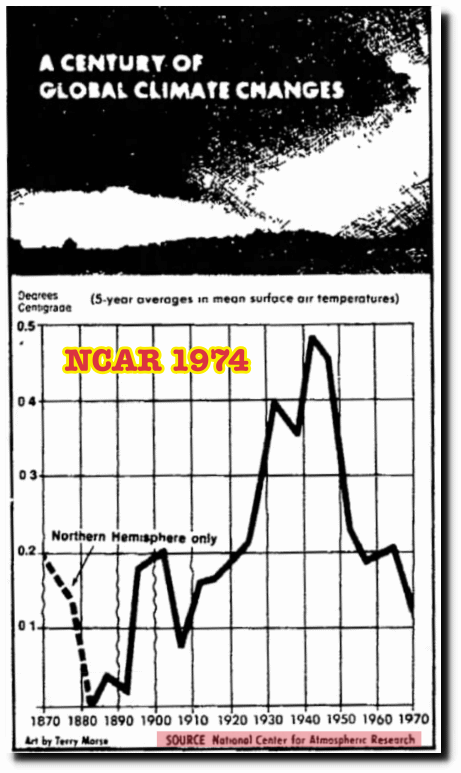
The fact is that to date, we have been unable to isolate the Climate Sensitivity to CO2 signal, if any at all exists, from the background of natural variation. Our data sets are not sufficient for the purpose; they have so many deficiencies and errors, that they are not capable of serious scientific study. The land based thermometer record has been so horribly bastardized that it might as well be chucked in the bin; the only signal in that is the artefacts of our own adjustments to the raw data, and should be chucked in the trash bin. The data sets are unable to answer the central question: is the climate sensitive to CO2, and if so what is the sensitivity?
If one looks at the data set before the late 20th century revisions/rewriting, the position is even more stark. I set out below the record as it was thought to be in the mid 1970s for the Northern Hemisphere. We do not have any worthwhils data on the Southern Hemisphere which is mostly ocean or Antarctica, or the outback of Australia.
“there is no correlation between the rise in CO2 and the observational temperature record”
Stated with such emphatic certitude it must be true…
Hmmm…
http://zfacts.com/metaPage/lib/zFacts-CO2-Temp.gif?w=240
http://www.icr.org/i/articles/af/does_carbon_dioxide_fig3new.jpg
Looks to be just a smidgen of correlation going on there.
I guess it all depends upon how much emphasis that you place on the word smidgen
There is some similarity, but correlation is something very different to similarity.
When someone asserts that there is correlation periods of anti-correlation, become a big issue. For example:
First, look at the blue temperature line between 1890 and 1910.It goes from about -0.4 to -0.8, and yet the red CO2 shows a steady increase during this period. Where is the correlation? Problem, Problem.
Second, look at the blue temperature line between 1920 and 1965. During this period, there is a steady increase in CO2, but the temperature during this period is anything but steady, the peak in temperature around the early 1940s cannot be explained by CO2, the divergence is far too great, and it contains a 15 year period between the early 1940s and late 1950s when temperatures drop significantly (a fall of some 0.5 degrees from about +0.1 to -0.4) whilst C02 rises unabated. That is significant anti-correlation
Third, I would accept that there is strong similarity during the period late 1960s through to early 2000s. If there was similar strong similarity during the earlier periods, ie., the period prior to 1960, one might even consider your assertion about correlation to be correct even though there are short lived problems with the temperature dips around the late 1970s and again around the late 1980s.
Fourth, look at the rate of warming between 1910 and the early 1940s. The rise in temperature during this period is some 0.8 deg C from about -0.7 to + 0.1 deg C. The rate of increase in temperature is about the same as the rate of increase in temperature between the period around the 1970s through to the early 2000s, and yet the gradient of CO2 emissions (the amount and rate of increase) is significantly different between these two periods. WupWT?. Given the very steep increase in the rate of CO2 emissions during the latter period, if CO2 was a driver one would expect to see a far greater rise in the rate of temperature increase during the period around 1970 to early 2000s when compared to the earlier period 1910 to early 1940s given that during the earlier period CO2 was far less and the rate of increase of CO2 far less. Once again, there is a breakdown in correlation.
Overall, there is nothing like correlation in your first plot. The devil with correlation is always in the detail. Some similarities, YES, but correlation certainly not.
I did not comment on your second plot, but we know that on paleo time scales, CO2 lags temperature changes. CO2 is a response not a driver of temperature on paleo scales.
Richard:
” CO2 is a response not a driver of temperature on paleo scales.”
Correct – it was a feedback …. except where out-gassing occurred from massive volcanic events (out of ice-ball Earth?).
However, if CO2 is put into the atmosphere OUTSIDE of the carbon cycle it will drive/lead.
Richard, I’m not a statistician….but I can tell you the first graph is showing an excellent correlation between temperature and CO2 and the second is an even better one.
On the second plot, whether one lags the other is immaterial to their correlation.
And no I have not mentioned causation once, but, where there is causation there is always correlation…
Which begs the question:
http://dangerousintersection.org/wp-content/uploads/2006/09/CO2-Temperature.gif
What happens next?
“The δ13C data are not consistent with an anthropogenic source UNLESS you invoke an additional independent source of variation in δ13C, which is of course what your explanation seeks to do.”
Jim:
From: https://www.esrl.noaa.gov/gmd/outreach/isotopes/c13tellsus.html
“The relative proportion of 13C in our atmosphere is steadily decreasing over time. Before the industrial revolution, δ13C of our atmosphere was approximately -6.5‰; now the value is around -8‰. Recall that plants have less 13C relative to the atmosphere (and therefore have a more negative δ13C value of around -25‰). Most fossil fuels, like oil and coal, which are ancient plant and animal material, have the same δ13C isotopic fingerprint as other plants. The annual trend–the overall decrease in atmospheric δ13C–is explained by the addition of carbon dioxide to the atmosphere that must come from the terrestrial biosphere and/or fossil fuels. In fact, we know from Δ14C measurements, inventories, and other sources, that this decrease is from fossil fuel emissions, and is an example of the Suess Effect.
Recall that the Suess Effect is the observed decrease in δ13C and Δ14C values due to fossil fuel emissions, which are depleted in 13C and do not contain 14C.
Total atmospheric carbon dioxide levels (not isotopic ratios, but just total carbon dioxide) show strong seasonal variations. In the summer (in the northern hemisphere–where most of the Earth’s land sits), carbon dioxide decreases as it is fixed by plants via photosynthesis. In the fall and winter, carbon dioxide increases as many plants stop photosynthesizing and some of the carbon dioxide they fixed is released through respiration from plants, animals, and soils. Seasonal δ13C variations show the opposite pattern. δ13C increases in the summer and decreases in the winter, as you can see on the graph below. This opposite trend is termed anticorrelation, and is explained using the same reasoning behind the total carbon dioxide pattern. When plants take up carbon dioxide, they prefer 12C over 13C. This leaves relatively more 13C in the atmosphere, which increases the δ13C of the atmosphere. However, in the winter, when the plants release more carbon dioxide than they consume, this carbon dioxide entering the atmosphere is relatively poor in 13C. This decreases the δ13C of the atmosphere during the fall and winter of each year since the carbon dioxide released from the plants is relatively rich in 12C–decreasing the ratio of 13C to 12C in the atmosphere. Of course, the seasons are opposite in the Northern and Southern Hemispheres, so why don’t the trends in the two hemispheres cancel each other out? The answer is as easy as looking at a globe. There’s a lot more land and a lot more land biota in the Northern Hemisphere, so on average across the globe, the δ13C and CO2 change with the Northern Hemisphere seasons.”
I appreciate you sharing this Toneb, but this is actually a very good example of the misinformation that I was referring to. We all can see that δ13C values are generally decreasing over time and are currently around -8 per mil. So we can all agree that, on average, the incremental CO2 has a δ13C value that is lower than this. But we can quite easily determine the actual value and it is -13 per mil, not -25 or -26 per mil. I can post the plot if you wish. This is a long term average and varies over shorter timescales with ENSO activity.
The other “problem” which is clearly shown on the plot that you posted is that there are times when atmospheric CO2 is increasing and yet the atmospheric δ13C value is also INCREASING (e.g. 1998-2001). These appear (to me at least) to correlate with La Niña events. Regardless, they demonstrate that some of the time, the incremental CO2 has a δ13C content that is higher (less negative) than current atmospheric levels. I believe this to be an extremely important point. You may also note that there are times when the rate of decrease in δ13C is faster (e.g. 1997-1998), which reflects a content that is significantly less that -13 per mil and these periods would appear to correlate with El Niño events.
Thus, my view of the δ13C content of the INCREMENTAL atmospheric CO2 averages out at -13 per mil, which happens to be roughly half way between a deep oceanic source and a biosphere/fossil source, and moves towards extremes of circa zero (during a La Niña) and – 26 (during an El Niño).
Jim,
It is like with many things in nature: it is not because there is a lot of natural variability that this denies a trend (natural or not). That is the case for temperature, CO2 increase rate, δ13C changes, sea level change,… In many cases you need several years (25 years for sea level) of data before you can (statistically) prove that there is a trend and what that trend is.
In the case of the CO2 increase you need at least 3 years of data to show the trend (~2 ppmv/year) over the noise (+/- 2 ppmv year by year).
In the case of δ13C you need ~8 years to separate the trend from the “noise”.
It can be proven from both the δ13C changes and the O2 changes that vegetation is the main cause of the variability around the trend, both for CO2 changes and δ13C changes. See:
http://www.bowdoin.edu/~mbattle/papers_posters_and_talks/BenderGBC2005.pdf
Vegetation is not the cause of the trend, as that is an increasing sink for CO2, preferentially 12CO2, thus increasing the relative 13CO2 content in the atmosphere and thus not the cause of the fast δ13C decline…
The oceans are higher in δ13C level than the atmosphere, thus neither responsible for the δ13C decline, but the deep ocean – atmosphere CO2 exchanges are responsible for the “dilution” of the δ13C decline caused by human emissions.
Ferdinand,
Three points (with apologies if they sound blunt):
1. If I have two separate measurements of a trend, however short term they might be, I take notice.
http://i64.tinypic.com/fw0tvt.jpg
2. Do you agree that the long term decline of atmospheric δ13C over vastly more than 8 years is consistent with an average content of the incremental CO2 of -13 per mil? The plot below shows 40 years. If not, please provide your numerically-based analysis that fully explains this linear relationship.
http://i64.tinypic.com/2qlwg42.jpg
3. Why do you post a link to a paper on O2/N2 when we are discussing δ13C content of CO2? I am surprised that any scientist could publish such a paper and discuss the O2/N2 decline only in terms of an annual decline rate (Gt C yr-1). I would not have accepted this paper if I had been asked to peer review it (but then I am not a “peer”). The relationship is linear with CO2 – did they really miss this?
http://i66.tinypic.com/d9ov5.jpg
Jim,
1. Shows that there is a decline in δ13C everywhere, starting near ground level in the NH (where 90% of human emissions are) and with some delay reaching the height of Mauna Loa and passing the ITCZ near the equator reaching the south pole a few years kater.
2, Yes.
3. I did post the link to the O2/N2 ratio, because that shows us what the biosphere is doing. The biosphere is the only other source or sink for low-13C. All other known sources of CO2 have higher δ13C levels than the atmosphere: the (deep) oceans, volcanoes, carbonate rocks,… Only ancient (“fossil”) organic carbon and recent organic carbon is low to extremely low (natural gas) in δ13C level.
Thus the biosphere can be another source of low-13CO2, besides humans. The link did show that this is not the case: the biosphere is a net sink for CO2, not a source.
Of course the O2/N2 ratio goes down in exact ratio with fossile fuel use, as that uses oxygen. The point is that after distracting the fossil O2 use from the O2 decline, what rests is the oxygen use or production by the biosphere. In this case there is less O2 used than calculated from fossil fuel burning. Thus the biosphere produces more O2 than it uses, thus takes more CO2 in than it releases and preferentially 12CO2…
4. Thus the average decline in δ13C is with a CO2 increase which is in average -13 per mil, while what we add to the atmosphere is average -26 per mil. That only means that part of human emissions are redistributed between the atmosphere and other reservoirs and/or other reservoirs “dilute” the human δ13C “fingerprint” either by additional CO2 with a higher δ13C level or simply pass by in sufficient quantity to never come back (at least not in the next centuries).
The redistribution is a fact, as the same δ13C changes are found in the ocean surface as in the atmosphere:
http://www.ferdinand-engelbeen.be/klimaat/klim_img/sponges.jpg
See the difference between the δ13C of the ocean surface and the atmosphere in that graph…
If there is any CO2 exchange between the oceans and the atmosphere, that would increase the δ13C level of the atmosphere: that is the source of the “dilution” of the human “fingerprint”. One can calculate that CO2 exchange that matches reality:
http://www.ferdinand-engelbeen.be/klimaat/klim_img/deep_ocean_air_zero.jpg
Thus a deep oceans – atmosphere and back flow of ~40 GtC/year is sufficient. Independently verified by the decay speed of the 14C level after the 1960 atomic bomb tests spike…
Ferdinand,
I will respond more fully tomorrow, but why would you say “Of course the O2/N2 ratio goes down in exact ratio with fossile fuel use, as that uses oxygen”? No it doesn’t (go down in the exact ratio), as I am sure you know. The ratio for fossil fuels is generally accepted as circa 1.4, whereas the graph demonstrates the reality to be 2.2 (10.81/4.8). I am familiar with the so-called oxygen balance model, which requires several other parameters to miraculously combine to give this beautiful long-term linear relationship (R2 of 0.9975). If we are going to progress these discussions, it is essential that we make a clear distinction between what the data actually show and what are the model(s) that have been proposed to explain that data. Currently, I am entirely focussed on what the data (observations/measurements) show. The explanatory models can come later.
On the other hand, I am pleased to see that you do accept that the decline in δ13C is consistent with an incremental CO2 content of -13 per mil.
Jim,
From the O2/N2 balance work:
Table 3. Conversion Factors and Other Terms for Calculating the Anthropogenic Mass Balance
GtC to ppm CO2: 0.471
ppm O2 to per meg δ(O2/N2): 4.8
fuel mean ΔO2/ΔCO2 during combustion: 1.45
bio mean ΔO2/ΔCO2 during photosynthesis/respiration: 1.1
You have an extra factor 4.8 in your graph between the O2 change in ppmv vs. per meg δ(O2/N2) and the increase of CO2 in the atmosphere is only about half (in mass) of the CO2 from combustion by humans…
Ferdinand, please read what I said …
“The ratio for fossil fuels is generally accepted as circa 1.4, whereas the graph demonstrates the reality to be 2.2 (10.81/4.8).” Note the division by 4.8!
The reality (2.2) is what the data tell us is the actual observed exchange ratio between O2 and CO2 in the atmosphere. The cause of it being double the value seen in photosynthesis/respiration (1.1) and 50% higher than the value for burning fossil fuels (1.4) is unproven, but is hypothesised (in the so-called oxygen balance model) to be due to the anthropogenic CO2 being partly taken up by the terrestrial biosphere and partly the oceans (in just the right proportions). In order to balance, however, it then needs to invoke some O2 outgassing in addition. All these parameters, which are all time-variant, then combine to provide the remarkable linear relationship. Apparently. Elephant’s trunk anyone?
Incidentally, have you noticed that since the rate of emissions increased during the first decade of this century, the amount of inferred O2 outgassing has had to increase significantly in order to maintain the “balance” (based on the CDIAC carbon (sic) budget: http://cdiac.ornl.gov/)?
It bothers me greatly that plots of δ13C vs 1/CO2 and O2/N2 vs CO2. which are utterly fundamental to our understanding of atmospheric changes, are rarely updated/published. Why is this?
Jim,
Sorry, indeed you used the conversion factor, but you didn’t take into account that the oxygen use is for the full burning of fossil fuels (+/- what the biosphere does), but the change of CO2 levels in the atmosphere is only about half human emissions.
The oxygen use or production O2/CO2 ratio is not far from 1:1, measured in the fields like here:
http://onlinelibrary.wiley.com/doi/10.1029/2004GB002242/pdf
The “airborne fraction”, what remains of the CO2 emissions in the atmosphere (as mass. not what remains of the human emissions alone) is known with high accuracy: that is what is measured at Mauna Loa. Human emissions are from national inventories of fossil fuel sales and burning efficiency, with an accuracy of +/- 0.5 GtC/year for ~9 GtC/year . Probably more underestimated than overestimated… That gives 50-55% of human emissions remaining in the atmosphere.
Oxygen changes are mainly from fossil fuel burning and photosynthesis. O2 changes from the oceans are limited as that is mainly a question of solubility in seawater, but I have the impression that they didn’t take into account biolife in the ocean surface, or included that in the overall O2 balance…
Indeed the O2 measurements need an urgent update, but I suppose that the main problem is the extremely care needed in sampling and measurement as you need an accuracy of better than 1:1 miilion…
Ferdinand,
You make the comment “… but I have the impression that they didn’t take into account biolife in the ocean surface, or included that in the overall O2 balance…”
That is certainly consistent with what I have read so we can agree on that!
100% of the CO2 in the atmosphere is produced by man?????
MarkW,
Of course not, but ~90% of the increase in CO2 since the LIA is caused by the ~200% emissions by man. That is for the increase in total CO2 mass, not the original molecules which are distributed over all reservoirs. Currently ~9% of the total CO2 mass in the atmosphere is from fossil fuel use…
“I believe thi§ §cienti§t i§ having hi§ “Michael Fi§h”-moment!”
“ultra-giganormous”
S.L.B.T.M.