Yet another study tries to erase "the pause" – but is missing a whole year of data

From UC Berkeley Earth comes this paper that tries some new statistical techniques to get “the pause” to go away, following on with the infamous Karl et al paper of 2015, that played tricks with SST measurements done in the 40’s and 50’s to increase the slope of the warming. This aims to do the same, though the methods look to be a bit more sophisticated than Karl’s ham-handed approach. The paper link is below, fully open sourced. I invite readers to have a look at it, and judge for yourselves. Personally, it looks like ignoring the most current data available for 2016, which has been cooling compared to 2015, invalidates the claim right out of the gate.

If a climate skeptic did this sort of stuff, using incomplete data, we’d be excoriated. yet somehow, this paper using incomplete data gets a pass by the journal, and publishes with 2015 data at the peak of warming, just as complete 2016 data becomes available.

The results section of the paper say:

From January 1997 through December 2015, ERSSTv3b has the lowest central trend estimate of the operational versions of the four composite SST series assessed, at 0.07°C per decade. HadSST3 is modestly higher at 0.09°C per decade, COBE-SST is at 0.08°C per decade, whereas ERSSTv4 shows a trend of 0.12°C per decade over the region of common coverage for all four series. We find that ERSSTv3b shows significantly less warming than the buoy-only record and satellite-based IHSSTs over the periods of overlap [P < 0.01, using an ARMA(1, 1) (autoregressive moving average) model to correct for autocorrelation], as shown in Fig. 1. ERSSTv3b is comparable to ERSSTv4 and the buoy and satellite records before 2003, but notable divergences are apparent thereafter.

zeke-allsets-fig1

What’s missing? Error bars showing uncertainty. Plus, the data only goes to December 2015They’ve missed an ENTIRE YEAR’s worth of data, and while doing so claim “the pause” is busted. It would be interesting to see that same graph done with current data through December 2016, where global SST has plummeted. Looks like a clear case of cherry picking to me, by not using all the available data. Look for a follow up post using all the data.

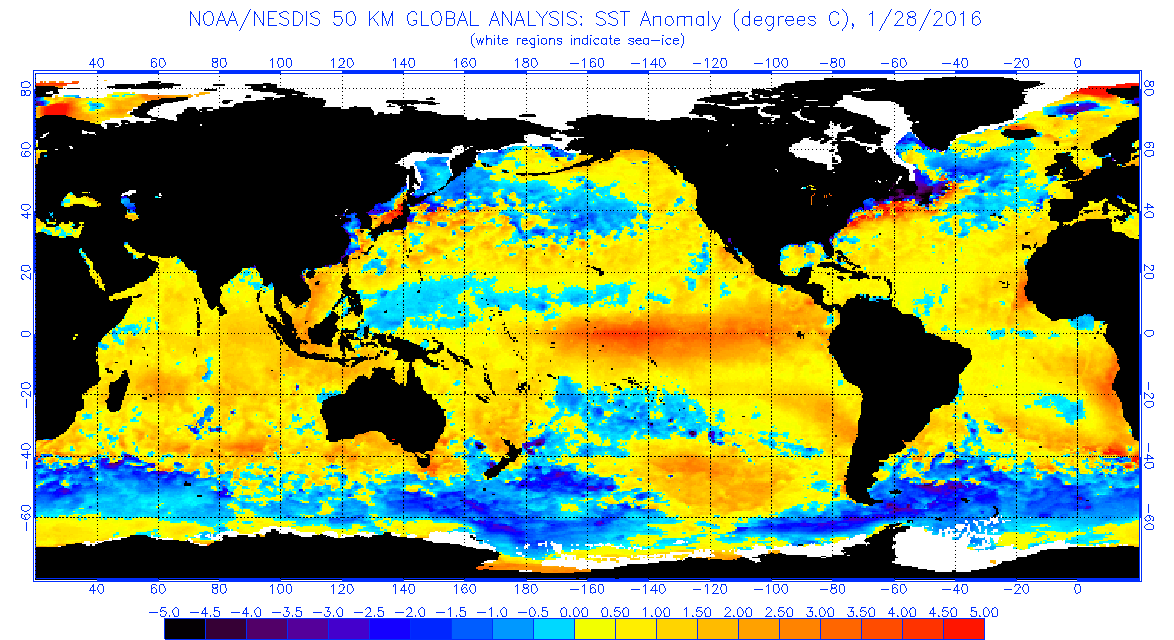
Here’s what the world’s sea surface temperature looks like at the end of 2016 – rather cool.

global-sst-12-29-2016

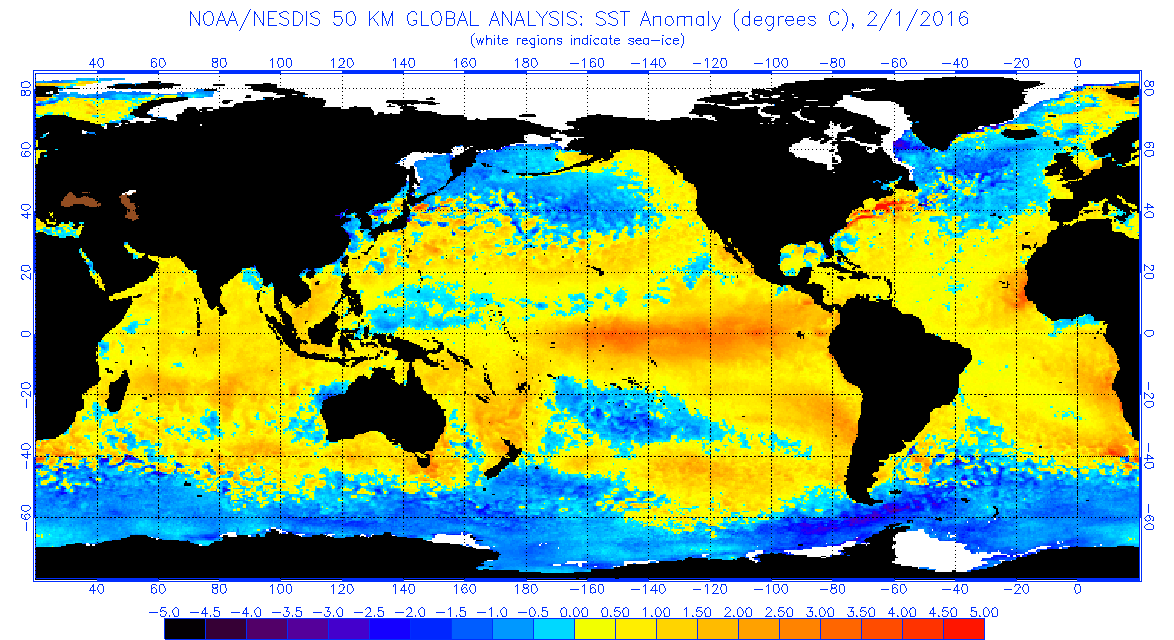
Compare that to December 2015, for Hausfather’s end data period – they ended on a hot note:

global-sst-12-31-2015


I did ask Zeke Hausfather, the lead author about this paper via email, about it and the data, and to his credit, he responded within the hour, saying:

Hi Anthony,

We haven’t updated our buoy-only, satellite-only, and argo-only records to present yet (then still end January 1st 2016), but we are planning on updating them in the near future.

By the way, the paper itself is open access, available here: http://advances.sciencemag.org/content/3/1/e1601207.full.pdf+html
We also have a background document we put together here: http://www-users.york.ac.uk/~kdc3/papers/ihsst2016/background.html
I’m attaching the data shown in that figure. All series have been masked to common coverage (though we we do three different variations of tests for coverage effects, as we discuss in detail in the paper).
The data are:
acci97Mm.temp – Satellite radiometer record from 1997 (from ATSR and AVHRR)
buoy97Mm.temp – Buoy-only record from 1997
cobe97Mm.temp – COBE-SST (Japanese record)
had97Mm.temp – HadSST3
v3_97Mm.temp – ERSSTv3b
v4_97Mm.temp – ERSSTv4
We start in 1997 because prior to that there is insufficient data from buoys to get a global estimate, and satellite data is only available from mid-1996.
Hope that helps,
-Zeke

I have made the data available here in a ZIP file (17KB)

That’s how science should work, sharing the data, but I contend that the data should be updated in the paper before publishing it. A year long gap, with a significant cooling taking place, is bound to change the results. Perhaps this is an artifact of the slow peer-review process.

But, Zeke should know better, than to allow the word “disproved” in a headline. We’ll see how well his study claims of “pause-busting” hold up in a year without a major El Niño to bolster his case.

UPDATE: Bob Tisdale points out via email that this paper seems to be a manifestation of a guest post at Judith Curry’s a year ago:

A buoy-only sea surface temperature record

In that post, there’s some serious concerns about the buoy data used, from climate Scientist John Kennedy of the UK Met Office

Dear Bob,

You raise some interesting points, which I’d like to expand on a little. I’ve used your numbering.

First, coastal “SST” from drifters can exhibit large variations because there can be large variations in coastal areas. Also, sometimes, buoys wash up on beaches and start measuring air temperature rather than SST. It’s also common to see drifting buoys reporting erratic measurements shortly before they go offline, wherever they happen to be. Occasionally, they get picked up by ships and, for a short period, record air temperatures on deck. This paper goes into some of the problems that ship and drifter data suffer from:

http://onlinelibrary.wiley.com/doi/10.1002/jgrc.20257/full

Second, drifter design was standardised in the early 1990s. Since then, the only major change I know of has been in the size of the buoys: modern mini drifters are smaller than their non-mini predecessors. Different manufacturers make buoys to the specifications laid down in the standard design. Metadata for buoys is not especially easy to get hold of (for ships there’s ICOADS and WMO publication 47), but work is ongoing to organise the metadata and to see if there are measurable differences between drifters from different manufacturers. Work has also been done to fit a small number of drifters with higher-quality thermometers alongside the standard thermistor. See e.g.

http://journals.ametsoc.org/doi/abs/10.1175/2010JTECHO741.1

The results suggest that individual buoys can exhibit a variety of problems. On average, though, they seem to be unbiased relative to the true SST. Individually, they are higher or lower, with calibrations that vary by a few tenths of a degree.

There can occasionally be large calibration errors (of a degree or more). Nowadays, there is constant monitoring of the drifter network by a number of different centres. Large calibration errors are usually identified quickly. Sometimes these can be fixed remotely, sometimes they can’t and the buoy goes onto a list (see, for example, http://www.meteo.shom.fr/qctools/ ). Monitoring of the early data was less thorough.

As a result of the above considerations, everyone who uses drifting buoy data applies some level of quality screening to it. What is generally accepted is that the average drifter makes a much better SST measurement than the average ship (though there are exceptions, of course, in both directions).

Third, I’d note that drifter coverage is not so great prior to 1995 (I think Kevin said the same), so the relative effect of calibration errors would be more pronounced as well as the difficulty of making a solid comparison with fewer data points. I think, more generally, it’s useful to know how consistent the trends are across a variety of periods. As your graphs show, looking at a variety of periods can reveal different aspects of the data.

Fourth, (I think you mistyped HadSST2 when you meant HadNMAT2, or did I misunderstand?). Question: are the coverages of HadNMAT2 and ERSSTv4 in your plot the same? Coverage of NMAT is confined to areas where ships go, and ship coverage has declined somewhat over this period, whereas ERSSTv4 is more or less global.

The closeness with which NMAT and ERSSTv4 should track each other is something to consider also. The ERSST ship adjustment is smoothed so that variations of shorter than a few years (approximately) are not resolved. My understanding of this is that it’s necessary to reduce the effect of random measurement errors on the estimated bias. By smoothing over several years, the effect of random measurement errors average out, so what’s left is largely due to systematic errors (which is good because that’s what they are trying to assess). On the other hand, it means that the method can’t resolve changes in bias that happen faster than that.

Fifth, the uptick in the number of ICOADS SST observations in 2005 coincides with a large increase in the number of drifting buoy data. Depending on the version of ICOADS used, there’s also often a change in the number and composition of observations at the switch from delayed mode to real time. I think for ICOADS 2.5, that’s the end of 2007.

Sixth, don’t forget that there are 100 different estimates of HadSST3 – which together span estimated uncertainty in the bias adjustment – and additional measurement, sampling and coverage uncertainties which can also affect the trends over shorter periods such as the ones being discussed here. In brief, the trend over this period as estimated by HadSST3 is uncertain. The same goes for ERSSTv4: there is an uncertainty analysis (Liu et al. 2015 published at the same time as Huang et al. 2015). One should be wary about drawing conclusions from a comparison based only on the medians.

http://journals.ametsoc.org/doi/abs/10.1175/JCLI-D-14-00007.1

Best regards to one and all,

John Kennedy

One wonders of Hausfather and Cowtan saw this concern, and if they did, heeded it.


Global warming hiatus disproved — again

By Robert Sanders, Media relations

A controversial paper published two years ago that concluded there was no detectable slowdown in ocean warming over the previous 15 years — widely known as the “global warming hiatus” — has now been confirmed using independent data in research led by researchers from UC Berkeley and Berkeley Earth, a non-profit research institute focused on climate change.

A NEMO float, part of the global Argo array of ocean sensing stations, deployed in the Arctic from the German icebreaker Polarstern Bremerhaven. (Photo courtesy of Argo)

After correcting for this “cold bias,” researchers with the National Oceanic and Atmospheric Administration concluded in the journal Science that the oceans have actually warmed 0.12 degrees Celsius (0.22 degrees Fahrenheit) per decade since 2000, nearly twice as fast as earlier estimates of 0.07 degrees Celsius per decade. This brought the rate of ocean temperature rise in line with estimates for the previous 30 years, between 1970 and 1999.The 2015 analysis showed that the modern buoys now used to measure ocean temperatures tend to report slightly cooler temperatures than older ship-based systems, even when measuring the same part of the ocean at the same time. As buoy measurements have replaced ship measurements, this had hidden some of the real-world warming.

This eliminated much of the global warming hiatus, an apparent slowdown in rising surface temperatures between 1998 and 2012. Many scientists, including the International Panel on Climate Change, acknowledged the puzzling hiatus, while those dubious about global warming pointed to it as evidence that climate change is a hoax.

Climate change skeptics attacked the NOAA researchers and a House of Representatives committee subpoenaed the scientists’ emails. NOAA agreed to provide data and respond to any scientific questions but refused to comply with the subpoena, a decision supported by scientists who feared the “chilling effect” of political inquisitions.

The new study, which uses independent data from satellites and robotic floats as well as buoys, concludes that the NOAA results were correct. The paper will be published Jan. 4 in the online, open-access journal Science Advances.

“Our results mean that essentially NOAA got it right, that they were not cooking the books,” said lead author Zeke Hausfather, a graduate student in UC Berkeley’s Energy and Resources Group.

Long-term climate records

Hausfather said that years ago, mariners measured the ocean temperature by scooping up a bucket of water from the ocean and sticking a thermometer in it. In the 1950s, however, ships began to automatically measure water piped through the engine room, which typically is warm. Nowadays, buoys cover much of the ocean and that data is beginning to supplant ship data. But the buoys report slightly cooler temperatures because they measure water directly from the ocean instead of after a trip through a warm engine room.

sst-berkeleynoaa
A new UC Berkeley analysis of ocean buoy (green) and satellite data (orange) show that ocean temperatures have increased steadily since 1999, as NOAA concluded in 2015 (red) after adjusting for a cold bias in buoy temperature measurements. NOAA’s earlier assessment (blue) underestimated sea surface temperature changes, falsely suggesting a hiatus in global warming. The lines show the general upward trend in ocean temperatures. (Zeke Hausfather graphic)

Hausfather and colleague Kevin Cowtan of the University of York in the UK extended that study to include the newer satellite and Argo float data in addition to the buoy data.NOAA is one of three organizations that keep historical records of ocean temperatures – some going back to the 1850s – widely used by climate modelers. The agency’s paper was an attempt to accurately combine the old ship measurements and the newer buoy data.

“Only a small fraction of the ocean measurement data is being used by climate monitoring groups, and they are trying to smush together data from different instruments, which leads to a lot of judgment calls about how you weight one versus the other, and how you adjust for the transition from one to another,” Hausfather said. “So we said, ‘What if we create a temperature record just from the buoys, or just from the satellites, or just from the Argo floats, so there is no mixing and matching of instruments?’”

In each case, using data from only one instrument type – either satellites, buoys or Argo floats – the results matched those of the NOAA group, supporting the case that the oceans warmed 0.12 degrees Celsius per decade over the past two decades, nearly twice the previous estimate. In other words, the upward trend seen in the last half of the 20th century continued through the first 15 years of the 21st: there was no hiatus.

“In the grand scheme of things, the main implication of our study is on the hiatus, which many people have focused on, claiming that global warming has slowed greatly or even stopped,” Hausfather said. “Based on our analysis, a good portion of that apparent slowdown in warming was due to biases in the ship records.”

Correcting other biases in ship records

In the same publication last year, NOAA scientists also accounted for changing shipping routes and measurement techniques. Their correction – giving greater weight to buoy measurements than to ship measurements in warming calculations – is also valid, Hausfather said, and a good way to correct for this second bias, short of throwing out the ship data altogether and relying only on buoys.

Berkeley’s analysis of ocean buoy (green) and satellite data (orange) and NOAA’s 2015 adjustment (red) are compared to the Hadley data (purple), which have not been adjusted to account for some sources of cold bias. The Hadley data still underestimate sea surface temperature changes. (Zeke Hausfather graphic)

“In the last seven years or so, you have buoys warming faster than ships are, independently of the ship offset, which produces a significant cool bias in the Hadley record,” Hausfather said. The new study, he said, argues that the Hadley center should introduce another correction to its data.

“People don’t get much credit for doing studies that replicate or independently validate other people’s work. But, particularly when things become so political, we feel it is really important to show that, if you look at all these other records, it seems these researchers did a good job with their corrections,” Hausfather said.

Co-author Mark Richardson of NASA‘s Jet Propulsion Laboratory and the California Institute of Technology in Pasadena added, “Satellites and automated floats are completely independent witnesses of recent ocean warming, and their testimony matches the NOAA results. It looks like the NOAA researchers were right all along.“

Other co-authors of the paper are David C. Clarke, an independent researcher from Montreal, Canada, Peter Jacobs of George Mason University in Fairfax, Virginia, and Robert Rohde of Berkeley Earth. The research was funded by Berkeley Earth.

The paper: Assessing Recent Warming Using Instrumentally-Homogeneous Sea Surface Temperature Records (Science Advances)

0 0 votes
Article Rating

Discover more from Watts Up With That?

Subscribe to get the latest posts sent to your email.

297 Comments
Inline Feedbacks
View all comments
Reply to  Robert Kernodle
January 4, 2017 4:31 pm

Thanks for that, Robert Kernodle. 🙂
Including just minimal systematic error, the temperature uncertainty bars would go right off the page in Figures 1, 6 and 7 in the head-post. Those plots are all physically meaningless.

Michael Kelly
Reply to  Pat Frank
January 4, 2017 5:27 pm

Wow! Excellent essay!

bit chilly
Reply to  Pat Frank
January 6, 2017 3:52 am

“these plots are all physically meaningless”
that is the only meaningful takeaway from this .

jeanparisot
Reply to  Robert Kernodle
January 5, 2017 4:57 am

I made my kids read that, thank you.
And, after all the instrument error you have to account for the spatial error in sampling. Even if you embrace the CO2 armeggedon, this error budget should concern you. After all (sorry), ‘you can’t manage what you can’t measure’ is a truism every good little Marxist should fear.

P Wilson
Reply to  jeanparisot
January 5, 2017 9:07 pm

Yes a fine essay. I wonder, however, if the global warming proponents actually read around the subject, to more truthful accounts than theirs, or whether they live completely in their own darkness?

Reply to  jeanparisot
January 6, 2017 6:42 pm

Jeanparisot,
How about having your kids read some real science:
This graphic compares the year-to-date temperature anomalies for 2016 (black line) to what were ultimately the seven warmest years on record: 2015, 2014, 2010, 2013, 2005, 2009, and 1998. Each month along each trace represents the year-to-date average temperature anomaly. In other words, the January value is the January average temperature anomaly, the February value is the average anomaly of both January and February, and so on. The average global land and ocean surface temperature for January–November 2016 was 0.94°C (1.69°F) above the 20th century average of 14.0°C (57.2°F)—the highest global land and ocean temperature for January–November in the 1880–2016 record, surpassing the previous record set in 2015 by 0.06°C (0.11°F)
Source: https://www.ncdc.noaa.gov/sotc/global/2016/11/supplemental/page-2
Jenaparisot: You do understand that the odds of consecutive warmest ever years is much greater than 1 in 10,000?
When your children’s taxes go out the roof in an attempt to deal with sea level rise and deal with which all the refugees which will be flooding in from some Central America or South America country you can explain how you and the deniers stood by and did nothing.

Reply to  jeanparisot
January 7, 2017 1:04 pm

Benjamin Wright, you understand, don’t you, that when ±0.5 C systematic measurement error (869.8 KB) is properly included, your temperature anomalies are shown to be the scientific nonsense they actually are, instead of NCDC’s disingenuous presentation of false precision.
You also realize, don’t you, that when air temperatures are rising out of a global cool period (the LIA), that a series of record annual high temperatures is inevitable, i.e., 1 chance in 1.
As soon as the AGW hysteria is ended, taxes will go down because huge tranches of money will not be wasted on nothing.
The rate of sea level rise hasn’t changed for as long as we’ve been measuring it. Your worries are completely vacuous. No one should pay attention to them.

jeanparisot
Reply to  Pat Frank
January 8, 2017 8:00 am

Pat, I agree with you, with the exception that our government will continue to fund some nonsense.

January 4, 2017 1:34 pm

I commented on Twitter on this paper.
The authors claim they validate and/or cross-check Karl et al adjustments by comparing ERSST4 against ‘instrumentally homogenous’ temperature records (IHSST) from buoys, and the like. Karl et al adjustments were made on the reasoning that buoys had a cool ‘bias.’ Now, the authors say they see the adjusted SSTs match buoys. This is circular reasoning. Additionally, the other IHSSTs used by the authors are themselves buoy-dependant, as the authors themselves admit.
When will we put a full stop to flawed non-independent reasoning in climate science? Of course, I could be wrong and I am happy to be educated but this sort of thing seems to repeat itself in climate science a lot. The author list is not confidence-inspiring either.

Reply to  Shub (@shubclimate)
January 4, 2017 2:22 pm

Hey Shub I asked you a question before this paper was published..
Would you believe in satelllite data?
You were silent…
Do you now want to deny satellite data
Karl got it right.
Come Jan 20th, Trump will have full and total control of the NOAA data.
1. No skeptic has shown that karl got it wrong.
2. An independent team of scientists looking at independent data, some data never considered before,
have demonstrated he got it right.
3. The showed the data and the CODE.
The best response?
The blog writer here complains that a papeer submitted in March 2016… doesnt have data through the end of 2016
Some skeptic…
[Hey Mosher, does the pause remain “busted” when you plot the 2016 data? Is a pause busted one year, but returning in the future via cooling still “busted”. Plot it and let’s see. Some scientist…-Anthony]

Reply to  Steven Mosher
January 4, 2017 3:09 pm

” No skeptic has shown that karl got it wrong.”
Karl et al took a Frankenstein of a dataset and compared it buoys. They declared the buoys have a ‘bias’ and adjusted them.
Where is the question of ‘right’ or ‘wrong’ in this? There are only choices. There is no methods of verification, or cross-validation. If you add numbers to numbers, you get bigger numbers period. There is little science in all this

Reply to  Steven Mosher
January 4, 2017 3:34 pm

Yours is a treffer reply, AW. Evidence is the ‘violent’ negative reaction to David Rose pointing out to UK readers the sharp T decline past 9 months as El Nino dissipated. ‘Cherry pick’ not. Just what happened after the El Nino peak. ‘Land only cheat’ when Rose explained he chose that because less thermal inertia so a lead indicator. Then followed up with land plus sea when that showed the same conclusion. Apoplexy amongst warmunists.
Here, Zeke and friends got their desired MSM headline. Won the PR skirmisch but will lose the battle and then the war. Failed to notice that with DOTUS, MSM doea not rule any more. Truth has found a way (like WUWT) to speed up and around roadblocks.

O R
Reply to  Steven Mosher
January 4, 2017 3:53 pm

“Hey Mosher, does the pause remain “busted” when you plot the 2016 data? Is a pause busted one year, but returning in the future via cooling still “busted”. Plot it and let’s see. Some scientist…-Anthony]”
Well, they have left out the whole year 2016, which actually is the warmest ERSST4 year on record. So if you are going to accuse them for anything, it should be to hide the warming.
But I guess you have missed the aim of the paper. It is not to analyse data that came in ofter submission of the manuscript, it is to validate ERSST4 against other modern independent datasets..

Reply to  Steven Mosher
January 4, 2017 4:06 pm

Steve,
Why the preoccupation with data, so much of which is demonstrably cherry picked, adjusted and manipulated towards a preconceived conclusion? I strongly suggest that you look at the physics to discern what is and is not possible and you will find that even the low end of the assumed sensitivity of 0.8C +/- 0.4C per W/m^2 is far beyond what can be justified by any physical laws.
Based on the sensitivity being the slope of the Stefan-Boltzmann LAW, it’s somewhere between 0.2 and 0.3 C per W/m^2 and which is readily validated with data, at least relative to solar forcing. The SB LAW is immutable physics that has been settled science for more than a century. What physical laws do you propose can override the sensitivity predicted by the SB LAW and do so by multiple factors of 2?
You should be able to agree that the SB LAW works exactly to predict the temperature and sensitivity of the Moon (I’ll refer you to the data from the Lunar Reconnaissance Orbiter), so how can you connect the dots between the SB sensitivity and the sensitivity assumed by the IPCC? The atmosphere is completely passive and in no way shape of form can add the amount of energy to the surface that the IPCC sensitivity requires.
While you’re at it, what physical law can explain how 1 W/m^2 of forcing can result in 4.3 W/m^2 of incremental surface emissions (to manifest a 0.8C increase), while each of the 240 W/m^2 arriving from the Sun results in only 1.6 W/m^2 of incremental emissions? It it your opinion that 1 W/m^2 of ‘forcing’ from CO2 is 4 times more powerful at warming the surface than 1 W/m^2 of solar forcing? Perhaps you believe that different Joules are capable of doing different amounts of work?

Reply to  co2isnotevil
January 4, 2017 6:29 pm

The atmosphere is completely passive

Co2, it isn’t passive. It’s active, with a variable nonlinear cooling rate. Herecomment image
Detains, data source, and paper referencing exponential decay in cooling rates. Here http://wp.me/p5VgHU-2A
But I identified the same change in cooling rate, prior to my finding the paper, in the original version it was not there at all. But I was surprised by their lack of correlation with rel humidity, then I remembered you don’t get the same results with linear correlation functions when applied to nonlinear relationships, looked at the data, and there it was in living color, the outgoing radiation being regulated.

Reply to  micro6500
January 4, 2017 7:19 pm

micro6500,
“Co2, it isn’t passive. It’s active”
It depends on your definition of active. The standard meaning is that active means it relies on an implicit, infinite source of Joules to supply as much energy as required. Things like resistors, capacitors, inductors and delay lines are passive while things like transistors, mosfets, vacuum tubes, op amps and anything else with an implicit power supply input are active.
Many confuse dynamic with active, but even a collection of R, L and C will exhibit dynamic behavior when driven by a dynamic stimulus. Even a system whose transfer function has dependencies on the stimulus is still a passive system, unless it also contains active elements.
Consensus climate science ASSUMES that the Sun is the implicit power supply of an active amplifier controlled by feedback, but if it was, the power delivered to the surface (output we care about) would be limited by the power available from the power supply and the surface would never emit more power than is supplied by the power supply, independent on the sign or magnitude of the ‘feedback’.
The atmosphere is more accurately modeled as a passive system with delay and its the delayed absorption returned to the surface (whether by GHG’s or clouds) that makes the surface warmer than it would be otherwise. The energy emitted by the atmosphere, whether out into space or back to the surface is limited to the energy absorbed by it, which is mostly originating from the surface. There’s no active amplification involved and the concept of feedback, positive or negative, is irrelevant.

Reply to  co2isnotevil
January 4, 2017 8:32 pm

For expediency I’ll accept passive. But that model as passive with delay is wrong, and the response of the atmosphere to radiation rate is very important, it renders the cooling process independent of any co2 forcing.

scraft1
Reply to  Steven Mosher
January 4, 2017 4:29 pm

Zeke Hausfather said they would update the study soon with full 2016 results. His history indicates that he is trustworthy. Shouldn’t his pledge to update be enough? Hold his feet to the fire and let’s see what the result is.

Evan Jones
Editor
Reply to  Steven Mosher
January 4, 2017 4:34 pm

Hullo, Mosh. What strikes me as odd is the choice of end date. Seems to me like one shouldn’t ride up one side of a blip and not down the other side. Include both of ’em in — or both ’em out. Not only that, but a blip (unless followed by an equivalent net dip) — even with both the ups and downs included — wreaks havoc on a linear trend if it occurs on either end of the graph.

Nick Stokes
Reply to  Steven Mosher
January 4, 2017 7:51 pm

” wreaks havoc on a linear trend if it occurs on either end of the graph”
What sort of havoc do you have in mind? All that counts for the trend is whether the added data is above or below. Adding more 2016 data just increases the trend. I gave trends starting June 1997 below, but it would be the same for any strat before about 2011. Here’s the table:

dataset       End 12/15  End 11/16
NOAA SST       1.099     1.316
HADSST3        0.763     1.026
rogerthesurf
Reply to  Steven Mosher
January 5, 2017 12:07 am

Steven
“Come Jan 20th, Trump will have full and total control of the NOAA data.”
True, and by Trumps own words it will not be politiczed. That is, it will return to being a scientific organization.
Do you have a problem with that?
Cheers
Roger

Ens Josh
Reply to  Steven Mosher
January 5, 2017 4:29 am

[Hey Mosher, does the pause remain “busted” when you plot the 2016 data? Is a pause busted one year, but returning in the future via cooling still “busted”. Plot it and let’s see. Some scientist…-Anthony]
Yes, it probably remains “busted”. Why don’t you try it?

MarkW
Reply to  Steven Mosher
January 5, 2017 9:09 am

I wonder how Nick would react if someone were to pick the bottom of an extreme La Nina as the end point of a temperature trend chart?

Reply to  Steven Mosher
January 5, 2017 10:51 am

Anthony, I am a great supporter of yours, but I think you are out of line with your criticism re 2016. The first thing is that, unfortunately, peer reviewed papers do tend to be a bit out of date because of delays in the review system. In an ideal world that wouldn’t happen of course, but we know we’re not in an ideal world. In fact a single year’s missing data is relatively benign.
The second thing is that it seems unlikely to me that 2016, which has been similar to 2015 by most accounts, is going to help to stop the imputed break in the Pause.
Whether the new adjustments are justified is another question altogether…
Rich.

Reply to  Steven Mosher
January 5, 2017 2:42 pm

You know Steve, a while back everybody was saying all kinds of bad things were going to happen if Global Air Temperatures went up 2K a century; now the temperature rise in the air has stalled (at least statistically) and instead the Oceans have gone up 0.12 degrees Celsius (0.22 degrees Fahrenheit) per decade since 2000; I’m just not getting the angst here, the sense of urgency is underwhelming!
Additionally when these guys flip flop between warming (a temperature thing) and heating (a calorie thing) so easily, it’s hard not to feel like the goalposts are being moved.

Reply to  Steven Mosher
January 5, 2017 9:40 pm

The pause has never been an SST phenomenon. The pause has been atmospheric. Global SST’s have continued to warm throughout the pause, although VERY unevenly. Atmospheric temperature is controlled principally by tropical SST’s. When ninos spread stored solar energy across the surface of the Pacific, atmospheric temperatures rise, spectacularly in the stratosphere. When ninas stack the energy in the warm pool and upwell cold subsurface water across the Pacific, the reverse.
Meanwhile, the unevenness of local warming and cooling of SST’s argues against control by a well mixed greenhouse gas, and if you choose the deviation from perfect CO2 atmospheric mixing shown by OCO, it does not match that either.
Fundamentally, the atmosphere does not warm the ocean.

Reply to  Steven Mosher
January 5, 2017 10:13 pm

No one I am aware of (or with a clue) ever claimed there was a pause in global SST’s. The pause is TLT. Steven is all crowing that buoys and satellites agree since 2000 for SST’s. So what? Karl’s error is preferring ship data to buoy data before the millenium.

Nick Stokes
Reply to  Shub (@shubclimate)
January 4, 2017 5:32 pm

“Now, the authors say they see the adjusted SSTs match buoys. This is circular reasoning.”
The reasoning is fine. It doesn’t matter which you choose as the standard. It especially doesn’t matter with anomalies, which is all they are ever really used for. After subtracting a mean, you get exactly the same numbers whichever you chose as the standard.

Hivemind
Reply to  Nick Stokes
January 4, 2017 7:04 pm

The reasoning is deeply flawed. The assert that the buoys are wrong, even though the collection methodology avoids some notable defects in the methodology of both bucket collection and engine intake measurements. After altering the superior buoy data, they fail to validate it against the real world. Only asserting that it matches the defective bucket and engine intake data better.
The conclusion is completely meaningless.

Nick Stokes
Reply to  Nick Stokes
January 4, 2017 7:17 pm

“The assert that the buoys are wrong”
What nonsense! They don’t assert that the buoys are wrong. They have gone to a lot of trouble to create and maintain them. All that happens is that they find a 0.1C difference (varies a little with the ocean). You can either A) add 0.1C to the buoys or B) subtract 0.1C from the ships. The only difference is that set A will be, for all types, 0.1C warmer than B. And that difference totally disappears when you form anomalies by subtracting a mean.
I extpect they prefer A because they still have more ship data than buoy. Just means less arithmetic.

Reply to  Nick Stokes
January 4, 2017 10:09 pm

ERSSTs uses 0.12C adjusted buoy data. It is no mystery ERSST which contains adjusted buoy data matches the buoys. They are the same thing.
Non-independent data cannot be used to validate one another. The flaw in reasoing is not about the choice of standard.

Nick Stokes
Reply to  Nick Stokes
January 4, 2017 10:49 pm

Shub,
” It is no mystery ERSST which contains adjusted buoy data matches the buoys. They are the same thing. “
No, they aren’t the same thing. They say that separately, buoys, ARGO and satellites, give a similar recent trend. They are homogeneous sets. Then they say that if you mix ship and buoy data with the appropriate offset, as in ERSST4, you get a similar trend to those. If you don’t offset, you get a different trend. The offset is validated by the observed homogeneous trends. That isn’t circular.

Reply to  Nick Stokes
January 4, 2017 10:57 pm

Nick writes: “The only difference is that set A will be, for all types, 0.1C warmer than B. And that difference totally disappears when you form anomalies by subtracting a mean”
It does? How do you figure that Nick? If you add .1C to everything and you keep the old mean it adds .1C to everything. You keep making these strange claims, where do those originate? Why would you write something like that?
This is the second time in a week I’ve read something you’re written about measurements and statistics that are patently wrong. Did you get your degree returning coupons on cereal box?
None of this even bothers with the idea 0.1C is withing the uncertainty of the measure. It’s an exercise that adds no information, only bias.

Nick Stokes
Reply to  Nick Stokes
January 5, 2017 12:19 am

Bartleby,
“How do you figure that Nick?”
Very simple. I’ll use R notation, which I’m sure all statisticians know. Let s be the vector of ship readings, b the vector of buoy.
Suppose you add offset d to b. Then the combined vector S1 = c(s,b+d)
Suppose you subtract offset d from s. Then the combined vector S2 = c(s-d,b)
And S2+d=c(s,b+d)=S1

Reply to  Nick Stokes
January 5, 2017 8:07 am

“No, they aren’t the same thing.”
Yes, there is more data in ERSSTv4 etc, etc, but analytically they are the same thing.
One contains an adjusted version of the other within it, and the purpose fo the adjustment was to make the former match the latter. It is circular to use either to ‘validate’ the other.
I believe using the use of satellite radiometer measurements on the other hand, is independent, on inferential grounds. Unlike buoy data. But then of course, one needs to look to see against what the satellite radiometer data are calibrated and verified.
I know you love to parse words and play games. Let’s get back when you have a substantive counter-argument.

Clyde Spencer
Reply to  Nick Stokes
January 5, 2017 12:51 pm

Stokes,
I beg to differ! The expediency of NOT adjusting a lot of ship data is a weak excuse in this day of computers. The rigorous approach should be used, which means adjusting the data with a known bias to agree with the high quality modern data, and let the chip fall where they will. One of the consequences of not adjusting the so-called “cold bias” buoys is that the claim of 2016 being 0.02 deg C warmer than 1998 would probably fall by the wayside. Anomaly slopes MAY (or may NOT, because the ratio of ship data to buoy data is changing over time) stay the same, but average actual temperatures will undoubtedly change.

Nick Stokes
Reply to  Nick Stokes
January 5, 2017 1:15 pm

Clyde Spencer,
” One of the consequences of not adjusting the so-called “cold bias” buoys is that the claim of 2016 being 0.02 deg C warmer than 1998 would probably fall by the wayside. “
No, it wouldn’t. That is the point of my little demonstration above. The only effect of changing the reference set (buoys or ships) is a constant and uniform 0.12°C added to all data for all time. It changes no relative differences, even with absolute temperatures. And it disappears entirely with anomaly.

bit chilly
Reply to  Nick Stokes
January 6, 2017 4:00 am

the very notion of “anomalies” in regard to air or ocean temps in earths history i find quite comical .

January 4, 2017 1:36 pm

Averaging the sea surface temperatures around the globe to create the global anomaly makes little sense, particularly if that is done over a short period of couple of decades.
About 3 years ago (it needs updating) using the NOAA data, I compared the SST for two strips of the Atlantic Ocean at high latitudes (north and south hemispheres).
http://www.vukcevic.talktalk.net/AOHL-SST.gif
Rise and fall of the SST in the two hemispheres periodically moves in and out of phase.

jorgekafkazar
Reply to  vukcevic
January 4, 2017 3:50 pm

Looks essentially 100% out of phase to me.

Reply to  jorgekafkazar
January 4, 2017 9:10 pm

From the early 1950s to the early 1960s, and again from about 1969 to about 1978, and again in the years before 2010, they are clearly “in phase.”

Reply to  vukcevic
January 5, 2017 12:33 am

If it is assumed that the NOAA data is good enough (within the reason) then:
– if two hemispheres are compared like for like (longitude x latitude is 10 x 10 degrees in both cases) these two parts of the same ocean do their own thing regardless of what CO2 was up to.
– while global ‘warming’ was apparently surging ahead these two patches of the Atlantic refuse to comply.
– ergo: sun provides the energy to keep oceans warm, but the oceans’ currents govern how the absorbed energy is distributed.

commieBob
January 4, 2017 1:36 pm

re. Bias correction. Dr. Lindzen observed a long time ago that it is indeed strange that the climate corrections seem to operate in one direction only.

Chris Hanley
Reply to  commieBob
January 4, 2017 2:18 pm

It’s astonishing with the constant one-direction post hoc adjustments or ‘corrections’ to recorded data that so-called ‘climate science’ as practiced by many is still taken seriously, that the science community in general doesn’t “smell a rat”.

Bartemis
Reply to  commieBob
January 4, 2017 2:33 pm

The problem is… well, part of the problem is they are only looking for corrections in one direction. You tend to find what you are looking for. Confirmation bias at work.

Evan Jones
Editor
Reply to  Bartemis
January 4, 2017 4:39 pm

Case in point: they found TOBS bias — but completely missed microsite bias.
(And don’t get me stated on MMTS vs. CRS bias.)

Jared
Reply to  Bartemis
January 6, 2017 6:44 am

They still don’t think UHI happens in rural sites because these ‘scientists’ have never stepped foot in the real world to do real science. They sit behind computers and make up codes of what they think is happening. I live in a rural setting and our local town has a mere 6,000 people in it yet on cold winter days UHI can cause that little town to be as much as 12 degrees Fahrenheit warmer than half a mile outside of town. (The land is all flat for miles around). Yet these ‘scientists’ sit behind their little computers and tell me my town is rural (first town with over 10,000 people in it is over 20 minutes away) and that UHI doesn’t really exist in my town because it’s rural and not urban. Maybe they should get out of in the real world and experience that 12 degree difference. I’ve had either Mosher or Stokes tell me UHI is adjusted for, and I’ve explained to them it’s impossible for it to be adjusted for because 100 years ago our little town had 1,000 people, now it’s at 6,000. How do they know how much to adjust the temps for UHI in 1920 of a 1,000 person town to 2017 in a 6,000 person town? In 2017 it can be as much as 12 degrees one day and 5 degrees the next day. It’s not a static number.

Kiwiseven
January 4, 2017 1:38 pm

Surely if they used consistent measurement techniques from buoys from 1998 to 2016, the fact that buoy measurements were slightly cooler than ship measurements is entirely irrelevant.
The amount of warming should be similar even if measured from a slightly lower baseline?

Nick Stokes
Reply to  Kiwiseven
January 4, 2017 2:06 pm

The point is that the proportion in the mix changed, with buoys increasing relative to ships.

Kiwiseven
Reply to  Nick Stokes
January 4, 2017 2:15 pm

But why try and integrate different datasets with different measurement techniques.
Why not create a buoy based dataset and a separate ship based one?

Latitude
Reply to  Nick Stokes
January 4, 2017 2:49 pm

But why….so you can play with it of course

Nick Stokes
Reply to  Nick Stokes
January 4, 2017 5:27 pm

“Why not create a buoy based dataset and a separate ship based one?”
Because the global indices need a continuous dataset. Buoys cover mainly the last 30 years, diminishing as you go back. Combining them is really not difficult; observation pf paired readings shows buoys are only about 0.1°C lower. That’s easy to measure, and you have to adjust for it, but it isn’t much. It had an effect in the last 20 years because of the rapid increase in buoys. That will stabilize.

Reply to  Nick Stokes
January 4, 2017 6:06 pm

Creating a buoy-based dataset is exactly what we did in the paper. Also created a satellite radiometer-only dataset. And an Argo-only dataset. These are each instrumentally homogenous, so need for adjustments for changing instruments. And all show pretty much the same warming as the new NOAA dataset and a lot more warming than the old NOAA dataset.
This is really a pretty simple paper…

Reply to  Nick Stokes
January 4, 2017 10:11 pm

Some of these datasets have just 10 years worth of data. Weak.

Ens Josh
Reply to  Nick Stokes
January 5, 2017 4:27 am

Some of these datasets have just 10 years worth of data. Weak.
Similar to 10 years of “pause”?

MarkW
Reply to  Nick Stokes
January 5, 2017 9:11 am

1) The pause is not a data set, it is the result of analyzing a data set.
2) 18 years and some months, not 10 years.

tom s
Reply to  Nick Stokes
January 5, 2017 3:14 pm

What I find fascinating with all this teeth mashing is the fact we are talking about an insignificant blip in a chaotic system. Who T F CARES? Now please arctic airmass, get the hell out of my country!!

george e. smith
Reply to  Kiwiseven
January 4, 2017 4:48 pm

People have a natural tendency to place more credibility on a story if some of it agrees with their own experience. And they do that, even if the story makes assertions that are completely contrary to their own experience.
We grab on to the good an brush off the bad.
This can be seen for example in the daily newspaper publishing of Horoscopes.
So if I’m a Leo, I will read the Leo column, and blow me down if that doesn’t describe me to a T. Well no there are some things in there that really aren’t me.
So I’ll try the Sagittarius, and now we are cooking; this really says who I am. But there are those couple of pesky assertions, that are just plain wrong; but mostly they pegged it.
By the time I have read all 12 entries, I will see that any one of the 12 describes exactly who I am, with just a few errant parts.
There is a whole branch of mathematics for concocting streams of evidence that lead in one direction in excess of the standard probability that this is true.
And those methods are employed in writing horoscopes, so there is a greater than even chance of the description matching virtually anyone who reads it.
You can for example construct sets of dice other than those having 1, 2, 3, 4, 5. 6 on their faces. One dice for example may have three ones, and three sixes on its faces.
The average score for a large number of rolls will still be 3.5 per roll.
So you can craft say three sets of dice; A, B, C, with say four dice per set, and every dice gives the same average score of 3.5.
But if for example you choose set A to play , and I choose set B, my set will end up beating your set, given that each roll of the dice is a different game.
But if you choose set B, I will choose set C, which is so constructed that per roll, it will beat set B more often than not.
So what if you have already chosen set C.
Well I happen to know that set A will beat set C more often than not, so I can always end up winning if I know that sequence order.
Fortunately; no physical system actually reacts to the statistics of the already known results.
And if you rely on the statistics to determine what you are going to do, you might as well be reading your horoscope, because there is no more credibility in what you are doing.
The results as observed is the most information you can ever have about your system.
G

January 4, 2017 1:47 pm

Correct me if I am wrong, but the trend differences seem to be larger than the limit of precision of the measuring instruments. I am certainly no expert in instrumentation, but just a quick Google of “surface temperature sensors” brought up a page showing an instrument whose instrumental uncertainty looked like this:
temperature Uncertainty
±0.2°C tolerance (-40° to +70°C)
±0.5°C tolerance (71° to 105°C)
±1°C tolerance (106° to 135°C)
Now, I don’t know what the specific instruments in all these measurements are, but the small range in which significant differences appear to be noted seem to be meaningless, if the actual measuring instruments are anywhere close to this.
We need an instrument expert to chime in, I guess, to point out how ignorant I might be or how close I might be to being right.

Reply to  Robert Kernodle
January 4, 2017 1:51 pm

I was referring to the Hausfather et al. paper that is the subject of the main post.

Bitter&twisted
January 4, 2017 1:47 pm

Is’nt it amazing? Climate psyientists can always manage to find a “cold bias” in the data, but never a “warm bias”.

Reply to  Bitter&twisted
January 4, 2017 2:24 pm

B&T, I think you are wrong. They find an even number of warm and cold biases in the data. Most of the warm biases are in the past, and cold biases are in the present, of course, but it’s obviously even overall!

Reply to  Jer0me
January 4, 2017 3:39 pm

Plus many, as my essay When Data Isn’t in ebook Blowing Smoke showed over and over and over… NOAA, NASA, BOM, Meteoschweiz…. USCHRN, GCHN, ACORN,….

January 4, 2017 1:49 pm

“From UC Berkeley News…”

From the radical leftists at Berkeley, just like Michael Mann is a radical leftist graduate of Berkeley. And just like almost all the leftist climate scientists: they’re conformists with a cause.
Climate ‘science’ is politicized science. What we got is a bunch of wingnut activists like Mann constantly hobnobbing with the most radical leftist politicians like Jerry Brown. Politicized science is political advocacy not science, and it is not credible at all.

January 4, 2017 1:50 pm

Hi Anthony,
I challenge you to find me an Ocean temperature record that was cooler on average in 2016 than in 2015. I for one haven’t been able to.comment image
The reason that the figures shown in the paper end on January 1st 2016 is that we submitted the paper for publication in March 2016. No nefarious hiding of the data involved.
[“No nefarious hiding of the data involved.” Your words, not mine – don’t put words in my mouth, very uncool. I simply say that you had a perfect opportunity to update the data set, when the timing was such that you could have. If it wouldn’t change your conclusions, why not do it then? – Anthony]

Reply to  Zeke Hausfather
January 4, 2017 1:59 pm

Monthly values from Jan 2012 through Nov 2016 for reference. Note that the MSU data shown is for ocean areas only (to match the SST series).comment image
Note that the satellite data we use in our study actually comes from radiometers (ATSR and AVHRR) rather than MSU, as it measures the skin temperature of the ocean rather than the temperature of the troposphere a few miles above.

Reply to  Zeke Hausfather
January 4, 2017 4:36 pm

The satellite SST radiometers have a ±0.3 C accuracy limit. Why doesn’t that uncertainty show up on your plot?

DWR54
Reply to  Zeke Hausfather
January 5, 2017 12:04 am

Pat Frank
“The satellite SST radiometers have a ±0.3 C accuracy limit. Why doesn’t that uncertainty show up on your plot?”
95% confidence intervals are clearly set out in Figure 2 of the paper: “Trends and 95% confidence intervals (°C per decade) in difference series for each IHSST and composite SST series, masked to common composite SST coverage.”

Reply to  Zeke Hausfather
January 5, 2017 9:40 am

DWR54, my point was about the ±0.3 C accuracy of the radiometric data itself, which does not average away.
The 95% confidence intervals are actually set out in Figure 4 of the paper, and they’re ludicrously small.
We find out why when reading the section Uncertainty estimation. Measurement error is assumed to be random. This is the standard mistake that infects all of the estimates of global air temperature.

MarkR
Reply to  Zeke Hausfather
January 6, 2017 4:56 pm

Pat Frank,
For the ATSR and AVHRR radiometer-based dataset, Merchant et al. (2014, doi: 10.5285/79229cee-71ab-48b6-b7d6-2fceccead938 ) provide uncertainty quantification through standard Bayesian Optimal Estimation, and pointwise validation statistics against surface measurements.
For global averages and trends, of the analysis in Hausfather et al., looks fine. Unless you have found something wrong in the ESA work.

Reply to  Zeke Hausfather
January 7, 2017 2:56 pm

MarkR, Merchant, et al.’s Bayesian scheme was applied to cloud detection, not to error propagation or uncertainty analysis.
My value for systematic error in the AATSR satellite SSTS comes from such calibration experiments as reported by Wimmer, at al., (2012) Long-term validation of AATSR SST data products using shipborne radiometry in the Bay of Biscay and English Channel Remote Sensing of Environment 116, 17-31; doi: 10.1016/j.rse.2011.03.022
They made thousands of calibration passes against AATSR SSTs using high-accuracy (±0.1 C) ship-borne radiometers. The mean AATSR error relative to the ship-borne measurements was about ±0.3 C. This is an empirical calibration, showing that the satellite radiometers pretty much achieved their resolution specification.
That ±0.3 C represents the AATSR resolution limit of accuracy. Supposing ±0.05 C accuracy is completely unrealistic.

Reply to  Zeke Hausfather
January 4, 2017 2:37 pm

Also, we have in fact talked to John Kennedy, and we address the issues he raised in Figure 5, Figure S19, and Figure S20 in the paper, as well as in the discussion of buoy data in the Methods section. We have a rather lengthy 25-figure supplementary materials examining the sensitivity of our results to a number of different factors that I’d encourage interested readers to check out.

Bill Illis
Reply to  Zeke Hausfather
January 4, 2017 3:01 pm

Why did we we get rid of the Bouy’s trend then ???
You are showing it is exactly the same as the new record.
Previously, Karl said it had a cooling bias. Now you are showing that it is exactly the same.
This is just too weird for me. It is the same now after we adjusted the record up by 0.12C because the buoys were lower by 0.12C. But they are now the same as the record that got adjusted up. So, did the bouys now get adjusted up by 0.24C. That is how the math works.

Reply to  Zeke Hausfather
January 4, 2017 3:25 pm

Bill Illis,
The cool bias was with regard to absolute temperature. You have a grid cell with some combination of buoy readings and ship readings. The buoys read 0.12C cooler than ships.
Year 1: grid contains 4 ships, 0 buoys. Ships measures 20degC. Grid cell average is 20degC
Year 2: 3 ships, 1 buoy. Ships measures 20degC. Buoy measures 19.88degC. Grid cell average is 19.97degC
Year 3: 2 ships, 2 buoys. Ships measures 20degC. Buoys measures 19.88degC. Grid cell average is 19.94degC
Year 4: 1 ship, 3 buoys. Ship measures 20degC. Buoys measures 19.88degC. Grid cell average is 19.91degC
Year 5: 0 ships, 4 buoys. Buoys measures 19.88degC. Grid cell average is 19.88degC
————————-
Both buoys and ships show the same trend in the grid cell (zero) but there is a spurious cooling trend due to the changing mix of measurements and the offset absolute bias.

Bill Illis
Reply to  Zeke Hausfather
January 4, 2017 4:36 pm

Zeke, you have completely repudiated the “rationale” for the adjustment in Karl 2015.
There is NO bias in the buoys’ trend (eliminated in ERSSTV4 and Karl 2015) or the satellites’ trend (eliminated in the move to ERSSTV3b from ERSSTV3).
So, now I have to say that the positions taken (yours versus Karl) and (yours versus the people who made the change in ERSSTV3b) is completely contradictory.
Somebody needs to be TRANSPARENT about what happened here.

Reply to  Zeke Hausfather
January 4, 2017 5:15 pm

Hi Bill,
Paulski0 gets it right. Put simply, if you take two instruments that have the same trend but an offset between them and mix them together, you will get a different (biased) trend.
Though in this case it turns out that both 1) ships measure temperatures warmer than buoys and 2) ships show less warming than buoys over recent years (due to changes in the composition of the ship fleet). This second factor explains most of the difference between the ERSSTv4 and HadSST3 records, since NOAA gives more weight to buoy data in their reconstruction.
Here is what a ship-only and buoy-only record look like (our figure S13 from the paper):comment image

Reply to  Zeke Hausfather
January 4, 2017 5:34 pm

Zeke maybe you are less of a numbers guy than I previously gave you credit for.
NOW you have shown in this chart that the buoys had a “higher” increasing trend than the ships had.
So, now you have declared that you are right and Karl 2015 actually got it completely “backwards” and the trend should have been adjusted “downwards” because the buoys had a “warming” bias versus the ships.
This is MAJOR problem for someone. Hopefully it is not you but it is for the NCDC and Karl.
I have saved your chart so there is no going back now.

Reply to  Zeke Hausfather
January 4, 2017 5:55 pm

At.some point, there has to a reckoning in this science.
It is not really a “science” but more of a “legend”.
I am completely mind-boggled by this latest turn of events.
The NCDC actually adjusted the trend of SSTs upwards because the buoys had more warming than the ships. Except they threw out the trend of the buoys and used the ships instead.
In actual fact, they should thrown out the “ships” to justify the adjustment they have made.
The whole science is based on this type of contradiction in the actual evidence versus the way they spin it. I had noticed this before in many, many different instances of course. The basic data presented along with a climate science paper most often completely contradicts the conclusion made in the paper.
But here we have somebody who I thought was one of the rare climate guys who understood the math and, yet, it turns out NONE of them have any basic numbers understanding at all. And these are the people who we are relying to tell us how much temperatures have increased as a result of CO2 and running the climate models to tell us how much temperatures will increase as a result of CO2.

kim
Reply to  Zeke Hausfather
January 4, 2017 8:54 pm

Bill, I wanna know what you really think, pretty please.
==========

Bill Illis
Reply to  Zeke Hausfather
January 5, 2017 5:25 am

I think we need to go back now and reverse this up adjustment.
It should be an adjustment DOWN instead.
A change in trend downward of 0.24C from the current NCDC ERSSTv4 record is what the data says.

michael hart
Reply to  Zeke Hausfather
January 5, 2017 12:43 pm

“And these are the people who we are relying to tell us how much temperatures have increased as a result of CO2 and running the climate models to tell us how much temperatures will increase as a result of CO2.”
I’m not relying on them, Bill.

Nick Stokes
Reply to  Zeke Hausfather
January 5, 2017 2:20 pm

“I think we need to go back now and reverse this up adjustment.
It should be an adjustment DOWN instead.”

OK, you don’t like adding 0.12°C to buoys. You think it should be subtracted from ships.
Suppose you added the 0.12 to buoys, and then subtracted 0.12 from everything. Net result; buoys unchanged, ships 0.12 down. What you are asking for, So what was the step that got everything right? Shifting all the numbers, for all time, by 0.12. This won’t affect the trend of anything. And it will make absolutely no difference to anomalies.

Bill Illis
Reply to  Zeke Hausfather
January 5, 2017 3:43 pm

You know what we need to do Nick Stokes,
We need to make an “adjustment” in WHO we are getting our climate data from because all these people who are now officially in charge of the data gathering and dissemination have a huge bias toward skewing the results so that they show global warming.
For the last 30 years, the only people who got hired in these agencies and promoted in these agencies is the pro-global warming people and even the fervent-global-warmists. The objective people were fired and demoted and sent to a cold weather observatory.
It is basic human nature on how organizations become biased.
It is time for someone objective like the national statistical agencies to take over.
I think we can throw out all the surface temperature records now because it has been nothing but adjustments and sketchy reasoning (as Zeke demonstrated).
“Start over” time is what it is.

Johann Wundersamer
Reply to  Zeke Hausfather
January 10, 2017 2:58 am

Nick Stokes,
‘Net result; buoys unchanged, ships 0.12 down.’
‘This won’t affect the trend of anything. And it will make absolutely no difference to anomalies.’
‘Shifting all the numbers, for all time, by 0.12. This won’t affect the trend of anything. And it will make absolutely no difference to anomalies.’
______________________________________
And that’s your wrong conclusion:
– You COMBINE 2 temperature data sets
instead of honestly
– showing 1 dataset next the other: the second PERMANENTLY calibrated to 0.05 °C higher temperatures than the first.
______________________________________
– So you get ‘cooler’ 20.ctry SHIFTING to warmer 21.ctry
instead of truly
– 20.ctry STEPPING to constantly 0.05 °C ‘warmer’ reported 21.ctry – a bias to ‘climate warming’.
: and yes ::
This WILL affect the trend of anything. And it will make absolutely A DIFFERENCE to anomalies !

Hivemind
Reply to  Zeke Hausfather
January 4, 2017 7:21 pm

Was your graph of real data, or homogenized?

Robert from oz
Reply to  Zeke Hausfather
January 5, 2017 1:03 am

Can I ask what is the worth of a study on climate that covers such a short time historically , what can you possibly gain in terms of scientific advancement of climate science other than it was hot yesterday ?

ironargonaut
Reply to  Zeke Hausfather
January 5, 2017 3:15 am

Zeke did you really say this “But the buoys report slightly cooler temperatures because they measure water directly from the ocean instead of after a trip through a warm engine room.” Isn’t the temperature taken at the INTAKE and not the outlet therefore, no “trip through a warm engine room”. I do realize that a there still is a difference, but don’t you think this is making people think the temperature is measured after it went through the engine, which is kind of insane to think any useful measurement could be had after water ran through and internal combustion engine. I sincerely believe it is just sloppy journalism but would like your clarification.

MarkW
Reply to  ironargonaut
January 5, 2017 9:18 am

He said engine room, not engine. Biiiiig difference.
The temperature is not taken at the intake port. They are taken just before the water enters the engine, after it has passed through a number of feet of piping that travels through the engine room.
The number of feet of piping depends on the type and size of the ship.
The temperature of the engine room likewise will vary from ship to ship.
As we all know, the temperature of the water being sucked in will depend on the depth of the water intake port. That depth depends on both the type of ship and how heavily it’s loaded.
All three of these factors will impact the temperature being measured.
None of these factors are recorded in the data base.
Finally, The quality and maintenance of the temperature sensors in ships is well below that of the sensors in the floats.

ironargonaut
Reply to  ironargonaut
January 5, 2017 10:37 pm

Mark W. so the engine is not in the engine room? What room is it in then the head? Reading comprehension article states AFTER the engine room not in the engine room “Biiiiig difference”. So just before the engine would not be after the engine room. Nothing I said was incorrect or inconsistent. Save the smart cracks for when you are actually correct.

Bruce Cobb
January 4, 2017 1:50 pm

Confirmation bias. On steroids.

Jon
January 4, 2017 1:51 pm

Didn’t NOAA reject buoy temperature in favour of ship temperature to get a higher reading years ago? Now it’s back to buoys! Sounds like the Apocalyptics go wherever it’s hottest to get the result they want.

Nick Stokes
Reply to  Jon
January 4, 2017 2:09 pm

“Didn’t NOAA reject buoy temperature in favour of ship temperature to get a higher reading years ago?”
I wish people would look up and cite, instead of just proceeding from an unanswered question. The answer is they didn’t.

Felflames
Reply to  Nick Stokes
January 4, 2017 7:15 pm

Can you cite that Nick?

Nick Stokes
Reply to  Nick Stokes
January 4, 2017 7:18 pm

Let’s have a cite for the original claim.

Brett Keane
Reply to  Nick Stokes
January 5, 2017 2:36 pm

Stokes
January 4, 2017 at 7:18 pm
Let’s have a cite for the original claim.: Of course you cannot cite, Nick. And note, he was asking a question….Flamin’ driveby’s

Hivemind
Reply to  Jon
January 4, 2017 7:22 pm

“Now it’s back to buoys”, yes, it’s back to buoys, but the data has been modified to support the global warming narrative.

Bill J
January 4, 2017 1:54 pm

Saying “the oceans warmed” implies that the entirety of the oceans warmed which certainly doesn’t seem to be the case.
When the hiatus became undeniable they said “but the oceans warmed, the surface temperature doesn’t matter!” and when the El Niño resulted in record high surface temperatures they said “2016 is the hottest year on record!” claiming that now the surface temperature matters again. I don’t think we’ll be seeing any headlines about surface temperature in 2017.

ironargonaut
Reply to  Bill J
January 5, 2017 3:25 am

Bingo. And everyone keeps playing the game responding to the latest proclamations as if they are relevant.
The stop in global warming was/is about global surface temperatures not about global sea surface temperatures. Yet, the first paragraph of the press release states calls it a global hiatus then goes to talk only about oceans. Apples and oranges.
Is global warming about temperature rise or is it about energy rise? Temperature rise where? Surface or deep oceans? Energy in atmosphere only or land, water, gas, etc?

January 4, 2017 1:55 pm

“In the grand scheme of things, the main implication of our study is on the hiatus, which many people have focused on, claiming that global warming has slowed greatly or even stopped,” Hausfather said. “Based on our analysis, a good portion of that apparent slowdown in warming was due to biases in the ship records.”

Does not pass the stink test. The surface stations measured a pause.comment image

Reply to  micro6500
January 5, 2017 3:10 pm

That’s cool, I was trying to do something like that with HadGHCND at ftp://ftp.ncdc.noaa.gov/pub/data/ghcn/daily/grid and was getting nonsensical results,, well actually zero anomaly to 8 decimal places nonsense!

Resourceguy
January 4, 2017 1:56 pm

Accounting for El Nino years above a certain threshold like maybe one or two SD might be more insightful.

January 4, 2017 1:58 pm

Measuring with 0.01 °C accuracy? An ocean-sized sample? Over decades? I want to see the equipment. Beam me up Scotty.

Reply to  jaakkokateenkorva
January 4, 2017 3:41 pm

Plus many. An obvious and telling point. No error bars is a classic warmunist tell.

Reply to  ristvan
January 4, 2017 8:37 pm

Would it matter if they did show error bars really?
GISS has already been shown to make adjustments that go way beyond their own error bars.
Is it any real surprise that teams of highly motivated people can, given years and years to come up with something…can come up with something?
Does this fact speak to the objective reality of the state of the climate, or to the character of the people who come up with this, um…stuff?

2PetitsVerres
Reply to  ristvan
January 5, 2017 1:06 am

There are errors bars in the paper.

MarkW
Reply to  ristvan
January 5, 2017 9:20 am

As I’ve been saying for years. If the signal you claim to have found is smaller than the adjustments you had to make to the data, then you haven’t found anything.
These guys make adjustments of up to a degree or two, then claim to have found a signal that’s only a few tenths of a degree.
Nonsense.

January 4, 2017 2:02 pm

One does not need another scientific study to prove the “Pause” is gone. All you have to do is recognize that Monckton is no longer publishing his “XXX months with no global warming” articles on WUWT. “The Pause” ended when he stopped writing the articles.

Reply to  Donald L. Klipstein
January 4, 2017 2:14 pm

Yesterday we hear that the 2016 El Nino year was just 0.02°C hotter than the 1998 El Nino year. If you want to call a rise of .02° over 18 years the end of the pause, then this “warming” will amount to 0.16° over 144 years. The latest scary phrase from the leftists may be global milding: catastrophic death from climate boredom.

bit chilly
Reply to  Eric Simpson
January 6, 2017 4:13 am

anyone claiming we can accurately measure the difference in global temperature between two different years to 0.02 c is either a liar or an idiot.

Reply to  Donald L. Klipstein
January 4, 2017 2:15 pm

Monckton has only made it to the exclusive club of ‘climate scientists’, but also as an overriding authority in the field? Might as well, Monckton seems to know as much about metrology as his new peers.

RWturner
Reply to  Donald L. Klipstein
January 4, 2017 2:23 pm

We’ll be glad to hear back from you in a few months when the pause is 20 years long.

Reply to  Donald L. Klipstein
January 4, 2017 4:04 pm

Perhaps ‘causality’ flows the other way around: when the Pause ended, he stopped writing the articles…

kim
Reply to  lsvalgaard
January 4, 2017 9:21 pm

Ah, but do they come when you do call them?
============

afonzarelli
Reply to  Donald L. Klipstein
January 4, 2017 5:14 pm

Ah, but Lord M. did promise that he would be back! (just wait and see)…

ironargonaut
Reply to  Donald L. Klipstein
January 5, 2017 3:30 am

So, you admit it existed? For something to be gone it must have been here. They are claiming it never was.

January 4, 2017 2:06 pm

Note that Mosher was skunked again as an author.

TonyL
January 4, 2017 2:13 pm

Kewl, I see how it is done.
ARGO, some of the most carefully crafted scientific instrumentation ever made is put into service. The data is compared to ship cooling water data, taken at the heat exchangers, which makes sense for the ship engineers.
The ARGO data is different (cooler) than the ship engineering data, so obviously the scientific data is wrong. So the ARGO data gets corrected upwards.
Now compare the hacked up ARGO data to another hacked up data set and find they are in good agreement. They must be right, the corrections to both are justified. Now let things run for a while. What happens?

In the last seven years or so, you have buoys warming faster than ships are, independently of the ship offset, which produces a significant cool bias

Surprise!
You did not overcorrect the buoy data, no, no, no. We need a new correction on the ship data to warm it up. Then we will eventually need another round of corrections to the buoy data to match the new ship data.
All warming trends are climate and are never questioned. All cooling trends are network bias, calibration error, measurement error. They must be corrected for.
It is breathtaking to see examples of where people actually think like this and actually believe they are doing the right thing.
Man Made Global Warming indeed.

Reply to  TonyL
January 4, 2017 2:30 pm

It’s unabashed data manipulation by the politicized scientists. On every front. And in most cases it’s totally open for everyone to see. They don’t care in the least that their manipulations are open to view and obviously altering the trends in the data, because they know that few will see or be informed of that, as it’s only the final figures or their final conclusions that will be handed off to their lapdogs and accomplices in the politicized media.
It’s shameful, and unethical. But they could care less as they think they are above “mundane normal ethics” as they are the superior ones chosen to perpetrate their leftist cause:
“It is clear that current lifestyles and consumption patterns of the affluent middle class… are not sustainable.” -Maurice Strong, 1989, ex UNEP Director (and pioneer of the global warming scare)
“Isn’t the only hope for this planet the total collapse of industrial civilisation?” -Maurice Strong

Reply to  Eric Simpson
January 4, 2017 8:42 pm

Exactly Eric.
This result has been trumpeted in media outlets around the world as “proving’ there was never any pause.
The number of people who read the headline dwarfs the number who are able to understand how this result was obtained. Most just read the headline anyway.
As expected, the lies will only intensify as the day of reckoning nears.

MarkR
Reply to  TonyL
January 6, 2017 5:02 pm

“All warming trends are climate and are never questioned. All cooling trends are network bias, calibration error, measurement error. They must be corrected for.”
Overall, “cooling” adjustments are bigger than the “warming” adjustments. Unadjusted data show more global warming. http://bit.ly/2j0kcR2

January 4, 2017 2:14 pm

“Personally, it looks like ignoring the most current data available for 2016, which has been cooling compared to 2015, invalidates the claim right out of the gate.”
Wrong
First off the paper was done and completed before 2016 ended.
Second the claim is that Karl got it right
And he did

Reply to  Anthony Watts
January 4, 2017 2:36 pm

The trend lines using the 2016 data, will in fact be different than the data ending on the hotter than normal December 2015.
Yes, they’ll be higher ending December 2016. But this is really not addressing the point of the paper at all.

Bartemis
Reply to  Anthony Watts
January 4, 2017 2:42 pm

This is an important point – the authors were well aware of the El Nino conditions. They knew they would retreat in time. They knew about how long it would take to retreat, and they knew about how long publication would take. I think they dost protest too much.

Reply to  Anthony Watts
January 4, 2017 3:05 pm

Thanks very much for your response to Mosher the Marketer. He is what would be called in the old days an insufferable boor. The substance of his comments is negligible and the style is arrogant. He is a squeaking precursor of the rats who will soon flee the sinking ship of the climate scam. Please keep calling him out when he can’t keep a civil tone.

Joel Snider
Reply to  Anthony Watts
January 4, 2017 4:04 pm

‘Put a sock in it.’
Thank you Anthony. Mosher’s been needing that for a long time.

afonzarelli
Reply to  Anthony Watts
January 4, 2017 5:24 pm

Yeah, this paper is going to be absolute rubbish in a few years time. Nino gone, solar min on the way. This one’s not worth getting all worked up about…

Reply to  Anthony Watts
January 4, 2017 6:22 pm

As far as “erasing the pause”, SST data never had much of a pause anyway. But inclusion of 2016 data radically increases trends. That is because the temperatures in 2016, while slowly declining, were way above the long term trend lines, and so increase the trend. Starting June 1997 was a popular “pause” marker; here are the trends in °C/decade ending Dec 2015 and Nov 2016:

dataset       End 12/15  End 11/16
NOAA SST       1.099     1.316
HADSST3        0.763     1.026
Reply to  Anthony Watts
January 4, 2017 6:36 pm

Correction – units are °C/Century

Lance Wallace
Reply to  Anthony Watts
January 4, 2017 11:21 pm

As Nick and others below point out, the trend will actually INCREASE when 2016 is added in, the reason being that most of the months in 2016 are higher than the best-fit line. I illustrated this by using UAH data and calculating the trend from 1997 through 2015 and then through 2016. The trend through 2015 for the Ocean was NEGATIVE (slightly) at -0.00009 but adding in 2016 made it positive at +0.005. (Of course, both trends are insignificantly different from zero and Oh, by the way, here’s that pesky pause back again!)

Reply to  Steven Mosher
January 4, 2017 4:16 pm

Second the claim is that Karl got it right

A big reason why you are so lost Steve, define “right”?
What zeke got was about the same. Right has nothing to do with it.

Reply to  micro6500
January 4, 2017 5:35 pm

micro6500,
To paraphrase a famous ex-president and serial sexual offender, “it depends on what the meaning of “right” is.”

Bartemis
Reply to  Steven Mosher
January 5, 2017 11:18 am

True enough, Lance. But, temperatures are still heading down. We won’t know the bottom until we reach an extended period of reduced rate.
When that happens, will the newly settled values be above, or below, where they started? I’d bet below.

Bryan A
January 4, 2017 2:19 pm

The 2015 analysis showed that the modern buoys now used to measure ocean temperatures tend to report slightly cooler temperatures than older ship-based systems, even when measuring the same part of the ocean at the same time. As buoy measurements have replaced ship measurements, this had hidden some of the real-world warming.

So which is correct then? The old fashioned way which measures warmer or the new high tech way that measures cooler?
Would seem to me that the more modern way would be more reliably accurate even if it is cooler. OOPS, i guess cooler doesn’t fit the mantra.
In a warming world only warmer temperature measurements are correct. anything that indicates cooling must therefore need adjustments

MarkR
Reply to  Bryan A
January 6, 2017 5:04 pm

Bryan A, whether you adjust buoys up or ships down, those have no effect on the trend. The correction is necessary when you change from ships to buoys, and this was worked out by checking results when buoys and ships measured the same bit of ocean at the same time.

RWturner
January 4, 2017 2:21 pm

Anyone else seeing a trend in “research” out of Berkley and other pseudo-universities?

MarkW
January 4, 2017 2:24 pm

Everyone, and I do mean everyone, expected the El Nino of 2015/2016 to end the pause.
That was expected 2 years ago.
Let’s wait a couple of years and see if the pause returns, either after a La Nina, or after a couple of years of back to normal temperatures have occurred.

Resourceguy
Reply to  MarkW
January 4, 2017 2:26 pm

Agreed

afonzarelli
Reply to  MarkW
January 4, 2017 5:39 pm

Mark, we also have a solar minimum on the way. AND with the el nino out of the way, we might expect to see the cool temps that we saw in ’08 without the interuption of an el nino (like we saw in ’10). It might be similar to the deep cooling seen in ’85 (at that solar min) which occurred after an early 80s el nino. A lot of us have waited a long, long time for this. So sit back, kick yer feet up, git yer popcorn ready and enjoy the show… (☺)

scraft1
Reply to  MarkW
January 5, 2017 5:27 am

Good idea. Pinning our hopes on late 2016 data is a fools errand.

ironargonaut
Reply to  MarkW
January 5, 2017 10:46 pm

Food for thought. If the direction the wind blows can change the temperature of the earth that drastically, what does CO2 have to do with anything. Could the direction of the wind just settle into a consistent El Nino and keep temps high or could it settle into a consistent La Nina and keep temps low? Are the directions of the winds the real reason for global warming?

Just Joo
January 4, 2017 2:27 pm

http://www.ospo.noaa.gov/data/sst/anomaly/2016/anomnight.1.28.2016.gif
http://www.ospo.noaa.gov/data/sst/anomaly/2016/anomnight.2.1.2016.gif.
NOAA changed their product in February 2016, so eyeballing makes no sense.
“Notice: CRW’s twice-weekly 50 km products will update around 2 pm on Mondays and Thursdays (U.S. Eastern Time) starting from 1 February 2016, using a new 50 km SST analysis (view details).
For information about these images, go to the methodology webpage.”

Coalsoffire
January 4, 2017 2:34 pm

Let’s do a trend line from a La Nina trough to an El Nino peak and see what we get. Gosh, no pause, who knew?

afonzarelli
Reply to  Coalsoffire
January 4, 2017 5:43 pm

Hivemind
Reply to  afonzarelli
January 4, 2017 8:29 pm

Nick, I think you’ve worked out the warmist’s methodology. Congratulations.

Reply to  Coalsoffire
January 4, 2017 6:39 pm

“Let’s do a trend line from a La Nina trough to an El Nino peak”
So what period would you like? Here is a plot of trends for periods of various start years (x-axis) and ending now. They reach a minimum about 1997; NOAA SST is 1.32 °C/Cen; HADSST3 is 1.03.comment image

john
January 4, 2017 2:38 pm

California Hires Eric Holder as Legal Bulwark Against Donald Trump
http://www.nytimes.com/2017/01/04/us/california-eric-holder-donald-trump
LOS ANGELES — Girding for four years of potential battles with President-elect Donald J. Trump, Democratic leaders of the California Legislature announced Wednesday that they had hired Eric H. Holder Jr., who was attorney general under President Obama, to represent them in any legal fights against the new Republican White House.
The decision by the Legislature to retain Mr. Holder, who is now a prominent Washington lawyer, is the latest sign of the ideological battlethat may play out over the next four years between this predominantly Democratic state and Washington. Hillary Clinton, the Democratic candidate for president, defeated Mr. Trump by more than four million votes here.
“Having the former attorney general of the United States brings us a lot of firepower in order to prepare to safeguard the values of the people of California,” Kevin de León, the Democratic leader of the Senate, said in an interview. “This means we are very, very serious.”
=====
I suppose Jon Corzine will be managing CALPERS too…

1 2 3 4