Yet another study tries to erase "the pause" – but is missing a whole year of data

From UC Berkeley Earth comes this paper that tries some new statistical techniques to get “the pause” to go away, following on with the infamous Karl et al paper of 2015, that played tricks with SST measurements done in the 40’s and 50’s to increase the slope of the warming. This aims to do the same, though the methods look to be a bit more sophisticated than Karl’s ham-handed approach. The paper link is below, fully open sourced. I invite readers to have a look at it, and judge for yourselves. Personally, it looks like ignoring the most current data available for 2016, which has been cooling compared to 2015, invalidates the claim right out of the gate.

If a climate skeptic did this sort of stuff, using incomplete data, we’d be excoriated. yet somehow, this paper using incomplete data gets a pass by the journal, and publishes with 2015 data at the peak of warming, just as complete 2016 data becomes available.

The results section of the paper say:

From January 1997 through December 2015, ERSSTv3b has the lowest central trend estimate of the operational versions of the four composite SST series assessed, at 0.07°C per decade. HadSST3 is modestly higher at 0.09°C per decade, COBE-SST is at 0.08°C per decade, whereas ERSSTv4 shows a trend of 0.12°C per decade over the region of common coverage for all four series. We find that ERSSTv3b shows significantly less warming than the buoy-only record and satellite-based IHSSTs over the periods of overlap [P < 0.01, using an ARMA(1, 1) (autoregressive moving average) model to correct for autocorrelation], as shown in Fig. 1. ERSSTv3b is comparable to ERSSTv4 and the buoy and satellite records before 2003, but notable divergences are apparent thereafter.

zeke-allsets-fig1

What’s missing? Error bars showing uncertainty. Plus, the data only goes to December 2015They’ve missed an ENTIRE YEAR’s worth of data, and while doing so claim “the pause” is busted. It would be interesting to see that same graph done with current data through December 2016, where global SST has plummeted. Looks like a clear case of cherry picking to me, by not using all the available data. Look for a follow up post using all the data.

Here’s what the world’s sea surface temperature looks like at the end of 2016 – rather cool.

global-sst-12-29-2016

Compare that to December 2015, for Hausfather’s end data period – they ended on a hot note:

global-sst-12-31-2015


I did ask Zeke Hausfather, the lead author about this paper via email, about it and the data, and to his credit, he responded within the hour, saying:

Hi Anthony,

We haven’t updated our buoy-only, satellite-only, and argo-only records to present yet (then still end January 1st 2016), but we are planning on updating them in the near future.

By the way, the paper itself is open access, available here: http://advances.sciencemag.org/content/3/1/e1601207.full.pdf+html
We also have a background document we put together here: http://www-users.york.ac.uk/~kdc3/papers/ihsst2016/background.html
I’m attaching the data shown in that figure. All series have been masked to common coverage (though we we do three different variations of tests for coverage effects, as we discuss in detail in the paper).
The data are:
acci97Mm.temp – Satellite radiometer record from 1997 (from ATSR and AVHRR)
buoy97Mm.temp – Buoy-only record from 1997
cobe97Mm.temp – COBE-SST (Japanese record)
had97Mm.temp – HadSST3
v3_97Mm.temp – ERSSTv3b
v4_97Mm.temp – ERSSTv4
We start in 1997 because prior to that there is insufficient data from buoys to get a global estimate, and satellite data is only available from mid-1996.
Hope that helps,
-Zeke

I have made the data available here in a ZIP file (17KB)

That’s how science should work, sharing the data, but I contend that the data should be updated in the paper before publishing it. A year long gap, with a significant cooling taking place, is bound to change the results. Perhaps this is an artifact of the slow peer-review process.

But, Zeke should know better, than to allow the word “disproved” in a headline. We’ll see how well his study claims of “pause-busting” hold up in a year without a major El Niño to bolster his case.

UPDATE: Bob Tisdale points out via email that this paper seems to be a manifestation of a guest post at Judith Curry’s a year ago:

A buoy-only sea surface temperature record

In that post, there’s some serious concerns about the buoy data used, from climate Scientist John Kennedy of the UK Met Office

Dear Bob,

You raise some interesting points, which I’d like to expand on a little. I’ve used your numbering.

First, coastal “SST” from drifters can exhibit large variations because there can be large variations in coastal areas. Also, sometimes, buoys wash up on beaches and start measuring air temperature rather than SST. It’s also common to see drifting buoys reporting erratic measurements shortly before they go offline, wherever they happen to be. Occasionally, they get picked up by ships and, for a short period, record air temperatures on deck. This paper goes into some of the problems that ship and drifter data suffer from:

http://onlinelibrary.wiley.com/doi/10.1002/jgrc.20257/full

Second, drifter design was standardised in the early 1990s. Since then, the only major change I know of has been in the size of the buoys: modern mini drifters are smaller than their non-mini predecessors. Different manufacturers make buoys to the specifications laid down in the standard design. Metadata for buoys is not especially easy to get hold of (for ships there’s ICOADS and WMO publication 47), but work is ongoing to organise the metadata and to see if there are measurable differences between drifters from different manufacturers. Work has also been done to fit a small number of drifters with higher-quality thermometers alongside the standard thermistor. See e.g.

http://journals.ametsoc.org/doi/abs/10.1175/2010JTECHO741.1

The results suggest that individual buoys can exhibit a variety of problems. On average, though, they seem to be unbiased relative to the true SST. Individually, they are higher or lower, with calibrations that vary by a few tenths of a degree.

There can occasionally be large calibration errors (of a degree or more). Nowadays, there is constant monitoring of the drifter network by a number of different centres. Large calibration errors are usually identified quickly. Sometimes these can be fixed remotely, sometimes they can’t and the buoy goes onto a list (see, for example, http://www.meteo.shom.fr/qctools/ ). Monitoring of the early data was less thorough.

As a result of the above considerations, everyone who uses drifting buoy data applies some level of quality screening to it. What is generally accepted is that the average drifter makes a much better SST measurement than the average ship (though there are exceptions, of course, in both directions).

Third, I’d note that drifter coverage is not so great prior to 1995 (I think Kevin said the same), so the relative effect of calibration errors would be more pronounced as well as the difficulty of making a solid comparison with fewer data points. I think, more generally, it’s useful to know how consistent the trends are across a variety of periods. As your graphs show, looking at a variety of periods can reveal different aspects of the data.

Fourth, (I think you mistyped HadSST2 when you meant HadNMAT2, or did I misunderstand?). Question: are the coverages of HadNMAT2 and ERSSTv4 in your plot the same? Coverage of NMAT is confined to areas where ships go, and ship coverage has declined somewhat over this period, whereas ERSSTv4 is more or less global.

The closeness with which NMAT and ERSSTv4 should track each other is something to consider also. The ERSST ship adjustment is smoothed so that variations of shorter than a few years (approximately) are not resolved. My understanding of this is that it’s necessary to reduce the effect of random measurement errors on the estimated bias. By smoothing over several years, the effect of random measurement errors average out, so what’s left is largely due to systematic errors (which is good because that’s what they are trying to assess). On the other hand, it means that the method can’t resolve changes in bias that happen faster than that.

Fifth, the uptick in the number of ICOADS SST observations in 2005 coincides with a large increase in the number of drifting buoy data. Depending on the version of ICOADS used, there’s also often a change in the number and composition of observations at the switch from delayed mode to real time. I think for ICOADS 2.5, that’s the end of 2007.

Sixth, don’t forget that there are 100 different estimates of HadSST3 – which together span estimated uncertainty in the bias adjustment – and additional measurement, sampling and coverage uncertainties which can also affect the trends over shorter periods such as the ones being discussed here. In brief, the trend over this period as estimated by HadSST3 is uncertain. The same goes for ERSSTv4: there is an uncertainty analysis (Liu et al. 2015 published at the same time as Huang et al. 2015). One should be wary about drawing conclusions from a comparison based only on the medians.

http://journals.ametsoc.org/doi/abs/10.1175/JCLI-D-14-00007.1

Best regards to one and all,

John Kennedy

One wonders of Hausfather and Cowtan saw this concern, and if they did, heeded it.


Global warming hiatus disproved — again

By Robert Sanders, Media relations

A controversial paper published two years ago that concluded there was no detectable slowdown in ocean warming over the previous 15 years — widely known as the “global warming hiatus” — has now been confirmed using independent data in research led by researchers from UC Berkeley and Berkeley Earth, a non-profit research institute focused on climate change.

A NEMO float, part of the global Argo array of ocean sensing stations, deployed in the Arctic from the German icebreaker Polarstern Bremerhaven. (Photo courtesy of Argo)

After correcting for this “cold bias,” researchers with the National Oceanic and Atmospheric Administration concluded in the journal Science that the oceans have actually warmed 0.12 degrees Celsius (0.22 degrees Fahrenheit) per decade since 2000, nearly twice as fast as earlier estimates of 0.07 degrees Celsius per decade. This brought the rate of ocean temperature rise in line with estimates for the previous 30 years, between 1970 and 1999.The 2015 analysis showed that the modern buoys now used to measure ocean temperatures tend to report slightly cooler temperatures than older ship-based systems, even when measuring the same part of the ocean at the same time. As buoy measurements have replaced ship measurements, this had hidden some of the real-world warming.

This eliminated much of the global warming hiatus, an apparent slowdown in rising surface temperatures between 1998 and 2012. Many scientists, including the International Panel on Climate Change, acknowledged the puzzling hiatus, while those dubious about global warming pointed to it as evidence that climate change is a hoax.

Climate change skeptics attacked the NOAA researchers and a House of Representatives committee subpoenaed the scientists’ emails. NOAA agreed to provide data and respond to any scientific questions but refused to comply with the subpoena, a decision supported by scientists who feared the “chilling effect” of political inquisitions.

The new study, which uses independent data from satellites and robotic floats as well as buoys, concludes that the NOAA results were correct. The paper will be published Jan. 4 in the online, open-access journal Science Advances.

“Our results mean that essentially NOAA got it right, that they were not cooking the books,” said lead author Zeke Hausfather, a graduate student in UC Berkeley’s Energy and Resources Group.

Long-term climate records

Hausfather said that years ago, mariners measured the ocean temperature by scooping up a bucket of water from the ocean and sticking a thermometer in it. In the 1950s, however, ships began to automatically measure water piped through the engine room, which typically is warm. Nowadays, buoys cover much of the ocean and that data is beginning to supplant ship data. But the buoys report slightly cooler temperatures because they measure water directly from the ocean instead of after a trip through a warm engine room.

sst-berkeleynoaa
A new UC Berkeley analysis of ocean buoy (green) and satellite data (orange) show that ocean temperatures have increased steadily since 1999, as NOAA concluded in 2015 (red) after adjusting for a cold bias in buoy temperature measurements. NOAA’s earlier assessment (blue) underestimated sea surface temperature changes, falsely suggesting a hiatus in global warming. The lines show the general upward trend in ocean temperatures. (Zeke Hausfather graphic)

Hausfather and colleague Kevin Cowtan of the University of York in the UK extended that study to include the newer satellite and Argo float data in addition to the buoy data.NOAA is one of three organizations that keep historical records of ocean temperatures – some going back to the 1850s – widely used by climate modelers. The agency’s paper was an attempt to accurately combine the old ship measurements and the newer buoy data.

“Only a small fraction of the ocean measurement data is being used by climate monitoring groups, and they are trying to smush together data from different instruments, which leads to a lot of judgment calls about how you weight one versus the other, and how you adjust for the transition from one to another,” Hausfather said. “So we said, ‘What if we create a temperature record just from the buoys, or just from the satellites, or just from the Argo floats, so there is no mixing and matching of instruments?’”

In each case, using data from only one instrument type – either satellites, buoys or Argo floats – the results matched those of the NOAA group, supporting the case that the oceans warmed 0.12 degrees Celsius per decade over the past two decades, nearly twice the previous estimate. In other words, the upward trend seen in the last half of the 20th century continued through the first 15 years of the 21st: there was no hiatus.

“In the grand scheme of things, the main implication of our study is on the hiatus, which many people have focused on, claiming that global warming has slowed greatly or even stopped,” Hausfather said. “Based on our analysis, a good portion of that apparent slowdown in warming was due to biases in the ship records.”

Correcting other biases in ship records

In the same publication last year, NOAA scientists also accounted for changing shipping routes and measurement techniques. Their correction – giving greater weight to buoy measurements than to ship measurements in warming calculations – is also valid, Hausfather said, and a good way to correct for this second bias, short of throwing out the ship data altogether and relying only on buoys.

Berkeley’s analysis of ocean buoy (green) and satellite data (orange) and NOAA’s 2015 adjustment (red) are compared to the Hadley data (purple), which have not been adjusted to account for some sources of cold bias. The Hadley data still underestimate sea surface temperature changes. (Zeke Hausfather graphic)

“In the last seven years or so, you have buoys warming faster than ships are, independently of the ship offset, which produces a significant cool bias in the Hadley record,” Hausfather said. The new study, he said, argues that the Hadley center should introduce another correction to its data.

“People don’t get much credit for doing studies that replicate or independently validate other people’s work. But, particularly when things become so political, we feel it is really important to show that, if you look at all these other records, it seems these researchers did a good job with their corrections,” Hausfather said.

Co-author Mark Richardson of NASA‘s Jet Propulsion Laboratory and the California Institute of Technology in Pasadena added, “Satellites and automated floats are completely independent witnesses of recent ocean warming, and their testimony matches the NOAA results. It looks like the NOAA researchers were right all along.“

Other co-authors of the paper are David C. Clarke, an independent researcher from Montreal, Canada, Peter Jacobs of George Mason University in Fairfax, Virginia, and Robert Rohde of Berkeley Earth. The research was funded by Berkeley Earth.

The paper: Assessing Recent Warming Using Instrumentally-Homogeneous Sea Surface Temperature Records (Science Advances)

The climate data they don't want you to find — free, to your inbox.
Join readers who get 5–8 new articles daily — no algorithms, no shadow bans.
0 0 votes
Article Rating
297 Comments
Inline Feedbacks
View all comments
January 4, 2017 2:40 pm

Reply to  Steven Mosher
January 4, 2017 5:09 pm

Every time I see one of those poncey little beard/moustache combos I just know I am dealing with an egotistical liar..

Reply to  Leo Smith
January 4, 2017 6:13 pm

With 100% certainty he voted for Clinton.

Bryan A
Reply to  Leo Smith
January 4, 2017 8:21 pm

Perhaps he voted for Johnson thereby giving the election to Trump

MarkW
Reply to  Leo Smith
January 5, 2017 9:24 am

If he’s at Berkley then he voted in CA. It doesn’t matter who he voted for. CA went Clinton by something like 60%.

mountainape5
January 4, 2017 3:03 pm

You can debate the leftovers now, they spread the word out and got the cash.

Reply to  mountainape5
January 4, 2017 3:46 pm

That changes on Jan 20. See AW reply comment upthread. They won this skirmish, not the battle or the war. Ma Nature herself is notmon their side.

Chris
Reply to  ristvan
January 5, 2017 10:44 am

Not remotely correct. The corporate world is moving ahead, nothing Trump does or says is going to change their mind. That is true both in the US and around the world, with very few exceptions.

January 4, 2017 3:03 pm

Whether it’s right or wrong (and everything is wrong eventually) this is real science.
It’s open access. We can check it.
It was on date when first put out for online review.
The authors engage with criticism.
Real science looks to find truth by proposing an idea and defending it with clarity, engagement and humility.
This is real science.
Probably wrong already, though.

Bill Treuren
Reply to  MCourtney
January 4, 2017 7:04 pm

Totally agree they have shown their data and taken the response right or wrong.
In science being wrong is not a fail so long as active thought results that is happening here, my hope is that Trump allows more of this process rather than less of the the lamentable BS that now gets passed as scientific debate.
lets hope.

MarkR
Reply to  MCourtney
January 6, 2017 5:07 pm

“Probably wrong already, though.”
How? The main conclusion shows that ERSST4 agrees well with satellites, buoys and Argo. ERSST3 does not, and we know why – because of changes in the mix of ship and buoy measurements.
It’ll be very surprising if another year of data changes that conclusion, check the difference figures in the paper.

Paul Penrose
January 4, 2017 3:07 pm

My concerns with the satellite data is that you have two different types of instruments here using different methods to calibrate them. AATSR has a precision of about 0.3C and drift as much as 0.1C per decade. I couldn’t get figures on the older AVHRR, but presumably it is even less precision. The buoy data is too sparse to really give us a good picture of “global” SST. I would be interested in seeing specs for the temperature sensors used, but would not be surprised to find out they are some variety of RTD. Which means no better than 0.3C precision and maybe not even that good.
All in all, just going by the instrument precision available, it’s quite likely that the reported trends are within the error bars. The short time period is a problem too. I know that’s all the data that was available from AATSR, but still does not justify pretending the trends mean anything. Many times we just have to admit that we don’t have enough data to know, especially when the variance is so large and the potential trend so small, as it is in this case.

M SEward
January 4, 2017 3:14 pm

Same old same old amateur hour pea and thinble trick to manufacture an uptrend. Finish data sample on a ‘peak’ or uptrend ( say due to a natural event like El Nino) and hey presto the linear fit show an uptrend. You can do the same with data that conforms to a pure sine wave FGS!
Are PhD’s and professorships on discount at Walmart these days?

Rhoda R
Reply to  M SEward
January 4, 2017 9:25 pm

I doubt that PhDs are available at Wal Mart, but I begin to wonder at the amount of statistics PhD candidates are expected understand.

MarkW
Reply to  Rhoda R
January 5, 2017 9:26 am

Depending on the field, it can be as little as none.
That seems to be the case for climate science.

Don B
January 4, 2017 3:37 pm

In October, 2016, Oregon State University’s Philip Mote published a study claiming the low Western US snowpack of 2015 was primarily due to the warm temperatures caused by greenhouse gases.
Of course, the low snowpack was related to the strong El Niño. This winter season, snow has returned to normal as El Niño has disappeared.
It is unlikely Mote will issue a correction, admitting that greenhouse gases were not to blame.
http://oregonstate.edu/ua/ncs/archives/2016/oct/study-west-coast-record-low-snowpack-2015-influenced-high-temperatures
Timing is everything. Another year would have revealed snowpack was normal, just as another year of temperatures might make The Pause reappear.

Joel Snider
Reply to  Don B
January 5, 2017 12:23 pm

‘It is unlikely Mote will issue a correction, admitting that greenhouse gases were not to blame.’
If he did, he would like be sent packing, like George Taylor. ‘Open-minded’ Oregon does not tolerate dissent.

Macusn
January 4, 2017 3:38 pm

All i know is that when i took the temps of the cooling water coming into the condensers, I really did not think i could show a .1 degree accuracy! Some of those dials were only showing increments of 2 degrees. The navy taught us that you could only report accuracy of half the increment marked on a dial so 1 degree. Don’t we have significant figures anymore? I measured water temps from 36 F to 98 F on two different ships. Not 98.001 F.
Mac

Reply to  Macusn
January 4, 2017 5:52 pm

It’s an academic thing. Years (many) ago when I was in graduate school for geology, I was taking a geophysics class from a professor that you might call a “theoretical geophysicist (i.e., brilliant at math, but not a lick of common sense).” In one lab we had a problem that was set up as a geophysical exploration on a ship. Due to the intervening time, I don’t remember exactly what the problem was, but I remember it had something to do with the location of the ship, converting coordinates and stuff like that.
The problem was set up with coordinates that had a precision of, like, eight or nine decimal places. for fun, I figured that the coordinate locations were on the scale of like a millimeter. I figured that this precision was ridiculous and that you could never get coordinates like that on a 400-foot ship moving through the ocean and being rolled by waves, so not being particularly good at geophysics but having some other classes (chemistry comes to mind) where they taught significant figures, i completed the problem but truncated the answer to what I thought was reasonable. Needless to say, I got the answer wrong (or mostly wrong) because I got the correct answer, but did not carry it out to the number of decimal places he had in his answer. Got credit for the problem, just not full credit.

Clyde Spencer
Reply to  Phil R
January 5, 2017 1:25 pm

Phil R,
It is interesting that I too got my most rigorous indoctrination in significant figures in my freshman chemistry classes. It was then reinforced in a surveying class I took in my sophomore year. Most of my other classes pretty much ignored the issue because in those days computations were pretty much restricted to slide rule precision.

Reply to  Macusn
January 4, 2017 6:13 pm

It’s all false precision, Mac. The entire AGW field has made an industry of it. And it’s paid them well.

Reply to  Pat Frank
January 4, 2017 8:08 pm

Dang, you said in a few brief words what I tried to say in two long paragraphs! I knew I was never cut out for academia.

Reply to  Pat Frank
January 5, 2017 9:42 am

Very instructive story, though, Phil.

Reply to  Macusn
January 5, 2017 6:35 am

Macusn +1 how true! Even more important is how often were the cooling inlet thermometers calibrated and to what accuracy? I doubt they are even in the same league as the units on the buoys. How a scientist can replace an accurate reading with random garbage from various depths and different type and quality of thermometers and with what appears to be zero quality control and then call it “DATA” is beyond me. This just points out how far science has fallen. They seem to be able to publish outright lies without any repercussions. I really think that jail time is needed to correct these people ( I refuse to call these lying scum scientists), if we jail a few maybe the others might fall in line.

Bill Illis
January 4, 2017 3:40 pm

I am reposting a comment I made on December 6, 2016 on WUWT. Especially now that Zeke has confirmed that the satellites and buoys never really showed any difference in the first place.
The reason they threw out the satellite and buoy trends is for “reduced transparency” is my view.
Do you know that they have thrown out the SSTs recorded from the satellites ($ billion of dollars spent by Nasa and the NOAA putting these dozens of satellites up there and they are supposed to be very accurate) but when the NCDC moved from ERSST V3 to ERSST V3b in 2013, they just got rid of the satellite measurements.
“However, the addition of satellite data led to residual biases. The ERSST v3b analysis is exactly as described in the ERSST v3 paper with one exception: ERSST v3b does not use satellite SST data. The ERSST v3 improvements are justified by testing with simulated data.”
https://www.ncdc.noaa.gov/data-access/marineocean-data/extended-reconstructed-sea-surface-temperature-ersst-v3b
AND, then they threw out all the drifters and buoys and Argo floats in ERSST V4 recently implemented in 2015. Huang 2015 Part 1 and Liu 2015 Part 2 and finally in Karl 2015.
“Buoy SSTs have been adjusted toward ship SSTs in ERSST.v4 to correct for a systematic difference of 0.12°C between ship and buoy observations. Although buoy SSTs are more homogeneous and reliable than ship observations, buoys were not widely available before around 1980.” If you are just adjusting the buoys to the Ships (and doing this continuously ever after, then you are not using the buoys.
http://journals.ametsoc.org/doi/full/10.1175/JCLI-D-14-00006.1
Well, I had a look at these.
Throw Out Satellites:
You can’t find ERSST V3 (ships, buoys and satellites) anywhere anymore (the NCDC has scraped the record out everywhere) BUT, naturally I have an old saved copy of the last version ERSST V3.5.1 only up to July 2012 (Stephen McIntyre noted in a subsequent comment that he had a version with a few months of data).
This is why they threw out the satellite data (noting that they really only got going around 1981 or so). REALLY. This tiny difference is well within any type of error margin and made no difference whatsoever.comment image
Throw out Bouys:
And then why did they throw out the buoys (noting that they really only got going around 1980). REALLY. This tiny difference is no difference at all. Huang 2015 Part 1 and Liu Part 2 and Karl 2015 were all based on a fake premise. There is no real difference.comment image
Even if you go back to 1947, You can not say there is any real difference between the Ships and Bouys and just the Ships. There is no rationale to cherrypick different periods like was done in Huang 2015 and Karl 2015 to try to pretend there is some difference. They actually added 0.12C to the trend from 1947 to 2010 based on this difference. After 2010, who knows what was added to the trend.comment image
But then, if you have now thrown out the satellites previously, and then the buoys, you are only relying on the ships now. Since this record ends in 2010, now you have room to bump the record up.comment image
Now if we go way back now and compare the last ship, buoy and satellite record, there isn’t much difference overall, but now one has complete control over what get reported from now on because its all random ship engine intake adjustment algorithms.comment image
There you go. Now you know why. Everything can be calculated in a basement office at the NCDC with ZERO transparency.
And now all we can rely on is the lower troposphere satellite measurements because the GHCN land temperatures from the NCDC are just completely adjusted out of all imagination. And now even the Ocean SST is nothing but adjustment algorithms.
You can easily subtract 0.5C from the NCDC and GISS and Had Centre and BEST global temperatures because that is how much unjustified adjustment has been done.
All the data is here. (Except I don’t think there is a copy of ERSST V3 available anywhere on the net anymore. The NCDC seems to have been very thorough in scaping off every version of it off the internet everywhere. Like why would they do that?.
http://climexp.knmi.nl/selectfield_obs.cgi?someone@somewhere

Reply to  Bill Illis
January 4, 2017 6:51 pm

“Nasa and the NOAA putting these dozens of satellites up there and they are supposed to be very accurate”
Satellites are accurate when they can see, but are flummoxed by clouds, which creates a bias.
“If you are just adjusting the buoys to the Ships (and doing this continuously ever after, then you are not using the buoys.”
Complete nonsense, and buoys are making an increasing contribution. The adjustment is just compensating for the difference. It doesn’t matter what you treat as the standard, and certainly when you form an anomaly and subtract the mean, it doesn’t even matter to the numbers. You get the same anomaly either way.
“All the data is here. (Except I don’t think there is a copy of ERSST V3 available anywhere on the net anymore. The NCDC seems to have been very thorough in scaping off every version of it off the internet everywhere. Like why would they do that?.”
ERSST V3 is where it always was on the NOAA site, here

Bryan A
Reply to  Nick Stokes
January 4, 2017 8:30 pm

But are the buoys biased cold or are the ship intake measurements biased warm?

DWR54
Reply to  Nick Stokes
January 5, 2017 12:19 am

Bryan A
“But are the buoys biased cold or are the ship intake measurements biased warm?”
__________________
From the first paragraph of the paper’s introduction:
“Modern ship-based measurements (primarily ERI, although hull contact sensors and other devices are also used) tend to generate temperature readings around 0.12°C higher than those of buoys, whose sensors are directly in contact with the ocean’s surface (1, 5, 6).”
So ship intake measurements are biased warm.

Paul Penrose
Reply to  Nick Stokes
January 5, 2017 4:17 am

Nick,
What you linked to is the ERSST V3B version without the satellite measurements, as Bill pointed out. It’s the A version (or whatever the pre-B version was called) that he claims has been disappeared. He was very clear about the difference, so either you were being disingenuous or just sloppy.

January 4, 2017 3:40 pm

“Perhaps this is an artifact of the slow peer-review process.”
More likely it’s the result of a peer review process driven by preconceived expectations and confirmation bias.

JasG
January 4, 2017 3:57 pm

Once again all the warming comes purely from adjustments which makes it unfit for policy. Starting at the start of an el nino and ending at the peak of an el nino is either a basic schoolboy error or confirmation bias. The language they use however betrays it as bias.
The pause will be even more evident with the coming la nina. Honest scientists have admitted that the pause will likely continue for another 10 years. And in any event none of these bogus adjustments are big enough allow the data to validate the even more pessimistic models.

knr
Reply to  JasG
January 4, 2017 4:24 pm

when your grant hunting you use ‘bait ‘ that attracts grants .

afonzarelli
Reply to  JasG
January 4, 2017 5:54 pm

“…the pause will likely continue for another 10 years.”
Or perhaps we might get a little “global cooling”(!) No one really knows what’s ahead. Now with this (expletive) nino out of the way, we will finally get to see where things are headed…

TomRude
January 4, 2017 3:59 pm

A little bit here and there… and hop, it is always, always warming…
Good boy. Line up and get funding.

JasG
January 4, 2017 4:05 pm

The satellites, buoys and radiosondes all agree with each other and none agree with Berkeley Earths toy-town amateur effort. The response from Berkeley Earth is that the satellites, buoys and radiosondes must all be wrong by the same amount. It’s like arguing with children!

ReallySkeptical
January 4, 2017 4:06 pm

AW: “Personally, it looks like ignoring the most current data available for 2016, which has been cooling compared to 2015, invalidates the claim right out of the gate. If a climate skeptic did this sort of stuff, using incomplete data, we’d be excoriated. yet somehow, this paper using incomplete data gets a pass by the journal, and publishes with 2015 data at the peak of warming, just as complete 2016 data becomes available.”
Zeke Hausfather: “The reason that the figures shown in the paper end on January 1st 2016 is that we submitted the paper for publication in March 2016. No nefarious hiding of the data involved.”
AW: “No nefarious hiding of the data involved.” Your words, not mine – don’t put words in my mouth, very uncool. I simply say that you had a perfect opportunity to update the data set, when the timing was such that you could have. If it wouldn’t change your conclusions, why not do it then? – Anthony
Uncool? It seems he captured your intent perfectly. Fact is, he answered your questions in detail, very nicely and politely, and in another post correctly argued that with the record 2016 data the results would be unchanged, and now he’s “uncool”. Good way to get real scientists to comment on your blog. Good job.

afonzarelli
Reply to  ReallySkeptical
January 4, 2017 6:00 pm

(better than calling him a bastard… ☺)

JasG
Reply to  ReallySkeptical
January 5, 2017 4:47 am

‘Uncool’ must be the weakest insult ever heard.

MarkW
Reply to  ReallySkeptical
January 5, 2017 9:30 am

If you know that your end point is going to create a problem with your analysis, a reputable scientist either waits until more data is in, or chooses a different end point for his analysis.
Zeke did neither.

Philip Schaeffer
Reply to  MarkW
January 6, 2017 4:19 am

What exactly do you think he was analyzing, and how would changing the end point to include figures from after the paper was submitted, change anything important about it’s conclusions? Have at it.

willhaas
January 4, 2017 4:06 pm

The radiant greenhouse effect has not been observed anywhere in the solar system and is hence fiction. Since the AGW conjecture is based upon the fictitious radiant greenhouse effect, the AGW conjecture is nothing but fiction itself. Sceince fiction authors, manipulate data anyway they want but we must all keep in mind that it is just fiction.

FTOP_T
Reply to  willhaas
January 4, 2017 8:33 pm

Exactly Willhaas,
From the climategate e-mails through the Karlization of the SST data, the ocean temp has been the target de jour for the climate cabal to continue to defend a flawed theory. UAH and RSS place limits on the ability of land based measurements to diverge too much from reality, but the SST measurements are fertile ground for temperature massage therapy.
The absurdity is that leveraging ocean temp to prove AGW is a direct violation of physics:
Air does not heat water due to the dramatically different heat capacities
The ocean heat capacity is infinitely greater than the atmosphere and it is already warmer than the air
CO2 “forcing” doesn’t penetrate beyond the thin surface layer because LWIR is completely absorbed in the first 50 microns
Oceans are heated by the sun and cool primarily through evaporation
There is NOTHING humans can put in the air to warm the oceans
Even if you believe in the fairy tale of CO2 warming, based on the IPCC calculations a100 ppm increase in CO2 has less warming capability than a 2 MPH wind has in cooling capability of water through evaporation.
Using SST to prove AGW literal falls apart in a 2 MPH puff of wind.

Reply to  FTOP_T
January 4, 2017 8:55 pm

FTOP_T
There’s a lot wrong with consensus climate science, but the radiative GHG effect is not one of them and the 3.7 W/m^2 of equivalent radiant solar forcing arising from doubling CO2 is not at all unreasonable and within a few percent of what I get from a HITRAN driven analysis on the standard atmosphere with nominal clouds. Of course, its important to understand that doubling CO2 keeping solar input constant is equivalent to adding 3.7 W/m^2 of solar input keeping CO2 concentrations constant. Otherwise, you count the effect twice.
The idea that each W/m^2 of forcing increases the surface temperature by 0.8C (4.3 W/m^2 increase in emissions) is off by about a factor of 4 and this is the keystone error that most of the other errors depend on.
Also, the GHG effect has been observed on Mars. It even has an effect on Venus, but no so much on the surface below, but on the virtual surface high up in the atmosphere that’s in direct equilibrium with incoming solar energy.

willhaas
Reply to  FTOP_T
January 4, 2017 9:47 pm

What also happens when the amount of CO2 in the atmosphere is doubled is that the dry lapse rate is lowered enough to reduce the radaition effect, if one believes that it is actually there, by a factor of more than 20. So instead of .8C it should really be .04C, a rather trivial abount. The high temperatures on the surface of Venus is all due to pressure and the planet’s proximity to the sun. Despite all the CO2 in the atmosphere of Venus, no radiant greenhouse effect has been observed. The Earth’s surface being on average 33 degrees C warmer because of the atmosphere is all caused by gravity and the heat capacity of the atmosphere as derived from first principals. There is no room for an aditional radiant grenhouse effect.

Reply to  willhaas
January 4, 2017 10:05 pm

willhass,
Gravity certainly establishes the lapse rate, but the direction of the temperature profile depends on which end of the lapse is bound to the surface in DIRECT equilibrium with the Sun. On Earth, the lapse is bound to the ‘surface’ and the temperature decreases as altitude increases. On Venus, the lapse is bound to a virtual surface high up in the atmosphere that is in direct equilibrium with the Sun and the temperature increase as the altitude decreases. These are fundamentally different manifestations of the same basic gravitational effect. And on Venus, the GHG effect does increase the temperature of the virtual surface in equilibrium with the Sun, but the magnitude of the effect is not much different than for the virtual surface of Earth surface in equilibrium with the Sun (top of ocean plus the bits of land that poke through).

willhaas
Reply to  FTOP_T
January 5, 2017 1:49 am

As a matter of energy equilibrum, from space, the Earth appears to radiate out to space as a roughly 0 degrees F black body radiating from an equivalent altitude of 17K feet which is right at the mass vs altitude midpoint of the Earth’s atmosphere. The lapse rate determines the temperatrue profile it either direction. The lapse rate is a function of the pressure gradient and the heat capacity of the atomosphere and has nothing to do with the LWIR absorption properties of so called greenhouse gases. The temperature in the atmosphere of Venus at an altitude of one bar, as compared to the Earth’s surface also at a pressure of one bar, is a function of Venus being closer to the sun then the Earth and the difference in the lapse rate in the atmosphere of Venus vs the lapse rate in the atmosphere of the Earth. LWIR absorption properties of greenhouse gases do not figure into any of the calculations. Compared to the Earth, the temperature on the sruface fo Venus is a function of now much closer to the sun Venus is, the lapse rate on Venus, the pressure gradient on Venus and the depth of the atmosphere. If there were a radiant greenhouse effect on Venus the surface would be much hotter than it actually is.

knr
January 4, 2017 4:23 pm

Science 101 to know the value of something you have to have the ability to accurately measure it .
Nowadays, buoys cover much of the ocean , not even close in reality given the surface area involved and the number of buoys its like claiming you know all about the the geological characteristics of a whole planet based on ‘one rock’ .
Therefore you cannot accurately measure this and cannot know it , You can guess it , you can ‘model ‘ it but you cannot know it at the level of scientific validity that is supposed to be used.

JasG
January 4, 2017 4:39 pm

knr
There are still a heck of a lot more buoys than there ever were bucket measurements and they are pretty well distributed unlike ships which were only on standard routes. The buoy network was specifically set up to end the uncertainty about the inadequate SST measurements which everyone already accepted were totally unfit for purpose. Everyone expected this expensive hi-tech buoy network to settle the issue that man-made warming was obvious. They instead showed no warming, man-made or otherwise. In fact prior to the first set of adjustments they were showing cooling – much to Josh Willis’ embarrassment. Now the trouble is that when everyone expects to see warming then they only ever look for ‘errors’ that adjust the record up the way. This is compounded by the problem that defunding is imminent if you show there is no actual problem to solve. Try as they might though there was no getting a significant warming trend even after ‘error correction’. Hence NOAA decided the buoys had to be ditched in favour of data well known to be unfit for purpose but, crucially, much easier to adjust. The amazing thing is Zeke complaining about skeptics being political. Can they really not see the the beam in their own eye?

January 4, 2017 6:34 pm

Temperature measurements in fluid media and particularly turbulent fluid media are notoriously tricky. Have a go. Obtain a calibrated state-of-the-art sensor plus appropriate signal conditioning unit and attempt to take the temperature of the room in which you find yourself and you will rapidly find out just how tricky it is. Or just take any old thermocouple, thermistor, PRT, pyrometer, LIG thermometer and try to get a consistent meaningful average to within +/- a degree let alone tenths of a degree.
The efforts towards global temperature measurements through a combination of sparse and often inappropriately sited surface station data combined with sparse ocean buoy data and satellite measurements are ridiculous beyond belief.
How anyone with even the most basic training in the physical sciences buys into this is properly beyond me.

Patrick MJD
Reply to  cephus0
January 4, 2017 10:04 pm

“cephus0 January 4, 2017 at 6:34 pm
How anyone with even the most basic training in the physical sciences buys into this is properly beyond me.”
I’ll have a go. I see three possibilities;
1. They are gullible/scientifically illiterate.
2. They are paid.
3. 1 or 2 or all of the above.

tony mcleod
Reply to  Patrick MJD
January 5, 2017 3:12 am

It’s quite possible this year Patrick. After years of low volumes this year’s freezing has had this to contend with this:comment image
The volume is down by over to a quarter of what it was 35 years ago and what is there now is almost entirely thin, 1st year ice in really poor shape – fractured and weak.
It would astonishing if there is much more than a remnant clinging onto northern Greenland and Canada.
Many who watch it carefully are predicting the same.
And so what? First, there’s no going back. Once the ice is gone it’s a very short trip to an ice-free winter and that’ll be a death knell for the Greenland ice sheet.
Geo-forming a frozen desert into a temperate ocean in less than a human lifetime. What could possibly go wrong?
I sincerely hope I am required to admit I was mistaken.

Reply to  tony mcleod
January 5, 2017 4:41 am

First, there’s no going back. Once the ice is gone it’s a very short trip to an ice-free winter

No even close, it’s more propaganda, open arctic water is a net sink to space, not a source of warming.

MarkW
Reply to  Patrick MJD
January 5, 2017 9:35 am

Ice has dropped from the coldest point of the PDO/AMO to the warmest point. You could knock me down with a feather.
Regardless, where does this nonsense that once the ice is gone, it’s gone for good come from?
Loss of ice is a negative feedback, not a positive one.
Lack of ice in the arctic means more snow in Greenland.

tony mcleod
Reply to  cephus0
January 4, 2017 10:35 pm

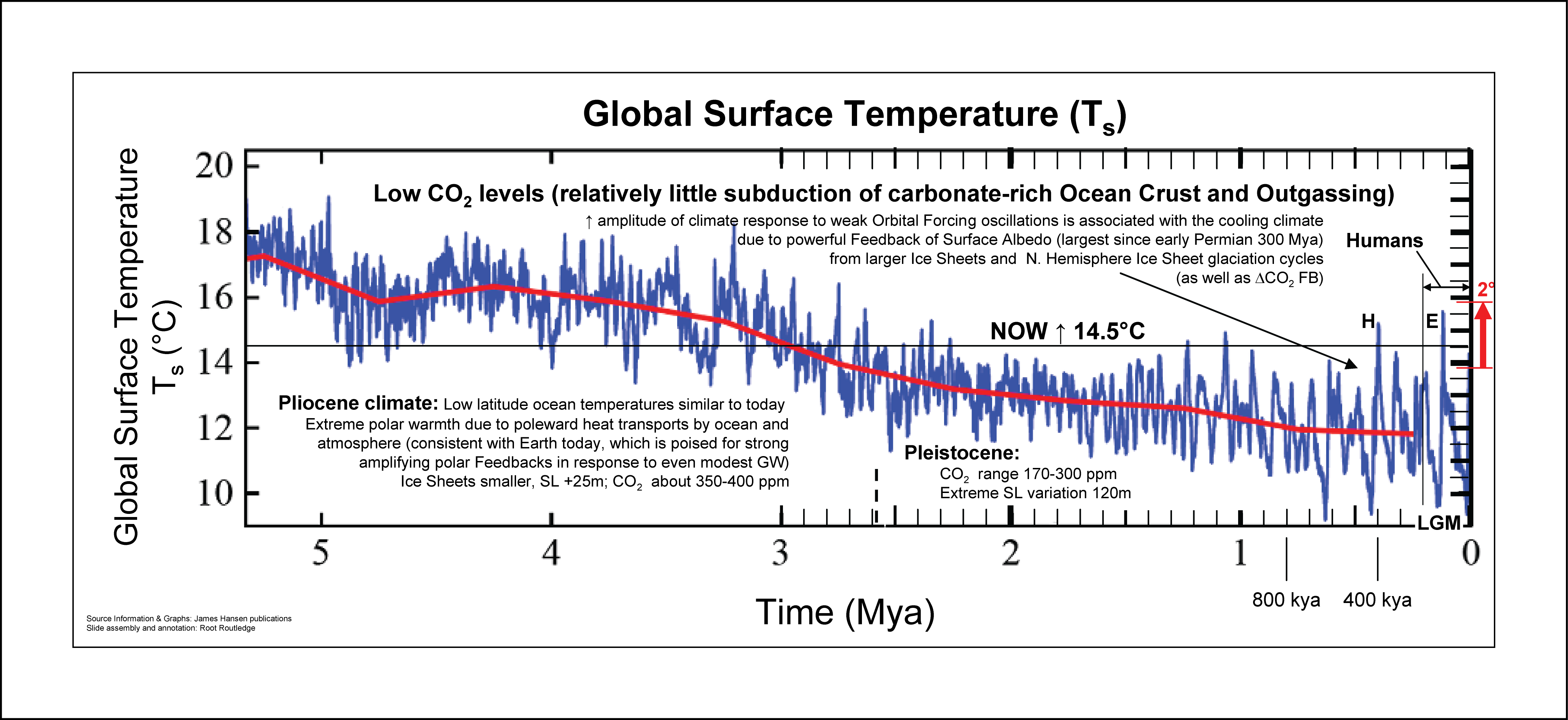
Would you “buy into” an ice-free Arctic for the first time in 2.5 million years cephus0?
http://www.alpineanalytics.com/Climate/DeepTime/WebDownloadImages/Plio-PleistoceneTs.7.5w.600ppi.png

Patrick MJD
Reply to  tony mcleod
January 5, 2017 12:14 am

Looking forward to see you retract this claim of yours this year.

richard verney
Reply to  tony mcleod
January 5, 2017 3:03 am

The balance of evidence suggests that the Arctic was ice free during the Holocene Optimum only 6000 to 8000 years ago.
I do not know where you get the idea that this would be the first time in 2.5 million years. The balance of evidence does not support that claim.

tony mcleod
Reply to  tony mcleod
January 5, 2017 3:23 am

Your right. I should have said “for most of the last 2.5my. It does seem there have been a few ice free periods including the early holocene.

Patrick MJD
Reply to  tony mcleod
January 5, 2017 3:29 am

“tony mcleod January 5, 2017 at 3:23 am”
Onus on you Tony.

Paul Penrose
Reply to  tony mcleod
January 5, 2017 4:32 am

Yea! An ice free Arctic would be great. Ice is a navigational hazard in the ocean. Great in drinks though.

MarkW
Reply to  tony mcleod
January 5, 2017 9:35 am

The arctic was ice free during the Holocene optimum.

John@EF
January 4, 2017 6:50 pm

Bit of an odd desperate yet petty sounding post title … which is echoed at various points within the reply/comment section. Wasn’t the 2016 temperature record warmer than 2015?

Reply to  John@EF
January 4, 2017 9:06 pm

Wasn’t the 2016 temperature record warmer than 2015?

Yes. For Hadsst3, the 2015 average was 0.592. The average after 11 months in 2016 is 0.627. See:
https://crudata.uea.ac.uk/cru/data/temperature/HadSST3-gl.dat

Paul Penrose
Reply to  Werner Brozek
January 5, 2017 4:37 am

Putting aside whether we can even measure the global temperature to thousands of a degree with the kind of instruments used, is the difference between 2015 and 2016 even statistically meaningful? At .035C I would think that are statistically a tie.

Reply to  Paul Penrose
January 5, 2017 9:43 am

“At .035C I would think that are statistically a tie.”
Anything less than 0.5C would be a statistical tie which means that other than La Nina minima and El Nino maximum, whose extents are about at the limit of rational detection, any absolute claim of warmest or coldest years are meaningless.

Reply to  Werner Brozek
January 5, 2017 4:56 am

At .035C I would think that are statistically a tie.

That is correct. And the difference will be even less when December’s number comes in. However as others have pointed out earlier, when 2016 is included, the slope is larger than when it is not included.

O R
Reply to  Werner Brozek
January 5, 2017 7:28 am

December ERSST4 data is in, the year 2016 is complete
Global Absolute annual temperatures in degrees C from KNMI climate explorer
2015 18.63611
2016 18.64894

thingodonta
January 4, 2017 6:53 pm

the oceans will continue to warm for a certain period after the surface stops warming.

noaaprogrammer
Reply to  thingodonta
January 4, 2017 10:32 pm

It’s the pause that refreshes.

Kailer
January 4, 2017 7:12 pm

I have a lot more confidence in Berkely Earth than NOAA, mostly because of Richard Muller, who I find to be the closest thing to an honest broker in the climate change debate. He’s someone who took it upon himself to look at the actual data and came around to the idea that global warming was caused by humans. At the same time he never failed to condemn the behaviour of the CRU and Mann as frauds, which proves he’s not a zealot with blind faith in the climate priests. The fact that they were so quick to respond to your requests and so transparent with their analysis only reinforces my opinion of them. I have to constantly remind myself to not make the same mistakes alarmists do and blindly reject anything that doesn’t agree with my priors.

O R
Reply to  Kailer
January 5, 2017 7:57 am

So You trust BEST l/o more than Gistemp loti?
Well the trend of BEST l/o is 0.180 C/decade in the satellite era, whereas that of Gistemp loti is “only” 0.172 C/decade

Reply to  Kailer
January 5, 2017 9:15 am

Sorry Kailer but Richard Muller was not a skeptic. He has always been a warmer. You are reading the garbage published by the MSM.

MarkW
Reply to  Kailer
January 5, 2017 9:37 am

Muller? Would that be the guy who claims that he was once a sceptic, but his previous statements contradict this claim?

Julien
January 4, 2017 7:35 pm

It seems to be looking more like they’re cherry picking the end date for misleading the readers.
Besides, they also claim that their result was achieved thanks to “adjusting” 2 disjoint datasets, according to the description on phys.org. Yet another politically motivated and untrustworthy study as a result.

January 4, 2017 8:56 pm

These kinds of studies are completely useless. The minimum period is a solar cycle in the case of climate change. The media will tell stories about the warmest year 2016 in the history and they do not even bother to mention that it was El Nino year – the strongest of the recorded history.

Chris
Reply to  aveollila
January 6, 2017 1:41 am

Except that the article above says it was weaker than the El Nino in 1998, so clearly not the strongest in recorded history.

Patrick MJD
January 4, 2017 9:59 pm

Picked up by our alarmist media here in Australia.
http://www.smh.com.au/environment/climate-change/no-cooking-the-books-new-study-confirms-global-warming-hiatus-didnt-happen-20170104-gtlujo.html
The media are all over this like a rash, an expert from The Climate Council, not Flannery, received copious amounts of air time on ABC stating that the “window of opportunity to reverse climate change is closing”, or some other such rubbish. Sigh…

Reply to  Patrick MJD
January 5, 2017 3:53 am

It was on channel 10. Some [pruned] called Steffen sprouting the the usual time is running out scenario. The usual scenes of unprecedented storms and heat waves, bush fires.It was the warmest Evah .At no time was the actual anomaly mentioned. The ABC news wasn’t as alarmist surprisingly. We’re all doomed for a fraction of a degree.The inmates are in charge of the asylum.

Phillip Bratby
January 4, 2017 10:50 pm

The sun heats the oceans, the oceans heat the atmosphere. So if there is any global warming, it’s the sun what did it, not CO2. These people yet again shoot themselves in the foot.

Chris
Reply to  Phillip Bratby
January 6, 2017 1:43 am

CO2 traps more heat in the earth’s atmosphere. More CO2 in the atmosphere, more heat gets trapped. That’s what has changed, not the sun, and it’s the change that matters, not the source of the earth’s heat.