
From the EUROPEAN GEOSCIENCES UNION and the “cold kills, so why all the whining about warming?” department.
How the cold 1430s led to famine and disease
While searching through historical archives to find out more about the 15th-century climate of what is now Belgium, northern France, Luxembourg, and the Netherlands, Chantal Camenisch noticed something odd. “I realised that there was something extraordinary going on regarding the climate during the 1430s,” says the historian from the University of Bern in Switzerland.
Compared with other decades of the last millennium, many of the 1430s’ winters and some springs were extremely cold in the Low Countries, as well as in other parts of Europe. In the winter of 1432-33, people in Scotland had to use fire to melt wine in bottles before drinking it. In central Europe, many rivers and lakes froze over. In the usually mild regions of southern France, northern and central Italy, some winters lasted until April, often with late frosts. This affected food production and food prices in many parts of Europe. “For the people, it meant that they were suffering from hunger, they were sick and many of them died,” says Camenisch.
She joined forces with Kathrin Keller, a climate modeller at the Oeschger Centre for Climate Change Research in Bern, and other researchers, to find out more about the 1430s climate and how it impacted societies in northwestern and central Europe. Their results are published today in Climate of the Past, a journal of the European Geosciences Union.
They looked into climate archives, data such as tree rings, ice cores, lake sediments and historical documents, to reconstruct the climate of the time. “The reconstructions show that the climatic conditions during the 1430s were very special. With its very cold winters and normal to warm summers, this decade is a one of a kind in the 400 years of data we were investigating, from 1300 to 1700 CE,” says Keller. “What cannot be answered by the reconstructions alone, however, is its origin – was the anomalous climate forced by external influences, such as volcanism or changes in solar activity, or was it simply the random result of natural variability inherent to the climate system?”

There have been other cold periods in Europe’s history. In 1815, the volcano Mount Tambora spewed large quantities of ash and particles into the atmosphere, blocking enough sunlight to significantly reduce temperatures in Europe and other parts of the world. But the 1430s were different, not only in what caused the cooling but also because they hadn’t been studied in detail until now.
The climate simulations ran by Keller and her team showed that, while there were some volcanic eruptions and changes in solar activity around that time, these could not explain the climate pattern of the 1430s. The climate models showed instead that these conditions were due to natural variations in the climate system, a combination of natural factors that occurred by chance and meant Europe had very cold winters and normal to warm summers. [See note]
Regardless of the underlying causes of the odd climate, the 1430s were “a cruel period” for those who lived through those years, says Camenisch. “Due to this cluster of extremely cold winters with low temperatures lasting until April and May, the growing grain was damaged, as well as the vineyards and other agricultural production. Therefore, there were considerable harvest failures in many places in northwestern and central Europe. These harvest failures led to rising food prices and consequently subsistence crisis and famine. Furthermore, epidemic diseases raged in many places. Famine and epidemics led to an increase of the mortality rate.” In the paper, the authors also mention other impacts: “In the context of the crisis, minorities were blamed for harsh climatic conditions, rising food prices, famine and plague.” However, in some cities, such as Basel, Strasbourg, Cologne or London, societies adapted more constructively to the crisis by building communal granaries that made them more resilient to future food shortages.
Keller says another decade of very cold winters could happen again. “However, such temperature variations have to be seen in the context of the state of the climate system. Compared to the 15th century we live in a distinctly warmer world. As a consequence, we are affected by climate extremes in a different way – cold extremes are less cold, hot extremes are even hotter.”
The team says their Climate of the Past study could help people today by showing how societies can be affected by extreme climate conditions, and how they should take precautions to make themselves less vulnerable to them. In the 1430s, people had not been exposed to such extreme conditions before and were unprepared to deal with the consequences.
“Our example of a climate-induced challenge to society shows the need to prepare for extreme climate conditions that might be coming sooner or later,” says Camenisch. “It also shows that, to avoid similar or even larger crises to that of the 1430s, societies today need to take measures to avoid dangerous anthropogenic climate interference.”
###
Link to the paper: http://www.clim-past.net/12/2107/2016
Pure neo-Marxism:
And where are those granaries today? Our need for their security did not disappear just because we are fortunately living in a temporarily warm period. Times of plenty is the time to fill adequate reserves for times of scarcity. You know – plan for the worst – hope for the best. GK
Nothing new here, see Genesis 41:27, Pharaoh’s dream, Seven lean years.
GK,
Your truism fails to explain why a communal granary is more effective than individuals storing their own grain. As with any type of communist wealth redistribution it erodes the individual’s incentive and need to work.
It’s too cold to plow today. I’m going to stay inside by the fire, cause thanks to the communal granary I know I won’t starve.
Rob Morrow December 1, 2016 at 8:49 am
GK,
Your truism fails to explain why a communal granary is more effective than individuals storing their own grain. As with any type of communist wealth redistribution it erodes the individual’s incentive and need to work.
At that time England was under the feudal system certainly not a communist one!
It’s too cold to plow today. I’m going to stay inside by the fire, cause thanks to the communal granary I know I won’t starve.
Not an option under the feudal system! You also apparently failed to read that it was the cities that built the granaries, the inhabitants of which were not working in the fields.
Phil,
This is meaningless sleight of hand.
Wealth redistribution under any form or government is still wealth redistribution. “Communal” (granary) and “Communist” have the same root for a reason.
Of course people in cities don’t plow. As a city dweller getting a free grain stipend from the communal granary, one has a similarly lowered incentive and need to work.
Rob Morrow – As long as the reserve exist, I don’t really care who creates them and neither will you, when beast and man are starving. Food reserve just doesn’t exist adequately today IMHO GK
Rob Morrow December 1, 2016 at 9:30 am
Everyone needs to stop with the fixation of socialism/communism for why pre-twentieth century societies took the steps they did. Marx did not write his Das Kapital until 1867 so why would anyone try to atribute concepts of an economic theory to a sociaty that had no knowledge or understanding of it. They based their actions on what they thought would work best for them. Judge how well their “communal granaries” worked for them.
First the “communal granaries” were actually typical of most cities -they were there to withstand SIEGES!
Next your view of a work ethic and theirs are vastly different. They had ways of dealing wrth artful slackers. Also, many cities at the time used the Guild system for non-agricultural workers. Also, besides the normal stockpiled city supplies, you had commercial granaries and warehouses which were used to store surplus grains and other commodities. You might buy from a farmer, pay a fee to store and later sell, gosh, just like today.
The author was taking liberaties with the term communal granaries, ever hear of a Grange or a Co-op we use them today. Leave the Marxism to Karl he was better at defining it.
michael
@ur momisugly GK & Mike,
I replied in the wrong place. See below.
Rob Morrow December 1, 2016 at 9:30 am
Phil,
This is meaningless sleight of hand.
“At that time England was under the feudal system certainly not a communist one!”
Wealth redistribution under any form or government is still wealth redistribution. “Communal” (granary) and “Communist” have the same root for a reason.
“Not an option under the feudal system! You also apparently failed to read that it was the cities that built the granaries, the inhabitants of which were not working in the fields.”
Of course people in cities don’t plow. As a city dweller getting a free grain stipend from the communal granary, one has a similarly lowered incentive and need to work.
Your total lack of knowledge of the history and your naive assumption that ‘communal’ meant ‘free’ means that you’re talking nonsense. The granaries were built to ensure a reliable supply of grain for the local bakers so that the inhabitants would have bread, no one got free grain or free bread. The Leadenhall granary in London was built in response to the earlier Black Death with a view to cleaning up the city streets, no more butchery and fishmongers in the streets with the attendant debris. The granary was built with a market place for the butchers/fishmongers etc. as well as the storage facilities. Buyers were sent out to buy grain to ensure a steady supply, in those days the locals tended to get upset when they couldn’t buy bread and tended to rebel so the ruling class had a vested interest in keeping the locals content. Especially when the army was off fighting in France in the Hundred Years War. The Peasants’ Revolt of 1381 would have been fresh in their minds!
Rob: This reminds me of a story I have to tell. Back in the early 60’s I would go out with my family each week to visit my Father a life long Nebraska Farmer. During one of these visits I asked, which do you thing will fail first the USSR or America. He replied: well if we don’t blow each other up first it will absolutely be the USSR, and I will tell you why.
It’s harvest time and the wheat is looking great this year when a weather announcement is reporting severe winds and hail for tomorrow. Every farmer in the area is harvesting at maximum effort until the storm arrives. Meanwhile with the same circumstances in the USSR the result would be the opposite. Since the harvest in the USSR belongs to the state and not the individual the farm laborer has no incentive to put forth extra effort; in fact with less than normal effort and if the storm is severe enough it may destroy the crop and may not even be harvested.
My Father continued: In the USSR or where ever socialism abounds this type of behavior is common throughout society and results in a slow deterioration of life in general and here in the USA that deterioration began under Wilson and Roosevelt and continues today With Kennedy. We must live with our decisions and never know what might have been. Without our Constitution and the rule of law no government has lasted as long. Our Constitution is constantly under duress and must be preserved before all else to sustain our nation.
Phil,
You’ve missed my point, and perhaps that’s my fault.
I don’t care whether the bread was free for the poor, subsidized, inflated in price for government monopoly, or whatever. No doubt there have been variations on all of these in history.
My point is, the authors implied that those citizens who didn’t mandate their city to build a communal granary were racists. That’s it. It’s a ridiculous thing to imply, and it’s the sort of thing we’ve heard for the last 18 months from the Democrats.
Of course, one communal service doesn’t constitute communism, but when the Left end of the spectrum constantly badgers the rest of us, calling them racists/sexist/homophobes/etc if they don’t agree to new government mandates for this that and the other, communism is basically the end product, if not the intentional goal.
…Hey Phil, who paid the farmers, to grow the crops, to put in the granaries ?
Dipchip,
Hear, hear. Good story.
Well I actually prefer the Feudal system myself; if properly organized.
You eliminate all governing bodies smaller than say a County Council. These days, anything smaller is not able to survive.
Then every citizen resident of the county of voting age, gets to vote for a slate of county counselors; I like 13 of them. So you pick your 13. None of this, I represent that district BS. They all work for the whole county.
Then those 13 who are elected, are the ONLY persons in the entire known universe who can tax you (or me). Then once a month, they nominate one of them to go to Sacramento to attend the monthly one day meeting of the State Government; which of course consists only of those county representatives. They get funds to built roads between the counties, by taxing the counties; not me.
Once per quarter, the State selects one of their number to go to Washington DC to attend the week long meeting of the Federal government. Mostly they talk about how much is each State’s share of the National Defense budget, so the feds tax the state government; not the counties nor me.
So I get to vote for or against the only people who can tax me
Anything we can’t handle in the County, we can pass off to Sacramento at the monthly meeting, and they can argue with the feds for the California share of the defense budget.
Not quite like the old feudal system; but much better for everybody.
G
Rob and Phil, the feudal system redistributed wealth upward through threat of force. “Property” was acquired and held via threat of force to the people living on the property. Your typical feudal lord was either a bandit or descended from one. In England feudalism did not emerge until the Norman Conquest and never acquired the hold it had in France, Prussia or Russia. In England a significant portion of the population remained in the yeomanry and thus owned their land. In a truly feudal society like France or Russia right up to the Russian revolution, the land was owned by feudal landlords. The people living on it were tenants at best – peasants as in France prior to the French Revolution, and at worst were essentially property – slaves or serfs, as in Russia right up until their revolution.
If you compare the relatively libertarian yeoman society of England in fifteenth century and the feudal society of France with modern American society, we are effectively a feudal society. We pay taxes simply to maintain our property rights. Paying off a house doesn’t make you a freeholder. Your tribute money is simply reduced to property taxes, income taxes, franchise taxes, sales taxes, license fees and on and on. Modern Great Britain has been steadily sliding toward the same state, ahead of the US, over the last few centuries. If you look at a decent history of gun control in Britain, you will find that Britain has always lead the US in restrictions, and we follow along like sheep.
When you consider towns and cities in the Renaissance, which is well underway by the 15th century – the period in the OP, modern – well real – capitalism is practiced only in cities and then only in cities that were not under a feudal lord’s rule. Communes were alliances of free people living in a city and often the farmers living on surrounding land. Communes are origin of city-states. Quite a number of people seem to think the Venice was a feudal city, but it was a republic and the Doge was elected by the city’s committee of Forty. In Genoa the same office was elected by popular vote.
If you want to see the interaction between yeoman land owners and a feudalistic bandit, lookup the conflict between the Scottish landowners and Donald Trump at his Balmedie golf course. His description of his “neighbors.” especially Michael Forbes, makes Clinton’s “deplorable” gaff look mild. And I did not vote for Clinton or the Green Party, so don’t bother jumping to conclusions. I grew up on a ranch and we had outbuildings always in need of maintenance, there were rusting vehicles that had died and not been scrapped yet, cattle and a couple of horses in the pastures, and we had chickens wandering the yard during the day – real free-range. DT would have described our ranch as a “slum” if we had lived next to a proposed Trump golf course. Look up Wu Ping and Nail House to see how very similar Trump and the Chinese Communist government behave.
the granaries are now privately owned, by glencore viterra and other mega agri mobs
no joy there if things go pearshaped
“Of course people in cities don’t plow. ”
Not in modern cities and towns, ……. they don‘t plow.
But in medieval Europe …….. everyone lived in a town or a city …… and the ones that did any plowing HAD TO go out of town or out of the city to do their plowing. To wit:
Europes granaries are the wheat fields of the the U.S, Canada and Australia.
Duster
December 2, 2016 at 1:49 am
Russian serfs were freed in 1861.
The Revolution (so-called) turned all Russians into serfs. It freed no one and enslaved everyone except the Bolshevik gang.
Moreover, most the leading revolutionaries weren’t even Russians of Russian Orthodox ancestry. They were essentially alien oppressors.
GK,
Clearly I do care whether or not my earnings belong to me or the state, or I wouldn’t have pointed out the marxist language used by the author.
Mike,
Other than pointing out the language used by the authors and what that indicates about their political views, I was not attempting to explain why anybody did anything in any period.
If you parse the quote that I posted at the top, it roughly translates to “the pragmatic people pooled their wealth to overcome a common problem, and everybody else was racist”. If you don’t think this is the same message coming from the regressive left today, than you weren’t paying attention to the US election.
Rob Morrow December 1, 2016 at 11:32 am
“Of course people in cities don’t plow. As a city dweller getting a free grain stipend from the communal granary,”
“Your truism fails to explain why a communal granary is more effective than individuals storing their own grain. As with any type of communist wealth redistribution it erodes the individual’s incentive and need to work.”
You were the one to take the leap from communal to communist. You detemined for yourself the political leanings of the Authors based on your interpratations of their definitions. The term communal pre-dates Marx.
It’s use is common in such contacts.
” If you don’t think this is the same message coming from the regressive left today, than you weren’t paying attention to the US election”
What does that have to do with what we are duscussing? And it also shows you jump to false conclusions in regards to the people speaking with you.
As I said despense with the projecting of modern politics to earlier communities there is no commonality.
By the way communal, the root is Latin. It has nothing to do with Marxism.
By the way if you have never read Das Kapital do so. Know your enemies.
Also it may keep you from condescending to allies
anyway
Mike,
The overarching theme from the Democrats this election cycle was “if you don’t agree with our party, the party who always wants to grow government, you’re a racist/sexist/homophobe/etc”. If you disagree with this statement, you probably voted for Hillary and are still scratching your head as to how Trump could have won.
Governments can only get so big before they must be considered socialist or communist. Communism is not a black or white concept. There’s a lot of grey area which separates communism from socialism from classical liberalism from libertarianism from anarchy. It’s a spectrum. Go enough increments toward the left and you get to communism.
Back to the quote I originally posted:
Again, when parsed, this translates to some cities mandated their government to provide a communal service which was not provided before, those that didn’t were racists”.” Racial agitation has long been part of Marxist methods, though the current wave of leftists go about it in a different way. Instead of trying to directly foment anger withing minority communities to stir up violent revolution, today’s leftists attempt to signal their virtue like peacocks while calling everybody else racist. This way, they can break down the electorate into manageable blocks of minorities which can be scared into voting left by stirring up fear of the “deplorables”.
Anybody who implies you’re a racist because you aren’t in favour of providing your government with a broader mandate, is, in my books, a neo-marxist, or is at the very least employing similar methods to achieve similar ends.
If it smells like a watermelon, and tastes like a watermelon… It’s a watermelon.
Rob Morrow December 1, 2016 at 2:29 pm
normally I would stop bothering, but I think we can talk.
“minorities were blamed for harsh climatic conditions, rising food prices, famine and plague.”
You are correct there is coding here, but not what you think. First, you have to know who the minorities were.
Gypsies, Jews, and non-Catholics.
Jews for the most part, they were able to lend money for profit, so in any disturbances, well go figure. need a debt canceled,? Standard practice. Read up on it. you won’t jump to such false conclusions
“Governments can only get so big before they must be considered socialist or communist. Communism is not a black or white concept.”
Hmm did Karl Publish a volume that I am unaware of? Please cite the volume. Page.
Rob, I am a Reagan Republican, what will do if you meet a real marxist? None of your knee jerk assumptions are applicable when reading papers written by a historian. Their buzz words are different.
“While searching through historical archives to find out more about the 15th-century climate of what is now Belgium, northern France, Luxembourg, and the Netherlands, Chantal Camenisch noticed something odd. “I realised that there was something extraordinary going on regarding the climate during the 1430s,” says the historian from the University of Bern in Switzerland.”
Have a good night, and read up on Karl you have a lot of misconceptions.
It will give you better arguments.
your friend
michael
And Mike,
I can’t help myself but “condescend” a little more. I get passionate about this sort of thing, you know, personal freedom, the value of the constitution, common law, private property, etc. When somebody starts two of three consecutive sentences with the phrase “by the way and then goes on call the recipient condescending, it is more than a little hypocritical.
A breakdown of the first two sentences in the above quote to show that you are wrong, in addition to being a condescending little hypocrite:
And, so? When you start a sentence that way, I must assume you were trying to convey some sort of manifest and material truth. Yet, whether the source language is Latin or Greek or anything else is not only irrelevant, it is not in contradiction with anything I’ve written.
Here’s where you’re 100% wrong. Communism describes a society that ideologically strives for total or near total communality (but always fails to achieve, at least in every real world experiment the result is serfdom and a ruling class), which is a measure of the degree to which the wealth and property of the citizenry is shared communally. And the word “communal” has nothing to do with Marxism? Yeah, I’ll condescend some when presented with aggressive nonsense. Guilty.
I’m fairly confident that my interpretation is the correct meaning of the words used in the original quote. If you disagree, please break it down and explain the use of the words “however” and “more” to distinguish between the group who built granaries and the others who were racists. Otherwise dispense with your own knee-jerk reactions of continually assuming that I’m trying to say anything about the historical period in question. That has never been my intention.
Rob Morrow December 1, 2016 at 6:24 pm
good night Rob
michael
You’ll notice that this is a compound quote, such that it is not the historian-author of the actual paper who twists language in a neo-marxist way, it’s whoever wrote the snippet article. This person took the quote about blaming minorities out of context, and followed it up by contrasting that group with a successful group who did something communally. I wrote that this is typical of today’s democrats, but you thought it was of topic, even though I am drawing a direct line for you.
Again, I think I’ve made it pretty clear in this thread that my issue is with the language used, the labeling of groups as racist/sexist/homophobic/etc because of how they vote. I am by no means attached to the phrase “neo-marxist” or “communist” or any other label in this context. I don’t hold those words in high esteem or believe in purity of ideology or anything like that. If you’re a Reagan republican, you are very confused about what you are trying to argue.
Rob Morrow wrote..
“My point is, the authors implied that those citizens who didn’t mandate their city to build a communal granary were racists”.
Ay? Please explain.
Racist with respect to whom?
And individuals storing their grain?
How does a peasant farmer/ not much more than a serf afford storage?
A modern grain farmer can store on farm because of the scale of their operations.
In medieval times individual small scale grain producers storing their own grain would have been like The Great Leap Forward when Mao mandated iron smelters in everybody’s backyard. Didn’t work for Mao and wouldn’t have worked in 1430. And their feudal overlords would not have allowed them to do it.
Further it was the cities attempting to secure their grain supplies.
While the approach to the market at the time was not in tune with current free market mores it was done without suggestion of Marxist collectivism or any ideology at all. The cities wanted grain and they intended to get it by whatever methods were necessary.
@Greg
As you’ll read in the quote I originally posted, the target group(s) are described only as “minorities”. The target group is immaterial to my point.
All of your subsequent comments assume (falsely) that I’m making some sort of commentary on the historical period in question, rather than on the present state of language degradation and identity politics.
This is not Marxism, neo or otherwise. As has been stated below, the middle ages operated on a feudal model that was still closely tied to village economics, in which life was not a zero sum game and the distinction between private and “communal” interest not as opposed as you assume. You really need to study some history before throwing those labels around. By your definitions, a hospital or a bridge is a “communist” enterprise.
See above. It is not my intention to categorize one communal service in the middle ages as communist in any modern or totalitarian sense.
Publicly owned hospitals and bridges are not by themselves enough to be considered a communist enterprise. I don’t know if anybody has tried to quantify the threshold of communism i.e. what percentage of the economy must controlled by government, levels of taxation, etc, which must exist for that society to be considered communist. For utility’s sake, I think most of us consider it to be somewhere between 100% and some amount less than 100%.
If we’re talking about you as a voter being labeled a racist/sexist/homophobe/etc by the left just because you vote a certain way or are not a minority, and the voters give-in en-masse incrementally until the new demands for bigger government eventually swell the public sector beyond the previously mentioned threshold, then yeah, those same hospitals and bridges would be part of a communist enterprise.
America Cares… I’m sending you a shovel. … I always wondered about that. Why would they send someone a shovel, when what they need is a system. ” I don’t need a track hoe, I can get a hundred men with shovels “…. really? Why don’t you get a thousand with Teaspoons? ( actual conversation) I guess it gives some people who feel guilty about their standard of living to feel better about themselves as the dig arsenic laced wells. And I thought they gave up lead pipes with the Romans. And at least one person that I think is pretty intelligent, thinks people aren’t that stupid. Hello, Flint Michigan.
Some societies are immune from adapting or changing.
If the king is to survive the winter, what does he need? More army? Or a placated population? Marxism? No, reality. Yes. Yes, he could keep all the goods for himself, let the army die off, since they are not the serfs, but now, who guards the walls? The serfs? Even the arch conservative would balk at that, a neo conservative would bark at the chance to enslave the king, so what would you do?
As a Jew, I am a bit outraged at all the comments denying racism because bigotry is politically incorrect in OUR time. Hitler was far from the first European to take it into his head to kill Jews. Jewish history recounts many, many mass murders of Jews in Europe–and if I recall things correctly, more than one genocidal incident occurred in that particular decade.
It makes perfect sense to me that other minorities would have been similarly affected.
And if we want to prevent anti-semitism, or various other bigotries in the United States (or your nation all you others here), an important key is to see to it that there is food security.
ladylifegrows December 1, 2016 at 6:25 pm
Please I hope you are not cross with me if you are speaking of the statements I made,
I felt they needed to be stated.
michael
As a rational person, I’m a bit outraged at your false outrage, that you would accuse anybody in this thread of denying racism. Please point it out. You won’t find a single comment, let alone enough to justify your use of the phrase “all the comments denying racism”.
You have just provided a textbook example of an attempt to coerce people into a political position by invoking racism and emotional righteousness as your main argument. If you’re a Jew and you think that’s a good reason to go above and beyond in the food supply, great, go ahead and increase your personal cache, but don’t tell be that we need to increase the food supply society-wide on that basis.
As a voter and consumer and thinker, I don’t care one way or the other if you’re a Jew. It doesn’t make your case more compelling. I think you only brought it up so you could immediately allude to Hitler.
And the comment from Mike above is an example of somebody who has little intellectual integrity and easily falls prey to that sort of baiting. He didn’t say anything denying racism, but he sure was quick to prostrate himself as soon as you summoned up the racist boogey man.
Dear ladylifegrows,
You are quite correct regarding genocidal attacks on European Jews across centuries.
But despite appearances many of these attacks were not strictly due to racism/anti-semitism but to greed. The people who provoked the attacks, frequently the aristocrats, were not necessarily anti-semitic but used anti-semitism [which was encouraged by the church] to provoke mobs to attack Jewish communities. Among the Jewish community were Jewish bankers/moneylenders [Christians were forbidden to charge interest].
Aristocrats frequently borrowed large amounts of money [from Jews] to fund their military obligations to their prince or king.
Your creditor dies [for whatever reason] and so does the debt
Why do Americans think that any kind of planning or working together to build a better future or mitigate risk is communism? Very odd – fortunately the rest of the world gets on with it.
Now we have insurance companies.
Cheers
Roger
http://www.rogerfromnewzealand.wordpress.com
lol rob you made me laugh…
are you actually aware that communal granaries were the key to surviving the LIA related seiges, shortages,…? Of course not! If we back then in time in europe wouldn’t have done this because some silly author Marx wrote “Das kapitaal” and that it would be defined as “communism” later on, you for sure wouldn’t have existed because your ancestors would have died of starvation caused by the LIA before they could migrate to the USA/Canada settle there and build up till you are born.
a lot of those communal services from the cities and guilds were the roots out of which the industrial revolution did got born. Without them cities never could have become trade centers, and places of exchange of wisdom. without that we would still live in the dark middle ages.
labeling the author as pro communist, because he describes a system of 1430 is what i call random political zealotry.
the only person you made a fool of is…. yourself
You have misunderstood my meaning entirely. Read the rest of the thread before throwing insults around.
My use of the term “neo-marxism” was highlighting the manipulative language used by the author of the article. The communal services and guilds in cities are indeed the roots our current system. My point is, they came about because of their own economic and strategic merit, not because the people said “if we don’t do this, we’re racists”.
Perhaps I should phrase this another way.
Do you really believe that cities of the region and period fit into two mutually exclusive categories:
1. Cities who blamed minorities for the weather, and by implication of the author, did not build communal granaries.
2. Cities who did not blame minorities and also built communal granaries.
Or do you believe the author used language that would be interpreted this way by somebody with a reasonable level of reading comprehension?
all i see in the article is the same fear mongering or money scraping CO2 line “with the current CO2 increase,…. (fill in any catastrophic line)”
it’s a European article so you need to know this fact about europe
CAGW as a political tool already left the left-right paradigm a loooong time ago in europe it did so for 20 years. so in europe there is basicly no political party without any climate related topics. even the most conservative party has some CAGW based programs. It’s actually only in the USA that it is that tightly wrapped with that socialist – liberalist paradigm
so extrapolating a European article into the political context of the USA is going entirely out of it’s context.
Espesially in the eyes of most european readers like me, now you know why i reacted that way.
CAGW can easily slip out of that paradigm you know….
Frederik,
If you don’t see the parallels between the MSM narrative in the U.S election and Brexit, then you are willfully blind and foolish. This is not an Ameri-centric issue, and the language I pointed out is being used with high frequency on both sides of the Atlantic to shame those who don’t agree with bigger government, globalism, identity politics, etc, etc.
Okay, what are the examples of anthropogenic cold interference?
The best interference would be rapid acquisition of productive real estate in, eg, Africa, to prepare for the coming 30 – 40 years of ‘Lil Ice Age. Crop failures will otherwise kill billions.
China, as it returns to world domination, sees the writing on the wall:
https://www.brookings.edu/blog/africa-in-focus/2015/11/05/what-do-we-know-about-the-chinese-land-grab-in-africa/
Question, unless you count the Khan-ate of Genghis Khan, when has China ever dominated the world? BTW, they were Mongolian…
“China, as it returns to world domination..”
Say what, now? When – just give me a century – was China dominating the world? The Middle Kingdom never developed great sailors, or conquering armies; it was the Mongols who rode in from Asia, not the Chinese.
A number of Chinese dynasties compared favorably with their Western contemporaries. Estimates of the population of the Roman Empire at its height vary from 55 to 100 million, but the Han (206 BC to AD 220) was on the scale of its contemporary, late Republican to middle Imperial Rome.
https://en.wikiversity.org/wiki/Comparison_between_Roman_and_Han_Empires
Population of the Han in AD 2 is estimated at ~58 million. The best estimate of early Roman Empire population is ~57 million in 25 BC.
At other periods, China and maybe India were united in polities larger and more advanced than Europe at the same time. Some Chinese empires have stretched from Vietnam and Tibet to Manchuria and Mongolia and into central Asia. Dunno if this equates to world domination or not.
In AD 751, the Abbasid Caliphate and its ally the Tibetan Empire fought Tang Dynasty troops at the Talas River in central Asia:
https://en.wikipedia.org/wiki/Battle_of_Talas
And, as is well known, the Ming Dynasty sent a great fleet to East Africa and back in the early 15th century, about the same time that Portugal was working its way down the Atlantic coast of Africa and reaching the Azores.
They haven’t found them in the models, yet, but give them time ….. .
And of course more money.
You should be ashamed for doubting that deep cold changes would be somehow unrelated to runaway global warming… /sarc off
Ding Ding Ding!
We have a new term to use now “Anthropogenic Climate Interference” not to be confused with:
Anthropogenic Global Warming
Anthropogenic Climate Change
Anthropogenic Climate Disruption
As with all of the previous terms since Global Warming was put to bed, they can claim that anything that happens to the climate is “man caused”. However, has anyone else noticed that the terms are getting less and less forceful?
Change: to make radically different
Disrupt: to interrupt the normal course
Interfere: to act reciprocally so as to augment, diminish, or otherwise affect
I agree that man “interferes with natural climate change” but climate is going to change anyway, as local “interferences” over land have no apparent effect on ocean surface temperatures as the big gears of the oceans turn the little gears of atmosphere.
They are hold in reserve the term Anthropogenic Whathaveyou
Whatever happens is bad, the fault of humans and requires immediate and massive government action.
How about: Anthropogenic Climate Indifference
Eric, how many times does this sort of zombie myth need to be debunked?
“They” never changed anything. That’s just a story that confirms your bias. Look stuff up first.
Climate Discombobulation.
Tony
I look “stuff” up all the time, thank you. What “myth” are you talking about? The climatists have used all of the terms I listed and in that specific order as well.
Here you go Tony McLeod, from your Grand Master himself (Dr. Holdren): http://belfercenter.ksg.harvard.edu/publication/17661/global_climate_disruption.html
How is Australia this time of year…?
Ahhh! Eric H, well said Sir. I was going to raise the point regarding the opinionated statement:
My feeling is that this statement could also be interpreted to imply the nonsensical attempts made of reducing the non-problem of CO2, those impoverishing financial and de-industrialising ‘methods’ used in the futile, politically motivated eco-Marxist endeavour that should indeed be described as,
Question, unless you count the Khan-ate of Genghis Khan, when has China ever dominated the world? BTW, they were Mongolian…
Bravo, the song remains the same.
How is Australia this time of year…?
Warming up. Getting into the 30s (90s) and humid where I am. Warm enough.
I suppose massive government spending in the exact wrong direction counts as anthropogenic interference by way of extreme lack of preparedness, debt, and misplaced agency priorities.
Exactly!
Get out the long johns, looks like we got us a massive Siberian express targeting the US for next week.
The fundamental lesson from this study is that, low and behold, very significant climate change, including much colder weather, can occur over very large areas not caused by increased or decreased CO2 levels. The later 17th C Mini Ice Age is an even better example. So why the hysterics and expenditure of £billions to reduce CO2 emissions?
Sutton’s Law.
The Dunning–Kruger effect.
Power. Pure power. Claims of anthropogenic climate control is the means to affect an end. An endstate where an elitist class has an unfettered path to the accumulation of power over people. A free people who consider themselves in possession of inalienable rights, so they must be duped with scaremongering climate propaganda to get them to submit to the elitists.
Put nature at the center of climate, there is nothing to control. But convince people with propaganda that mankind with CO2 emissions is at the center, and a path to power and wealth becomes possible.
The socialists began their climate crusade for power in late 1980’s. The more informed climate charlatans likely understood they had a 30-ish year window of opportunity to pull off their hustle as the mid70’s Ice Age scare memories faded from the public. Their window of opportunity is now closing, as reality comes home that natural variability and natural cycles controls Earth’s climate.
“elitist class”
Do you mean the multi-billionaires Joel?
aaaah that’s why we see here in Belgium more and more climate related taxes last 2 years….
oops 2 years ago the socialists were kicked out of our governement which is now right – liberal. Let’s do the math:
– full stop of building plots in 2040
– shutdown of the nuclear power plants replaced by green power in 2025
– extra taxes on power
– extra road tax
– in 2040 all cars must be electric
and more on the list.
sorry this is not about socialism greens, or any political issue. this is about getting rich on the back of others.
and any politician will find a way to do that. just a matter of throwing the right illusion in people’s eyes….
climate is just one of those many illusions.
I suppose the term, ‘low and behold”, could be appropriate when discussing a cold climate. However, in the context of the sentence, the classic term ‘lo and behold’ is my preference!
“It also shows that, to avoid similar or even larger crises to that of the 1430s, societies today need to take measures to avoid dangerous anthropogenic climate interference.”
Without this (must be) final sentence and submission under the ruling orthodox AGW ideology, the authors would risk their further professional career…
“Without this (must be) final sentence and submission under the ruling orthodox AGW ideology, the authors would risk their further professional career…”
Yep. My own thoughts exactly.
The extreme cold of the 1430s caused them to invent the SUV so that they could cause global warming.
The moral of the story is spend communal resources on mitigation technology to survive natural variations. That sounds sensible.
Yeah…let’s call it Climate Preparedness.
Or better yet we could just call it planning for the future. In either case do we plan for warmth or cold or both? Either way we will be wasting half our planning. 😉
Brilliant idea. De-fund the UN, in particularly the foetid political edifice ECOSOC and use a fraction of the money to do just that. The rest could be used to pay down the US debt.
Was this “the straw that broke the camel’s back” on the Moorish occupation of Spain? Hispania is Latin for land of rabbit eaters, an animal most definitely non-halal. So Moorish people adherant to Islam would have faced disadvantage in reliance on long supply chains.
Keith J December 1, 2016 at 8:11 am
Interesting thought, Keith. Not sure about the long supply chains though. Spain had okay agriculture and there was the fishing in both the Med and the Atlantic. Also shipping from africa was a day away and most of the Moorish holding that remained at the this point were in the south with in easy reach of Noth Africa.
Worth looking into though
michael
Keith,
That’s one of many proposed etymologies for Hispania, and probably not the currently most favored one. But in fact no one knows for sure whence came the name.
By 1250, the Emirate of Granada was the last Muslim province in Spain. IMO it’s a bit of a stretch to attribute its final fall in 1492 to bad weather in the 1430s. The 1480s and ’90s do however fall within the Spoerer Minimum.
Still, IMO other factors than climate led to the downfall of Granada. Among these was the 1469 union of the crowns of Castille and Aragon by the marriage of Queen Isabella and King Ferdinand. More unity among Christian realms might have doomed the last Moorish stronghold, anyway, but Granada gave the united kingdoms all the excuse they needed to wage war by attacking the border town of Zahara in December 1481. This led to a protracted conflict, 1482-92, and final defeat.
Protected by the Sierra Nevada range, Granada was quite secure and prosperous until the 15th century, when Portugal opened up direct trade routes to Subsaharan Africa by sea. It then declined in importance as a regional commercial center. But in the 13th and 14th centuries it had been tightly integrated into Mediterranean trade networks, heavily financed by Genoese bankers intent on controlling the gold trade carried to Grenada via Saharan caravan routes.
Chimp December 1, 2016 at 11:52 am
Did not think it was logistics
Lots of stuff happening in a short space of time.
michael
Very correct Chimp. The Granada Emirate had over 200 years of entrenchment and defensive building while Castile had dynastic troubles and weak kings. Granada only had frontiers with Castile and so it was Castile’s problem, not Aragon. Every king of Castile had wanted to end the moorish occupation and important battles were won, and Gibraltar was recovered in 1462. With the ascent of Isabel in 1475 Castile had a strong monarch after a long time. She had to deal with a civil war against supporters of her half-sister Juana that had Portuguese and French help. Once she cleared that up she had to deal with the troublesome high nobility that had opposed her. Only then she fixated on the Granada problem. But Granada was a very tough nut to crack and required years of preparations, money raising and gaining both nobility and popular support for a very long protracted war. While preparations were under way, the Christian response to a Muslim raid in Zahara where the entire population was enslaved, was the surprise occupation of the important position of Alhama by the Marquis of Cádiz. All this with a truce in effect. The orders from the Crown to the Marquis were to resist at all cost and 4 months later reinforcements were sent to end the Muslim siege. Castile was ill-prepared for such war and thus took her 10 years to overcome the Muslim encroachment with the first use of artillery in Spain.
Climate had little to do with the end of the Muslim occupation in Spain. But it might have had to do with the start of the Muslim occupation, that took place in 711 AD, at the end of the migration period that happened during the Roman solar minimum, a period of difficult climate, and when the population of Spain had significantly declined from the Roman times.
Javier,
Good summary. Like their Visigothic ancestors, the (often blond or red-headed, ie “rubia”) Trastamara dynasty (from 1369) and its predecessors in the Castilian crown, was plagued by internecine feuds. The English crown got involved, in the form of John of Gaunt (whose second wife had a claim on the Castilian throne), son of warlike Edward III of Crecy fame, and John’s elder brother Edward, the Black Prince (of Wales).
King Edward’s daughter Joan was betrothed to Pedro the Cruel, last monarch of the main line of the House of Ivrea, but she died en route from the Black Death. Her brother the Black Prince caught whatever eventually killed him while fighting in Spain, after his great victory over France at Poitiers (1356) in the HYW. His early death saddled England with his young son Richard II, eventually overthrown by his (Richard’s) cousin Henry IV, father of famous warrior king Henry V, victor at Agincourt (1415).
In the War of the Two Peters, Pedro fought Aragon, 1356-66, then waged the Castilian Civil War against his half-brother Henry the Bastard (of Trastamara). The connection with England continued long afterwards, to include Catherine of Aragon, daughter of Isabella I of Castile and Ferdinand II of Aragon, sister of Juana la Loca (mother of Holy Roman Emperor Charles V) and wife of two Tudors, Prince Arthur and King Henry VIII.
PS: Gotta love 14th and 15th century royal names, eg Peter the Cruel, Henry the Bastard, Joan the Mad and the Black Prince. The French had some good ones, too.
Although the 16th century wasn’t a slouch, either, with Ivan the Terrible (1530-84), whose appellation doesn’t signify quite what’s usually meant in English.
Anyway, the climate was terrible during the LIA. Much better today. Hope it gets as balmy as the Medieval Warm Period and stays that way as long.
Today we have Mikey the Tricky, Gavin the Shy and Kevin the Travestidious.
“As a consequence, we are affected by climate extremes in a different way – cold extremes are less cold, hot extremes are even hotter.”
… Until there are record lows somewhere and they have to evoke deus ex machina explanations like polar vortexes and still make some mental contortionism to fit that into the global warming narrative.
Lucius:
Berkley data and others have noted that cold extremes are getting less cold faster than hot extremes are rising … in fact in many places the hot extremes are less extreme while cold extremes continue to get less extreme … based on my limited reading and Environment Canada publicly available data giving results such as this:
https://www.dropbox.com/s/73bzb5btpja32ms/MedicineHatExtremes.tiff?dl=0
is that why in November 138 russian stations saw their cold record shatterd by 5 to 10 degrees C?
{S}ocieties today need to take measures to avoid dangerous anthropogenic climate interference.
This is as true as:
Societies today need to take measures to avoid dangerously interfering with the Sun.
shows the need to prepare for extreme climate conditions…
Why do all of these people have to sound like drag queens on speed?
Amazing how much faith they put on their models.
“It also shows that, to avoid similar or even larger crises to that of the 1430s, societies today need to take measures to avoid dangerous anthropogenic climate interference.”
=======================
Nonsense. Complete BS. Nowhere does their study support this conclusion. Nowhere did the authors.present any evidence that past climate was affected by “anthropogenic climate interference”. Rather, they found that significant climate change occurs without any “anthropogenic climate interference”.
In point of fact, what the authors did state was:”they should take precautions to make themselves less vulnerable to them”. In other words, take steps to deal with climate change, as history shows the climate can change regardless of “anthropogenic climate interference”.
In other words, since climate can change naturally, trying to “interfere” with climate is a fools errand. Rather, the best strategy is to adapt to change.
ferd….obviously she’s referring to retroactive anthropogenic climate interference
Such as adjusting and re-adjusting past temperature measurements?
Ferd
Your missing their point, I think they were saying dump as much co2 into the atmosphere as we can to stop natural variation.
Sarc
This was all before farmers learned to feed their cows beans so they would burp and fart more. Just ask the Governor of California.
Enhanced Meridional flow.
Anthro climate interference results from Enhanced oral-colonic flow from academics.
Precisely.
“Compared to the 15th century we live in a distinctly warmer world. As a consequence, we are affected by climate extremes in a different way – cold extremes are less cold, hot extremes are even hotter.”
I would like to see them prove that statement above.
We aren’t even hotter than the 1930’s right now, so how are our hot extremes today “even hotter”? “Even hotter” than what?
This is balmy weather we are living in today as compared to the 1930’s. “Even hotter” does not apply to today.
I think this group of climate historians should study the 1930’s for a while. They might learn something important.
The 1430s fell between the Wolf and Spoerer Minima, but solar activity dropped off again steeply after recovery from the the Wolf, c. AD 1350. By 1430-40, radioisotopes show that the sun was already less active than during the Wolf, but still headed down to the trough of the Spoerer, which commenced about 1460.
This entry just about says it all…
“1433… Frost. November 24. London.
The river frozen below London Bridge and Gravesend, from November 4 till February 10 1434.
The price of wheat rose to 27s. per quarter, but afterwards fell to 5s.”
https://books.google.ca/books?id=SS8BAAAAQAAJ&printsec=frontcover&source=gbs_atb#v=onepage&q&f=false
Thanks for that link.
The history of climate shows that warmer is better.
Cold decades use to happen more often in the low countries. In the Netherlands the years 1940, 1041, 1942 and 1947 showed four of the ten coldest winters since 1900. They were 6-8 degrees Celsius colder than the recent warm 2016 and 2014 winters. http://www.knmi.nl/nederland-nu/klimatologie/lijsten/seizoensextremen/winter And they were the start of a colder period that lasted till the seventies.
What Western Europe needs for a real cold winter is a ‘high pressure’ area on the Scandinavian. The cold eastern wind from the North of Russia will bring the cold to Eastern Europe and to the low countries more to the West.
Southwestern winds from the ocean like in 2016 and 2014 bring the low lands warm winter weather. It is a matter of circulation. So far, this October and November the warm winds went straight to the Arctic. We know the results for the Arctic. And in the Netherlands, October and November 2016 showed temperatures one degree C below average.
Just what do these geniuses think mankind has been doing. Better dwellings, better heating and cooling, better transportation to move food around, civil societies for mutual assistance and trade, refrigeration and drying to preserve food, modern medicine, improved agriculture – all of this is adaptation to a fickle climate. Reliable power is the key to overcoming the many lethal events that we face. CAGW threatens the very life-blood of modern society. The “snowflakes”, however, are probably most concerned about losing their cellphones.
I guess it’s time again to post Dr. Sally Baliunas discussing the history of people’s reactions to extreme weather. For those who haven’t seen this short video:
Ref Wikipedia:
“By 1995, she (Baliunas) had entered the global warming controversy. In January of that year the Marshall Institute think tank published a review she had written for them, “Are Human Activities Causing Global Warming?” disputing the IPCC Second Assessment Report and arguing that “predictions of an anthropogenic global warming have been greatly exaggerated, and that the human contribution to global warming over the course of the 21st century will be less than one degree Celsius and probably only a few tenths of a degree.” She concluded with the view that “even if fears of anthropogenic global warming were realized – a concern which finds no support in the scientific data – there is no significant penalty for waiting at least two decades before taking corrective action to reduce global CO2 emissions.”[11] The work of Willie Soon and Baliunas, suggesting that solar variability is more strongly correlated with variations in air temperature than any other factor, even carbon dioxide levels, has been widely publicized by lobby groups including the Marshall Institute[12] and Tech Central Station,[13] and mentioned in the popular press.[14]”
Heretics like Soon and Baliunas were burned at the public stake by the Liberal dishonest media for their blasphemy.
Exxperts like Baliunas view sunspots at the cause of climate change.
So she should.
Excellent, thank you, this edition of CAM the University of Cambridge alumni magazine has an account of Johannes Kepler’s successful six year defence of his mother against an accusation of witchcraft. [page 26 onwards]. Interesting that Kepler’s mother though not poor was illiterate.
https://www.alumni.cam.ac.uk/magazine/cam-78
Cambridge as prone to fashionable delusions as the rest of us unfortunately including, infamously, communism of course (still a pretty enviable record on Nobel Prizes as well as Olympic Medals and even Oscars).
Katharina Kepler was however old and a widow (or at least abandoned by her husband, a mercenary probably killed in the Netherlands’ 80 Years War), hence vulnerable. She was 69 when accused by another woman, and 76 when finally acquitted, dying the next year (1622).
She seems to have had many accusers from the article in CAM. At her trial in 1620 21 local people testified including Leonberg’s schoolmaster who had been a school friend. Dorothea Klebl gave hearsay evidence that Frau Kepler had encouraged a young seamstress to become a witch promising “joy and debauchery beyond measure”.
Nigel,
One may wonder about the veracity of testimony against her. The witch hunter had a lot of power.
Thank you for bringing up that interesting video.
The early Sporer Minimum was possibly the cause of the cold decade. link It’s well known, I’m surprised the authors didn’t mention it.
Bob,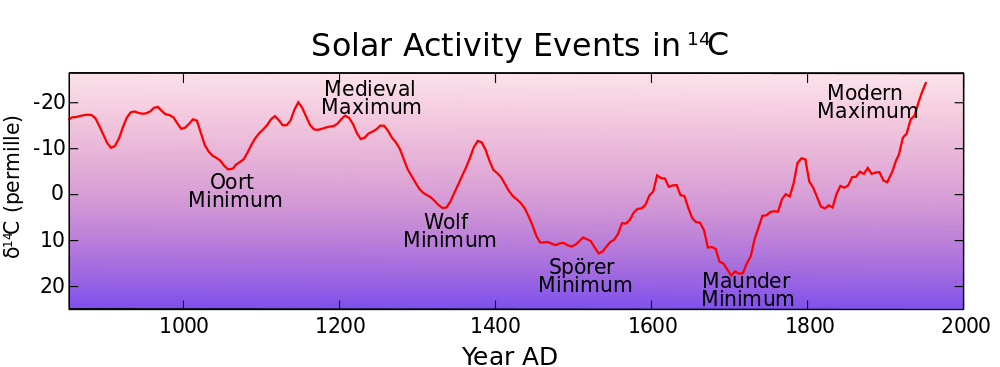
As I commented above, 1430-39 was a little before the onset of the Spoerer as shown by 10Be and 14C isotopes (usually dated from 1460), but solar activity and temperatures were headed down from the post-Wolf Minimum peak.
Thanks for your link showing that at least some researchers recognize an Early Spoerer from c. AD 1433.
Later in the LIA, even after the Maunder Minimum, there were some notoriously cold years and decades, such as the terrible famine-producing Great Winter of 1740, but IMO 1708-09 still takes the cake, as an extreme weather event at the tail end of the Maunder. It had an impact on world history. Peter the Great might not have defeated Swedish King Charles XII at Poltava, Ukraine the following summer without the dire effects of the winter on his exposed troops, some of whom literally suffered their testicles freezing off. So General Winter was on the side of Russia even at that early date.
There was no modern maximum. Solar activity in the mid 20th century was no different to that in the mid 19th and mid 18th centuries.
John,
The isotopes and observations beg to differ with you.
Bob,
The link you provided was the early draft of the new paper, pre peer review and without the IPCC and AGW references which subsequently appeared in the final publication, its interesting to compare the conclusion section side by side. btw references to sporer minimum are in the text but removed from the published conclusion
more smoke and mirrors
Yes, the solar suggestions were downplayed, so now it is a strange article with Spörer in the title but no solar variability content. Clearly the authors were not allowed to highlight their favorite explanation, which is unusual as generally authors are at liberty to discuss what they think is the cause of the results presented.
They are just finding that out? I am certain that this has been brought up before. In fact, some one used a graph of the, let’s say, ” weather ” and the cost of wheat in Dutch Guilders. Now if only there was a blizzard in Saudi Arabia. As if that could happen. ( sarc, sarc, sarc )… you know, that cold was local and not world wide. When it snows is or unusually cold, that’s global warming. ( I’m going to make myself a snow camel )
Two more decades of cold coming up. Get used to it or move south.
Might not be as bad as 1433 though. Just normal minimum. Nothing grand.
I already did. I bought land in the deep south in the early 1990’s. I might wait until after 2018 though. I have a reason for that, not related to climate.
Hemispherist
“As a consequence, we are affected by climate extremes in a different way – cold extremes are less cold, hot extremes are even hotter.”
This is another of the non sequitur’s used by alarmists to support a case that doesn’t exist.
cold extremes are less cold……. ?w=720
Thank you J.Philip Peterson for the video link – I’m sending this to my history teaching colleagues in the hope it helps them when they are dealing with the topic of witchcraft crazes.
As is so often the case, the Four Horsemen tend to ride together.
During that decade, the Hundred Years War was in a hot phase. From the Siege of Orleans and the Battle of Patay (1429), the English started losing, and not just because of Joan. Their final defeat was in the southeast of France at the Battle of Castillon in 1453, although they held on to Calais until it too was lost under Bloody Mary Tudor.
Also in that year befell the calamity of the Ottoman conquest of Constantinople. On the bright side, this disaster for civilization spurred exploration of other routes to the Indies, led to an exodus of Greek scholars from Byzantium to the West and about that time Gutenberg printed his first Bibles.
During the Spoerer Minimum, England suffered the dynastic Wars of the Roses, 1455-85. The crucial, gigantic, bloody Battle of Towton was fought in a snowstorm on Palm Sunday, 29 March 1461.
The Italian Wars, 1494–1559, with the French Valois dynasty fighting the Hapsburgs of Spain and Austria for possession of parts of the peninsula, also occurred largely during the Spoerer. Financed by the silver and gold of the New World, the conflict was a disaster for all concerned.
Depends of point of view. For Fernand Braudel after 1559 Italy under the hegemony of Spain entered a century and a half of Pax Hispanica, a peaceful period they had not known since Roman times. So for the Italian people it cannot be considered a disaster.
Frankly I don’t think you can find a period without conflicts somewhere. This is related to human nature, not climate nature. Bad climate just worsens the consequences.
Agree about the consequences of bad climate. But IMO worsening climate, ie colder, also can lead to war, famine, pestilence and death not just by exposure to the worsened elements.
As for the man-made disasters, I was thinking of the wars themselves, their participants and victims, not the consequences of Hapsburg victory. During the wars, firearms came to prominence (1503), the French king was captured (1525) and ransomed, virulent syphilis spread (1494 et seq) from Spain to Italy to France and beyond, death and destruction were visited on Italy, financial ruin threatened France and Spain, which suffered inflation from the influx of gold and silver, not to mention the effects of colonization on the Americas.
It has been shown quite convincingly many times. But the drought has usually a much worse effect on crops and social upheaval that the drop in temperatures. The Peoples of the Sea that caused the Late Bronze collapse are a classic example. Droughts are believed to have been behind the Huns invasions too.
But the Italian wars of the first half of the 16th century are actually not a good example. The 30 year war is the perfect example. During the Italian wars the local population suffered very little if at all, because both contenders wanted to rule the land by keeping the locals happy. They were probably doing good business with both armies. We know at least the brothels did, because that is how syphilis spread from the Spanish sailors to the French soldiers in Naples. Casualties at the battles were somewhat high but far from unusual for the time. The French king suffered in his pride and as a result of his cravings strawberries were introduced in Spain from France. Neither the French, nor the Spaniards suffered from the wars. The French monarchy had financial troubles, but again they were having them all the time. Over-reaching kings were broke all the time.
The 30-year war was a very different kind of conflict. As a civil war there was an intent on destroying physically the rival, and population massacres were common, as crop destruction and housing burning. An awful period that damaged the land and the population. The difficult climate could have acted at the same time as stimulus for aggression, upsetting the population (over ten thousand people were killed for witchcraft for cooking climate), and as worsening of the consequences.
Javier,
For sure the 30 Years War was worse for the locals than the Italian Wars. But armies marching repeatedly over your land means your food gets eaten, your daughters raped, your goods stolen and crops trampled. No doubt some Italian city state citizens did prosper as a result of the wars, but there was also a lot of looting and destruction.
Chimp,
I am not trying to demonstrate that the Italian wars of the first half of the 16th century were harmless floral games, but the evidence that they can be singled out from many similar conflicts as “the conflict was a disaster for all concerned” is simply lacking. The Italian City States were engaged in low level warfare almost continuously over the previous three centuries so the situation wasn’t radically different, just at a different scale.
And a final point is that many historians believe that the political fragmentation and frequent warfare that took place in Europe from the Middle Ages is not coincidentally but causally related to the extraordinary cultural, technical, and scientific advance that took place simultaneously in that part of the world and that resulted in the posterior “discovery”, conquest, and colonization of the rest of the world by Europeans.
Javier,
IMO large foreign armies marching up and down the peninsula produces more devastation than city state rivalries, destructive as some of those were, especially after companies of mercenaries unemployed by truces in the 100 Years War sought work in Italy.
The wars after 1494 were different. They saw not just the slaughter of at least tens of thousands of soldiers, but the laying waste of much fine country. The wars affected almost everyone.
http://theborgias.wikifoundry.com/page/The+Italian+WARS
In the same year as the Sack of Rome (1527), two English envoys traveling through Lomardy reported that ‘the most goodly countree for corne and vynes that may be seen is so desolate that in all ways we sawe not oon man or woman in the fylde, nor yet creatour stirring but in great villaiges fyve or six myserable persons and in Pavia children crying in the street and dying of hunger’ (Barbara Tuchman).
PS:
It wasn’t just the size of the invading armies, but their technology that made the Valois-Hapsburg wars over Italy so much more destructive than city state conflicts. Modern nation states were able to tax and spend on armed forces on a scale unimaginable for Milan or Florence, Siena or Pisa.
The French had perfected field and siege artillery during the HYW. The power of gun powder came as a shock to Italians and Hapsburgs alike. Soon infantry firearms also dominated combat, with new formations and tactics.
Contemporaneous historian Francesco Guicciardini wrote of the initial 1494 French onslaught:
“Now owing to this invasion of the French everything was turned upside down in a sudden storm…sudden and violent wars broke out, ending with the conquest of a state in less time than it used to take to occupy a villa. The siege and taking of a city became extremely rapid and achieved not in month but in days and hours.”
The Sack of Naples in 1495 was one such sudden descent.
Eventually Spanish pike and shot tercios would defeat French heavy cavalry (gendarmes) combined with Swiss or German mercenary infantry, but not before Italy was, as I said, devastated. The end was near when France allied with the Ottoman Empire against Emperor Charles V, who abdicated in favor of his brother Ferdinand as HR Emperor and son Philip as King of Spain.
Ok, Chimp. You seem to know more of this than I do, so I won’t discuss it any more. The Italian Wars are placed between the Hundred Year War and the the Thirty Year War, and I don’t find them nearly as damaging as those two, but as my knowledge is not as profound as yours I will have to maintain that it is just my opinion.