Guest post by David Middleton

As someone rather detached from the automotive world — in other words, someone who considers cars to simply be tools and not extensions of identity — the fervor surrounding debates in the industry often seems strange to me.
Why so much psychological investment in the outdated idea that electric vehicles are crap and can’t compete with internal combustion engine (ICE) vehicles? Or, for that matter, the idea that electric vehicles can function as some kind of savior of humanity and preclude the need for fundamental changes to social/industrial systems if anthropogenic climate change is to be limited in any real way?
Ex-GM, -BMW, and -Chrysler exec Bob Lutz is a case in point. It seems like every chance he gets, he goes off on some rant about Tesla, CEO Elon Musk, or electric vehicles in general, rants that often don’t have anything to do with the facts of what he’s discussing.
His most recent rant, on CNBC, featured the claim that: “Tesla supporters are like members of a religious cult. Just like Steve Jobs was worshiped at Apple, it’s the same way with Elon Musk, who is seen as a new visionary god who promises this phantasmagorical future, a utopia of profitability and volume. The only problem is, Steve Jobs delivered and Elon, God bless him, hasn’t delivered a thing, except increasingly negative cash flow, and an increasing lack of profitability; more and more capital spending.”
Hasn’t delivered a thing? What world is Lutz living in? I’m by no means a fanboy of any kind, and yet I can easily say that no one out there is doing anything similar to what Tesla and Elon Musk have been doing. The all-electric firm has been a wrecking ball to the automotive industry. And its efforts appear to be picking up more and more momentum every year.
[…]
Interestingly, the CNBC coverage, which was published before Tesla’s release of its Quarter 3 2016 results, included this bit: “Tesla is set to report third-quarter results Wednesday after the closing bell. The electric automaker is projected to post a loss of 54 cents per share on revenue of nearly $1.98 billion.”
Well, they weren’t quite right with that “projection,” were they? Whose bets were being set up by those “projections?”
Here are a few more of Lutz’s comments from the interview: “I just don’t see anything about Tesla that gives me any confidence that that business can survive. The last time I checked, (Tesla’s) quarterly cash burn is about $250 million. For a company that size, that’s horrific.”
And: “Every time (Tesla) gets a $500 million injection from a new stock sale or a $750 million injection of new money, it lasts them two or three quarters. This is a problem that volume can’t fix. … If you’re in a variable loss — that is, you’re not recovering labor and materials in your sale price — then doing twice as many, or three times as many, or four times as many (sales) doesn’t help. The losses just get bigger and bigger.”
Since when is Tesla not recovering production costs on its vehicles? Where does Lutz come up with this stuff?
[…]
Define Irony: A cultist ridiculing, in a cult-like manner, a critic of his cult.
Mr. Ayre stipulates to “rather detached from the automotive world” and then zealously defends Tesla from Mr. Lutz’s factual statement:
“Tesla supporters are like members of a religious cult. Just like Steve Jobs was worshiped at Apple, it’s the same way with Elon Musk, who is seen as a new visionary god who promises this phantasmagorical future, a utopia of profitability and volume. The only problem is, Steve Jobs delivered and Elon, God bless him, hasn’t delivered a thing, except increasingly negative cash flow, and an increasing lack of profitability; more and more capital spending.”
The basis of Mr. Ayre’s criticism is the fact that Tesla managed to beat the analysts’ Q3 2016 forecast of “a loss of 54 cents per share on revenue of nearly $1.98 billion” and posted a profitable quarter form only the second time in its glorious history. I would venture a guess that the “automotive world” isn’t the only world from which Mr. Ayre’s is detached.
In three of the past four quarters Tesla fell short of the analysts’ projections, including Q4 2015, when analysts projected a minuscule profit…

More importantly, as the lower panel demonstrates, Tesla’s annual net loss has been growing geometrically. Without a continuous infusion of new capital, Tesla would cease to be a going concern rather rapidly.
Telsa Operating Income (Loss), Thousands of USD
2013 ($61,283)
2014 ($186,689)
2015 ($716,629)
Tesla Cash Flow From Operating Activities, Thousands of USD
2013 $264,804
2014 ($57,337)
2015 ($524,499)
Through Q1 and Q2 2016, Tesla’s operating income and cash flow have also been negative.
The “quarterly cash burn” of $250 million may not he exactly correct, but Mr. Lutz is spot-on here…
“I just don’t see anything about Tesla that gives me any confidence that that business can survive. The last time I checked, (Tesla’s) quarterly cash burn is about $250 million. For a company that size, that’s horrific.”
And here, if you include all operating costs…
“Every time (Tesla) gets a $500 million injection from a new stock sale or a $750 million injection of new money, it lasts them two or three quarters. This is a problem that volume can’t fix. … If you’re in a variable loss — that is, you’re not recovering labor and materials in your sale price — then doing twice as many, or three times as many, or four times as many (sales) doesn’t help. The losses just get bigger and bigger.”
All companies have to include all operating costs when reporting operating income. There is no special accounting exemption for being green.
Mr. Ayre’s laid out the best evidence for the Tesla Cult here…
Why so much psychological investment in the outdated idea that electric vehicles are crap and can’t compete with internal combustion engine (ICE) vehicles? Or, for that matter, the idea that electric vehicles can function as some kind of savior of humanity and preclude the need for fundamental changes to social/industrial systems if anthropogenic climate change is to be limited in any real way?
Clearly he is so deluded that he thinks the climate will behave for Elon Musk and “that electric vehicles can function as some kind of savior of humanity.”
About Telsa’s Q3 2016 “Profit”

One day after Tesla said it earned 71 cents a share, adjusted, in the third quarter, several analysts poked holes in the company’s unexpected profit and revenue beat.
While acknowledging that Tesla had a good quarter, JPMorgan analyst Ryan Brinkman told investors that his team saw “one reason why the [third-quarter] earnings report is not as good as it looks, and another reason why it might not be as good as it looks.”
Brinkman’s issues were both tied to Tesla’s revenue beat. The automaker’s results included just under $140 million in zero emission vehicle credits, which are handed out to companies for selling zero-emission cars. That’s far higher than many analysts had forecast.
The JPMorgan analyst, for example, had expected the automaker to generate a mere $25 million from these credits. Tesla recognized a negligible amount of revenue from ZEV credits in the previous quarter.
Changes the company recently made to the way it reports revenue could be another reason its sales beat analysts’ forecasts by such as wide margin, Brinkman said. Revenue came in at $2.3 billion versus a consensus estimate for $1.9 billion, “even though the approximate number of deliveries in the quarter was known ahead of time.”
“We feel the difference clearly relates more to the change in accounting than it does to [average selling prices],” he said.
Tesla made this change to bring itself closer in line with GAAP accounting standards.
[…]
The difference between the projected loss of $0.54 and an the reported profit of $0.71 per share was $400 million in revenue. $140 million of which was corporate welfare (ZEV credits) and the rest due to lower capital spending and a change in accounting methods.
While I think Tesla’s are really cool toys, engineering masterpieces, and that Elon Musk is a brilliant person, the cult-like worship of the car and the man is one more reason to think that green ribbons are very appropriate for mental health awareness.
Most sold % EV of new cars in Norway: 24.4%! Netherlands: 1.8%, France: 1.5% and UK: 1.3%. Why? Subisidies. The sales dropped 85% in Denmark when the subsidies were removed this year.
Putting EV Sales Into Context
From January through August, EV sales in the U.S. totaled 99,634 vehicles. Over the same time period, sales of Ford F-Series pickup trucks totaled 527,847 vehicles. Each of the 20 top-selling models outsold the sum-total of EV models. Year-to-date EV sales are comparable to about 45 days of Ford F-Series sales. http://online.wsj.com/mdc/public/page/2_3022-autosales.html%5B/caption%5D
 Zero-point-six percent… Very close to zero-point-zero.[/caption]
 EV’s are on trend to account for 2% of U.S. vehicle sales in 2040.[/caption]
[caption id="attachment_153728" align="alignnone" width="648"]
EV’s have accounted for 0.6% of auto sales this year:
[caption id="attachment_153738" align="alignnone" width="960"]
These “futurists” really seem to believe that EV’s “could account for 25 percent of passenger cars by 2040, likely depressing oil prices” because EV sales have increased from zero-point-zero to slightly above zero-point-zero since 2011.
The Federal Reserve Bank of St. Louis keeps track of U.S. vehicle sales. If I plot the EV sales from the article along with total vehicle sales and extrapolate the data out to 2040, I don’t get anything close to 25%.
[caption id="attachment_153742" align="alignnone" width="960"]
Even if I limited it to passenger cars, which account for about 30% of U.S. auto sales I only get to 5%. The only way this trend could lead to EV’s accounting “for 25 percent of passenger cars by 2040,” would be to assume that EV’s lasted longer than conventional passenger cars and the cumulative sales would eventually bring them up to 25% of passenger cars… AKA imaginary math.
So, “green” math yields a five-fold exaggeration in future EV auto sales… Very consistent with “green” estimates of global warming and climate sensitivity: About five times larger than reality.
Data Sources
Wall Street Journal
Federal Reserve Bank of St. Louis
https://wattsupwiththat.com/2016/09/15/green-math-must-be-a-common-core-product-ev-edition/
Model S sales in Q2 2016 totaled 9,745 units, about 3,250 per month. Mercedes Benz USA sold 5,225 E-Class vehicles just in July 2016. Tesla’s total sales in Q2 2016 were 14,370 vehicles, about 4,790 per month. MB USA sold 28,523 in July alone.
Tesla Model S sales fall short of expectations as company makes bold new promise
Mercedes-Benz USA July Sales Hit All-Time High Of 28,523 Units, Up 3.6%
Teslas are technological masterpieces.
If I could afford a $100,000 toy, it would be the second one I would pick.
The average price of the Tesla Model S starts out twice as high as the 5-yr true cost to own of the MB E350.
If I drove a Tesla from Houston to Dallas, I could recharge at one of two charging stations between here and there, Huntsville and Corsicana. If I drove a MB from Houston to Dallas, I could refuel at one of dozens of gas stations between here and there.
Tesla has a ways to go before I would choose it over the MB. Since I drive a Jeep Rubicon, I wouldn’t choose either, unless I could afford a G-Wagon.
“I could refuel at one of dozens of gas stations between here and there.”
Closer to hundreds.
I only go to real gas stations… Exxon, Shell, Chevron, etc.
22% of new vehicle sales in Norway are EVs.
Just because Texas and USA are behind global trends…
Griff… A single data point is not a trend.


http://theicct.org/sites/default/files/Picture1_0.png
The US % EV numbers appear to be exaggerated by a factor of about 3x… Maybe they don’t include light trucks & SUV’s.
Let’s assume that the numbers for Norway are accurate…
At $6.48 per gallon, EV’s make at least a little economic sense in Norway.
When you top off the atrociously high gasoline prices with $15,000 of corporate welfare per vehicle, Norway should be 80% EV’s, if not higher.
David, Griff is still trying to convince everyone that just because windmills once, for a couple of minutes provided 20% of Germany’s power needs, that this proves that windmills are providing 20% of Germany’s power needs.
I just like burying him in numbers and charts… and a laughing Data on occasion… 😉
Since the early nineteenth century electromobility is in use and the problems are still the same, the power density of batteries! Even if we ignore the enery waste caused by transmission losses,
the highest electrochemically realizable cell voltage is 6,xx Volts and the elements and electrolytes required for these cells are extremely dangerous for daily use. Faults, when charging or discharging f.ex.,turn those batteries into bombs! See the recent problems of Samsung with their rather simple 3,2 V high efficiency Li-Ion cells in cell-phones!
Bob Lutz is right.E. Musk, the electromobility guru, is riding a dead horse and wasting money! I would like to have one of these very fine designed cars with a small clean turbo-diesel + plug-in system just for use in city green zones! And forget the hullabaloo about NOx, the limits are absurd!
I suspect President Trump will not be kind to Tesla and the other green crony corps.
I not seeing very many if any working poor who give a rat’s patoot about Tesla or any other electric vehicle. Give them a good gasoline powered Toyota sedan or pick up truck.
I’m not seeing …
‘Affordable and efficient electric vehicles are changing the world energy markets in fundamental ways.’
Name one.
Intentionally ambiguous.
Name one ‘affordable and efficient electric vehicle.’ Electric vehicles cost way more than gasoline powered cars. Especially in capital costs. Except for Tesla, PEV residual value is AWFUL. Three-year depreciation of the Nissan Leaf is 73%. The stuff of nightmares for families that bought into the electric car schtick.
Name one ‘world energy market’ that has been changed by electric vehicles. In fundamental ways, no less.
For every new wind mill installed, for every new solar panel installed, for every new A/C unit upgraded, for every new energy efficient building code that emerges, for every employee that can stop commuting from home and begin working from home, for every upgrade to existing home energy efficiency, for every pound removed from vehicle weight…there are additional electrons available from the grid to power EV’s. We aren’t going to add EV’s at a huge rate so the need to find new electrons aren’t going to be in extra special demand. Slowly and consistently the changeover to EV’s can be managed without requiring extraordinary changes in the supply of electrons.
I wouldn’t be so concerned about the fallacy of EV’s. It’s going to happen in one form or another with battery or hydrogen. As long as it’s slow, it’s manageable.
Hydrogen looks more realistic but range is only 300miles but fill up in 10 mins.
They need to solve the embrittlement and leakage problems first.
Other than wanting to own the latest enthusiast’s driving machine, I can think of only one good reason to own a Tesla: as an investment. Twenty or thirty years from now, long after Tesla Motors has gone out of business, a $75,000 Tesla (possibly with spare battery) should be worth upwards of $750,000 to $1,000,000. Buy it, put it in a garage and maybe drive it once or twice a month to keep it in running shape.. They haven’t built that many and with normal attrition there will only be a very few mint-condition ones left around in that time frame. Besides, it’s gotta be a better investment than real estate in New York or California.
If you leave a Tesla off the charger for a month the battery pack dies and you have to buy another one. Ask some very unhappy owners. By the time the car becomes a ‘classic’ it will have to run on whatever batteries are available at that future time.
Batteries from the future might actually be economically viable.
Assuming flux capacitors never take off.
Crispen,
That’s good information on the Tesla. I didn’t realize the Li-ion batteries had such a high self-discharge rate. I can see where an owner might get a little PO’d if his house/garage power tripped off while on an extended vacation and he had to spend more on battery replacement than on the vacation or more probable, he left his Tesla at the airport and it was dead when he got back.
The Green Madoff
Middleton has the buggy-whip mindset: nothing could be better than a reliable horse and smooth-running buggy. Look how that turned out.
EV charging stations in the US can be found on a map at https://www.plugshare.com
Many hundreds at present, with more built every week.
Too fracking funny… I-45 from Houston to Dallas: ?w=680
Two Tesla supercharger stations (tan markers): Hunstville and Corsicana. The green markers (Madisonville, Fairfield and Corsicana) are RV parks. There are more gas stations in Fairfield than there are charging stations on I-45 between Houston and Dallas.
The fact that EV’s, batteries, solar and wind generation may become less expensive in the future, is irrelevant to the current build-out of uneconomic infrastructure. Our government isn’t funding the development of new technology when they mandate and subsidize solar power plants, Tesla purchases and EV charging stations that no one uses. They are funding the uneconomic build out of utility scale infrastructure because they think they see a future need for green schist.
Imagine if the government had mandated and subsidized the manufacturing of a home version of the UNIVAC I in 1957 because some prescient bureaucrats foresaw a future market for home computers. The misallocation of capital would have been horrendous.
With energy, it’s even worse. Electricity is a cost. When bureaucrats mandate that “x” percentage of electricity be generated by so-called renewable sources, they are mandating higher energy costs – they are destroying wealth. When government subsidizes the build out of utility scale solar power plants, they are subsidizing more expensive and less available electricity – they are destroying wealth.
When the free market is allowed to work, people like Thomas Edison, Bill Gates and Steve Jobs create wealth. When government picks winners and losers, corporate welfare pimps win, while taxpayers and consumers lose.
The issue isn’t teething problems with a new technology. The problem is a mentally deficient government crowbarring the economic equivalent of a 1957 home version of the UNIVAC I into an economy with no real market for a prohibitively expensive home version of the UNIVAC I.
Some day in the future coal, gasoline, natural gas, nuclear fission and just about every other power generation source will be replaced by something that delivers more value to the economy… Real value… Measured in $$$. Not phony value like “social cost of carbon,” EROEI or fill-in-the-blank averted. That day is not here yet.
Man did not leave the Stone Age because of a stone shortage. Man did not advance from the Chalcolithic to the Bronze Age because brilliant government bureaucrats forced coppersmiths to purchase bronze credits.
There is a problem facing regulators. If there is a desire to reduce the use of fossil fuels in transport then taxes to cover the externalities is the most obvious choice. But many users of fossil fuels they are locked in by past investments. It is likely that some form of intervention that rather than taxes the fuel taxes the conversation equipment (aka in this case as the car) would be more efficent. Politics can make taxes incumbent technologies difficult (I won’t mention “cult” and “petrol head” in the same sentence) so we end up with the second best approach, namely to subsidise non-fossil fuel conversion equipment.
So one can see why it is adopted as a policy response.
The UNIVAC is a strawman in this context because it would have been home computers that would be subsidised following this logic, not a specific solution. As others have noted here in pushing EVs one needs to be aware of impacts back up the fuel supply chain.
If thinking about buggies etc, it is also worthwhile thinking about trip replacements that may leave cars behind – fleet and logistics optimisation, and moving electrons rather than physical things (eg telepresence, 3D printing). This will happen faster than EVs because it is low capital cost and people will own the hardware for other reasons (and partly thanks to Eckert and Mauchly).
It would only be a strawman if I changed the nature of my opponent’s argument and then argued against my version of their argument.
I merely drew analogy, which you just reinforced. The government is interfering with the free (ish) market because bureaucrats think they know what’s good for us.
I hadn’t thought of you as my opponent.
In defence of bureaucrats they only can do what our elected reps approve, and it is well accepted that governments have a role to play in internalising externalities. The expectation however is that they should do this as efficiently as possible.
So from a public policy point of view the two questions are: whether there is a significant externality associated with fossil fuel use, and if so what’s the best intervention to achieve it. I suspect that if you accept there are problems with using fossil fuels in ICEs that are being captured in the market, then incentives to buy other technology isn’t the worst way to do something about it. I don’t know how the US system works but competitive tendering on a regular basis to benefit from the incentives gets over some of the potential dynamic inefficiencies that arise from them.
“aren’t being captured in the market”
Actually, you could buy a home computer in the early 50’s. In the back of popular science, for something like $3.95. It was called a Brainiac. It was essentially an electric version of a simple mechanical adding machine. It could be programmed to some extent for simple problems. An interesting technical toy for smart kids so inclined. Useful otherwise, no.
“Man did not leave the Stone Age because of a stone shortage”
Its funny – I’ve seen that quote from a Saudi oil minister, explaining why the Saudis are embracing solar power.
HAS… You keep making my point. The only rationale for a home version of the UNIVAC I would have been “from a public policy point of view.” This is also the only rationale for EV’s and utility scale solar and wind power.
Griff… The Saudis have an excess of both sun and oil. However, once they deplete their oil resources to the point that they can’t pay the bills, they won’t have anything left other than sun and sand.
Cherry pick much, Middleton?
See http://car stations.com for US
charging locations and number of stations there.
Note that California has more than 2,000 charging stations at present. Texas has more than 600, mostly in the Dallas, Houston, and San Antonio cities.
Rants such as Middleton made here and below are funny to those of us who understand a revolutionary technology when it appears.
I zoomed in on the route of my weekly commute. ?w=720
 ?w=680
There are plenty of charging stations in Dallas and Houston. There’s one at the Walgreens across the street from my house in Dallas. It’s been there for about 5 years, I think I’ve seen it used twice. But there are very few in between Dallas and Houston. What’s the point in having a $100,000 car that you have to plan any trips longer than 100 miles around the locations of charging stations?
As I said in the post… I am awestruck by the engineering of Tesla cars. My problem with EV’s and utility scale solar power isn’t with the technology; it’s with the economics. The UNIVAC I was “a revolutionary technology” 60+ years ago. Thank God prescient bureaucrats didn’t decide we would need a home version of it in the 1950’s.
I also get a kick out of ridiculing green cultists.
What’s that? You can’t see the EV sales? Let me fix that with a log scale on the y-axis.
http://debunkhouse.files.wordpress.com/2013/06/wpid-data-laughs-o.gif?w=450
Data laughing at you… 😉
You mean funny to you and your fellow cultists? Your “revolutionary” technology isn’t there yet. The advantages of it are few and far between, and the disadvantages are frankly embarassing. Give it 30 or 40 years. Then we’ll see.
The October sales numbers are in for plug-in cars. Tesla model S and X both dropped by a factor of 4 relative to September which was the basis for all the upbeat news. http://insideevs.com/monthly-plug-in-sales-scorecard/
Small quibble. The numbers given in the Operating Income (Loss) figures are shown in ($1000)’s..
“More importantly, as the lower panel demonstrates, Tesla’s annual net loss has been growing geometrically. Without a continuous infusion of new capital, Tesla would cease to be a going concern rather rapidly.
Telsa Operating Income (Loss)
2013 ($61,283)
2014 ($186,689)
2015 ($716,629) ”
The 2015 loss was $716 MILLION, not $716,629. Most would probably realize that, but the chart should show the correct magnitude.
I meant to note that. I’ll fix it… Thanks.
Fixed.
Does that include the $400 million from 400,000 potential buyers of the model 3? I think it’s extremely creative that Tesla got potential car buyers to loan them, interest free, $400M.
I don’t know. In our industry, we will often licence seismic data in volume purchase agreements. We pay a discounted rate up front for X number of OCS blocks of 3d which we can select over a period of time. Even though we paid up front, the seismic contractor can’t book the revenue until we select and take delivery of the data..
At least Jim Bakker had SOME hotel rooms when he sold them.
The greenies are showing their ignorance on this one. Bob Lutz said not one word against electric cars. Why wouldhe – he was the guy who produced the first mostly electric vehicle by any major
American automaker. What Lutz is pointing out is that Tesla Motors is living on govt doles and
has so far prodced exactly one vehicle, a vehicle that is sold in the thousands, not hundreds of thousands. Tesla has not proven itself to be a major automaker, much less the star of the East.
Lutz’s GM is producing two electrics now – the Volt and the Bolt, both of which can be owned by
non-zillionaires. Tesla has attracted the greenies not from what it has accomplished, but because of Elon Musk’s rather simple minded green thoughts. He’s into govt subsidies from solar panel roofing companies as well. The Tesla Model S may be electric, but it is one big energy hog, at more than 4000 pounds. He spends his engineering time making it run faster than other cars, not more efficiently, something greenies have griped about for decades. Go figure. Which is the dumber
member of this mutual admiration society? Musk also has made multiple claims in the past concerning wwhat the price of his cars and their range would be and how cheap they supposedly are to operate. All those claims were bogus, like much of the man himself. As an energy guru he avoids new nuclear and therefore is an energy ignoramus. He defrauds the public with his claims about solar.
Tesla has produced three vehicles: the roadster, model S, and model X.
Given the current mix of fuels used to produce electricity in the US, the Tesla Model S causes the emission of as much CO2 as a car that gets 16 miles to the gallon. It’s certainly cheaper to power a Tesla since grid power is much cheaper than gasoline power, but free of emissions Teslas are not. They just displace the emissions to the power plant.
don’t have issues with electric/hybrids, have issue with people getting tax breaks to buy them as it creates false foundations.
up here in cold country hybrids operate on gas a lot anyway.
and have had to pull a few here on bad roads with my crown vic.
seriously would like to see diesel electric like in locomotives though.
Who Will Become the First Master Builder of Clean Energy?
By Steve Heins, The Word Merchant
Many have probably heard a lot about Tesla lately, including the latest dust up with the “Autopilot” accidents. Beneath the headlines, the recently announced Tesla and Solar City merger will be an interesting experiment: Can massive government spending stimulate its own economy, without the usual worry about return on investment or real market demand. Stated differently, can the public sector make “better” and more clean energy choices than the private sector?
First, with so many phrases being bandied about by the energy and environmental communities like “sustainable,” “clean,” “renewable,” and “environmentally friendly,” a broader meaning is required: “Clean energy” is energy efficiency, solar, wind, large scale battery storage, new gas/natural gas pipelines, new state of the art transmission lines, geothermal, hydro, improved and cleaner coal power plants, wave, new or updated nuclear power plants, and new natural gas power plants. They are all a part of a global greenhouse gas emission reduction strategy that at a minimum doesn’t damage the 3 billion people living in poverty, and 1.6 billion people still living without clean water, reliable electricity and inadequate telecommunications.
A necessary measuring stick is that all “clean energy” must share the ability to be measured and verified over time. Also, instead of the many imperfections of the cap and trade platforms like the European Union’s Emission Trading Scheme (and its ilk) and the carbon tax, the plan should be all inclusive. Renewables would not be treated as the only tradable emission credit, voluntary or otherwise. This notion reflects a sense that a 100 % renewables world isn’t a sacred goal nor is it even desirable.”
Frankly, when it comes to global economic development, the political class has proven, at their best, that they are enormously vulnerable to the Chinese menu of human frailties. Conversely, the private sector corrects its own historical mistakes, if only for economic survival.
Even the most recent example of a successful federal program, the Internet itself, only became commercialized and successful, after the heavy-handed regulation by the federal government was supplanted with technologies developed in the private sector. The TCP/IP protocol was established in 1983, and the invention of the browser by Marc Andreesen in 1993. Unlike the inevitable ossification of any large government entity, the private sector has the ‘machinery for change”, as Leonard Cohen put it.
One could argue, as the Wall Street Journal does, that Telsa and Solar City are both taxpayer subsidized companies. In fact, neither company has returned its first dollar of profit.
Essentially, the public sector, including well-funded politically active environmental groups, have decided that the solar industries, coal capture, electric cars, and large scale storage batteries are some of the best investments for the future of energy, economic development and environmentalism. “Tesla customers can drive clean cars and they can use our battery packs to help consume energy more efficiently,” as stated in a recent Tesla blog, “but they still need access to the most sustainable energy source that’s available: the sun.”
Lost in Tesla’s quote is the fact that the solar industry, coal capture or battery storage business cannot yet be defined as a “clean energy” sources, at least until they can prove they have the profitability and scalability to create the enormous amount of capital necessary for the global infrastructural investments, and all without the kindness of governmental assistance.
Currently, the public sector seems awash in money for renewables, studies and reports dedicated to the environmental community by the environmental and energy agencies. In addition, there is large amount of money that is being donated by individuals and foundations to environmental organization, which receive public or private funding.
At a minimum, there must be full disclosure of all public sector funding, when these funds and grants are received and expended on these environmental and economic debates. In a world flooded with funding biases and dubious economic claims, material facts help Wall Street and global investors keep the world in economic perspective no matter what is being said in public about energy and the environment.
After the failures of Solyndra, SunEdison, FutureGen in Illinois, the Kemper Project of Mississippi, Telsa and Elon Musk must grow from being great marketers to becoming a master builders of energy sustainability. If Telsa fails, they certainly will do irreparable harm to the credibility of federalism, renewables, and clean energy.
####
You guys are funny. Whilst I’m a dyed in the wool AGW sceptic, the IC engine is dying out. It’s a bizarre concept with innumerable moving parts held together with nuts and bolts, thrashing around and entirely reliant on gas (petrol to us Brits) stations every few miles. And I mean every few miles. I can name 30 petrol stations within 3 or 4 miles from my house. The whole concept is ludicrous. Wholesale distribution of fuel by innumerable tankers trundling around our roads whilst a perfectly good national grid exists. Oceans ploughed by tankers spewing the damn stuff overboard just for car fuel. And whilst I’m preaching to the converted (almost) it would be far better if we resurrected our coal industry, built ‘clean’ power stations, became self-sufficient and invested in EV technology.
Someone on here condemned Musk’s Tesla car by posting a single photograph of a truck that was hit by a Tesla and the driver died whilst it was on auto pilot. I could show millions of shots of fatal accidents in conventional cars when the only pilot was the nut holding the wheel.
When it was first developed, the motor car was horrendously expensive, for the landed gentry only. They, of course, adopted their own sat nav and auto pilot, the butler (later dedicated chauffeur) and the challenge was to get from London to Brighton, 50 or 60 miles or so? There were few, if any, petrol stations so range anxiety was acute. They cars also stank, they were exposed, noisy and unreliable.
However, they were encouraged as the alternative was cities drowning in horse shit (literally) which became a serious health hazard. The drains couldn’t cope and the effluent was invariably dumped into the nearest river affecting everything downstream for miles. The resistance to cars was, nevertheless, immense.
Now whilst electric cars aren’t perfect, of course we must charge them, and the energy to do so will largely come from fossil fuel powered electricity generation; but I suspect the particulate emissions from a single power station, powering thousands of cars, is easier to capture and dispose of safely than from individual vehicles. Daily I drive behind cars and lorries belching plumes of black diesel smoke from badly maintained engines. That’s the reality of the situation, the theoretical differences between the energy efficiency of EV’s or IC’s is inconsequential.
EV’s are not perfect, but neither were IC’s when they were introduced. It took time, effort and government subsidies to get them to where they are now. EV’s are the same, as the technology matures, the subsidies will reduce.
If you lot swallowed your pride and thought about it for more than a nanosecond, supporting EV’s gets you closer to the AGW alarmist’s and the debate would be narrowed to the actual problem. Can they prove conclusively that CO2 causes GW? Of course not. Have they spent 40 years trying to prove it? Yep, and come up blank.
Quit giving them ammunition to divert the discussion with. You need to sell the sceptical view to the public, they then need to put pressure on governments who will not allow votes to walk out the door, even over GW.
You are all clever guys. I have only spent 30 years in sales and marketing, but there is one absolute universal truth about delivering an acceptable product or service: consumers won’t buy more than one thing at a time. And the single most important message to be delivered is that no one has proven CO2 causes GW. Get the public asking that single question and you will get converts. Blind them with science about ‘cloud feedback’ or the effects of El Niño and El Nina and they will switch off. Tell them no one has proven CO2 causes GW then demonstrate some evidence from peer reviews that CO2 lags Temp. rise by 800 years, and that’s easy for them to digest.
If we buy something from Amazon, most of us asses the reviews before we decide. This forum is the first port of call for anyone with the desire to ask a question, and it is seriously off-putting. It’s claimed to be the most read sceptical site on the internet but I provoked a meaningless and puerile argument with Isvalgaard (sp?) (sorry mate, it was quite deliberate, no offence) to see just how far it would go. The real problem is that anyone caring to look at the comments would have seen it.
Hundreds of thousands (?) of people across the world love Tesla’s. This thread has just alienated all of them because you question their judgement, taste, motivation etc. by slagging off an expensive item they have invested in. Even if they don’t believe in AGW, you have still pissed them off.
It all comes down to features and benefits. What are the features of the relative arguments (AGW Vs. sceptics) and what are the benefits? The biggest, demonstrable, undeniable benefit as far as sceptics are concerned is that the greens have won! The planet is greening, it’s what they demanded, it’s what they got. It’s positive, it’s measurable, its definable. On the other hand, the only ‘benefit’ the AGW believers can deliver is that rising CO2 causes increased hurricanes, drought, sea level rise etc. But even if it has happened by any fractional degree they care to name, it’s not by the 14% greening has occurred. So, what’s the trade-off? A degree of GW caused by increased CO2, delivering another 14% greening (or more) in 30 years’ time. Wouldn’t their kids just hate them if they prevented that bounty.
And the cost? Some nutter at a congressional hearing demonstrated the sun hitting his bald spot as the Milankovitch effect manifested itself and melted Arctic ice as the earth tilted towards the sun. No one had the gumption to ask him what his arse was doing when it was pointing away from the sun. Nor did anyone ask him the benefit of ice at the poles, other than to drop into a G&T. So the stuff melts over the next 1,000 years, big deal. We lose some cities built precariously on river banks, estuaries and flood plains? That’s our own fault. We have known for hundreds of years that sea levels rise and fall and cities drown, so start building up the damn hill if you don’t want to run a risk.
And whilst this site exists to challenge the AGW concept, if a frank discussion board exists, it needs to be by membership. That way you don’t get wankers like me coming on and causing trouble. By all means maintain an open board, but elect a few experts to deal with members of the public interested in the sceptical view. Assemble the questions they will ask and give them just 3 solid examples each that refute them. Not in a list, but by the selected experts engaging in discussion and ‘handing over’ the evidence in links etc.
Openly calling Hansen and Mann et al wankers and ridiculing Tesla does no one any good at all, it sounds too much like the other side.
“It’s a bizarre concept with innumerable moving parts held together with nuts and bolts”
which is why total cost of ownership for an EV is lower… there are so many less components to go wrong.
For fleet car/van operators, in cities or with fixed routes, EVs are already cheaper to operate. That’ll grow as range extends.
The average price of the Tesla Model S starts out twice as high as the 5-yr true cost to own of the MB E350.
http://debunkhouse.files.wordpress.com/2013/06/wpid-data-laughs-o.gif?w=450
Data laughing at you… 😉
Of course once they start charging road taxes by miles driven instead of gallons consumed, the so called cheapness of EVs dissapears.
My post isn’t about the quality of Tesla motor vehicles. It’s about the fact that Tesla’s net losses continue to grow in proportion with increases in their gross revenue. The more cars they make and sell, the more money they lose. Source: Yahoo! Finance[/caption]
In three of the past four quarters Tesla fell short of the analysts’ projections, including Q4 2015, when analysts projected a minuscule profit…
[caption id="attachment_156722" align="alignnone" width="340"]
More importantly, as the lower panel demonstrates, Tesla’s annual net loss has been growing geometrically, despite increasing gross revenue. Without a continuous infusion of new capital, Tesla would cease to be a going concern rather rapidly.
Telsa Operating Income (Loss), Thousands of USD
2013 ($61,283)
2014 ($186,689)
2015 ($716,629)
Tesla Cash Flow From Operating Activities, Thousands of USD
2013 $264,804
2014 ($57,337)
2015 ($524,499)
Through Q1 and Q2 2016, Tesla’s operating income and cash flow have also been negative.
Tesla’s Q3 2016 profit was greeted with cultish glee by Tesla cultists, like the author of the Clean Technica article featured in this post. Analysts not afflicted by the Tesla cult were quick to point out that Tesla’s Q3 2016 profit was due to much larger than expected revenue from zero emission credits (corporate welfare), changes in Tesla’s accounting methods and a brief dip in their capital expenditures.
Ayre also conveniently forgot to cite the rest of Lutz’s comments in that interview…the parts about the new EV competitors that Tesla hasn’t a chance against, he said Chevy’s EV outperforms Tesla in terms of range, the major players (BMW et al) are introducing better EVs that they can actually produce in volume, Tesla hasn’t introduced anything worthwhile after their sports car (which he likes).
Modern day DeLorean. Every shady deal he does to squeak by makes him more likely to fail spectacularly.
The USA has a quarter of all the cars in the world. Which means if all became electric you would need to build a minimum of an EXTRA 900 x 1000 MW Nuclear power stations just to charge them up. (Thanks to Ristvan for his working out). This is based on the Chevy volt with an all electric range of 38 miles before recharge. So each time that electric cars become 1% more of that 253 million vehicles you will have to build an extra 9 nuclear power stations. The last nuclear power station to open in the USA took 31 years from planning to completion so coal or gas (maybe wind?) is going to have to fill the gap.
Do I notice a lack of joined up thinking the same as here in the UK where 60% of all cars (20.6 million) have by law to be electric by 2030. That is because our politicians nodded through the Fifth Carbon Amendment in July this year without thinking through the implications. So 1,584,000 of the 1,500,000 cars made here are going to have to be electric every year until 2030. Maybe a good export market for Tesla. Plus we need to build an extra 80 x 1000MW nuclear power stations to charge them. The one that has just gained approval, Hinckley Point, is estimated to take 13 years from planning to completion.
There are many words that can be said to the powers that be about their plans, most very impolite if not down right rude, but lets just say “DREAM ON”.
Don’t worry, Trumps election win in the U.S. will start a chain reaction around the world and all the liberal socialists will be outed eventually, thus, putting an end to this Green Unicorn Fantasy…..
We can only hope. Another dream, IMO.
Ristvan adds the additional demand to maximum US demand figures… when in fact electric cars will use power overnight, when existing capacity is underused.
And there will be a parallel rollout of (e.g.) solar and battery…
There’s enough excess capacity in the system to cope for a few decades yet.
Translation, the excess capacity will last until EV’s reach about 3% of the market.
Griff… The problem is that EV’s will get plugged in when their owners get home from work…
Paying up to $1 trillion in higher taxes and/or electric bills for a gov’t-controlled remote control to my circuit breaker box so that the gov’t can switch off some people’s power so a bunch of greenies can charge their EV’s during prime time should be a bad thing to anyone who pays taxes and/or an electric bill.
If EV’s ever reach the market share envisioned by Musk and his ilk, it will lead to “neighborhood concentrations pulling new EV loads at 6 p.m. on still-hot afternoons” which “could be disastrous for local distribution grids.”
That’s why we supposedly need the Smart Grid, the projected cost which has climbed from $165 to $476 billion since 2004. The odds are that the cost will ultimately be more than $1 trillion.
The Smart Grid will supposedly return $1.2 to $2.0 trillion in benefits… Although those benefits never show up on consumer electricity bills…
http://i90.photobucket.com/albums/k247/dhm1353/SmartGrid.png
A 12% hike in my electric bill would be a Helluva lot more than $145/year. And, why on Earth would I want to pay 10% more for electricity, just so the gov’t can shut off my AC or pool pump when they think I’m using too much electricity? The projected benefits to the consumer/taxpayer are all speculative, useless, intangible and/or mythological.
NO2 and SO2 were already well below the national standard and declining before Obama sent the EPA on an Enviromarxist jihad against American industry.
SO2 is at, or very near, an irreducible level.
CO2 is only a pollutant in the imaginations of Al Gore and EPA Administrator Lisa Jackson.
This “benefit” is idiotic…
I already have “access to competing suppliers.” I can freely switch from TXU to Reliant to many other electricity providers… Whoever offers the lowest rate gets my business.
The article says, “The private sector can and will invest in all this energy-saving… but it will all happen much faster if the federal government provides, or continues, incentives and policies to spur it.” Irrespective of the degree to which the private sector and/or federal gov’t funds it – The cost will be born by the taxpayers and/or the consumers – Who often happen to be the same people.
The purpose of the Smart Grid is 100% driven by the zero-sum steady-state economic philosophy of Enviromarxism, “with FERC insisting that grid operators treat removing load on par with adding generation.”
The sole purpose of the Smart Grid is to give the gov’t the equivalent of a remotely operated main disconnect switch for every privately owned circuit breaker box in the nation… So that they can forcibly or coercively “treat removing load on par with adding generation.”
Given the direction recent governments have been moving. What are the odds that some bureaucrat will decide to add a new criteria to who’s power gets cut off.
That being, how often the person has criticized the current president.
Wrong number. Let’s apply the KISS principle. 900 x 1000 MW is simply 900 GW. The US averages 450 GW today, powering EVERYTHING. To replace all US cars with equivalently sized electrics would add 110 GW. (For details: https://www.masterresource.org/electric-vehicles/energy-usage-cost-gasoline-vs-electric/.)
This is not to promote el. cars but rather to condemn Tesla: Where we need el. vehicles is in short-haul vehicles. Instead, Instead, we have luxurious Tesla supported by Government grants with the result that millions of people are still tormented waiting at airport terminals and living in inner cities amid unnecessary noise and air pollution. In this respect the Tesla car is an example of misappropriated funds for it cannot alleviate the traffic nuisance problems to a measurable degree.
Currently, the US government is subsiding electric vehicles at up to $7,500/vehicles (based on battery size).
Telsa have said their new Telsa series 3 vehicles will sell for $35,000 and have a range of 208 miles.
If electric vehicle sales were to significantly increase in the US (US electric vehicle sales will be limited to rich guys as the general public will not pay $35,000 for a small car that has a range of 208 miles and requires 4 to 6 hours to charge at home), the US government would be forced to stop the subsidy as the US piggy bank is empty (accumulated deficit is now 105% of GDP). T
In addition to cost, there are a number of practical issues (ambient temperatures above 100F and below 10F.)
http://www.thechargingpoint.com/knowledge-hub/hot-topics/what-are-electric-cars-like-in-bad-weather.html
William,
Look forward a little will you?
Subsidies will roll off over time. the value cost of EV’s have been steadily falling, the range has been steadily rising, the efficiency of the battery has been steadily improving, when you charge while you are sleeping the ‘wait’ time to charge is 0 minutes. The average price paid of a car sold in April this year was $33,560. The annual operating cost of a FF car is ~5x that of the Tesla.
Electrified vehicles are coming as fossil fuel vehicles wane. Musk/Tesla will be vindicated as an early adopter and a successful technology and you will be forced to eat your words. You can fight this trend all you want, but you are already losing the war…
JJ, electric car nuts have been making that same claim for almost 100 years.
1) More than half the cost of the Tesla isn’t paid by the buyer.
2) Electric cars are being subsidized in that they don’t pay road taxes. Fix that and the cost of fuel will triple.
3) Those estimates involve wild exaggerations regarding the life span of batteries and cost reductions in future batteries.
As mentioned by George Winski, Tesla’s accounts payable and liabilities ballooned out during Q3. It went from $1.63 billion to $2.31 billion – a $628 million increase.
https://wattsupwiththat.com/2016/11/02/the-cult-of-tesla/#comment-2331867
And then you have to factor in the SolarCity bailout (since Elon and his cousins have huge equity in that disaster incl bonds) and the SpaceX circular finance. Fascinating entertainment but I can’t see it last much longer as the stock for both companies has been sliding over the last week despite the Q3 figures and the solar roof and Powerwall 2 presentation at Hollywood.
If you really want to monitor this saga properly, join Seeking Alpha and read the articles by Montana Skeptic, Enertuition etc. The fanboi articles by Value Analyst and Randy Carlson are hilarious as are their comments.
Tesla fully embodies “The Third Way”
I am a car guy and have owned and drvien a number of sports and racing cars including Jags, Ferraris, Porsches, and quite a few Lotuses (Loti?) including my current Elise. I was, until a few weeks ago, a staunch defender of the ICE for all of the ressons noted above, plus I like rorty exhausts and rowing through gears. The Tesla may not work economically but the Model S is a blast to drive! Eyeball flattening acceleration and totally silent, plus it has the only navagation system I’ve seen with a proper map. I for one hope it lives on, and might even consider getting one if I wasn’t in love with the new Lotus Evora 400.
The Tesla kicks@ur momisugly$$ with the best of them… How is it off-road?
And isn’t great around the Nurburgring?
“Cube November 2, 2016 at 4:29 pm”
Yes, electric motors have one moving part (Assuming field effect motors, not brush types), and deliver maximum torque the instant you apply maximum power. It’s one reason why we have traction motors in rail locomotives either diesel-electric or fully electrically powered. So BOTH need some energy reservoir, fossil fuel or electricity (Usually derived from burning fossil fuel). Electrically powered cars have to carry that reservoir in the form of ~1000kgs of batteries. Not terribly efficient. A solution is to carry some batteries and some fossil fuel, best of both worlds. You disconnect, mechanically, the fossil fueled engine from the transmission, and power electric motor(s) to do that work. It works and it is very efficient.
Judge for yourself, Analitik:
http://jalopnik.com/heres-what-a-tesla-model-s-can-do-around-the-nurburgrin-1600644908
Yep. Slower than a hot hatch.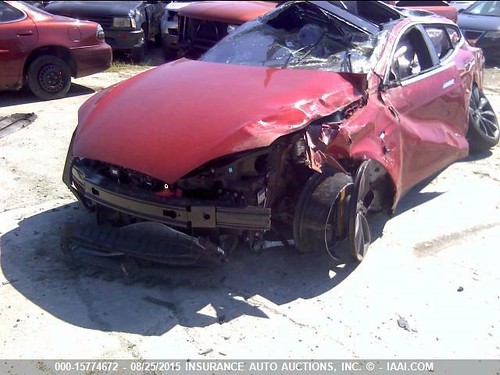
Blasting off from low speeds is all the Tesla can do – a one trick pony.
Plus there’s the strong possibility of this if you push Teslas.
The number of suspension failures given the relatively small numbers on the road is deeply worrying.
https://www.flickr.com/photos/136377865@N05/sets/72157658490111523/
Sabine would beat it in a Transit.
‘unfortunately the car went into a reduced power mode about 3 minutes in due to excess battery heat (at least, that’s my guess).’
Beaten by ‘a girl in a van’!
Second that!!!! You should try X model! It is large, larger than my other – BMW GT5, and it’s accelerating like mad. One thing I don’t like the large turning radius. I also wish the nest to Tesla motors and hope they will come up with model E to supplement in between the current S and X.
Second that!!!! You should try X model! It is large, larger than my other – BMW GT5, and it’s accelerating like mad. One thing I don’t like the large turning radius. I also wish the nest to Tesla motors and hope they will come up with model E to supplement in between the current S and X.
When are they going to figure out how to make electric cars help pay for roads and bridges?
The day they decide they don’t really care if they sell any more.
“phantasmagorical”
After 40 years I am still learning English
The Tesla cash burn per vehicle sold is something on the magnitude of $50.000 per car. Selling a $35,000 car, the profit margin is going to be substantially less than the average $110,000 car they now sell. The average auto dealer in the USA sells something like 750 new cars a year. Tesla has 91 sales outlets in the USA. To sell 500,000 Tesla units by 2018, they would be selling over 5,000 units annually per sales outlet. Some sales outlets are in malls. Something simply isnt going to work here.