From DOE/LAWRENCE LIVERMORE NATIONAL LABORATORY
Clouds are impeding global warming… for now
Lawrence Livermore National Laboratory researchers have identified a mechanism that causes low clouds – and their influence on Earth’s energy balance – to respond differently to global warming depending on their spatial pattern.
The results imply that studies relying solely on recent observed trends are likely to underestimate how much Earth will warm due to increased carbon dioxide. The research appears in the Oct. 31 edition of the journal, Nature Geosciences.
The research focused on clouds, which influence Earth’s climate by reflecting incoming solar radiation and reducing outgoing thermal radiation. As the Earth’s surface warms, the net radiative effect of clouds also changes, contributing a feedback to the climate system. If these cloud changes enhance the radiative cooling of the Earth, they act as a negative, dampening feedback on warming. Otherwise, they act as a positive, amplifying feedback on warming. The amount of global warming due to increased carbon dioxide is critically dependent on the sign and magnitude of the cloud feedback, making it an area of intense research.
The researchers showed that the strength of the cloud feedback simulated by a climate model exhibits large fluctuations depending on the time period. Despite having a positive cloud feedback in response to long-term projected global warming, the model exhibits a strong negative cloud feedback over the last 30 years. At the heart of this difference are low-level clouds in the tropics, which strongly cool the planet by reflecting solar radiation to space.
“With a combination of climate model simulations and satellite observations, we found that the trend of low-level cloud cover over the last three decades differs substantially from that under long-term global warming” said Chen Zhou, lead author of the paper.
“The key difference is the spatial pattern of global warming”, said Mark Zelinka, LLNL climate scientists and co-author of the study. “Not every degree of global warming is created equal, in terms of its effect on low clouds.”
In response to increased carbon dioxide, climate models predict a nearly uniform warming of the planet that favors reductions in highly reflective low clouds and a positive feedback. In contrast, over the last 30 years, tropical surface temperatures have increased in regions where air ascends and decreased where air descends. “This particular pattern of warming is nearly optimal for enhancing low cloud coverage because it increases low-level atmospheric stability that keeps the lower atmosphere moist and cloudy”, said Stephen Klein, the third co-author.
“Most satellite data starts around 1980, so linear trends over the last three decades are often used to make inferences about long-term global warming and to estimate climate sensitivity,” said LLNL’s Chen Zhou, lead author of the study. “Our results indicate that cloud feedback and climate sensitivity calculated from recently observed trends may be underestimated, since the warming pattern during this period is so unique.”
Global temperature has gradually increased over the instrumental record due to increased greenhouse gas concentrations. But superimposed on this warming are large temperature fluctuations due to natural internal variability of the climate system, as well as influences from volcanic eruptions, aerosol pollution and solar variability. Whereas warming due to CO2 tends to be relatively spatially uniform, surface temperature trends due to internal climate variability and aerosol pollution are highly non-uniform, with trends on one side of an ocean basin often opposing those on the other. Trends computed over short time periods are often strongly influenced by factors other than CO2 and can be highly misleading indicators of what to expect under CO2-forced global warming.
The team emphasized that clouds are particularly sensitive to subtle differences in surface warming patterns, and researchers must carefully account for such pattern effects when making inferences about cloud feedback and climate sensitivity from observations over short time periods.
###
The work was funded by the Regional and Global Climate Modeling Program of the Office of Science at the U. S. Department of Energy (DOE) under the project “Identifying Robust Cloud Feedbacks in Observations and Models.”
The paper: http://www.nature.com/ngeo/journal/vaop/ncurrent/full/ngeo2828.html
Impact of decadal cloud variations on the Earth’s energy budget
Chen Zhou, Mark D. Zelinka & Stephen A. Klein
Feedbacks of clouds on climate change strongly influence the magnitude of global warming1, 2, 3. Cloud feedbacks, in turn, depend on the spatial patterns of surface warming4, 5, 6, 7, 8, 9, which vary on decadal timescales. Therefore, the magnitude of the decadal cloud feedback could deviate from the long-term cloud feedback4. Here we present climate model simulations to show that the global mean cloud feedback in response to decadal temperature fluctuations varies dramatically due to time variations in the spatial pattern of sea surface temperature. We find that cloud anomalies associated with these patterns significantly modify the Earth’s energy budget. Specifically, the decadal cloud feedback between the 1980s and 2000s is substantially more negative than the long-term cloud feedback. This is a result of cooling in tropical regions where air descends, relative to warming in tropical ascent regions, which strengthens low-level atmospheric stability. Under these conditions, low-level cloud cover and its reflection of solar radiation increase, despite an increase in global mean surface temperature. These results suggest that sea surface temperature pattern-induced low cloud anomalies could have contributed to the period of reduced warming between 1998 and 2013, and offer a physical explanation of why climate sensitivities estimated from recently observed trends are probably biased low4.

Not a very surprising excuse, as the climate simulations are useless at modelling clouds.
Not again.
More warming more evap, more clouds, less sunlight less warming less evap, more precip less clouds more sun, more warming.
Better throw your super computer in the trashcan.
G
DOE LLNL needs to get back to their task of capturing the energy of the sun in their giant whack a mole machine that squishes glass pellets one at a time to turn DT into hot neutrons or something.
g
climate feedback is low due to clouds “impeding global warming”
Im surprised they admit that there is less global warming, most others are telling us how its hear and biting us already and watch out for the floods.
Of course clouds affect climate – what a lot of plonkers.
Roger
http://www.thedemiseofchristchurch.com
Yes this seems to confirm stronger neg. f/b in tropics in a period when GHG forcing was increasing. This is broadly in agreement with Willis’ suggestions about tropical feedbacks.
So what do they conclude?
So having “observed” an increased neg. f/b in the model in a period of increased GHG forcing which would be in agreement with a reduced climate sensitivity as derived by real world observations, they manage to interpret this as being a “bias”.
What is the “long term” feedback that they are presenting as the true, unbiased value we should apparently be believing ? The long term f/b value includes the reduced f/b when GHG were not signficant, so by what contorted logic do they conclude that is a better value and a truer indication of current or future climate.
What they are showing is a non-linearly, increasing neg. f/b to rising CO2 forcing which will render climate far more stable the current alarmist scientists claim. In short we don’t need the Paris agreement.
Maybe they had to put the ” it’s worse than we thought” spin in order to get published but it seems that this result is great news for anyone who is honestly concerned about the dangers of future warming.
Greg, they also admit that negative feedbacks have lessened (pretty much stopped) global warming. But they assure as that the models tell them that soon, CO2 will over whelm these previously unacknowleged negative feedbacks, and things will get worser even faster.
Plainly, it will be worse than we thought as soon as it clears up.
That’s not the only thing effecting clouds,mthough. Some seed particles are required for nuclear ion.
Exactly. Before they go off extolling how great their new model of clouds works in the models they might want to have a tad of skepticism since the models failed before. The new model may be as flawed as the last with the next datapoint. That’s the problem with fitting. Science is done in the real world by running experiments and predicting results not going back and fitting some new theory and saying : Proved. There are millions of ways to fit the data to some theory. The proof is if it actually predicts what happens. Unfortunately for the computer models everything they predict never happens. So, some of us are a little skeptical this is any better.
So if something as low energy as clouds can impede Global Warming…that claim about the Sun having no impact is put to lie….
What a lame excuse, weak as water. Science has degenerated into mindless piffle.
Not science, climate science.
Correct me if I’m wrong in my assumption, but isn’t this exactly what Willis has been expounding in his Thermostat Hypothesis?
Now you have it from dye-in-the-wool scientists. They give no credits.
Except they’re babbling “worse than we thought.”
Don’t recall what that was. Izzit different from “How much more rain will global warming bring?” from SCIENCE july 13 2007 Wentz et al.
G
And exactly why do they suppose that this will not continue into the future? How are we going to get warmer if more clouds reduce the energy input?
That’s where the magick effect of CO2 comes into play. It truly is a wondrous molecule.
That’s why there hasn’t been the expected warming over the past several decades? I thought the official line was that the heat had gone down and hid in the ocean only to re-emerge at some future date. In other words, the models are right and the heat is in the pipeline.
That is so right. They seem to be confused where the heat went. Now they are admitting as seems most likely that the energy was lost into space. The heat in the ocean they blamed for the lack of warming is almost certainly related to PDO/AMO phenomenon. Of course they have no clue what AMO / PDO is or why it is happening. They said 10 years ago PDO/AMO would stop. Guess again. Huge el nino last year.
The problem with it being lost in space is then they can’t say “it will come back and hurt us.” That heat is gone forever. Which means their miss is something they should adjust all the models DOWN 0.5C since they now admit the heat is gone.
A very long winded restatement of the fact that Gobal Circulation Models do not model clouds well, and clouds have a significant effect. So why are they still making policy based on GCM’s?
Global not gobal
Are you sure?
How can you tell?
nobody makes policy based on GCMS
the 2C target and the 1.5C targets have nothing to do with GCMs or any specific science.
truth is… GCMs are just window dressing for policies decided on other grounds
I mean used as a piece of sagecraft, to borrrow a term. GCM’s have the sort of use as “expert testimony” as used by liability lawyers.
Yes, we know policies are not decided on the grounds of anything real to do with climate.
Anything else you want to try and sell, Mosh ?
@ur momisugly ossqss
Barn… aim… oops missed… build bigger barn.
Mosh’ said :
Thanks. One of the most sensible things you’ve said in a long time.
Like Rumsfelt’s WMD claims, they new it was false but needed a simple message to get the public on side for policies decided on other grounds.
AGW scare is just an attempt at establishing and financing the UN as a de facto, unelected world government..
Finally Mosh says something that most of can agree with:
“GCMs are just window dressing for policies decided on other grounds”
Global warming is just the latest excuse to impose the solutions they have always wanted to force on us.
I can’t let that lie stand, the did not know that the WMD claims were false. In fact most of them have been verified by discoveries in Iraq.
Some of them have been shown to be false, but that’s not the same as claiming everyone knew they were false to begin with.
“… did not know that the WMD claims were false …”
Quite right. They just planned to murder 100,000 people on the off-chance.
**the 2C target and the 1.5C targets have nothing to do with GCMs or any specific science.**
Mosher got this right. 2 deg C has nothing to do with science. It was pulled out of thin air. Now we can just extend this to most of the CO2 rumours.
“nobody makes policy based on GCMS”
No not GCMs, just the “consensus projections” derived from them.
https://wattsupwiththat.com/2016/10/26/madness-climate-projections-can-now-be-used-as-evidence-to-list-endangered-species/
Another lie, nowhere close to 100K were killed.
More would have died had Saddam gotten the bomb.
Mosh,
You’re right about the 2C target having nothing to do with any specific science:
http://www.spiegel.de/international/world/climate-catastrophe-a-superstorm-for-global-warming-research-a-686697-8.html
Gerald Machnee,
Whoops, should have read further. See you got there first! 🙂
Unbelievable. They’ve mistaken a natural feedback mechanism for something transitory and ephemeral. This cooling response to tropical warming is one of the things that makes global sensitivity to increased CO2 much less than the alarmists predict.
Yes, they seem to expect those nasty, interfering clouds will go away any time now and global warming will come roaring back in all it’s demonic glory. Yeesh.
In other words, we need to continue to disregard reality and the realworld feedback that happens to counteract increasing temperatures.
When reality shows you your overestimates are too high, in Climatism you simply claim the observed temperature undershoots are merely aberrations of what they fervently believe should be happening any day now.
And The cargo planes will be landing any day now for these climatists.
OMG! Disater! climate feedback is low due to clouds “impeding global warming”
What next? Tipping-Point? Extinction?
This looks like a major walkback in progress. Clouds counteract the effects of increased CO2. Not so dangerous after all.
Some years ago, someone here at WUWT calculated that an increase of 0.1% in daily cloudiness in the tropics would counteract the effects of doubled CO2. An increase that for all practical purposes would be impossible to quantify, at least with current capabilities.
Also, as Warren notes above, this is what Willis has been saying for quite a while now.
Possibilities:
1) a major retrenchment is just now starting. Just like we saw with CAGW getting morphed into Climate Change when CAGW was no longer tenable. They are adjusting their position.
2) They are staking out unclaimed ground for “The Cause”. Add it to the list.
Global Warming causes warming!
Global Warming causes cooling!
Global Warming causes clouds!
Global Warming causes nothing much!
And all bases are covered.
No walkback. It is just another hand-waving fantasy to explain why AGW (let alone CAGW) is not happening.
Don’t hold your breath waiting for a walkback. In the models, clouds are a feedback, ie. clouds react to temperature, period. The modellers still haven’t recognised that clouds can operate in other ways, even though that is what they are describing. The level of understanding of climate is quite simply woeful.
Jer0me + Mike Jonas:
You are both right. At first I missed the importance of the last paragraph.
The all-important metrics of GW are the ECS, equilibrium climate sensitivity, and TCR, transient climate response.
They claim that GW is causing more cloudiness, OK so far. Then they claim that the cloudiness causes a systematic underestimate of ECS and TCR.
SO: GW causes a systematic underestimate of GW! And it is all because of the Pause, no less.
Mark it down as excuse #94 for the Pause.
The long suffering taxpayers deserve better from the great LLNL.
So….the modellers finally discovered there are clouds in the sky? And wouldn’t you know it that they are responsible for ruining their otherwise perfect prognostications. Damned skeptical nature.
Here they go using arbitrary cloud changes to try to make their CO2 based models fit the historical data. It is just another parameter that will not behave as they predict in the future and will require frequent re-adjustment to try to hide the fundamental errors in their logic as time goes on.
Cart followed by horse.
And more horse manure than will fill the cart.
I think it’s the “fluffy” ones causing all the climate modeling problems.
And another Group gets it wrong! It’s SO2, not CO2. Google it.
I could of sworn the science was settled.
I especially loved the part where the ocean surface warms where the air is rising…
Quite
I was flabbergasted that the researchers seem to have gotten the concept of convective heating taught in elementary school completely backwards. The circulation is caused by heat differential, not the other way around.
We’ve spent many hours arguing about whether the heat has been released or retained. ( oh do tell me I’m wrong about thermodynamics, see some of science of doom musings in support of CAGW) So, another question I have is what does this do to the earth’s energy budget ? ( it’s a rhetorical question ) CAGW alledegedly has measured this and it conforms to their math that the earth will warm by so much. Are they saying that, that is in error too ? ( do understand these questions aren’t directed at you, I just thought of it) if they didn’t measure the heat escaping, where did it go ? Is the assumption (1-a) is incorrect ? Are the satellite readings incorrect ? Has there been another instrument failure ? ( like the one for TSI ? )
What appeals to authority or papers will they trot out to prove this isn’t so ? CAGW does have a proven tactic, ignore it.
So what they are saying is that we need to ignore the negative feedback in the climate system because it is doing what it is supposed to do. This is a big problem because it also creates a negative feedback loop with our future funding prospects.
So, cloud patterns changes aren’t incorporated into the models.
Sam Grove commented: “…So, cloud patterns changes aren’t incorporated into the models….”
No clouds at all that I’m aware of much less changes.
Negative feedback. This is terrible, terrible news. Climate scientists should be very afraid.
“… Our results indicate that cloud feedback and climate sensitivity calculated from recently observed trends may be underestimated, since the warming pattern during this period is so unique …”.
=================================
By “recently observed trends” presumably they mean the non-existent ~20 years warming relative slowdown/stasis.
http://www.team5ge.yolasite.com/resources/%E3%85%87%E3%84%B9%E3%85%87%E3%84%B9%E3%85%87%E3%84%B9.jpg
As Prof Humlum explains the cloud cover over the tropical (mostly) oceans is likely to be an important control of the amount of solar radiation reaching the surface and therefore the GAT.
Why do the authors assume that the period of relative temperature stasis is so unique?
On the available satellite evidence it could equally be the period 1979 – ~1997 that is unique, or that neither is unique, that both represent natural system fluctuations.
“Unique” is synonymous with one-of-a-kind, so warming patterns are either unique or they’re not. They can’t be “so unique,” a dreadful solecism. Academics are not up to the standards of my college days.
I knew someone would pick that up, thanks all the same.
I don’t understand the reference to “academics”.
I’m quite relaxed about the use of ‘so unique’ or ‘almost unique’ and I don’t see why the purists get so upset about it. The sense is fine – the subject under discussion has many facets, some of which may be unique, some not, and the sum of all those facets may be so unique, very unique, somewhat unique, or not at all unique. Language has only one use – if it can be understood, that’s all that matters. The authors can be criticised for hyperbole, but not for wrong use of ‘unique’.
Promised myself I would never get into that sort of argument – sorry!
But I like the ‘horse follows cart’ summary of this work. The inversion of logic and purpose it contains is surely (almost) unique.
“At the heart of this difference are low-level clouds in the tropics, which strongly cool the planet by reflecting solar radiation to space.”
Yet the graph above shows warming when the cloud % is decreasing. OOPS !!
That ISCCP plot is directly supported by ERBE+CERES measurements of outgoing (reflected) SW from the Earth system: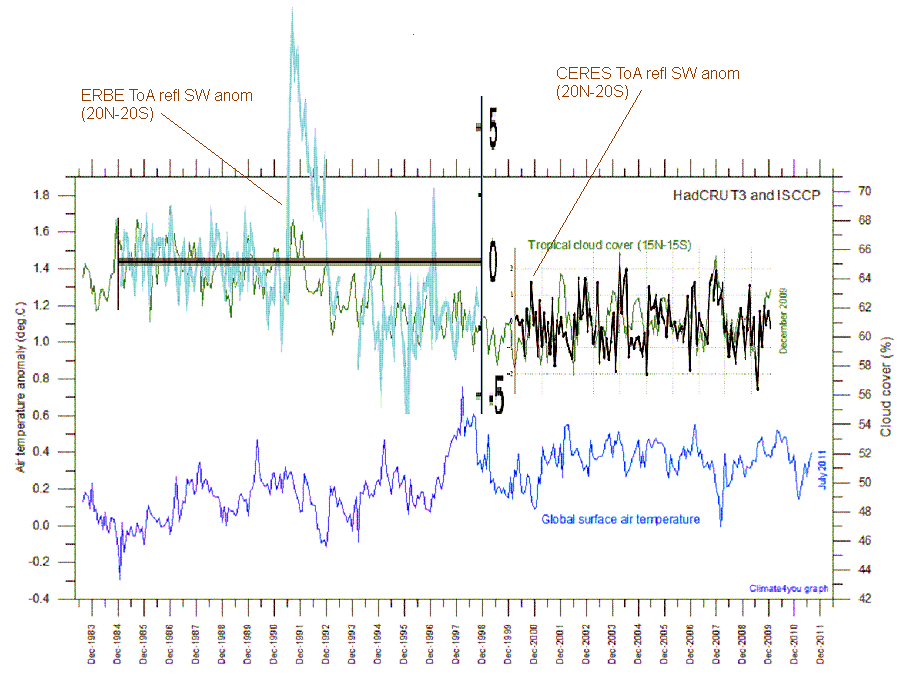

And so it’s clear that clouds haven’t been a feedback to the warming at all. They’re the cause. They allowed the mean level of ASR (“absorbed solar radiation”, TSI minus reflected SW) to increase substantially from the last half of the 80s to about 2000:
Yes, once again they ASSUME that any recent warming is due to increased CO2, without a scrap of evidence – just their true believer faith – AND assume of course that the reason for increased CO2 is human activities, when all they actually measure in terms of CO2 sources and sinks IS what is emitted from human activities. Observation means nothing if it disagrees with their preconceived conclusions. And they call this drivel “science.” It’s enough to make you nuts.
I once debated a warmist who readily admitted that they had no idea what caused the warm period in the past, but that didn’t matter because the models assured us that the current warming was caused by CO2 alone.
It will be fun to watch as the warmistas ‘discover’, one at a time, all the feedbacks and other factors that have been missing from their over-simplified and biased models.
But our joy will be tempered by the knowledge of all the money wasted and damage done by their cult.
Sorry to disagree, but it won’t be fun. You can see that, because this is one of them – they are discovering a feedback or factor that has been missing from their over-simplified and biased models. But you see, they don’t actually acknowledge it as such, they say it is “responding differently” for a while, ie. “the trend of low-level cloud cover over the last three decades differs substantially from that under long-term global warming“. In other words, the behaviour now is not as predicted, but in future the climate will be as predicted. No matter what they find missing from their models, nothing that happens in the real world will ever get them to change their predictions. This is not fun. The model predictions are their absolute truth, and everything else is simply interpreted accordingly!
Mike, I agree that most of them won’t acknowledge their errors. That’s why I put the word ‘discover’ in quotes. Perhaps I should have used the word ‘amusing’ instead of fun, as we watch them make fools of themselves trying desperately to make the data conform to their pre-conceived beliefs.
Nonetheless, my amusement will be tinged with sadness, over the wasted money and the damage done to science.
And these supposedly educated people really cannot see the obvious potential falicy in that argument? They must be incredibly biased to even think that this is not immediately obvious.
As I keep saying, the feedbacks must be negative, or our climate would be swinging wildly in all directions, and it just does not – the major argument against the feedback argument, without which CAGW cannot exist.
Worse – nut just supposedly educated, but supposedly SCIENTISTS! Agreed on feedbacks – there’s no way Earth’s climate could exhibit stability over long periods (as it has) if the system were dominated by positive feedbacks – it’s ridiculous. The only “CO2 forced global warming” that occurs is the warming in their fantasy world models that ASSUME it occurs. In the real world, it’s meaningless unless they can provide some actual scientific evidence otherwise. (And just for the records, stacks of “peer reviewed” garbage does not constitute “evidence” of anything, any more than this fine example of agricultural commodity does; “because I said so” doesn’t cut it for scientists.) On geologic time scales, CO2 and temperature aren’t even correlated, are often enough REVERSE correlated to reject CO2 as temperature driver, and the Earth’s “average” temperature has fluctuated between two extremes that haven’t changed no matter how much (or little) CO2 is in the atmosphere.
Must be all that cosmic ray rebounding effort.
How can there possibly be negative feedback ? But what of the retained heat from the latent energy when water vapor condenses? Isn’t co2 suppose to hold on to that heat in a never ending cycle? Isn’t that is were the tipping point is suppose to occur ? 97% of scientist agree ! (Sarc)
I’m sure that this has been argued from the skeptic side of things.