OAK RIDGE, Tenn.,—In a new twist to waste-to-fuel technology, scientists at the Department of Energy’s Oak Ridge National Laboratory have developed an electrochemical process that uses tiny spikes of carbon and copper to turn carbon dioxide, a greenhouse gas, into ethanol. Their finding, which involves nanofabrication and catalysis science, was serendipitous. Video follows.
“We discovered somewhat by accident that this material worked,” said ORNL’s Adam Rondinone, lead author of the team’s study published in ChemistrySelect. “We were trying to study the first step of a proposed reaction when we realized that the catalyst was doing the entire reaction on its own.”
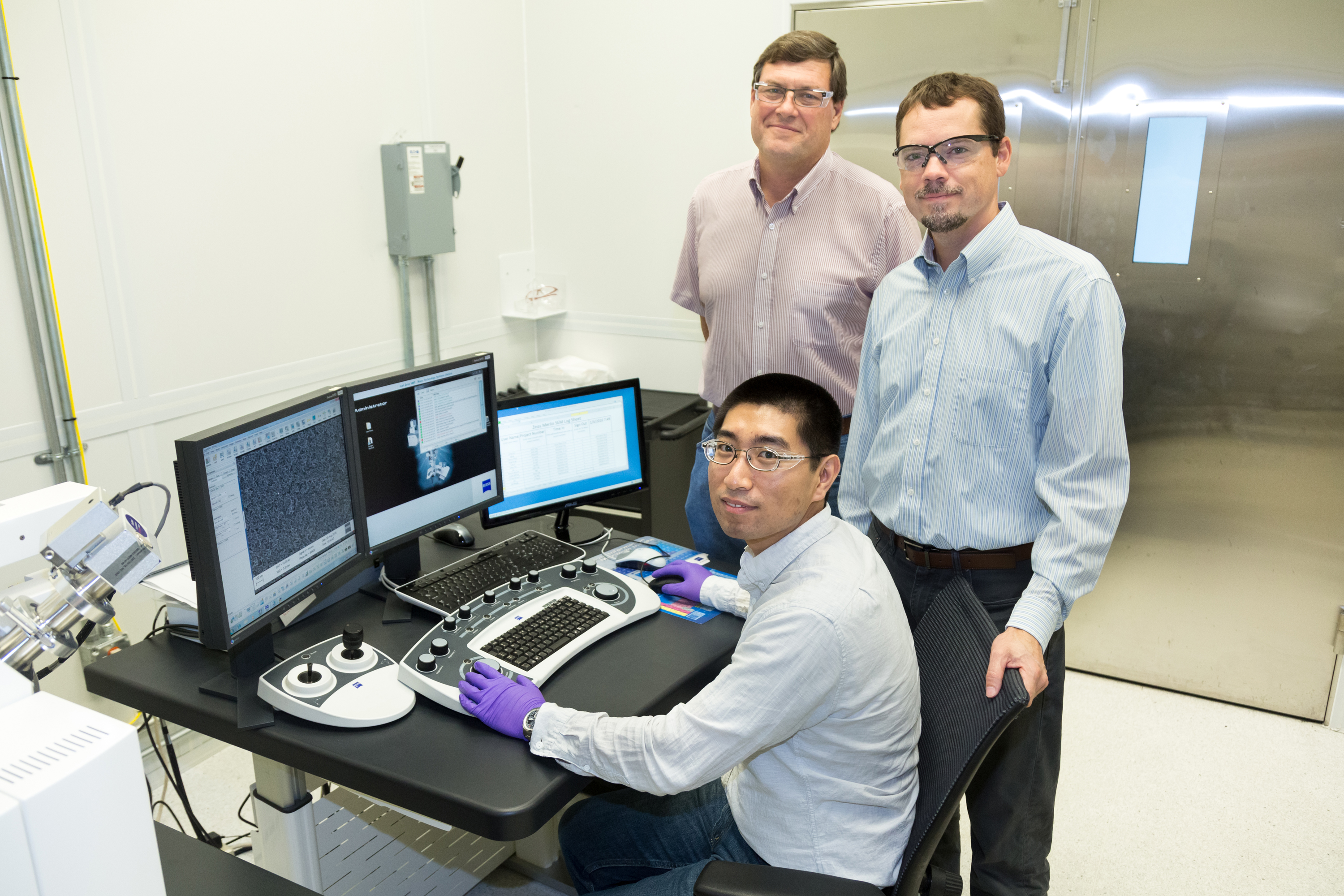
The team used a catalyst made of carbon, copper and nitrogen and applied voltage to trigger a complicated chemical reaction that essentially reverses the combustion process. With the help of the nanotechnology-based catalyst which contains multiple reaction sites, the solution of carbon dioxide dissolved in water turned into ethanol with a yield of 63 percent. Typically, this type of electrochemical reaction results in a mix of several different products in small amounts.

“We’re taking carbon dioxide, a waste product of combustion, and we’re pushing that combustion reaction backwards with very high selectivity to a useful fuel,” Rondinone said. “Ethanol was a surprise — it’s extremely difficult to go straight from carbon dioxide to ethanol with a single catalyst.”
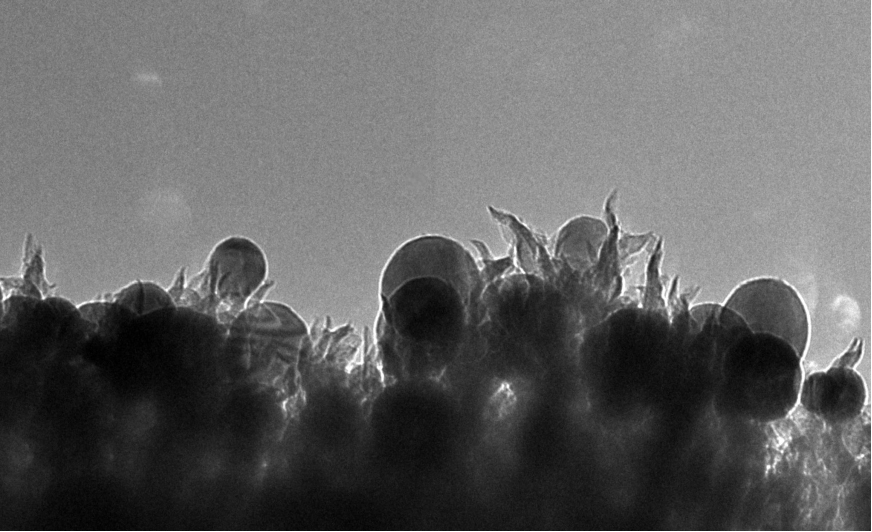
The catalyst’s novelty lies in its nanoscale structure, consisting of copper nanoparticles embedded in carbon spikes. This nano-texturing approach avoids the use of expensive or rare metals such as platinum that limit the economic viability of many catalysts.
“By using common materials, but arranging them with nanotechnology, we figured out how to limit the side reactions and end up with the one thing that we want,” Rondinone said.
The researchers’ initial analysis suggests that the spiky textured surface of the catalysts provides ample reactive sites to facilitate the carbon dioxide-to-ethanol conversion.
“They are like 50-nanometer lightning rods that concentrate electrochemical reactivity at the tip of the spike,” Rondinone said.
Given the technique’s reliance on low-cost materials and an ability to operate at room temperature in water, the researchers believe the approach could be scaled up for industrially relevant applications. For instance, the process could be used to store excess electricity generated from variable power sources such as wind and solar.
“A process like this would allow you to consume extra electricity when it’s available to make and store as ethanol,” Rondinone said. “This could help to balance a grid supplied by intermittent renewable sources.”
The researchers plan to refine their approach to improve the overall production rate and further study the catalyst’s properties and behavior.
ORNL’s Yang Song, Rui Peng, Dale Hensley, Peter Bonnesen, Liangbo Liang, Zili Wu, Harry Meyer III, Miaofang Chi, Cheng Ma, Bobby Sumpter and Adam Rondinone are coauthors on the study, which is published as “High-Selectivity Electrochemical Conversion of CO2 to Ethanol using a Copper Nanoparticle/N-Doped Graphene Electrode.”
The work was supported by DOE’s Office of Science and used resources at the ORNL’s Center for Nanophase Materials Sciences, which is a DOE Office of Science User Facility.
Leaving aside the obvious fact that this is a lab demonstration and far from an industrialized process, most of the naysayers here miss an important point. You don’t use a process like this where fuel is readily available You use it in places where you have a lot of electricity already but fuel, for one reason or another, is expensive. The U.S. Navy spent some effort in figuring out how to convert seawater into JP4. http://www.huffingtonpost.com/2014/04/09/seawater-to-fuel-navy-vessels-_n_5113822.html
Not because of “fossil fuel” but because at sea, or in a Middle East desert, transportation costs (especially in a combat zone) mean that fuel costs upwards of $600/gallon! On the other hand, especially when you are on a nuclear aircraft carrier, electricity is cheap.
So, where might a process like this come in handy? Where else do we need fuel, and CO2 is prevalent? How about Mars? Ethanol makes a dandy rocket fuel. Antarctica, the desert, or out at sea, where fuel is hard to come by, energy from solar or wind is available, and ethanol is a compact and reliable way to store energy until needed.
This is not energy generation, but energy storage so inefficiency is expected. The question is how does it compare to other energy storage systems. For electrical energy storage (in terms of grid use) there really isn’t anything but limited capacity pumped storage or massive amounts of batteries, but our bigger issue is transport where storing electrical energy is currently batteries or nothing.
The problems with battery storage for transportation is the weight of the batteries – which remains even when they are flat making it just about the worst possible way to store energy for transportation. A storage system that converts electricity to a liquid energy store (ethanol) does have a utility if it can actually be scaled up. Generating hydrogen with electricity is a competing option, but the storage and distribution of hydrogen are quite problematic. There is potential for what these people are claiming here to fit into the current distribution chain so it deserves some attention.
However, potential is nothing more than a pretty press release. Give it a couple of years and see if it is still around. Until then sit down and chill out with traditionally prepared ethnol delivered in a convenient format of your choosing. Mine’s a pint, thanks.
Are you aware of the problems of storing and transporting ethanol?
Have you seen the multitude of railroad cars transporting ethanol (some in a river in Pa.)? Ethanol cannot be transported in existing pipelines, maybe some new ones that the Administration will not allow building.
Finally the storage life for ethanol is about a month in gasoline as it loves to combine with water.
http://www.ethanolproducer.com/articles/8853/stainless-steels-cost-effective-materials
Hum … I understand that chemists find it cool to have high yield conversion … but in practice, what we need to know is the energy / workforce efficiency of the process : can it beat vodka (potatoes), rhum (sugarcane), or even ethylene hydration ?
If it does, they could get rich, very rich.
If not -> second chance : can it be use in reverse mode, as a Direct Ethanol Fuel Cell, better than current existing one ? if it does (see above)
… if not … dump, i guess : even if electricity were free, the system is still too costly.
I find it strange that natural fertilizer is considered a waste product.
I’m not a scientist, but this seems like it might be a way to recover lost energy from internal combustion engines that produce CO2. You already have an alternator generating electricity. If it was practical to “mine” the exhaust for the CO2, create ethanol and then run the ethanol back into the gas tank, could it be a reasonably economical recycling system?
I am interested in the catalyst. Could it be used at hydrothermal vents where there is plenty of power available?
Great! Now ‘warmists’ can drink their way to a ‘climate change’ solution. If they stay drunk enough we won’t have to hear from them anymore.
Looking at many of the comments above, I think we should give these guys a break – they never claimed to be engineers, just scientists making a discovery they called “serendipitous” – so they didn’t even exhibit ego that would claim it was all because of their brilliance.
This is what most of us seek – people who do research, document their findings and leave a trail behind for others to follow, including engineers who can look at this and decide if it makes sense to implement, and if so, under what circumstances, to solve what real world problem. Again, we should be encouraging this kind of stuff, not attacking it because it might not be practical.
good point
The key to being economically viable is to use the ethanol in a way that is valued more than the inputs. I’m suggesting the opening of “The Green CO2 Bar and Tavern.”
If you build it somewhere like Brooklyn or San Francisco where people would be taken in by such things in order to aid their moral preening, it could be very profitable. You just need to know when to close it when the fad is over.
I think it’s more fun to let a grapevine plus some fermentation turn carbon dioxide into ethanol.
Isn’t this one of many fischer-tropsch reactions used to formulate hydrocarbons? https://en.wikipedia.org/wiki/Fischer%E2%80%93Tropsch_process
The USN has a similar process that converts seawater to hydrocarbons, using the ‘excess capacity of nuclear propulsion’ to make the conversion.
What smart people need to ask is: Show us the balanced energy equation. Until then it’s a novelty.